Work
Work
The work W that is done by a constant force F
moving an object of a distance d is defined to be
W = F * d
Work
The work W that is done by a constant force F
moving an object of a distance d is defined to be
W = F * d
For example, a book that weights 10 lb is moved
vertically by a distance of 5 ft. The work that's done is
W = 5*10 = 50 (ft-lb)
Work
The work W that is done by a constant force F
moving an object of a distance d is defined to be
W = F * d
For example, a book that weights 10 lb is moved
vertically by a distance of 5 ft. The work that's done is
W = 5*10 = 50 (ft-lb)We are to calculate the work done on an object under
a non–constant force.
Work
The work W that is done by a constant force F
moving an object of a distance d is defined to be
W = F * d
For example, a book that weights 10 lb is moved
vertically by a distance of 5 ft. The work that's done is
W = 5*10 = 50 (ft-lb)We are to calculate the work done on an object under
a non–constant force. Some examples of these are:
* tension of a stretched spring
* work done on an object’s movement in a force field
such as a current flow, or a gravitational force field.
Work
The work W that is done by a constant force F
moving an object of a distance d is defined to be
W = F * d
For example, a book that weights 10 lb is moved
vertically by a distance of 5 ft. The work that's done is
W = 5*10 = 50 (ft-lb)We are to calculate the work done on an object under
a non–constant force. Some examples of these are:
* tension of a stretched spring
* work done on an object’s movement in a force field
such as a current flow, or a gravitational force field.
Let’s clarity the notion of a force field.
Vector Fields, Work and Line Integrals
A 2D vector field is a function that assigns a vector
at each point (x, y).
Vector Fields, Work and Line Integrals
A 2D vector field is a function that assigns a vector
at each point (x, y).
The vector assigned at (x, y) is denoted as
F(x, y) = <f(x, y), g(x, y)> = f(x, y)i + g(x, y)j
Vector Fields, Work and Line Integrals
A 2D vector field is a function that assigns a vector
at each point (x, y).
The vector assigned at (x, y) is denoted as
F(x, y) = <f(x, y), g(x, y)> = f(x, y)i + g(x, y)j
Vector Fields, Work and Line Integrals
Example: Draw the vector field F(x, y) = <x, y>
A 2D vector field is a function that assigns a vector
at each point (x, y).
The vector assigned at (x, y) is denoted as
F(x, y) = <f(x, y), g(x, y)> = f(x, y)i + g(x, y)j
Vector Fields, Work and Line Integrals
Example: Draw the vector field F(x, y) = <x, y>
Make a table:
(x, y) <x, y>
(1, 1) <1, 1>
(1, -1) <1, -1>
(-1, 1) <-1, 1>
(-1, -1) <-1, -1>
(3, 3) <3, 3>
A 2D vector field is a function that assigns a vector
at each point (x, y).
The vector assigned at (x, y) is denoted as
F(x, y) = <f(x, y), g(x, y)> = f(x, y)i + g(x, y)j
Vector Fields, Work and Line Integrals
Example: Draw the vector field F(x, y) = <x, y>
Make a table:
(x, y) <x, y>
(1, 1) <1, 1>
(1, -1) <1, -1>
(-1, 1) <-1, 1>
(-1, -1) <-1, -1>
(3, 3) <3, 3>
A 2D vector field is a function that assigns a vector
at each point (x, y).
The vector assigned at (x, y) is denoted as
F(x, y) = <f(x, y), g(x, y)> = f(x, y)i + g(x, y)j
Vector Fields, Work and Line Integrals
Example: Draw the vector field F(x, y) = <x, y>
Make a table:
(x, y) <x, y>
(1, 1) <1, 1>
(1, -1) <1, -1>
(-1, 1) <-1, 1>
(-1, -1) <-1, -1>
(3, 3) <3, 3>
Vector Fields, Work and Line Integrals
Example: Draw the vector field F(x, y) = <x, 1>
Vector Fields, Work and Line Integrals
Example: Draw the vector field F(x, y) = <x, 1>
Make a table:
(x, y) <x, y>
Vector Fields, Work and Line Integrals
Example: Draw the vector field F(x, y) = <x, 1>
Make a table:
(x, y) <x, y>
(0, y) <0, 1>
Vector Fields, Work and Line Integrals
Example: Draw the vector field F(x, y) = <x, 1>
Make a table:
(x, y) <x, y>
(0, y) <0, 1>
(1, y) <1, 1>
Vector Fields, Work and Line Integrals
Example: Draw the vector field F(x, y) = <x, 1>
Make a table:
(x, y) <x, y>
(0, y) <0, 1>
(1, y) <1, 1>
(2, y) <2, 1>
Vector Fields, Work and Line Integrals
Example: Draw the vector field F(x, y) = <x, 1>
Make a table:
(x, y) <x, y>
(0, y) <0, 1>
(1, y) <1, 1>
(2, y) <2, 1>
(-1, y) <-1, 1>
(-2, y) <-2, 1>
Vector fields are used to represent force fields such
as gravitational, magnetic fields or wind speed,
pressure charts.
Vector Fields, Work and Line Integrals
Example: Draw the vector field F(x, y) = <x, 1>
Make a table:
(x, y) <x, y>
(0, y) <0, 1>
(1, y) <1, 1>
(2, y) <2, 1>
(-1, y) <-1, 1>
(-2, y) <-2, y>
The work W of a force F
vector acting on a particle
moving it from P to Q along
a straight line is given by the
dot product
F
P
Q
θ
Vector Fields, Work and Line Integrals
The work W of a force F
vector acting on a particle
moving it from P to Q along
a straight line is given by the
dot product
W = F • PQ = |PQ|(|F|cos(θ)).
F
P
Q
θ
|F|cos(θ) = force projected
in the direction PQ
Vector Fields, Work and Line Integrals
The work W of a force F
vector acting on a particle
moving it from P to Q along
a straight line is given by the
dot product
W = F • PQ = |PQ|(|F|cos(θ)).
F
P
Q
θ
|F|cos(θ) = force projected
in the direction PQ
Vector Fields, Work and Line Integrals
Note that the work W may be negative meaning
the angle θ is more than 90o
.
The work W of a force F
vector acting on a particle
moving it from P to Q along
a straight line is given by the
dot product
W = F • PQ = |PQ|(|F|cos(θ)).
F
P
Q
θ
|F|cos(θ) = force projected
in the direction PQ
We want to generalize this
computation for work done
moving a particle along a
curve from points P to Q in a
vector field. P
Q
Vector Fields, Work and Line Integrals
Note that the work W may be negative meaning
the angle θ is more than 90o
.
Let C(t) = (x(t), y(t)) be a paramterization of the
curve C where a < t < b with C(a) = P and C(b) = Q.
Vector Fields, Work and Line Integrals
Let C(t) = (x(t), y(t)) be a paramterization of the
curve C where a < t < b with C(a) = P and C(b) = Q.
Let F(x, y) = <f(x, y), g(x, y)> = f(x, y)i + g(x, y)j be
a vector-valued function defines over C that gives
the force at each point on C. (F: R2
R2
)
C(a)=P
C(b)=Q
C(t) = (x, y)
F(x, y)=force
at (x, y)
Vector Fields, Work and Line Integrals
Let C(t) = (x(t), y(t)) be a paramterization of the
curve C where a < t < b with C(a) = P and C(b) = Q.
Let F(x, y) = <f(x, y), g(x, y)> = f(x, y)i + g(x, y)j be
a vector-valued function defines over C that gives
the force at each point on C. (F: R2
R2
)
C(a)=P
C(b)=Q
C(t) = (x, y)
F(x, y)=force
at (x, y)
f(x, y), g(x, y) the coordinate functions of the forces
are functions from R2
R .
Vector Fields, Work and Line Integrals
Let C(t) = (x(t), y(t)) be a paramterization of the
curve C where a < t < b with C(a) = P and C(b) = Q.
Let F(x, y) = <f(x, y), g(x, y)> = f(x, y)i + g(x, y)j be
a vector-valued function defines over C that gives
the force at each point on C. (F: R2
R2
)
C(a)=P
C(b)=Q
C(t) = (x, y)
F(x, y)=force
at (x, y)
F(x, y) can be viewed as
F(x(t), y(t)) as a function from
R  R2
with domain a < t < b.
f(x, y), g(x, y) the coordinate functions of the forces
are functions from R2
R .
Vector Fields, Work and Line Integrals
C(a)=P
C(b)=Q
To find the total work done from
P to Q, we partition the interval
[a, b] by Δt and write the partition
as a=t0, t1, t2,…tn=b.
Vector Fields, Work and Line Integrals
C(a)=P
C(b)=Q
To find the total work done from
P to Q, we partition the interval
[a, b] by Δt and write the partition
as a=t0, t1, t2,…tn=b.
This gives a partition C.
Vector Fields, Work and Line Integrals
C(a)=P
C(b)=Q
C(ti)
To find the total work done from
P to Q, we partition the interval
[a, b] by Δt and write the partition
as a=t0, t1, t2,…tn=b.
This gives a partition C.
Let C(ti) and C(ti +Δt) be a two
points in the partition of C.
C(ti+Δt)
Vector Fields, Work and Line Integrals
C(a)=P
C(b)=Q
C(ti)
F(x(ti), y(ti))
=force at C(ti)
To find the total work done from
P to Q, we partition the interval
[a, b] by Δt and write the partition
as a=t0, t1, t2,…tn=b.
This gives a partition C.
Let C(ti) and C(ti +Δt) be a two
points in the partition of C.
C(ti+Δt)
Then the work required to move the particle from
C(ti) to C(ti+Δt) is approximately the dot product
F(x(ti), y(ti)) • C(ti+Δt) – C(ti)
C(ti+Δt) – C(ti)
Vector Fields, Work and Line Integrals
C(a)=P
C(b)=Q
C(ti)
F(x(ti), y(ti))
=force at C(ti)
To find the total work done from
P to Q, we partition the interval
[a, b] by Δt and write the partition
as a=t0, t1, t2,…tn=b.
This gives a partition C.
Let C(ti) and C(ti +Δt) be a two
points in the partition of C.
C(ti+Δt)
Then the work required to move the particle from
C(ti) to C(ti+Δt) is approximately the dot product
F(x(ti), y(ti)) • C(ti+Δt) – C(ti)
C(ti+Δt) – C(ti)
Hence the total work
W = lim Σ F(x(ti), y(ti)) • C(ti+Δt) – C(ti)Δt0
Vector Fields, Work and Line Integrals
W = lim Σ F(x(ti), y(ti) • C(ti+Δt) – C(ti)Δt0
Vector Fields, Work and Line Integrals
W = lim Σ F(x(ti), y(ti) • C(ti+Δt) – C(ti)Δt0
= lim Σ F(x(ti),y(ti)) •
Δt0
C(ti+Δt) – C(ti)
Δt
Δt
Vector Fields, Work and Line Integrals
W = lim Σ F(x(ti), y(ti) • C(ti+Δt) – C(ti)Δt0
= lim Σ F(x(ti),y(ti)) •
Δt0
C(ti+Δt) – C(ti)
Δt
Δt
As limit Δt  0, the Σ tunes into integral,
Vector Fields, Work and Line Integrals
W = lim Σ F(x(ti), y(ti) • C(ti+Δt) – C(ti)Δt0
= lim Σ F(x(ti),y(ti)) •
Δt0
C(ti+Δt) – C(ti)
Δt
Δt
As limit Δt  0, the Σ tunes into integral, and
C(ti+Δt) – C(ti)
Δt
 C'(t).
Vector Fields, Work and Line Integrals
As limit Δt  0, the Σ tunes into integral, and
C(ti+Δt) – C(ti)
Δt
 C'(t).
Hence W = ∫ F • C' dt.
t = a
b
W = lim Σ F(x(ti), y(ti) • C(ti+Δt) – C(ti)Δt0
= lim Σ F(x(ti),y(ti)) •
Δt0
C(ti+Δt) – C(ti)
Δt
Δt
Vector Fields, Work and Line Integrals
As limit Δt  0, the Σ tunes into integral, and
C(ti+Δt) – C(ti)
Δt
 C'(t).
Hence W = ∫ F • C' dt.
t = a
b
C'(t) dt = dC
dt
*dt = dC
W = lim Σ F(x(ti), y(ti) • C(ti+Δt) – C(ti)Δt0
= lim Σ F(x(ti),y(ti)) •
Δt0
C(ti+Δt) – C(ti)
Δt
Δt
Vector Fields, Work and Line Integrals
As limit Δt  0, the Σ tunes into integral, and
C(ti+Δt) – C(ti)
Δt
 C'(t).
Hence W = ∫ F • C' dt.
t = a
b
C'(t) dt = dC
dt
*dt = dC
So we write W = ∫ F • dC where dC = C'(t) dt
t = a
b
W = lim Σ F(x(ti), y(ti) • C(ti+Δt) – C(ti)Δt0
= lim Σ F(x(ti),y(ti)) •
Δt0
C(ti+Δt) – C(ti)
Δt
Δt
Vector Fields, Work and Line Integrals
As limit Δt  0, the Σ tunes into integral, and
C(ti+Δt) – C(ti)
Δt
 C'(t).
Hence W = ∫ F • C' dt.
t = a
b
C'(t) dt = dC
dt
*dt = dC
So we write W = ∫ F • dC where dC = C'(t) dt
t = a
b
W = lim Σ F(x(ti), y(ti) • C(ti+Δt) – C(ti)Δt0
= lim Σ F(x(ti),y(ti)) •
Δt0
C(ti+Δt) – C(ti)
Δt
Δt
Its also written as W = ∫C
F • dC
Vector Fields, Work and Line Integrals
As limit Δt  0, the Σ tunes into integral, and
C(ti+Δt) – C(ti)
Δt
 C'(t).
Hence W = ∫ F • C' dt.
t = a
b
C'(t) dt = dC
dt
*dt = dC
So we write W = ∫ F • dC where dC = C'(t) dt
t = a
b
W = lim Σ F(x(ti), y(ti) • C(ti+Δt) – C(ti)Δt0
= lim Σ F(x(ti),y(ti)) •
Δt0
C(ti+Δt) – C(ti)
Δt
Δt
Its also written as W = ∫C
F • dC
and it is called the line integral of F over C.
Vector Fields, Work and Line Integrals
Theorem: The line integral is independent
of the parameterizations of the curve C.
∫C
F • dC
Vector Fields, Work and Line Integrals
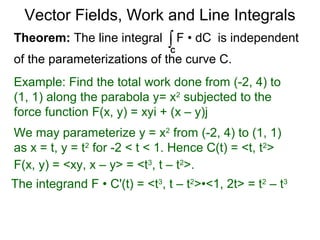
Example: Find the total work done from (-2, 4) to
(1, 1) along the parabola y= x2
subjected to the
force function F(x, y) = xyi + (x – y)j
Theorem: The line integral is independent
of the parameterizations of the curve C.
∫C
F • dC
Vector Fields, Work and Line Integrals
Theorem: The line integral is independent
of the parameterizations of the curve C.
∫C
F • dC
We may parameterize y = x2
from (-2, 4) to (1, 1)
as x = t, y = t2
for -2 < t < 1.
Example: Find the total work done from (-2, 4) to
(1, 1) along the parabola y= x2
subjected to the
force function F(x, y) = xyi + (x – y)j
Vector Fields, Work and Line Integrals
Theorem: The line integral is independent
of the parameterizations of the curve C.
∫C
F • dC
We may parameterize y = x2
from (-2, 4) to (1, 1)
as x = t, y = t2
for -2 < t < 1. Hence C(t) = <t, t2
>
Example: Find the total work done from (-2, 4) to
(1, 1) along the parabola y= x2
subjected to the
force function F(x, y) = xyi + (x – y)j
Vector Fields, Work and Line Integrals
Theorem: The line integral is independent
of the parameterizations of the curve C.
∫C
F • dC
We may parameterize y = x2
from (-2, 4) to (1, 1)
as x = t, y = t2
for -2 < t < 1. Hence C(t) = <t, t2
>
F(x, y) = <xy, x – y>
Example: Find the total work done from (-2, 4) to
(1, 1) along the parabola y= x2
subjected to the
force function F(x, y) = xyi + (x – y)j
Vector Fields, Work and Line Integrals
Theorem: The line integral is independent
of the parameterizations of the curve C.
∫C
F • dC
We may parameterize y = x2
from (-2, 4) to (1, 1)
as x = t, y = t2
for -2 < t < 1. Hence C(t) = <t, t2
>
F(x, y) = <xy, x – y> = <t3
, t – t2
>.
Example: Find the total work done from (-2, 4) to
(1, 1) along the parabola y= x2
subjected to the
force function F(x, y) = xyi + (x – y)j
Vector Fields, Work and Line Integrals
Theorem: The line integral is independent
of the parameterizations of the curve C.
∫C
F • dC
We may parameterize y = x2
from (-2, 4) to (1, 1)
as x = t, y = t2
for -2 < t < 1. Hence C(t) = <t, t2
>
F(x, y) = <xy, x – y> = <t3
, t – t2
>.
The integrand F • C'(t) = <t3
, t – t2
>•<1, 2t>
Example: Find the total work done from (-2, 4) to
(1, 1) along the parabola y= x2
subjected to the
force function F(x, y) = xyi + (x – y)j
Vector Fields, Work and Line Integrals
Theorem: The line integral is independent
of the parameterizations of the curve C.
∫C
F • dC
We may parameterize y = x2
from (-2, 4) to (1, 1)
as x = t, y = t2
for -2 < t < 1. Hence C(t) = <t, t2
>
F(x, y) = <xy, x – y> = <t3
, t – t2
>.
The integrand F • C'(t) = <t3
, t – t2
>•<1, 2t> = t2
– t3
Example: Find the total work done from (-2, 4) to
(1, 1) along the parabola y= x2
subjected to the
force function F(x, y) = xyi + (x – y)j
Vector Fields, Work and Line Integrals
Theorem: The line integral is independent
of the parameterizations of the curve C.
∫C
F • dC
We may parameterize y = x2
from (-2, 4) to (1, 1)
as x = t, y = t2
for -2 < t < 1. Hence C(t) = <t, t2
>
F(x, y) = <xy, x – y> = <t3
, t – t2
>.
The integrand F • C'(t) = <t3
, t – t2
>•<1, 2t> = t2
– t3
Hence W = ∫ F • C' dt =
b
t=a
∫ t2
– t3
dt =
1
t=-2
Example: Find the total work done from (-2, 4) to
(1, 1) along the parabola y= x2
subjected to the
force function F(x, y) = xyi + (x – y)j
Vector Fields, Work and Line Integrals
Theorem: The line integral is independent
of the parameterizations of the curve C.
∫C
F • dC
We may parameterize y = x2
from (-2, 4) to (1, 1)
as x = t, y = t2
for -2 < t < 1. Hence C(t) = <t, t2
>
F(x, y) = <xy, x – y> = <t3
, t – t2
>.
The integrand F • C'(t) = <t3
, t – t2
>•<1, 2t> = t2
– t3
Hence W = ∫ F • C' dt =
b
t=a
∫ t2
– t3
dt =
1
t=-2
27
4
Example: Find the total work done from (-2, 4) to
(1, 1) along the parabola y= x2
subjected to the
force function F(x, y) = xyi + (x – y)j
Vector Fields, Work and Line Integrals
Theorem: If D is a parameterization of C in the
opposite directiont, then = – .∫C
F • dC∫D
F • dD
Vector Fields, Work and Line Integrals
Theorem: If D is a parameterization of C in the
opposite directiont, then = – .∫C
F • dC∫D
F • dD
The line integrals may be written as the sum of two integrals:
Vector Fields, Work and Line Integrals
Theorem: If D is a parameterization of C in the
opposite directiont, then = – .∫C
F • dC∫D
F • dD
The line integrals may be written as the sum of two integrals:
C(t) = <x(t), y(t)>  C'(t) = <x'(t), y'(t)>, with a < t < b.
Vector Fields, Work and Line Integrals
Theorem: If D is a parameterization of C in the
opposite directiont, then = – .∫C
F • dC∫D
F • dD
The line integrals may be written as the sum of two integrals:
C(t) = <x(t), y(t)>  C'(t) = <x'(t), y'(t)>, with a < t < b.
F(x, y) = <f(x, y), g(x, y)> = <f(x(t), y(t)), g(x(t), y(t))>
Vector Fields, Work and Line Integrals
Theorem: If D is a parameterization of C in the
opposite directiont, then = – .∫C
F • dC∫D
F • dD
The line integrals may be written as the sum of two integrals:
C(t) = <x(t), y(t)>  C'(t) = <x'(t), y'(t)>, with a < t < b.
F(x, y) = <f(x, y), g(x, y)> = <f(x(t), y(t)), g(x(t), y(t))>
∫C
F • dC = ∫t=a
F • C' dt =
b
Vector Fields, Work and Line Integrals
Theorem: If D is a parameterization of C in the
opposite directiont, then = – .∫C
F • dC∫D
F • dD
The line integrals may be written as the sum of two integrals:
C(t) = <x(t), y(t)>  C'(t) = <x'(t), y'(t)>, with a < t < b.
F(x, y) = <f(x, y), g(x, y)> = <f(x(t), y(t)), g(x(t), y(t))>
∫C
F • dC = ∫t=a
F • C' dt =
b
<f(x(t), y(t)), g(x(t), y(t))>•<x'(t), y'(t)> dt∫t=a
b
Vector Fields, Work and Line Integrals
Theorem: If D is a parameterization of C in the
opposite directiont, then = – .∫C
F • dC∫D
F • dD
The line integrals may be written as the sum of two integrals:
C(t) = <x(t), y(t)>  C'(t) = <x'(t), y'(t)>, with a < t < b.
F(x, y) = <f(x, y), g(x, y)> = <f(x(t), y(t)), g(x(t), y(t))>
∫C
F • dC = ∫t=a
F • C' dt =
b
<f(x(t), y(t)), g(x(t), y(t))>•<x'(t), y'(t)> dt∫t=a
b
= f(x(t), y(t)) x'(t)dt + g(x(t), y(t)) y'(t)dt∫t=a
b
∫t=a
b
Vector Fields, Work and Line Integrals
Theorem: If D is a parameterization of C in the
opposite directiont, then = – .∫C
F • dC∫D
F • dD
The line integrals may be written as the sum of two integrals:
C(t) = <x(t), y(t)>  C'(t) = <x'(t), y'(t)>, with a < t < b.
F(x, y) = <f(x, y), g(x, y)> = <f(x(t), y(t)), g(x(t), y(t))>
∫C
F • dC = ∫t=a
F • C' dt =
b
<f(x(t), y(t)), g(x(t), y(t))>•<x'(t), y'(t)> dt∫t=a
b
= f(x(t), y(t)) x'(t)dt + g(x(t), y(t)) y'(t)dt∫t=a
b
∫t=a
b
or simply as f(x, y)dx + g(x, y)dy∫C
∫C
where dx = x'(t)dt, dy = y'(t)dt.
Vector Fields, Work and Line Integrals
Example: Let C be the curve from (0, 1) to (1, e)
along the y = ex
and h(x, y) = xy. Find ∫C
h(x, y) dy.
Vector Fields, Work and Line Integrals
Example: Let C be the curve from (0, 1) to (1, e)
along the y = ex
and h(x, y) = xy. Find
We may parameterize y = ex
from (0, 1) to (1, e)
as x = t, y = et
with 0 < t < 1.
∫C
h(x, y) dy.
Vector Fields, Work and Line Integrals
Example: Let C be the curve from (0, 1) to (1, e)
along the y = ex
and h(x, y) = xy. Find
We may parameterize y = ex
from (0, 1) to (1, e)
as x = t, y = et
with 0 < t < 1.
Therefore h(x, y) = tet
and dy = y'(t)dt = et
dt.
∫C
h(x, y) dy.
Vector Fields, Work and Line Integrals
Example: Let C be the curve from (0, 1) to (1, e)
along the y = ex
and h(x, y) = xy. Find
We may parameterize y = ex
from (0, 1) to (1, e)
as x = t, y = et
with 0 < t < 1.
Therefore h(x, y) = tet
and dy = y'(t)dt = et
dt.
∫C
h(x, y) dy.
∫C
h(x, y) dy =So ∫t=0
h(x, y) dy
1
∫t=0
tet
* et
dt =
1
=
Vector Fields, Work and Line Integrals
Example: Let C be the curve from (0, 1) to (1, e)
along the y = ex
and h(x, y) = xy. Find
We may parameterize y = ex
from (0, 1) to (1, e)
as x = t, y = et
with 0 < t < 1.
Therefore h(x, y) = tet
and dy = y'(t)dt = et
dt.
∫C
h(x, y) dy.
∫C
h(x, y) dy =So ∫t=0
h(x, y) dy
1
∫t=0
tet
* et
dt =
1
= ∫t=0
te2t
dt =
1
Vector Fields, Work and Line Integrals
Example: Let C be the curve from (0, 1) to (1, e)
along the y = ex
and h(x, y) = xy. Find
We may parameterize y = ex
from (0, 1) to (1, e)
as x = t, y = et
with 0 < t < 1.
Therefore h(x, y) = tet
and dy = y'(t)dt = et
dt.
∫C
h(x, y) dy.
∫C
h(x, y) dy =So ∫t=0
h(x, y) dy
1
∫t=0
tet
* et
dt =
1
= ∫t=0
te2t
dt = ½ (te2t
– ½ e2t
)
1
integration by parts
Vector Fields, Work and Line Integrals
Example: Let C be the curve from (0, 1) to (1, e)
along the y = ex
and h(x, y) = xy. Find
We may parameterize y = ex
from (0, 1) to (1, e)
as x = t, y = et
with 0 < t < 1.
Therefore h(x, y) = tet
and dy = y'(t)dt = et
dt.
∫C
h(x, y) dy.
∫C
h(x, y) dy =So ∫t=0
h(x, y) dy
1
∫t=0
tet
* et
dt =
1
= ∫t=0
te2t
dt = ½ (te2t
– ½ e2t
) | =
1
t=0
1
e2
+ 1
4
integration by parts
Vector Fields, Work and Line Integrals
We define the line integral in 3D space similarly .
Vector Fields, Work and Line Integrals
We define the line integral in 3D space similarly .
C(t) = <x(t), y(t), z(t)> be a parameterized space curve with
a < t < b and f(x, y, z), g(x, y, z), and h(x, y, z) be functions on
C.
Vector Fields, Work and Line Integrals
We define the line integral in 3D space similarly .
C(t) = <x(t), y(t), z(t)> be a parameterized space curve with
a < t < b and f(x, y, z), g(x, y, z), and h(x, y, z) be functions on
C. Then
∫C
f(x, y, z) dx = ∫t=a
f(x, y, z) x'(t) dt
b
Vector Fields, Work and Line Integrals
We define the line integral in 3D space similarly .
C(t) = <x(t), y(t), z(t)> be a parameterized space curve with
a < t < b and f(x, y, z), g(x, y, z), and h(x, y, z) be functions on
C. Then
∫C
f(x, y, z) dx = ∫t=a
f(x, y, z) x'(t) dt
b
∫C
g(x, y, z) dy = ∫t=a
g(x, y, z) y'(t) dt
b
Vector Fields, Work and Line Integrals
We define the line integral in 3D space similarly .
C(t) = <x(t), y(t), z(t)> be a parameterized space curve with
a < t < b and f(x, y, z), g(x, y, z), and h(x, y, z) be functions on
C. Then
∫C
f(x, y, z) dx = ∫t=a
f(x, y, z) x'(t) dt
b
∫C
g(x, y, z) dy = ∫t=a
g(x, y, z) y'(t) dt
b
∫C
h(x, y, z) dz = ∫t=a
h(x, y, z) z'(t) dt
b
Vector Fields, Work and Line Integrals
We define the line integral in 3D space similarly .
C(t) = <x(t), y(t), z(t)> be a parameterized space curve with
a < t < b and f(x, y, z), g(x, y, z), and h(x, y, z) be functions on
C. Then
These are the lines integrals for calculating the work of
moving a particle in 3D space.
∫C
f(x, y, z) dx = ∫t=a
f(x, y, z) x'(t) dt
b
∫C
g(x, y, z) dy = ∫t=a
g(x, y, z) y'(t) dt
b
∫C
h(x, y, z) dz = ∫t=a
h(x, y, z) z'(t) dt
b
Vector Fields, Work and Line Integrals
Let F(x, y, z) = <f(x, y, z), g(x, y, z), h(x, y, z)>
be a 3D vector field.
Vector Fields, Work and Line Integrals
Let F(x, y, z) = <f(x, y, z), g(x, y, z), h(x, y, z)>
be a 3D vector field.
C(t) = <x(t), y(t), z(t)> is a parameterized space curve with
a < t < b.
Vector Fields, Work and Line Integrals
Let F(x, y, z) = <f(x, y, z), g(x, y, z), h(x, y, z)>
be a 3D vector field.
C(t) = <x(t), y(t), z(t)> is a parameterized space curve with
a < t < b. Let P = C(a) and Q = C(b).
Vector Fields, Work and Line Integrals
Let F(x, y, z) = <f(x, y, z), g(x, y, z), h(x, y, z)>
be a 3D vector field.
C(t) = <x(t), y(t), z(t)> is a parameterized space curve with
a < t < b. Let P = C(a) and Q = C(b).
Then the work done for moving the particle from P to Q is
Vector Fields, Work and Line Integrals
Let F(x, y, z) = <f(x, y, z), g(x, y, z), h(x, y, z)>
be a 3D vector field.
C(t) = <x(t), y(t), z(t)> is a parameterized space curve with
a < t < b. Let P = C(a) and Q = C(b).
Then the work done for moving the particle from P to Q is
∫C
F • dC = ∫C
F • C' dt =
Vector Fields, Work and Line Integrals
Let F(x, y, z) = <f(x, y, z), g(x, y, z), h(x, y, z)>
be a 3D vector field.
C(t) = <x(t), y(t), z(t)> is a parameterized space curve with
a < t < b. Let P = C(a) and Q = C(b).
Then the work done for moving the particle from P to Q is
∫C
F • dC = ∫C
F • C' dt = <f, g, h> • <x', y', z'> dt∫C
Vector Fields, Work and Line Integrals
Let F(x, y, z) = <f(x, y, z), g(x, y, z), h(x, y, z)>
be a 3D vector field.
C(t) = <x(t), y(t), z(t)> is a parameterized space curve with
a < t < b. Let P = C(a) and Q = C(b).
∫t=a
f(x, y, z) x'(t) dt +
b
∫t=a
g(x, y, z) y'(t) dt +
b
= ∫t=a
h(x, y, z) z'(t) dt
b
Then the work done for moving the particle from P to Q is
∫C
F • dC = ∫C
F • C' dt = <f, g, h> • <x', y', z'> dt∫C
Vector Fields, Work and Line Integrals
A piece-wise curve C is the joint of
finitely many curves
C1, C2, .. Cn end to end.
W write C = C1 + C2 + … + Cn
Vector Fields, Work and Line Integrals
A piece-wise curve C is the joint of
finitely many curves
C1, C2, .. Cn end to end.
W write C = C1 + C2 + … + Cn
C1
C2
C3
C1 + C2 + C3
Vector Fields, Work and Line Integrals
A piece-wise curve C is the joint of
finitely many curves
C1, C2, .. Cn end to end.
W write C = C1 + C2 + … + Cn
Then the work done for moving the particle over C is
∫
C1
F • dC1 +∫F • C' dt =
C1
C2
C3
C1 + C2 + C3
C1+C2+…+Cn
∫
C2
F • dC2 + .. ∫
Cn
F • dCn∫
C
F • dC =
Vector Fields, Work and Line Integrals
A piece-wise curve C is the joint of
finitely many curves
C1, C2, .. Cn end to end.
W write C = C1 + C2 + … + Cn
Then the work done for moving the particle over C is
∫
C1
F • dC1 +∫F • C' dt =
C1
C2
C3
C1 + C2 + C3
C1+C2+…+Cn
∫
C2
F • dC2 + .. ∫
Cn
F • dCn∫
C
F • dC =
Example: Evaluate
Write C = C1 + C2 + … + Cn
∫C
f dy where f(x, y) = xy – y
with C as shown.
1
1
C
Vector Fields, Work and Line Integrals
C = C1 + C2 + C3
1
1
C
C1
C2
C3
Vector Fields, Work and Line Integrals
C = C1 + C2 + C3 where
1
1
C
C1 = <x(t) = 0, y(t) = t> and 0 < t < 1
C1
C2
C3
Vector Fields, Work and Line Integrals
C = C1 + C2 + C3 where
1
1
C
C1 = <x(t) = 0, y(t) = t> and 0 < t < 1
C2 = <x(t) = t, y(t) =1 – t> and 0 < t < 1 C1
C2
C3
Vector Fields, Work and Line Integrals
C = C1 + C2 + C3 where
1
1
C
C1 = <x(t) = 0, y(t) = t> and 0 < t < 1
C2 = <x(t) = t, y(t) =1 – t> and 0 < t < 1
C3 = <x(t) = t, y(t) = 0> and t from 1 to 0
C1
C2
C3
Vector Fields, Work and Line Integrals
C = C1 + C2 + C3 where
1
1
C
C1 = <x(t) = 0, y(t) = t> and 0 < t < 1
C2 = <x(t) = t, y(t) =1 – t> and 0 < t < 1
For C1: f(x, y) = xy – y = -t, and dy = y'dt = dt.
C1
C2
C3
C3 = <x(t) = t, y(t) = 0> and t from 1 to 0
Vector Fields, Work and Line Integrals
C = C1 + C2 + C3 where
1
1
C
C1 = <x(t) = 0, y(t) = t> and 0 < t < 1
C2 = <x(t) = t, y(t) =1 – t> and 0 < t < 1
For C1: f(x, y) = xy – y = -t, and dy = y'dt = dt.
So ∫C1
f dy = ∫t=0
-t dt
1
C1
C2
C3
C3 = <x(t) = t, y(t) = 0> and t from 1 to 0
Vector Fields, Work and Line Integrals
C = C1 + C2 + C3 where
1
1
C
C1 = <x(t) = 0, y(t) = t> and 0 < t < 1
C2 = <x(t) = t, y(t) =1 – t> and 0 < t < 1
For C1: f(x, y) = xy – y = -t, and dy = y'dt = dt.
So ∫C1
f dy = ∫t=0
-t dt = -t2
/2 | = -1/2
1
t=0
1
C1
C2
C3
C3 = <x(t) = t, y(t) = 0> and t from 1 to 0
Vector Fields, Work and Line Integrals
C = C1 + C2 + C3 where
1
1
C
C1 = <x(t) = 0, y(t) = t> and 0 < t < 1
C2 = <x(t) = t, y(t) =1 – t> and 0 < t < 1
For C1: f(x, y) = xy – y = -t, and dy = y'dt = dt.
So ∫C1
f dy = ∫t=0
-t dt = -t2
/2 | = -1/2
1
t=0
1
For C2: f(x, y) = -(1 – t)2
, and dy = y'dt = -dt.
C1
C2
C3
C3 = <x(t) = t, y(t) = 0> and t from 1 to 0
Vector Fields, Work and Line Integrals
C = C1 + C2 + C3 where
1
1
C
C1 = <x(t) = 0, y(t) = t> and 0 < t < 1
C2 = <x(t) = t, y(t) =1 – t> and 0 < t < 1
For C1: f(x, y) = xy – y = -t, and dy = y'dt = dt.
So ∫C1
f dy = ∫t=0
-t dt = -t2
/2 | = -1/2
1
t=0
1
So ∫C2
f dy = ∫t=0
(1 – t)2
dt =
1
C1
C2
C3
For C2: f(x, y) = -(1 – t)2
, and dy = y'dt = -dt.
C3 = <x(t) = t, y(t) = 0> and t from 1 to 0
Vector Fields, Work and Line Integrals
C = C1 + C2 + C3 where
1
1
C
C1 = <x(t) = 0, y(t) = t> and 0 < t < 1
C2 = <x(t) = t, y(t) =1 – t> and 0 < t < 1
For C1: f(x, y) = xy – y = -t, and dy = y'dt = dt.
So ∫C1
f dy = ∫t=0
-t dt = -t2
/2 | = -1/2
1
t=0
1
So ∫C2
f dy = ∫t=0
(1 – t)2
dt = -(1 – t)3
/3 | = 1/3
1
t=0
1
C1
C2
C3
For C2: f(x, y) = -(1 – t)2
, and dy = y'dt = -dt.
C3 = <x(t) = t, y(t) = 0> and t from 1 to 0
Vector Fields, Work and Line Integrals
C = C1 + C2 + C3 where
1
1
C
C1 = <x(t) = 0, y(t) = t> and 0 < t < 1
C2 = <x(t) = t, y(t) =1 – t> and 0 < t < 1
For C1: f(x, y) = xy – y = -t, and dy = y'dt = dt.
So ∫C1
f dy = ∫t=0
-t dt = -t2
/2 | = -1/2
1
t=0
1
So ∫C2
f dy = ∫t=0
(1 – t)2
dt = -(1 – t)3
/3 | = 1/3
1
t=0
1
For C3: f(x, y) = 0, so ∫C3
f dy = 0.
C1
C2
C3
For C2: f(x, y) = -(1 – t)2
, and dy = y'dt = -dt.
C3 = <x(t) = t, y(t) = 0> and t from 1 to 0
Vector Fields, Work and Line Integrals
C = C1 + C2 + C3 where
1
1
C
C1 = <x(t) = 0, y(t) = t> and 0 < t < 1
C2 = <x(t) = t, y(t) =1 – t> and 0 < t < 1
For C1: f(x, y) = xy – y = -t, and dy = y'dt = dt.
So ∫C1
f dy = ∫t=0
-t dt = -t2
/2 | = -1/2
1
t=0
1
So ∫C2
f dy = ∫t=0
(1 – t)2
dt = -(1 – t)3
/3 | = 1/3
1
t=0
1
For C3: f(x, y) = 0, so ∫C3
f dy = 0.
Therefore ∫C
f dy = -1/2 +1/3 = -1/6
C1
C2
C3
For C2: f(x, y) = -(1 – t)2
, and dy = y'dt = -dt.
C3 = <x(t) = t, y(t) = 0> and t from 1 to 0

28 work and line integrals

  • 1.
  • 2.
    Work The work Wthat is done by a constant force F moving an object of a distance d is defined to be W = F * d
  • 3.
    Work The work Wthat is done by a constant force F moving an object of a distance d is defined to be W = F * d For example, a book that weights 10 lb is moved vertically by a distance of 5 ft. The work that's done is W = 5*10 = 50 (ft-lb)
  • 4.
    Work The work Wthat is done by a constant force F moving an object of a distance d is defined to be W = F * d For example, a book that weights 10 lb is moved vertically by a distance of 5 ft. The work that's done is W = 5*10 = 50 (ft-lb)We are to calculate the work done on an object under a non–constant force.
  • 5.
    Work The work Wthat is done by a constant force F moving an object of a distance d is defined to be W = F * d For example, a book that weights 10 lb is moved vertically by a distance of 5 ft. The work that's done is W = 5*10 = 50 (ft-lb)We are to calculate the work done on an object under a non–constant force. Some examples of these are: * tension of a stretched spring * work done on an object’s movement in a force field such as a current flow, or a gravitational force field.
  • 6.
    Work The work Wthat is done by a constant force F moving an object of a distance d is defined to be W = F * d For example, a book that weights 10 lb is moved vertically by a distance of 5 ft. The work that's done is W = 5*10 = 50 (ft-lb)We are to calculate the work done on an object under a non–constant force. Some examples of these are: * tension of a stretched spring * work done on an object’s movement in a force field such as a current flow, or a gravitational force field. Let’s clarity the notion of a force field.
  • 7.
    Vector Fields, Workand Line Integrals
  • 8.
    A 2D vectorfield is a function that assigns a vector at each point (x, y). Vector Fields, Work and Line Integrals
  • 9.
    A 2D vectorfield is a function that assigns a vector at each point (x, y). The vector assigned at (x, y) is denoted as F(x, y) = <f(x, y), g(x, y)> = f(x, y)i + g(x, y)j Vector Fields, Work and Line Integrals
  • 10.
    A 2D vectorfield is a function that assigns a vector at each point (x, y). The vector assigned at (x, y) is denoted as F(x, y) = <f(x, y), g(x, y)> = f(x, y)i + g(x, y)j Vector Fields, Work and Line Integrals Example: Draw the vector field F(x, y) = <x, y>
  • 11.
    A 2D vectorfield is a function that assigns a vector at each point (x, y). The vector assigned at (x, y) is denoted as F(x, y) = <f(x, y), g(x, y)> = f(x, y)i + g(x, y)j Vector Fields, Work and Line Integrals Example: Draw the vector field F(x, y) = <x, y> Make a table: (x, y) <x, y> (1, 1) <1, 1> (1, -1) <1, -1> (-1, 1) <-1, 1> (-1, -1) <-1, -1> (3, 3) <3, 3>
  • 12.
    A 2D vectorfield is a function that assigns a vector at each point (x, y). The vector assigned at (x, y) is denoted as F(x, y) = <f(x, y), g(x, y)> = f(x, y)i + g(x, y)j Vector Fields, Work and Line Integrals Example: Draw the vector field F(x, y) = <x, y> Make a table: (x, y) <x, y> (1, 1) <1, 1> (1, -1) <1, -1> (-1, 1) <-1, 1> (-1, -1) <-1, -1> (3, 3) <3, 3>
  • 13.
    A 2D vectorfield is a function that assigns a vector at each point (x, y). The vector assigned at (x, y) is denoted as F(x, y) = <f(x, y), g(x, y)> = f(x, y)i + g(x, y)j Vector Fields, Work and Line Integrals Example: Draw the vector field F(x, y) = <x, y> Make a table: (x, y) <x, y> (1, 1) <1, 1> (1, -1) <1, -1> (-1, 1) <-1, 1> (-1, -1) <-1, -1> (3, 3) <3, 3>
  • 14.
    Vector Fields, Workand Line Integrals Example: Draw the vector field F(x, y) = <x, 1>
  • 15.
    Vector Fields, Workand Line Integrals Example: Draw the vector field F(x, y) = <x, 1> Make a table: (x, y) <x, y>
  • 16.
    Vector Fields, Workand Line Integrals Example: Draw the vector field F(x, y) = <x, 1> Make a table: (x, y) <x, y> (0, y) <0, 1>
  • 17.
    Vector Fields, Workand Line Integrals Example: Draw the vector field F(x, y) = <x, 1> Make a table: (x, y) <x, y> (0, y) <0, 1> (1, y) <1, 1>
  • 18.
    Vector Fields, Workand Line Integrals Example: Draw the vector field F(x, y) = <x, 1> Make a table: (x, y) <x, y> (0, y) <0, 1> (1, y) <1, 1> (2, y) <2, 1>
  • 19.
    Vector Fields, Workand Line Integrals Example: Draw the vector field F(x, y) = <x, 1> Make a table: (x, y) <x, y> (0, y) <0, 1> (1, y) <1, 1> (2, y) <2, 1> (-1, y) <-1, 1> (-2, y) <-2, 1>
  • 20.
    Vector fields areused to represent force fields such as gravitational, magnetic fields or wind speed, pressure charts. Vector Fields, Work and Line Integrals Example: Draw the vector field F(x, y) = <x, 1> Make a table: (x, y) <x, y> (0, y) <0, 1> (1, y) <1, 1> (2, y) <2, 1> (-1, y) <-1, 1> (-2, y) <-2, y>
  • 21.
    The work Wof a force F vector acting on a particle moving it from P to Q along a straight line is given by the dot product F P Q θ Vector Fields, Work and Line Integrals
  • 22.
    The work Wof a force F vector acting on a particle moving it from P to Q along a straight line is given by the dot product W = F • PQ = |PQ|(|F|cos(θ)). F P Q θ |F|cos(θ) = force projected in the direction PQ Vector Fields, Work and Line Integrals
  • 23.
    The work Wof a force F vector acting on a particle moving it from P to Q along a straight line is given by the dot product W = F • PQ = |PQ|(|F|cos(θ)). F P Q θ |F|cos(θ) = force projected in the direction PQ Vector Fields, Work and Line Integrals Note that the work W may be negative meaning the angle θ is more than 90o .
  • 24.
    The work Wof a force F vector acting on a particle moving it from P to Q along a straight line is given by the dot product W = F • PQ = |PQ|(|F|cos(θ)). F P Q θ |F|cos(θ) = force projected in the direction PQ We want to generalize this computation for work done moving a particle along a curve from points P to Q in a vector field. P Q Vector Fields, Work and Line Integrals Note that the work W may be negative meaning the angle θ is more than 90o .
  • 25.
    Let C(t) =(x(t), y(t)) be a paramterization of the curve C where a < t < b with C(a) = P and C(b) = Q. Vector Fields, Work and Line Integrals
  • 26.
    Let C(t) =(x(t), y(t)) be a paramterization of the curve C where a < t < b with C(a) = P and C(b) = Q. Let F(x, y) = <f(x, y), g(x, y)> = f(x, y)i + g(x, y)j be a vector-valued function defines over C that gives the force at each point on C. (F: R2 R2 ) C(a)=P C(b)=Q C(t) = (x, y) F(x, y)=force at (x, y) Vector Fields, Work and Line Integrals
  • 27.
    Let C(t) =(x(t), y(t)) be a paramterization of the curve C where a < t < b with C(a) = P and C(b) = Q. Let F(x, y) = <f(x, y), g(x, y)> = f(x, y)i + g(x, y)j be a vector-valued function defines over C that gives the force at each point on C. (F: R2 R2 ) C(a)=P C(b)=Q C(t) = (x, y) F(x, y)=force at (x, y) f(x, y), g(x, y) the coordinate functions of the forces are functions from R2 R . Vector Fields, Work and Line Integrals
  • 28.
    Let C(t) =(x(t), y(t)) be a paramterization of the curve C where a < t < b with C(a) = P and C(b) = Q. Let F(x, y) = <f(x, y), g(x, y)> = f(x, y)i + g(x, y)j be a vector-valued function defines over C that gives the force at each point on C. (F: R2 R2 ) C(a)=P C(b)=Q C(t) = (x, y) F(x, y)=force at (x, y) F(x, y) can be viewed as F(x(t), y(t)) as a function from R  R2 with domain a < t < b. f(x, y), g(x, y) the coordinate functions of the forces are functions from R2 R . Vector Fields, Work and Line Integrals
  • 29.
    C(a)=P C(b)=Q To find thetotal work done from P to Q, we partition the interval [a, b] by Δt and write the partition as a=t0, t1, t2,…tn=b. Vector Fields, Work and Line Integrals
  • 30.
    C(a)=P C(b)=Q To find thetotal work done from P to Q, we partition the interval [a, b] by Δt and write the partition as a=t0, t1, t2,…tn=b. This gives a partition C. Vector Fields, Work and Line Integrals
  • 31.
    C(a)=P C(b)=Q C(ti) To find thetotal work done from P to Q, we partition the interval [a, b] by Δt and write the partition as a=t0, t1, t2,…tn=b. This gives a partition C. Let C(ti) and C(ti +Δt) be a two points in the partition of C. C(ti+Δt) Vector Fields, Work and Line Integrals
  • 32.
    C(a)=P C(b)=Q C(ti) F(x(ti), y(ti)) =force atC(ti) To find the total work done from P to Q, we partition the interval [a, b] by Δt and write the partition as a=t0, t1, t2,…tn=b. This gives a partition C. Let C(ti) and C(ti +Δt) be a two points in the partition of C. C(ti+Δt) Then the work required to move the particle from C(ti) to C(ti+Δt) is approximately the dot product F(x(ti), y(ti)) • C(ti+Δt) – C(ti) C(ti+Δt) – C(ti) Vector Fields, Work and Line Integrals
  • 33.
    C(a)=P C(b)=Q C(ti) F(x(ti), y(ti)) =force atC(ti) To find the total work done from P to Q, we partition the interval [a, b] by Δt and write the partition as a=t0, t1, t2,…tn=b. This gives a partition C. Let C(ti) and C(ti +Δt) be a two points in the partition of C. C(ti+Δt) Then the work required to move the particle from C(ti) to C(ti+Δt) is approximately the dot product F(x(ti), y(ti)) • C(ti+Δt) – C(ti) C(ti+Δt) – C(ti) Hence the total work W = lim Σ F(x(ti), y(ti)) • C(ti+Δt) – C(ti)Δt0 Vector Fields, Work and Line Integrals
  • 34.
    W = limΣ F(x(ti), y(ti) • C(ti+Δt) – C(ti)Δt0 Vector Fields, Work and Line Integrals
  • 35.
    W = limΣ F(x(ti), y(ti) • C(ti+Δt) – C(ti)Δt0 = lim Σ F(x(ti),y(ti)) • Δt0 C(ti+Δt) – C(ti) Δt Δt Vector Fields, Work and Line Integrals
  • 36.
    W = limΣ F(x(ti), y(ti) • C(ti+Δt) – C(ti)Δt0 = lim Σ F(x(ti),y(ti)) • Δt0 C(ti+Δt) – C(ti) Δt Δt As limit Δt  0, the Σ tunes into integral, Vector Fields, Work and Line Integrals
  • 37.
    W = limΣ F(x(ti), y(ti) • C(ti+Δt) – C(ti)Δt0 = lim Σ F(x(ti),y(ti)) • Δt0 C(ti+Δt) – C(ti) Δt Δt As limit Δt  0, the Σ tunes into integral, and C(ti+Δt) – C(ti) Δt  C'(t). Vector Fields, Work and Line Integrals
  • 38.
    As limit Δt 0, the Σ tunes into integral, and C(ti+Δt) – C(ti) Δt  C'(t). Hence W = ∫ F • C' dt. t = a b W = lim Σ F(x(ti), y(ti) • C(ti+Δt) – C(ti)Δt0 = lim Σ F(x(ti),y(ti)) • Δt0 C(ti+Δt) – C(ti) Δt Δt Vector Fields, Work and Line Integrals
  • 39.
    As limit Δt 0, the Σ tunes into integral, and C(ti+Δt) – C(ti) Δt  C'(t). Hence W = ∫ F • C' dt. t = a b C'(t) dt = dC dt *dt = dC W = lim Σ F(x(ti), y(ti) • C(ti+Δt) – C(ti)Δt0 = lim Σ F(x(ti),y(ti)) • Δt0 C(ti+Δt) – C(ti) Δt Δt Vector Fields, Work and Line Integrals
  • 40.
    As limit Δt 0, the Σ tunes into integral, and C(ti+Δt) – C(ti) Δt  C'(t). Hence W = ∫ F • C' dt. t = a b C'(t) dt = dC dt *dt = dC So we write W = ∫ F • dC where dC = C'(t) dt t = a b W = lim Σ F(x(ti), y(ti) • C(ti+Δt) – C(ti)Δt0 = lim Σ F(x(ti),y(ti)) • Δt0 C(ti+Δt) – C(ti) Δt Δt Vector Fields, Work and Line Integrals
  • 41.
    As limit Δt 0, the Σ tunes into integral, and C(ti+Δt) – C(ti) Δt  C'(t). Hence W = ∫ F • C' dt. t = a b C'(t) dt = dC dt *dt = dC So we write W = ∫ F • dC where dC = C'(t) dt t = a b W = lim Σ F(x(ti), y(ti) • C(ti+Δt) – C(ti)Δt0 = lim Σ F(x(ti),y(ti)) • Δt0 C(ti+Δt) – C(ti) Δt Δt Its also written as W = ∫C F • dC Vector Fields, Work and Line Integrals
  • 42.
    As limit Δt 0, the Σ tunes into integral, and C(ti+Δt) – C(ti) Δt  C'(t). Hence W = ∫ F • C' dt. t = a b C'(t) dt = dC dt *dt = dC So we write W = ∫ F • dC where dC = C'(t) dt t = a b W = lim Σ F(x(ti), y(ti) • C(ti+Δt) – C(ti)Δt0 = lim Σ F(x(ti),y(ti)) • Δt0 C(ti+Δt) – C(ti) Δt Δt Its also written as W = ∫C F • dC and it is called the line integral of F over C. Vector Fields, Work and Line Integrals
  • 43.
    Vector Fields, Workand Line Integrals Theorem: The line integral is independent of the parameterizations of the curve C. ∫C F • dC
  • 44.
    Vector Fields, Workand Line Integrals Example: Find the total work done from (-2, 4) to (1, 1) along the parabola y= x2 subjected to the force function F(x, y) = xyi + (x – y)j Theorem: The line integral is independent of the parameterizations of the curve C. ∫C F • dC
  • 45.
    Vector Fields, Workand Line Integrals Theorem: The line integral is independent of the parameterizations of the curve C. ∫C F • dC We may parameterize y = x2 from (-2, 4) to (1, 1) as x = t, y = t2 for -2 < t < 1. Example: Find the total work done from (-2, 4) to (1, 1) along the parabola y= x2 subjected to the force function F(x, y) = xyi + (x – y)j
  • 46.
    Vector Fields, Workand Line Integrals Theorem: The line integral is independent of the parameterizations of the curve C. ∫C F • dC We may parameterize y = x2 from (-2, 4) to (1, 1) as x = t, y = t2 for -2 < t < 1. Hence C(t) = <t, t2 > Example: Find the total work done from (-2, 4) to (1, 1) along the parabola y= x2 subjected to the force function F(x, y) = xyi + (x – y)j
  • 47.
    Vector Fields, Workand Line Integrals Theorem: The line integral is independent of the parameterizations of the curve C. ∫C F • dC We may parameterize y = x2 from (-2, 4) to (1, 1) as x = t, y = t2 for -2 < t < 1. Hence C(t) = <t, t2 > F(x, y) = <xy, x – y> Example: Find the total work done from (-2, 4) to (1, 1) along the parabola y= x2 subjected to the force function F(x, y) = xyi + (x – y)j
  • 48.
    Vector Fields, Workand Line Integrals Theorem: The line integral is independent of the parameterizations of the curve C. ∫C F • dC We may parameterize y = x2 from (-2, 4) to (1, 1) as x = t, y = t2 for -2 < t < 1. Hence C(t) = <t, t2 > F(x, y) = <xy, x – y> = <t3 , t – t2 >. Example: Find the total work done from (-2, 4) to (1, 1) along the parabola y= x2 subjected to the force function F(x, y) = xyi + (x – y)j
  • 49.
    Vector Fields, Workand Line Integrals Theorem: The line integral is independent of the parameterizations of the curve C. ∫C F • dC We may parameterize y = x2 from (-2, 4) to (1, 1) as x = t, y = t2 for -2 < t < 1. Hence C(t) = <t, t2 > F(x, y) = <xy, x – y> = <t3 , t – t2 >. The integrand F • C'(t) = <t3 , t – t2 >•<1, 2t> Example: Find the total work done from (-2, 4) to (1, 1) along the parabola y= x2 subjected to the force function F(x, y) = xyi + (x – y)j
  • 50.
    Vector Fields, Workand Line Integrals Theorem: The line integral is independent of the parameterizations of the curve C. ∫C F • dC We may parameterize y = x2 from (-2, 4) to (1, 1) as x = t, y = t2 for -2 < t < 1. Hence C(t) = <t, t2 > F(x, y) = <xy, x – y> = <t3 , t – t2 >. The integrand F • C'(t) = <t3 , t – t2 >•<1, 2t> = t2 – t3 Example: Find the total work done from (-2, 4) to (1, 1) along the parabola y= x2 subjected to the force function F(x, y) = xyi + (x – y)j
  • 51.
    Vector Fields, Workand Line Integrals Theorem: The line integral is independent of the parameterizations of the curve C. ∫C F • dC We may parameterize y = x2 from (-2, 4) to (1, 1) as x = t, y = t2 for -2 < t < 1. Hence C(t) = <t, t2 > F(x, y) = <xy, x – y> = <t3 , t – t2 >. The integrand F • C'(t) = <t3 , t – t2 >•<1, 2t> = t2 – t3 Hence W = ∫ F • C' dt = b t=a ∫ t2 – t3 dt = 1 t=-2 Example: Find the total work done from (-2, 4) to (1, 1) along the parabola y= x2 subjected to the force function F(x, y) = xyi + (x – y)j
  • 52.
    Vector Fields, Workand Line Integrals Theorem: The line integral is independent of the parameterizations of the curve C. ∫C F • dC We may parameterize y = x2 from (-2, 4) to (1, 1) as x = t, y = t2 for -2 < t < 1. Hence C(t) = <t, t2 > F(x, y) = <xy, x – y> = <t3 , t – t2 >. The integrand F • C'(t) = <t3 , t – t2 >•<1, 2t> = t2 – t3 Hence W = ∫ F • C' dt = b t=a ∫ t2 – t3 dt = 1 t=-2 27 4 Example: Find the total work done from (-2, 4) to (1, 1) along the parabola y= x2 subjected to the force function F(x, y) = xyi + (x – y)j
  • 53.
    Vector Fields, Workand Line Integrals Theorem: If D is a parameterization of C in the opposite directiont, then = – .∫C F • dC∫D F • dD
  • 54.
    Vector Fields, Workand Line Integrals Theorem: If D is a parameterization of C in the opposite directiont, then = – .∫C F • dC∫D F • dD The line integrals may be written as the sum of two integrals:
  • 55.
    Vector Fields, Workand Line Integrals Theorem: If D is a parameterization of C in the opposite directiont, then = – .∫C F • dC∫D F • dD The line integrals may be written as the sum of two integrals: C(t) = <x(t), y(t)>  C'(t) = <x'(t), y'(t)>, with a < t < b.
  • 56.
    Vector Fields, Workand Line Integrals Theorem: If D is a parameterization of C in the opposite directiont, then = – .∫C F • dC∫D F • dD The line integrals may be written as the sum of two integrals: C(t) = <x(t), y(t)>  C'(t) = <x'(t), y'(t)>, with a < t < b. F(x, y) = <f(x, y), g(x, y)> = <f(x(t), y(t)), g(x(t), y(t))>
  • 57.
    Vector Fields, Workand Line Integrals Theorem: If D is a parameterization of C in the opposite directiont, then = – .∫C F • dC∫D F • dD The line integrals may be written as the sum of two integrals: C(t) = <x(t), y(t)>  C'(t) = <x'(t), y'(t)>, with a < t < b. F(x, y) = <f(x, y), g(x, y)> = <f(x(t), y(t)), g(x(t), y(t))> ∫C F • dC = ∫t=a F • C' dt = b
  • 58.
    Vector Fields, Workand Line Integrals Theorem: If D is a parameterization of C in the opposite directiont, then = – .∫C F • dC∫D F • dD The line integrals may be written as the sum of two integrals: C(t) = <x(t), y(t)>  C'(t) = <x'(t), y'(t)>, with a < t < b. F(x, y) = <f(x, y), g(x, y)> = <f(x(t), y(t)), g(x(t), y(t))> ∫C F • dC = ∫t=a F • C' dt = b <f(x(t), y(t)), g(x(t), y(t))>•<x'(t), y'(t)> dt∫t=a b
  • 59.
    Vector Fields, Workand Line Integrals Theorem: If D is a parameterization of C in the opposite directiont, then = – .∫C F • dC∫D F • dD The line integrals may be written as the sum of two integrals: C(t) = <x(t), y(t)>  C'(t) = <x'(t), y'(t)>, with a < t < b. F(x, y) = <f(x, y), g(x, y)> = <f(x(t), y(t)), g(x(t), y(t))> ∫C F • dC = ∫t=a F • C' dt = b <f(x(t), y(t)), g(x(t), y(t))>•<x'(t), y'(t)> dt∫t=a b = f(x(t), y(t)) x'(t)dt + g(x(t), y(t)) y'(t)dt∫t=a b ∫t=a b
  • 60.
    Vector Fields, Workand Line Integrals Theorem: If D is a parameterization of C in the opposite directiont, then = – .∫C F • dC∫D F • dD The line integrals may be written as the sum of two integrals: C(t) = <x(t), y(t)>  C'(t) = <x'(t), y'(t)>, with a < t < b. F(x, y) = <f(x, y), g(x, y)> = <f(x(t), y(t)), g(x(t), y(t))> ∫C F • dC = ∫t=a F • C' dt = b <f(x(t), y(t)), g(x(t), y(t))>•<x'(t), y'(t)> dt∫t=a b = f(x(t), y(t)) x'(t)dt + g(x(t), y(t)) y'(t)dt∫t=a b ∫t=a b or simply as f(x, y)dx + g(x, y)dy∫C ∫C where dx = x'(t)dt, dy = y'(t)dt.
  • 61.
    Vector Fields, Workand Line Integrals Example: Let C be the curve from (0, 1) to (1, e) along the y = ex and h(x, y) = xy. Find ∫C h(x, y) dy.
  • 62.
    Vector Fields, Workand Line Integrals Example: Let C be the curve from (0, 1) to (1, e) along the y = ex and h(x, y) = xy. Find We may parameterize y = ex from (0, 1) to (1, e) as x = t, y = et with 0 < t < 1. ∫C h(x, y) dy.
  • 63.
    Vector Fields, Workand Line Integrals Example: Let C be the curve from (0, 1) to (1, e) along the y = ex and h(x, y) = xy. Find We may parameterize y = ex from (0, 1) to (1, e) as x = t, y = et with 0 < t < 1. Therefore h(x, y) = tet and dy = y'(t)dt = et dt. ∫C h(x, y) dy.
  • 64.
    Vector Fields, Workand Line Integrals Example: Let C be the curve from (0, 1) to (1, e) along the y = ex and h(x, y) = xy. Find We may parameterize y = ex from (0, 1) to (1, e) as x = t, y = et with 0 < t < 1. Therefore h(x, y) = tet and dy = y'(t)dt = et dt. ∫C h(x, y) dy. ∫C h(x, y) dy =So ∫t=0 h(x, y) dy 1 ∫t=0 tet * et dt = 1 =
  • 65.
    Vector Fields, Workand Line Integrals Example: Let C be the curve from (0, 1) to (1, e) along the y = ex and h(x, y) = xy. Find We may parameterize y = ex from (0, 1) to (1, e) as x = t, y = et with 0 < t < 1. Therefore h(x, y) = tet and dy = y'(t)dt = et dt. ∫C h(x, y) dy. ∫C h(x, y) dy =So ∫t=0 h(x, y) dy 1 ∫t=0 tet * et dt = 1 = ∫t=0 te2t dt = 1
  • 66.
    Vector Fields, Workand Line Integrals Example: Let C be the curve from (0, 1) to (1, e) along the y = ex and h(x, y) = xy. Find We may parameterize y = ex from (0, 1) to (1, e) as x = t, y = et with 0 < t < 1. Therefore h(x, y) = tet and dy = y'(t)dt = et dt. ∫C h(x, y) dy. ∫C h(x, y) dy =So ∫t=0 h(x, y) dy 1 ∫t=0 tet * et dt = 1 = ∫t=0 te2t dt = ½ (te2t – ½ e2t ) 1 integration by parts
  • 67.
    Vector Fields, Workand Line Integrals Example: Let C be the curve from (0, 1) to (1, e) along the y = ex and h(x, y) = xy. Find We may parameterize y = ex from (0, 1) to (1, e) as x = t, y = et with 0 < t < 1. Therefore h(x, y) = tet and dy = y'(t)dt = et dt. ∫C h(x, y) dy. ∫C h(x, y) dy =So ∫t=0 h(x, y) dy 1 ∫t=0 tet * et dt = 1 = ∫t=0 te2t dt = ½ (te2t – ½ e2t ) | = 1 t=0 1 e2 + 1 4 integration by parts
  • 68.
    Vector Fields, Workand Line Integrals We define the line integral in 3D space similarly .
  • 69.
    Vector Fields, Workand Line Integrals We define the line integral in 3D space similarly . C(t) = <x(t), y(t), z(t)> be a parameterized space curve with a < t < b and f(x, y, z), g(x, y, z), and h(x, y, z) be functions on C.
  • 70.
    Vector Fields, Workand Line Integrals We define the line integral in 3D space similarly . C(t) = <x(t), y(t), z(t)> be a parameterized space curve with a < t < b and f(x, y, z), g(x, y, z), and h(x, y, z) be functions on C. Then ∫C f(x, y, z) dx = ∫t=a f(x, y, z) x'(t) dt b
  • 71.
    Vector Fields, Workand Line Integrals We define the line integral in 3D space similarly . C(t) = <x(t), y(t), z(t)> be a parameterized space curve with a < t < b and f(x, y, z), g(x, y, z), and h(x, y, z) be functions on C. Then ∫C f(x, y, z) dx = ∫t=a f(x, y, z) x'(t) dt b ∫C g(x, y, z) dy = ∫t=a g(x, y, z) y'(t) dt b
  • 72.
    Vector Fields, Workand Line Integrals We define the line integral in 3D space similarly . C(t) = <x(t), y(t), z(t)> be a parameterized space curve with a < t < b and f(x, y, z), g(x, y, z), and h(x, y, z) be functions on C. Then ∫C f(x, y, z) dx = ∫t=a f(x, y, z) x'(t) dt b ∫C g(x, y, z) dy = ∫t=a g(x, y, z) y'(t) dt b ∫C h(x, y, z) dz = ∫t=a h(x, y, z) z'(t) dt b
  • 73.
    Vector Fields, Workand Line Integrals We define the line integral in 3D space similarly . C(t) = <x(t), y(t), z(t)> be a parameterized space curve with a < t < b and f(x, y, z), g(x, y, z), and h(x, y, z) be functions on C. Then These are the lines integrals for calculating the work of moving a particle in 3D space. ∫C f(x, y, z) dx = ∫t=a f(x, y, z) x'(t) dt b ∫C g(x, y, z) dy = ∫t=a g(x, y, z) y'(t) dt b ∫C h(x, y, z) dz = ∫t=a h(x, y, z) z'(t) dt b
  • 74.
    Vector Fields, Workand Line Integrals Let F(x, y, z) = <f(x, y, z), g(x, y, z), h(x, y, z)> be a 3D vector field.
  • 75.
    Vector Fields, Workand Line Integrals Let F(x, y, z) = <f(x, y, z), g(x, y, z), h(x, y, z)> be a 3D vector field. C(t) = <x(t), y(t), z(t)> is a parameterized space curve with a < t < b.
  • 76.
    Vector Fields, Workand Line Integrals Let F(x, y, z) = <f(x, y, z), g(x, y, z), h(x, y, z)> be a 3D vector field. C(t) = <x(t), y(t), z(t)> is a parameterized space curve with a < t < b. Let P = C(a) and Q = C(b).
  • 77.
    Vector Fields, Workand Line Integrals Let F(x, y, z) = <f(x, y, z), g(x, y, z), h(x, y, z)> be a 3D vector field. C(t) = <x(t), y(t), z(t)> is a parameterized space curve with a < t < b. Let P = C(a) and Q = C(b). Then the work done for moving the particle from P to Q is
  • 78.
    Vector Fields, Workand Line Integrals Let F(x, y, z) = <f(x, y, z), g(x, y, z), h(x, y, z)> be a 3D vector field. C(t) = <x(t), y(t), z(t)> is a parameterized space curve with a < t < b. Let P = C(a) and Q = C(b). Then the work done for moving the particle from P to Q is ∫C F • dC = ∫C F • C' dt =
  • 79.
    Vector Fields, Workand Line Integrals Let F(x, y, z) = <f(x, y, z), g(x, y, z), h(x, y, z)> be a 3D vector field. C(t) = <x(t), y(t), z(t)> is a parameterized space curve with a < t < b. Let P = C(a) and Q = C(b). Then the work done for moving the particle from P to Q is ∫C F • dC = ∫C F • C' dt = <f, g, h> • <x', y', z'> dt∫C
  • 80.
    Vector Fields, Workand Line Integrals Let F(x, y, z) = <f(x, y, z), g(x, y, z), h(x, y, z)> be a 3D vector field. C(t) = <x(t), y(t), z(t)> is a parameterized space curve with a < t < b. Let P = C(a) and Q = C(b). ∫t=a f(x, y, z) x'(t) dt + b ∫t=a g(x, y, z) y'(t) dt + b = ∫t=a h(x, y, z) z'(t) dt b Then the work done for moving the particle from P to Q is ∫C F • dC = ∫C F • C' dt = <f, g, h> • <x', y', z'> dt∫C
  • 81.
    Vector Fields, Workand Line Integrals A piece-wise curve C is the joint of finitely many curves C1, C2, .. Cn end to end. W write C = C1 + C2 + … + Cn
  • 82.
    Vector Fields, Workand Line Integrals A piece-wise curve C is the joint of finitely many curves C1, C2, .. Cn end to end. W write C = C1 + C2 + … + Cn C1 C2 C3 C1 + C2 + C3
  • 83.
    Vector Fields, Workand Line Integrals A piece-wise curve C is the joint of finitely many curves C1, C2, .. Cn end to end. W write C = C1 + C2 + … + Cn Then the work done for moving the particle over C is ∫ C1 F • dC1 +∫F • C' dt = C1 C2 C3 C1 + C2 + C3 C1+C2+…+Cn ∫ C2 F • dC2 + .. ∫ Cn F • dCn∫ C F • dC =
  • 84.
    Vector Fields, Workand Line Integrals A piece-wise curve C is the joint of finitely many curves C1, C2, .. Cn end to end. W write C = C1 + C2 + … + Cn Then the work done for moving the particle over C is ∫ C1 F • dC1 +∫F • C' dt = C1 C2 C3 C1 + C2 + C3 C1+C2+…+Cn ∫ C2 F • dC2 + .. ∫ Cn F • dCn∫ C F • dC = Example: Evaluate Write C = C1 + C2 + … + Cn ∫C f dy where f(x, y) = xy – y with C as shown. 1 1 C
  • 85.
    Vector Fields, Workand Line Integrals C = C1 + C2 + C3 1 1 C C1 C2 C3
  • 86.
    Vector Fields, Workand Line Integrals C = C1 + C2 + C3 where 1 1 C C1 = <x(t) = 0, y(t) = t> and 0 < t < 1 C1 C2 C3
  • 87.
    Vector Fields, Workand Line Integrals C = C1 + C2 + C3 where 1 1 C C1 = <x(t) = 0, y(t) = t> and 0 < t < 1 C2 = <x(t) = t, y(t) =1 – t> and 0 < t < 1 C1 C2 C3
  • 88.
    Vector Fields, Workand Line Integrals C = C1 + C2 + C3 where 1 1 C C1 = <x(t) = 0, y(t) = t> and 0 < t < 1 C2 = <x(t) = t, y(t) =1 – t> and 0 < t < 1 C3 = <x(t) = t, y(t) = 0> and t from 1 to 0 C1 C2 C3
  • 89.
    Vector Fields, Workand Line Integrals C = C1 + C2 + C3 where 1 1 C C1 = <x(t) = 0, y(t) = t> and 0 < t < 1 C2 = <x(t) = t, y(t) =1 – t> and 0 < t < 1 For C1: f(x, y) = xy – y = -t, and dy = y'dt = dt. C1 C2 C3 C3 = <x(t) = t, y(t) = 0> and t from 1 to 0
  • 90.
    Vector Fields, Workand Line Integrals C = C1 + C2 + C3 where 1 1 C C1 = <x(t) = 0, y(t) = t> and 0 < t < 1 C2 = <x(t) = t, y(t) =1 – t> and 0 < t < 1 For C1: f(x, y) = xy – y = -t, and dy = y'dt = dt. So ∫C1 f dy = ∫t=0 -t dt 1 C1 C2 C3 C3 = <x(t) = t, y(t) = 0> and t from 1 to 0
  • 91.
    Vector Fields, Workand Line Integrals C = C1 + C2 + C3 where 1 1 C C1 = <x(t) = 0, y(t) = t> and 0 < t < 1 C2 = <x(t) = t, y(t) =1 – t> and 0 < t < 1 For C1: f(x, y) = xy – y = -t, and dy = y'dt = dt. So ∫C1 f dy = ∫t=0 -t dt = -t2 /2 | = -1/2 1 t=0 1 C1 C2 C3 C3 = <x(t) = t, y(t) = 0> and t from 1 to 0
  • 92.
    Vector Fields, Workand Line Integrals C = C1 + C2 + C3 where 1 1 C C1 = <x(t) = 0, y(t) = t> and 0 < t < 1 C2 = <x(t) = t, y(t) =1 – t> and 0 < t < 1 For C1: f(x, y) = xy – y = -t, and dy = y'dt = dt. So ∫C1 f dy = ∫t=0 -t dt = -t2 /2 | = -1/2 1 t=0 1 For C2: f(x, y) = -(1 – t)2 , and dy = y'dt = -dt. C1 C2 C3 C3 = <x(t) = t, y(t) = 0> and t from 1 to 0
  • 93.
    Vector Fields, Workand Line Integrals C = C1 + C2 + C3 where 1 1 C C1 = <x(t) = 0, y(t) = t> and 0 < t < 1 C2 = <x(t) = t, y(t) =1 – t> and 0 < t < 1 For C1: f(x, y) = xy – y = -t, and dy = y'dt = dt. So ∫C1 f dy = ∫t=0 -t dt = -t2 /2 | = -1/2 1 t=0 1 So ∫C2 f dy = ∫t=0 (1 – t)2 dt = 1 C1 C2 C3 For C2: f(x, y) = -(1 – t)2 , and dy = y'dt = -dt. C3 = <x(t) = t, y(t) = 0> and t from 1 to 0
  • 94.
    Vector Fields, Workand Line Integrals C = C1 + C2 + C3 where 1 1 C C1 = <x(t) = 0, y(t) = t> and 0 < t < 1 C2 = <x(t) = t, y(t) =1 – t> and 0 < t < 1 For C1: f(x, y) = xy – y = -t, and dy = y'dt = dt. So ∫C1 f dy = ∫t=0 -t dt = -t2 /2 | = -1/2 1 t=0 1 So ∫C2 f dy = ∫t=0 (1 – t)2 dt = -(1 – t)3 /3 | = 1/3 1 t=0 1 C1 C2 C3 For C2: f(x, y) = -(1 – t)2 , and dy = y'dt = -dt. C3 = <x(t) = t, y(t) = 0> and t from 1 to 0
  • 95.
    Vector Fields, Workand Line Integrals C = C1 + C2 + C3 where 1 1 C C1 = <x(t) = 0, y(t) = t> and 0 < t < 1 C2 = <x(t) = t, y(t) =1 – t> and 0 < t < 1 For C1: f(x, y) = xy – y = -t, and dy = y'dt = dt. So ∫C1 f dy = ∫t=0 -t dt = -t2 /2 | = -1/2 1 t=0 1 So ∫C2 f dy = ∫t=0 (1 – t)2 dt = -(1 – t)3 /3 | = 1/3 1 t=0 1 For C3: f(x, y) = 0, so ∫C3 f dy = 0. C1 C2 C3 For C2: f(x, y) = -(1 – t)2 , and dy = y'dt = -dt. C3 = <x(t) = t, y(t) = 0> and t from 1 to 0
  • 96.
    Vector Fields, Workand Line Integrals C = C1 + C2 + C3 where 1 1 C C1 = <x(t) = 0, y(t) = t> and 0 < t < 1 C2 = <x(t) = t, y(t) =1 – t> and 0 < t < 1 For C1: f(x, y) = xy – y = -t, and dy = y'dt = dt. So ∫C1 f dy = ∫t=0 -t dt = -t2 /2 | = -1/2 1 t=0 1 So ∫C2 f dy = ∫t=0 (1 – t)2 dt = -(1 – t)3 /3 | = 1/3 1 t=0 1 For C3: f(x, y) = 0, so ∫C3 f dy = 0. Therefore ∫C f dy = -1/2 +1/3 = -1/6 C1 C2 C3 For C2: f(x, y) = -(1 – t)2 , and dy = y'dt = -dt. C3 = <x(t) = t, y(t) = 0> and t from 1 to 0