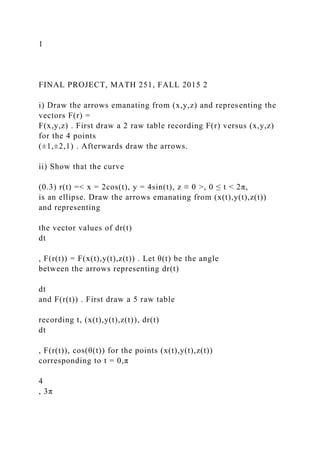
FINAL PROJECT, MATH 251, FALL 2015
[The project is Due Monday after the thanks giving recess]
.NAME(PRINT).________________ SHOW ALL WORK.
Explain and
SKETCH (everywhere anytime and especially as you try to
comprehend the prob-
lems below) whenever possible and/or necessary. Please
carefully recheck your
answers. Leave reasonable space between lines on your solution
sheets. Number
them and print your name.
Please sign the following. I hereby affirm that all the work in
this project was
done by myself ______________________.
1) i) Explain how to derive the representation of the Cartesian
coordinates x,y,z
in terms of the spherical coordinates ρ, θ, φ to obtain
(0.1) r =< x = ρsin(φ)cos(θ), y = ρsin(φ)sin(θ), z = ρcos(φ) > .
What are the conventional ranges of ρ, θ, φ?
ii) Conversely, explain how to express ρ, sin(θ), cos(θ), cos(φ),
sin(φ) as
functions of x,y,z.
iii) Consider the spherical coordinates ρ,θ, φ. Sketch and
describe in your own
words the set of all points x,y,z in x,y,z space such that:
a) 0 ≤ ρ ≤ 1, 0 ≤ θ < 2π, 0 ≤ φ ≤ π b) ρ = 1, 0 ≤ θ < 2π, 0 ≤ φ ≤
π,
c) 0 ≤ ρ < ∞, 0 ≤ θ < 2π, φ = π
4
, d) ρ = 1, 0 ≤ θ < 2π, φ = π
4
,
e) ρ = 1, θ = π
4
, 0 ≤ φ ≤ π. f) 1 ≤ ρ ≤ 2, 0 ≤ θ < 2π, π
6
≤ φ ≤ π
3
.
iv) In a different set of Cartesian Coordinates ρ, θ, φ sketch and
describe in your
own words the set of points (ρ, θ, φ) given above in each item
a) to f). For example
the set in a) in x,y,z space is a ball with radius 1 and center
(0,0,0). However, in
the Cartesian coordinates ρ, θ, φ the set in a) is a rectangular
box.
2) [Computation and graphing of vector fields]. Given r =<
x,y,z > and the
vector Field
(0.2) F(x,y,z) = F(r) =< 1 + z,yx,y >,
1
FINAL PROJECT, MATH 251, FALL 2015 2
i) Draw the arrows emanating from (x,y,z) and representing the
vectors F(r) =
F(x,y,z) . First draw a 2 raw table recording F(r) versus (x,y,z)
for the 4 points
(±1,±2,1) . Afterwards draw the arrows.
ii) Show that the curve
(0.3) r(t) =< x = 2cos(t), y = 4sin(t), z ≡ 0 >, 0 ≤ t < 2π,
is an ellipse. Draw the arrows emanating from (x(t),y(t),z(t))
and representing
the vector values of dr(t)
dt
, F(r(t)) = F(x(t),y(t),z(t)) . Let θ(t) be the angle
between the arrows representing dr(t)
dt
and F(r(t)) . First draw a 5 raw table
recording t, (x(t),y(t),z(t)), dr(t)
dt
, F(r(t)), cos(θ(t)) for the points (x(t),y(t),z(t))
corresponding to t = 0,π
4
, 3π
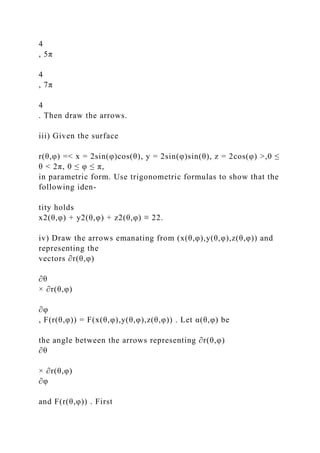
4
, 5π
4
, 7π
4
. Then draw the arrows.
iii) Given the surface
r(θ,φ) =< x = 2sin(φ)cos(θ), y = 2sin(φ)sin(θ), z = 2cos(φ) >,0 ≤
θ < 2π, 0 ≤ φ ≤ π,
in parametric form. Use trigonometric formulas to show that the
following iden-
tity holds
x2(θ,φ) + y2(θ,φ) + z2(θ,φ) ≡ 22.
iv) Draw the arrows emanating from (x(θ,φ),y(θ,φ),z(θ,φ)) and
representing the
vectors ∂r(θ,φ)
∂θ
× ∂r(θ,φ)
∂φ
, F(r(θ,φ)) = F(x(θ,φ),y(θ,φ),z(θ,φ)) . Let α(θ,φ) be
the angle between the arrows representing ∂r(θ,φ)
∂θ
× ∂r(θ,φ)
∂φ
and F(r(θ,φ)) . First
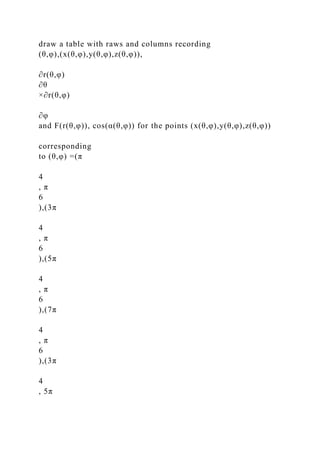
draw a table with raws and columns recording
(θ,φ),(x(θ,φ),y(θ,φ),z(θ,φ)),
∂r(θ,φ)
∂θ
×∂r(θ,φ)
∂φ
and F(r(θ,φ)), cos(α(θ,φ)) for the points (x(θ,φ),y(θ,φ),z(θ,φ))
corresponding
to (θ,φ) =(π
4
, π
6
),(3π
4
, π
6
),(5π
4
, π
6
),(7π
4
, π
6
),(3π
4
, 5π
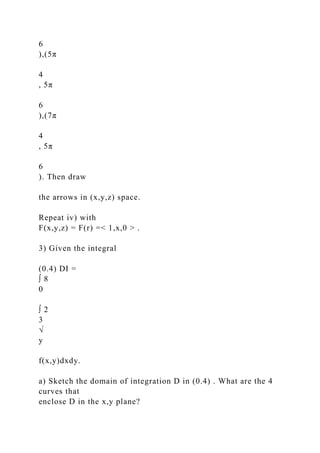
6
),(5π
4
, 5π
6
),(7π
4
, 5π
6
). Then draw
the arrows in (x,y,z) space.
Repeat iv) with
F(x,y,z) = F(r) =< 1,x,0 > .
3) Given the integral
(0.4) DI =
∫ 8
0
∫ 2
3
√
y
f(x,y)dxdy.
a) Sketch the domain of integration D in (0.4) . What are the 4
curves that
enclose D in the x,y plane?
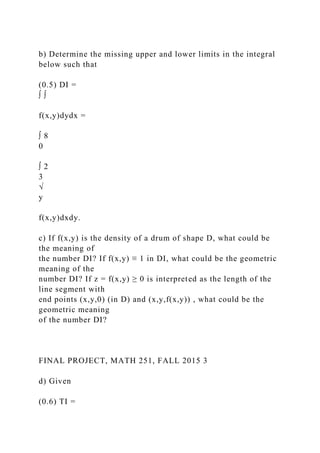
b) Determine the missing upper and lower limits in the integral
below such that
(0.5) DI =
∫ ∫
f(x,y)dydx =
∫ 8
0
∫ 2
3
√
y
f(x,y)dxdy.
c) If f(x,y) is the density of a drum of shape D, what could be
the meaning of
the number DI? If f(x,y) ≡ 1 in DI, what could be the geometric
meaning of the
number DI? If z = f(x,y) ≥ 0 is interpreted as the length of the
line segment with
end points (x,y,0) (in D) and (x,y,f(x,y)) , what could be the
geometric meaning
of the number DI?
FINAL PROJECT, MATH 251, FALL 2015 3
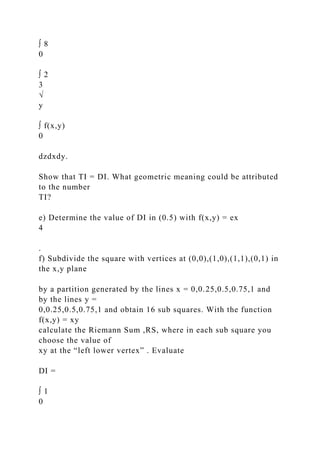
d) Given
(0.6) TI =
∫ 8
0
∫ 2
3
√
y
∫ f(x,y)
0
dzdxdy.
Show that TI = DI. What geometric meaning could be attributed
to the number
TI?
e) Determine the value of DI in (0.5) with f(x,y) = ex
4
.
f) Subdivide the square with vertices at (0,0),(1,0),(1,1),(0,1) in
the x,y plane
by a partition generated by the lines x = 0,0.25,0.5,0.75,1 and
by the lines y =
0,0.25,0.5,0.75,1 and obtain 16 sub squares. With the function
f(x,y) = xy
calculate the Riemann Sum ,RS, where in each sub square you
choose the value of
xy at the “left lower vertex” . Evaluate
DI =
∫ 1
0
∫ 1
0
(xy)dydx.
and determine [DI −RS].
4) a) The function z = f(x,y) = 2x2−2xy+y2 in defined for all
−∞ < x,y < ∞
. Determine the critical points and the values of f(x,y) at these
critical points.
Determine wether the function attains a local minimum a local
maximum or a
saddle point at these critical points.
b) Determine all the critical points of the function z = f(x,y) =
(xy)
1
3 that is
defined for all −∞ < x,y < ∞ and mark these critical points in
the x,y plane .
c) Use the method of traces to determine the shape of the
surface z = f(x,y) =
xy defined for all −∞ < x,y < ∞ . Determine the traces of z =
f(x,y) in the
planes z = 0,1,−1,3,−3,5,−5,7,−7. (you may add more traces) .
Sketch first the
level curves. Determine a parametric representation r(t) =<
x(t),y(t),z(t) > for
the trace z = −3 . Determine a parametric representation r(t) =<
x(t),y(t),z(t) >
for the projection of the trace z = −3 on thex,y plane.
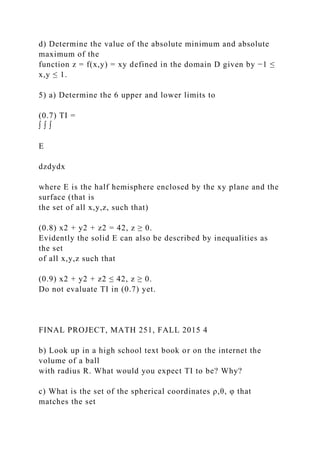
d) Determine the value of the absolute minimum and absolute
maximum of the
function z = f(x,y) = xy defined in the domain D given by −1 ≤
x,y ≤ 1.
5) a) Determine the 6 upper and lower limits to
(0.7) TI =
∫ ∫ ∫
E
dzdydx
where E is the half hemisphere enclosed by the xy plane and the
surface (that is
the set of all x,y,z, such that)
(0.8) x2 + y2 + z2 = 42, z ≥ 0.
Evidently the solid E can also be described by inequalities as
the set
of all x,y,z such that
(0.9) x2 + y2 + z2 ≤ 42, z ≥ 0.
Do not evaluate TI in (0.7) yet.
FINAL PROJECT, MATH 251, FALL 2015 4
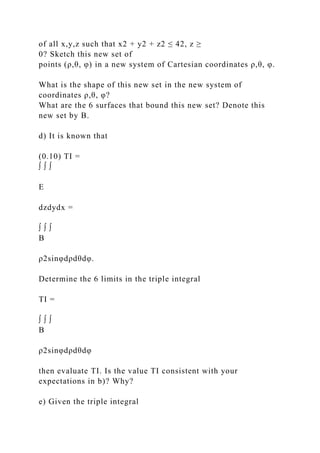
b) Look up in a high school text book or on the internet the
volume of a ball
with radius R. What would you expect TI to be? Why?
c) What is the set of the spherical coordinates ρ,θ, φ that
matches the set
of all x,y,z such that x2 + y2 + z2 ≤ 42, z ≥
0? Sketch this new set of
points (ρ,θ, φ) in a new system of Cartesian coordinates ρ,θ, φ.
What is the shape of this new set in the new system of
coordinates ρ,θ, φ?
What are the 6 surfaces that bound this new set? Denote this
new set by B.
d) It is known that
(0.10) TI =
∫ ∫ ∫
E
dzdydx =
∫ ∫ ∫
B
ρ2sinφdρdθdφ.
Determine the 6 limits in the triple integral
TI =
∫ ∫ ∫
B
ρ2sinφdρdθdφ
then evaluate TI. Is the value TI consistent with your
expectations in b)? Why?
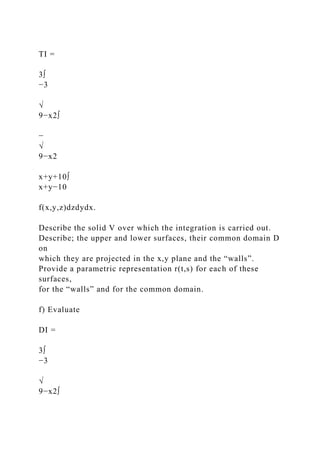
e) Given the triple integral
TI =
3∫
−3
√
9−x2∫
−
√
9−x2
x+y+10∫
x+y−10
f(x,y,z)dzdydx.
Describe the solid V over which the integration is carried out.
Describe; the upper and lower surfaces, their common domain D
on
which they are projected in the x,y plane and the “walls”.
Provide a parametric representation r(t,s) for each of these
surfaces,
for the “walls” and for the common domain.
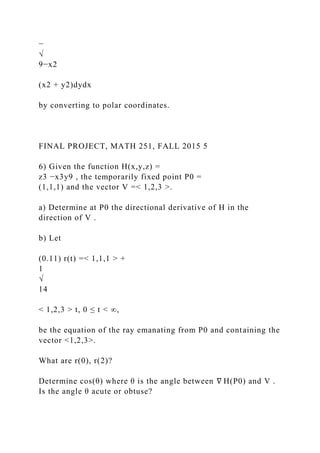
f) Evaluate
DI =
3∫
−3
√
9−x2∫
−
√
9−x2
(x2 + y2)dydx
by converting to polar coordinates.
FINAL PROJECT, MATH 251, FALL 2015 5
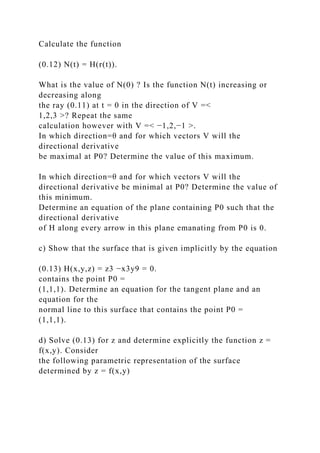
6) Given the function H(x,y,z) =
z3 −x3y9 , the temporarily fixed point P0 =
(1,1,1) and the vector V =< 1,2,3 >.
a) Determine at P0 the directional derivative of H in the
direction of V .
b) Let
(0.11) r(t) =< 1,1,1 > +
1
√
14
< 1,2,3 > t, 0 ≤ t < ∞,
be the equation of the ray emanating from P0 and containing the
vector <1,2,3>.
What are r(0), r(2)?
Determine cos(θ) where θ is the angle between ∇ H(P0) and V .
Is the angle θ acute or obtuse?
Calculate the function
(0.12) N(t) = H(r(t)).
What is the value of N(0) ? Is the function N(t) increasing or
decreasing along
the ray (0.11) at t = 0 in the direction of V =<
1,2,3 >? Repeat the same
calculation however with V =< −1,2,−1 >.
In which direction=θ and for which vectors V will the
directional derivative
be maximal at P0? Determine the value of this maximum.
In which direction=θ and for which vectors V will the
directional derivative be minimal at P0? Determine the value of
this minimum.
Determine an equation of the plane containing P0 such that the
directional derivative
of H along every arrow in this plane emanating from P0 is 0.
c) Show that the surface that is given implicitly by the equation
(0.13) H(x,y,z) = z3 −x3y9 = 0.
contains the point P0 =
(1,1,1). Determine an equation for the tangent plane and an
equation for the
normal line to this surface that contains the point P0 =
(1,1,1).
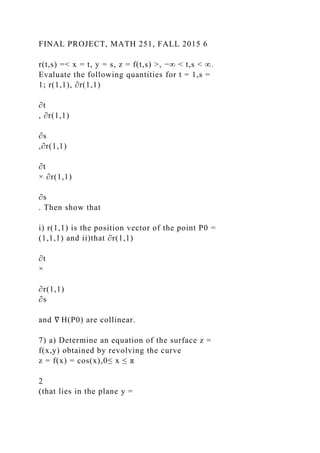
d) Solve (0.13) for z and determine explicitly the function z =
f(x,y). Consider
the following parametric representation of the surface
determined by z = f(x,y)
FINAL PROJECT, MATH 251, FALL 2015 6
r(t,s) =< x = t, y = s, z = f(t,s) >, −∞ < t,s < ∞.
Evaluate the following quantities for t = 1,s =
1; r(1,1), ∂r(1,1)
∂t
, ∂r(1,1)
∂s
,∂r(1,1)
∂t
× ∂r(1,1)
∂s
. Then show that
i) r(1,1) is the position vector of the point P0 =
(1,1,1) and ii)that ∂r(1,1)
∂t
×
∂r(1,1)
∂s
and ∇ H(P0) are collinear.
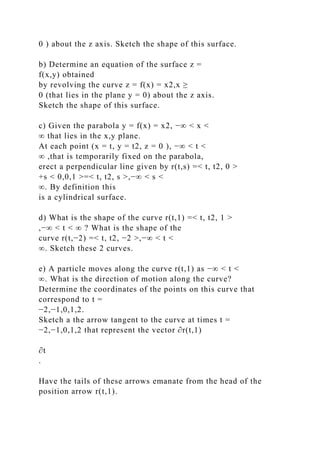
7) a) Determine an equation of the surface z =
f(x,y) obtained by revolving the curve
z = f(x) = cos(x),0≤ x ≤ π
2
(that lies in the plane y =
0 ) about the z axis. Sketch the shape of this surface.
b) Determine an equation of the surface z =
f(x,y) obtained
by revolving the curve z = f(x) = x2,x ≥
0 (that lies in the plane y = 0) about the z axis.
Sketch the shape of this surface.
c) Given the parabola y = f(x) = x2, −∞ < x <
∞ that lies in the x,y plane.
At each point (x = t, y = t2, z = 0 ), −∞ < t <
∞ ,that is temporarily fixed on the parabola,
erect a perpendicular line given by r(t,s) =< t, t2, 0 >
+s < 0,0,1 >=< t, t2, s >,−∞ < s <
∞. By definition this
is a cylindrical surface.
d) What is the shape of the curve r(t,1) =< t, t2, 1 >
,−∞ < t < ∞ ? What is the shape of the
curve r(t,−2) =< t, t2, −2 >,−∞ < t <
∞. Sketch these 2 curves.
e) A particle moves along the curve r(t,1) as −∞ < t <
∞. What is the direction of motion along the curve?
Determine the coordinates of the points on this curve that
correspond to t =
−2,−1,0,1,2.
Sketch a the arrow tangent to the curve at times t =
−2,−1,0,1,2 that represent the vector ∂r(t,1)
∂t
.
Have the tails of these arrows emanate from the head of the
position arrow r(t,1).
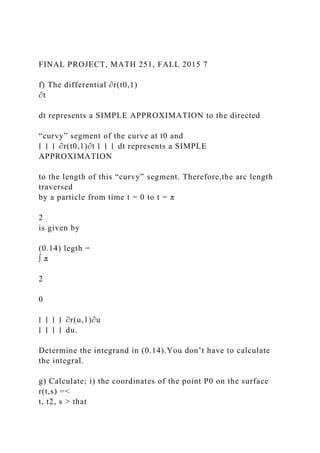
FINAL PROJECT, MATH 251, FALL 2015 7
f) The differential ∂r(t0,1)
∂t
dt represents a SIMPLE APPROXIMATION to the directed
“curvy” segment of the curve at t0 and
∣ ∣ ∣ ∂r(t0,1)∂t ∣ ∣ ∣ dt represents a SIMPLE
APPROXIMATION
to the length of this “curvy” segment. Therefore,the arc length
traversed
by a particle from time t = 0 to t = π
2
is given by
(0.14) legth =
∫ π
2
0
∣ ∣ ∣ ∣ ∂r(u,1)∂u
∣ ∣ ∣ ∣ du.
Determine the integrand in (0.14).You don’t have to calculate
the integral.
g) Calculate; i) the coordinates of the point P0 on the surface
r(t,s) =<
t, t2, s > that
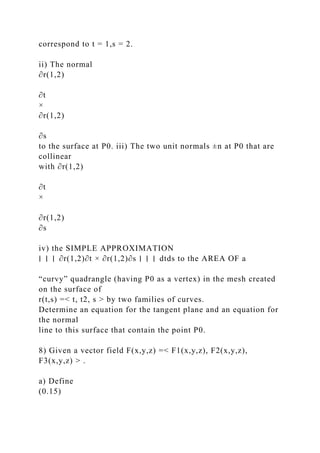
correspond to t = 1,s = 2.
ii) The normal
∂r(1,2)
∂t
×
∂r(1,2)
∂s
to the surface at P0. iii) The two unit normals ±n at P0 that are
collinear
with ∂r(1,2)
∂t
×
∂r(1,2)
∂s
iv) the SIMPLE APPROXIMATION
∣ ∣ ∣ ∂r(1,2)∂t × ∂r(1,2)∂s ∣ ∣ ∣ dtds to the AREA OF a
“curvy” quadrangle (having P0 as a vertex) in the mesh created
on the surface of
r(t,s) =< t, t2, s > by two families of curves.
Determine an equation for the tangent plane and an equation for
the normal
line to this surface that contain the point P0.
8) Given a vector field F(x,y,z) =< F1(x,y,z), F2(x,y,z),
F3(x,y,z) > .
a) Define
(0.15)
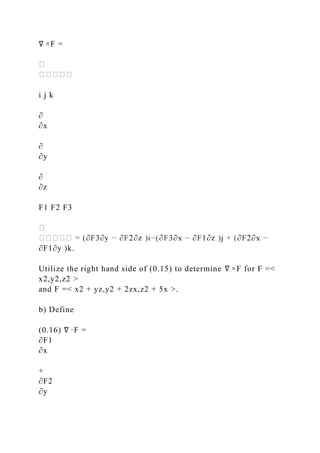
∇ ×F =
i j k
∂
∂x
∂
∂y
∂
∂z
F1 F2 F3
∂F1∂y )k.
Utilize the right hand side of (0.15) to determine ∇ ×F for F =<
x2,y2,z2 >
and F =< x2 + yz,y2 + 2zx,z2 + 5x >.
b) Define
(0.16) ∇ ·F =
∂F1
∂x
+
∂F2
∂y
+
∂F3
∂z
and determine ∇ ·F for F =< x2,y2,z2 > and F =< x2 +yz,y2
+2zx,z2 +5x >.
FINAL PROJECT, MATH 251, FALL 2015 8
Denote by w = φ(x,y,z) a scalar function. For φ(x,y,z) = exy+2z
determine
∂2φ
∂y∂x
and ∂
2φ
∂x∂y
.
c) Prove or demonstrate that for any vector field F(x,y,z) and
scalar function
φ the following holds; i) ∇ · (∇ ×F) = 0 and ii) ∇ × (∇ φ) =< 0,0,0
>.
—————————-
Useful formulas.
An element of area dA in polar coordinates is given by
dA = rdrdθ.
An element of volume dV in cylindrical coordinates is given by
dV = rdzdrdθ.
An element of volume dV in spherical coordinates is given by
dV = ρ2sinφdρdθdφ.

FINAL PROJECT, MATH 251, FALL 2015[The project is Due Mond.docx

  • 1.
    FINAL PROJECT, MATH251, FALL 2015 [The project is Due Monday after the thanks giving recess] .NAME(PRINT).________________ SHOW ALL WORK. Explain and SKETCH (everywhere anytime and especially as you try to comprehend the prob- lems below) whenever possible and/or necessary. Please carefully recheck your answers. Leave reasonable space between lines on your solution sheets. Number them and print your name. Please sign the following. I hereby affirm that all the work in this project was done by myself ______________________. 1) i) Explain how to derive the representation of the Cartesian coordinates x,y,z in terms of the spherical coordinates ρ, θ, φ to obtain (0.1) r =< x = ρsin(φ)cos(θ), y = ρsin(φ)sin(θ), z = ρcos(φ) > . What are the conventional ranges of ρ, θ, φ? ii) Conversely, explain how to express ρ, sin(θ), cos(θ), cos(φ), sin(φ) as functions of x,y,z. iii) Consider the spherical coordinates ρ,θ, φ. Sketch and describe in your own
  • 2.
    words the setof all points x,y,z in x,y,z space such that: a) 0 ≤ ρ ≤ 1, 0 ≤ θ < 2π, 0 ≤ φ ≤ π b) ρ = 1, 0 ≤ θ < 2π, 0 ≤ φ ≤ π, c) 0 ≤ ρ < ∞, 0 ≤ θ < 2π, φ = π 4 , d) ρ = 1, 0 ≤ θ < 2π, φ = π 4 , e) ρ = 1, θ = π 4 , 0 ≤ φ ≤ π. f) 1 ≤ ρ ≤ 2, 0 ≤ θ < 2π, π 6 ≤ φ ≤ π 3 . iv) In a different set of Cartesian Coordinates ρ, θ, φ sketch and describe in your own words the set of points (ρ, θ, φ) given above in each item a) to f). For example the set in a) in x,y,z space is a ball with radius 1 and center (0,0,0). However, in the Cartesian coordinates ρ, θ, φ the set in a) is a rectangular box. 2) [Computation and graphing of vector fields]. Given r =< x,y,z > and the vector Field (0.2) F(x,y,z) = F(r) =< 1 + z,yx,y >,
  • 3.
    1 FINAL PROJECT, MATH251, FALL 2015 2 i) Draw the arrows emanating from (x,y,z) and representing the vectors F(r) = F(x,y,z) . First draw a 2 raw table recording F(r) versus (x,y,z) for the 4 points (±1,±2,1) . Afterwards draw the arrows. ii) Show that the curve (0.3) r(t) =< x = 2cos(t), y = 4sin(t), z ≡ 0 >, 0 ≤ t < 2π, is an ellipse. Draw the arrows emanating from (x(t),y(t),z(t)) and representing the vector values of dr(t) dt , F(r(t)) = F(x(t),y(t),z(t)) . Let θ(t) be the angle between the arrows representing dr(t) dt and F(r(t)) . First draw a 5 raw table recording t, (x(t),y(t),z(t)), dr(t) dt , F(r(t)), cos(θ(t)) for the points (x(t),y(t),z(t)) corresponding to t = 0,π 4 , 3π
  • 4.
    4 , 5π 4 , 7π 4 .Then draw the arrows. iii) Given the surface r(θ,φ) =< x = 2sin(φ)cos(θ), y = 2sin(φ)sin(θ), z = 2cos(φ) >,0 ≤ θ < 2π, 0 ≤ φ ≤ π, in parametric form. Use trigonometric formulas to show that the following iden- tity holds x2(θ,φ) + y2(θ,φ) + z2(θ,φ) ≡ 22. iv) Draw the arrows emanating from (x(θ,φ),y(θ,φ),z(θ,φ)) and representing the vectors ∂r(θ,φ) ∂θ × ∂r(θ,φ) ∂φ , F(r(θ,φ)) = F(x(θ,φ),y(θ,φ),z(θ,φ)) . Let α(θ,φ) be the angle between the arrows representing ∂r(θ,φ) ∂θ × ∂r(θ,φ) ∂φ and F(r(θ,φ)) . First
  • 5.
    draw a tablewith raws and columns recording (θ,φ),(x(θ,φ),y(θ,φ),z(θ,φ)), ∂r(θ,φ) ∂θ ×∂r(θ,φ) ∂φ and F(r(θ,φ)), cos(α(θ,φ)) for the points (x(θ,φ),y(θ,φ),z(θ,φ)) corresponding to (θ,φ) =(π 4 , π 6 ),(3π 4 , π 6 ),(5π 4 , π 6 ),(7π 4 , π 6 ),(3π 4 , 5π
  • 6.
    6 ),(5π 4 , 5π 6 ),(7π 4 , 5π 6 ).Then draw the arrows in (x,y,z) space. Repeat iv) with F(x,y,z) = F(r) =< 1,x,0 > . 3) Given the integral (0.4) DI = ∫ 8 0 ∫ 2 3 √ y f(x,y)dxdy. a) Sketch the domain of integration D in (0.4) . What are the 4 curves that enclose D in the x,y plane?
  • 7.
    b) Determine themissing upper and lower limits in the integral below such that (0.5) DI = ∫ ∫ f(x,y)dydx = ∫ 8 0 ∫ 2 3 √ y f(x,y)dxdy. c) If f(x,y) is the density of a drum of shape D, what could be the meaning of the number DI? If f(x,y) ≡ 1 in DI, what could be the geometric meaning of the number DI? If z = f(x,y) ≥ 0 is interpreted as the length of the line segment with end points (x,y,0) (in D) and (x,y,f(x,y)) , what could be the geometric meaning of the number DI? FINAL PROJECT, MATH 251, FALL 2015 3 d) Given (0.6) TI =
  • 8.
    ∫ 8 0 ∫ 2 3 √ y ∫f(x,y) 0 dzdxdy. Show that TI = DI. What geometric meaning could be attributed to the number TI? e) Determine the value of DI in (0.5) with f(x,y) = ex 4 . f) Subdivide the square with vertices at (0,0),(1,0),(1,1),(0,1) in the x,y plane by a partition generated by the lines x = 0,0.25,0.5,0.75,1 and by the lines y = 0,0.25,0.5,0.75,1 and obtain 16 sub squares. With the function f(x,y) = xy calculate the Riemann Sum ,RS, where in each sub square you choose the value of xy at the “left lower vertex” . Evaluate DI = ∫ 1 0
  • 9.
    ∫ 1 0 (xy)dydx. and determine[DI −RS]. 4) a) The function z = f(x,y) = 2x2−2xy+y2 in defined for all −∞ < x,y < ∞ . Determine the critical points and the values of f(x,y) at these critical points. Determine wether the function attains a local minimum a local maximum or a saddle point at these critical points. b) Determine all the critical points of the function z = f(x,y) = (xy) 1 3 that is defined for all −∞ < x,y < ∞ and mark these critical points in the x,y plane . c) Use the method of traces to determine the shape of the surface z = f(x,y) = xy defined for all −∞ < x,y < ∞ . Determine the traces of z = f(x,y) in the planes z = 0,1,−1,3,−3,5,−5,7,−7. (you may add more traces) . Sketch first the level curves. Determine a parametric representation r(t) =< x(t),y(t),z(t) > for the trace z = −3 . Determine a parametric representation r(t) =< x(t),y(t),z(t) > for the projection of the trace z = −3 on thex,y plane.
  • 10.
    d) Determine thevalue of the absolute minimum and absolute maximum of the function z = f(x,y) = xy defined in the domain D given by −1 ≤ x,y ≤ 1. 5) a) Determine the 6 upper and lower limits to (0.7) TI = ∫ ∫ ∫ E dzdydx where E is the half hemisphere enclosed by the xy plane and the surface (that is the set of all x,y,z, such that) (0.8) x2 + y2 + z2 = 42, z ≥ 0. Evidently the solid E can also be described by inequalities as the set of all x,y,z such that (0.9) x2 + y2 + z2 ≤ 42, z ≥ 0. Do not evaluate TI in (0.7) yet. FINAL PROJECT, MATH 251, FALL 2015 4 b) Look up in a high school text book or on the internet the volume of a ball with radius R. What would you expect TI to be? Why? c) What is the set of the spherical coordinates ρ,θ, φ that matches the set
  • 11.
    of all x,y,zsuch that x2 + y2 + z2 ≤ 42, z ≥ 0? Sketch this new set of points (ρ,θ, φ) in a new system of Cartesian coordinates ρ,θ, φ. What is the shape of this new set in the new system of coordinates ρ,θ, φ? What are the 6 surfaces that bound this new set? Denote this new set by B. d) It is known that (0.10) TI = ∫ ∫ ∫ E dzdydx = ∫ ∫ ∫ B ρ2sinφdρdθdφ. Determine the 6 limits in the triple integral TI = ∫ ∫ ∫ B ρ2sinφdρdθdφ then evaluate TI. Is the value TI consistent with your expectations in b)? Why? e) Given the triple integral
  • 12.
    TI = 3∫ −3 √ 9−x2∫ − √ 9−x2 x+y+10∫ x+y−10 f(x,y,z)dzdydx. Describe thesolid V over which the integration is carried out. Describe; the upper and lower surfaces, their common domain D on which they are projected in the x,y plane and the “walls”. Provide a parametric representation r(t,s) for each of these surfaces, for the “walls” and for the common domain. f) Evaluate DI = 3∫ −3 √ 9−x2∫
  • 13.
    − √ 9−x2 (x2 + y2)dydx byconverting to polar coordinates. FINAL PROJECT, MATH 251, FALL 2015 5 6) Given the function H(x,y,z) = z3 −x3y9 , the temporarily fixed point P0 = (1,1,1) and the vector V =< 1,2,3 >. a) Determine at P0 the directional derivative of H in the direction of V . b) Let (0.11) r(t) =< 1,1,1 > + 1 √ 14 < 1,2,3 > t, 0 ≤ t < ∞, be the equation of the ray emanating from P0 and containing the vector <1,2,3>. What are r(0), r(2)? Determine cos(θ) where θ is the angle between ∇ H(P0) and V . Is the angle θ acute or obtuse?
  • 14.
    Calculate the function (0.12)N(t) = H(r(t)). What is the value of N(0) ? Is the function N(t) increasing or decreasing along the ray (0.11) at t = 0 in the direction of V =< 1,2,3 >? Repeat the same calculation however with V =< −1,2,−1 >. In which direction=θ and for which vectors V will the directional derivative be maximal at P0? Determine the value of this maximum. In which direction=θ and for which vectors V will the directional derivative be minimal at P0? Determine the value of this minimum. Determine an equation of the plane containing P0 such that the directional derivative of H along every arrow in this plane emanating from P0 is 0. c) Show that the surface that is given implicitly by the equation (0.13) H(x,y,z) = z3 −x3y9 = 0. contains the point P0 = (1,1,1). Determine an equation for the tangent plane and an equation for the normal line to this surface that contains the point P0 = (1,1,1). d) Solve (0.13) for z and determine explicitly the function z = f(x,y). Consider the following parametric representation of the surface determined by z = f(x,y)
  • 15.
    FINAL PROJECT, MATH251, FALL 2015 6 r(t,s) =< x = t, y = s, z = f(t,s) >, −∞ < t,s < ∞. Evaluate the following quantities for t = 1,s = 1; r(1,1), ∂r(1,1) ∂t , ∂r(1,1) ∂s ,∂r(1,1) ∂t × ∂r(1,1) ∂s . Then show that i) r(1,1) is the position vector of the point P0 = (1,1,1) and ii)that ∂r(1,1) ∂t × ∂r(1,1) ∂s and ∇ H(P0) are collinear. 7) a) Determine an equation of the surface z = f(x,y) obtained by revolving the curve z = f(x) = cos(x),0≤ x ≤ π 2 (that lies in the plane y =
  • 16.
    0 ) aboutthe z axis. Sketch the shape of this surface. b) Determine an equation of the surface z = f(x,y) obtained by revolving the curve z = f(x) = x2,x ≥ 0 (that lies in the plane y = 0) about the z axis. Sketch the shape of this surface. c) Given the parabola y = f(x) = x2, −∞ < x < ∞ that lies in the x,y plane. At each point (x = t, y = t2, z = 0 ), −∞ < t < ∞ ,that is temporarily fixed on the parabola, erect a perpendicular line given by r(t,s) =< t, t2, 0 > +s < 0,0,1 >=< t, t2, s >,−∞ < s < ∞. By definition this is a cylindrical surface. d) What is the shape of the curve r(t,1) =< t, t2, 1 > ,−∞ < t < ∞ ? What is the shape of the curve r(t,−2) =< t, t2, −2 >,−∞ < t < ∞. Sketch these 2 curves. e) A particle moves along the curve r(t,1) as −∞ < t < ∞. What is the direction of motion along the curve? Determine the coordinates of the points on this curve that correspond to t = −2,−1,0,1,2. Sketch a the arrow tangent to the curve at times t = −2,−1,0,1,2 that represent the vector ∂r(t,1) ∂t . Have the tails of these arrows emanate from the head of the position arrow r(t,1).
  • 17.
    FINAL PROJECT, MATH251, FALL 2015 7 f) The differential ∂r(t0,1) ∂t dt represents a SIMPLE APPROXIMATION to the directed “curvy” segment of the curve at t0 and ∣ ∣ ∣ ∂r(t0,1)∂t ∣ ∣ ∣ dt represents a SIMPLE APPROXIMATION to the length of this “curvy” segment. Therefore,the arc length traversed by a particle from time t = 0 to t = π 2 is given by (0.14) legth = ∫ π 2 0 ∣ ∣ ∣ ∣ ∂r(u,1)∂u ∣ ∣ ∣ ∣ du. Determine the integrand in (0.14).You don’t have to calculate the integral. g) Calculate; i) the coordinates of the point P0 on the surface r(t,s) =< t, t2, s > that
  • 18.
    correspond to t= 1,s = 2. ii) The normal ∂r(1,2) ∂t × ∂r(1,2) ∂s to the surface at P0. iii) The two unit normals ±n at P0 that are collinear with ∂r(1,2) ∂t × ∂r(1,2) ∂s iv) the SIMPLE APPROXIMATION ∣ ∣ ∣ ∂r(1,2)∂t × ∂r(1,2)∂s ∣ ∣ ∣ dtds to the AREA OF a “curvy” quadrangle (having P0 as a vertex) in the mesh created on the surface of r(t,s) =< t, t2, s > by two families of curves. Determine an equation for the tangent plane and an equation for the normal line to this surface that contain the point P0. 8) Given a vector field F(x,y,z) =< F1(x,y,z), F2(x,y,z), F3(x,y,z) > . a) Define (0.15)
  • 19.
    ∇ ×F = ij k ∂ ∂x ∂ ∂y ∂ ∂z F1 F2 F3 ∂F1∂y )k. Utilize the right hand side of (0.15) to determine ∇ ×F for F =< x2,y2,z2 > and F =< x2 + yz,y2 + 2zx,z2 + 5x >. b) Define (0.16) ∇ ·F = ∂F1 ∂x + ∂F2 ∂y
  • 20.
    + ∂F3 ∂z and determine ∇·F for F =< x2,y2,z2 > and F =< x2 +yz,y2 +2zx,z2 +5x >. FINAL PROJECT, MATH 251, FALL 2015 8 Denote by w = φ(x,y,z) a scalar function. For φ(x,y,z) = exy+2z determine ∂2φ ∂y∂x and ∂ 2φ ∂x∂y . c) Prove or demonstrate that for any vector field F(x,y,z) and scalar function φ the following holds; i) ∇ · (∇ ×F) = 0 and ii) ∇ × (∇ φ) =< 0,0,0 >. —————————- Useful formulas. An element of area dA in polar coordinates is given by dA = rdrdθ. An element of volume dV in cylindrical coordinates is given by dV = rdzdrdθ.
  • 21.
    An element ofvolume dV in spherical coordinates is given by dV = ρ2sinφdρdθdφ.