Fluid Pressures
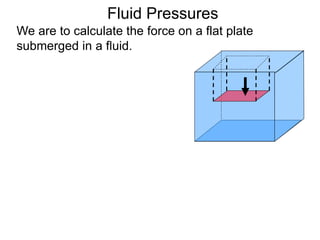
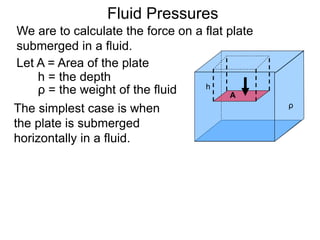
We are to calculate the force on a flat plate
submerged in a fluid.
Fluid Pressures
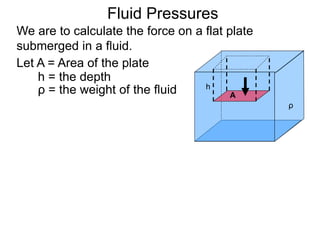
We are to calculate the force on a flat plate
submerged in a fluid.
Let A = Area of the plate
h = the depth
ρ = the weight of the fluid A
h
ρ
Fluid Pressures
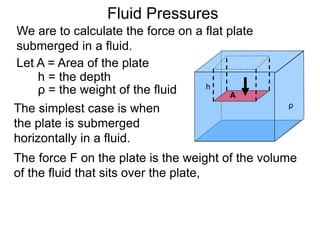
Let A = Area of the plate
h = the depth
ρ = the weight of the fluid
The simplest case is when
the plate is submerged
horizontally in a fluid.
A
h
ρ
Fluid Pressures
We are to calculate the force on a flat plate
submerged in a fluid.
Let A = Area of the plate
h = the depth
ρ = the weight of the fluid
The simplest case is when
the plate is submerged
horizontally in a fluid.
A
h
ρ
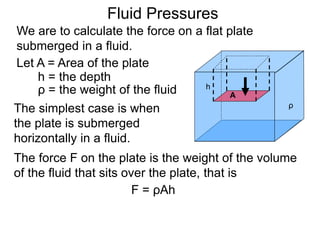
The force F on the plate is the weight of the volume
of the fluid that sits over the plate,
Fluid Pressures
We are to calculate the force on a flat plate
submerged in a fluid.
Let A = Area of the plate
h = the depth
ρ = the weight of the fluid
The simplest case is when
the plate is submerged
horizontally in a fluid.
A
h
ρ
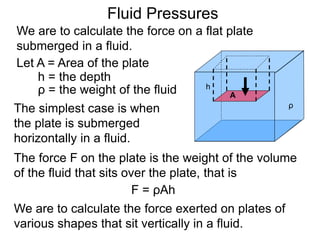
The force F on the plate is the weight of the volume
of the fluid that sits over the plate, that is
F = ρAh
Fluid Pressures
We are to calculate the force on a flat plate
submerged in a fluid.
Let A = Area of the plate
h = the depth
ρ = the weight of the fluid
The simplest case is when
the plate is submerged
horizontally in a fluid.
A
h
ρ
The force F on the plate is the weight of the volume
of the fluid that sits over the plate, that is
F = ρAh
We are to calculate the force exerted on plates of
various shapes that sit vertically in a fluid.
Fluid Pressures
We are to calculate the force on a flat plate
submerged in a fluid.
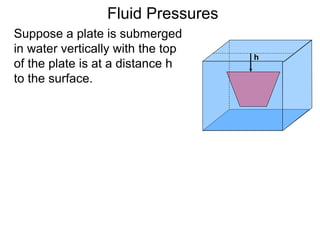
Suppose a plate is submerged
in water vertically with the top
of the plate is at a distance h
to the surface.
h
Fluid Pressures
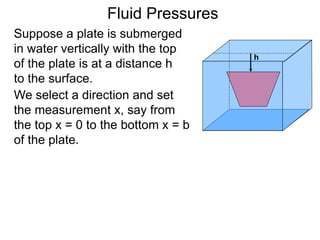
Suppose a plate is submerged
in water vertically with the top
of the plate is at a distance h
to the surface.
h
We select a direction and set
the measurement x, say from
the top x = 0 to the bottom x = b
of the plate.
Fluid Pressures
Suppose a plate is submerged
in water vertically with the top
of the plate is at a distance h
to the surface.
h
We select a direction and set
the measurement x, say from
the top x = 0 to the bottom x = b
of the plate.
x=0
x=b
xi-1
xi
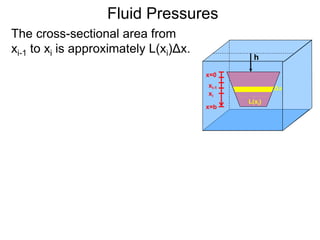
Let the sequence {0=x0, x1, x2, .. , xn=b} be an equi-
partition of [0, b] and xi–1 and xi be two consecutive
points.
Fluid Pressures
Suppose a plate is submerged
in water vertically with the top
of the plate is at a distance h
to the surface.
h
We select a direction and set
the measurement x, say from
the top x = 0 to the bottom x = b
of the plate.
x=0
x=b
xi-1
xi
Let L(x) = cross-sectional length at x, so
L(xi) = cross-sectional length at xi.
Let the sequence {0=x0, x1, x2, .. , xn=b} be an equi-
partition of [0, b] and xi–1 and xi be two consecutive
points.
Fluid Pressures
L(xi)
Suppose a plate is submerged
in water vertically with the top
of the plate is at a distance h
to the surface.
h
We select a direction and set
the measurement x, say from
the top x = 0 to the bottom x = b
of the plate.
x=0
x=b
xi-1
xi
Let L(x) = cross-sectional length at x, so
L(xi) = cross-sectional length at xi.
Let the sequence {0=x0, x1, x2, .. , xn=b} be an equi-
partition of [0, b] and xi–1 and xi be two consecutive
points.
Let Δx = the length of each subinterval.
Fluid Pressures
L(xi)
Δx
h
x=0
x=b
xi-1
xi
L(xi)
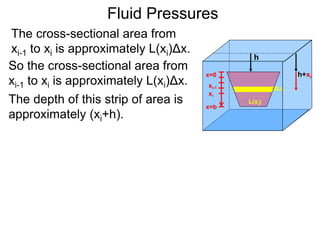
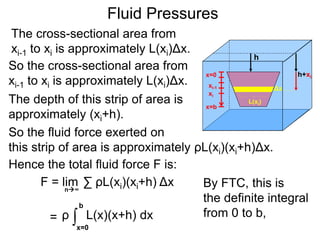
The cross-sectional area from
xi-1 to xi is approximately L(xi)Δx.
Δx
Fluid Pressures
h
x=0
x=b
xi-1
xi
L(xi)
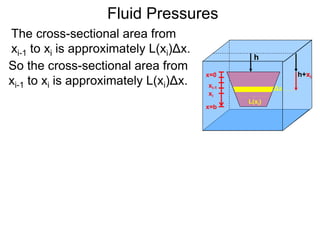
The cross-sectional area from
xi-1 to xi is approximately L(xi)Δx.
So the cross-sectional area from
xi-1 to xi is approximately L(xi)Δx. Δx
h+xi
Fluid Pressures
The cross-sectional area from
xi-1 to xi is approximately L(xi)Δx.
So the cross-sectional area from
xi-1 to xi is approximately L(xi)Δx.
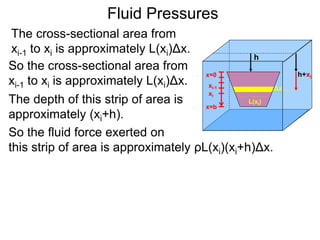
The depth of this strip of area is
approximately (xi+h).
Fluid Pressures
h
x=0
x=b
xi-1
xi
L(xi)
Δx
h+xi
The cross-sectional area from
xi-1 to xi is approximately L(xi)Δx.
So the cross-sectional area from
xi-1 to xi is approximately L(xi)Δx.
So the fluid force exerted on
this strip of area is approximately ρL(xi)(xi+h)Δx.
The depth of this strip of area is
approximately (xi+h).
Fluid Pressures
h
x=0
x=b
xi-1
xi
L(xi)
Δx
h+xi
The cross-sectional area from
xi-1 to xi is approximately L(xi)Δx.
So the cross-sectional area from
xi-1 to xi is approximately L(xi)Δx.
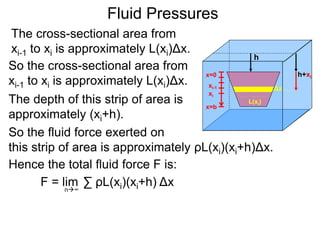
So the fluid force exerted on
this strip of area is approximately ρL(xi)(xi+h)Δx.
The depth of this strip of area is
approximately (xi+h).
Hence the total fluid force F is:
∑ ρL(xi)(xi+h) ΔxF = limn∞
Fluid Pressures
h
x=0
x=b
xi-1
xi
L(xi)
Δx
h+xi
The cross-sectional area from
xi-1 to xi is approximately L(xi)Δx.
So the cross-sectional area from
xi-1 to xi is approximately L(xi)Δx.
So the fluid force exerted on
this strip of area is approximately ρL(xi)(xi+h)Δx.
The depth of this strip of area is
approximately (xi+h).
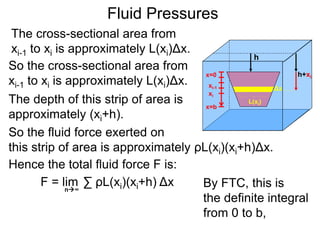
Hence the total fluid force F is:
∑ ρL(xi)(xi+h) ΔxF = lim By FTC, this is
the definite integral
from 0 to b,
n∞
Fluid Pressures
h
x=0
x=b
xi-1
xi
L(xi)
Δx
h+xi
The cross-sectional area from
xi-1 to xi is approximately L(xi)Δx.
So the cross-sectional area from
xi-1 to xi is approximately L(xi)Δx.
So the fluid force exerted on
this strip of area is approximately ρL(xi)(xi+h)Δx.
The depth of this strip of area is
approximately (xi+h).
Hence the total fluid force F is:
∑ ρL(xi)(xi+h) ΔxF = lim By FTC, this is
the definite integral
from 0 to b,= ∫x=0
b
ρ L(x)(x+h) dx
n∞
Fluid Pressures
h
x=0
x=b
xi-1
xi
L(xi)
Δx
h+xi
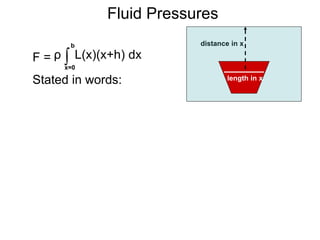
Stated in words:
∫x=0
b
ρ L(x)(x+h) dxF =
distance in x
length in x
Fluid Pressures
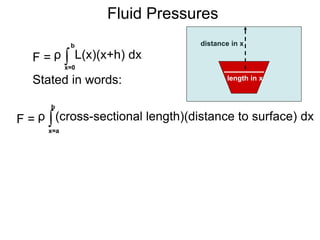
Stated in words:
∫x=0
b
ρ L(x)(x+h) dxF =
distance in x
length in x
∫
b
ρ (cross-sectional length)(distance to surface) dxF =
x=a
Fluid Pressures
Stated in words:
∫x=0
b
ρ L(x)(x+h) dxF =
∫
b
ρ (cross-sectional length)(distance to surface) dxF =
distance in x
length in x
x=a
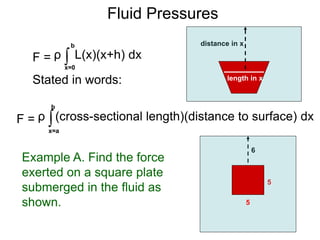
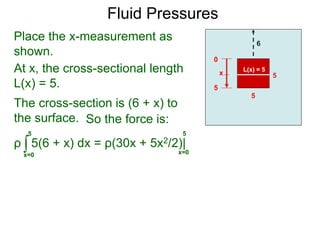
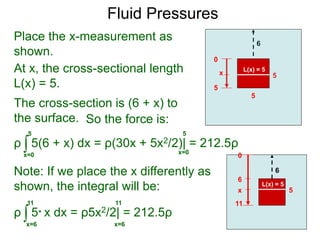
Example A. Find the force
exerted on a square plate
submerged in the fluid as
shown.
5
6
5
Fluid Pressures
5
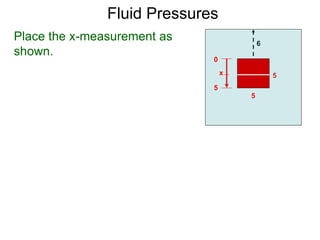
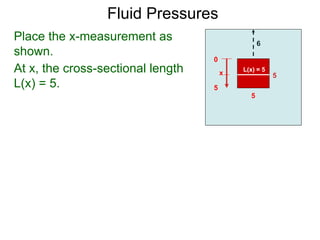
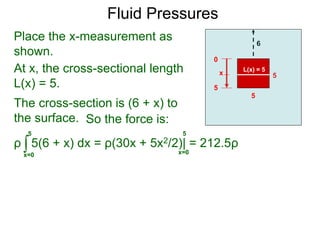
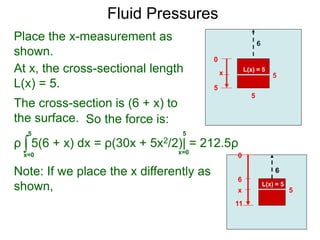
Place the x-measurement as
shown.
6
5
x
0
5
Fluid Pressures
5
Place the x-measurement as
shown.
6
5
x
0
5
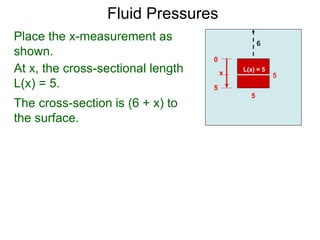
At x, the cross-sectional length
L(x) = 5.
L(x) = 5
Fluid Pressures
5
Place the x-measurement as
shown.
6
5
x
0
5
At x, the cross-sectional length
L(x) = 5.
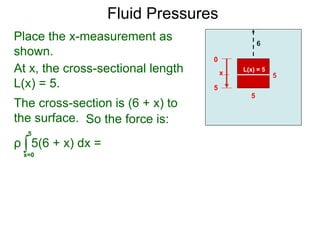
The cross-section is (6 + x) to
the surface.
L(x) = 5
Fluid Pressures
5
Place the x-measurement as
shown.
6
5
x
0
5
At x, the cross-sectional length
L(x) = 5.
The cross-section is (6 + x) to
the surface. So the force is:
L(x) = 5
ρ 5(6 + x) dx =∫x=0
5
Fluid Pressures
5
Place the x-measurement as
shown.
6
5
x
0
5
At x, the cross-sectional length
L(x) = 5.
The cross-section is (6 + x) to
the surface. So the force is:
L(x) = 5
ρ 5(6 + x) dx = ρ(30x + 5x2/2)|∫x=0
5
x=0
5
Fluid Pressures
5
Place the x-measurement as
shown.
6
5
x
0
5
At x, the cross-sectional length
L(x) = 5.
The cross-section is (6 + x) to
the surface. So the force is:
L(x) = 5
ρ 5(6 + x) dx = ρ(30x + 5x2/2)| = 212.5ρ∫x=0
5
x=0
5
Fluid Pressures
5
Place the x-measurement as
shown.
6
5
x
0
5
At x, the cross-sectional length
L(x) = 5.
The cross-section is (6 + x) to
the surface. So the force is:
L(x) = 5
ρ 5(6 + x) dx = ρ(30x + 5x2/2)| = 212.5ρ∫x=0
5
x=0
5
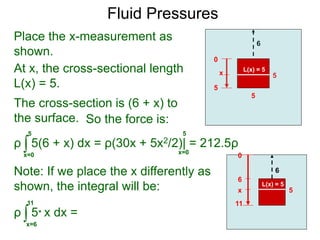
Note: If we place the x differently as
shown,
6
5x
0
11
6
L(x) = 5
Fluid Pressures
5
Place the x-measurement as
shown.
6
5
x
0
5
At x, the cross-sectional length
L(x) = 5.
The cross-section is (6 + x) to
the surface. So the force is:
L(x) = 5
ρ 5(6 + x) dx = ρ(30x + 5x2/2)| = 212.5ρ∫x=0
5
x=0
5
Note: If we place the x differently as
shown, the integral will be:
6
5x
0
11
6
ρ 5* x dx =∫x=6
11
L(x) = 5
Fluid Pressures
5
Place the x-measurement as
shown.
6
5
x
0
5
At x, the cross-sectional length
L(x) = 5.
The cross-section is (6 + x) to
the surface. So the force is:
L(x) = 5
ρ 5(6 + x) dx = ρ(30x + 5x2/2)| = 212.5ρ∫x=0
5
x=0
5
Note: If we place the x differently as
shown, the integral will be:
6
5x
0
11
6
ρ 5* x dx = ρ5x2/2| = 212.5ρ∫x=6
11
x=6
11
L(x) = 5
Fluid Pressures
9
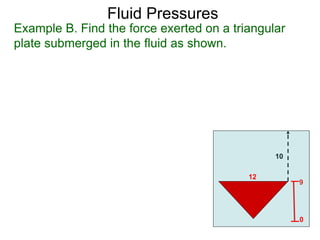
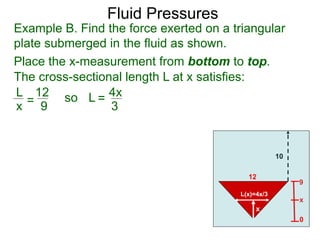
Example B. Find the force exerted on a triangular
plate submerged in the fluid as shown.
10
12
0
Fluid Pressures
9
x
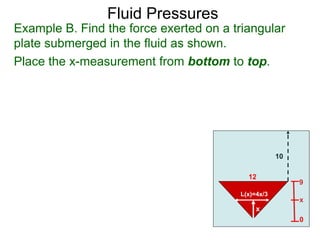
Example B. Find the force exerted on a triangular
plate submerged in the fluid as shown.
Place the x-measurement from bottom to top.
10
12
0
x
L(x)=4x/3
Fluid Pressures
9
x
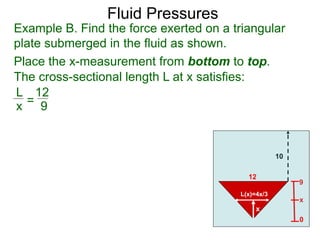
Example B. Find the force exerted on a triangular
plate submerged in the fluid as shown.
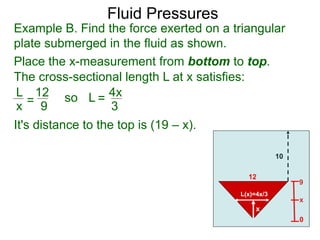
Place the x-measurement from bottom to top.
10
12
0
x
L(x)=4x/3
The cross-sectional length L at x satisfies:
L
x =
12
9
Fluid Pressures
9
x
Example B. Find the force exerted on a triangular
plate submerged in the fluid as shown.
Place the x-measurement from bottom to top.
10
12
0
x
L(x)=4x/3
The cross-sectional length L at x satisfies:
L
x =
12
9
so L = 4x
3
Fluid Pressures
9
x
Example B. Find the force exerted on a triangular
plate submerged in the fluid as shown.
Place the x-measurement from bottom to top.
10
12
0
x
L(x)=4x/3
The cross-sectional length L at x satisfies:
L
x =
12
9
so L = 4x
3
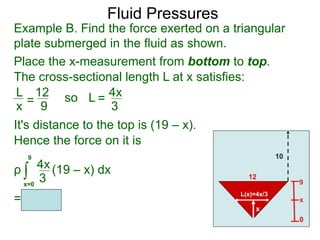
It's distance to the top is (19 – x).
Fluid Pressures
9
x
Example B. Find the force exerted on a triangular
plate submerged in the fluid as shown.
Place the x-measurement from bottom to top.
10
12
0
x
L(x)=4x/3
The cross-sectional length L at x satisfies:
L
x =
12
9
so L = 4x
3
It's distance to the top is (19 – x).
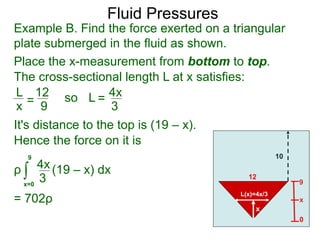
Hence the force on it is
ρ (19 – x) dx
= 702ρ
∫x=0
9
4x
3
Fluid Pressures
9
x
Example B. Find the force exerted on a triangular
plate submerged in the fluid as shown.
Place the x-measurement from bottom to top.
10
12
0
x
L(x)=4x/3
The cross-sectional length L at x satisfies:
L
x =
12
9
so L = 4x
3
It's distance to the top is (19 – x).
Hence the force on it is
ρ (19 – x) dx
= 702ρ
∫x=0
9
4x
3
Fluid Pressures
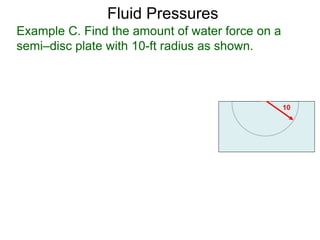
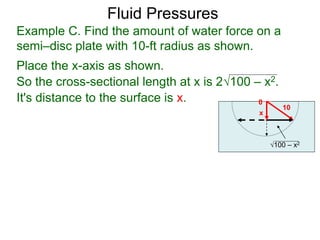
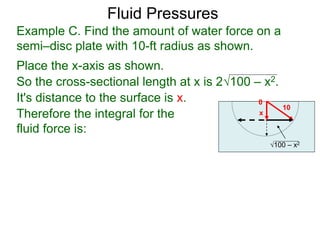
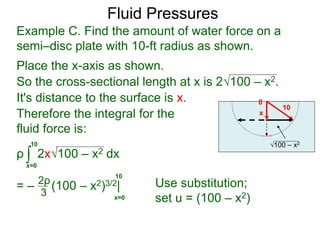
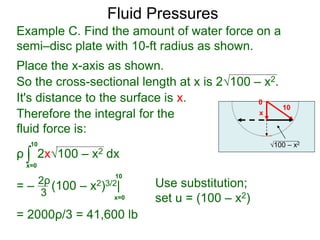
Example C. Find the amount of water force on a
semi–disc plate with 10-ft radius as shown.
10
Fluid Pressures
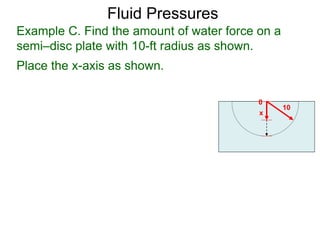
Place the x-axis as shown.
0
x
10
Example C. Find the amount of water force on a
semi–disc plate with 10-ft radius as shown.
Fluid Pressures
Fluid Pressure
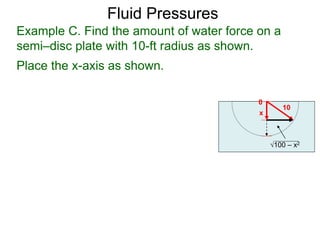
Place the x-axis as shown.
0
x
10
100 – x2
Example C. Find the amount of water force on a
semi–disc plate with 10-ft radius as shown.
Fluid Pressures
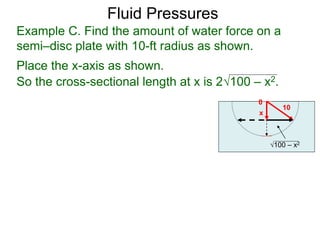
Place the x-axis as shown.
0
x
10
100 – x2
Example C. Find the amount of water force on a
semi–disc plate with 10-ft radius as shown.
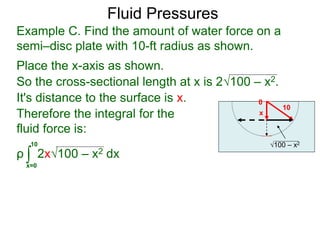
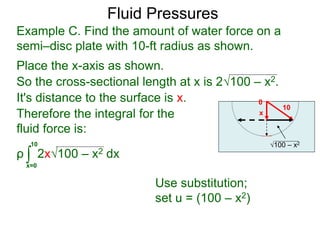
So the cross-sectional length at x is 2100 – x2.
Fluid Pressures
Place the x-axis as shown.
0
x
10
100 – x2
It's distance to the surface is x.
Example C. Find the amount of water force on a
semi–disc plate with 10-ft radius as shown.
So the cross-sectional length at x is 2100 – x2.
Fluid Pressures
Place the x-axis as shown.
0
x
10
100 – x2
It's distance to the surface is x.
Therefore the integral for the
fluid force is:
Example C. Find the amount of water force on a
semi–disc plate with 10-ft radius as shown.
So the cross-sectional length at x is 2100 – x2.
Fluid Pressures
Place the x-axis as shown.
0
x
10
100 – x2
It's distance to the surface is x.
Therefore the integral for the
fluid force is:
ρ 2x100 – x2 dx∫x=0
10
Example C. Find the amount of water force on a
semi–disc plate with 10-ft radius as shown.
So the cross-sectional length at x is 2100 – x2.
Fluid Pressures
Place the x-axis as shown.
0
x
10
100 – x2
It's distance to the surface is x.
Therefore the integral for the
fluid force is:
ρ 2x100 – x2 dx∫x=0
10
Use substitution;
set u = (100 – x2)
Example C. Find the amount of water force on a
semi–disc plate with 10-ft radius as shown.
So the cross-sectional length at x is 2100 – x2.
Fluid Pressures
Place the x-axis as shown.
0
x
10
100 – x2
It's distance to the surface is x.
Therefore the integral for the
fluid force is:
ρ 2x100 – x2 dx
= – (100 – x2)3/2|
∫x=0
10
2ρ
3 x=0
10
Use substitution;
set u = (100 – x2)
Example C. Find the amount of water force on a
semi–disc plate with 10-ft radius as shown.
So the cross-sectional length at x is 2100 – x2.
Fluid Pressures
Place the x-axis as shown.
0
x
10
100 – x2
It's distance to the surface is x.
Therefore the integral for the
fluid force is:
ρ 2x100 – x2 dx
= – (100 – x2)3/2|
= 2000ρ/3 = 41,600 lb
∫x=0
10
2ρ
3 x=0
10
Use substitution;
set u = (100 – x2)
Example C. Find the amount of water force on a
semi–disc plate with 10-ft radius as shown.
So the cross-sectional length at x is 2100 – x2.
Fluid Pressures

10 fluid pressures x

  • 1.
  • 2.
    We are tocalculate the force on a flat plate submerged in a fluid. Fluid Pressures
  • 3.
    We are tocalculate the force on a flat plate submerged in a fluid. Let A = Area of the plate h = the depth ρ = the weight of the fluid A h ρ Fluid Pressures
  • 4.
    Let A =Area of the plate h = the depth ρ = the weight of the fluid The simplest case is when the plate is submerged horizontally in a fluid. A h ρ Fluid Pressures We are to calculate the force on a flat plate submerged in a fluid.
  • 5.
    Let A =Area of the plate h = the depth ρ = the weight of the fluid The simplest case is when the plate is submerged horizontally in a fluid. A h ρ The force F on the plate is the weight of the volume of the fluid that sits over the plate, Fluid Pressures We are to calculate the force on a flat plate submerged in a fluid.
  • 6.
    Let A =Area of the plate h = the depth ρ = the weight of the fluid The simplest case is when the plate is submerged horizontally in a fluid. A h ρ The force F on the plate is the weight of the volume of the fluid that sits over the plate, that is F = ρAh Fluid Pressures We are to calculate the force on a flat plate submerged in a fluid.
  • 7.
    Let A =Area of the plate h = the depth ρ = the weight of the fluid The simplest case is when the plate is submerged horizontally in a fluid. A h ρ The force F on the plate is the weight of the volume of the fluid that sits over the plate, that is F = ρAh We are to calculate the force exerted on plates of various shapes that sit vertically in a fluid. Fluid Pressures We are to calculate the force on a flat plate submerged in a fluid.
  • 8.
    Suppose a plateis submerged in water vertically with the top of the plate is at a distance h to the surface. h Fluid Pressures
  • 9.
    Suppose a plateis submerged in water vertically with the top of the plate is at a distance h to the surface. h We select a direction and set the measurement x, say from the top x = 0 to the bottom x = b of the plate. Fluid Pressures
  • 10.
    Suppose a plateis submerged in water vertically with the top of the plate is at a distance h to the surface. h We select a direction and set the measurement x, say from the top x = 0 to the bottom x = b of the plate. x=0 x=b xi-1 xi Let the sequence {0=x0, x1, x2, .. , xn=b} be an equi- partition of [0, b] and xi–1 and xi be two consecutive points. Fluid Pressures
  • 11.
    Suppose a plateis submerged in water vertically with the top of the plate is at a distance h to the surface. h We select a direction and set the measurement x, say from the top x = 0 to the bottom x = b of the plate. x=0 x=b xi-1 xi Let L(x) = cross-sectional length at x, so L(xi) = cross-sectional length at xi. Let the sequence {0=x0, x1, x2, .. , xn=b} be an equi- partition of [0, b] and xi–1 and xi be two consecutive points. Fluid Pressures L(xi)
  • 12.
    Suppose a plateis submerged in water vertically with the top of the plate is at a distance h to the surface. h We select a direction and set the measurement x, say from the top x = 0 to the bottom x = b of the plate. x=0 x=b xi-1 xi Let L(x) = cross-sectional length at x, so L(xi) = cross-sectional length at xi. Let the sequence {0=x0, x1, x2, .. , xn=b} be an equi- partition of [0, b] and xi–1 and xi be two consecutive points. Let Δx = the length of each subinterval. Fluid Pressures L(xi) Δx
  • 13.
    h x=0 x=b xi-1 xi L(xi) The cross-sectional areafrom xi-1 to xi is approximately L(xi)Δx. Δx Fluid Pressures
  • 14.
    h x=0 x=b xi-1 xi L(xi) The cross-sectional areafrom xi-1 to xi is approximately L(xi)Δx. So the cross-sectional area from xi-1 to xi is approximately L(xi)Δx. Δx h+xi Fluid Pressures
  • 15.
    The cross-sectional areafrom xi-1 to xi is approximately L(xi)Δx. So the cross-sectional area from xi-1 to xi is approximately L(xi)Δx. The depth of this strip of area is approximately (xi+h). Fluid Pressures h x=0 x=b xi-1 xi L(xi) Δx h+xi
  • 16.
    The cross-sectional areafrom xi-1 to xi is approximately L(xi)Δx. So the cross-sectional area from xi-1 to xi is approximately L(xi)Δx. So the fluid force exerted on this strip of area is approximately ρL(xi)(xi+h)Δx. The depth of this strip of area is approximately (xi+h). Fluid Pressures h x=0 x=b xi-1 xi L(xi) Δx h+xi
  • 17.
    The cross-sectional areafrom xi-1 to xi is approximately L(xi)Δx. So the cross-sectional area from xi-1 to xi is approximately L(xi)Δx. So the fluid force exerted on this strip of area is approximately ρL(xi)(xi+h)Δx. The depth of this strip of area is approximately (xi+h). Hence the total fluid force F is: ∑ ρL(xi)(xi+h) ΔxF = limn∞ Fluid Pressures h x=0 x=b xi-1 xi L(xi) Δx h+xi
  • 18.
    The cross-sectional areafrom xi-1 to xi is approximately L(xi)Δx. So the cross-sectional area from xi-1 to xi is approximately L(xi)Δx. So the fluid force exerted on this strip of area is approximately ρL(xi)(xi+h)Δx. The depth of this strip of area is approximately (xi+h). Hence the total fluid force F is: ∑ ρL(xi)(xi+h) ΔxF = lim By FTC, this is the definite integral from 0 to b, n∞ Fluid Pressures h x=0 x=b xi-1 xi L(xi) Δx h+xi
  • 19.
    The cross-sectional areafrom xi-1 to xi is approximately L(xi)Δx. So the cross-sectional area from xi-1 to xi is approximately L(xi)Δx. So the fluid force exerted on this strip of area is approximately ρL(xi)(xi+h)Δx. The depth of this strip of area is approximately (xi+h). Hence the total fluid force F is: ∑ ρL(xi)(xi+h) ΔxF = lim By FTC, this is the definite integral from 0 to b,= ∫x=0 b ρ L(x)(x+h) dx n∞ Fluid Pressures h x=0 x=b xi-1 xi L(xi) Δx h+xi
  • 20.
    Stated in words: ∫x=0 b ρL(x)(x+h) dxF = distance in x length in x Fluid Pressures
  • 21.
    Stated in words: ∫x=0 b ρL(x)(x+h) dxF = distance in x length in x ∫ b ρ (cross-sectional length)(distance to surface) dxF = x=a Fluid Pressures
  • 22.
    Stated in words: ∫x=0 b ρL(x)(x+h) dxF = ∫ b ρ (cross-sectional length)(distance to surface) dxF = distance in x length in x x=a Example A. Find the force exerted on a square plate submerged in the fluid as shown. 5 6 5 Fluid Pressures
  • 23.
    5 Place the x-measurementas shown. 6 5 x 0 5 Fluid Pressures
  • 24.
    5 Place the x-measurementas shown. 6 5 x 0 5 At x, the cross-sectional length L(x) = 5. L(x) = 5 Fluid Pressures
  • 25.
    5 Place the x-measurementas shown. 6 5 x 0 5 At x, the cross-sectional length L(x) = 5. The cross-section is (6 + x) to the surface. L(x) = 5 Fluid Pressures
  • 26.
    5 Place the x-measurementas shown. 6 5 x 0 5 At x, the cross-sectional length L(x) = 5. The cross-section is (6 + x) to the surface. So the force is: L(x) = 5 ρ 5(6 + x) dx =∫x=0 5 Fluid Pressures
  • 27.
    5 Place the x-measurementas shown. 6 5 x 0 5 At x, the cross-sectional length L(x) = 5. The cross-section is (6 + x) to the surface. So the force is: L(x) = 5 ρ 5(6 + x) dx = ρ(30x + 5x2/2)|∫x=0 5 x=0 5 Fluid Pressures
  • 28.
    5 Place the x-measurementas shown. 6 5 x 0 5 At x, the cross-sectional length L(x) = 5. The cross-section is (6 + x) to the surface. So the force is: L(x) = 5 ρ 5(6 + x) dx = ρ(30x + 5x2/2)| = 212.5ρ∫x=0 5 x=0 5 Fluid Pressures
  • 29.
    5 Place the x-measurementas shown. 6 5 x 0 5 At x, the cross-sectional length L(x) = 5. The cross-section is (6 + x) to the surface. So the force is: L(x) = 5 ρ 5(6 + x) dx = ρ(30x + 5x2/2)| = 212.5ρ∫x=0 5 x=0 5 Note: If we place the x differently as shown, 6 5x 0 11 6 L(x) = 5 Fluid Pressures
  • 30.
    5 Place the x-measurementas shown. 6 5 x 0 5 At x, the cross-sectional length L(x) = 5. The cross-section is (6 + x) to the surface. So the force is: L(x) = 5 ρ 5(6 + x) dx = ρ(30x + 5x2/2)| = 212.5ρ∫x=0 5 x=0 5 Note: If we place the x differently as shown, the integral will be: 6 5x 0 11 6 ρ 5* x dx =∫x=6 11 L(x) = 5 Fluid Pressures
  • 31.
    5 Place the x-measurementas shown. 6 5 x 0 5 At x, the cross-sectional length L(x) = 5. The cross-section is (6 + x) to the surface. So the force is: L(x) = 5 ρ 5(6 + x) dx = ρ(30x + 5x2/2)| = 212.5ρ∫x=0 5 x=0 5 Note: If we place the x differently as shown, the integral will be: 6 5x 0 11 6 ρ 5* x dx = ρ5x2/2| = 212.5ρ∫x=6 11 x=6 11 L(x) = 5 Fluid Pressures
  • 32.
    9 Example B. Findthe force exerted on a triangular plate submerged in the fluid as shown. 10 12 0 Fluid Pressures
  • 33.
    9 x Example B. Findthe force exerted on a triangular plate submerged in the fluid as shown. Place the x-measurement from bottom to top. 10 12 0 x L(x)=4x/3 Fluid Pressures
  • 34.
    9 x Example B. Findthe force exerted on a triangular plate submerged in the fluid as shown. Place the x-measurement from bottom to top. 10 12 0 x L(x)=4x/3 The cross-sectional length L at x satisfies: L x = 12 9 Fluid Pressures
  • 35.
    9 x Example B. Findthe force exerted on a triangular plate submerged in the fluid as shown. Place the x-measurement from bottom to top. 10 12 0 x L(x)=4x/3 The cross-sectional length L at x satisfies: L x = 12 9 so L = 4x 3 Fluid Pressures
  • 36.
    9 x Example B. Findthe force exerted on a triangular plate submerged in the fluid as shown. Place the x-measurement from bottom to top. 10 12 0 x L(x)=4x/3 The cross-sectional length L at x satisfies: L x = 12 9 so L = 4x 3 It's distance to the top is (19 – x). Fluid Pressures
  • 37.
    9 x Example B. Findthe force exerted on a triangular plate submerged in the fluid as shown. Place the x-measurement from bottom to top. 10 12 0 x L(x)=4x/3 The cross-sectional length L at x satisfies: L x = 12 9 so L = 4x 3 It's distance to the top is (19 – x). Hence the force on it is ρ (19 – x) dx = 702ρ ∫x=0 9 4x 3 Fluid Pressures
  • 38.
    9 x Example B. Findthe force exerted on a triangular plate submerged in the fluid as shown. Place the x-measurement from bottom to top. 10 12 0 x L(x)=4x/3 The cross-sectional length L at x satisfies: L x = 12 9 so L = 4x 3 It's distance to the top is (19 – x). Hence the force on it is ρ (19 – x) dx = 702ρ ∫x=0 9 4x 3 Fluid Pressures
  • 39.
    Example C. Findthe amount of water force on a semi–disc plate with 10-ft radius as shown. 10 Fluid Pressures
  • 40.
    Place the x-axisas shown. 0 x 10 Example C. Find the amount of water force on a semi–disc plate with 10-ft radius as shown. Fluid Pressures
  • 41.
    Fluid Pressure Place thex-axis as shown. 0 x 10 100 – x2 Example C. Find the amount of water force on a semi–disc plate with 10-ft radius as shown. Fluid Pressures
  • 42.
    Place the x-axisas shown. 0 x 10 100 – x2 Example C. Find the amount of water force on a semi–disc plate with 10-ft radius as shown. So the cross-sectional length at x is 2100 – x2. Fluid Pressures
  • 43.
    Place the x-axisas shown. 0 x 10 100 – x2 It's distance to the surface is x. Example C. Find the amount of water force on a semi–disc plate with 10-ft radius as shown. So the cross-sectional length at x is 2100 – x2. Fluid Pressures
  • 44.
    Place the x-axisas shown. 0 x 10 100 – x2 It's distance to the surface is x. Therefore the integral for the fluid force is: Example C. Find the amount of water force on a semi–disc plate with 10-ft radius as shown. So the cross-sectional length at x is 2100 – x2. Fluid Pressures
  • 45.
    Place the x-axisas shown. 0 x 10 100 – x2 It's distance to the surface is x. Therefore the integral for the fluid force is: ρ 2x100 – x2 dx∫x=0 10 Example C. Find the amount of water force on a semi–disc plate with 10-ft radius as shown. So the cross-sectional length at x is 2100 – x2. Fluid Pressures
  • 46.
    Place the x-axisas shown. 0 x 10 100 – x2 It's distance to the surface is x. Therefore the integral for the fluid force is: ρ 2x100 – x2 dx∫x=0 10 Use substitution; set u = (100 – x2) Example C. Find the amount of water force on a semi–disc plate with 10-ft radius as shown. So the cross-sectional length at x is 2100 – x2. Fluid Pressures
  • 47.
    Place the x-axisas shown. 0 x 10 100 – x2 It's distance to the surface is x. Therefore the integral for the fluid force is: ρ 2x100 – x2 dx = – (100 – x2)3/2| ∫x=0 10 2ρ 3 x=0 10 Use substitution; set u = (100 – x2) Example C. Find the amount of water force on a semi–disc plate with 10-ft radius as shown. So the cross-sectional length at x is 2100 – x2. Fluid Pressures
  • 48.
    Place the x-axisas shown. 0 x 10 100 – x2 It's distance to the surface is x. Therefore the integral for the fluid force is: ρ 2x100 – x2 dx = – (100 – x2)3/2| = 2000ρ/3 = 41,600 lb ∫x=0 10 2ρ 3 x=0 10 Use substitution; set u = (100 – x2) Example C. Find the amount of water force on a semi–disc plate with 10-ft radius as shown. So the cross-sectional length at x is 2100 – x2. Fluid Pressures