y = f(x)
y = f–1 (x)
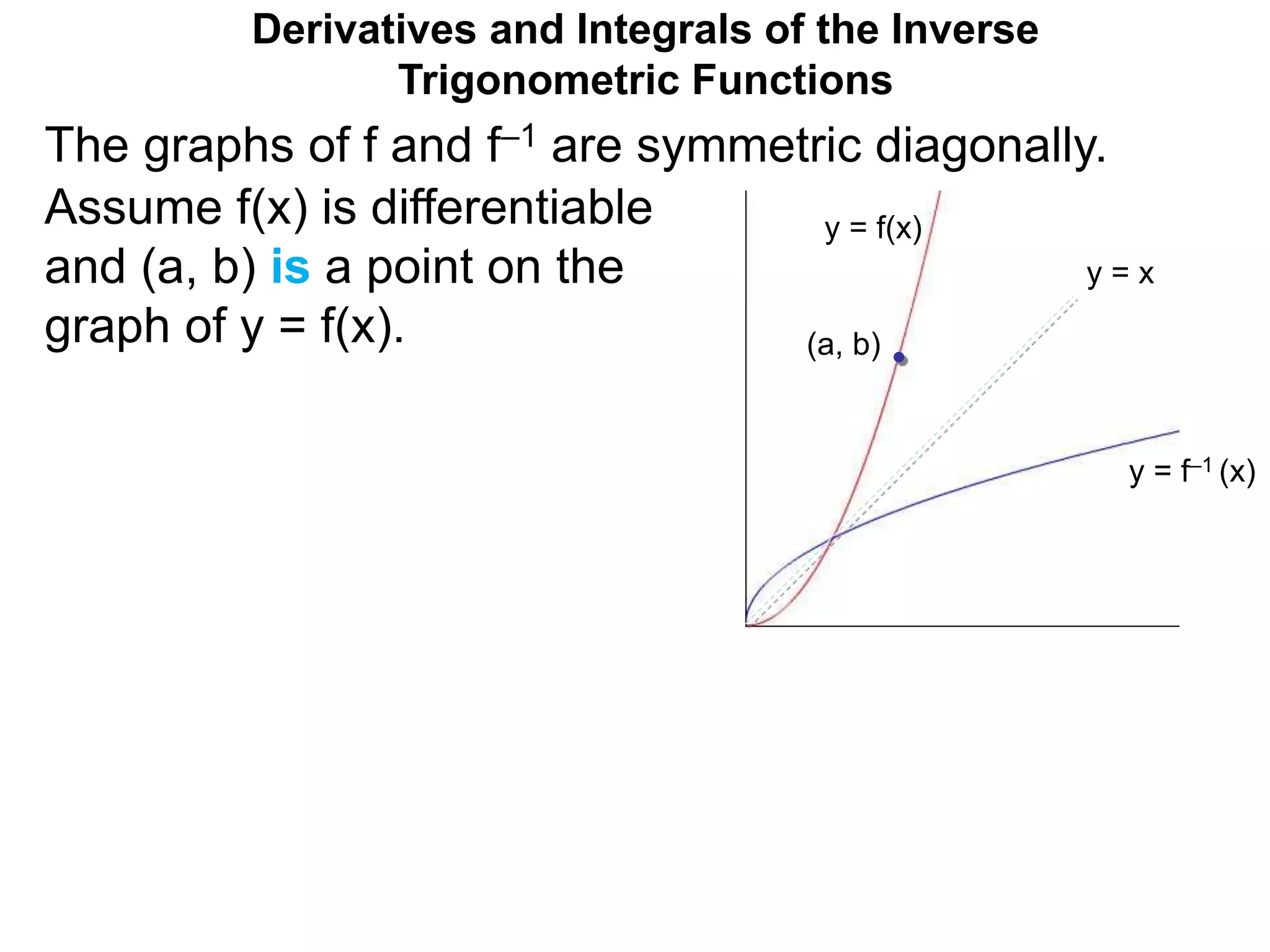
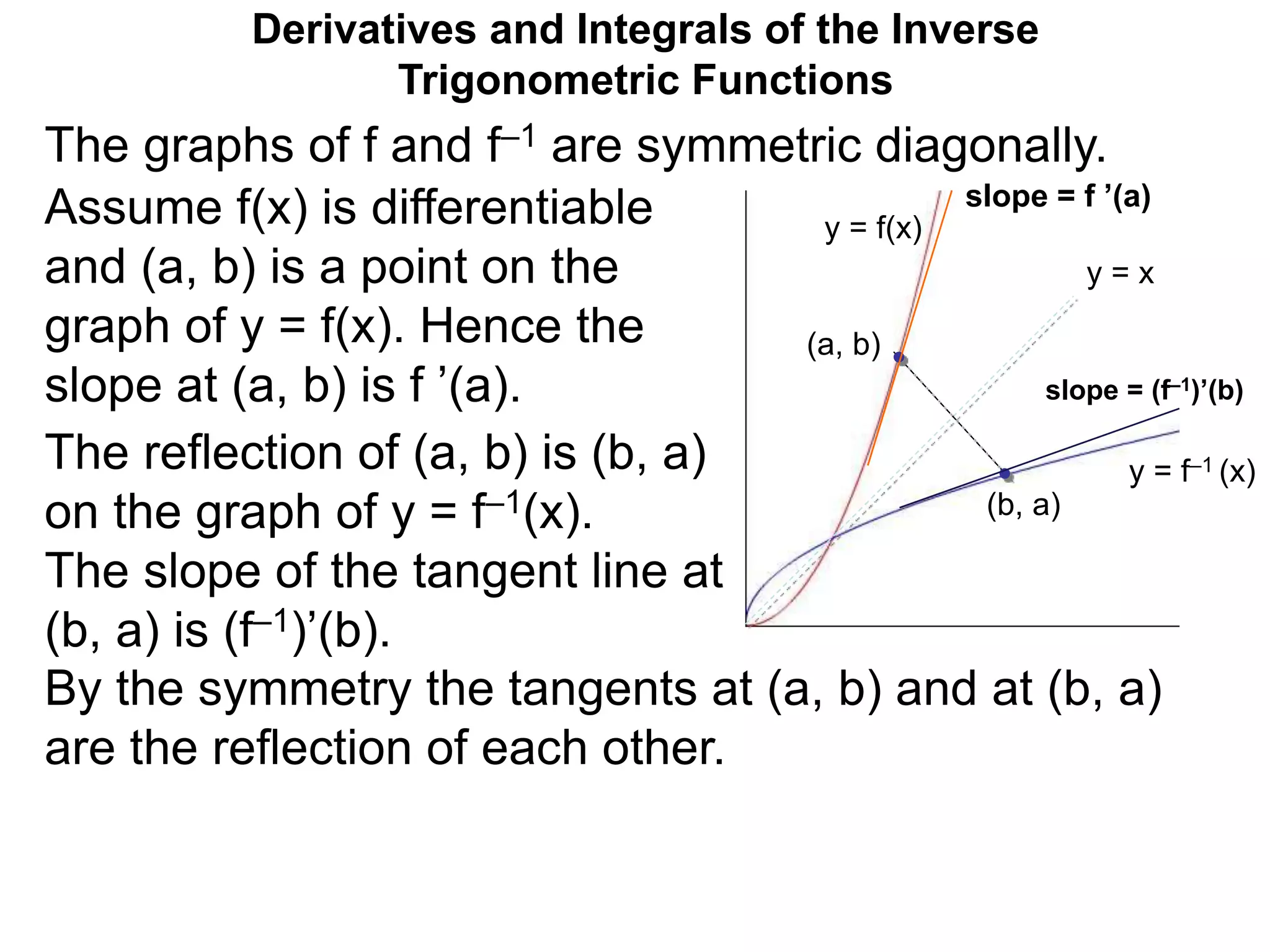
The graphs of f and f–1 are symmetric diagonally.
y = x
Derivatives and Integrals of the Inverse
Trigonometric Functions
y = f(x)
y = f–1 (x)
The graphs of f and f–1 are symmetric diagonally.
y = x
Derivatives and Integrals of the Inverse
Trigonometric Functions
(a, b)
Assume f(x) is differentiable
and (a, b) is a point on the
graph of y = f(x).
y = f(x)
y = f–1 (x)
The graphs of f and f–1 are symmetric diagonally.
y = x
Derivatives and Integrals of the Inverse
Trigonometric Functions
(a, b)
Assume f(x) is differentiable
and (a, b) is a point on the
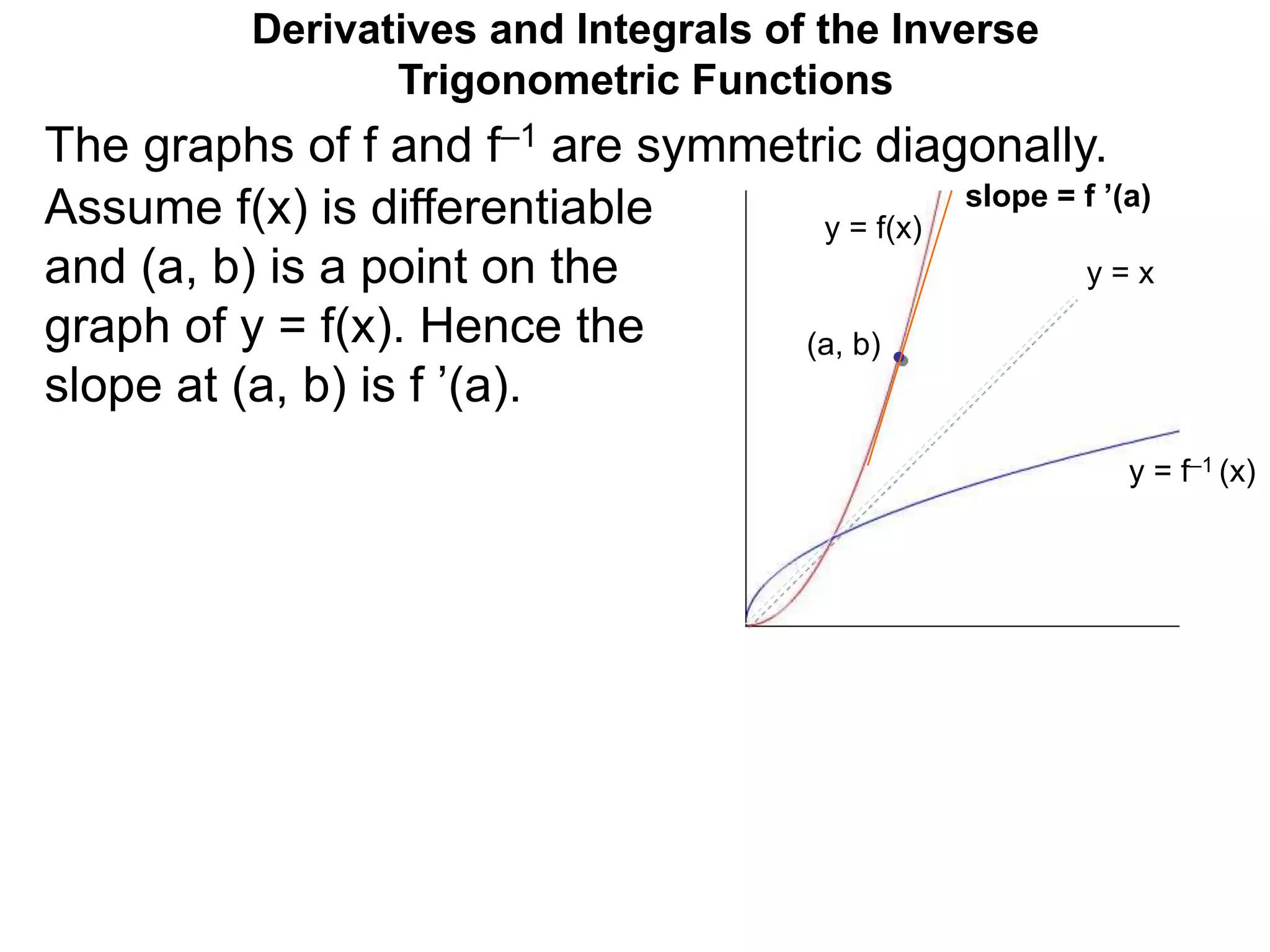
graph of y = f(x). Hence the
slope at (a, b) is f ’(a).
slope = f ’(a)
y = f(x)
y = f–1 (x)
The graphs of f and f–1 are symmetric diagonally.
y = x
Derivatives and Integrals of the Inverse
Trigonometric Functions
(a, b)
Assume f(x) is differentiable
and (a, b) is a point on the
graph of y = f(x). Hence the
slope at (a, b) is f ’(a).
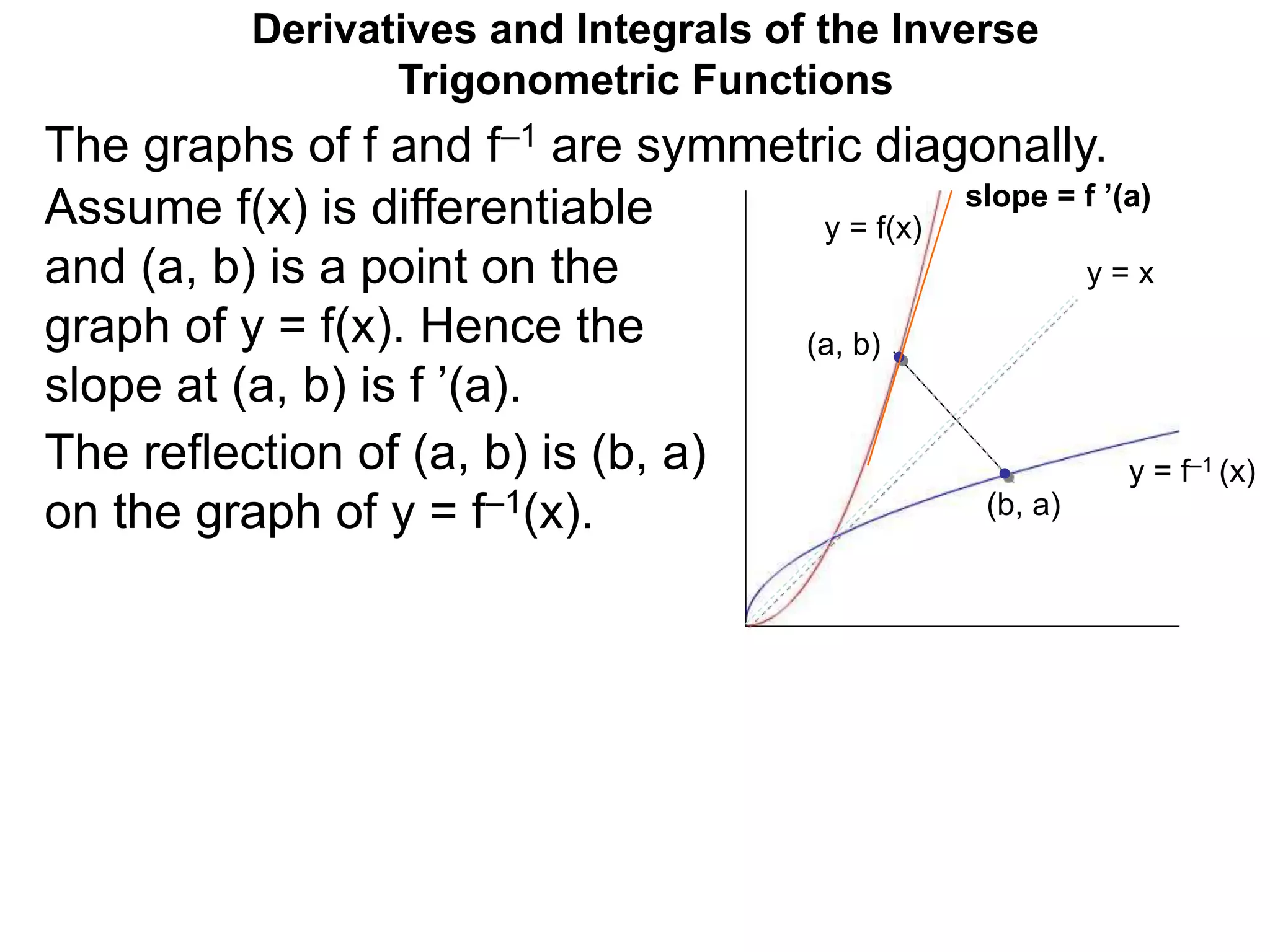
(b, a)
slope = f ’(a)
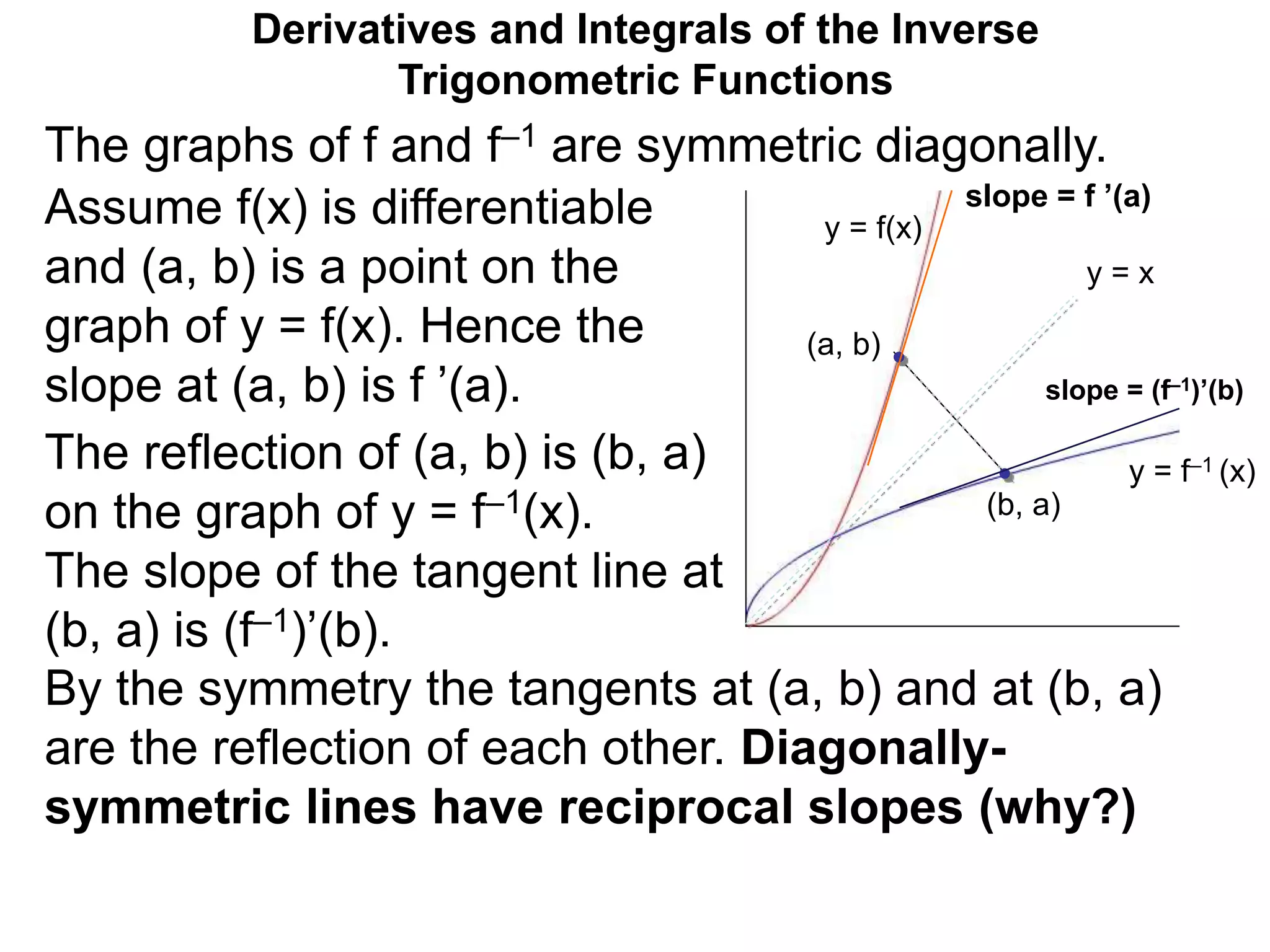
The reflection of (a, b) is (b, a)
on the graph of y = f–1(x).
y = f(x)
y = f–1 (x)
The graphs of f and f–1 are symmetric diagonally.
y = x
Derivatives and Integrals of the Inverse
Trigonometric Functions
(a, b)
Assume f(x) is differentiable
and (a, b) is a point on the
graph of y = f(x). Hence the
slope at (a, b) is f ’(a).
(b, a)
slope = f ’(a)
The reflection of (a, b) is (b, a)
on the graph of y = f–1(x).
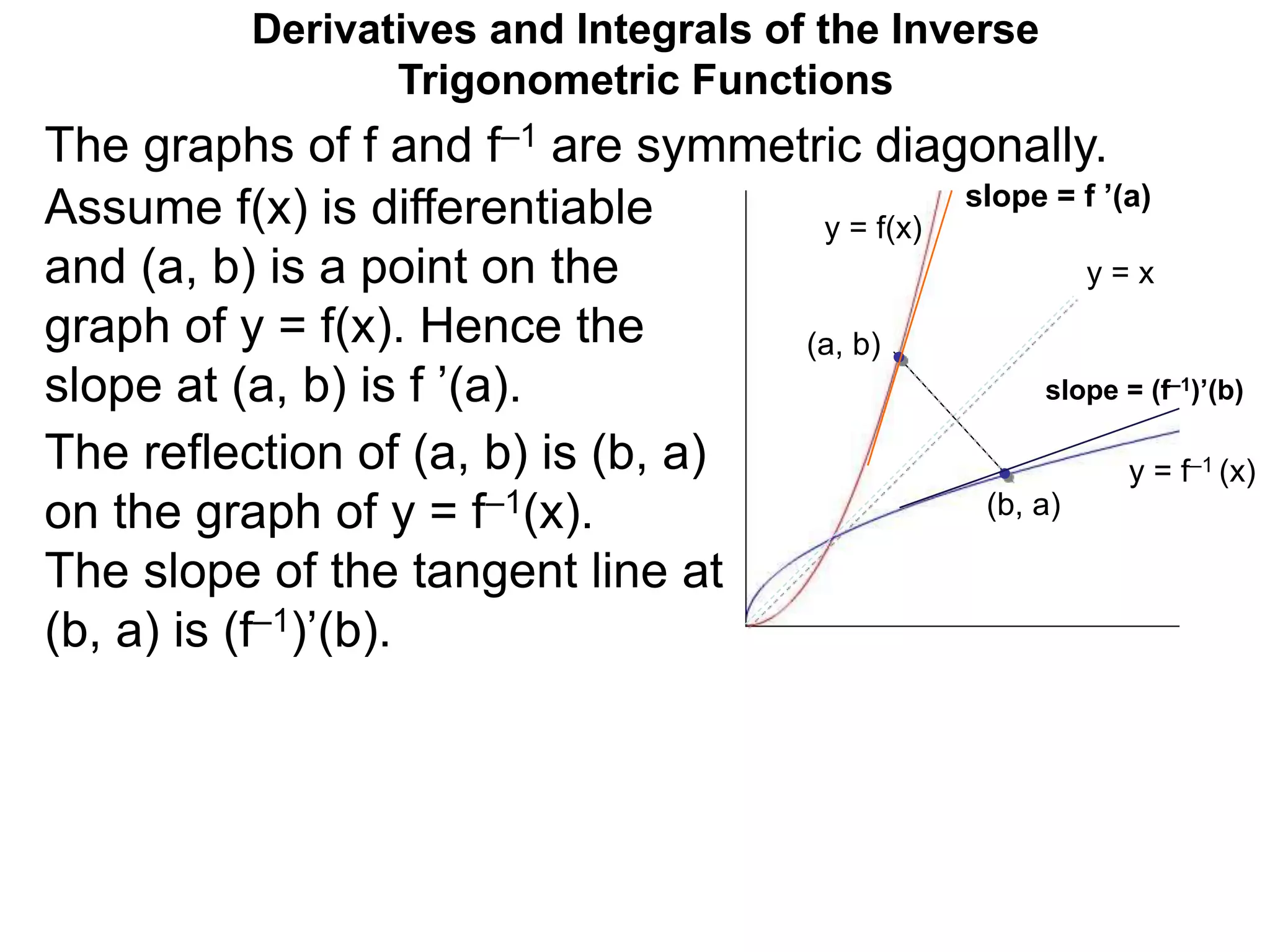
The slope of the tangent line at
(b, a) is (f–1)’(b).
slope = (f–1)’(b)
The graphs of f and f–1 are symmetric diagonally.
Derivatives and Integrals of the Inverse
Trigonometric Functions
Assume f(x) is differentiable
and (a, b) is a point on the
graph of y = f(x). Hence the
slope at (a, b) is f ’(a).
The reflection of (a, b) is (b, a)
on the graph of y = f–1(x).
The slope of the tangent line at
(b, a) is (f–1)’(b).
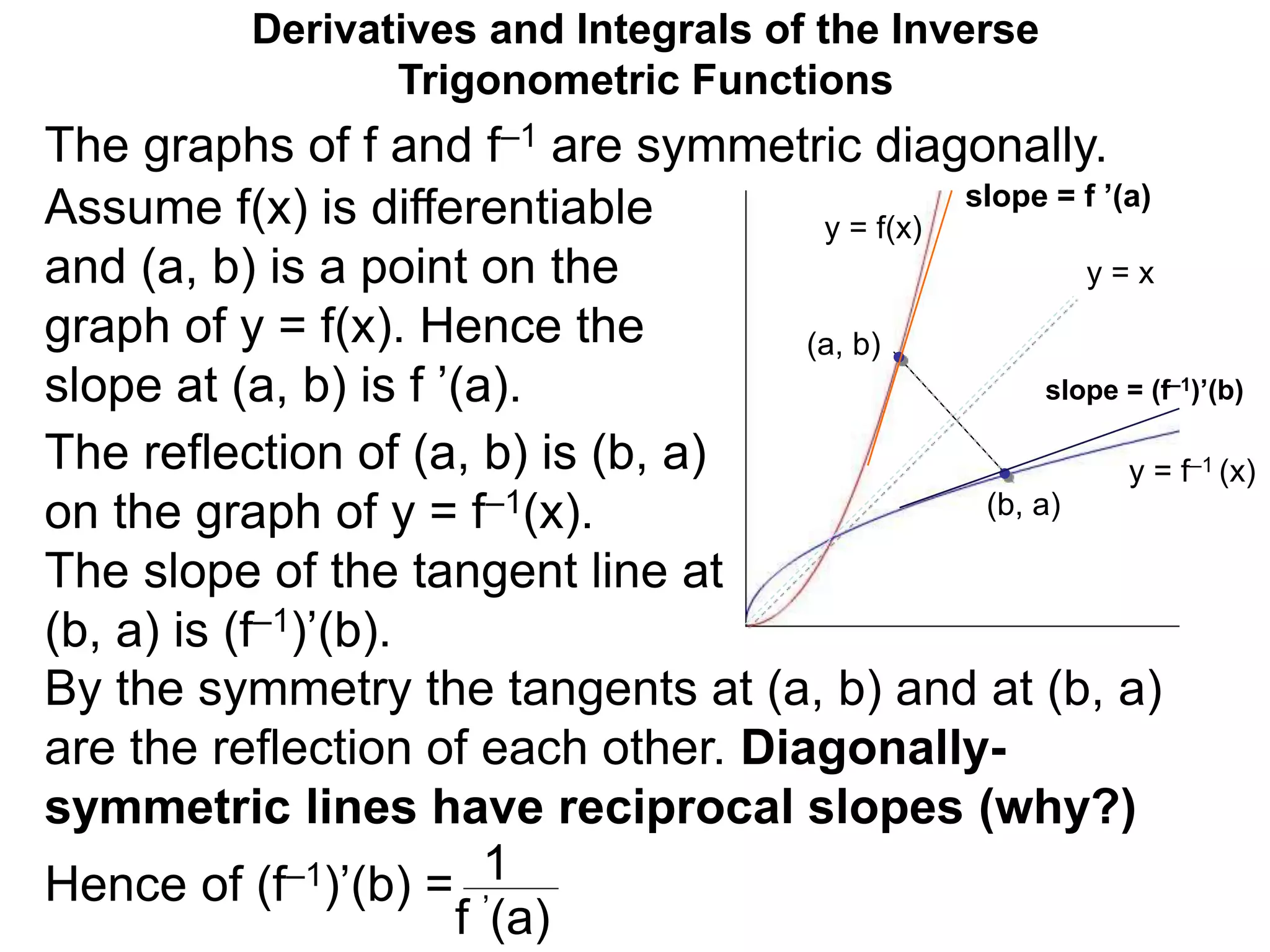
By the symmetry the tangents at (a, b) and at (b, a)
are the reflection of each other.
y = f(x)
y = f–1 (x)
y = x
(a, b)
(b, a)
slope = f ’(a)
slope = (f–1)’(b)
The graphs of f and f–1 are symmetric diagonally.
Derivatives and Integrals of the Inverse
Trigonometric Functions
Assume f(x) is differentiable
and (a, b) is a point on the
graph of y = f(x). Hence the
slope at (a, b) is f ’(a).
The reflection of (a, b) is (b, a)
on the graph of y = f–1(x).
The slope of the tangent line at
(b, a) is (f–1)’(b).
By the symmetry the tangents at (a, b) and at (b, a)
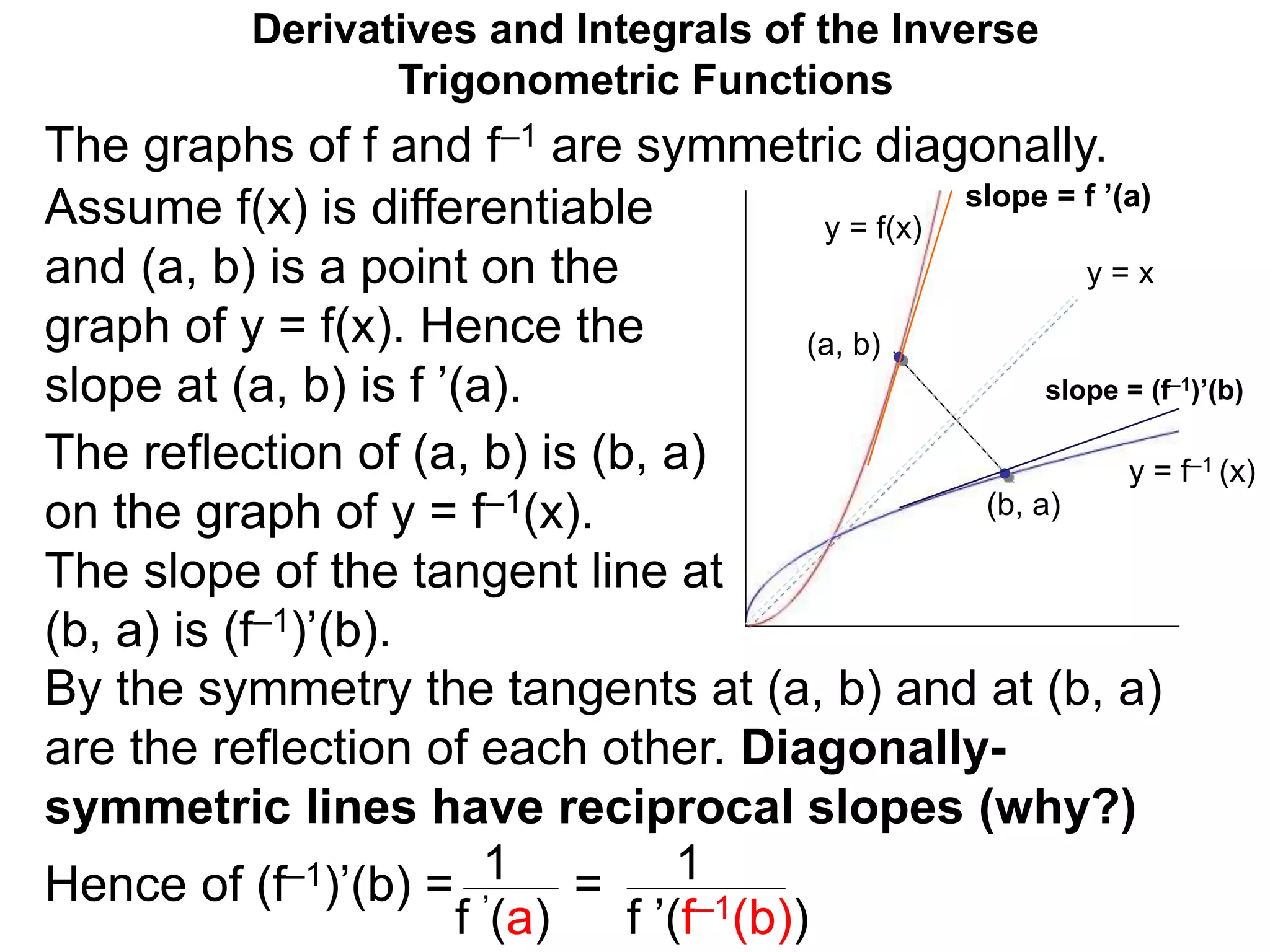
are the reflection of each other. Diagonally-
symmetric lines have reciprocal slopes (why?)
y = f(x)
y = f–1 (x)
y = x
(a, b)
(b, a)
slope = f ’(a)
slope = (f–1)’(b)
The graphs of f and f–1 are symmetric diagonally.
Derivatives and Integrals of the Inverse
Trigonometric Functions
Assume f(x) is differentiable
and (a, b) is a point on the
graph of y = f(x). Hence the
slope at (a, b) is f ’(a).
The reflection of (a, b) is (b, a)
on the graph of y = f–1(x).
The slope of the tangent line at
(b, a) is (f–1)’(b).
By the symmetry the tangents at (a, b) and at (b, a)
are the reflection of each other. Diagonally-
symmetric lines have reciprocal slopes (why?)
y = f(x)
y = f–1 (x)
y = x
(a, b)
(b, a)
slope = f ’(a)
slope = (f–1)’(b)
Hence of (f–1)’(b) = 1
f ’(a)
The graphs of f and f–1 are symmetric diagonally.
Derivatives and Integrals of the Inverse
Trigonometric Functions
Assume f(x) is differentiable
and (a, b) is a point on the
graph of y = f(x). Hence the
slope at (a, b) is f ’(a).
The reflection of (a, b) is (b, a)
on the graph of y = f–1(x).
The slope of the tangent line at
(b, a) is (f–1)’(b).
By the symmetry the tangents at (a, b) and at (b, a)
are the reflection of each other. Diagonally-
symmetric lines have reciprocal slopes (why?)
y = f(x)
y = f–1 (x)
y = x
(a, b)
(b, a)
slope = f ’(a)
slope = (f–1)’(b)
Hence of (f–1)’(b) = 1 = 1
f ’(f–1(b))f ’(a)
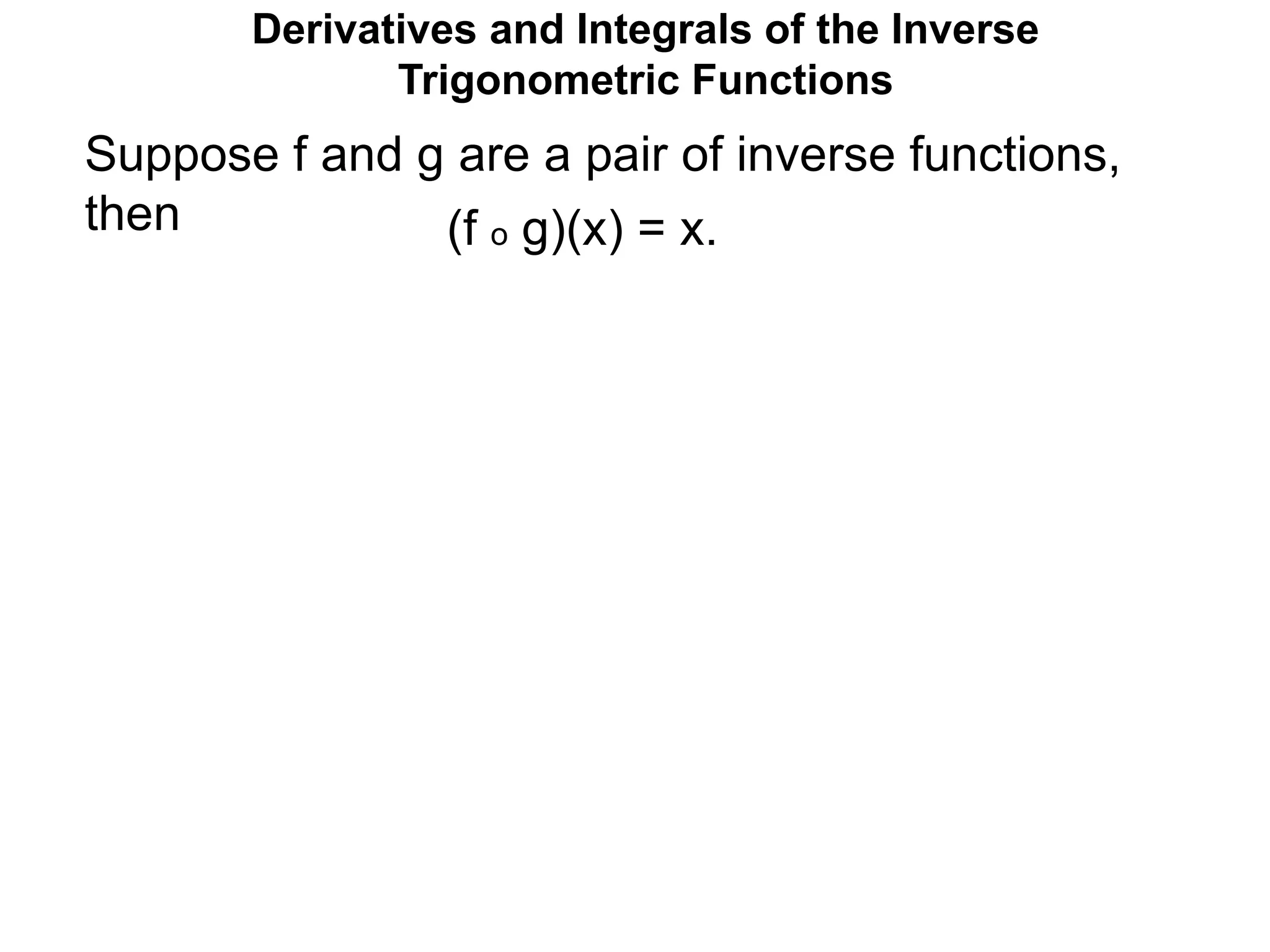
Suppose f and g are a pair of inverse functions,
then (f o g)(x) = x.
Derivatives and Integrals of the Inverse
Trigonometric Functions
Suppose f and g are a pair of inverse functions,
then (f o g)(x) = x.
Differentiate both sides with respect to x and use
the chain rule:
[(f o g)(x)]' = x'
Derivatives and Integrals of the Inverse
Trigonometric Functions
Suppose f and g are a pair of inverse functions,
then (f o g)(x) = x.
Differentiate both sides with respect to x and use
the chain rule:
[(f o g)(x)]' = x'
f '(g(x)) * g'(x) = 1
Derivatives and Integrals of the Inverse
Trigonometric Functions
Suppose f and g are a pair of inverse functions,
then (f o g)(x) = x.
Differentiate both sides with respect to x and use
the chain rule:
[(f o g)(x)]' = x'
f '(g(x)) * g'(x) = 1
or
g'(x) = 1
f '(g(x))
Derivatives and Integrals of the Inverse
Trigonometric Functions
Suppose f and g are a pair of inverse functions,
then (f o g)(x) = x.
Differentiate both sides with respect to x and use
the chain rule:
[(f o g)(x)]' = x'
f '(g(x)) * g'(x) = 1
or
g'(x) = 1
f '(g(x))
Set f = sin(x) and g = arcsin(x)
Derivatives and Integrals of the Inverse
Trigonometric Functions
Suppose f and g are a pair of inverse functions,
then (f o g)(x) = x.
Differentiate both sides with respect to x and use
the chain rule:
[(f o g)(x)]' = x'
f '(g(x)) * g'(x) = 1
or
g'(x) = 1
f '(g(x))
Set f = sin(x) and g = arcsin(x) we obtain
[arcsin(x)]' = 1
dsin(y)
Derivatives and Integrals of the Inverse
Trigonometric Functions
dy y=arcsin(x)
Suppose f and g are a pair of inverse functions,
then (f o g)(x) = x.
Differentiate both sides with respect to x and use
the chain rule:
[(f o g)(x)]' = x'
f '(g(x)) * g'(x) = 1
or
g'(x) = 1
f '(g(x))
Set f = sin(x) and g = arcsin(x) we obtain
[arcsin(x)]' = 1
dsin(y)
1
cos(arcsin(x))
=
Derivatives and Integrals of the Inverse
Trigonometric Functions
dy y=arcsin(x)
[arcsin(x)]'
1
cos(arcsin(x))
=
Derivatives and Integrals of the Inverse
Trigonometric Functions
θ=arcsin(x)
x
1
[arcsin(x)]'
1
cos(arcsin(x))
=
Derivatives and Integrals of the Inverse
Trigonometric Functions
θ=arcsin(x)
x
1
1 – x2
[arcsin(x)]'
1
cos(arcsin(x))
=
Derivatives and Integrals of the Inverse
Trigonometric Functions
θ=arcsin(x)
x
1
1 – x2
[arcsin(x)]'
1
cos(arcsin(x))
=
1
1 – x2
[arcsin(x)]' =
Derivatives and Integrals of the Inverse
Trigonometric Functions
θ=arcsin(x)
x
1
1 – x2
[arcsin(x)]'
1
cos(arcsin(x))
=
1
1 – x2
[arcsin(x)]' =
Derivatives and Integrals of the Inverse
Trigonometric Functions
–1 1
–π/2
π/2
x
y=arcsin(x)
θ=arcsin(x)
x
1
1 – x2
[arcsin(x)]'
1
cos(arcsin(x))
=
1
1 – x2
[arcsin(x)]' =
We use the same technique to obtain the
derivatives of the other inverse trig-functions.
Derivatives and Integrals of the Inverse
Trigonometric Functions
–1 1
–π/2
π/2
x
y=arcsin(x)
θ=arcsin(x)
x
1
1 – x2
[arcsin(x)]'
1
cos(arcsin(x))
=
1
1 – x2
[arcsin(x)]' =
We use the same technique to obtain the
derivatives of the other inverse trig-functions.
Derivatives and Integrals of the Inverse
Trigonometric Functions
–1 1
–π/2
π/2
x
y=arcsin(x)
We display the graphs of each inverse–trig and
list each of their derivatives below.
Derivatives of the Inverse Trig–Functions
1
1 – x2
[sin–1(x)] ' =
y =sin–1(x)
Derivatives of the Inverse Trig–Functions
[cos–1(x)]' =
1
1 – x2
[sin–1(x)] ' =
–1
1 – x2
y =sin–1(x)
y =cos–1(x)
Derivatives of the Inverse Trig–Functions
[cos–1(x)]' =
1
1 + x2
[tan–1(x)]' =
1
1 – x2
[sin–1(x)] ' =
–1
1 – x2
y =tan–1(x)
y =sin–1(x)
y =cos–1(x)
Derivatives of the Inverse Trig–Functions
[cos–1(x)]' =
1
1 + x2
[tan–1(x)]' =
–1
1 + x2[cot–1(x)]' =
1
1 – x2
[sin–1(x)] ' =
–1
1 – x2
y =tan–1(x)
y =sin–1(x)
y =cos–1(x)
y =cot–1(x)
Derivatives of the Inverse Trig–Functions
[cos–1(x)]' =
1
1 + x2
[tan–1(x)]' =
|x|x2 – 1
[sec–1(x)]' =
–1
1 + x2[cot–1(x)]' =
y =sec–1(x)
1
1 – x2
[sin–1(x)] ' =
–1
1 – x2
1
y =tan–1(x)
y =sin–1(x)
y =cos–1(x)
y =cot–1(x)
Derivatives of the Inverse Trig–Functions
[cos–1(x)]' =
1
1 + x2
[tan–1(x)]' =
|x|x2 – 1
[sec–1(x)]' =
–1
1 + x2[cot–1(x)]' =
–1
|x|x2 – 1
[csc–1(x)]' =
y =sec–1(x) y =csc–1(x)
1
1 – x2
[sin–1(x)] ' =
–1
1 – x2
1
y =tan–1(x)
y =sin–1(x)
y =cos–1(x)
y =cot–1(x)
Derivatives of the Inverse Trig–Functions
u'
1 – u2[sin–1(u)]' = –u'
1 – u2
[cos–1 (u)]' =
u'
1 + u2[tan–1(u)]' =
u'
|u|u2 – 1
[sec–1(u)]' =
–u'
1 + u2[cot–1(u)]' =
–u'
|u|u2 – 1
[csc–1(u)]' =
dsin-1(u)
dx
= 1
1 – u2
du
dx
–1
1 – u2
du
dx
1
1 + u2
du
dx
1
|u|u2 – 1
du
dx
dcos-1(u)
dx
=
dtan-1(u)
dx
=
dsec-1(u)
dx
=
–1
1 + u2
du
dx
dtan-1(u)
dx
=
–1
|u|u2 – 1
du
dx
dcsc-1(u)
dx
=
Below are the chain–rule versions where u = u(x).
Derivatives and Integrals of the Inverse
Trigonometric Functions
–u'
1 – u2
[cos–1 (u)]' = u'
1 + u2[tan–1(u)]' =
u'
|u|u2 – 1
[sec–1(u)]' =
We’ll use the following formulas for the next example.
Derivatives and Integrals of the Inverse
Trigonometric Functions
b. cos–1(ex )
Example A. Find the following derivatives.
a. tan–1(x3)
–u'
1 – u2
[cos–1 (u)]' = u'
1 + u2[tan–1(u)]' =
u'
|u|u2 – 1
[sec–1(u)]' =
We’ll use the following formulas for the next example.
2
c. sec–1(ln(x))
Derivatives and Integrals of the Inverse
Trigonometric Functions
b. cos–1(ex )
2
Example A. Find the following derivatives.
Set u = x3,
a. tan–1(x3)
–u'
1 – u2
[cos–1 (u)]' = u'
1 + u2[tan–1(u)]' =
u'
|u|u2 – 1
[sec–1(u)]' =
We’ll use the following formulas for the next example.
c. sec–1(ln(x))
Derivatives and Integrals of the Inverse
Trigonometric Functions
b. cos–1(ex )
2
Example A. Find the following derivatives.
Set u = x3, so [tan–1(x3)]' = (x3)'
1 + (x3)2
a. tan–1(x3)
–u'
1 – u2
[cos–1 (u)]' = u'
1 + u2[tan–1(u)]' =
u'
|u|u2 – 1
[sec–1(u)]' =
We’ll use the following formulas for the next example.
c. sec–1(ln(x))
Derivatives and Integrals of the Inverse
Trigonometric Functions
b. cos–1(ex )
2
Example A. Find the following derivatives.
Set u = x3, so [tan–1(x3)]' = (x3)'
1 + (x3)2 = 3x2
1 + x6
a. tan–1(x3)
–u'
1 – u2
[cos–1 (u)]' = u'
1 + u2[tan–1(u)]' =
u'
|u|u2 – 1
[sec–1(u)]' =
We’ll use the following formulas for the next example.
c. sec–1(ln(x))
Derivatives and Integrals of the Inverse
Trigonometric Functions
b. cos–1(ex )
Set u = ex,
2
Example A. Find the following derivatives.
Set u = x3, so [tan–1(x3)]' = (x3)'
1 + (x3)2 = 3x2
1 + x6
a. tan–1(x3)
–u'
1 – u2
[cos–1 (u)]' = u'
1 + u2[tan–1(u)]' =
u'
|u|u2 – 1
[sec–1(u)]' =
We’ll use the following formulas for the next example.
c. sec–1(ln(x))
Derivatives and Integrals of the Inverse
Trigonometric Functions
b. cos–1(ex )
Set u = ex, so [cos-1(ex )]' =
2
2
1 – (ex )2
–(ex )'
2
2
Example A. Find the following derivatives.
Set u = x3, so [tan–1(x3)]' = (x3)'
1 + (x3)2 = 3x2
1 + x6
a. tan–1(x3)
–u'
1 – u2
[cos–1 (u)]' = u'
1 + u2[tan–1(u)]' =
u'
|u|u2 – 1
[sec–1(u)]' =
We’ll use the following formulas for the next example.
c. sec–1(ln(x))
Derivatives and Integrals of the Inverse
Trigonometric Functions
b. cos–1(ex )
Set u = ex, so [cos-1(ex )]' =
2
2
1 – (ex )2
–(ex )'
2
2
=
–2xex
1 – e2x2
2
Example A. Find the following derivatives.
Set u = x3, so [tan–1(x3)]' = (x3)'
1 + (x3)2 = 3x2
1 + x6
a. tan–1(x3)
–u'
1 – u2
[cos–1 (u)]' = u'
1 + u2[tan–1(u)]' =
u'
|u|u2 – 1
[sec–1(u)]' =
We’ll use the following formulas for the next example.
c. sec–1(ln(x))
Derivatives and Integrals of the Inverse
Trigonometric Functions
b. cos–1(ex )
Set u = ex, so [cos-1(ex )]' =
2
2
1 – (ex )2
–(ex )'
2
2
=
–2xex
1 – e2x2
2
Set u = ln(x), so [sec–1(ln(x)]'
=
Example A. Find the following derivatives.
Set u = x3, so [tan–1(x3)]' = (x3)'
1 + (x3)2 = 3x2
1 + x6
a. tan–1(x3)
–u'
1 – u2
[cos–1 (u)]' = u'
1 + u2[tan–1(u)]' =
u'
|u|u2 – 1
[sec–1(u)]' =
We’ll use the following formulas for the next example.
c. sec–1(ln(x))
Derivatives and Integrals of the Inverse
Trigonometric Functions
b. cos–1(ex )
Set u = ex, so [cos-1(ex )]' =
2
2
1 – (ex )2
–(ex )'
2
2
=
–2xex
1 – e2x2
2
c. sec–1(ln(x))
Set u = ln(x), so [sec–1(ln(x)]'
=
1/x
|ln(x)|ln2(x) – 1
Example A. Find the following derivatives.
Set u = x3, so [tan–1(x3)]' = (x3)'
1 + (x3)2 = 3x2
1 + x6
a. tan–1(x3)
–u'
1 – u2
[cos–1 (u)]' = u'
1 + u2[tan–1(u)]' =
u'
|u|u2 – 1
[sec–1(u)]' =
We’ll use the following formulas for the next example.
Derivatives and Integrals of the Inverse
Trigonometric Functions
b. cos–1(ex )
Set u = ex, so [cos-1(ex )]' =
2
2
1 – (ex )2
–(ex )'
2
2
=
–2xex
1 – e2x2
2
Set u = ln(x), so [sec–1(ln(x)]'
=
1/x
|ln(x)|ln2(x) – 1
= 1
x|ln(x)||ln2(x) – 1
Example A. Find the following derivatives.
Set u = x3, so [tan–1(x3)]' = (x3)'
1 + (x3)2 = 3x2
1 + x6
a. tan–1(x3)
–u'
1 – u2
[cos–1 (u)]' = u'
1 + u2[tan–1(u)]' =
u'
|u|u2 – 1
[sec–1(u)]' =
We’ll use the following formulas for the next example.
c. sec–1(ln(x))
Derivatives and Integrals of the Inverse
Trigonometric Functions
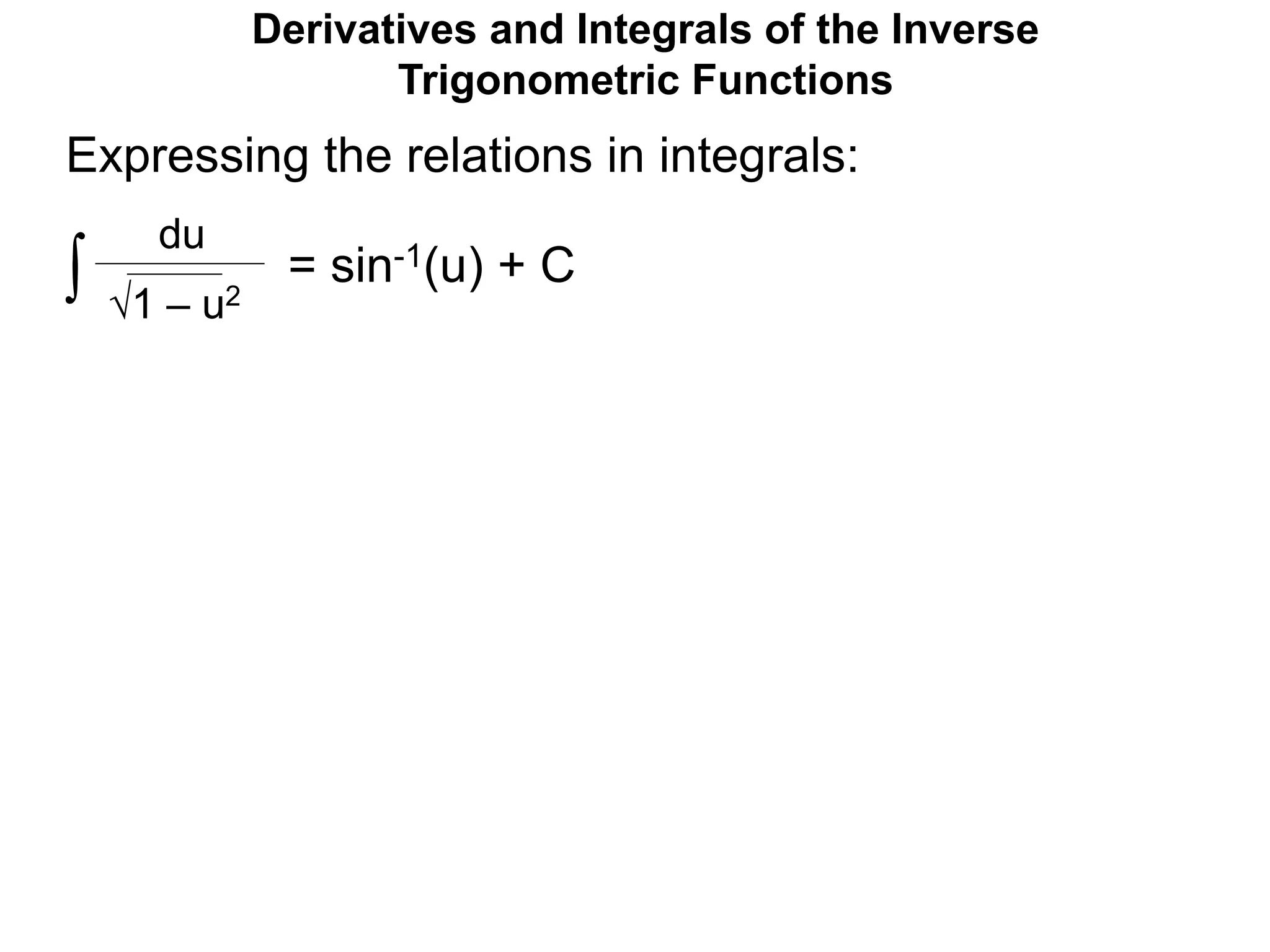
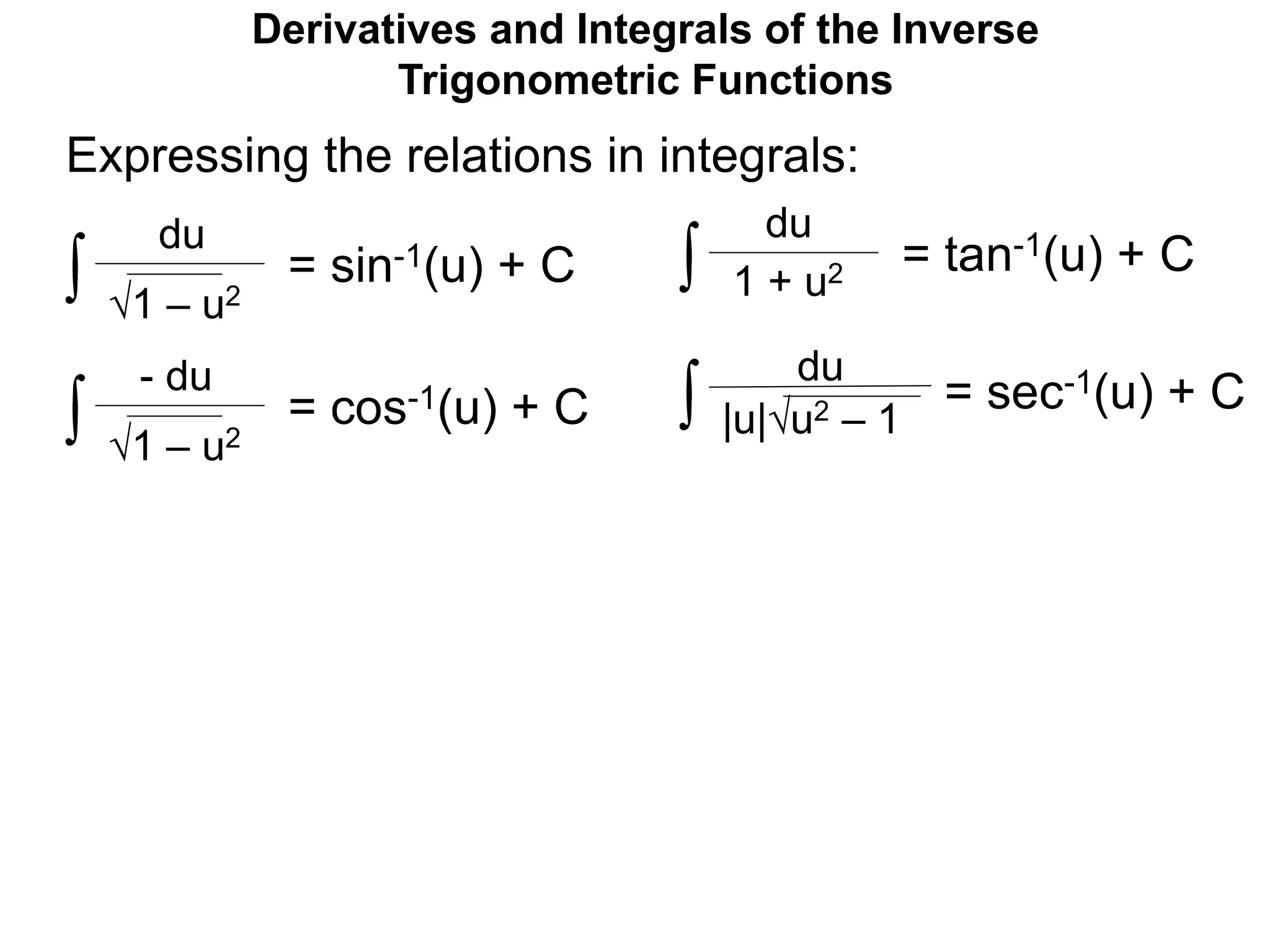
= sin-1(u) + C
1 – u2
du
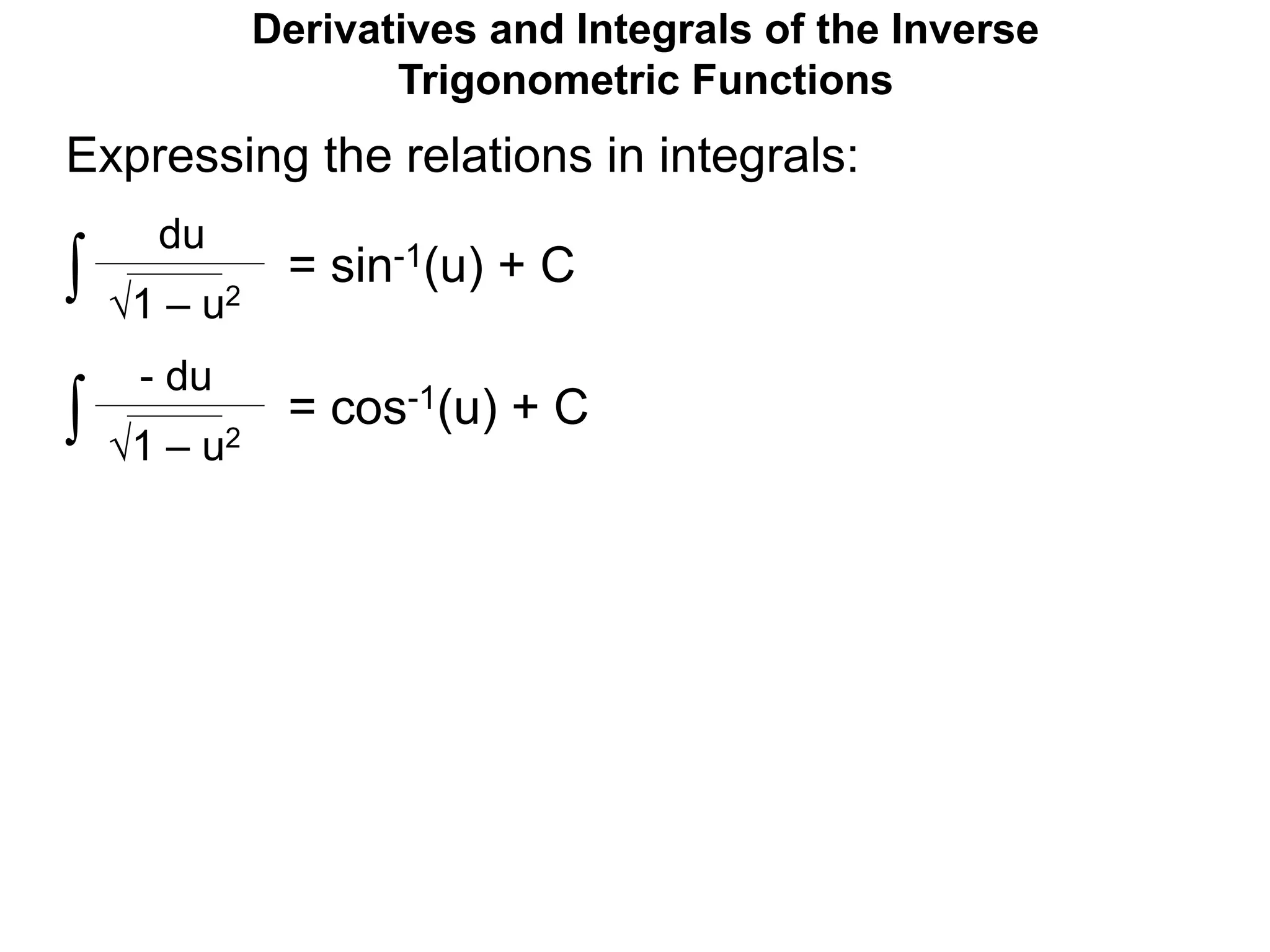
Expressing the relations in integrals:
∫
Derivatives and Integrals of the Inverse
Trigonometric Functions
= sin-1(u) + C
1 – u2
du
Expressing the relations in integrals:
∫
= cos-1(u) + C
1 – u2
- du
∫
Derivatives and Integrals of the Inverse
Trigonometric Functions
= sin-1(u) + C
1 – u2
du
Expressing the relations in integrals:
∫
= cos-1(u) + C
1 – u2
- du
∫
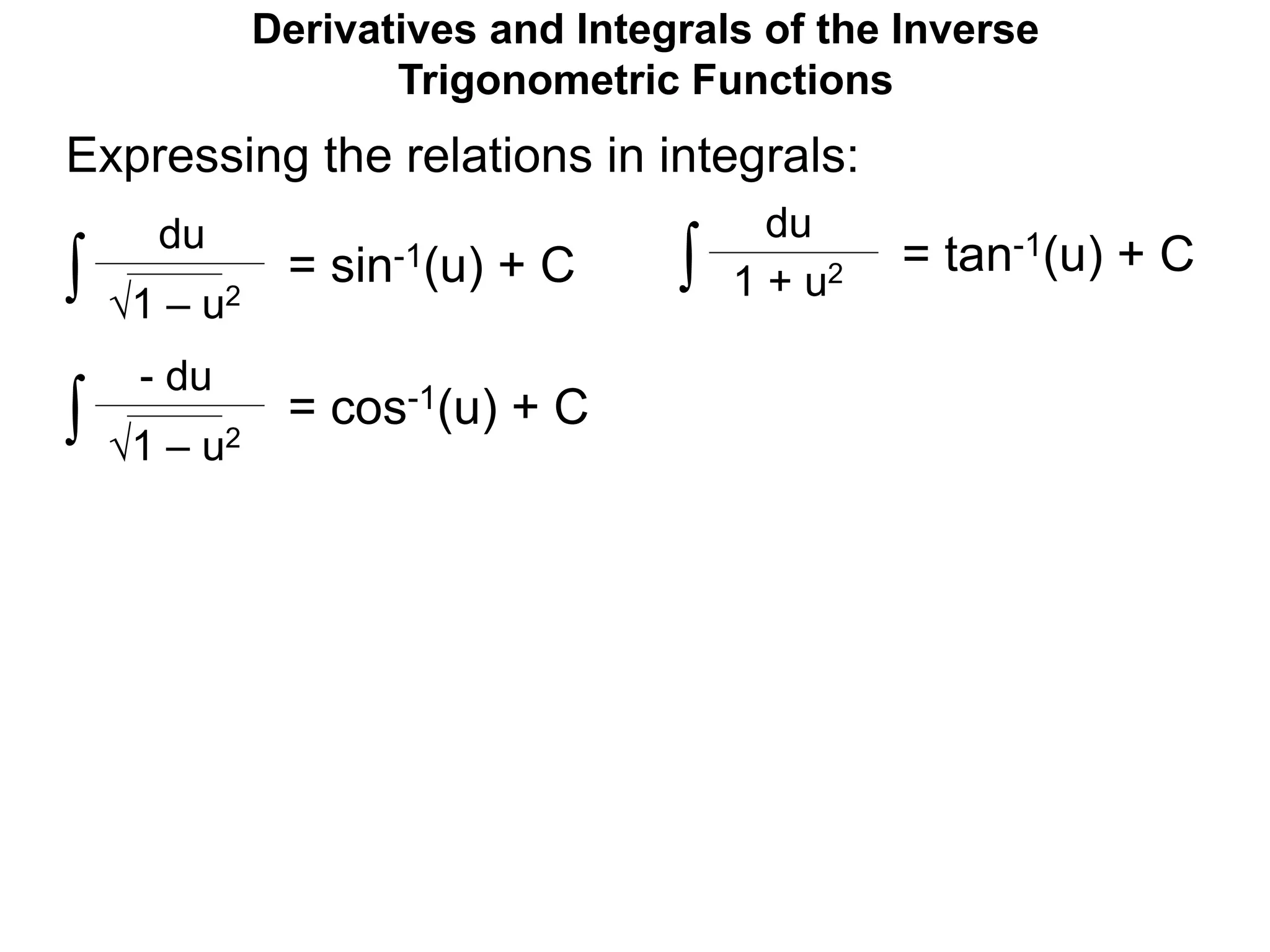
= tan-1(u) + C
du
∫ 1 + u2
Derivatives and Integrals of the Inverse
Trigonometric Functions
= sin-1(u) + C
1 – u2
du
|u|u2 – 1
Expressing the relations in integrals:
∫
= cos-1(u) + C
1 – u2
- du
∫
= tan-1(u) + C
du
∫ 1 + u2
= sec-1(u) + C∫
du
Derivatives and Integrals of the Inverse
Trigonometric Functions
= sin-1(u) + C
1 – u2
du
Expressing the relations in integrals:
∫
= cos-1(u) + C
1 – u2
- du
∫
= tan-1(u) + C
du
∫ 1 + u2
= sec-1(u) + C∫
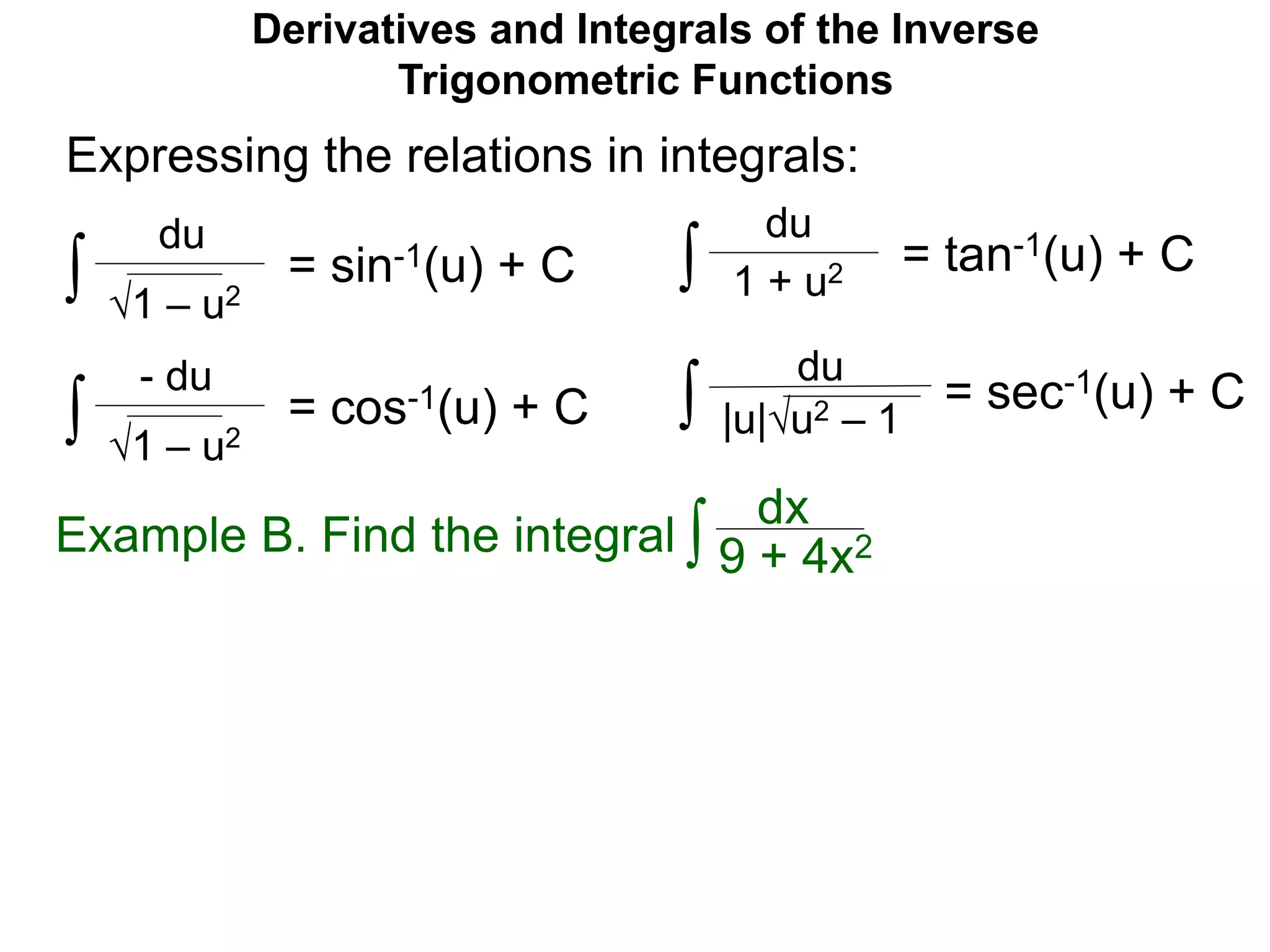
Example B. Find the integral ∫
dx
9 + 4x2
|u|u2 – 1
du
Derivatives and Integrals of the Inverse
Trigonometric Functions
= sin-1(u) + C
1 – u2
du
Expressing the relations in integrals:
∫
= cos-1(u) + C
1 – u2
- du
∫
= tan-1(u) + C
du
∫ 1 + u2
= sec-1(u) + C∫
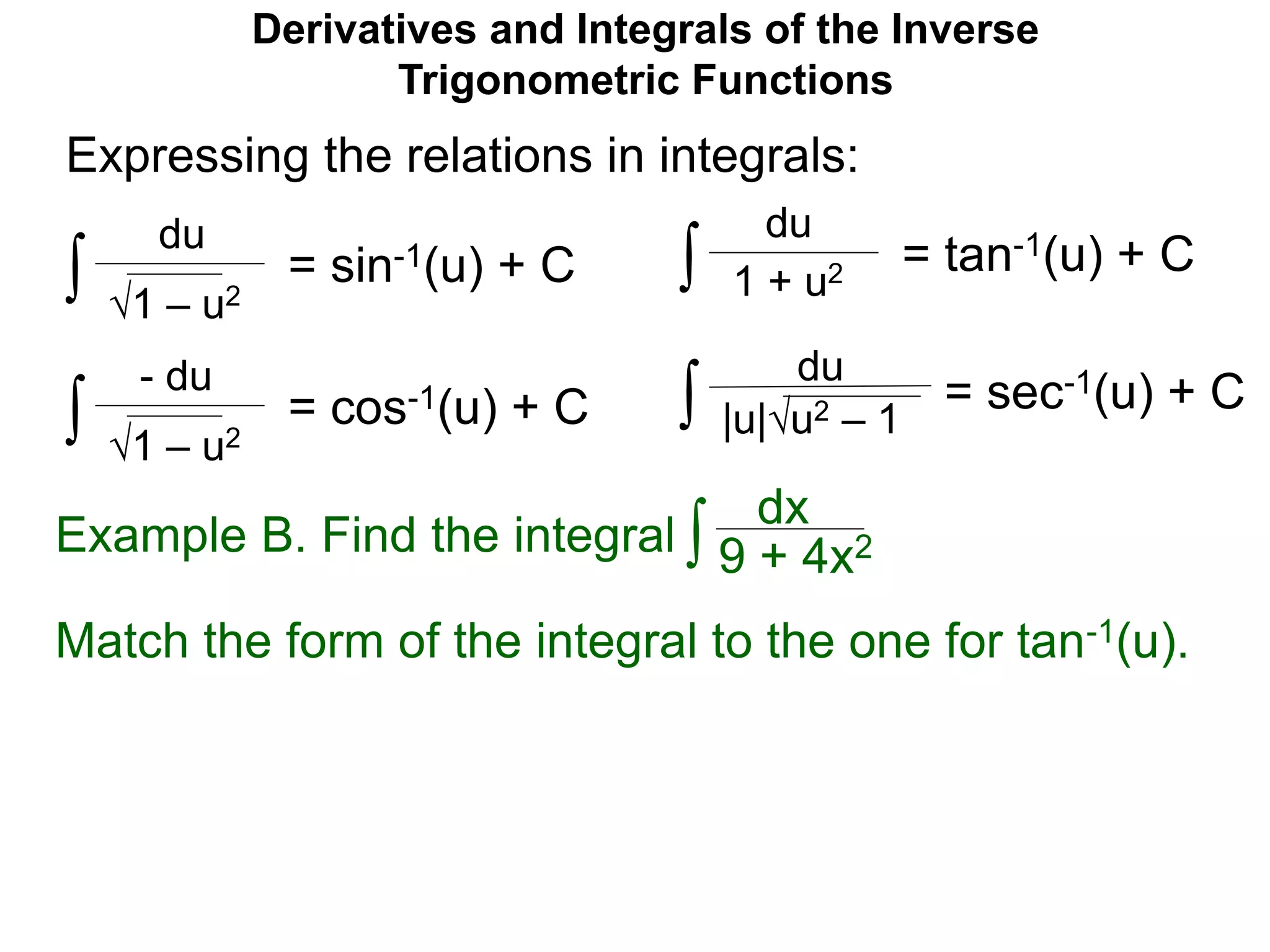
Match the form of the integral to the one for tan-1(u).
|u|u2 – 1
du
Example B. Find the integral ∫
dx
9 + 4x2
Derivatives and Integrals of the Inverse
Trigonometric Functions
= sin-1(u) + C
1 – u2
du
Expressing the relations in integrals:
∫
= cos-1(u) + C
1 – u2
- du
∫
= tan-1(u) + C
du
∫ 1 + u2
= sec-1(u) + C∫
Match the form of the integral to the one for tan-1(u).
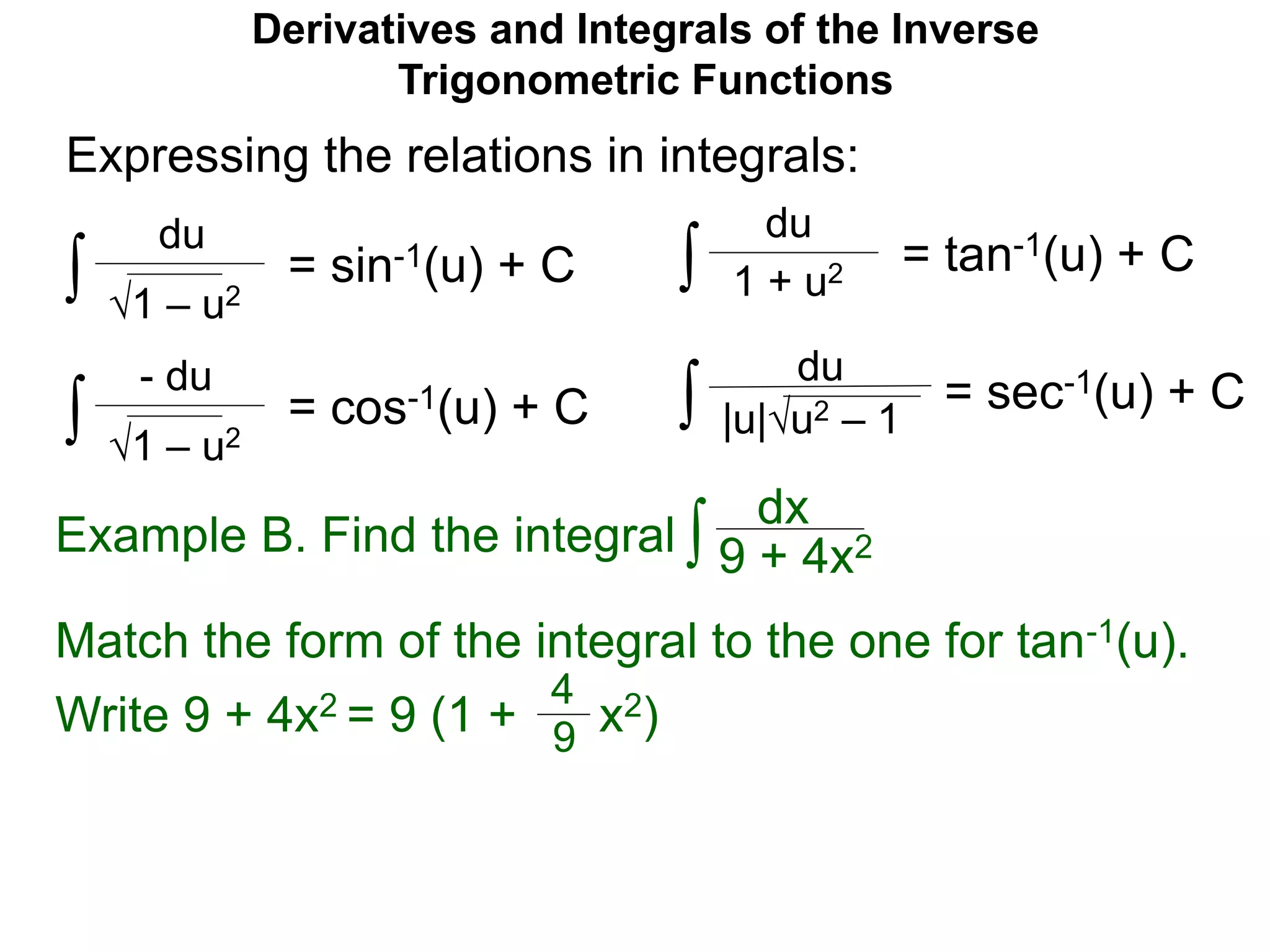
Write 9 + 4x2 = 9 (1 + x2)
4
9
|u|u2 – 1
du
Example B. Find the integral ∫
dx
9 + 4x2
Derivatives and Integrals of the Inverse
Trigonometric Functions
= sin-1(u) + C
1 – u2
du
Expressing the relations in integrals:
∫
= cos-1(u) + C
1 – u2
- du
∫
= tan-1(u) + C
du
∫ 1 + u2
= sec-1(u) + C∫
Match the form of the integral to the one for tan-1(u).
Write 9 + 4x2 = 9 (1 + x2) = 9 [1 + ( x)2]2
3
4
9
|u|u2 – 1
du
Example B. Find the integral ∫
dx
9 + 4x2
Derivatives and Integrals of the Inverse
Trigonometric Functions
= sin-1(u) + C
1 – u2
du
Expressing the relations in integrals:
∫
= cos-1(u) + C
1 – u2
- du
∫
= tan-1(u) + C
du
∫ 1 + u2
= sec-1(u) + C∫
Match the form of the integral to the one for tan-1(u).
Write 9 + 4x2 = 9 (1 + x2) = 9 [1 + ( x)2]2
3
4
9
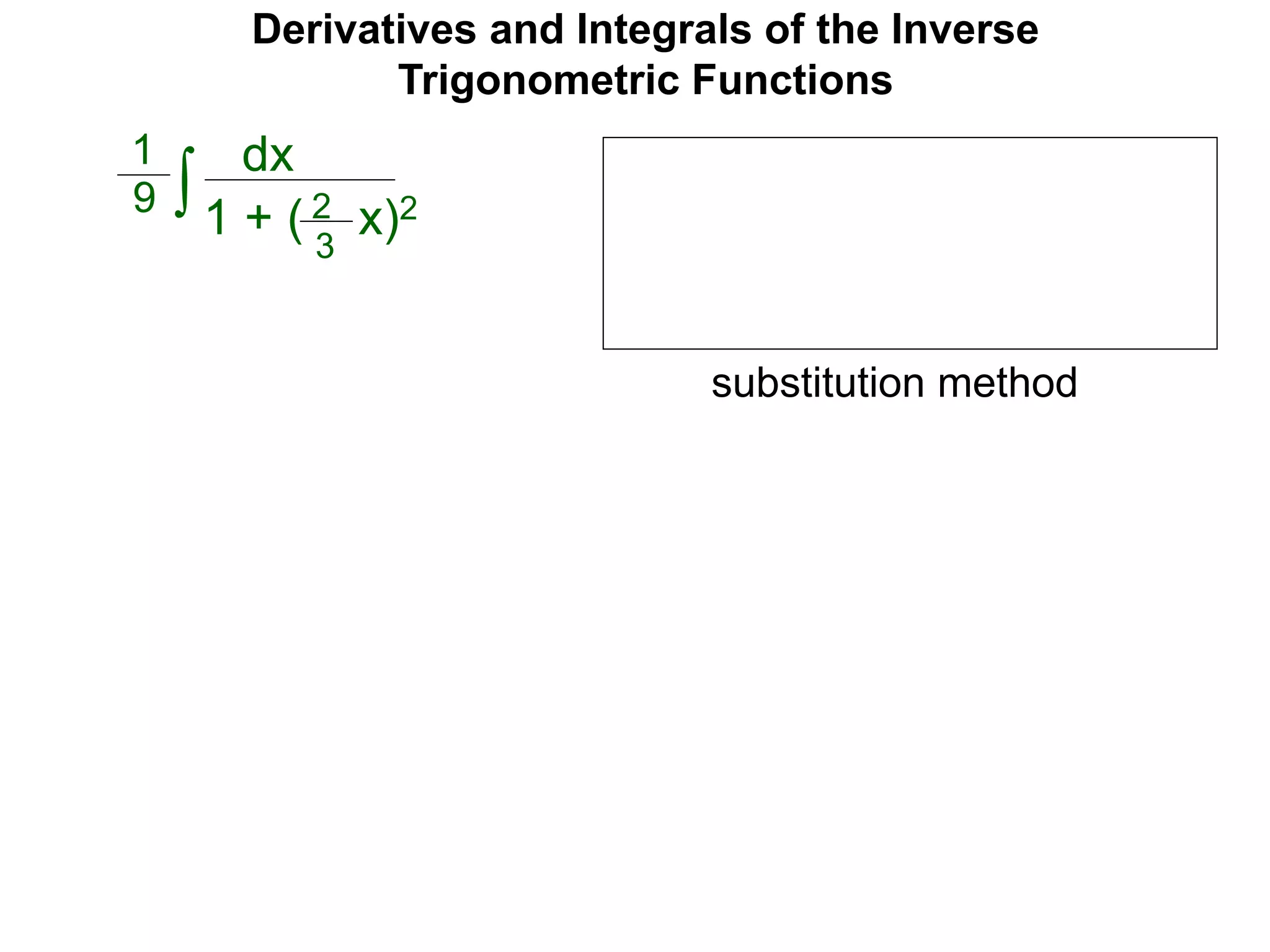
Hence dx
9 + 4x2∫ = dx
1 + ( x)2∫
1
9 2
3
|u|u2 – 1
du
Example B. Find the integral ∫
dx
9 + 4x2
Derivatives and Integrals of the Inverse
Trigonometric Functions
dx
1 + ( x)2∫
1
9 2
3
substitution method
Derivatives and Integrals of the Inverse
Trigonometric Functions
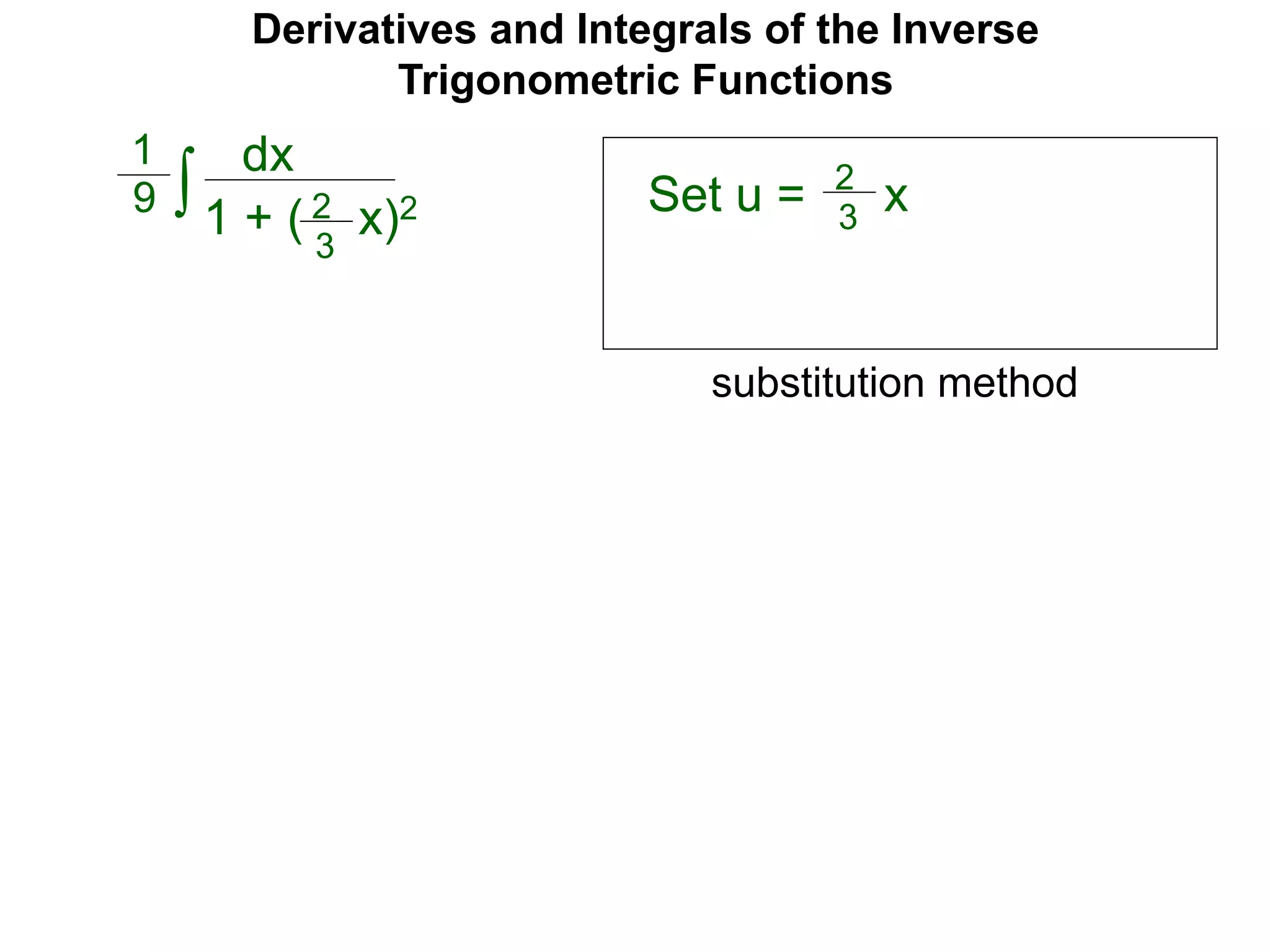
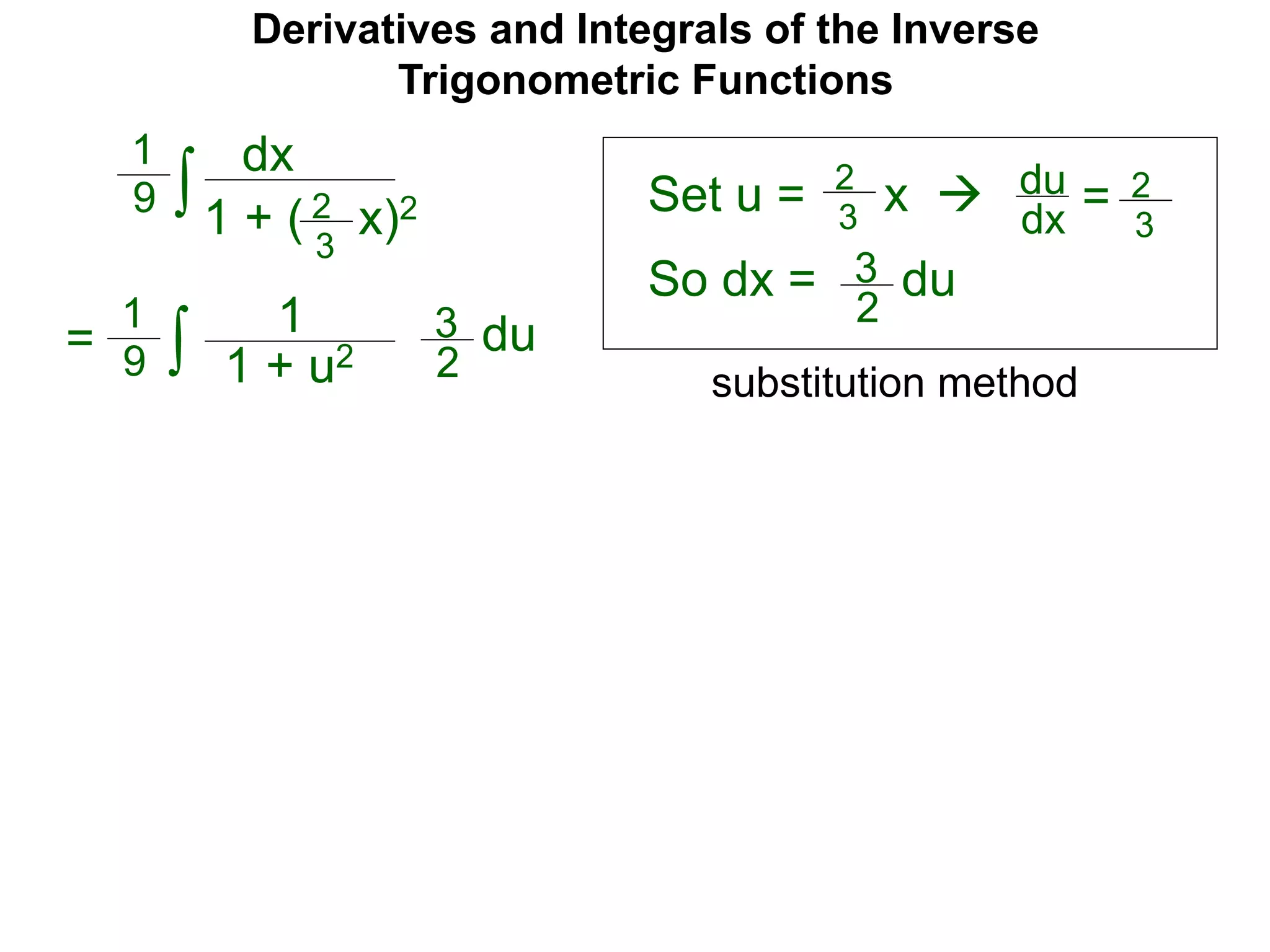
Set u =
dx
1 + ( x)2∫
1
9 2
3
2
3
x
substitution method
Derivatives and Integrals of the Inverse
Trigonometric Functions
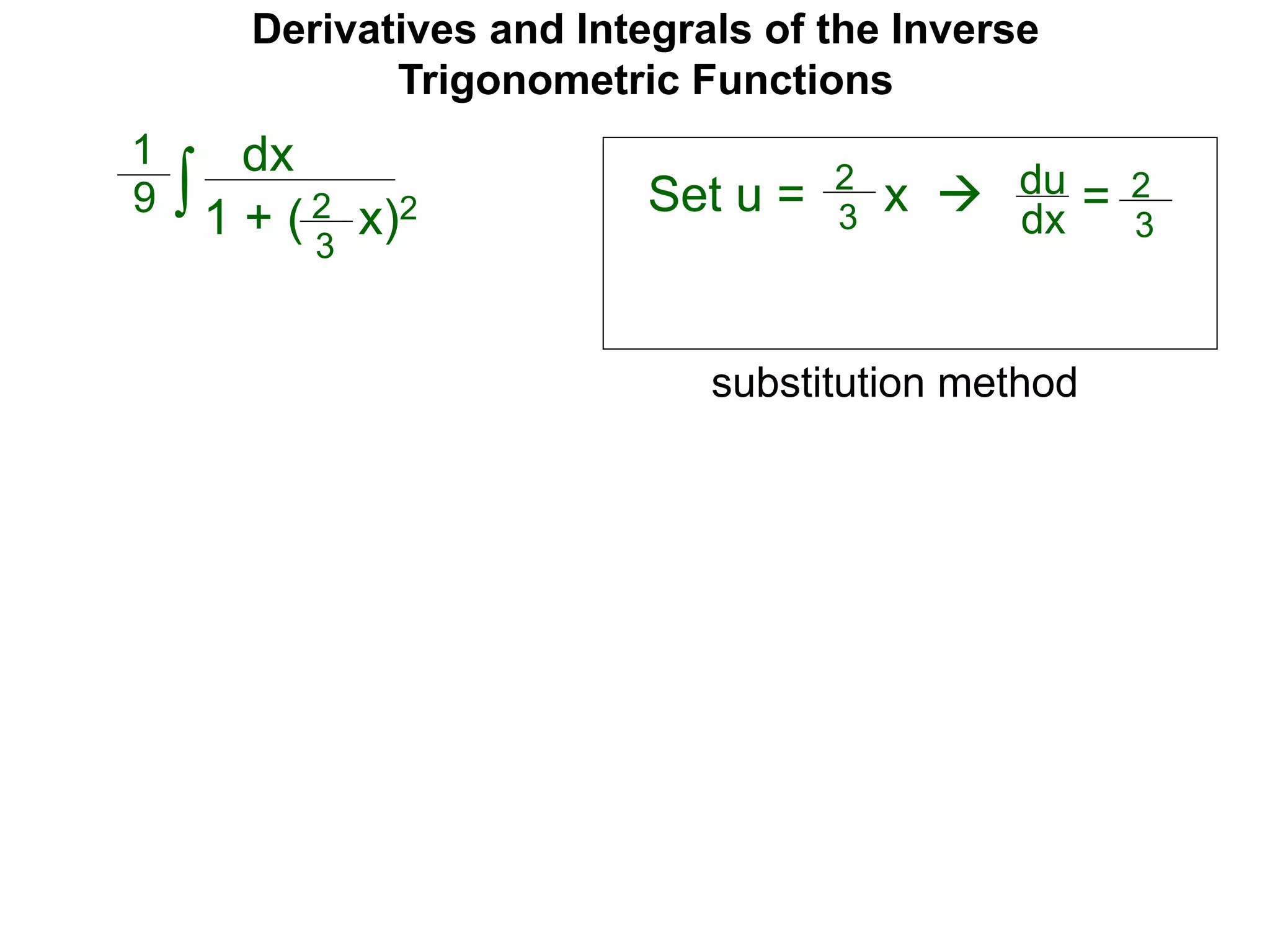
Set u =
dx
1 + ( x)2∫
1
9 2
3
2
3
x  du
dx = 2
3
substitution method
Derivatives and Integrals of the Inverse
Trigonometric Functions
Set u =
dx
1 + ( x)2∫
1
9 2
3
2
3
x  du
dx = 2
3
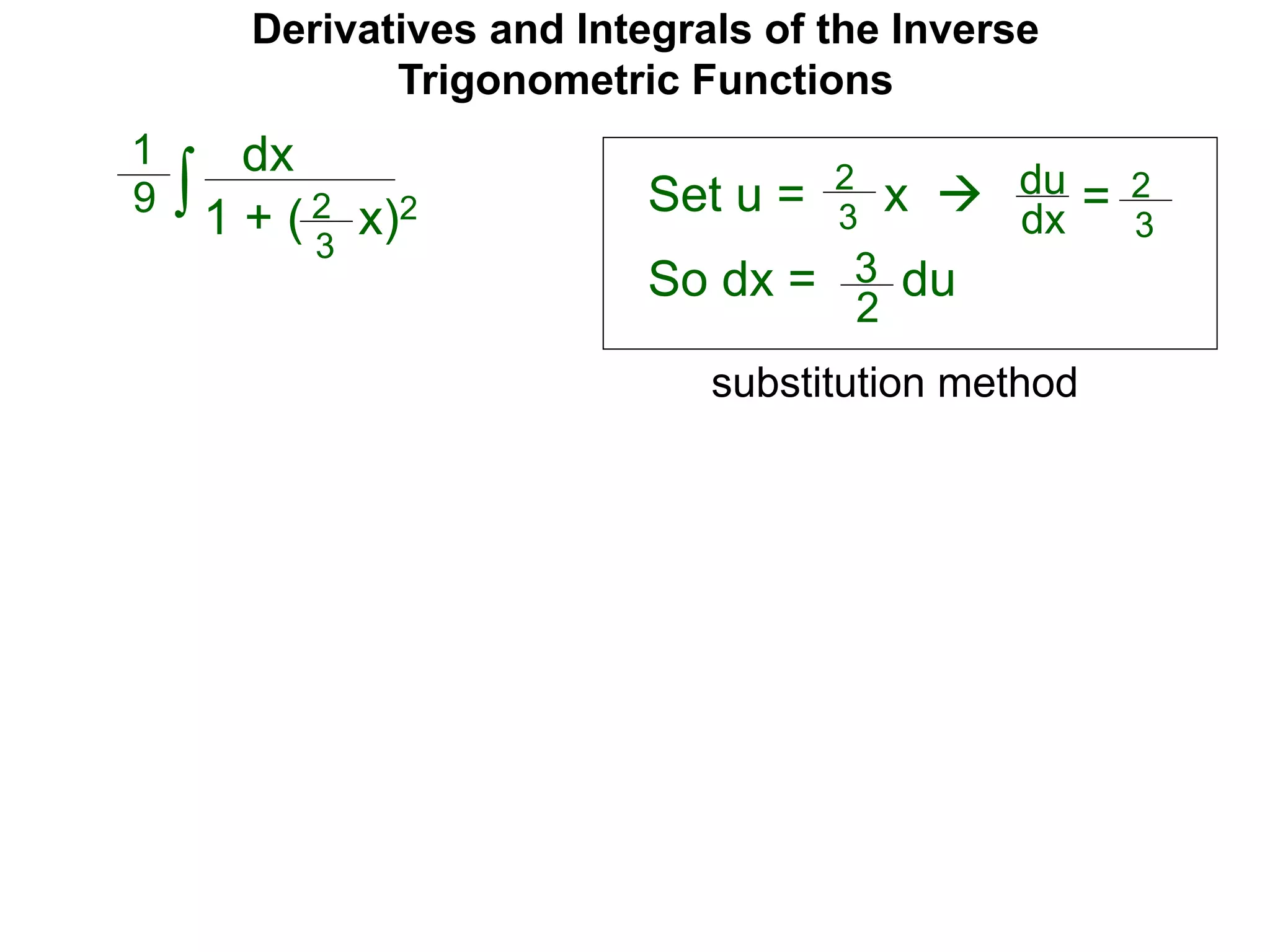
So dx = 3
2
du
substitution method
Derivatives and Integrals of the Inverse
Trigonometric Functions
Set u =
dx
1 + ( x)2∫
1
9 2
3
2
3
x  du
dx = 2
3
So dx = 3
2
du
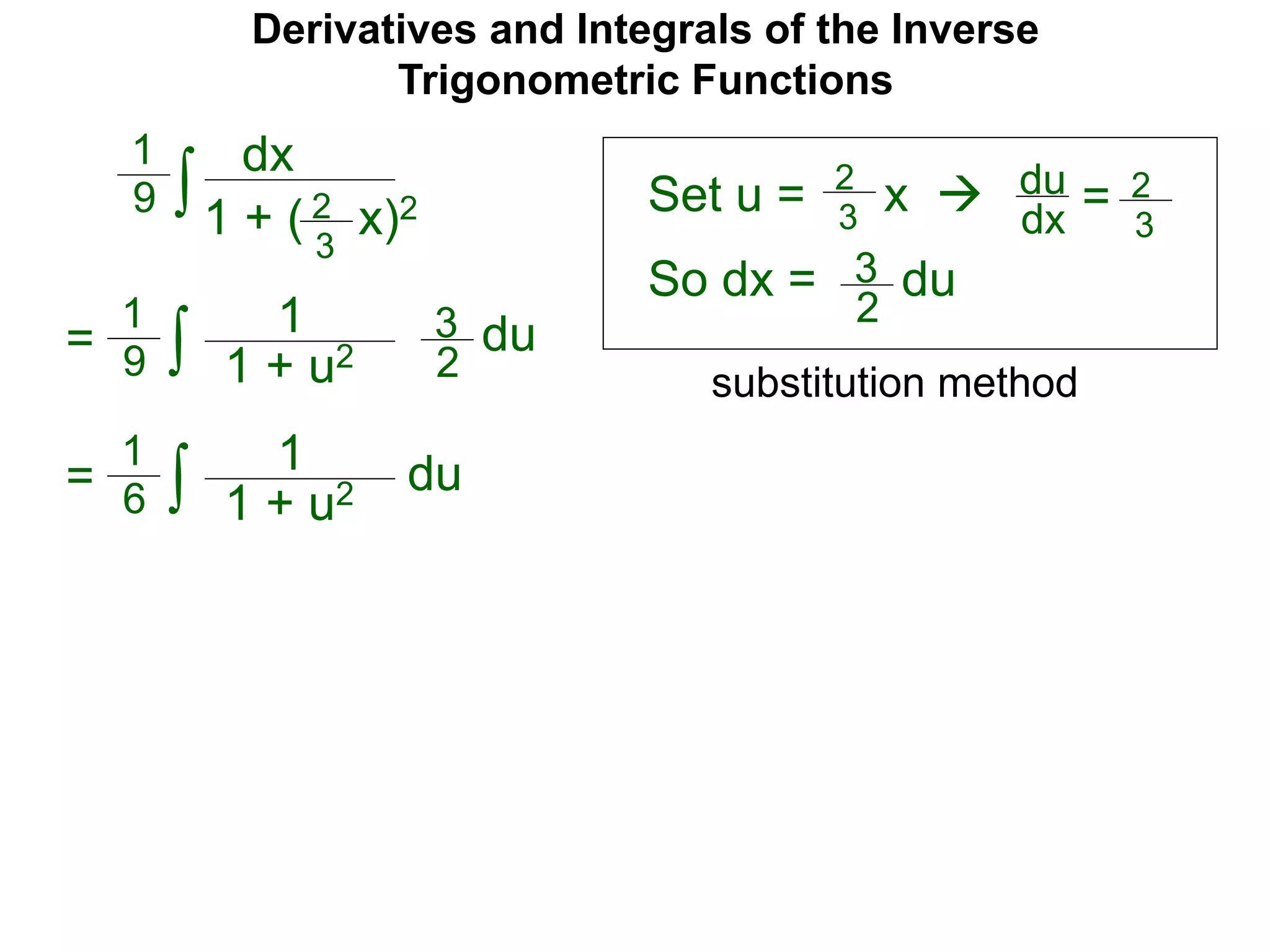
= ∫
1
9
1
1 + u2
3
2
du
substitution method
Derivatives and Integrals of the Inverse
Trigonometric Functions
Set u =
dx
1 + ( x)2∫
1
9 2
3
2
3
x  du
dx = 2
3
So dx = 3
2
du
= ∫
1
9
1
1 + u2
3
2
du
= ∫
1
6
1
1 + u2 du
substitution method
Derivatives and Integrals of the Inverse
Trigonometric Functions
Set u =
dx
1 + ( x)2∫
1
9 2
3
2
3
x  du
dx = 2
3
So dx = 3
2
du
= ∫
1
9
1
1 + u2
3
2
du
= ∫
1
6
1
1 + u2 du
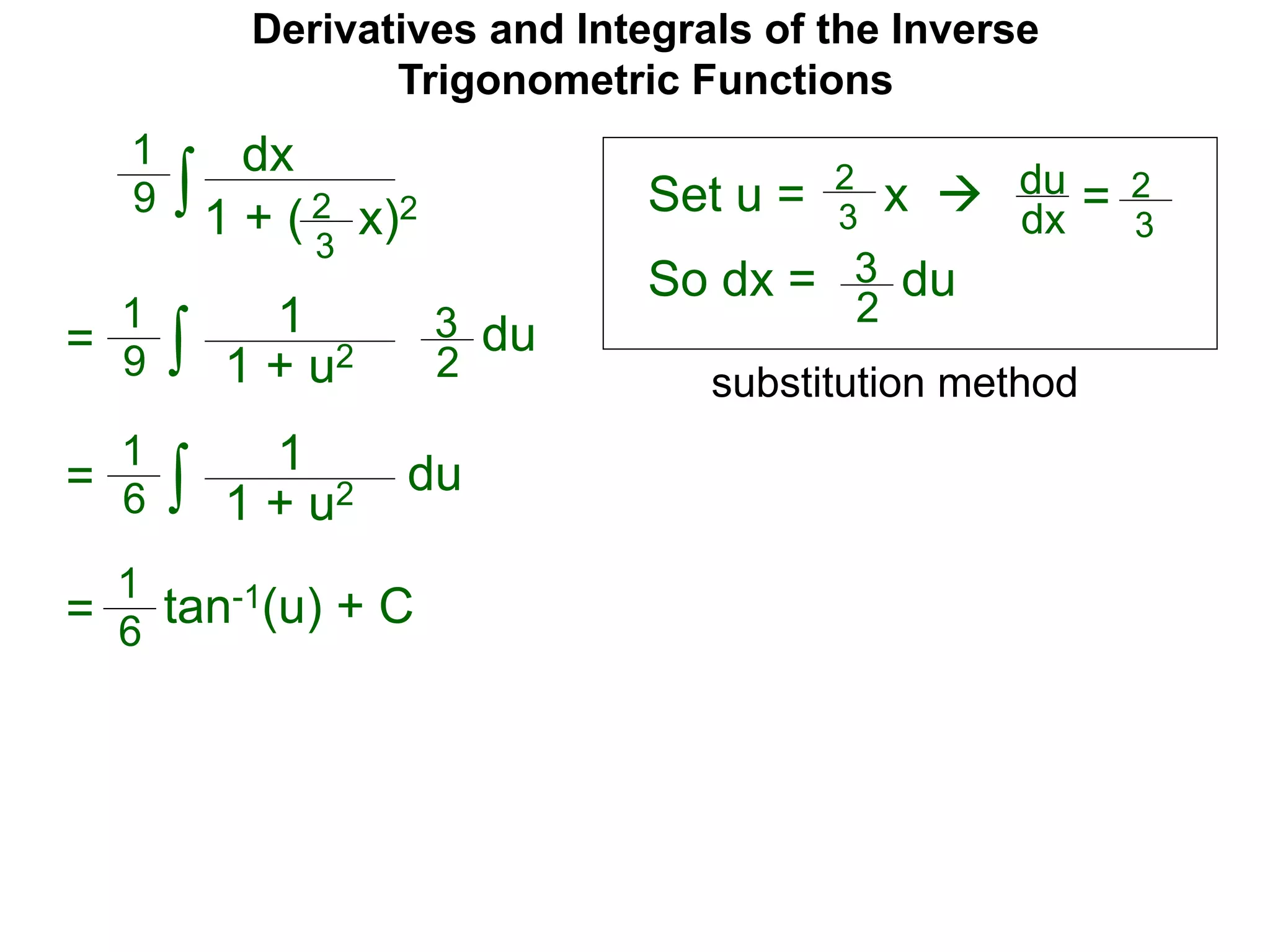
= tan-1(u) + C
1
6
substitution method
Derivatives and Integrals of the Inverse
Trigonometric Functions
Set u =
dx
1 + ( x)2∫
1
9 2
3
2
3
x  du
dx = 2
3
So dx = 3
2
du
= ∫
1
9
1
1 + u2
3
2
du
= ∫
1
6
1
1 + u2 du
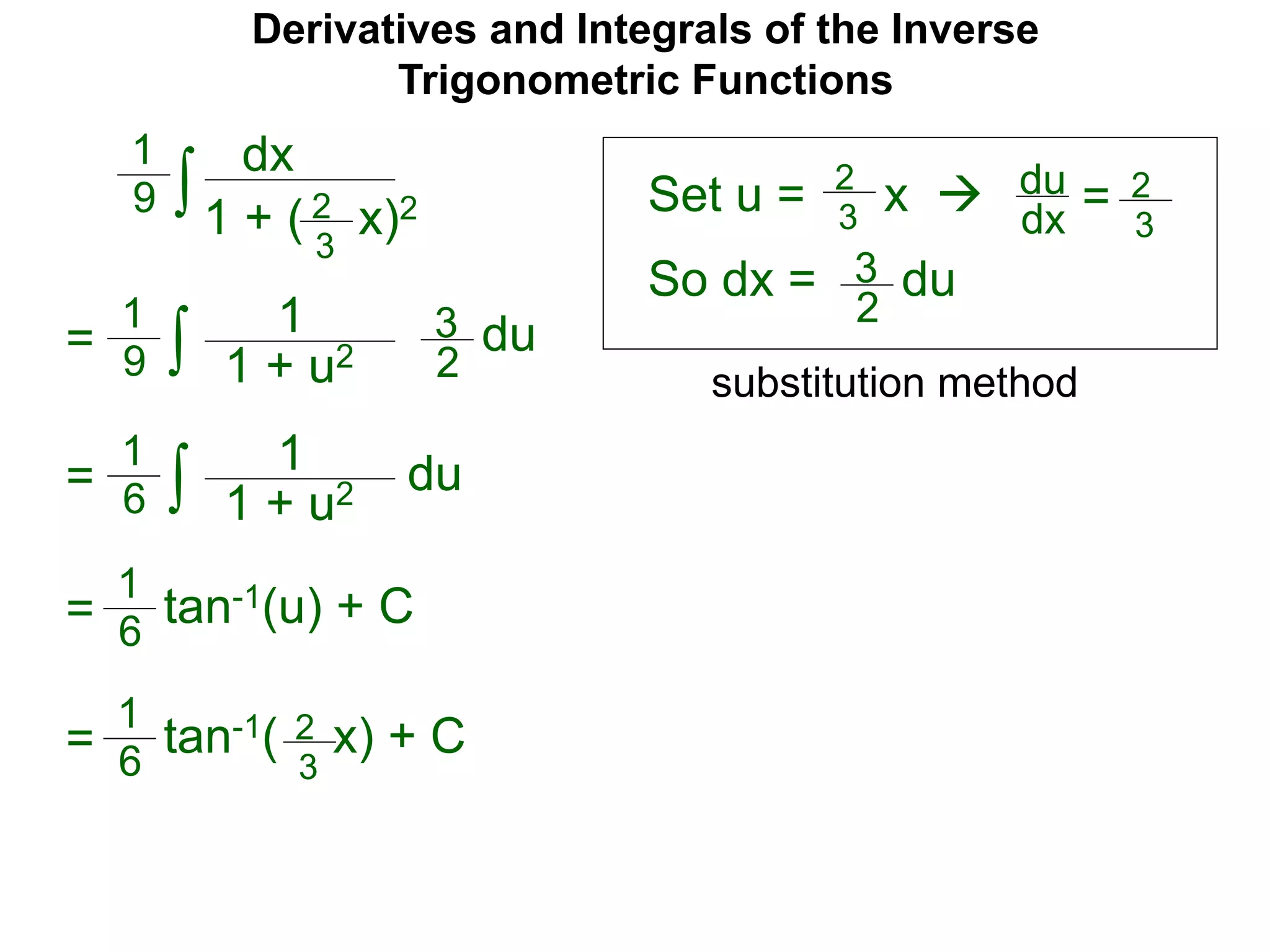
= tan-1(u) + C
1
6
= tan-1( x) + C
1
6
2
3
substitution method
Derivatives and Integrals of the Inverse
Trigonometric Functions
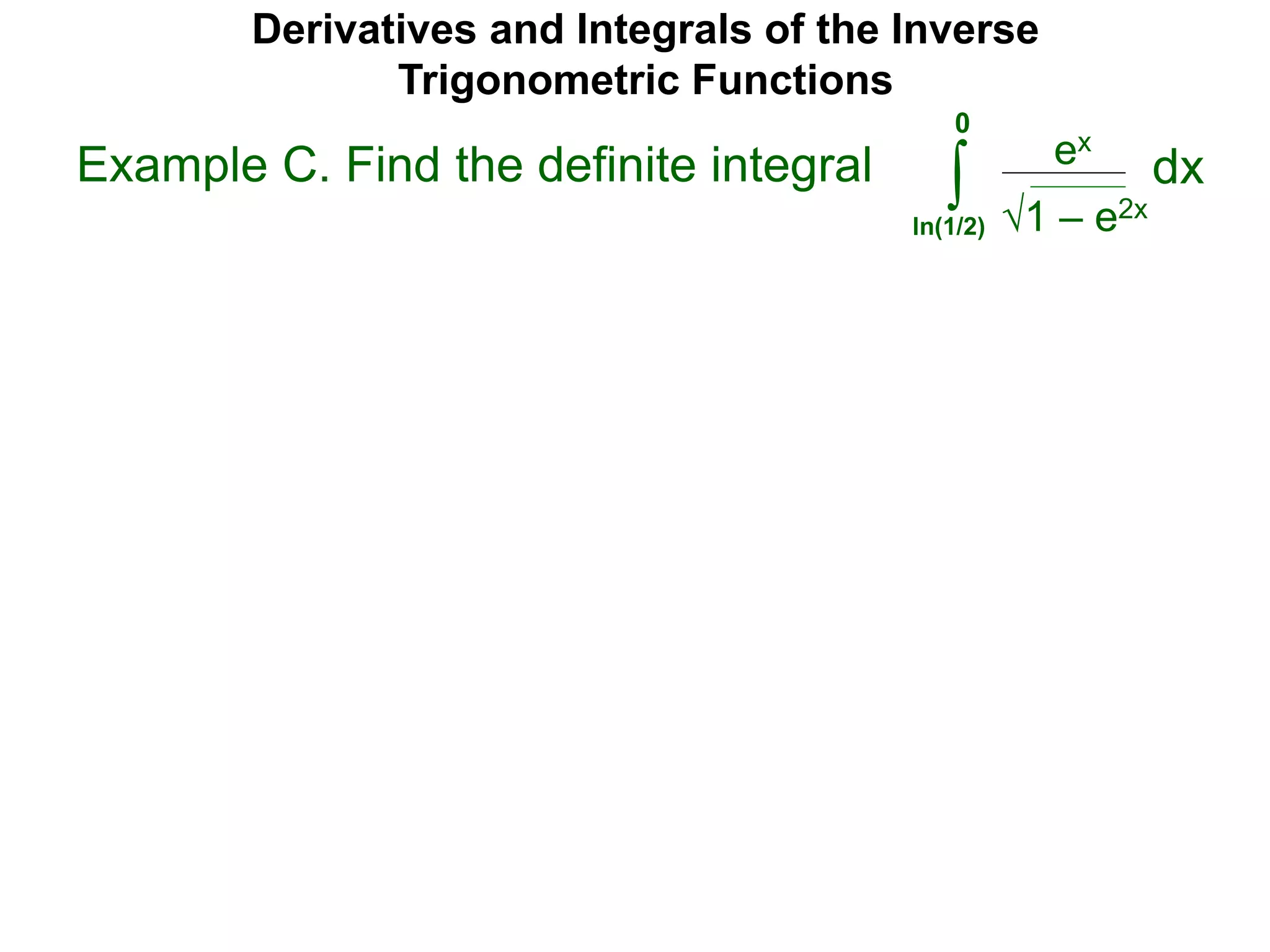
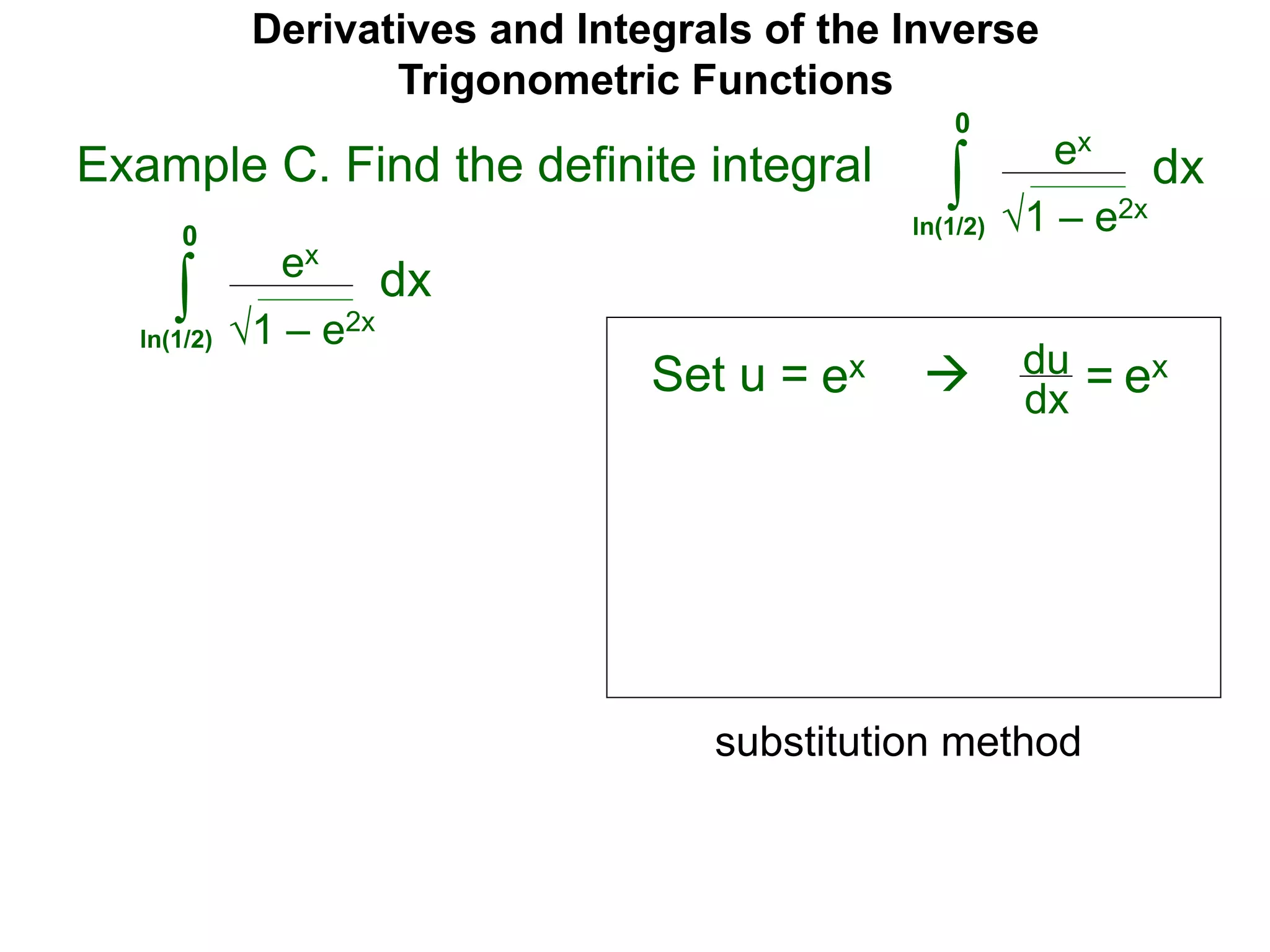
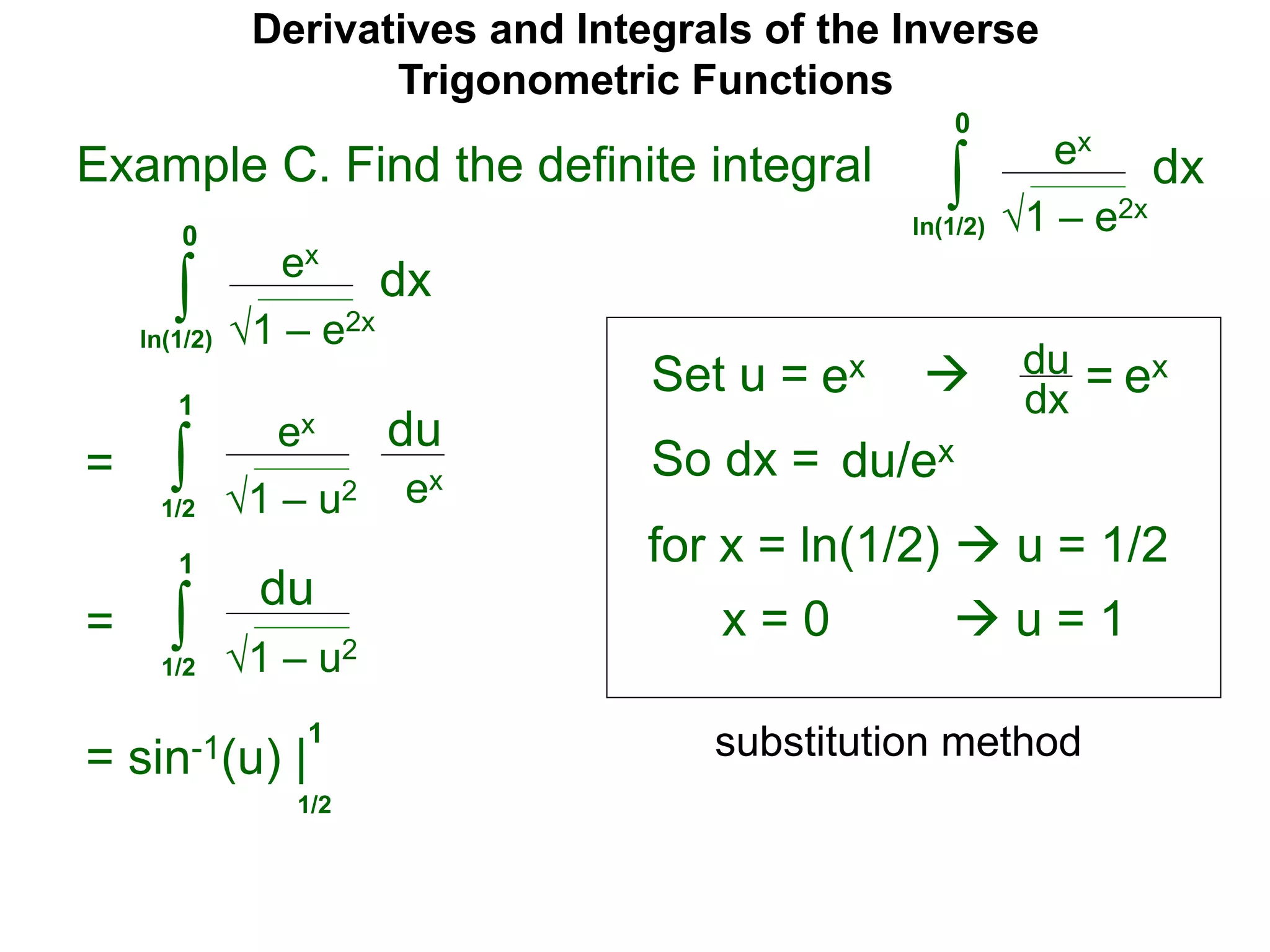
ex
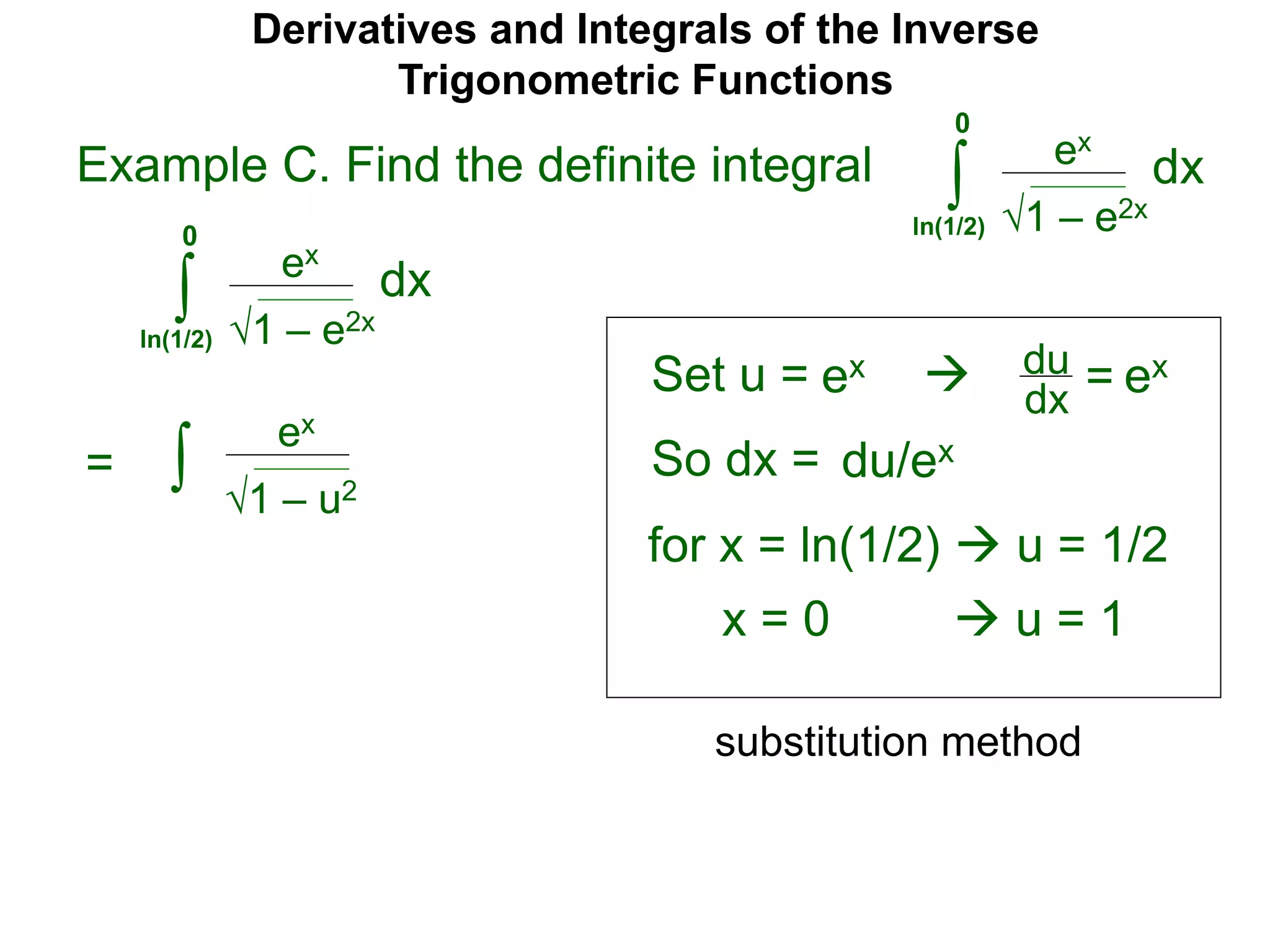
∫Example C. Find the definite integral
1 – e2x
dx
0
ln(1/2)
Derivatives and Integrals of the Inverse
Trigonometric Functions
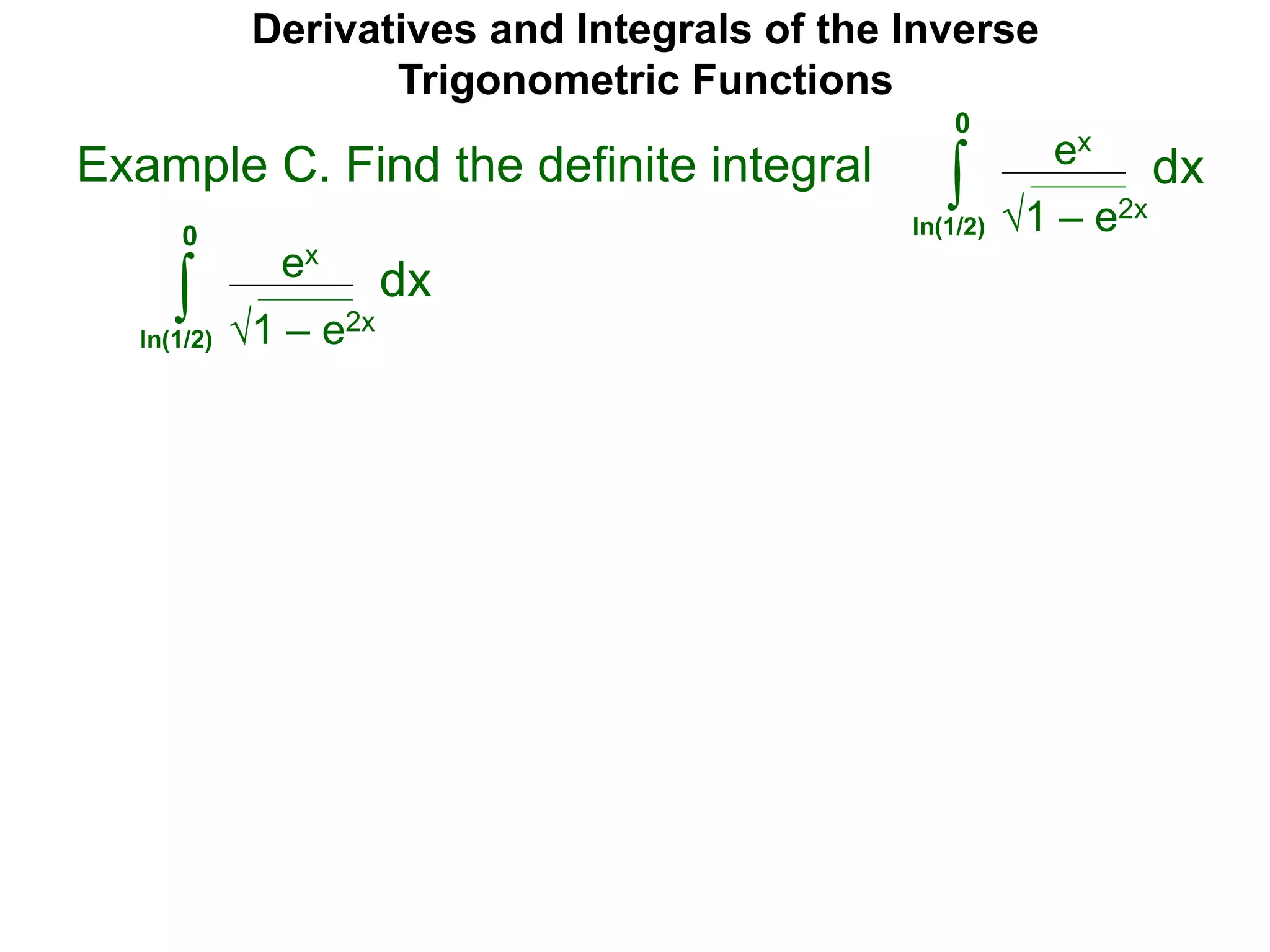
ex
∫Example C. Find the definite integral
1 – e2x
dx
0
ln(1/2)
ex
∫ 1 – e2x
dx
0
ln(1/2)
Derivatives and Integrals of the Inverse
Trigonometric Functions
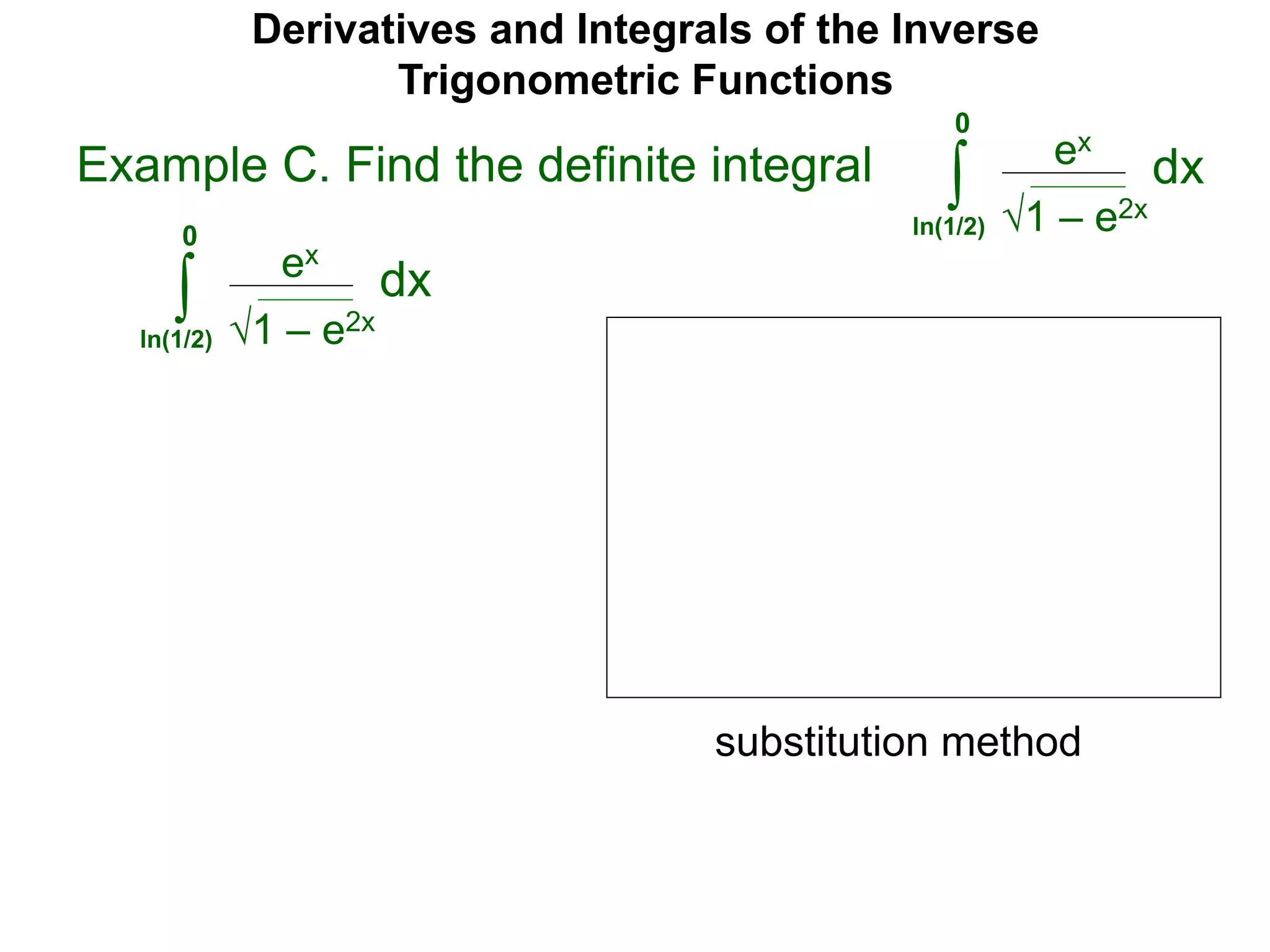
ex
∫
substitution method
Example C. Find the definite integral
1 – e2x
dx
0
ln(1/2)
ex
∫ 1 – e2x
dx
0
ln(1/2)
Derivatives and Integrals of the Inverse
Trigonometric Functions
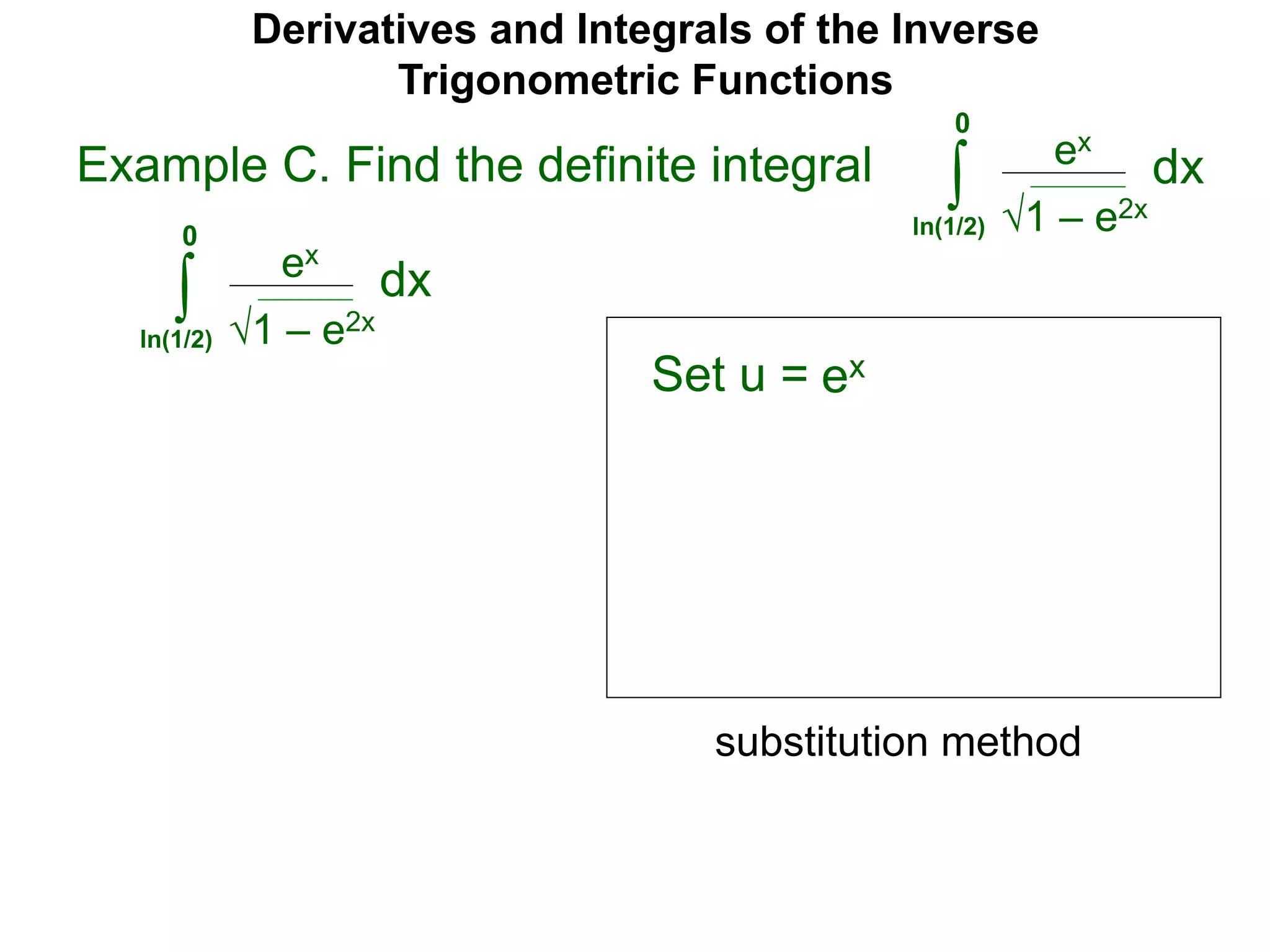
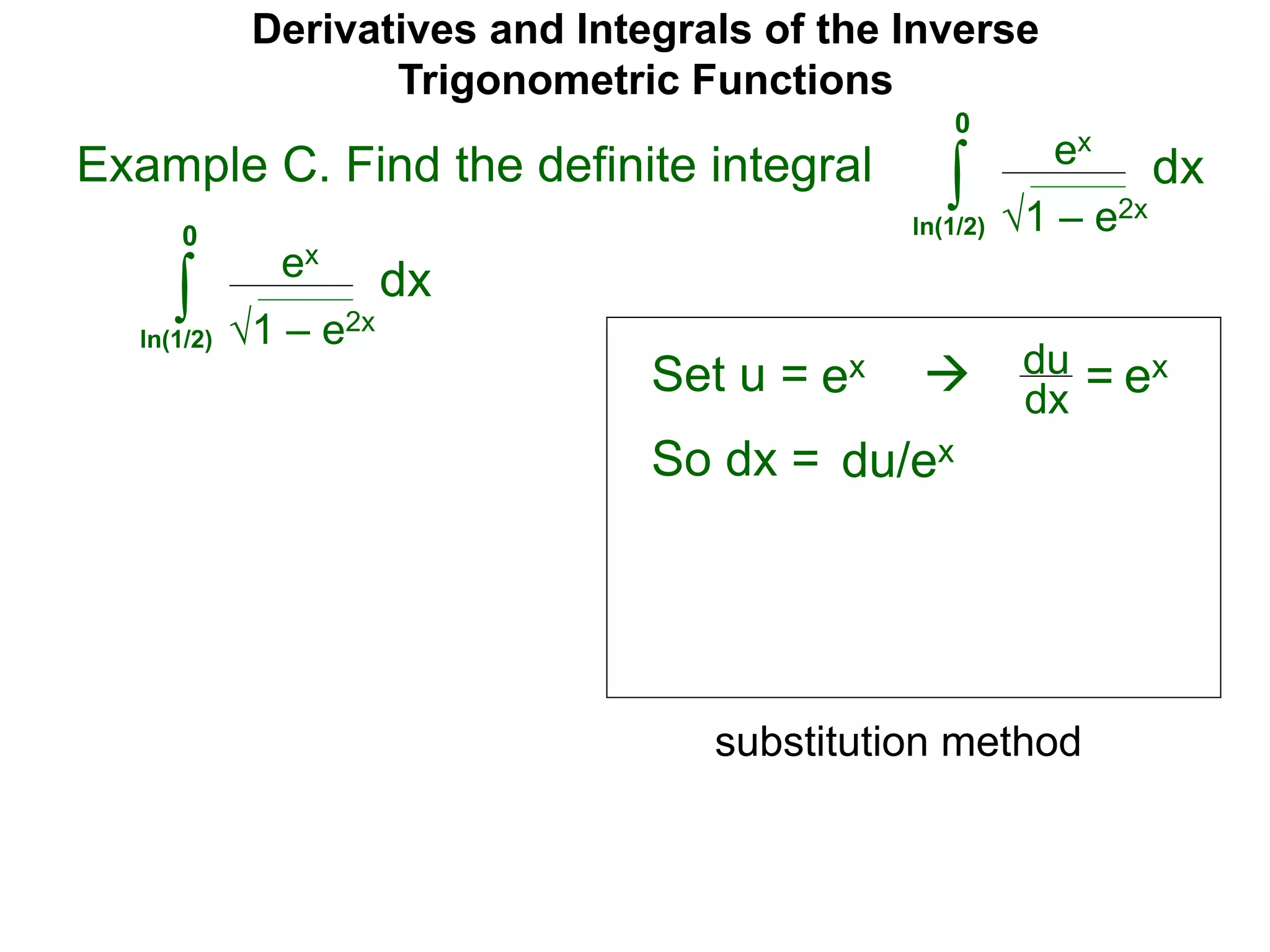
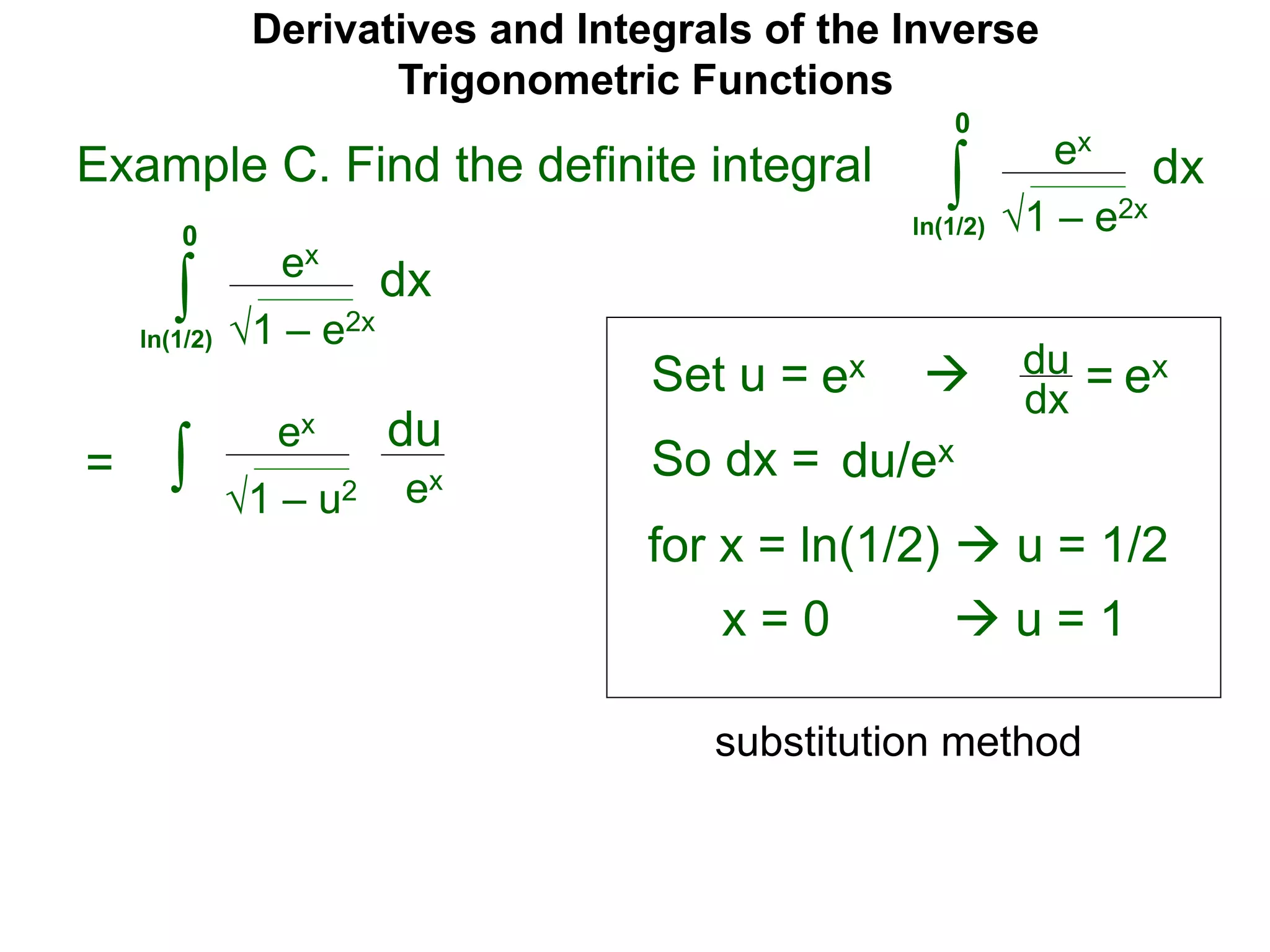
Set u =
ex
∫
substitution method
Example C. Find the definite integral
1 – e2x
dx
0
ln(1/2)
ex
ex
∫ 1 – e2x
dx
0
ln(1/2)
Derivatives and Integrals of the Inverse
Trigonometric Functions
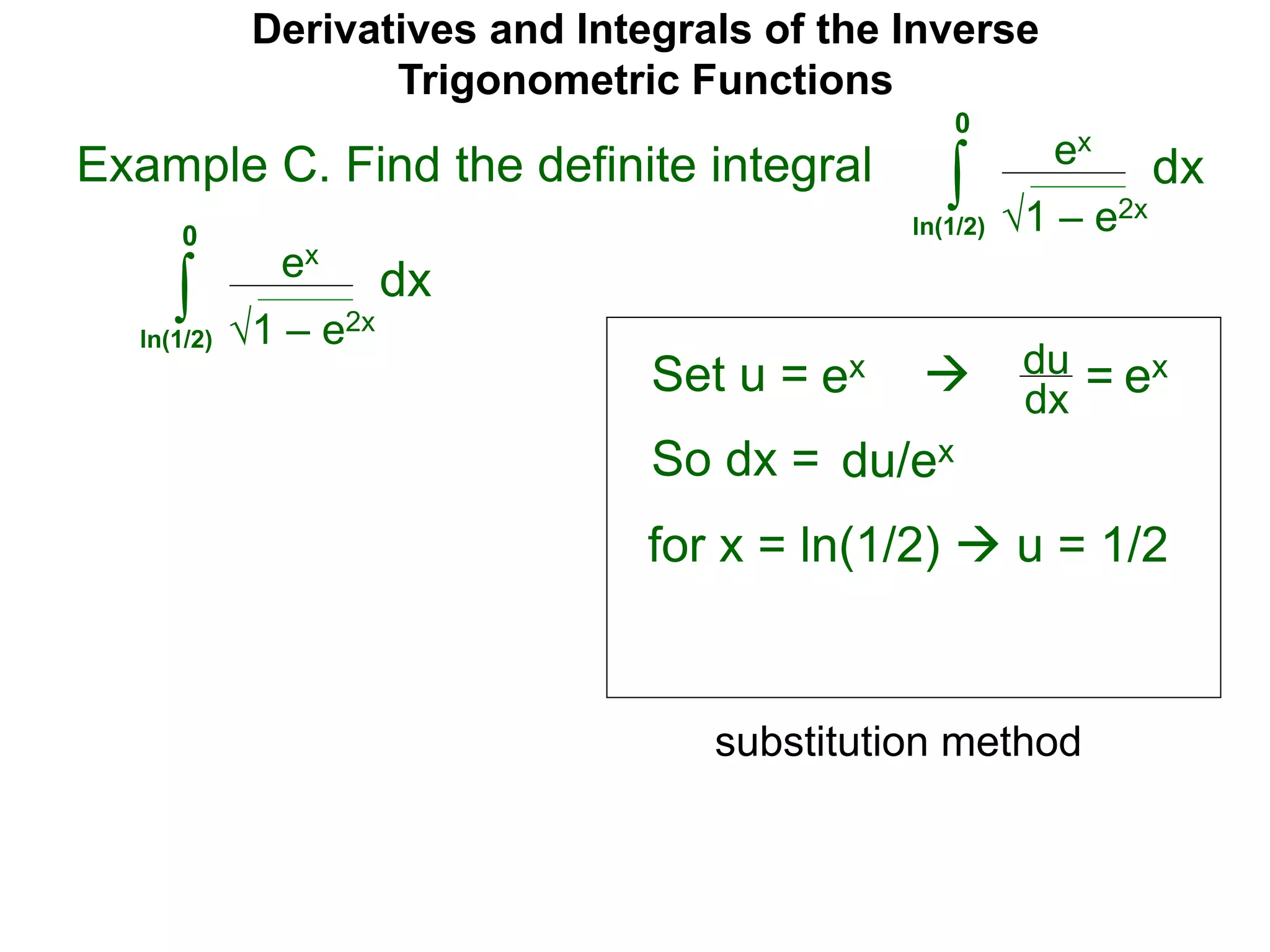
Set u =
ex
∫
 du
dx =
substitution method
Example C. Find the definite integral
1 – e2x
dx
0
ln(1/2)
ex ex
ex
∫ 1 – e2x
dx
0
ln(1/2)
Derivatives and Integrals of the Inverse
Trigonometric Functions
Set u =
ex
∫
 du
dx =
So dx = du/ex
substitution method
Example C. Find the definite integral
1 – e2x
dx
0
ln(1/2)
ex ex
ex
∫ 1 – e2x
dx
0
ln(1/2)
Derivatives and Integrals of the Inverse
Trigonometric Functions
Set u =
ex
∫
 du
dx =
So dx = du/ex
substitution method
Example C. Find the definite integral
1 – e2x
dx
0
ln(1/2)
ex ex
for x = ln(1/2)  u = 1/2
ex
∫ 1 – e2x
dx
0
ln(1/2)
Derivatives and Integrals of the Inverse
Trigonometric Functions
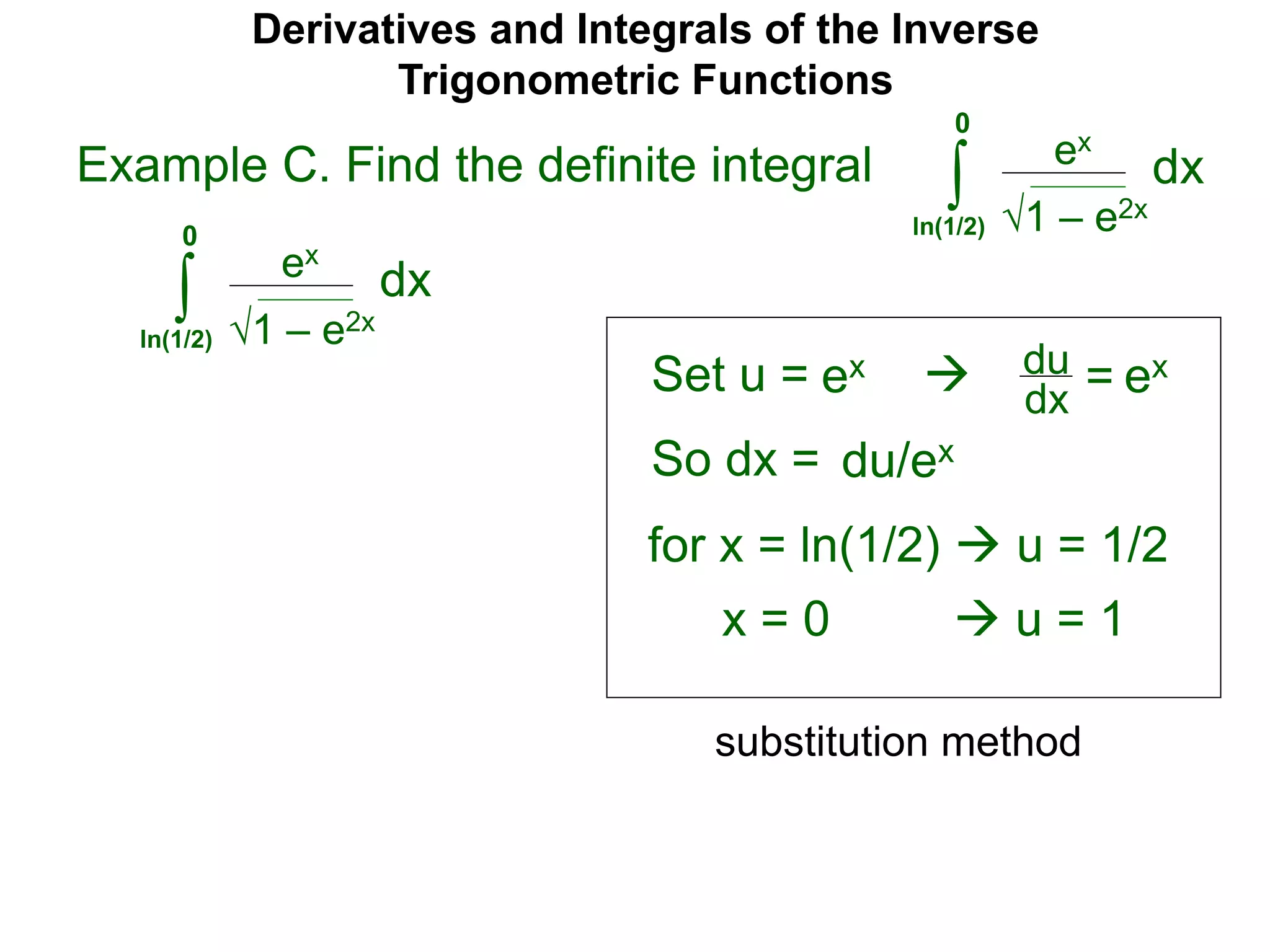
Set u =
ex
∫
 du
dx =
So dx = du/ex
substitution method
Example C. Find the definite integral
1 – e2x
dx
0
ln(1/2)
ex
∫ 1 – e2x
dx
0
ln(1/2)
ex ex
for x = ln(1/2)  u = 1/2
x = 0  u = 1
Derivatives and Integrals of the Inverse
Trigonometric Functions
Set u =
ex
∫
 du
dx =
So dx = du/ex
=
substitution method
Example C. Find the definite integral
1 – e2x
dx
0
ln(1/2)
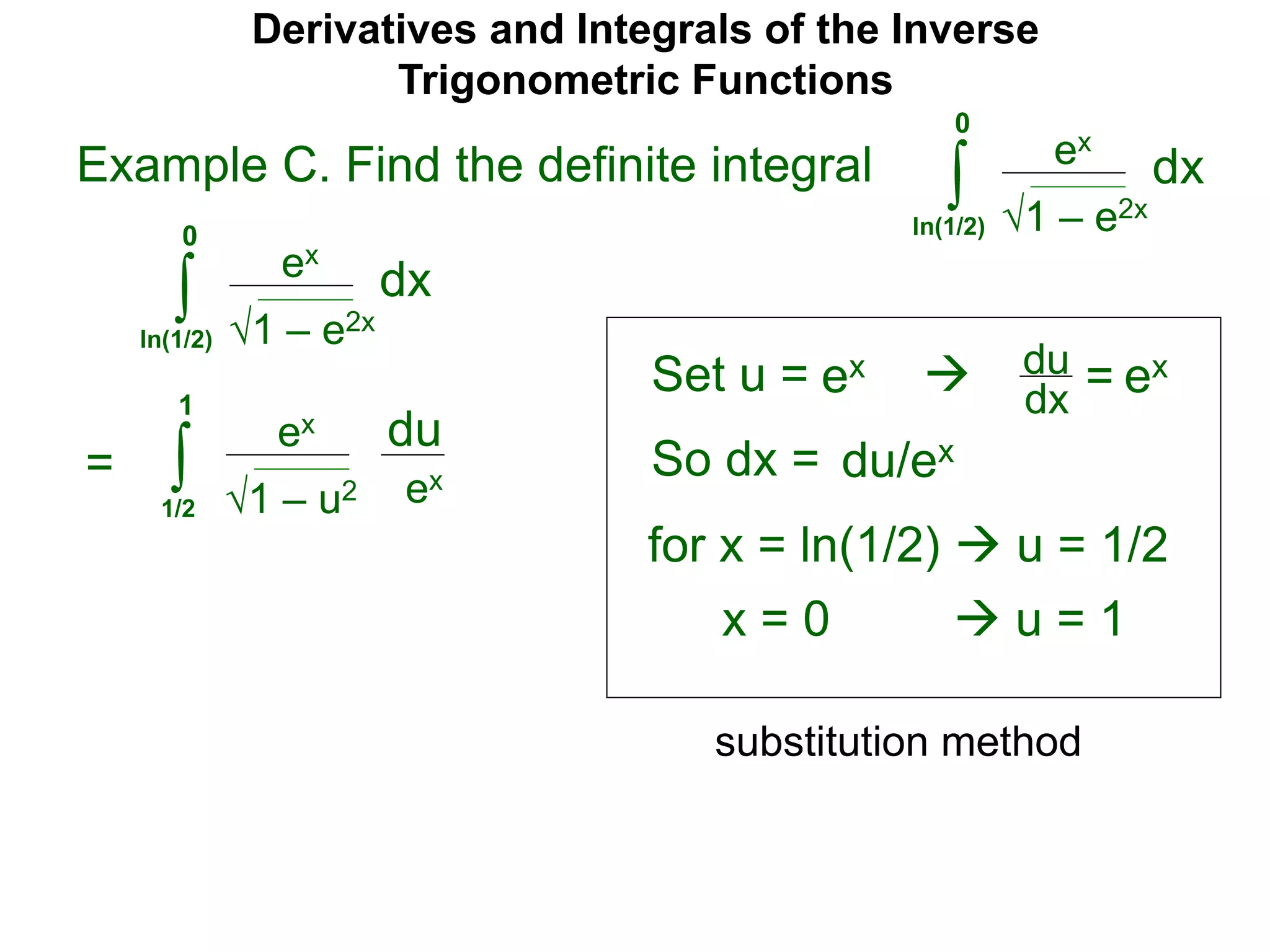
ex
∫ 1 – e2x
dx
0
ln(1/2)
ex ex
for x = ln(1/2)  u = 1/2
x = 0  u = 1
ex
∫ 1 – u2
Derivatives and Integrals of the Inverse
Trigonometric Functions
Set u =
ex
∫
 du
dx =
So dx = du/ex
=
substitution method
Example C. Find the definite integral
1 – e2x
dx
0
ln(1/2)
ex
∫ 1 – e2x
dx
0
ln(1/2)
ex ex
for x = ln(1/2)  u = 1/2
x = 0  u = 1
ex
∫ 1 – u2
du
ex
Derivatives and Integrals of the Inverse
Trigonometric Functions
Set u =
ex
∫
 du
dx =
So dx = du/ex
=
substitution method
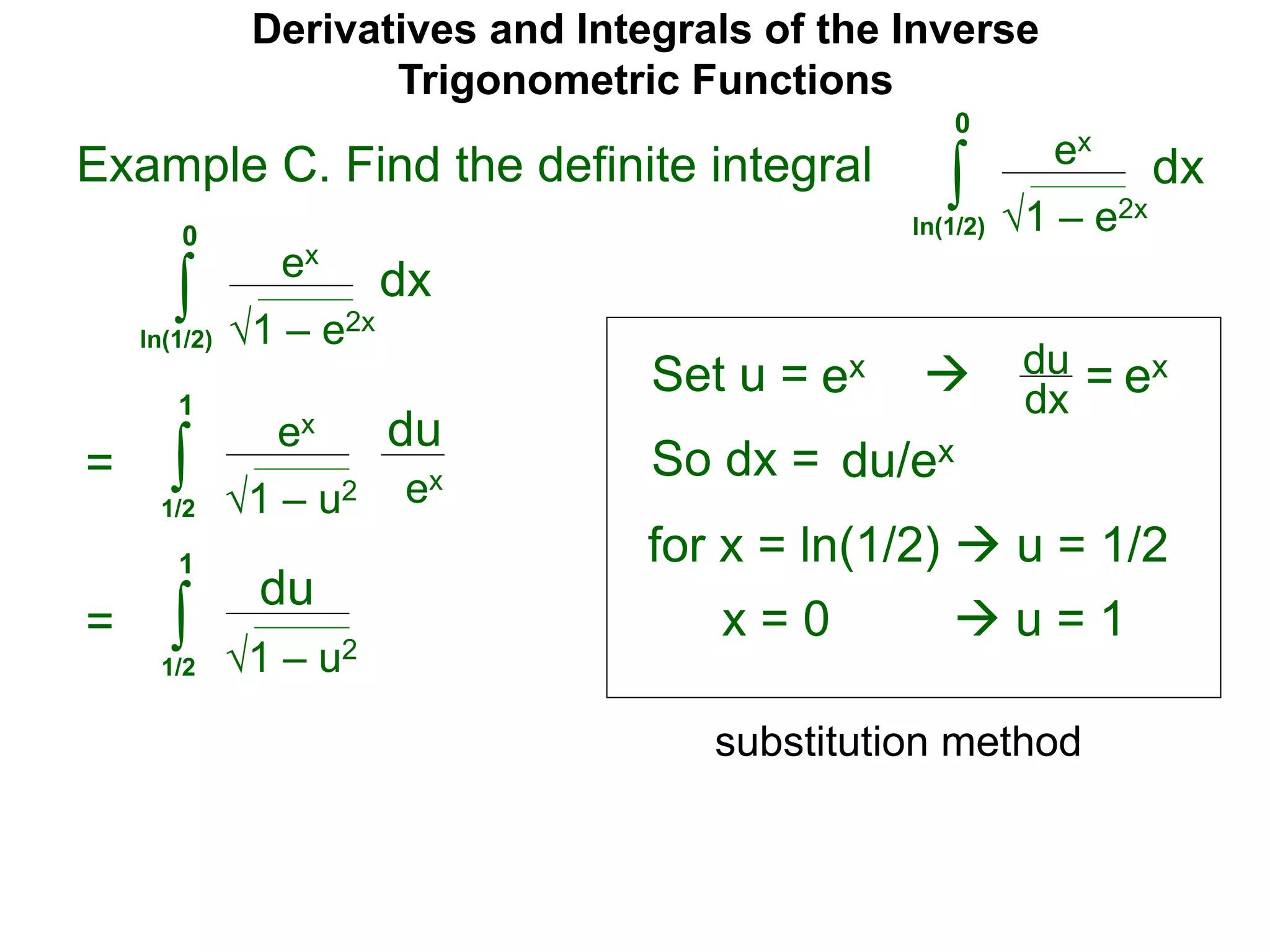
Example C. Find the definite integral
1 – e2x
dx
0
ln(1/2)
ex
∫ 1 – e2x
dx
0
ln(1/2)
ex ex
for x = ln(1/2)  u = 1/2
x = 0  u = 1
ex
∫ 1 – u2
du
1
1/2
ex
Derivatives and Integrals of the Inverse
Trigonometric Functions
Set u =
ex
∫
 du
dx =
So dx = du/ex
=
substitution method
Example C. Find the definite integral
1 – e2x
dx
0
ln(1/2)
ex
∫ 1 – e2x
dx
0
ln(1/2)
ex ex
for x = ln(1/2)  u = 1/2
x = 0  u = 1
ex
∫ 1 – u2
du
1
1/2
ex
= ∫ 1 – u2
du
1
1/2
Derivatives and Integrals of the Inverse
Trigonometric Functions
Set u =
ex
∫
 du
dx =
So dx = du/ex
=
substitution method
Example C. Find the definite integral
1 – e2x
dx
0
ln(1/2)
ex
∫ 1 – e2x
dx
0
ln(1/2)
ex ex
for x = ln(1/2)  u = 1/2
x = 0  u = 1
ex
∫ 1 – u2
du
1
1/2
ex
= ∫ 1 – u2
du
1
1/2
= sin-1(u) |
1/2
1
Derivatives and Integrals of the Inverse
Trigonometric Functions
Set u =
ex
∫
 du
dx =
So dx = du/ex
=
substitution method
Example C. Find the definite integral
1 – e2x
dx
0
ln(1/2)
ex
∫ 1 – e2x
dx
0
ln(1/2)
ex ex
for x = ln(1/2)  u = 1/2
x = 0  u = 1
ex
∫ 1 – u2
du
1
1/2
ex
= ∫ 1 – u2
du
1
1/2
= sin-1(u) |
1/2
1
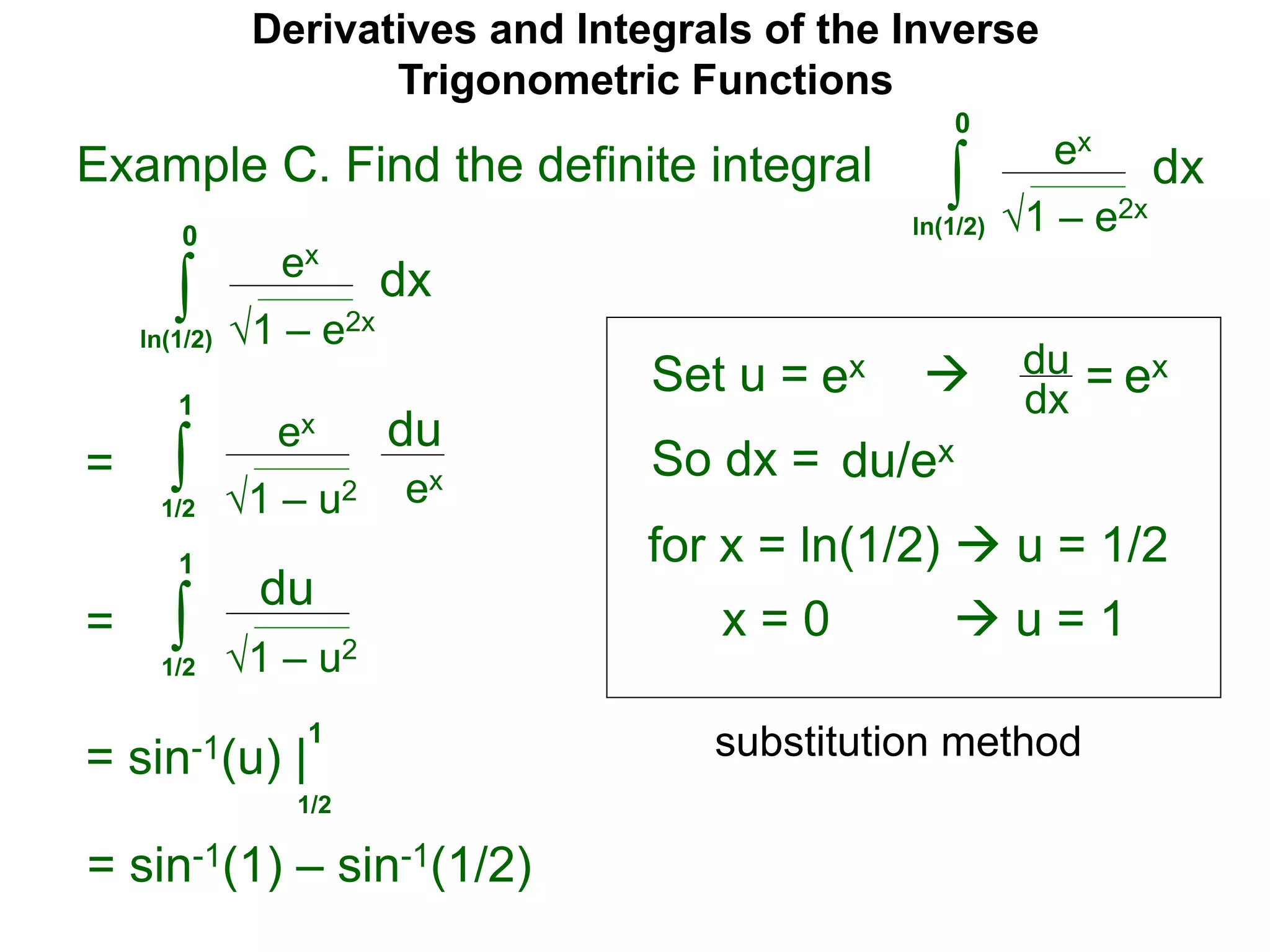
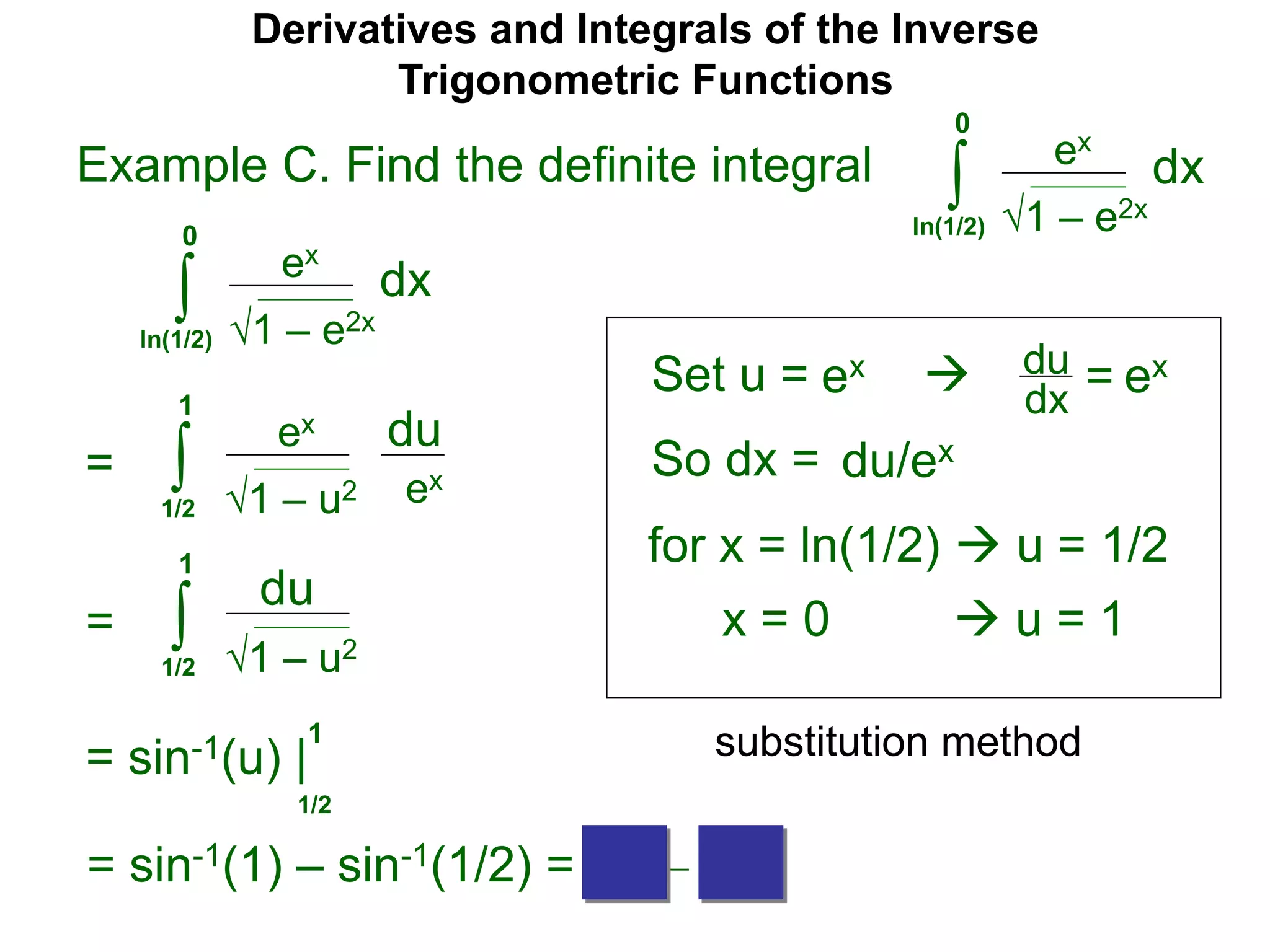
= sin-1(1) – sin-1(1/2)
Derivatives and Integrals of the Inverse
Trigonometric Functions
Set u =
ex
∫
 du
dx =
So dx = du/ex
=
substitution method
Example C. Find the definite integral
1 – e2x
dx
0
ln(1/2)
ex
∫ 1 – e2x
dx
0
ln(1/2)
ex ex
for x = ln(1/2)  u = 1/2
x = 0  u = 1
ex
∫ 1 – u2
du
1
1/2
ex
= ∫ 1 – u2
du
1
1/2
= sin-1(u) |
1/2
1
= sin-1(1) – sin-1(1/2) = π/2 – π/6
Derivatives and Integrals of the Inverse
Trigonometric Functions
Set u =
ex
∫
 du
dx =
So dx = du/ex
=
substitution method
Example C. Find the definite integral
1 – e2x
dx
0
ln(1/2)
ex
∫ 1 – e2x
dx
0
ln(1/2)
ex ex
for x = ln(1/2)  u = 1/2
x = 0  u = 1
ex
∫ 1 – u2
du
1
1/2
ex
= ∫ 1 – u2
du
1
1/2
= sin-1(u) |
1/2
1
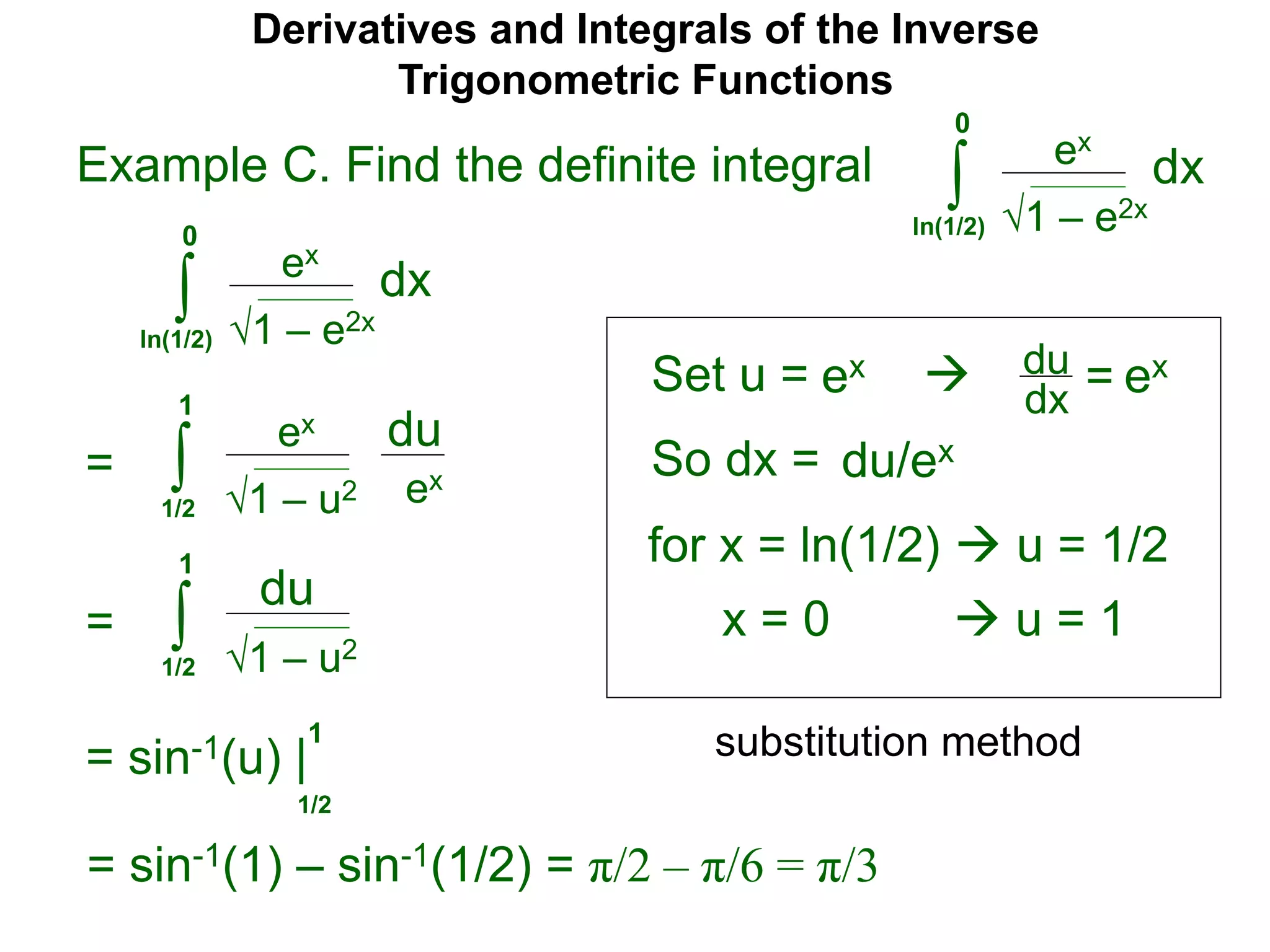
= sin-1(1) – sin-1(1/2) = π/2 – π/6 = π/3
Lastly, we have the hyperbolic trigonometric
functions.
Derivatives and Integrals of the Inverse
Trigonometric Functions
Lastly, we have the hyperbolic trigonometric
functions. These functions are made from the
exponential functions with relations among
them that are similar to the trig-family.
Derivatives and Integrals of the Inverse
Trigonometric Functions
Derivatives and Integrals of the Inverse
Trigonometric Functions
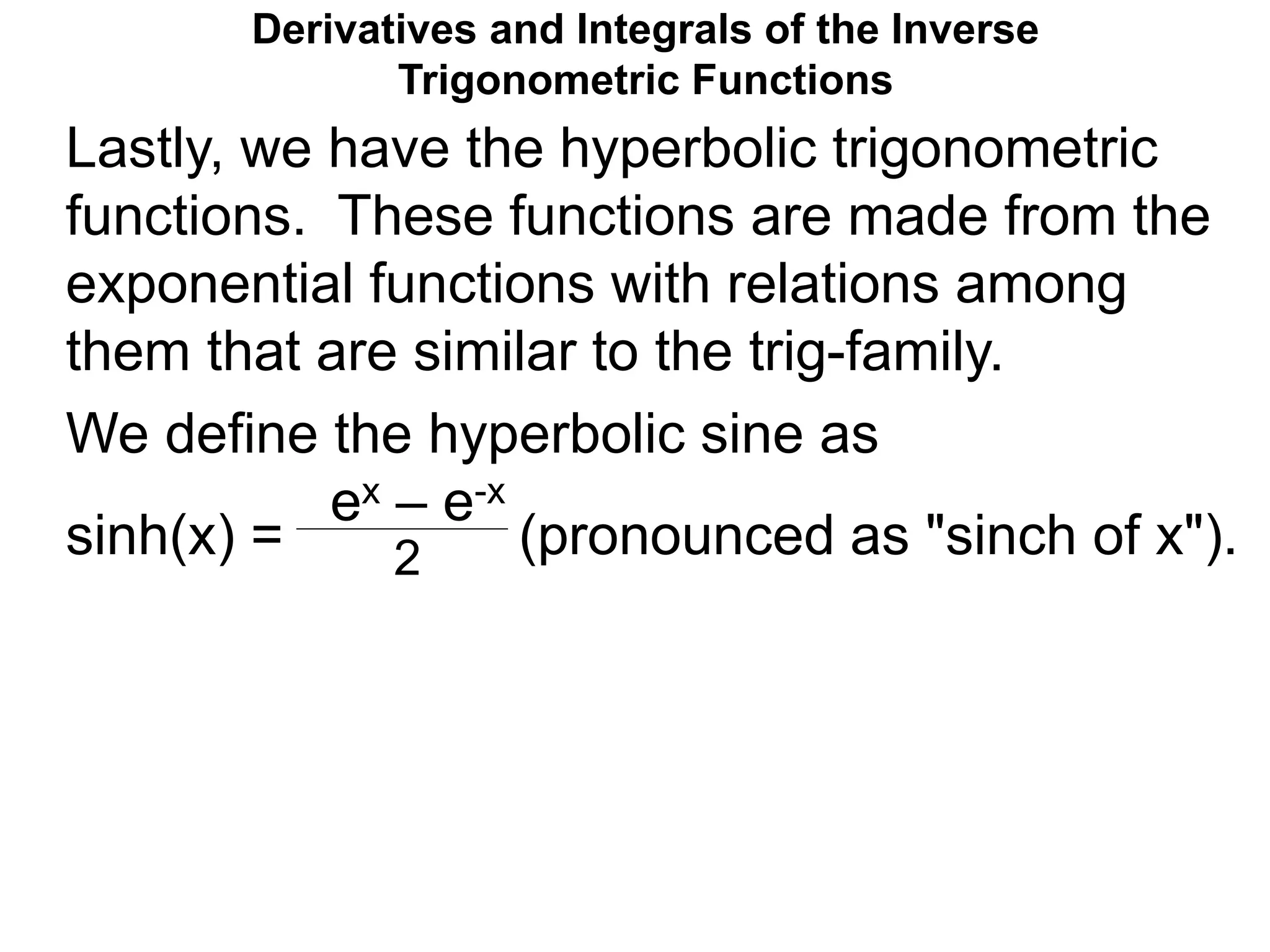
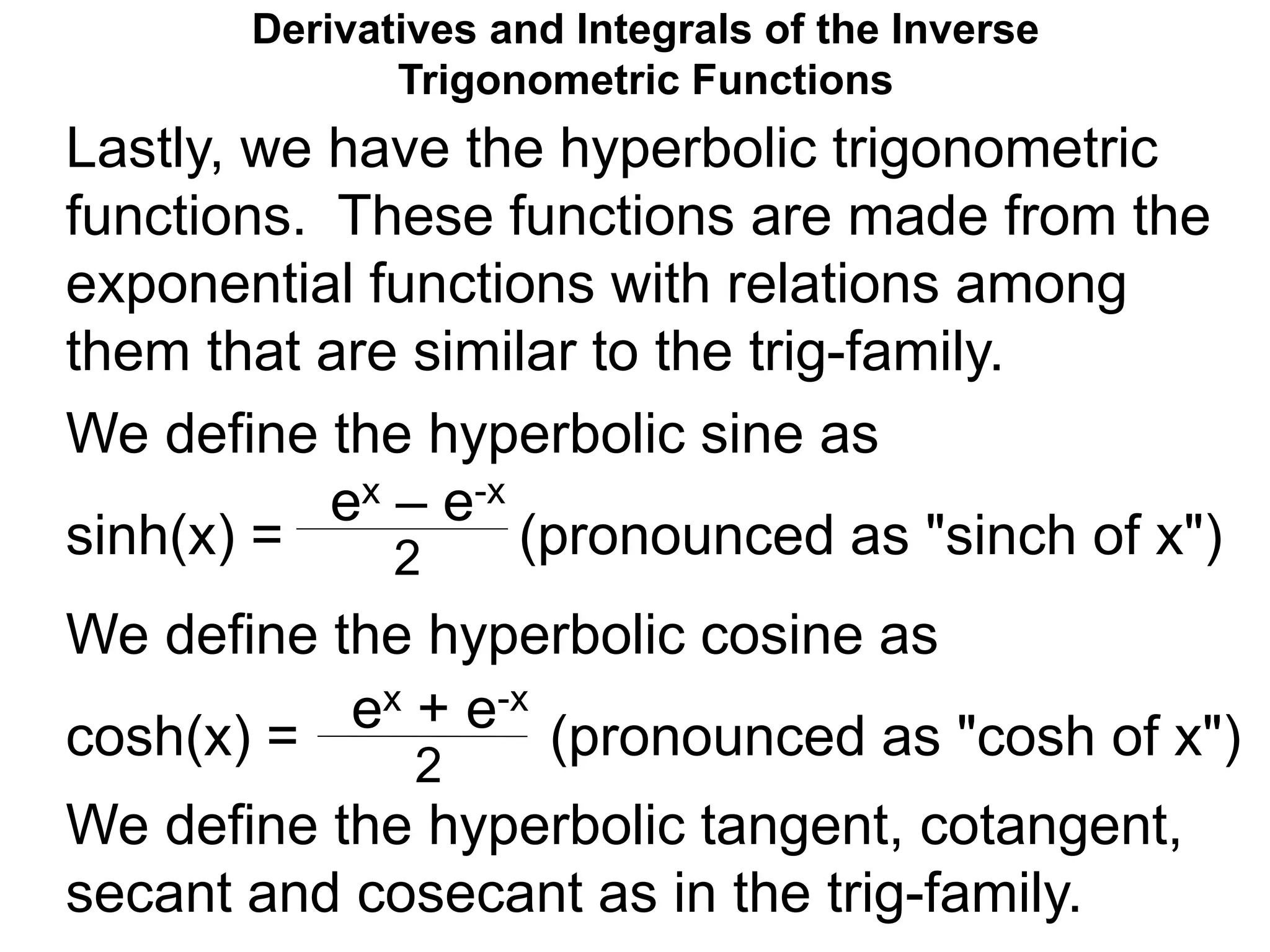
We define the hyperbolic sine as
sinh(x) = (pronounced as "sinch of x").
ex – e-x
2
Lastly, we have the hyperbolic trigonometric
functions. These functions are made from the
exponential functions with relations among
them that are similar to the trig-family.
Derivatives and Integrals of the Inverse
Trigonometric Functions
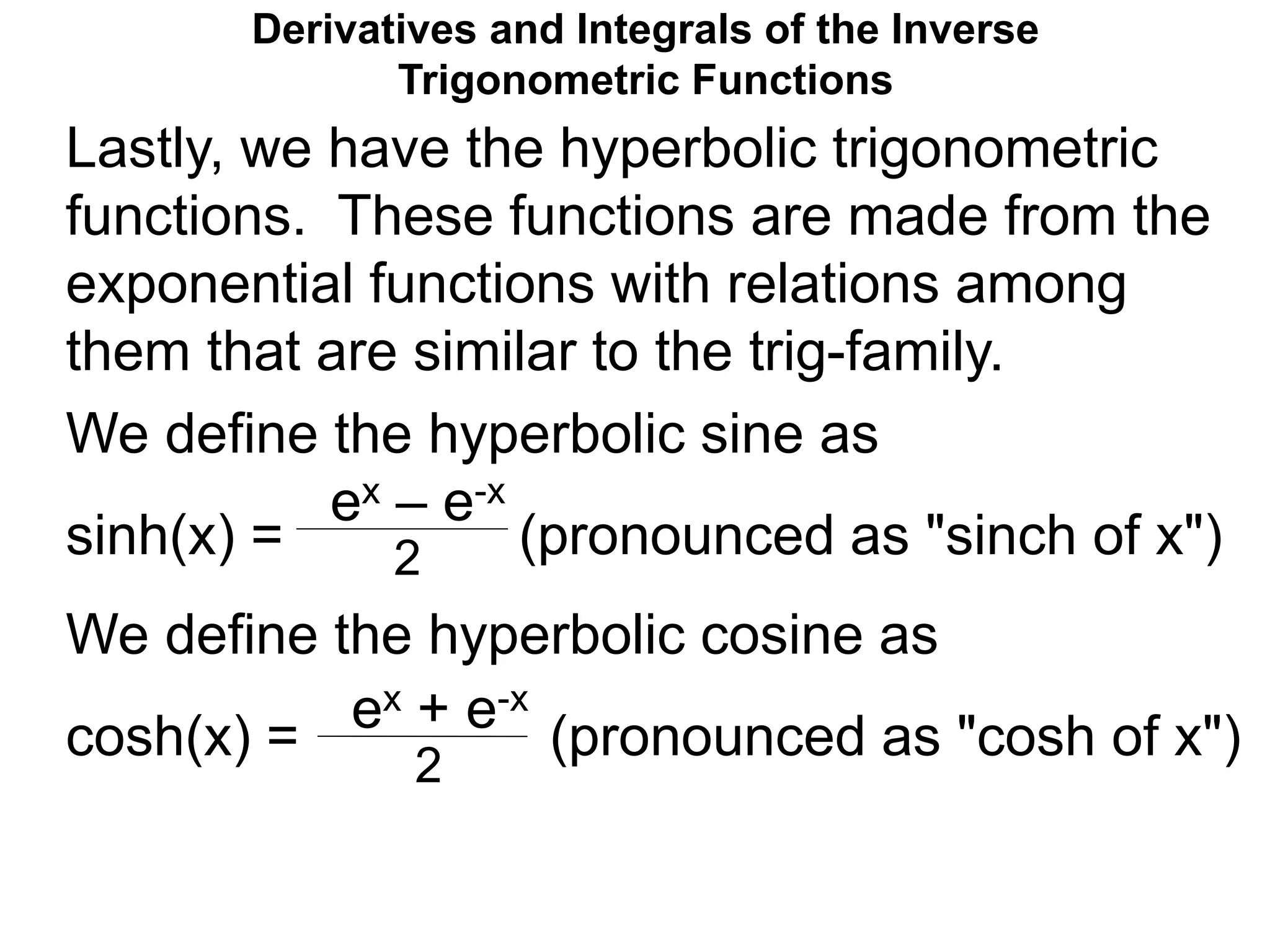
We define the hyperbolic sine as
sinh(x) = (pronounced as "sinch of x")
We define the hyperbolic cosine as
cosh(x) = (pronounced as "cosh of x")
ex – e-x
2
ex + e-x
2
Lastly, we have the hyperbolic trigonometric
functions. These functions are made from the
exponential functions with relations among
them that are similar to the trig-family.
Derivatives and Integrals of the Inverse
Trigonometric Functions
We define the hyperbolic sine as
sinh(x) = (pronounced as "sinch of x")
We define the hyperbolic cosine as
cosh(x) = (pronounced as "cosh of x")
ex – e-x
2
ex + e-x
2
We define the hyperbolic tangent, cotangent,
secant and cosecant as in the trig-family.
Lastly, we have the hyperbolic trigonometric
functions. These functions are made from the
exponential functions with relations among
them that are similar to the trig-family.
Derivatives and Integrals of the Inverse
Trigonometric Functions
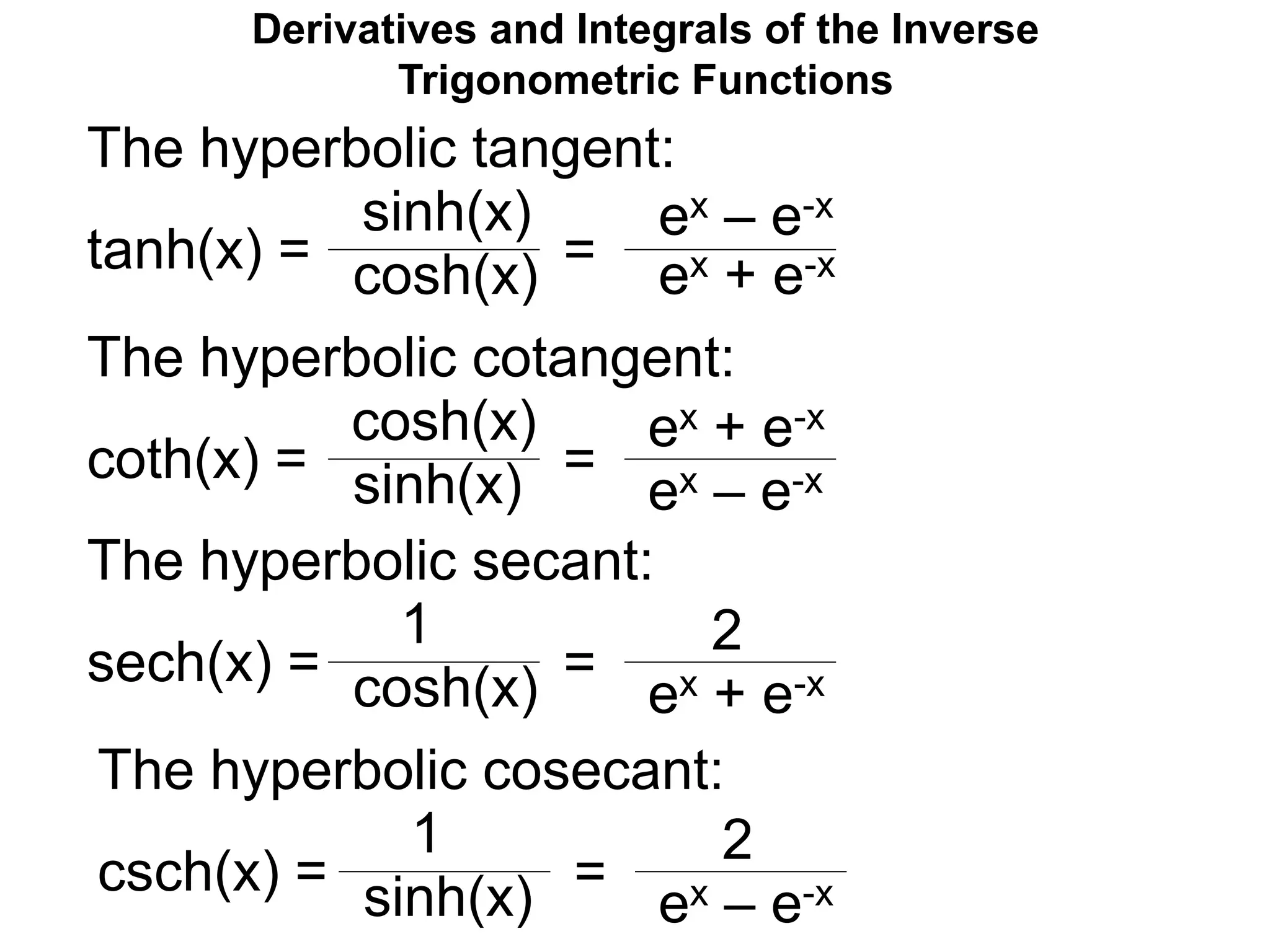
The hyperbolic tangent:
tanh(x) =
sinh(x)
cosh(x) =
ex – e-x
ex + e-x
The hyperbolic cotangent:
coth(x) =
cosh(x)
sinh(x) =
ex – e-x
ex + e-x
The hyperbolic secant:
sech(x) =
1
cosh(x) =
ex + e-x
2
The hyperbolic cosecant:
csch(x) =
1
sinh(x) =
ex – e-x
2
Derivatives and Integrals of the Inverse
Trigonometric Functions
3,11,12,33,77,78,82,89,90.
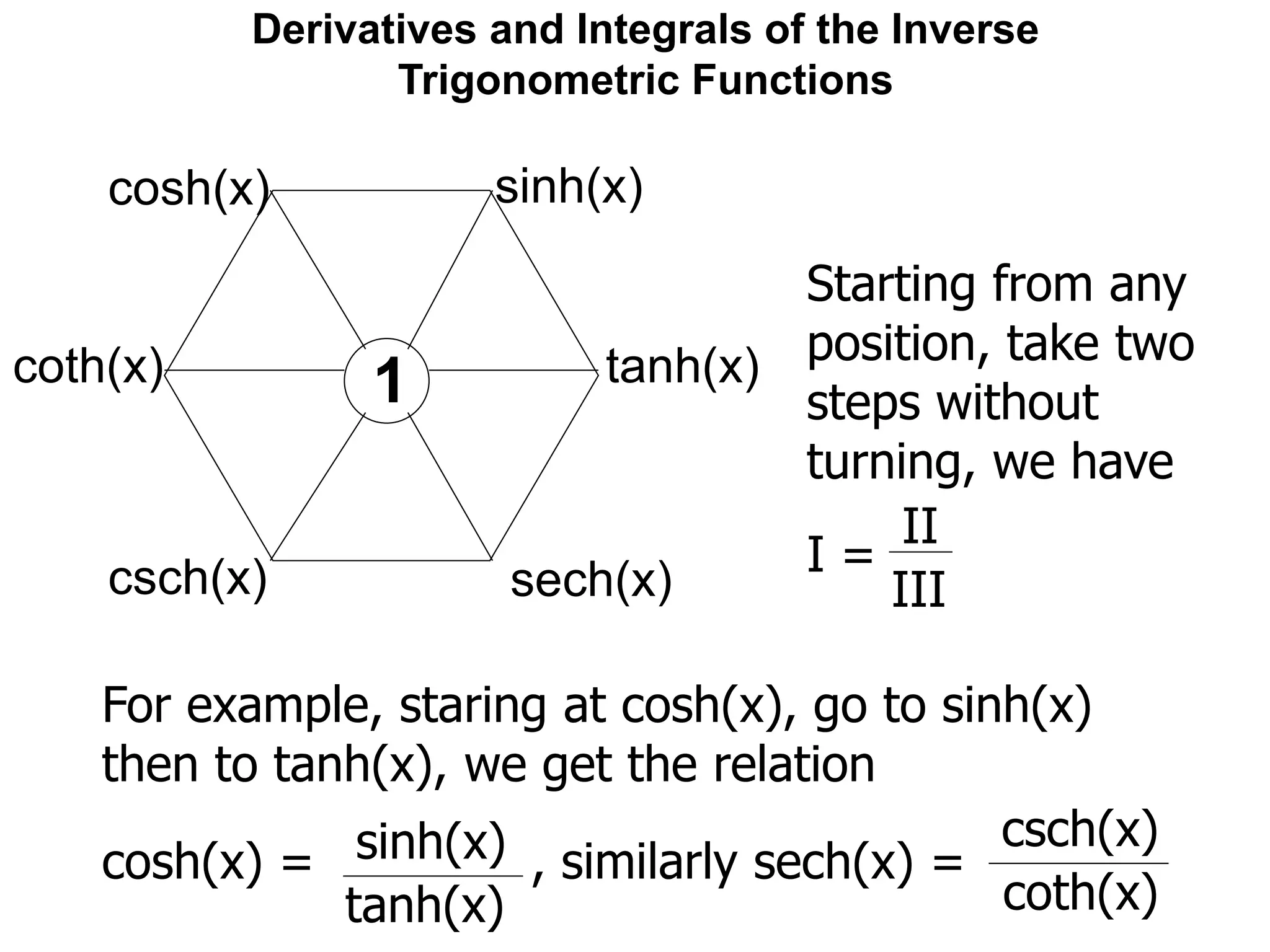
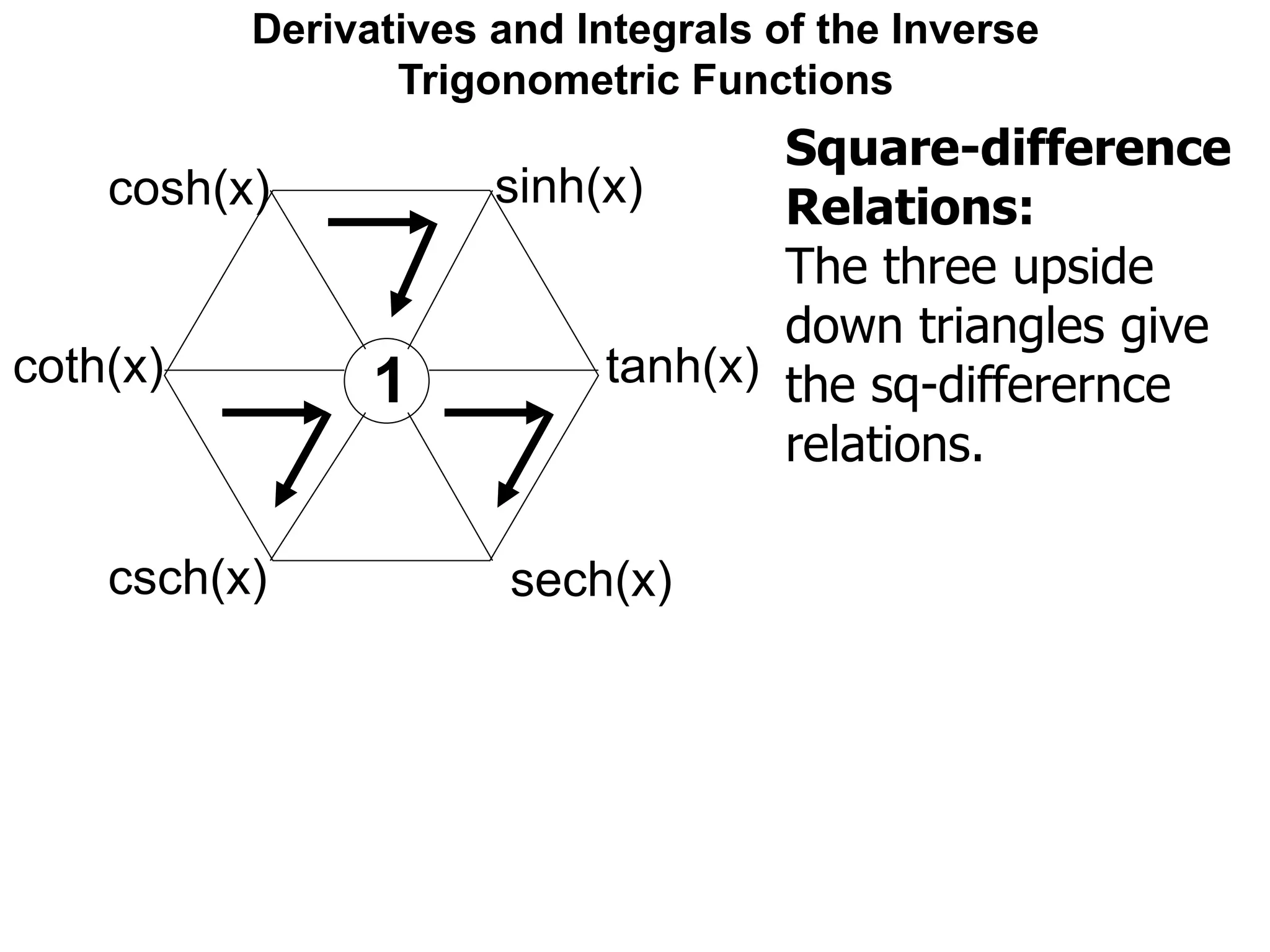
As with the trig-family, we have the hyperbolic-
trig hexagram to help us with their relations.
Derivatives and Integrals of the Inverse
Trigonometric Functions
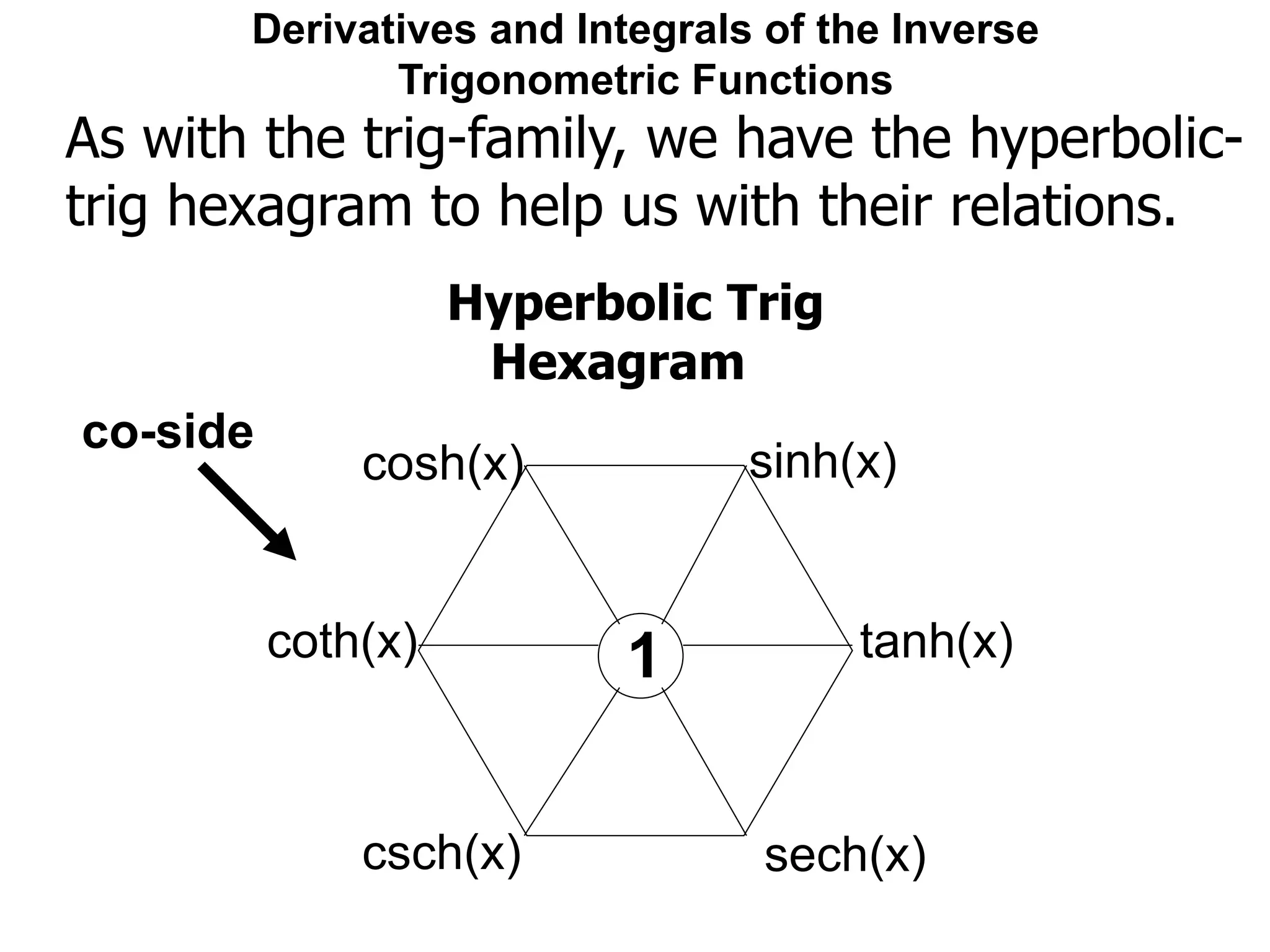
Hyperbolic Trig
Hexagram
Derivatives and Integrals of the Inverse
Trigonometric Functions
sinh(x)cosh(x)
coth(x)
csch(x)
tanh(x)
sech(x)
1
co-side
As with the trig-family, we have the hyperbolic-
trig hexagram to help us with their relations.
Derivatives and Integrals of the Inverse
Trigonometric Functions
sinh(x)cosh(x)
coth(x)
csch(x)
tanh(x)
sech(x)
1
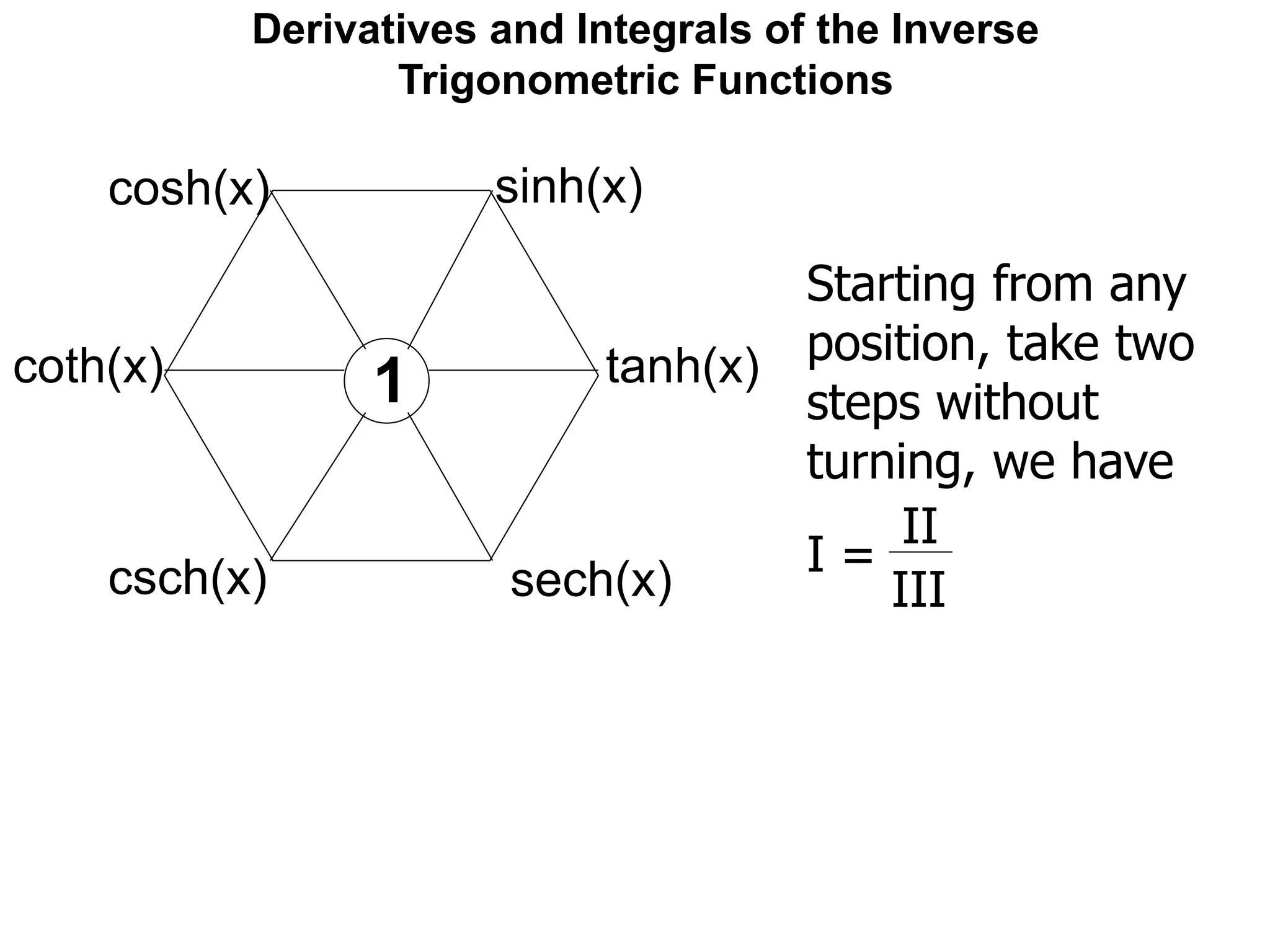
Starting from any
position, take two
steps without
turning, we have
I =
II
III
Derivatives and Integrals of the Inverse
Trigonometric Functions
sinh(x)cosh(x)
coth(x)
csch(x)
tanh(x)
sech(x)
1
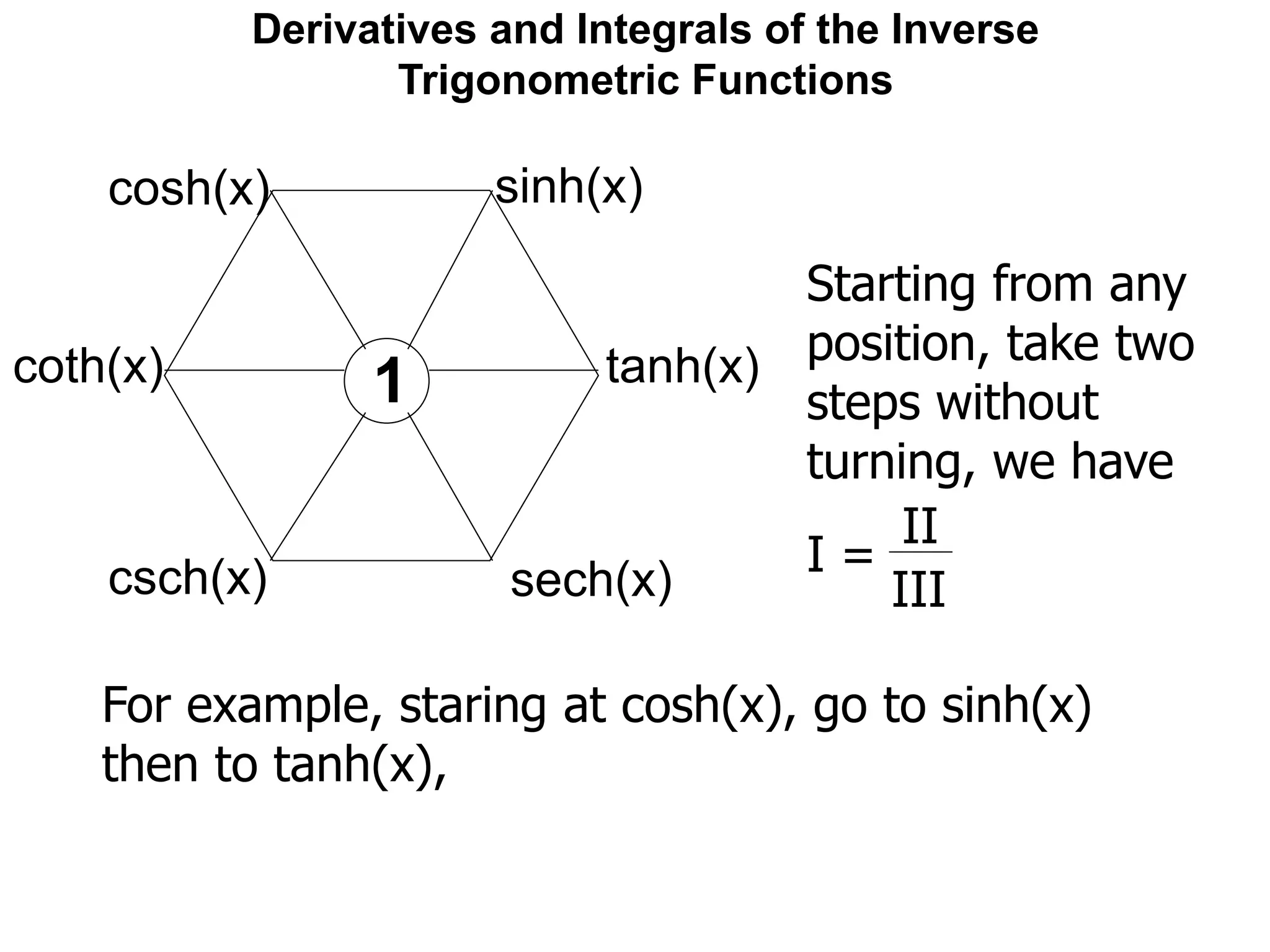
Starting from any
position, take two
steps without
turning, we have
I =
II
III
For example, staring at cosh(x), go to sinh(x)
then to tanh(x),
Derivatives and Integrals of the Inverse
Trigonometric Functions
sinh(x)cosh(x)
coth(x)
csch(x)
tanh(x)
sech(x)
1
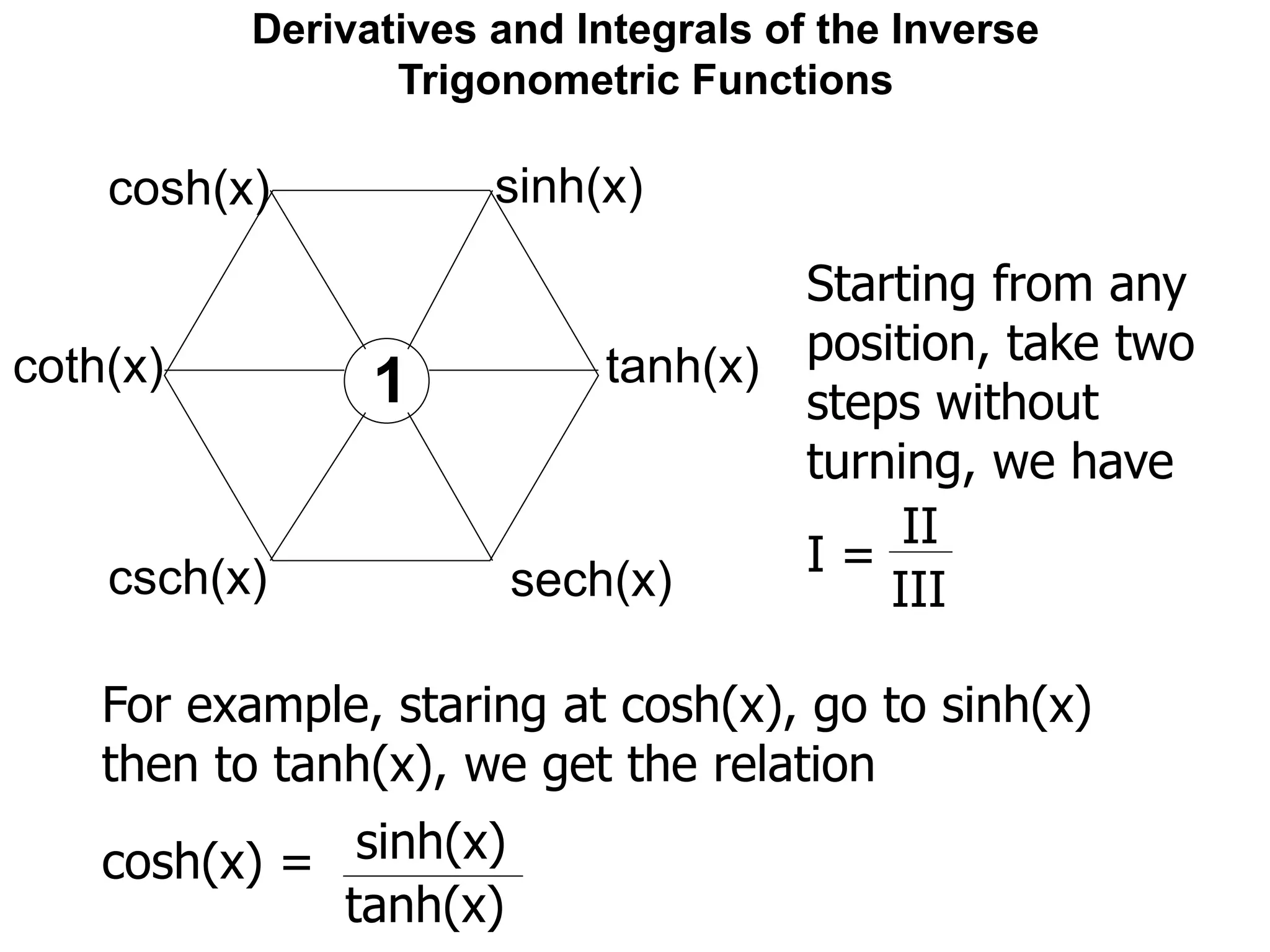
Starting from any
position, take two
steps without
turning, we have
I =
II
III
For example, staring at cosh(x), go to sinh(x)
then to tanh(x), we get the relation
cosh(x) = sinh(x)
tanh(x)
Derivatives and Integrals of the Inverse
Trigonometric Functions
sinh(x)cosh(x)
coth(x)
csch(x)
tanh(x)
sech(x)
1
Starting from any
position, take two
steps without
turning, we have
I =
II
III
For example, staring at cosh(x), go to sinh(x)
then to tanh(x), we get the relation
cosh(x) = , similarly sech(x) =sinh(x)
tanh(x)
csch(x)
coth(x)
Derivatives and Integrals of the Inverse
Trigonometric Functions
sinh(x)cosh(x)
coth(x)
csch(x)
tanh(x)
sech(x)
1
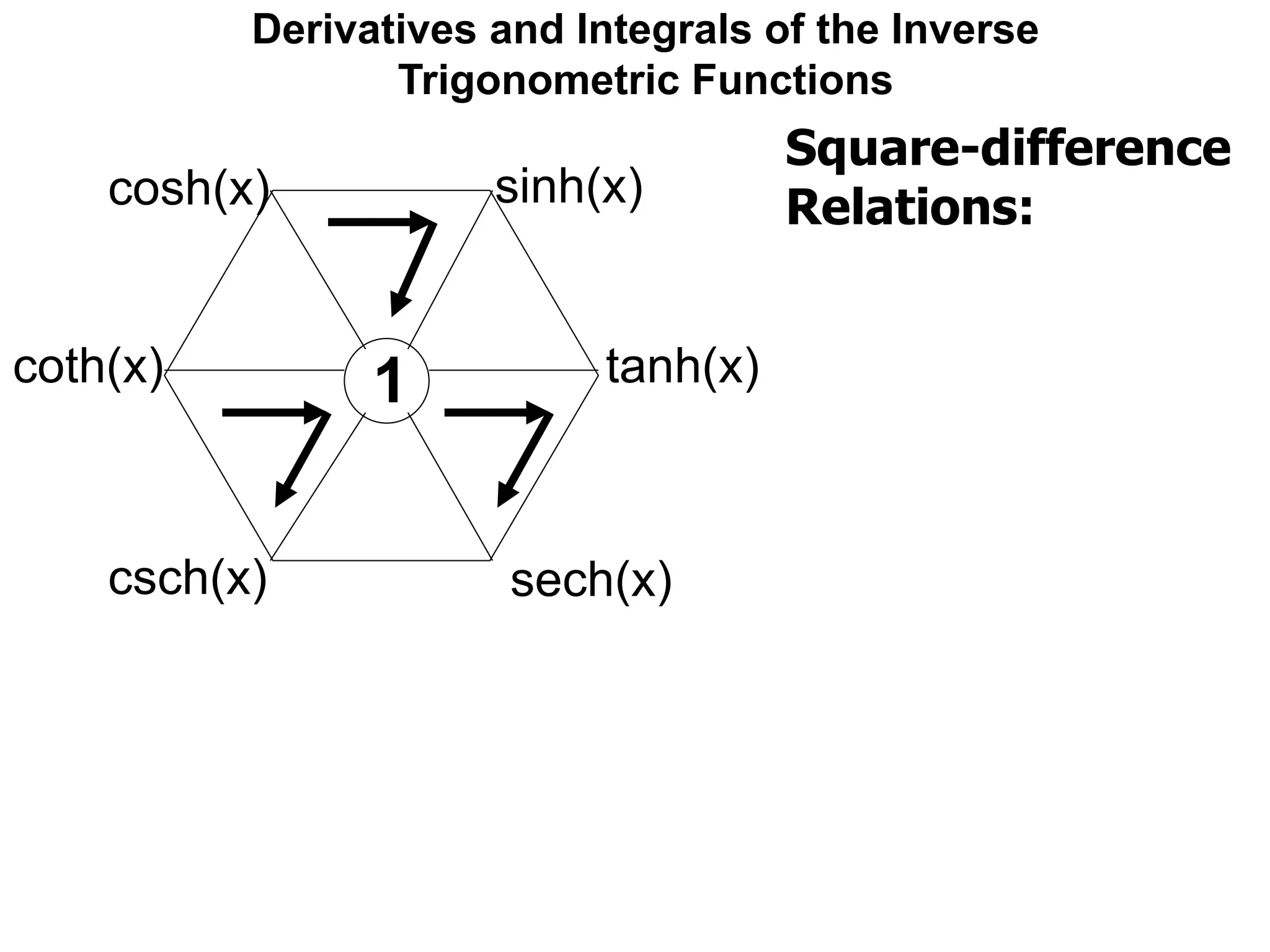
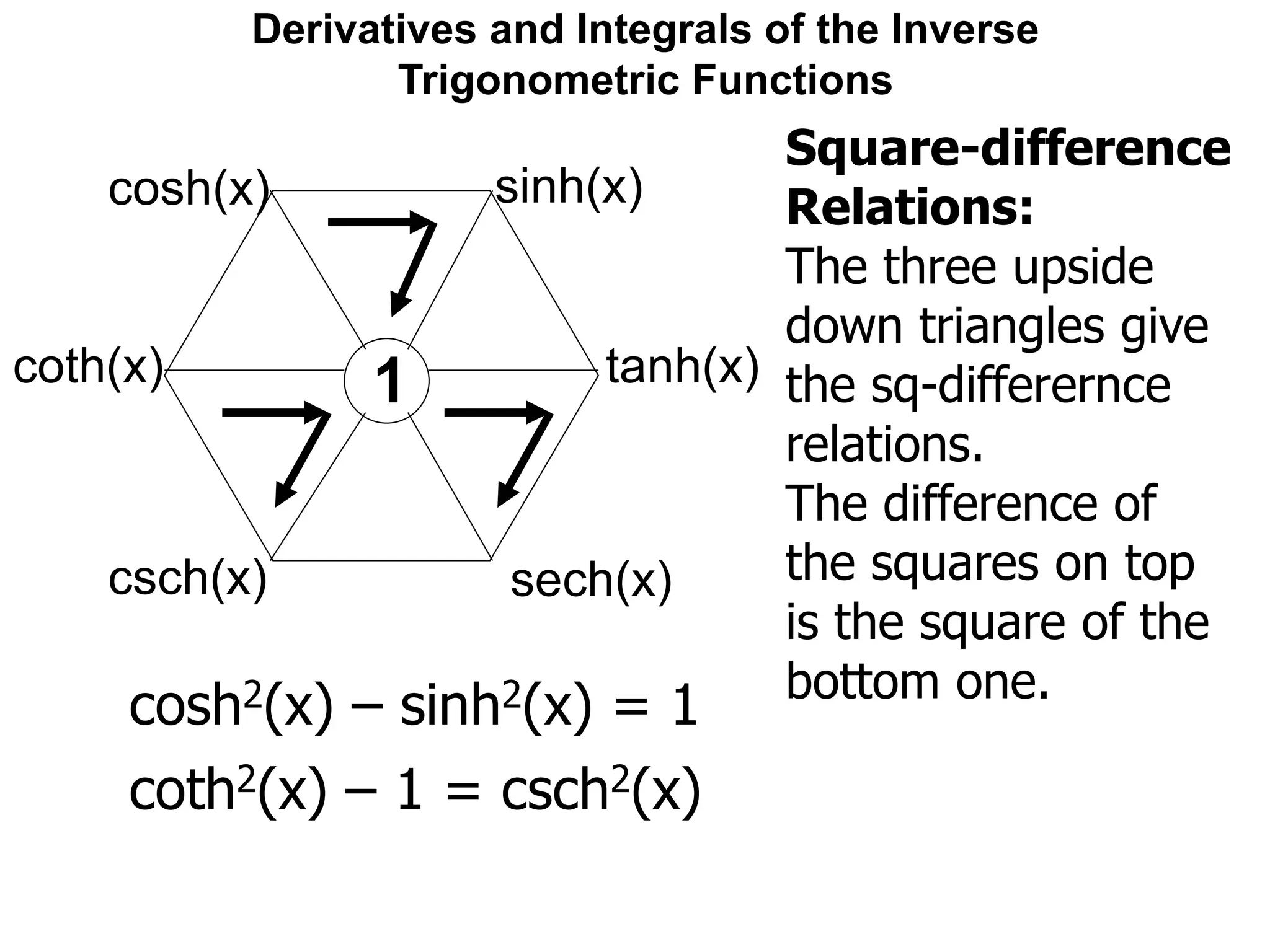
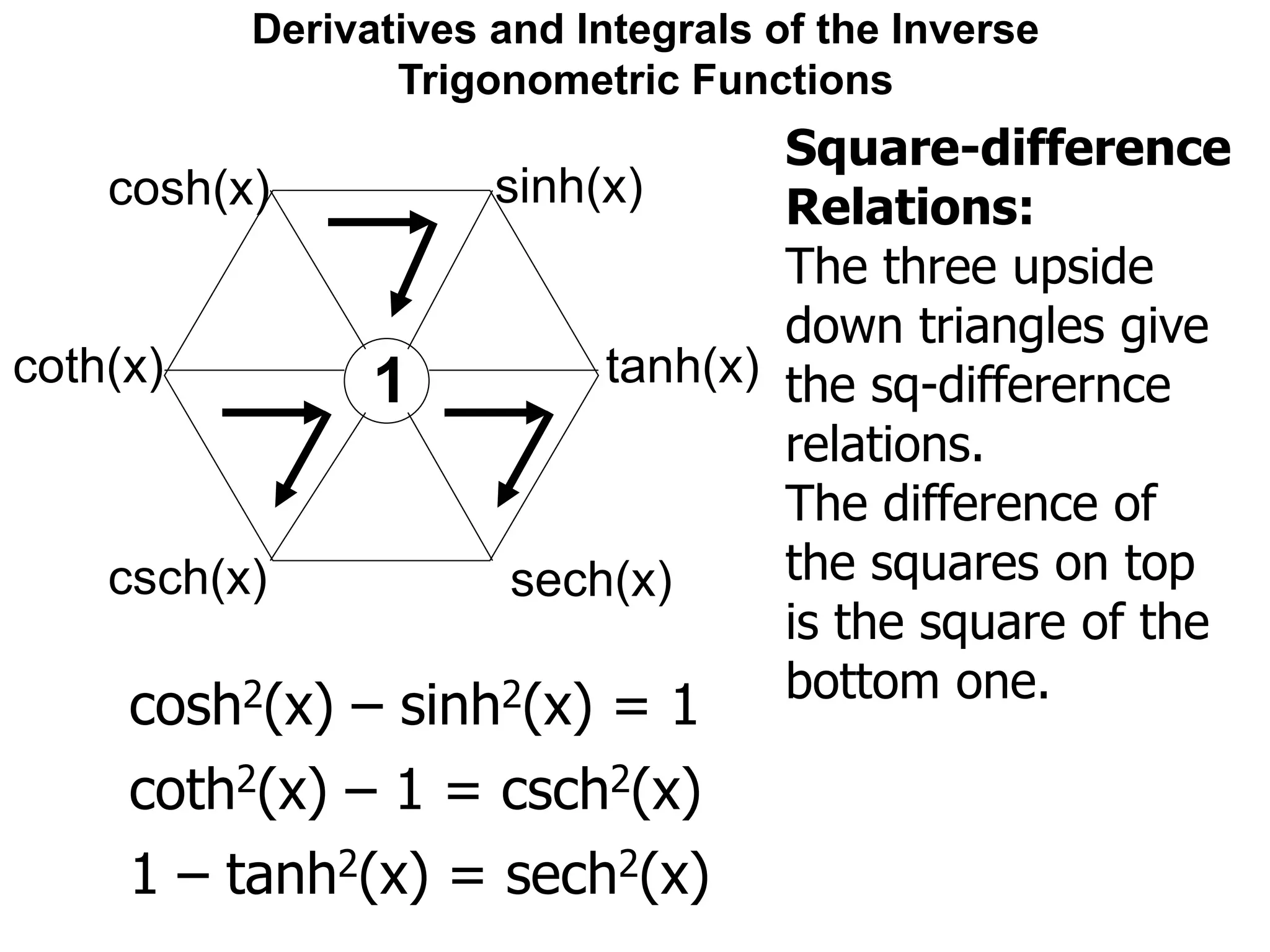
Square-difference
Relations:
Derivatives and Integrals of the Inverse
Trigonometric Functions
sinh(x)cosh(x)
coth(x)
csch(x)
tanh(x)
sech(x)
1
Square-difference
Relations:
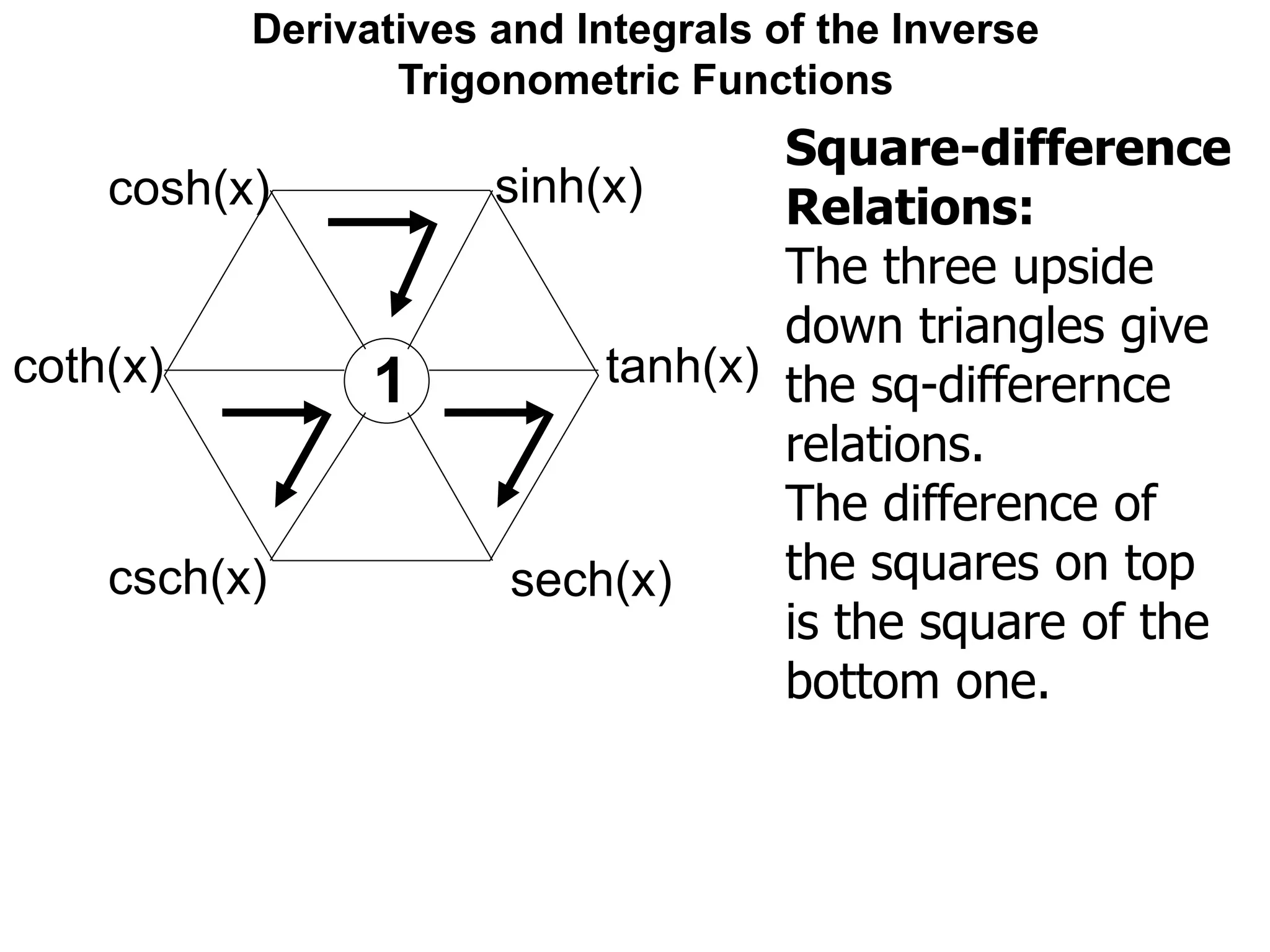
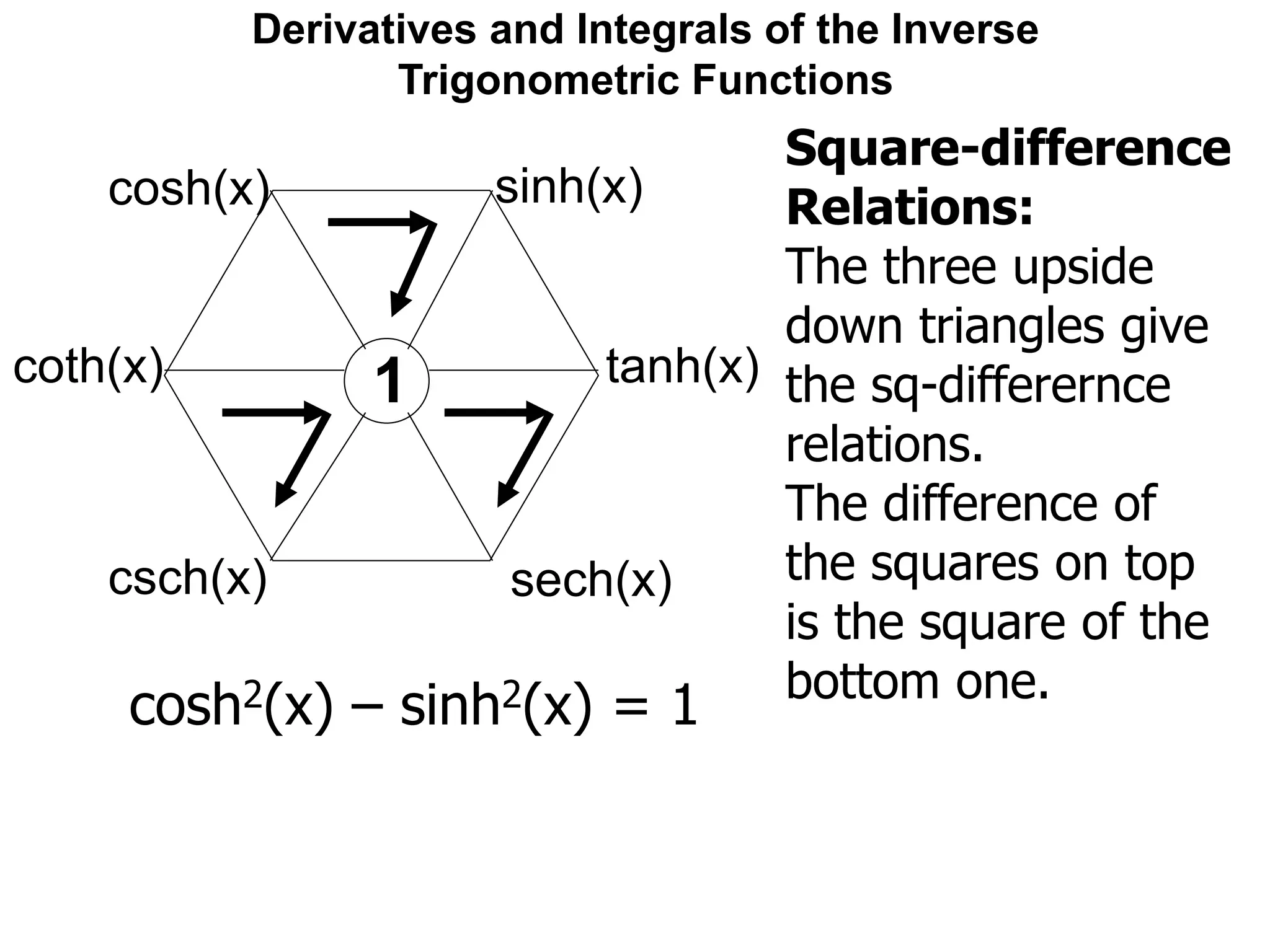
The three upside
down triangles give
the sq-differernce
relations.
Derivatives and Integrals of the Inverse
Trigonometric Functions
sinh(x)cosh(x)
coth(x)
csch(x)
tanh(x)
sech(x)
1
Square-difference
Relations:
The three upside
down triangles give
the sq-differernce
relations.
The difference of
the squares on top
is the square of the
bottom one.
Derivatives and Integrals of the Inverse
Trigonometric Functions
sinh(x)cosh(x)
coth(x)
csch(x)
tanh(x)
sech(x)
1
Square-difference
Relations:
The three upside
down triangles give
the sq-differernce
relations.
The difference of
the squares on top
is the square of the
bottom one.
cosh2(x) – sinh2(x) = 1
Derivatives and Integrals of the Inverse
Trigonometric Functions
sinh(x)cosh(x)
coth(x)
csch(x)
tanh(x)
sech(x)
1
Square-difference
Relations:
The three upside
down triangles give
the sq-differernce
relations.
The difference of
the squares on top
is the square of the
bottom one.
cosh2(x) – sinh2(x) = 1
coth2(x) – 1 = csch2(x)
Derivatives and Integrals of the Inverse
Trigonometric Functions
sinh(x)cosh(x)
coth(x)
csch(x)
tanh(x)
sech(x)
1
Square-difference
Relations:
The three upside
down triangles give
the sq-differernce
relations.
The difference of
the squares on top
is the square of the
bottom one.
cosh2(x) – sinh2(x) = 1
coth2(x) – 1 = csch2(x)
1 – tanh2(x) = sech2(x)
Derivatives and Integrals of the Inverse
Trigonometric Functions
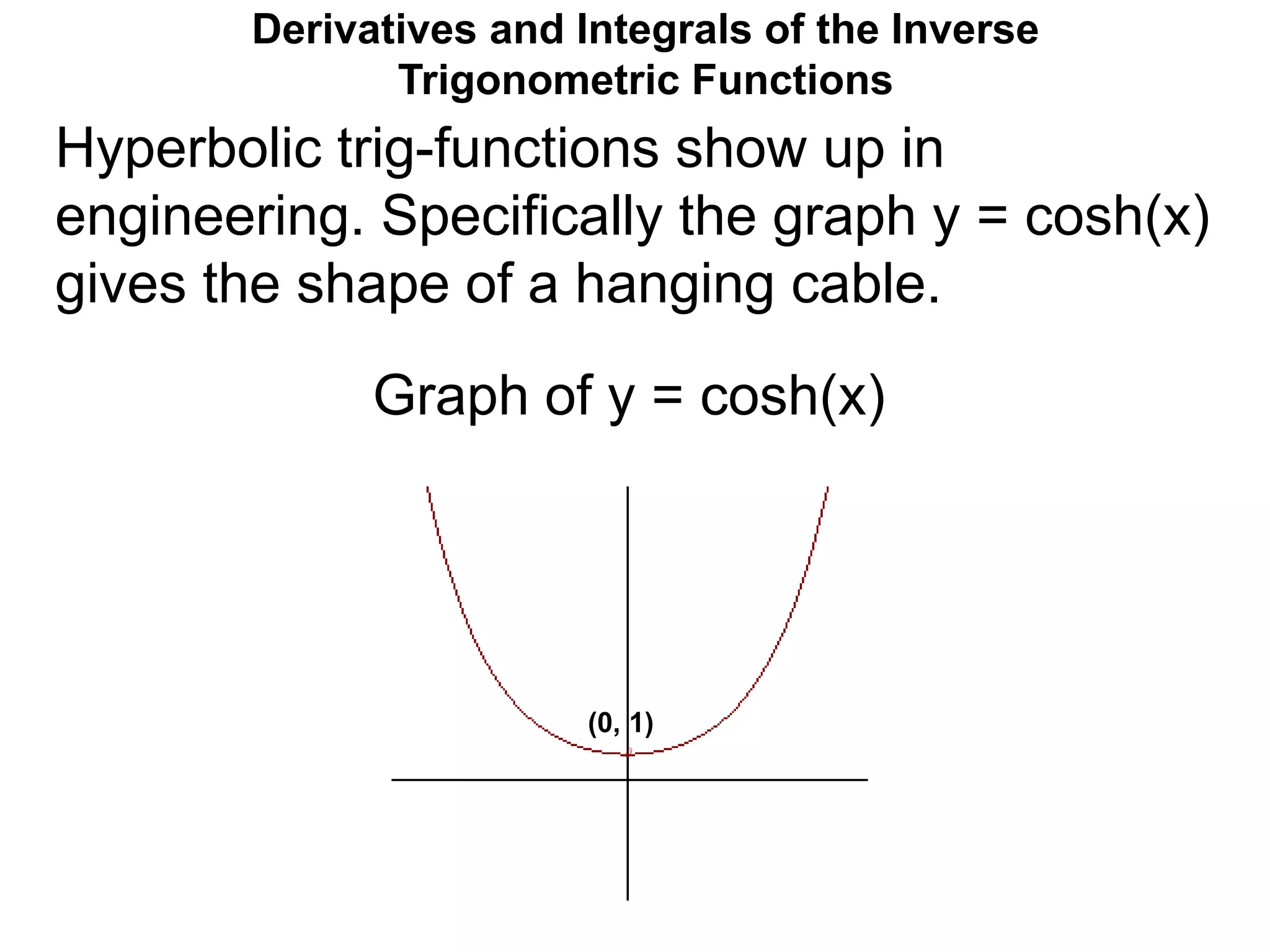
Hyperbolic trig-functions show up in
engineering.
Derivatives and Integrals of the Inverse
Trigonometric Functions
Hyperbolic trig-functions show up in
engineering. Specifically the graph y = cosh(x)
gives the shape of a hanging cable.
Derivatives and Integrals of the Inverse
Trigonometric Functions
Graph of y = cosh(x)
Hyperbolic trig-functions show up in
engineering. Specifically the graph y = cosh(x)
gives the shape of a hanging cable.
(0, 1)
Derivatives and Integrals of the Inverse
Trigonometric Functions
The derivatives of the hyperbolic trig-functions
are similar, but not the same as, the trig-family.
Derivatives and Integrals of the Inverse
Trigonometric Functions
The derivatives of the hyperbolic trig-functions
are similar, but not the same as, the trig-family.
One may easily check that:
[sinh(x)]' = cosh(x)
[cosh(x)]' = sinh(x)
Derivatives and Integrals of the Inverse
Trigonometric Functions
The derivatives of the hyperbolic trig-functions
are similar, but not the same as, the trig-family.
One may easily check that:
[sinh(x)]' = cosh(x)
[cosh(x)]' = sinh(x)
[tanh(x)]' = sech2(x)
[coth(x)]' = -csch2(x)
Derivatives and Integrals of the Inverse
Trigonometric Functions
The derivatives of the hyperbolic trig-functions
are similar, but not the same as, the trig-family.
One may easily check that:
[sinh(x)]' = cosh(x)
[cosh(x)]' = sinh(x)
[tanh(x)]' = sech2(x)
[coth(x)]' = -csch2(x)
[sech(x)]' = -sech(x)tanh(x)
[csch(x)]' = -csch(x)coth(x)

F
r
a
n
k
M
a
2
0
0
6
Derivatives and Integrals of the Inverse
Trigonometric Functions
The derivatives of the hyperbolic trig-functions
are similar, but not the same as, the trig-family.
One may easily check that:
[sinh(x)]' = cosh(x)
[cosh(x)]' = sinh(x)
[tanh(x)]' = sech2(x)
[coth(x)]' = -csch2(x)
[sech(x)]' = -sech(x)tanh(x)
[csch(x)]' = -csch(x)coth(x)
HW. Write down the chain–rule versions of the
derivatives of the hyperbolic trig-functions.

12 derivatives and integrals of inverse trigonometric functions x

  • 1.
    y = f(x) y= f–1 (x) The graphs of f and f–1 are symmetric diagonally. y = x Derivatives and Integrals of the Inverse Trigonometric Functions
  • 2.
    y = f(x) y= f–1 (x) The graphs of f and f–1 are symmetric diagonally. y = x Derivatives and Integrals of the Inverse Trigonometric Functions (a, b) Assume f(x) is differentiable and (a, b) is a point on the graph of y = f(x).
  • 3.
    y = f(x) y= f–1 (x) The graphs of f and f–1 are symmetric diagonally. y = x Derivatives and Integrals of the Inverse Trigonometric Functions (a, b) Assume f(x) is differentiable and (a, b) is a point on the graph of y = f(x). Hence the slope at (a, b) is f ’(a). slope = f ’(a)
  • 4.
    y = f(x) y= f–1 (x) The graphs of f and f–1 are symmetric diagonally. y = x Derivatives and Integrals of the Inverse Trigonometric Functions (a, b) Assume f(x) is differentiable and (a, b) is a point on the graph of y = f(x). Hence the slope at (a, b) is f ’(a). (b, a) slope = f ’(a) The reflection of (a, b) is (b, a) on the graph of y = f–1(x).
  • 5.
    y = f(x) y= f–1 (x) The graphs of f and f–1 are symmetric diagonally. y = x Derivatives and Integrals of the Inverse Trigonometric Functions (a, b) Assume f(x) is differentiable and (a, b) is a point on the graph of y = f(x). Hence the slope at (a, b) is f ’(a). (b, a) slope = f ’(a) The reflection of (a, b) is (b, a) on the graph of y = f–1(x). The slope of the tangent line at (b, a) is (f–1)’(b). slope = (f–1)’(b)
  • 6.
    The graphs off and f–1 are symmetric diagonally. Derivatives and Integrals of the Inverse Trigonometric Functions Assume f(x) is differentiable and (a, b) is a point on the graph of y = f(x). Hence the slope at (a, b) is f ’(a). The reflection of (a, b) is (b, a) on the graph of y = f–1(x). The slope of the tangent line at (b, a) is (f–1)’(b). By the symmetry the tangents at (a, b) and at (b, a) are the reflection of each other. y = f(x) y = f–1 (x) y = x (a, b) (b, a) slope = f ’(a) slope = (f–1)’(b)
  • 7.
    The graphs off and f–1 are symmetric diagonally. Derivatives and Integrals of the Inverse Trigonometric Functions Assume f(x) is differentiable and (a, b) is a point on the graph of y = f(x). Hence the slope at (a, b) is f ’(a). The reflection of (a, b) is (b, a) on the graph of y = f–1(x). The slope of the tangent line at (b, a) is (f–1)’(b). By the symmetry the tangents at (a, b) and at (b, a) are the reflection of each other. Diagonally- symmetric lines have reciprocal slopes (why?) y = f(x) y = f–1 (x) y = x (a, b) (b, a) slope = f ’(a) slope = (f–1)’(b)
  • 8.
    The graphs off and f–1 are symmetric diagonally. Derivatives and Integrals of the Inverse Trigonometric Functions Assume f(x) is differentiable and (a, b) is a point on the graph of y = f(x). Hence the slope at (a, b) is f ’(a). The reflection of (a, b) is (b, a) on the graph of y = f–1(x). The slope of the tangent line at (b, a) is (f–1)’(b). By the symmetry the tangents at (a, b) and at (b, a) are the reflection of each other. Diagonally- symmetric lines have reciprocal slopes (why?) y = f(x) y = f–1 (x) y = x (a, b) (b, a) slope = f ’(a) slope = (f–1)’(b) Hence of (f–1)’(b) = 1 f ’(a)
  • 9.
    The graphs off and f–1 are symmetric diagonally. Derivatives and Integrals of the Inverse Trigonometric Functions Assume f(x) is differentiable and (a, b) is a point on the graph of y = f(x). Hence the slope at (a, b) is f ’(a). The reflection of (a, b) is (b, a) on the graph of y = f–1(x). The slope of the tangent line at (b, a) is (f–1)’(b). By the symmetry the tangents at (a, b) and at (b, a) are the reflection of each other. Diagonally- symmetric lines have reciprocal slopes (why?) y = f(x) y = f–1 (x) y = x (a, b) (b, a) slope = f ’(a) slope = (f–1)’(b) Hence of (f–1)’(b) = 1 = 1 f ’(f–1(b))f ’(a)
  • 10.
    Suppose f andg are a pair of inverse functions, then (f o g)(x) = x. Derivatives and Integrals of the Inverse Trigonometric Functions
  • 11.
    Suppose f andg are a pair of inverse functions, then (f o g)(x) = x. Differentiate both sides with respect to x and use the chain rule: [(f o g)(x)]' = x' Derivatives and Integrals of the Inverse Trigonometric Functions
  • 12.
    Suppose f andg are a pair of inverse functions, then (f o g)(x) = x. Differentiate both sides with respect to x and use the chain rule: [(f o g)(x)]' = x' f '(g(x)) * g'(x) = 1 Derivatives and Integrals of the Inverse Trigonometric Functions
  • 13.
    Suppose f andg are a pair of inverse functions, then (f o g)(x) = x. Differentiate both sides with respect to x and use the chain rule: [(f o g)(x)]' = x' f '(g(x)) * g'(x) = 1 or g'(x) = 1 f '(g(x)) Derivatives and Integrals of the Inverse Trigonometric Functions
  • 14.
    Suppose f andg are a pair of inverse functions, then (f o g)(x) = x. Differentiate both sides with respect to x and use the chain rule: [(f o g)(x)]' = x' f '(g(x)) * g'(x) = 1 or g'(x) = 1 f '(g(x)) Set f = sin(x) and g = arcsin(x) Derivatives and Integrals of the Inverse Trigonometric Functions
  • 15.
    Suppose f andg are a pair of inverse functions, then (f o g)(x) = x. Differentiate both sides with respect to x and use the chain rule: [(f o g)(x)]' = x' f '(g(x)) * g'(x) = 1 or g'(x) = 1 f '(g(x)) Set f = sin(x) and g = arcsin(x) we obtain [arcsin(x)]' = 1 dsin(y) Derivatives and Integrals of the Inverse Trigonometric Functions dy y=arcsin(x)
  • 16.
    Suppose f andg are a pair of inverse functions, then (f o g)(x) = x. Differentiate both sides with respect to x and use the chain rule: [(f o g)(x)]' = x' f '(g(x)) * g'(x) = 1 or g'(x) = 1 f '(g(x)) Set f = sin(x) and g = arcsin(x) we obtain [arcsin(x)]' = 1 dsin(y) 1 cos(arcsin(x)) = Derivatives and Integrals of the Inverse Trigonometric Functions dy y=arcsin(x)
  • 17.
    [arcsin(x)]' 1 cos(arcsin(x)) = Derivatives and Integralsof the Inverse Trigonometric Functions
  • 18.
  • 19.
    θ=arcsin(x) x 1 1 – x2 [arcsin(x)]' 1 cos(arcsin(x)) = Derivativesand Integrals of the Inverse Trigonometric Functions
  • 20.
    θ=arcsin(x) x 1 1 – x2 [arcsin(x)]' 1 cos(arcsin(x)) = 1 1– x2 [arcsin(x)]' = Derivatives and Integrals of the Inverse Trigonometric Functions
  • 21.
    θ=arcsin(x) x 1 1 – x2 [arcsin(x)]' 1 cos(arcsin(x)) = 1 1– x2 [arcsin(x)]' = Derivatives and Integrals of the Inverse Trigonometric Functions –1 1 –π/2 π/2 x y=arcsin(x)
  • 22.
    θ=arcsin(x) x 1 1 – x2 [arcsin(x)]' 1 cos(arcsin(x)) = 1 1– x2 [arcsin(x)]' = We use the same technique to obtain the derivatives of the other inverse trig-functions. Derivatives and Integrals of the Inverse Trigonometric Functions –1 1 –π/2 π/2 x y=arcsin(x)
  • 23.
    θ=arcsin(x) x 1 1 – x2 [arcsin(x)]' 1 cos(arcsin(x)) = 1 1– x2 [arcsin(x)]' = We use the same technique to obtain the derivatives of the other inverse trig-functions. Derivatives and Integrals of the Inverse Trigonometric Functions –1 1 –π/2 π/2 x y=arcsin(x) We display the graphs of each inverse–trig and list each of their derivatives below.
  • 24.
    Derivatives of theInverse Trig–Functions 1 1 – x2 [sin–1(x)] ' = y =sin–1(x)
  • 25.
    Derivatives of theInverse Trig–Functions [cos–1(x)]' = 1 1 – x2 [sin–1(x)] ' = –1 1 – x2 y =sin–1(x) y =cos–1(x)
  • 26.
    Derivatives of theInverse Trig–Functions [cos–1(x)]' = 1 1 + x2 [tan–1(x)]' = 1 1 – x2 [sin–1(x)] ' = –1 1 – x2 y =tan–1(x) y =sin–1(x) y =cos–1(x)
  • 27.
    Derivatives of theInverse Trig–Functions [cos–1(x)]' = 1 1 + x2 [tan–1(x)]' = –1 1 + x2[cot–1(x)]' = 1 1 – x2 [sin–1(x)] ' = –1 1 – x2 y =tan–1(x) y =sin–1(x) y =cos–1(x) y =cot–1(x)
  • 28.
    Derivatives of theInverse Trig–Functions [cos–1(x)]' = 1 1 + x2 [tan–1(x)]' = |x|x2 – 1 [sec–1(x)]' = –1 1 + x2[cot–1(x)]' = y =sec–1(x) 1 1 – x2 [sin–1(x)] ' = –1 1 – x2 1 y =tan–1(x) y =sin–1(x) y =cos–1(x) y =cot–1(x)
  • 29.
    Derivatives of theInverse Trig–Functions [cos–1(x)]' = 1 1 + x2 [tan–1(x)]' = |x|x2 – 1 [sec–1(x)]' = –1 1 + x2[cot–1(x)]' = –1 |x|x2 – 1 [csc–1(x)]' = y =sec–1(x) y =csc–1(x) 1 1 – x2 [sin–1(x)] ' = –1 1 – x2 1 y =tan–1(x) y =sin–1(x) y =cos–1(x) y =cot–1(x)
  • 30.
    Derivatives of theInverse Trig–Functions u' 1 – u2[sin–1(u)]' = –u' 1 – u2 [cos–1 (u)]' = u' 1 + u2[tan–1(u)]' = u' |u|u2 – 1 [sec–1(u)]' = –u' 1 + u2[cot–1(u)]' = –u' |u|u2 – 1 [csc–1(u)]' = dsin-1(u) dx = 1 1 – u2 du dx –1 1 – u2 du dx 1 1 + u2 du dx 1 |u|u2 – 1 du dx dcos-1(u) dx = dtan-1(u) dx = dsec-1(u) dx = –1 1 + u2 du dx dtan-1(u) dx = –1 |u|u2 – 1 du dx dcsc-1(u) dx = Below are the chain–rule versions where u = u(x).
  • 31.
    Derivatives and Integralsof the Inverse Trigonometric Functions –u' 1 – u2 [cos–1 (u)]' = u' 1 + u2[tan–1(u)]' = u' |u|u2 – 1 [sec–1(u)]' = We’ll use the following formulas for the next example.
  • 32.
    Derivatives and Integralsof the Inverse Trigonometric Functions b. cos–1(ex ) Example A. Find the following derivatives. a. tan–1(x3) –u' 1 – u2 [cos–1 (u)]' = u' 1 + u2[tan–1(u)]' = u' |u|u2 – 1 [sec–1(u)]' = We’ll use the following formulas for the next example. 2 c. sec–1(ln(x))
  • 33.
    Derivatives and Integralsof the Inverse Trigonometric Functions b. cos–1(ex ) 2 Example A. Find the following derivatives. Set u = x3, a. tan–1(x3) –u' 1 – u2 [cos–1 (u)]' = u' 1 + u2[tan–1(u)]' = u' |u|u2 – 1 [sec–1(u)]' = We’ll use the following formulas for the next example. c. sec–1(ln(x))
  • 34.
    Derivatives and Integralsof the Inverse Trigonometric Functions b. cos–1(ex ) 2 Example A. Find the following derivatives. Set u = x3, so [tan–1(x3)]' = (x3)' 1 + (x3)2 a. tan–1(x3) –u' 1 – u2 [cos–1 (u)]' = u' 1 + u2[tan–1(u)]' = u' |u|u2 – 1 [sec–1(u)]' = We’ll use the following formulas for the next example. c. sec–1(ln(x))
  • 35.
    Derivatives and Integralsof the Inverse Trigonometric Functions b. cos–1(ex ) 2 Example A. Find the following derivatives. Set u = x3, so [tan–1(x3)]' = (x3)' 1 + (x3)2 = 3x2 1 + x6 a. tan–1(x3) –u' 1 – u2 [cos–1 (u)]' = u' 1 + u2[tan–1(u)]' = u' |u|u2 – 1 [sec–1(u)]' = We’ll use the following formulas for the next example. c. sec–1(ln(x))
  • 36.
    Derivatives and Integralsof the Inverse Trigonometric Functions b. cos–1(ex ) Set u = ex, 2 Example A. Find the following derivatives. Set u = x3, so [tan–1(x3)]' = (x3)' 1 + (x3)2 = 3x2 1 + x6 a. tan–1(x3) –u' 1 – u2 [cos–1 (u)]' = u' 1 + u2[tan–1(u)]' = u' |u|u2 – 1 [sec–1(u)]' = We’ll use the following formulas for the next example. c. sec–1(ln(x))
  • 37.
    Derivatives and Integralsof the Inverse Trigonometric Functions b. cos–1(ex ) Set u = ex, so [cos-1(ex )]' = 2 2 1 – (ex )2 –(ex )' 2 2 Example A. Find the following derivatives. Set u = x3, so [tan–1(x3)]' = (x3)' 1 + (x3)2 = 3x2 1 + x6 a. tan–1(x3) –u' 1 – u2 [cos–1 (u)]' = u' 1 + u2[tan–1(u)]' = u' |u|u2 – 1 [sec–1(u)]' = We’ll use the following formulas for the next example. c. sec–1(ln(x))
  • 38.
    Derivatives and Integralsof the Inverse Trigonometric Functions b. cos–1(ex ) Set u = ex, so [cos-1(ex )]' = 2 2 1 – (ex )2 –(ex )' 2 2 = –2xex 1 – e2x2 2 Example A. Find the following derivatives. Set u = x3, so [tan–1(x3)]' = (x3)' 1 + (x3)2 = 3x2 1 + x6 a. tan–1(x3) –u' 1 – u2 [cos–1 (u)]' = u' 1 + u2[tan–1(u)]' = u' |u|u2 – 1 [sec–1(u)]' = We’ll use the following formulas for the next example. c. sec–1(ln(x))
  • 39.
    Derivatives and Integralsof the Inverse Trigonometric Functions b. cos–1(ex ) Set u = ex, so [cos-1(ex )]' = 2 2 1 – (ex )2 –(ex )' 2 2 = –2xex 1 – e2x2 2 Set u = ln(x), so [sec–1(ln(x)]' = Example A. Find the following derivatives. Set u = x3, so [tan–1(x3)]' = (x3)' 1 + (x3)2 = 3x2 1 + x6 a. tan–1(x3) –u' 1 – u2 [cos–1 (u)]' = u' 1 + u2[tan–1(u)]' = u' |u|u2 – 1 [sec–1(u)]' = We’ll use the following formulas for the next example. c. sec–1(ln(x))
  • 40.
    Derivatives and Integralsof the Inverse Trigonometric Functions b. cos–1(ex ) Set u = ex, so [cos-1(ex )]' = 2 2 1 – (ex )2 –(ex )' 2 2 = –2xex 1 – e2x2 2 c. sec–1(ln(x)) Set u = ln(x), so [sec–1(ln(x)]' = 1/x |ln(x)|ln2(x) – 1 Example A. Find the following derivatives. Set u = x3, so [tan–1(x3)]' = (x3)' 1 + (x3)2 = 3x2 1 + x6 a. tan–1(x3) –u' 1 – u2 [cos–1 (u)]' = u' 1 + u2[tan–1(u)]' = u' |u|u2 – 1 [sec–1(u)]' = We’ll use the following formulas for the next example.
  • 41.
    Derivatives and Integralsof the Inverse Trigonometric Functions b. cos–1(ex ) Set u = ex, so [cos-1(ex )]' = 2 2 1 – (ex )2 –(ex )' 2 2 = –2xex 1 – e2x2 2 Set u = ln(x), so [sec–1(ln(x)]' = 1/x |ln(x)|ln2(x) – 1 = 1 x|ln(x)||ln2(x) – 1 Example A. Find the following derivatives. Set u = x3, so [tan–1(x3)]' = (x3)' 1 + (x3)2 = 3x2 1 + x6 a. tan–1(x3) –u' 1 – u2 [cos–1 (u)]' = u' 1 + u2[tan–1(u)]' = u' |u|u2 – 1 [sec–1(u)]' = We’ll use the following formulas for the next example. c. sec–1(ln(x))
  • 42.
    Derivatives and Integralsof the Inverse Trigonometric Functions = sin-1(u) + C 1 – u2 du Expressing the relations in integrals: ∫
  • 43.
    Derivatives and Integralsof the Inverse Trigonometric Functions = sin-1(u) + C 1 – u2 du Expressing the relations in integrals: ∫ = cos-1(u) + C 1 – u2 - du ∫
  • 44.
    Derivatives and Integralsof the Inverse Trigonometric Functions = sin-1(u) + C 1 – u2 du Expressing the relations in integrals: ∫ = cos-1(u) + C 1 – u2 - du ∫ = tan-1(u) + C du ∫ 1 + u2
  • 45.
    Derivatives and Integralsof the Inverse Trigonometric Functions = sin-1(u) + C 1 – u2 du |u|u2 – 1 Expressing the relations in integrals: ∫ = cos-1(u) + C 1 – u2 - du ∫ = tan-1(u) + C du ∫ 1 + u2 = sec-1(u) + C∫ du
  • 46.
    Derivatives and Integralsof the Inverse Trigonometric Functions = sin-1(u) + C 1 – u2 du Expressing the relations in integrals: ∫ = cos-1(u) + C 1 – u2 - du ∫ = tan-1(u) + C du ∫ 1 + u2 = sec-1(u) + C∫ Example B. Find the integral ∫ dx 9 + 4x2 |u|u2 – 1 du
  • 47.
    Derivatives and Integralsof the Inverse Trigonometric Functions = sin-1(u) + C 1 – u2 du Expressing the relations in integrals: ∫ = cos-1(u) + C 1 – u2 - du ∫ = tan-1(u) + C du ∫ 1 + u2 = sec-1(u) + C∫ Match the form of the integral to the one for tan-1(u). |u|u2 – 1 du Example B. Find the integral ∫ dx 9 + 4x2
  • 48.
    Derivatives and Integralsof the Inverse Trigonometric Functions = sin-1(u) + C 1 – u2 du Expressing the relations in integrals: ∫ = cos-1(u) + C 1 – u2 - du ∫ = tan-1(u) + C du ∫ 1 + u2 = sec-1(u) + C∫ Match the form of the integral to the one for tan-1(u). Write 9 + 4x2 = 9 (1 + x2) 4 9 |u|u2 – 1 du Example B. Find the integral ∫ dx 9 + 4x2
  • 49.
    Derivatives and Integralsof the Inverse Trigonometric Functions = sin-1(u) + C 1 – u2 du Expressing the relations in integrals: ∫ = cos-1(u) + C 1 – u2 - du ∫ = tan-1(u) + C du ∫ 1 + u2 = sec-1(u) + C∫ Match the form of the integral to the one for tan-1(u). Write 9 + 4x2 = 9 (1 + x2) = 9 [1 + ( x)2]2 3 4 9 |u|u2 – 1 du Example B. Find the integral ∫ dx 9 + 4x2
  • 50.
    Derivatives and Integralsof the Inverse Trigonometric Functions = sin-1(u) + C 1 – u2 du Expressing the relations in integrals: ∫ = cos-1(u) + C 1 – u2 - du ∫ = tan-1(u) + C du ∫ 1 + u2 = sec-1(u) + C∫ Match the form of the integral to the one for tan-1(u). Write 9 + 4x2 = 9 (1 + x2) = 9 [1 + ( x)2]2 3 4 9 Hence dx 9 + 4x2∫ = dx 1 + ( x)2∫ 1 9 2 3 |u|u2 – 1 du Example B. Find the integral ∫ dx 9 + 4x2
  • 51.
    Derivatives and Integralsof the Inverse Trigonometric Functions dx 1 + ( x)2∫ 1 9 2 3 substitution method
  • 52.
    Derivatives and Integralsof the Inverse Trigonometric Functions Set u = dx 1 + ( x)2∫ 1 9 2 3 2 3 x substitution method
  • 53.
    Derivatives and Integralsof the Inverse Trigonometric Functions Set u = dx 1 + ( x)2∫ 1 9 2 3 2 3 x  du dx = 2 3 substitution method
  • 54.
    Derivatives and Integralsof the Inverse Trigonometric Functions Set u = dx 1 + ( x)2∫ 1 9 2 3 2 3 x  du dx = 2 3 So dx = 3 2 du substitution method
  • 55.
    Derivatives and Integralsof the Inverse Trigonometric Functions Set u = dx 1 + ( x)2∫ 1 9 2 3 2 3 x  du dx = 2 3 So dx = 3 2 du = ∫ 1 9 1 1 + u2 3 2 du substitution method
  • 56.
    Derivatives and Integralsof the Inverse Trigonometric Functions Set u = dx 1 + ( x)2∫ 1 9 2 3 2 3 x  du dx = 2 3 So dx = 3 2 du = ∫ 1 9 1 1 + u2 3 2 du = ∫ 1 6 1 1 + u2 du substitution method
  • 57.
    Derivatives and Integralsof the Inverse Trigonometric Functions Set u = dx 1 + ( x)2∫ 1 9 2 3 2 3 x  du dx = 2 3 So dx = 3 2 du = ∫ 1 9 1 1 + u2 3 2 du = ∫ 1 6 1 1 + u2 du = tan-1(u) + C 1 6 substitution method
  • 58.
    Derivatives and Integralsof the Inverse Trigonometric Functions Set u = dx 1 + ( x)2∫ 1 9 2 3 2 3 x  du dx = 2 3 So dx = 3 2 du = ∫ 1 9 1 1 + u2 3 2 du = ∫ 1 6 1 1 + u2 du = tan-1(u) + C 1 6 = tan-1( x) + C 1 6 2 3 substitution method
  • 59.
    Derivatives and Integralsof the Inverse Trigonometric Functions ex ∫Example C. Find the definite integral 1 – e2x dx 0 ln(1/2)
  • 60.
    Derivatives and Integralsof the Inverse Trigonometric Functions ex ∫Example C. Find the definite integral 1 – e2x dx 0 ln(1/2) ex ∫ 1 – e2x dx 0 ln(1/2)
  • 61.
    Derivatives and Integralsof the Inverse Trigonometric Functions ex ∫ substitution method Example C. Find the definite integral 1 – e2x dx 0 ln(1/2) ex ∫ 1 – e2x dx 0 ln(1/2)
  • 62.
    Derivatives and Integralsof the Inverse Trigonometric Functions Set u = ex ∫ substitution method Example C. Find the definite integral 1 – e2x dx 0 ln(1/2) ex ex ∫ 1 – e2x dx 0 ln(1/2)
  • 63.
    Derivatives and Integralsof the Inverse Trigonometric Functions Set u = ex ∫  du dx = substitution method Example C. Find the definite integral 1 – e2x dx 0 ln(1/2) ex ex ex ∫ 1 – e2x dx 0 ln(1/2)
  • 64.
    Derivatives and Integralsof the Inverse Trigonometric Functions Set u = ex ∫  du dx = So dx = du/ex substitution method Example C. Find the definite integral 1 – e2x dx 0 ln(1/2) ex ex ex ∫ 1 – e2x dx 0 ln(1/2)
  • 65.
    Derivatives and Integralsof the Inverse Trigonometric Functions Set u = ex ∫  du dx = So dx = du/ex substitution method Example C. Find the definite integral 1 – e2x dx 0 ln(1/2) ex ex for x = ln(1/2)  u = 1/2 ex ∫ 1 – e2x dx 0 ln(1/2)
  • 66.
    Derivatives and Integralsof the Inverse Trigonometric Functions Set u = ex ∫  du dx = So dx = du/ex substitution method Example C. Find the definite integral 1 – e2x dx 0 ln(1/2) ex ∫ 1 – e2x dx 0 ln(1/2) ex ex for x = ln(1/2)  u = 1/2 x = 0  u = 1
  • 67.
    Derivatives and Integralsof the Inverse Trigonometric Functions Set u = ex ∫  du dx = So dx = du/ex = substitution method Example C. Find the definite integral 1 – e2x dx 0 ln(1/2) ex ∫ 1 – e2x dx 0 ln(1/2) ex ex for x = ln(1/2)  u = 1/2 x = 0  u = 1 ex ∫ 1 – u2
  • 68.
    Derivatives and Integralsof the Inverse Trigonometric Functions Set u = ex ∫  du dx = So dx = du/ex = substitution method Example C. Find the definite integral 1 – e2x dx 0 ln(1/2) ex ∫ 1 – e2x dx 0 ln(1/2) ex ex for x = ln(1/2)  u = 1/2 x = 0  u = 1 ex ∫ 1 – u2 du ex
  • 69.
    Derivatives and Integralsof the Inverse Trigonometric Functions Set u = ex ∫  du dx = So dx = du/ex = substitution method Example C. Find the definite integral 1 – e2x dx 0 ln(1/2) ex ∫ 1 – e2x dx 0 ln(1/2) ex ex for x = ln(1/2)  u = 1/2 x = 0  u = 1 ex ∫ 1 – u2 du 1 1/2 ex
  • 70.
    Derivatives and Integralsof the Inverse Trigonometric Functions Set u = ex ∫  du dx = So dx = du/ex = substitution method Example C. Find the definite integral 1 – e2x dx 0 ln(1/2) ex ∫ 1 – e2x dx 0 ln(1/2) ex ex for x = ln(1/2)  u = 1/2 x = 0  u = 1 ex ∫ 1 – u2 du 1 1/2 ex = ∫ 1 – u2 du 1 1/2
  • 71.
    Derivatives and Integralsof the Inverse Trigonometric Functions Set u = ex ∫  du dx = So dx = du/ex = substitution method Example C. Find the definite integral 1 – e2x dx 0 ln(1/2) ex ∫ 1 – e2x dx 0 ln(1/2) ex ex for x = ln(1/2)  u = 1/2 x = 0  u = 1 ex ∫ 1 – u2 du 1 1/2 ex = ∫ 1 – u2 du 1 1/2 = sin-1(u) | 1/2 1
  • 72.
    Derivatives and Integralsof the Inverse Trigonometric Functions Set u = ex ∫  du dx = So dx = du/ex = substitution method Example C. Find the definite integral 1 – e2x dx 0 ln(1/2) ex ∫ 1 – e2x dx 0 ln(1/2) ex ex for x = ln(1/2)  u = 1/2 x = 0  u = 1 ex ∫ 1 – u2 du 1 1/2 ex = ∫ 1 – u2 du 1 1/2 = sin-1(u) | 1/2 1 = sin-1(1) – sin-1(1/2)
  • 73.
    Derivatives and Integralsof the Inverse Trigonometric Functions Set u = ex ∫  du dx = So dx = du/ex = substitution method Example C. Find the definite integral 1 – e2x dx 0 ln(1/2) ex ∫ 1 – e2x dx 0 ln(1/2) ex ex for x = ln(1/2)  u = 1/2 x = 0  u = 1 ex ∫ 1 – u2 du 1 1/2 ex = ∫ 1 – u2 du 1 1/2 = sin-1(u) | 1/2 1 = sin-1(1) – sin-1(1/2) = π/2 – π/6
  • 74.
    Derivatives and Integralsof the Inverse Trigonometric Functions Set u = ex ∫  du dx = So dx = du/ex = substitution method Example C. Find the definite integral 1 – e2x dx 0 ln(1/2) ex ∫ 1 – e2x dx 0 ln(1/2) ex ex for x = ln(1/2)  u = 1/2 x = 0  u = 1 ex ∫ 1 – u2 du 1 1/2 ex = ∫ 1 – u2 du 1 1/2 = sin-1(u) | 1/2 1 = sin-1(1) – sin-1(1/2) = π/2 – π/6 = π/3
  • 75.
    Lastly, we havethe hyperbolic trigonometric functions. Derivatives and Integrals of the Inverse Trigonometric Functions
  • 76.
    Lastly, we havethe hyperbolic trigonometric functions. These functions are made from the exponential functions with relations among them that are similar to the trig-family. Derivatives and Integrals of the Inverse Trigonometric Functions
  • 77.
    Derivatives and Integralsof the Inverse Trigonometric Functions We define the hyperbolic sine as sinh(x) = (pronounced as "sinch of x"). ex – e-x 2 Lastly, we have the hyperbolic trigonometric functions. These functions are made from the exponential functions with relations among them that are similar to the trig-family.
  • 78.
    Derivatives and Integralsof the Inverse Trigonometric Functions We define the hyperbolic sine as sinh(x) = (pronounced as "sinch of x") We define the hyperbolic cosine as cosh(x) = (pronounced as "cosh of x") ex – e-x 2 ex + e-x 2 Lastly, we have the hyperbolic trigonometric functions. These functions are made from the exponential functions with relations among them that are similar to the trig-family.
  • 79.
    Derivatives and Integralsof the Inverse Trigonometric Functions We define the hyperbolic sine as sinh(x) = (pronounced as "sinch of x") We define the hyperbolic cosine as cosh(x) = (pronounced as "cosh of x") ex – e-x 2 ex + e-x 2 We define the hyperbolic tangent, cotangent, secant and cosecant as in the trig-family. Lastly, we have the hyperbolic trigonometric functions. These functions are made from the exponential functions with relations among them that are similar to the trig-family.
  • 80.
    Derivatives and Integralsof the Inverse Trigonometric Functions The hyperbolic tangent: tanh(x) = sinh(x) cosh(x) = ex – e-x ex + e-x The hyperbolic cotangent: coth(x) = cosh(x) sinh(x) = ex – e-x ex + e-x The hyperbolic secant: sech(x) = 1 cosh(x) = ex + e-x 2 The hyperbolic cosecant: csch(x) = 1 sinh(x) = ex – e-x 2
  • 81.
    Derivatives and Integralsof the Inverse Trigonometric Functions 3,11,12,33,77,78,82,89,90.
  • 82.
    As with thetrig-family, we have the hyperbolic- trig hexagram to help us with their relations. Derivatives and Integrals of the Inverse Trigonometric Functions
  • 83.
    Hyperbolic Trig Hexagram Derivatives andIntegrals of the Inverse Trigonometric Functions sinh(x)cosh(x) coth(x) csch(x) tanh(x) sech(x) 1 co-side As with the trig-family, we have the hyperbolic- trig hexagram to help us with their relations.
  • 84.
    Derivatives and Integralsof the Inverse Trigonometric Functions sinh(x)cosh(x) coth(x) csch(x) tanh(x) sech(x) 1 Starting from any position, take two steps without turning, we have I = II III
  • 85.
    Derivatives and Integralsof the Inverse Trigonometric Functions sinh(x)cosh(x) coth(x) csch(x) tanh(x) sech(x) 1 Starting from any position, take two steps without turning, we have I = II III For example, staring at cosh(x), go to sinh(x) then to tanh(x),
  • 86.
    Derivatives and Integralsof the Inverse Trigonometric Functions sinh(x)cosh(x) coth(x) csch(x) tanh(x) sech(x) 1 Starting from any position, take two steps without turning, we have I = II III For example, staring at cosh(x), go to sinh(x) then to tanh(x), we get the relation cosh(x) = sinh(x) tanh(x)
  • 87.
    Derivatives and Integralsof the Inverse Trigonometric Functions sinh(x)cosh(x) coth(x) csch(x) tanh(x) sech(x) 1 Starting from any position, take two steps without turning, we have I = II III For example, staring at cosh(x), go to sinh(x) then to tanh(x), we get the relation cosh(x) = , similarly sech(x) =sinh(x) tanh(x) csch(x) coth(x)
  • 88.
    Derivatives and Integralsof the Inverse Trigonometric Functions sinh(x)cosh(x) coth(x) csch(x) tanh(x) sech(x) 1 Square-difference Relations:
  • 89.
    Derivatives and Integralsof the Inverse Trigonometric Functions sinh(x)cosh(x) coth(x) csch(x) tanh(x) sech(x) 1 Square-difference Relations: The three upside down triangles give the sq-differernce relations.
  • 90.
    Derivatives and Integralsof the Inverse Trigonometric Functions sinh(x)cosh(x) coth(x) csch(x) tanh(x) sech(x) 1 Square-difference Relations: The three upside down triangles give the sq-differernce relations. The difference of the squares on top is the square of the bottom one.
  • 91.
    Derivatives and Integralsof the Inverse Trigonometric Functions sinh(x)cosh(x) coth(x) csch(x) tanh(x) sech(x) 1 Square-difference Relations: The three upside down triangles give the sq-differernce relations. The difference of the squares on top is the square of the bottom one. cosh2(x) – sinh2(x) = 1
  • 92.
    Derivatives and Integralsof the Inverse Trigonometric Functions sinh(x)cosh(x) coth(x) csch(x) tanh(x) sech(x) 1 Square-difference Relations: The three upside down triangles give the sq-differernce relations. The difference of the squares on top is the square of the bottom one. cosh2(x) – sinh2(x) = 1 coth2(x) – 1 = csch2(x)
  • 93.
    Derivatives and Integralsof the Inverse Trigonometric Functions sinh(x)cosh(x) coth(x) csch(x) tanh(x) sech(x) 1 Square-difference Relations: The three upside down triangles give the sq-differernce relations. The difference of the squares on top is the square of the bottom one. cosh2(x) – sinh2(x) = 1 coth2(x) – 1 = csch2(x) 1 – tanh2(x) = sech2(x)
  • 94.
    Derivatives and Integralsof the Inverse Trigonometric Functions Hyperbolic trig-functions show up in engineering.
  • 95.
    Derivatives and Integralsof the Inverse Trigonometric Functions Hyperbolic trig-functions show up in engineering. Specifically the graph y = cosh(x) gives the shape of a hanging cable.
  • 96.
    Derivatives and Integralsof the Inverse Trigonometric Functions Graph of y = cosh(x) Hyperbolic trig-functions show up in engineering. Specifically the graph y = cosh(x) gives the shape of a hanging cable. (0, 1)
  • 97.
    Derivatives and Integralsof the Inverse Trigonometric Functions The derivatives of the hyperbolic trig-functions are similar, but not the same as, the trig-family.
  • 98.
    Derivatives and Integralsof the Inverse Trigonometric Functions The derivatives of the hyperbolic trig-functions are similar, but not the same as, the trig-family. One may easily check that: [sinh(x)]' = cosh(x) [cosh(x)]' = sinh(x)
  • 99.
    Derivatives and Integralsof the Inverse Trigonometric Functions The derivatives of the hyperbolic trig-functions are similar, but not the same as, the trig-family. One may easily check that: [sinh(x)]' = cosh(x) [cosh(x)]' = sinh(x) [tanh(x)]' = sech2(x) [coth(x)]' = -csch2(x)
  • 100.
    Derivatives and Integralsof the Inverse Trigonometric Functions The derivatives of the hyperbolic trig-functions are similar, but not the same as, the trig-family. One may easily check that: [sinh(x)]' = cosh(x) [cosh(x)]' = sinh(x) [tanh(x)]' = sech2(x) [coth(x)]' = -csch2(x) [sech(x)]' = -sech(x)tanh(x) [csch(x)]' = -csch(x)coth(x)  F r a n k M a 2 0 0 6
  • 101.
    Derivatives and Integralsof the Inverse Trigonometric Functions The derivatives of the hyperbolic trig-functions are similar, but not the same as, the trig-family. One may easily check that: [sinh(x)]' = cosh(x) [cosh(x)]' = sinh(x) [tanh(x)]' = sech2(x) [coth(x)]' = -csch2(x) [sech(x)]' = -sech(x)tanh(x) [csch(x)]' = -csch(x)coth(x) HW. Write down the chain–rule versions of the derivatives of the hyperbolic trig-functions.