2.7.1.Exponential Functions
and Their Graphs
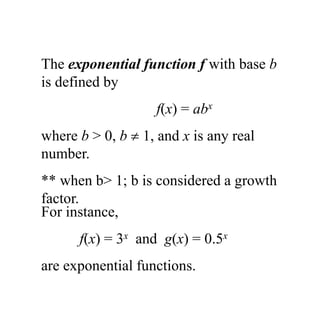
The exponential function f with base b
is defined by
f(x) = abx
where b > 0, b  1, and x is any real
number.
** when b> 1; b is considered a growth
factor.
For instance,
f(x) = 3x and g(x) = 0.5x
are exponential functions.
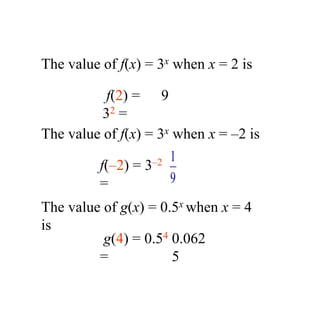
The value of f(x) = 3x when x = 2 is
f(2) =
32 =
The value of g(x) = 0.5x when x = 4
is
g(4) = 0.54
=
The value of f(x) = 3x when x = –2 is
9
1
9
f(–2) = 3–2
=
0.062
5
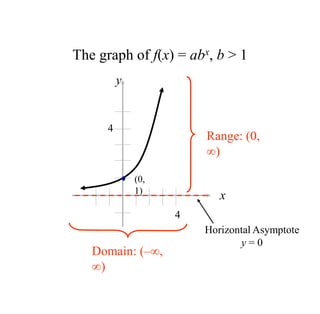
The graph of f(x) = abx, b > 1
y
x
(0,
1)
Domain: (–,
)
Range: (0,
)
Horizontal Asymptote
y = 0
4
4
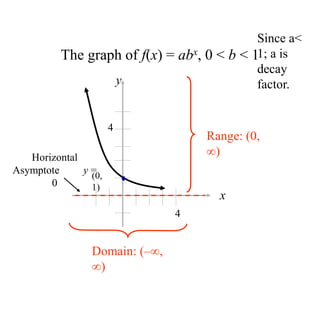
The graph of f(x) = abx, 0 < b < 1
y
x
(0,
1)
Domain: (–,
)
Range: (0,
)
Horizontal
Asymptote y =
0
4
4
Since a<
1; a is
decay
factor.
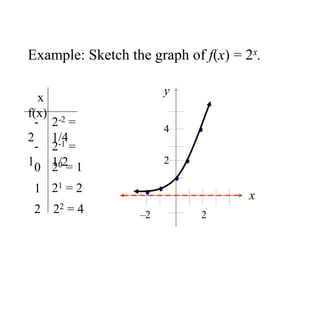
Example: Sketch the graph of f(x) = 2x.
x
y
2
–2
2
4
x
f(x)
-
2
-
10
1
2
2-2 =
1/4
2-1 =
1/2
20 = 1
21 = 2
22 = 4
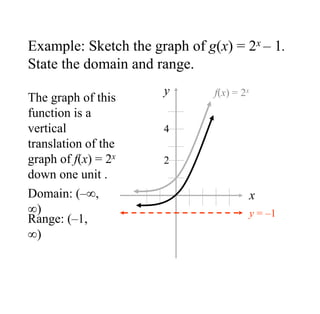
Example: Sketch the graph of g(x) = 2x – 1.
State the domain and range.
x
y
The graph of this
function is a
vertical
translation of the
graph of f(x) = 2x
down one unit .
f(x) = 2x
y = –1
Domain: (–,
)
Range: (–1,
)
2
4
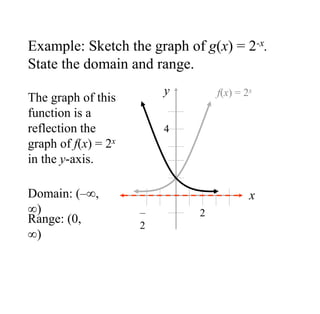
Example: Sketch the graph of g(x) = 2-x.
State the domain and range.
x
y
The graph of this
function is a
reflection the
graph of f(x) = 2x
in the y-axis.
f(x) = 2x
Domain: (–,
)
Range: (0,
)
2
–
2
4
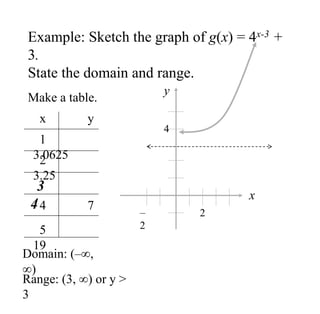
Example: Sketch the graph of g(x) = 4x-3 +
3.
State the domain and range.
x
y
Make a table.
Domain: (–,
)
Range: (3, ) or y >
3
2
–
2
4
x y
3
4
2
3.25
1
3.0625
4 7
5
19
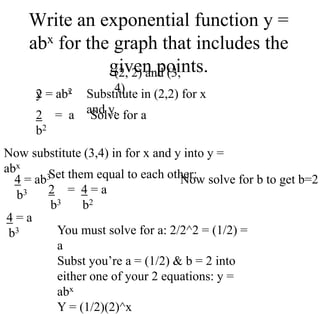
Write an exponential function y =
abx for the graph that includes the
given points.
(2, 2) and (3,
4)
y = abx Substitute in (2,2) for x
and y.
2 = ab2
Solve for a
2 = a
b2
Now substitute (3,4) in for x and y into y =
abx
4 = ab3
b3
4 = a
b3
Set them equal to each other:
2 = 4 = a
b3 b2
Now solve for b to get b=2
You must solve for a: 2/2^2 = (1/2) =
a
Subst you’re a = (1/2) & b = 2 into
either one of your 2 equations: y =
abx
Y = (1/2)(2)^x
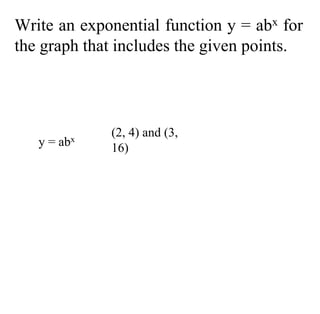
Write an exponential function y = abx for
the graph that includes the given points.
(2, 4) and (3,
16)
y = abx
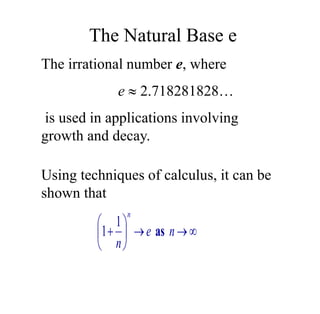
The irrational number e, where
e  2.718281828…
is used in applications involving
growth and decay.
Using techniques of calculus, it can be
shown that









 n
e
n
n
as
1
1
The Natural Base e
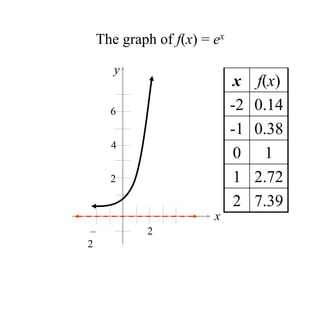
The graph of f(x) = ex
y
x
2
–
2
2
4
6
x f(x)
-2 0.14
-1 0.38
0 1
1 2.72
2 7.39
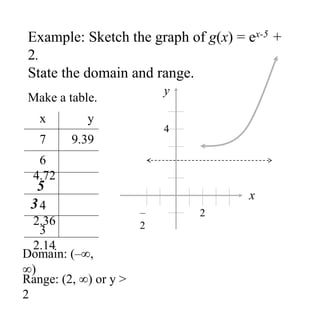
Example: Sketch the graph of g(x) = ex-5 +
2.
State the domain and range.
x
y
Make a table.
Domain: (–,
)
Range: (2, ) or y >
2
2
–
2
4
x y
5
3
6
4.72
7 9.39
4
2.36
3
2.14
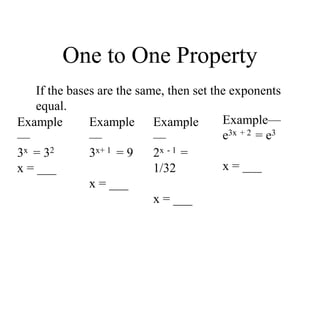
One to One Property
Copyright © by
Houghton Mifflin
Company, Inc. All rights
reserved.
If the bases are the same, then set the exponents
equal.
Example
—
3x = 32
x = ___
Example
—
3x+ 1 = 9
x = ___
Example
—
2x - 1 =
1/32
x = ___
Example—
e3x + 2 = e3
x = ___
2.7.2. Logarithmic Functions
and Their Graphs
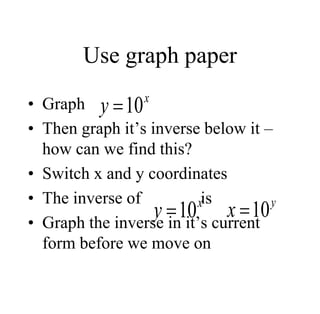
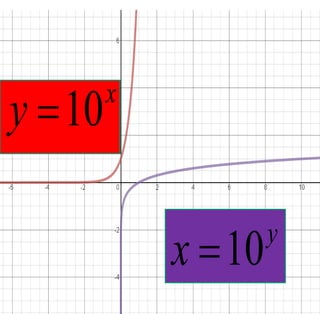
Use graph paper
• Graph
• Then graph it’s inverse below it –
how can we find this?
• Switch x and y coordinates
• The inverse of is
• Graph the inverse in it’s current
form before we move on
x
y 10

x
y 10
 y
x 10

x
y 10

y
x 10

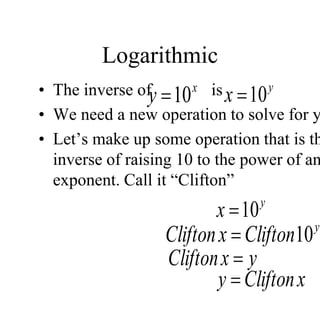
Logarithmic
• The inverse of is
• We need a new operation to solve for y
• Let’s make up some operation that is th
inverse of raising 10 to the power of an
exponent. Call it “Clifton”
x
y 10
 y
x 10

y
x 10

y
Clifton
x
Clifton 10

x
Clifton
y 
y
x
Clifton 
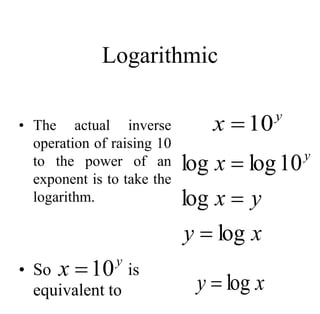
Logarithmic
• The actual inverse
operation of raising 10
to the power of an
exponent is to take the
logarithm.
• So is
equivalent to
y
x 10

x
y
y
x
x y
log
log
10
log
log



y
x 10

x
y log

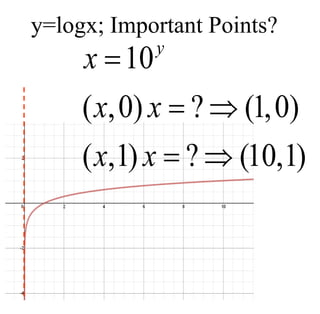
y=logx; Important Points?
)
1
,
10
(
?
)
1
,
(
)
0
,
1
(
?
)
0
,
(
10





x
x
x
x
x y
x
y 10

x
y log

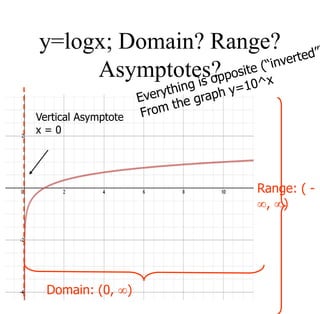
y=logx; Domain? Range?
Asymptotes?
Domain: (0, )
Range: ( -
, )
Vertical Asymptote
x = 0
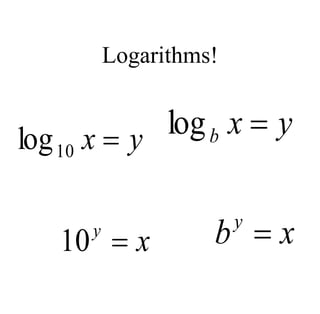
Logarithms!
x
y
x
y


10
log10
x
b
y
x
y
b


log
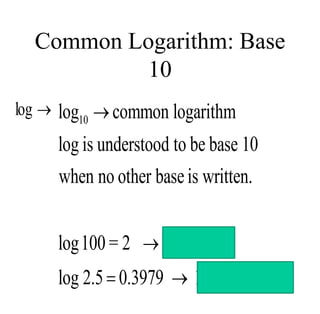
Common Logarithm: Base
10
10
2
0.3979
log common logarithm
log is understood to be base 10
when no other baseis written.
log100 = 2 10 100
log 2.5 0.3979 10 2.5

 
  

log
Logarithms, Explained -
Steve Kelly
• http://www.youtube.com/watch?v=z
zu2POfYv0Y
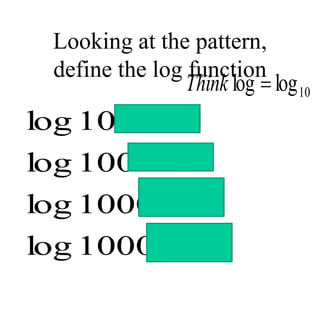
Looking at the pattern,
define the log function
4
10000
log
3
1000
log
2
100
log
1
10
log




10
log
log 
Think
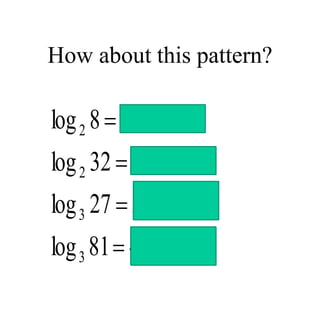
How about this pattern?
4
81
log
3
27
log
5
32
log
3
8
log
3
3
2
2




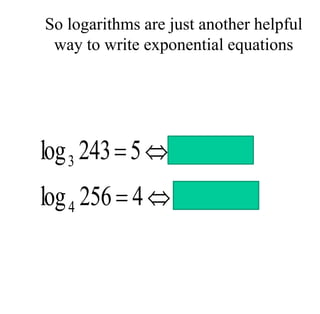
So logarithms are just another helpful
way to write exponential equations
256
4
4
256
log
243
3
5
243
log
4
4
5
3






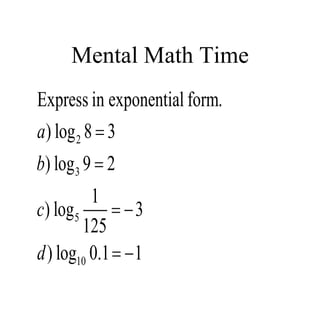
Mental Math Time
2
3
5
10
Express in exponential form.
) log 8 3
) log 9 2
1
) log 3
125
) log 0.1 1
a
b
c
d


 
 
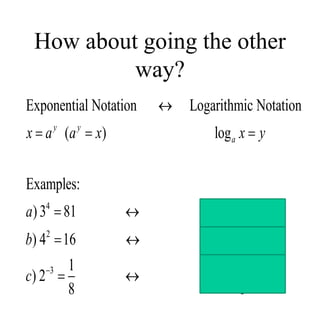
How about going the other
way?
4
3
2
4
3
2
Exponential Notation Logarithmic Notation
( ) log
Examples:
) 3 81 log 81 4
) 4 16 log 16 2
1 1
) 2 log 3
8 8
y y
a
x a a x x y
a
b
c 

  
  
  
   
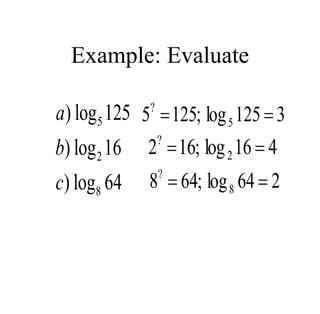
Example: Evaluate
5
2
8
) log 125
) log 16
) log 64
a
b
c
3
125
log
;
125
5 5
?


4
16
log
;
16
2 2
?


2
64
log
;
64
8 8
?


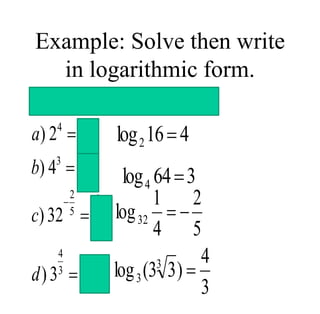
Example: Solve then write
in logarithmic form.
4
3
2
5
4
3
3
Express in logarithmic form.
) 2 16
) 4 64
1
)32
4
)3 3 3
a
b
c
d





4
16
log2 
3
4
)
3
3
(
log 3
3 
3
64
log4 
5
2
4
1
log32 

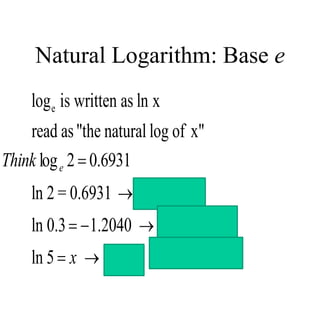
Natural Logarithm: Base e
e
0.6931
1.2040
log is written as ln x
read as"the natural log of x"
ln 2 = 0.6931 e 2
ln 0.3 1.2040 0.3
ln 5 5 1.609
x
e
x e x

 
   
    
6931
.
0
2
log 
e
Think
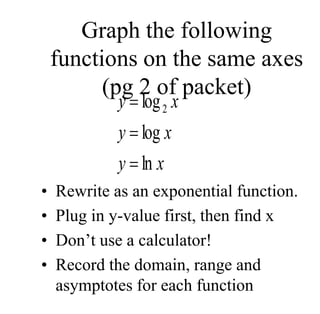
Graph the following
functions on the same axes
(pg 2 of packet)
• Rewrite as an exponential function.
• Plug in y-value first, then find x
• Don’t use a calculator!
• Record the domain, range and
asymptotes for each function
x
y
x
y
x
y
ln
log
log2



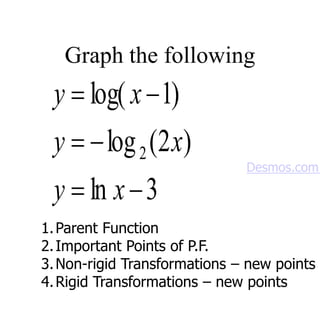
Graph the following
3
ln
)
2
(
log
)
1
log(
2






x
y
x
y
x
y
Desmos.com
1.Parent Function
2.Important Points of P.F.
3.Non-rigid Transformations – new points
4.Rigid Transformations – new points
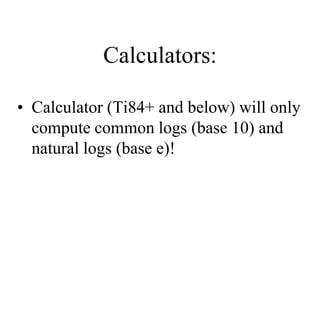
Calculators:
• Calculator (Ti84+ and below) will only
compute common logs (base 10) and
natural logs (base e)!
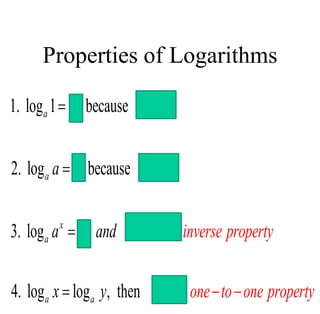
Properties of Logarithms
0
1
log
1. log 1 0 because 1
2. log 1 because
3. log
4. log log , then
a
a
a
x
x
a
a a
a
a a
i
a
a x and a x
x y
nverse prop
x
erty
one to one property
y
 
 
 
  

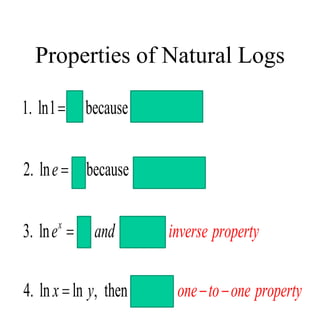
Properties of Natural Logs
0
1
ln
1. ln1 0 because 1
2. ln 1 because
3. ln
4. ln ln , then
x x
inverse property
one to one property
e
e e e
e x and e x
x y x y
 
 
 
 
 
• We will get practice using these
properties in the next lessons.
H Dub:
• Pg 1 and 2 – bottom half
• Pg 3 – #”3”-5
• Pg 4 – #11-18
• 3-2 Pg. 236 #1-19odd, 27-44,
76-83, 87
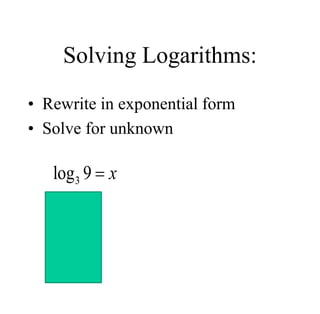
Solving Logarithms:
• Rewrite in exponential form
• Solve for unknown
3
2
log 9
3 9
3 3
2
x
x
x
x




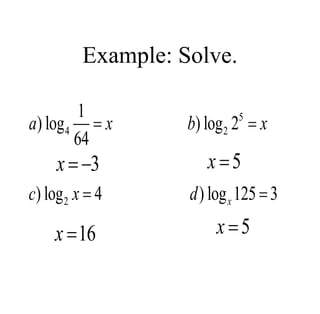
Example: Solve.
5
4 2
2
1
) log ) log 2
64
) log 4 ) log 125 3
x
a x b x
c x d
 
 
3


x 5

x
16

x 5

x
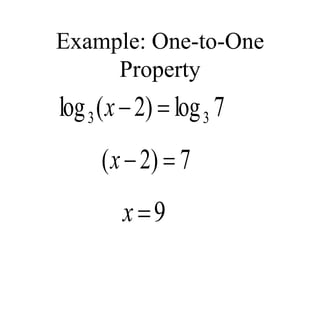
Example: One-to-One
Property
7
log
)
2
(
log 3
3 

x
7
)
2
( 

x
9

x
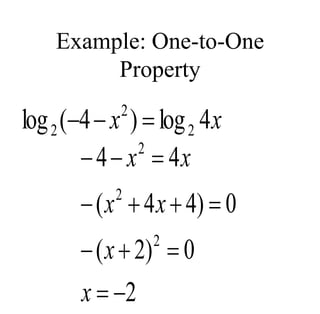
Example: One-to-One
Property
x
x 4
log
)
4
(
log 2
2
2 


2
0
)
2
(
0
)
4
4
(
4
4
2
2
2












x
x
x
x
x
x
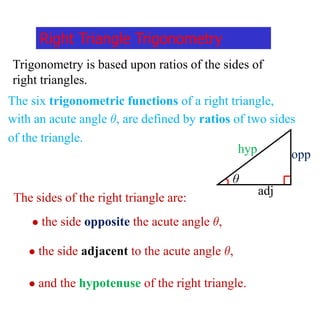
Right Triangle Trigonometry
Trigonometry is based upon ratios of the sides of
right triangles.
The six trigonometric functions of a right triangle,
with an acute angle , are defined by ratios of two sides
of the triangle.
θ
opp
hyp
adj
The sides of the right triangle are:
 the side opposite the acute angle ,
 the side adjacent to the acute angle ,
 and the hypotenuse of the right triangle.
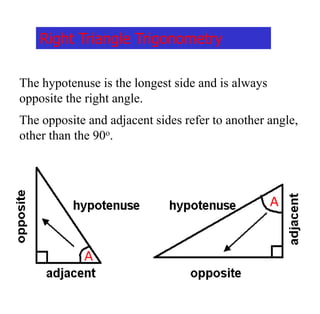
A
A
The hypotenuse is the longest side and is always
opposite the right angle.
The opposite and adjacent sides refer to another angle,
other than the 90o.
Right Triangle Trigonometry
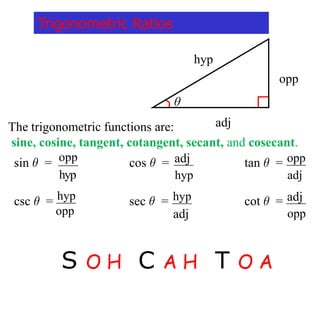
S O H C A H T O A
The trigonometric functions are:
sine, cosine, tangent, cotangent, secant, and cosecant.
opp
adj
hyp
θ
sin  = cos  = tan  =
csc  = sec  = cot  =
opp
hyp
adj
hyp
hyp
adj
adj
opp
opp
adj
hyp
opp
Trigonometric Ratios
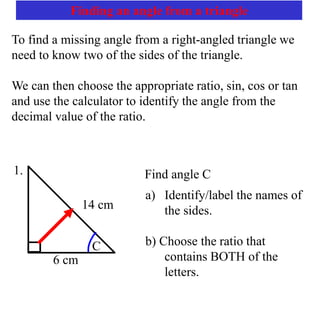
Finding an angle from a triangle
To find a missing angle from a right-angled triangle we
need to know two of the sides of the triangle.
We can then choose the appropriate ratio, sin, cos or tan
and use the calculator to identify the angle from the
decimal value of the ratio.
Find angle C
a) Identify/label the names of
the sides.
b) Choose the ratio that
contains BOTH of the
letters.
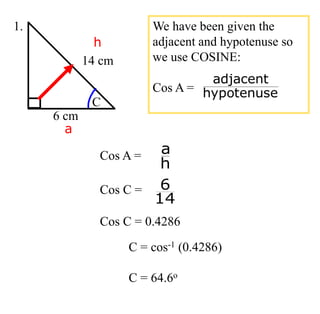
14 cm
6 cm
C
1.
C = cos-1 (0.4286)
C = 64.6o
14 cm
6 cm
C
1.
h
a
We have been given the
adjacent and hypotenuse so
we use COSINE:
Cos A = hypotenuse
adjacent
Cos A =
h
a
Cos C =
14
6
Cos C = 0.4286
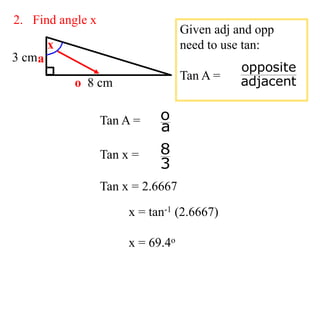
Find angle x
2.
8 cm
3 cm
x
a
o
Given adj and opp
need to use tan:
Tan A = adjacent
opposite
x = tan-1 (2.6667)
x = 69.4o
Tan A =
a
o
Tan x =
3
8
Tan x = 2.6667
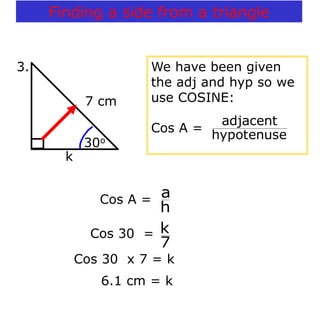
Cos 30 x 7 = k
6.1 cm = k
7 cm
k
30o
3. We have been given
the adj and hyp so we
use COSINE:
Cos A =
hypotenuse
adjacent
Cos A =
h
a
Cos 30 =
7
k
Finding a side from a triangle
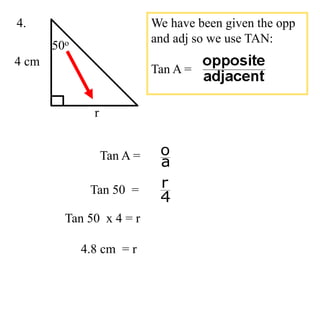
Tan 50 x 4 = r
4.8 cm = r
4 cm
r
50o
4.
Tan A =
a
o
Tan 50 =
4
r
We have been given the opp
and adj so we use TAN:
Tan A =
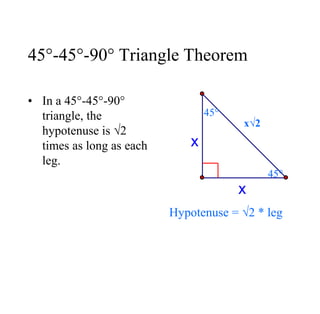
45°-45°-90° Triangle Theorem
• In a 45°-45°-90°
triangle, the
hypotenuse is √2
times as long as each
leg.
x
x
x√2
45°
45°
Hypotenuse = √2 * leg
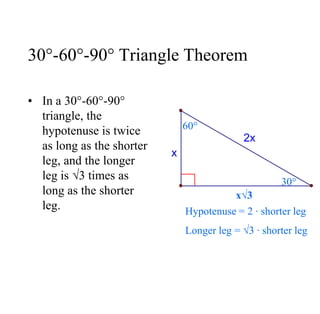
30°-60°-90° Triangle Theorem
• In a 30°-60°-90°
triangle, the
hypotenuse is twice
as long as the shorter
leg, and the longer
leg is √3 times as
long as the shorter
leg.
x√3
60°
30°
Hypotenuse = 2 ∙ shorter leg
Longer leg = √3 ∙ shorter leg
2x
x
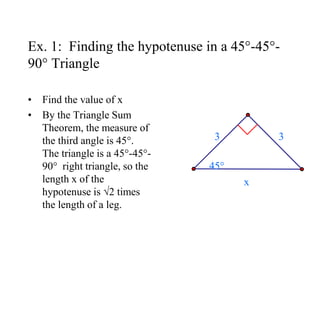
Ex. 1: Finding the hypotenuse in a 45°-45°-
90° Triangle
• Find the value of x
• By the Triangle Sum
Theorem, the measure of
the third angle is 45°.
The triangle is a 45°-45°-
90° right triangle, so the
length x of the
hypotenuse is √2 times
the length of a leg.
3 3
x
45°
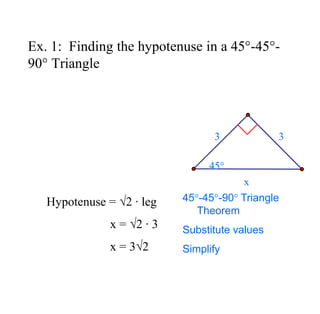
Ex. 1: Finding the hypotenuse in a 45°-45°-
90° Triangle
Hypotenuse = √2 ∙ leg
x = √2 ∙ 3
x = 3√2
3 3
x
45°
45°-45°-90° Triangle
Theorem
Substitute values
Simplify
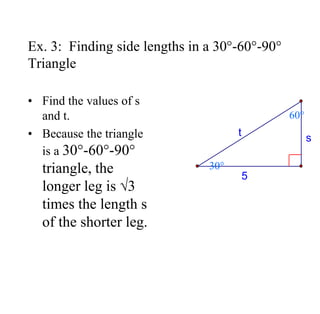
Ex. 3: Finding side lengths in a 30°-60°-90°
Triangle
• Find the values of s
and t.
• Because the triangle
is a 30°-60°-90°
triangle, the
longer leg is √3
times the length s
of the shorter leg.
5
s
t
30°
60°
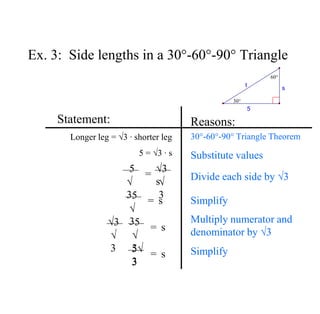
Ex. 3: Side lengths in a 30°-60°-90° Triangle
Statement:
Longer leg = √3 ∙ shorter leg
5 = √3 ∙ s
Reasons:
30°-60°-90° Triangle Theorem
5
√
3
√3
s√
3
=
5
√
3
s
=
5
√
3
s
=
√3
√
3 5√
3
3
s
=
Substitute values
Divide each side by √3
Simplify
Multiply numerator and
denominator by √3
Simplify
5
s
t
30°
60°
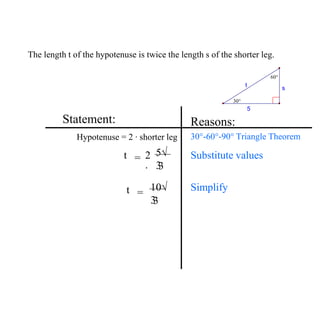
The length t of the hypotenuse is twice the length s of the shorter leg.
Statement:
Hypotenuse = 2 ∙ shorter leg
Reasons:
30°-60°-90° Triangle Theorem
t 2
∙
5√
3
3
= Substitute values
Simplify
5
s
t
30°
60°
t 10√
3
3
=

logarithmic, exponential, trigonometric functions and their graphs.ppt

  • 1.
  • 2.
    The exponential functionf with base b is defined by f(x) = abx where b > 0, b  1, and x is any real number. ** when b> 1; b is considered a growth factor. For instance, f(x) = 3x and g(x) = 0.5x are exponential functions.
  • 3.
    The value off(x) = 3x when x = 2 is f(2) = 32 = The value of g(x) = 0.5x when x = 4 is g(4) = 0.54 = The value of f(x) = 3x when x = –2 is 9 1 9 f(–2) = 3–2 = 0.062 5
  • 4.
    The graph off(x) = abx, b > 1 y x (0, 1) Domain: (–, ) Range: (0, ) Horizontal Asymptote y = 0 4 4
  • 5.
    The graph off(x) = abx, 0 < b < 1 y x (0, 1) Domain: (–, ) Range: (0, ) Horizontal Asymptote y = 0 4 4 Since a< 1; a is decay factor.
  • 6.
    Example: Sketch thegraph of f(x) = 2x. x y 2 –2 2 4 x f(x) - 2 - 10 1 2 2-2 = 1/4 2-1 = 1/2 20 = 1 21 = 2 22 = 4
  • 7.
    Example: Sketch thegraph of g(x) = 2x – 1. State the domain and range. x y The graph of this function is a vertical translation of the graph of f(x) = 2x down one unit . f(x) = 2x y = –1 Domain: (–, ) Range: (–1, ) 2 4
  • 8.
    Example: Sketch thegraph of g(x) = 2-x. State the domain and range. x y The graph of this function is a reflection the graph of f(x) = 2x in the y-axis. f(x) = 2x Domain: (–, ) Range: (0, ) 2 – 2 4
  • 9.
    Example: Sketch thegraph of g(x) = 4x-3 + 3. State the domain and range. x y Make a table. Domain: (–, ) Range: (3, ) or y > 3 2 – 2 4 x y 3 4 2 3.25 1 3.0625 4 7 5 19
  • 10.
    Write an exponentialfunction y = abx for the graph that includes the given points. (2, 2) and (3, 4) y = abx Substitute in (2,2) for x and y. 2 = ab2 Solve for a 2 = a b2 Now substitute (3,4) in for x and y into y = abx 4 = ab3 b3 4 = a b3 Set them equal to each other: 2 = 4 = a b3 b2 Now solve for b to get b=2 You must solve for a: 2/2^2 = (1/2) = a Subst you’re a = (1/2) & b = 2 into either one of your 2 equations: y = abx Y = (1/2)(2)^x
  • 11.
    Write an exponentialfunction y = abx for the graph that includes the given points. (2, 4) and (3, 16) y = abx
  • 12.
    The irrational numbere, where e  2.718281828… is used in applications involving growth and decay. Using techniques of calculus, it can be shown that           n e n n as 1 1 The Natural Base e
  • 13.
    The graph off(x) = ex y x 2 – 2 2 4 6 x f(x) -2 0.14 -1 0.38 0 1 1 2.72 2 7.39
  • 14.
    Example: Sketch thegraph of g(x) = ex-5 + 2. State the domain and range. x y Make a table. Domain: (–, ) Range: (2, ) or y > 2 2 – 2 4 x y 5 3 6 4.72 7 9.39 4 2.36 3 2.14
  • 15.
    One to OneProperty Copyright © by Houghton Mifflin Company, Inc. All rights reserved. If the bases are the same, then set the exponents equal. Example — 3x = 32 x = ___ Example — 3x+ 1 = 9 x = ___ Example — 2x - 1 = 1/32 x = ___ Example— e3x + 2 = e3 x = ___
  • 16.
  • 17.
    Use graph paper •Graph • Then graph it’s inverse below it – how can we find this? • Switch x and y coordinates • The inverse of is • Graph the inverse in it’s current form before we move on x y 10  x y 10  y x 10 
  • 18.
  • 19.
    Logarithmic • The inverseof is • We need a new operation to solve for y • Let’s make up some operation that is th inverse of raising 10 to the power of an exponent. Call it “Clifton” x y 10  y x 10  y x 10  y Clifton x Clifton 10  x Clifton y  y x Clifton 
  • 20.
    Logarithmic • The actualinverse operation of raising 10 to the power of an exponent is to take the logarithm. • So is equivalent to y x 10  x y y x x y log log 10 log log    y x 10  x y log 
  • 21.
  • 22.
  • 23.
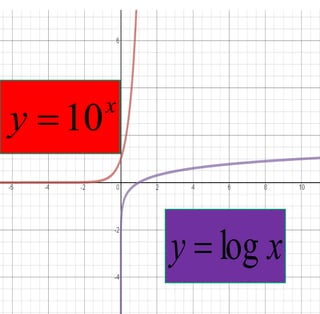
    y=logx; Domain? Range? Asymptotes? Domain:(0, ) Range: ( - , ) Vertical Asymptote x = 0
  • 24.
  • 25.
    Common Logarithm: Base 10 10 2 0.3979 logcommon logarithm log is understood to be base 10 when no other baseis written. log100 = 2 10 100 log 2.5 0.3979 10 2.5        log
  • 26.
    Logarithms, Explained - SteveKelly • http://www.youtube.com/watch?v=z zu2POfYv0Y
  • 27.
    Looking at thepattern, define the log function 4 10000 log 3 1000 log 2 100 log 1 10 log     10 log log  Think
  • 28.
    How about thispattern? 4 81 log 3 27 log 5 32 log 3 8 log 3 3 2 2    
  • 29.
    So logarithms arejust another helpful way to write exponential equations 256 4 4 256 log 243 3 5 243 log 4 4 5 3      
  • 30.
    Mental Math Time 2 3 5 10 Expressin exponential form. ) log 8 3 ) log 9 2 1 ) log 3 125 ) log 0.1 1 a b c d      
  • 31.
    How about goingthe other way? 4 3 2 4 3 2 Exponential Notation Logarithmic Notation ( ) log Examples: ) 3 81 log 81 4 ) 4 16 log 16 2 1 1 ) 2 log 3 8 8 y y a x a a x x y a b c               
  • 32.
    Example: Evaluate 5 2 8 ) log125 ) log 16 ) log 64 a b c 3 125 log ; 125 5 5 ?   4 16 log ; 16 2 2 ?   2 64 log ; 64 8 8 ?  
  • 33.
    Example: Solve thenwrite in logarithmic form. 4 3 2 5 4 3 3 Express in logarithmic form. ) 2 16 ) 4 64 1 )32 4 )3 3 3 a b c d      4 16 log2  3 4 ) 3 3 ( log 3 3  3 64 log4  5 2 4 1 log32  
  • 34.
    Natural Logarithm: Basee e 0.6931 1.2040 log is written as ln x read as"the natural log of x" ln 2 = 0.6931 e 2 ln 0.3 1.2040 0.3 ln 5 5 1.609 x e x e x             6931 . 0 2 log  e Think
  • 35.
    Graph the following functionson the same axes (pg 2 of packet) • Rewrite as an exponential function. • Plug in y-value first, then find x • Don’t use a calculator! • Record the domain, range and asymptotes for each function x y x y x y ln log log2   
  • 36.
    Graph the following 3 ln ) 2 ( log ) 1 log( 2       x y x y x y Desmos.com 1.ParentFunction 2.Important Points of P.F. 3.Non-rigid Transformations – new points 4.Rigid Transformations – new points
  • 37.
    Calculators: • Calculator (Ti84+and below) will only compute common logs (base 10) and natural logs (base e)!
  • 38.
    Properties of Logarithms 0 1 log 1.log 1 0 because 1 2. log 1 because 3. log 4. log log , then a a a x x a a a a a a i a a x and a x x y nverse prop x erty one to one property y          
  • 39.
    Properties of NaturalLogs 0 1 ln 1. ln1 0 because 1 2. ln 1 because 3. ln 4. ln ln , then x x inverse property one to one property e e e e e x and e x x y x y          
  • 40.
    • We willget practice using these properties in the next lessons.
  • 41.
    H Dub: • Pg1 and 2 – bottom half • Pg 3 – #”3”-5 • Pg 4 – #11-18 • 3-2 Pg. 236 #1-19odd, 27-44, 76-83, 87
  • 42.
    Solving Logarithms: • Rewritein exponential form • Solve for unknown 3 2 log 9 3 9 3 3 2 x x x x    
  • 43.
    Example: Solve. 5 4 2 2 1 )log ) log 2 64 ) log 4 ) log 125 3 x a x b x c x d     3   x 5  x 16  x 5  x
  • 44.
    Example: One-to-One Property 7 log ) 2 ( log 3 3  x 7 ) 2 (   x 9  x
  • 45.
    Example: One-to-One Property x x 4 log ) 4 ( log2 2 2    2 0 ) 2 ( 0 ) 4 4 ( 4 4 2 2 2             x x x x x x
  • 46.
    Right Triangle Trigonometry Trigonometryis based upon ratios of the sides of right triangles. The six trigonometric functions of a right triangle, with an acute angle , are defined by ratios of two sides of the triangle. θ opp hyp adj The sides of the right triangle are:  the side opposite the acute angle ,  the side adjacent to the acute angle ,  and the hypotenuse of the right triangle.
  • 47.
    A A The hypotenuse isthe longest side and is always opposite the right angle. The opposite and adjacent sides refer to another angle, other than the 90o. Right Triangle Trigonometry
  • 48.
    S O HC A H T O A The trigonometric functions are: sine, cosine, tangent, cotangent, secant, and cosecant. opp adj hyp θ sin  = cos  = tan  = csc  = sec  = cot  = opp hyp adj hyp hyp adj adj opp opp adj hyp opp Trigonometric Ratios
  • 49.
    Finding an anglefrom a triangle To find a missing angle from a right-angled triangle we need to know two of the sides of the triangle. We can then choose the appropriate ratio, sin, cos or tan and use the calculator to identify the angle from the decimal value of the ratio. Find angle C a) Identify/label the names of the sides. b) Choose the ratio that contains BOTH of the letters. 14 cm 6 cm C 1.
  • 50.
    C = cos-1(0.4286) C = 64.6o 14 cm 6 cm C 1. h a We have been given the adjacent and hypotenuse so we use COSINE: Cos A = hypotenuse adjacent Cos A = h a Cos C = 14 6 Cos C = 0.4286
  • 51.
    Find angle x 2. 8cm 3 cm x a o Given adj and opp need to use tan: Tan A = adjacent opposite x = tan-1 (2.6667) x = 69.4o Tan A = a o Tan x = 3 8 Tan x = 2.6667
  • 52.
    Cos 30 x7 = k 6.1 cm = k 7 cm k 30o 3. We have been given the adj and hyp so we use COSINE: Cos A = hypotenuse adjacent Cos A = h a Cos 30 = 7 k Finding a side from a triangle
  • 53.
    Tan 50 x4 = r 4.8 cm = r 4 cm r 50o 4. Tan A = a o Tan 50 = 4 r We have been given the opp and adj so we use TAN: Tan A =
  • 54.
    45°-45°-90° Triangle Theorem •In a 45°-45°-90° triangle, the hypotenuse is √2 times as long as each leg. x x x√2 45° 45° Hypotenuse = √2 * leg
  • 55.
    30°-60°-90° Triangle Theorem •In a 30°-60°-90° triangle, the hypotenuse is twice as long as the shorter leg, and the longer leg is √3 times as long as the shorter leg. x√3 60° 30° Hypotenuse = 2 ∙ shorter leg Longer leg = √3 ∙ shorter leg 2x x
  • 56.
    Ex. 1: Findingthe hypotenuse in a 45°-45°- 90° Triangle • Find the value of x • By the Triangle Sum Theorem, the measure of the third angle is 45°. The triangle is a 45°-45°- 90° right triangle, so the length x of the hypotenuse is √2 times the length of a leg. 3 3 x 45°
  • 57.
    Ex. 1: Findingthe hypotenuse in a 45°-45°- 90° Triangle Hypotenuse = √2 ∙ leg x = √2 ∙ 3 x = 3√2 3 3 x 45° 45°-45°-90° Triangle Theorem Substitute values Simplify
  • 58.
    Ex. 3: Findingside lengths in a 30°-60°-90° Triangle • Find the values of s and t. • Because the triangle is a 30°-60°-90° triangle, the longer leg is √3 times the length s of the shorter leg. 5 s t 30° 60°
  • 59.
    Ex. 3: Sidelengths in a 30°-60°-90° Triangle Statement: Longer leg = √3 ∙ shorter leg 5 = √3 ∙ s Reasons: 30°-60°-90° Triangle Theorem 5 √ 3 √3 s√ 3 = 5 √ 3 s = 5 √ 3 s = √3 √ 3 5√ 3 3 s = Substitute values Divide each side by √3 Simplify Multiply numerator and denominator by √3 Simplify 5 s t 30° 60°
  • 60.
    The length tof the hypotenuse is twice the length s of the shorter leg. Statement: Hypotenuse = 2 ∙ shorter leg Reasons: 30°-60°-90° Triangle Theorem t 2 ∙ 5√ 3 3 = Substitute values Simplify 5 s t 30° 60° t 10√ 3 3 =