Double Integrals Over Polar Equations
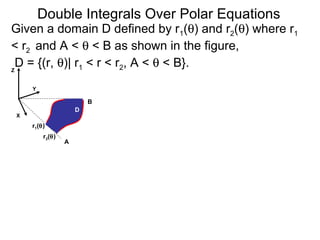
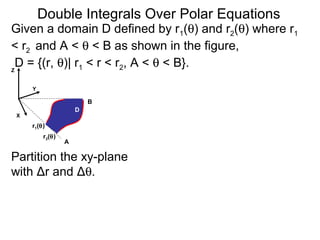
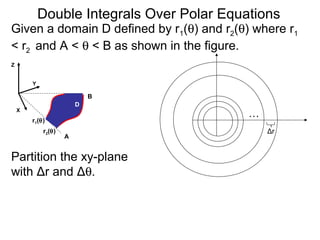
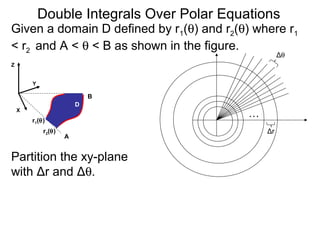
Given a domain D defined by r1(θ) and r2(θ) where r1
< r2 and A < θ < B as shown in the figure,
D = {(r, θ)| r1 < r < r2, A < θ < B}.
Double Integrals Over Polar Equations
Y
Z
A
B
X
D
r2(θ)
r1(θ)
Double Integrals Over Polar Equations
Y
Z
A
B
X
Partition the xy-plane
with Δr and Δθ.
D
r2(θ)
r1(θ)
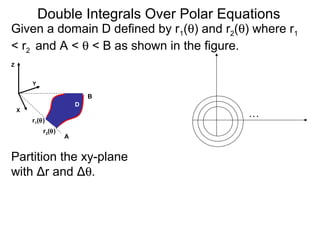
Given a domain D defined by r1(θ) and r2(θ) where r1
< r2 and A < θ < B as shown in the figure,
D = {(r, θ)| r1 < r < r2, A < θ < B}.
Given a domain D defined by r1(θ) and r2(θ) where r1
< r2 and A < θ < B as shown in the figure.
…
Double Integrals Over Polar Equations
Y
Z
A
B
X
Partition the xy-plane
with Δr and Δθ.
D
r2(θ)
r1(θ)
Given a domain D defined by r1(θ) and r2(θ) where r1
< r2 and A < θ < B as shown in the figure.
…
Δr
Double Integrals Over Polar Equations
Y
Z
A
B
X
Partition the xy-plane
with Δr and Δθ.
D
r2(θ)
r1(θ)
Given a domain D defined by r1(θ) and r2(θ) where r1
< r2 and A < θ < B as shown in the figure.
…
Δθ
Δr
Double Integrals Over Polar Equations
Y
Z
A
B
X
Partition the xy-plane
with Δr and Δθ.
D
r2(θ)
r1(θ)
Given a domain D defined by r1(θ) and r2(θ) where r1
< r2 and A < θ < B as shown in the figure.
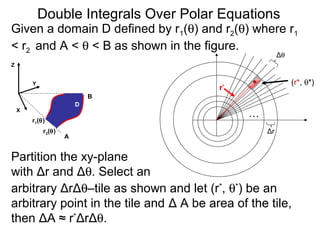
arbitrary ΔrΔθ–tile as shown and let (r*
, θ*
) be an
arbitrary point in the tile and Δ A be area of the tile,
then ΔA ≈ r*
ΔrΔθ.
…
Δθ
Δr
(r*, θ*)
r*
Double Integrals Over Polar Equations
Y
Z
A
B
X
Partition the xy-plane
with Δr and Δθ. Select an
D
r2(θ)
r1(θ)
Given a domain D defined by r1(θ) and r2(θ) where r1
< r2 and A < θ < B as shown in the figure.
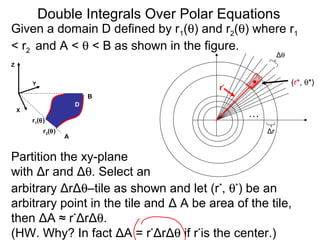
arbitrary ΔrΔθ–tile as shown and let (r*
, θ*
) be an
arbitrary point in the tile and Δ A be area of the tile,
then ΔA ≈ r*
ΔrΔθ.
(HW. Why? In fact ΔA = r*
ΔrΔθ if r*
is the center.)
…
Δθ
Δr
(r*, θ*)
r*
Double Integrals Over Polar Equations
Y
Z
A
B
X
Partition the xy-plane
with Δr and Δθ. Select an
D
r2(θ)
r1(θ)
Double Integrals Over Polar Equations
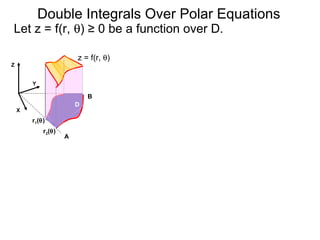
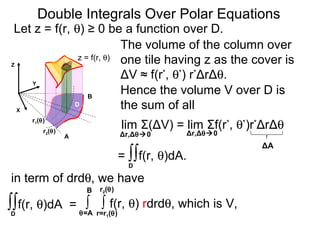
Let z = f(r, θ) ≥ 0 be a function over D.
Y
Z
A
B
X
z = f(r, θ)
D
r2(θ)
r1(θ)
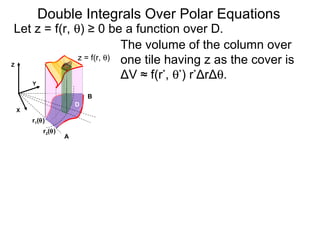
The volume of the column over
one tile having z as the cover is
ΔV ≈ f(r*
, θ*
) r*
ΔrΔθ.
Double Integrals Over Polar Equations
Y
A
B
X
Let z = f(r, θ) ≥ 0 be a function over D.
D
Z
z = f(r, θ)
r2(θ)
r1(θ)
The volume of the column over
one tile having z as the cover is
ΔV ≈ f(r*
, θ*
) r*
ΔrΔθ.
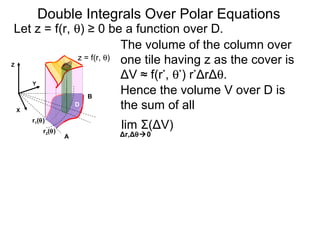
lim Σ(ΔV)
Δr,Δθ0
Double Integrals Over Polar Equations
Y
A
B
X
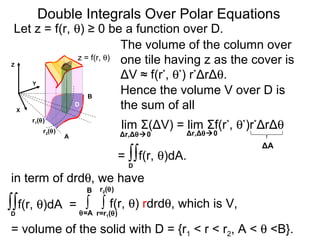
Let z = f(r, θ) ≥ 0 be a function over D.
D
Z
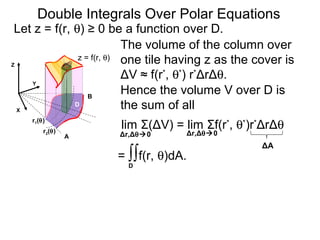
Hence the volume V over D is
the sum of all
z = f(r, θ)
r2(θ)
r1(θ)
The volume of the column over
one tile having z as the cover is
ΔV ≈ f(r*
, θ*
) r*
ΔrΔθ.
lim Σ(ΔV) = lim Σf(r*
, θ*
)r*
ΔrΔθ
= ∫∫f(r, θ)dA.
Δr,Δθ0 Δr,Δθ0
ΔA
Double Integrals Over Polar Equations
Y
A
B
X
Let z = f(r, θ) ≥ 0 be a function over D.
D
D
Z
Hence the volume V over D is
the sum of all
z = f(r, θ)
r2(θ)
r1(θ)
The volume of the column over
one tile having z as the cover is
ΔV ≈ f(r*
, θ*
) r*
ΔrΔθ.
lim Σ(ΔV) = lim Σf(r*
, θ*
)r*
ΔrΔθ
= ∫∫f(r, θ)dA.
Δr,Δθ0 Δr,Δθ0
∫ ∫ f(r, θ) rdrdθ, which is V,
r=r1(θ)
r2(θ)
θ=A
B
ΔA
Double Integrals Over Polar Equations
Y
A
B
X
Let z = f(r, θ) ≥ 0 be a function over D.
D
D
Z
Hence the volume V over D is
the sum of all
z = f(r, θ)
in term of drdθ, we have
r2(θ)
r1(θ)
∫∫f(r, θ)dA =
D
The volume of the column over
one tile having z as the cover is
ΔV ≈ f(r*
, θ*
) r*
ΔrΔθ.
lim Σ(ΔV) = lim Σf(r*
, θ*
)r*
ΔrΔθ
= ∫∫f(r, θ)dA.
Δr,Δθ0 Δr,Δθ0
∫ ∫ f(r, θ) rdrdθ, which is V,
r=r1(θ)
r2(θ)
θ=A
B
ΔA
Double Integrals Over Polar Equations
Y
A
B
X
Let z = f(r, θ) ≥ 0 be a function over D.
D
D
Z
Hence the volume V over D is
the sum of all
z = f(r, θ)
in term of drdθ, we have
= volume of the solid with D = {r1 < r < r2, A < θ <B}.
r2(θ)
r1(θ)
∫∫f(r, θ)dA =
D
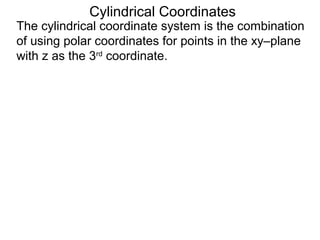
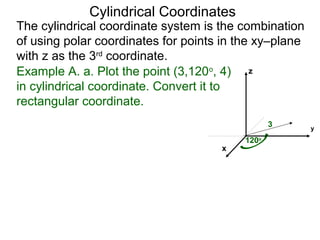
Cylindrical Coordinates
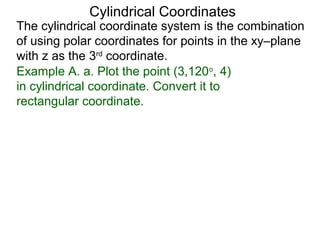
The cylindrical coordinate system is the combination
of using polar coordinates for points in the xy–plane
with z as the 3rd
coordinate.
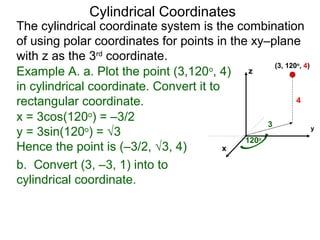
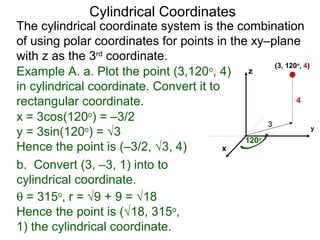
Example A. a. Plot the point (3,120o
, 4)
in cylindrical coordinate. Convert it to
rectangular coordinate.
Cylindrical Coordinates
The cylindrical coordinate system is the combination
of using polar coordinates for points in the xy–plane
with z as the 3rd
coordinate.
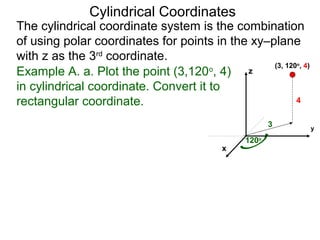
Example A. a. Plot the point (3,120o
, 4)
in cylindrical coordinate. Convert it to
rectangular coordinate.
3
120o
x
y
z
Cylindrical Coordinates
The cylindrical coordinate system is the combination
of using polar coordinates for points in the xy–plane
with z as the 3rd
coordinate.
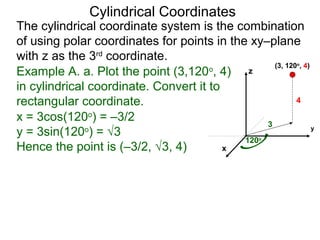
Example A. a. Plot the point (3,120o
, 4)
in cylindrical coordinate. Convert it to
rectangular coordinate.
3
120o
4
x
y
z
(3, 120o
, 4)
Cylindrical Coordinates
The cylindrical coordinate system is the combination
of using polar coordinates for points in the xy–plane
with z as the 3rd
coordinate.
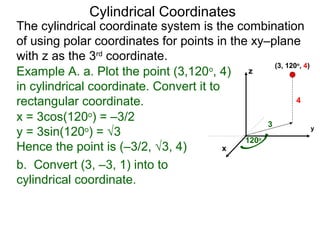
Example A. a. Plot the point (3,120o
, 4)
in cylindrical coordinate. Convert it to
rectangular coordinate.
3
120o
4
x
y
z
(3, 120o
, 4)
x = 3cos(120o
) = –3/2
y = 3sin(120o
) = √3
Hence the point is (–3/2, √3, 4)
Cylindrical Coordinates
The cylindrical coordinate system is the combination
of using polar coordinates for points in the xy–plane
with z as the 3rd
coordinate.
Example A. a. Plot the point (3,120o
, 4)
in cylindrical coordinate. Convert it to
rectangular coordinate.
3
120o
4
x
y
z
(3, 120o
, 4)
x = 3cos(120o
) = –3/2
y = 3sin(120o
) = √3
Hence the point is (–3/2, √3, 4)
b. Convert (3, –3, 1) into to
cylindrical coordinate.
Cylindrical Coordinates
The cylindrical coordinate system is the combination
of using polar coordinates for points in the xy–plane
with z as the 3rd
coordinate.
Example A. a. Plot the point (3,120o
, 4)
in cylindrical coordinate. Convert it to
rectangular coordinate.
3
120o
4
x
y
z
(3, 120o
, 4)
x = 3cos(120o
) = –3/2
y = 3sin(120o
) = √3
Hence the point is (–3/2, √3, 4)
b. Convert (3, –3, 1) into to
cylindrical coordinate.
Cylindrical Coordinates
The cylindrical coordinate system is the combination
of using polar coordinates for points in the xy–plane
with z as the 3rd
coordinate.
Example A. a. Plot the point (3,120o
, 4)
in cylindrical coordinate. Convert it to
rectangular coordinate.
3
120o
4
x
y
z
(3, 120o
, 4)
x = 3cos(120o
) = –3/2
y = 3sin(120o
) = √3
Hence the point is (–3/2, √3, 4)
b. Convert (3, –3, 1) into to
cylindrical coordinate.
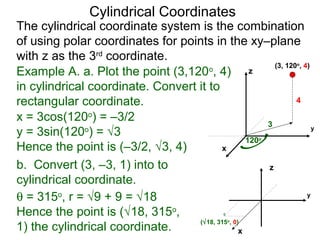
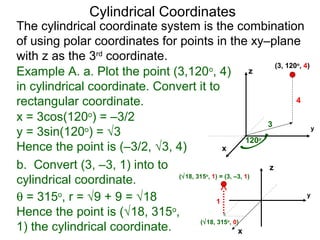
θ = 315o
, r = √9 + 9 = √18
Hence the point is (√18, 315o
,
1) the cylindrical coordinate.
Cylindrical Coordinates
The cylindrical coordinate system is the combination
of using polar coordinates for points in the xy–plane
with z as the 3rd
coordinate.
Example A. a. Plot the point (3,120o
, 4)
in cylindrical coordinate. Convert it to
rectangular coordinate.
3
120o
4
x
y
z
(3, 120o
, 4)
x = 3cos(120o
) = –3/2
y = 3sin(120o
) = √3
Hence the point is (–3/2, √3, 4)
b. Convert (3, –3, 1) into to
cylindrical coordinate.
(√18, 315o
, 0)
θ = 315o
, r = √9 + 9 = √18
Hence the point is (√18, 315o
,
1) the cylindrical coordinate. x
y
Cylindrical Coordinates
z
The cylindrical coordinate system is the combination
of using polar coordinates for points in the xy–plane
with z as the 3rd
coordinate.
Example A. a. Plot the point (3,120o
, 4)
in cylindrical coordinate. Convert it to
rectangular coordinate.
3
120o
4
x
y
z
(3, 120o
, 4)
x = 3cos(120o
) = –3/2
y = 3sin(120o
) = √3
Hence the point is (–3/2, √3, 4)
b. Convert (3, –3, 1) into to
cylindrical coordinate.
(√18, 315o
, 0)
θ = 315o
, r = √9 + 9 = √18
Hence the point is (√18, 315o
,
1) the cylindrical coordinate. x
y
Cylindrical Coordinates
z
(√18, 315o
, 1) = (3, –3, 1)
1
The cylindrical coordinate system is the combination
of using polar coordinates for points in the xy–plane
with z as the 3rd
coordinate.
Cylindrical Coordinates
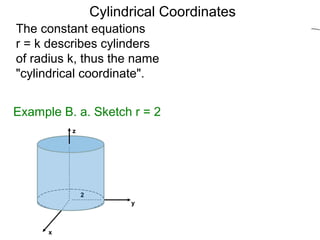
The constant equations
r = k describes cylinders
of radius k, thus the name
"cylindrical coordinate".
The constant equations
r = k describes cylinders
of radius k, thus the name
"cylindrical coordinate".
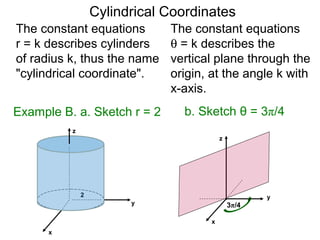
Example B. a. Sketch r = 2
2
Cylindrical Coordinates
x
y
z
The constant equations
r = k describes cylinders
of radius k, thus the name
"cylindrical coordinate".
x
y
Example B. a. Sketch r = 2
2
The constant equations
θ = k describes the
vertical plane through the
origin, at the angle k with
x-axis.
b. Sketch θ = 3π/4
3π/4
Cylindrical Coordinates
z
x
y
z
The constant equations
r = k describes cylinders
of radius k, thus the name
"cylindrical coordinate".
x
y
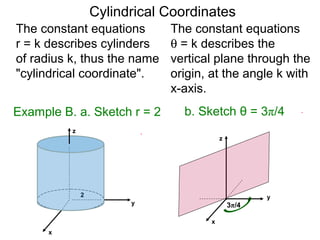
Example B. a. Sketch r = 2
2
The constant equations
θ = k describes the
vertical plane through the
origin, at the angle k with
x-axis.
b. Sketch θ = 3π/4
3π/4
Cylindrical Coordinates
z
x
y
z
Cylindrical Coordinates
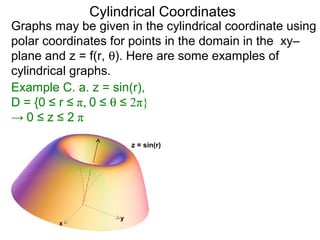
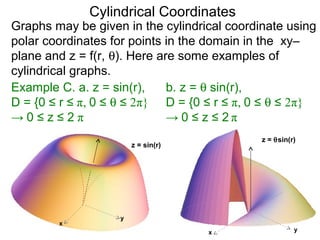
Graphs may be given in the cylindrical coordinate using
polar coordinates for points in the domain in the xy–
plane and z = f(r, θ). Here are some examples of
cylindrical graphs.
Cylindrical Coordinates
Graphs may be given in the cylindrical coordinate using
polar coordinates for points in the domain in the xy–
plane and z = f(r, θ). Here are some examples of
cylindrical graphs.
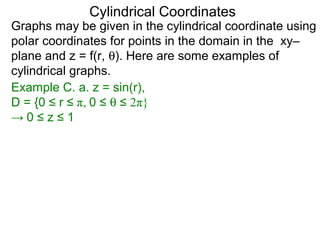
Example C. a. z = sin(r),
D = {0 ≤ r ≤ π, 0 ≤ θ ≤ 2π}
→ 0 ≤ z ≤ 1
Cylindrical Coordinates
Graphs may be given in the cylindrical coordinate using
polar coordinates for points in the domain in the xy–
plane and z = f(r, θ). Here are some examples of
cylindrical graphs.
Example C. a. z = sin(r),
D = {0 ≤ r ≤ π, 0 ≤ θ ≤ 2π}
→ 0 ≤ z ≤ 2 π
x
y
z = sin(r)
Cylindrical Coordinates
Graphs may be given in the cylindrical coordinate using
polar coordinates for points in the domain in the xy–
plane and z = f(r, θ). Here are some examples of
cylindrical graphs.
Example C. a. z = sin(r),
D = {0 ≤ r ≤ π, 0 ≤ θ ≤ 2π}
→ 0 ≤ z ≤ 2 π
x
y
z = sin(r)
b. z = θ sin(r),
D = {0 ≤ r ≤ π, 0 ≤ θ ≤ 2π}
→ 0 ≤ z ≤ 2 π
Cylindrical Coordinates
Graphs may be given in the cylindrical coordinate using
polar coordinates for points in the domain in the xy–
plane and z = f(r, θ). Here are some examples of
cylindrical graphs.
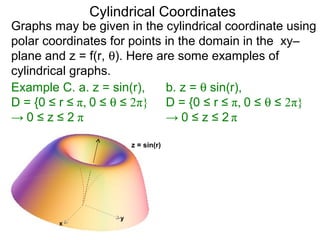
Example C. a. z = sin(r),
D = {0 ≤ r ≤ π, 0 ≤ θ ≤ 2π}
→ 0 ≤ z ≤ 2 π
x
y
z = sin(r)
x y
z = θsin(r)
b. z = θ sin(r),
D = {0 ≤ r ≤ π, 0 ≤ θ ≤ 2π}
→ 0 ≤ z ≤ 2 π
Double Integrals Over Polar Equations
D D
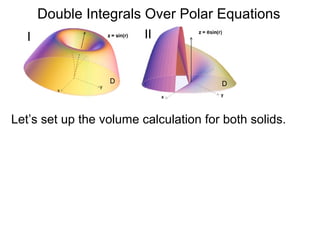
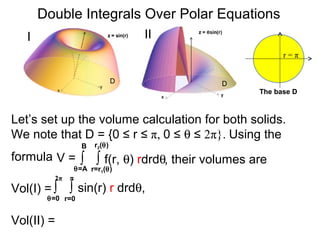
Let’s set up the volume calculation for both solids.
I II
Double Integrals Over Polar Equations
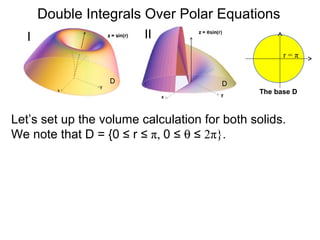
The base D
D D
r = π
Let’s set up the volume calculation for both solids.
We note that D = {0 ≤ r ≤ π, 0 ≤ θ ≤ 2π}.
I II
∫ ∫ f(r, θ) rdrdθ
r=r1(θ)
r2(θ)
θ=A
B
Double Integrals Over Polar Equations
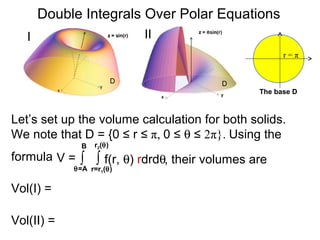
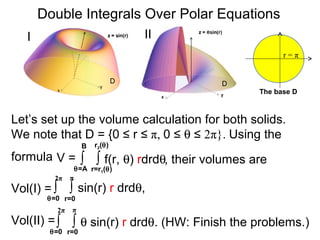
Vol(I) =
The base D
D D
r = π
Let’s set up the volume calculation for both solids.
We note that D = {0 ≤ r ≤ π, 0 ≤ θ ≤ 2π}. Using the
formula
I II
V =
Vol(II) =
, their volumes are
∫ ∫ f(r, θ) rdrdθ
r=r1(θ)
r2(θ)
θ=A
B
Double Integrals Over Polar Equations
Vol(I) =
The base D
D D
r = π
Let’s set up the volume calculation for both solids.
We note that D = {0 ≤ r ≤ π, 0 ≤ θ ≤ 2π}. Using the
formula
I II
V =
∫ ∫ sin(r) r drdθ,
r=0
π
θ=0
2π
Vol(II) =
, their volumes are
∫ ∫ f(r, θ) rdrdθ
r=r1(θ)
r2(θ)
θ=A
B
Double Integrals Over Polar Equations
Vol(I) =
The base D
D D
r = π
Let’s set up the volume calculation for both solids.
We note that D = {0 ≤ r ≤ π, 0 ≤ θ ≤ 2π}. Using the
formula
I II
V =
∫ ∫ sin(r) r drdθ,
r=0
π
θ=0
2π
Vol(II) =∫ ∫ θ sin(r) r drdθ. (HW: Finish the problems.)
r=0
π
θ=0
2π
, their volumes are
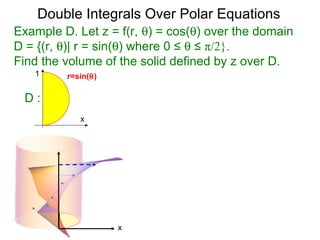
Example D. Let z = f(r, θ) = cos(θ) over the domain
D = {(r, θ)| r = sin(θ) where 0 ≤ θ ≤ π/2}.
Find the volume of the solid defined by z over D.
Double Integrals Over Polar Equations
Example D. Let z = f(r, θ) = cos(θ) over the domain
D = {(r, θ)| r = sin(θ) where 0 ≤ θ ≤ π/2}.
Find the volume of the solid defined by z over D.
Double Integrals Over Polar Equations
x
1
D :
r=sin(θ)
x
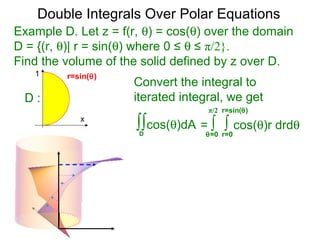
Example D. Let z = f(r, θ) = cos(θ) over the domain
D = {(r, θ)| r = sin(θ) where 0 ≤ θ ≤ π/2}.
Find the volume of the solid defined by z over D.
= ∫ ∫ cos(θ)r drdθ
r=0θ=0
Convert the integral to
iterated integral, we get
∫∫cos(θ)dA
D
r=sin(θ)π/2
Double Integrals Over Polar Equations
x
1
D :
r=sin(θ)
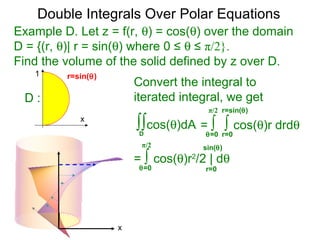
Example D. Let z = f(r, θ) = cos(θ) over the domain
D = {(r, θ)| r = sin(θ) where 0 ≤ θ ≤ π/2}.
Find the volume of the solid defined by z over D.
= ∫ ∫ cos(θ)r drdθ
r=0θ=0
Convert the integral to
iterated integral, we get
∫∫cos(θ)dA
D
r=sin(θ)π/2
= ∫ cos(θ)r2
/2 | dθ
r=0θ=0
π/2 sin(θ)
Double Integrals Over Polar Equations
x
1
x
D :
r=sin(θ)
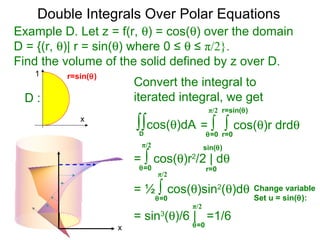
Example D. Let z = f(r, θ) = cos(θ) over the domain
D = {(r, θ)| r = sin(θ) where 0 ≤ θ ≤ π/2}.
Find the volume of the solid defined by z over D.
= ∫ ∫ cos(θ)r drdθ
r=0θ=0
Convert the integral to
iterated integral, we get
∫∫cos(θ)dA
D
r=sin(θ)π/2
= ∫ cos(θ)r2
/2 | dθ
r=0θ=0
π/2 sin(θ)
= ½ ∫ cos(θ)sin2
(θ)dθ
θ=0
π/2
Change variable
Set u = sin(θ):
= sin3
(θ)/6 | =1/6
θ=0
π/2
Double Integrals Over Polar Equations
x
1
x
D :
r=sin(θ)
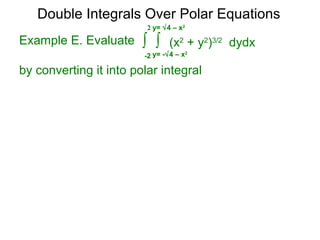
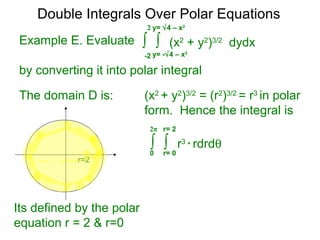
Example E. Evaluate
by converting it into polar integral
Double Integrals Over Polar Equations
∫ ∫ (x2
+ y2
)3/2
dydx
y= -√4 – x2
-2
2 y= √4 – x2
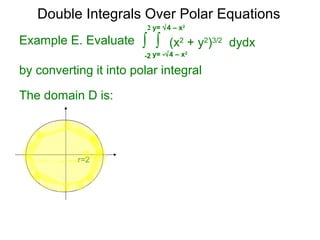
Example E. Evaluate
by converting it into polar integral
The domain D is:
r=2
Double Integrals Over Polar Equations
∫ ∫ (x2
+ y2
)3/2
dydx
y= -√4 – x2
-2
2 y= √4 – x2
Example E. Evaluate
by converting it into polar integral
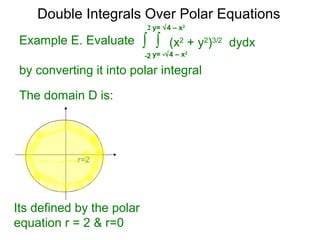
The domain D is:
r=2
Its defined by the polar
equation r = 2 & r=0
Double Integrals Over Polar Equations
∫ ∫ (x2
+ y2
)3/2
dydx
y= -√4 – x2
-2
2 y= √4 – x2
Example E. Evaluate
by converting it into polar integral
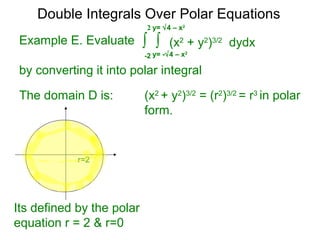
The domain D is: (x2
+ y2
)3/2
= (r2
)3/2
= r3
in polar
form.
r=2
Its defined by the polar
equation r = 2 & r=0
Double Integrals Over Polar Equations
∫ ∫ (x2
+ y2
)3/2
dydx
y= -√4 – x2
-2
2 y= √4 – x2
Example E. Evaluate
by converting it into polar integral
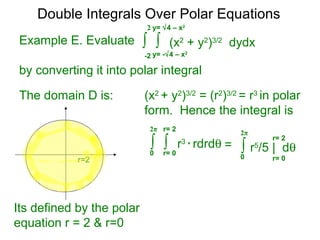
The domain D is: (x2
+ y2
)3/2
= (r2
)3/2
= r3
in polar
form. Hence the integral is
r=2
Its defined by the polar
equation r = 2 & r=0
∫ ∫ r3
* rdrdθ
r= 00
2π r= 2
Double Integrals Over Polar Equations
∫ ∫ (x2
+ y2
)3/2
dydx
y= -√4 – x2
-2
2 y= √4 – x2
Example E. Evaluate
by converting it into polar integral
The domain D is: (x2
+ y2
)3/2
= (r2
)3/2
= r3
in polar
form. Hence the integral is
r=2
Its defined by the polar
equation r = 2 & r=0
∫ ∫ r3
* rdrdθ
r= 00
2π r= 2
∫ r5
/5 | dθ
r= 00
2π
r= 2
=
Double Integrals Over Polar Equations
∫ ∫ (x2
+ y2
)3/2
dydx
y= -√4 – x2
-2
2 y= √4 – x2
Example E. Evaluate
by converting it into polar integral
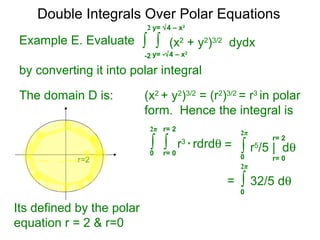
The domain D is: (x2
+ y2
)3/2
= (r2
)3/2
= r3
in polar
form. Hence the integral is
r=2
Its defined by the polar
equation r = 2 & r=0
∫ ∫ r3
* rdrdθ
r= 00
2π r= 2
∫ r5
/5 | dθ
r= 00
2π
r= 2
=
∫ 32/5 dθ
0
2π
=
Double Integrals Over Polar Equations
∫ ∫ (x2
+ y2
)3/2
dydx
y= -√4 – x2
-2
2 y= √4 – x2
Example E. Evaluate
by converting it into polar integral
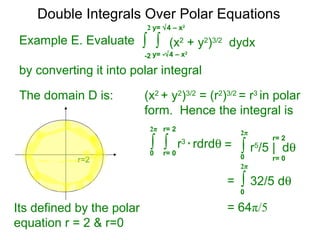
The domain D is: (x2
+ y2
)3/2
= (r2
)3/2
= r3
in polar
form. Hence the integral is
∫ ∫ (x2
+ y2
)3/2
dydx
y= -√4 – x2
-2
2 y= √4 – x2
r=2
Its defined by the polar
equation r = 2 & r=0
∫ ∫ r3
* rdrdθ
r= 00
2π r= 2
∫ r5
/5 | dθ
r= 00
2π
r= 2
=
∫ 32/5 dθ
0
2π
=
= 64π/5
Double Integrals Over Polar Equations
For more integration examples of changing from
dxdy form to the polar rdrdθr –form may be found at
the following link:
Double Integrals Over Polar Equations
http://ltcconline.net/greenl/courses/202/multipleIntegration/d
oublePolarIntegration.htm

24 double integral over polar coordinate

  • 1.
    Double Integrals OverPolar Equations
  • 2.
    Given a domainD defined by r1(θ) and r2(θ) where r1 < r2 and A < θ < B as shown in the figure, D = {(r, θ)| r1 < r < r2, A < θ < B}. Double Integrals Over Polar Equations Y Z A B X D r2(θ) r1(θ)
  • 3.
    Double Integrals OverPolar Equations Y Z A B X Partition the xy-plane with Δr and Δθ. D r2(θ) r1(θ) Given a domain D defined by r1(θ) and r2(θ) where r1 < r2 and A < θ < B as shown in the figure, D = {(r, θ)| r1 < r < r2, A < θ < B}.
  • 4.
    Given a domainD defined by r1(θ) and r2(θ) where r1 < r2 and A < θ < B as shown in the figure. … Double Integrals Over Polar Equations Y Z A B X Partition the xy-plane with Δr and Δθ. D r2(θ) r1(θ)
  • 5.
    Given a domainD defined by r1(θ) and r2(θ) where r1 < r2 and A < θ < B as shown in the figure. … Δr Double Integrals Over Polar Equations Y Z A B X Partition the xy-plane with Δr and Δθ. D r2(θ) r1(θ)
  • 6.
    Given a domainD defined by r1(θ) and r2(θ) where r1 < r2 and A < θ < B as shown in the figure. … Δθ Δr Double Integrals Over Polar Equations Y Z A B X Partition the xy-plane with Δr and Δθ. D r2(θ) r1(θ)
  • 7.
    Given a domainD defined by r1(θ) and r2(θ) where r1 < r2 and A < θ < B as shown in the figure. arbitrary ΔrΔθ–tile as shown and let (r* , θ* ) be an arbitrary point in the tile and Δ A be area of the tile, then ΔA ≈ r* ΔrΔθ. … Δθ Δr (r*, θ*) r* Double Integrals Over Polar Equations Y Z A B X Partition the xy-plane with Δr and Δθ. Select an D r2(θ) r1(θ)
  • 8.
    Given a domainD defined by r1(θ) and r2(θ) where r1 < r2 and A < θ < B as shown in the figure. arbitrary ΔrΔθ–tile as shown and let (r* , θ* ) be an arbitrary point in the tile and Δ A be area of the tile, then ΔA ≈ r* ΔrΔθ. (HW. Why? In fact ΔA = r* ΔrΔθ if r* is the center.) … Δθ Δr (r*, θ*) r* Double Integrals Over Polar Equations Y Z A B X Partition the xy-plane with Δr and Δθ. Select an D r2(θ) r1(θ)
  • 9.
    Double Integrals OverPolar Equations Let z = f(r, θ) ≥ 0 be a function over D. Y Z A B X z = f(r, θ) D r2(θ) r1(θ)
  • 10.
    The volume ofthe column over one tile having z as the cover is ΔV ≈ f(r* , θ* ) r* ΔrΔθ. Double Integrals Over Polar Equations Y A B X Let z = f(r, θ) ≥ 0 be a function over D. D Z z = f(r, θ) r2(θ) r1(θ)
  • 11.
    The volume ofthe column over one tile having z as the cover is ΔV ≈ f(r* , θ* ) r* ΔrΔθ. lim Σ(ΔV) Δr,Δθ0 Double Integrals Over Polar Equations Y A B X Let z = f(r, θ) ≥ 0 be a function over D. D Z Hence the volume V over D is the sum of all z = f(r, θ) r2(θ) r1(θ)
  • 12.
    The volume ofthe column over one tile having z as the cover is ΔV ≈ f(r* , θ* ) r* ΔrΔθ. lim Σ(ΔV) = lim Σf(r* , θ* )r* ΔrΔθ = ∫∫f(r, θ)dA. Δr,Δθ0 Δr,Δθ0 ΔA Double Integrals Over Polar Equations Y A B X Let z = f(r, θ) ≥ 0 be a function over D. D D Z Hence the volume V over D is the sum of all z = f(r, θ) r2(θ) r1(θ)
  • 13.
    The volume ofthe column over one tile having z as the cover is ΔV ≈ f(r* , θ* ) r* ΔrΔθ. lim Σ(ΔV) = lim Σf(r* , θ* )r* ΔrΔθ = ∫∫f(r, θ)dA. Δr,Δθ0 Δr,Δθ0 ∫ ∫ f(r, θ) rdrdθ, which is V, r=r1(θ) r2(θ) θ=A B ΔA Double Integrals Over Polar Equations Y A B X Let z = f(r, θ) ≥ 0 be a function over D. D D Z Hence the volume V over D is the sum of all z = f(r, θ) in term of drdθ, we have r2(θ) r1(θ) ∫∫f(r, θ)dA = D
  • 14.
    The volume ofthe column over one tile having z as the cover is ΔV ≈ f(r* , θ* ) r* ΔrΔθ. lim Σ(ΔV) = lim Σf(r* , θ* )r* ΔrΔθ = ∫∫f(r, θ)dA. Δr,Δθ0 Δr,Δθ0 ∫ ∫ f(r, θ) rdrdθ, which is V, r=r1(θ) r2(θ) θ=A B ΔA Double Integrals Over Polar Equations Y A B X Let z = f(r, θ) ≥ 0 be a function over D. D D Z Hence the volume V over D is the sum of all z = f(r, θ) in term of drdθ, we have = volume of the solid with D = {r1 < r < r2, A < θ <B}. r2(θ) r1(θ) ∫∫f(r, θ)dA = D
  • 15.
    Cylindrical Coordinates The cylindricalcoordinate system is the combination of using polar coordinates for points in the xy–plane with z as the 3rd coordinate.
  • 16.
    Example A. a.Plot the point (3,120o , 4) in cylindrical coordinate. Convert it to rectangular coordinate. Cylindrical Coordinates The cylindrical coordinate system is the combination of using polar coordinates for points in the xy–plane with z as the 3rd coordinate.
  • 17.
    Example A. a.Plot the point (3,120o , 4) in cylindrical coordinate. Convert it to rectangular coordinate. 3 120o x y z Cylindrical Coordinates The cylindrical coordinate system is the combination of using polar coordinates for points in the xy–plane with z as the 3rd coordinate.
  • 18.
    Example A. a.Plot the point (3,120o , 4) in cylindrical coordinate. Convert it to rectangular coordinate. 3 120o 4 x y z (3, 120o , 4) Cylindrical Coordinates The cylindrical coordinate system is the combination of using polar coordinates for points in the xy–plane with z as the 3rd coordinate.
  • 19.
    Example A. a.Plot the point (3,120o , 4) in cylindrical coordinate. Convert it to rectangular coordinate. 3 120o 4 x y z (3, 120o , 4) x = 3cos(120o ) = –3/2 y = 3sin(120o ) = √3 Hence the point is (–3/2, √3, 4) Cylindrical Coordinates The cylindrical coordinate system is the combination of using polar coordinates for points in the xy–plane with z as the 3rd coordinate.
  • 20.
    Example A. a.Plot the point (3,120o , 4) in cylindrical coordinate. Convert it to rectangular coordinate. 3 120o 4 x y z (3, 120o , 4) x = 3cos(120o ) = –3/2 y = 3sin(120o ) = √3 Hence the point is (–3/2, √3, 4) b. Convert (3, –3, 1) into to cylindrical coordinate. Cylindrical Coordinates The cylindrical coordinate system is the combination of using polar coordinates for points in the xy–plane with z as the 3rd coordinate.
  • 21.
    Example A. a.Plot the point (3,120o , 4) in cylindrical coordinate. Convert it to rectangular coordinate. 3 120o 4 x y z (3, 120o , 4) x = 3cos(120o ) = –3/2 y = 3sin(120o ) = √3 Hence the point is (–3/2, √3, 4) b. Convert (3, –3, 1) into to cylindrical coordinate. Cylindrical Coordinates The cylindrical coordinate system is the combination of using polar coordinates for points in the xy–plane with z as the 3rd coordinate.
  • 22.
    Example A. a.Plot the point (3,120o , 4) in cylindrical coordinate. Convert it to rectangular coordinate. 3 120o 4 x y z (3, 120o , 4) x = 3cos(120o ) = –3/2 y = 3sin(120o ) = √3 Hence the point is (–3/2, √3, 4) b. Convert (3, –3, 1) into to cylindrical coordinate. θ = 315o , r = √9 + 9 = √18 Hence the point is (√18, 315o , 1) the cylindrical coordinate. Cylindrical Coordinates The cylindrical coordinate system is the combination of using polar coordinates for points in the xy–plane with z as the 3rd coordinate.
  • 23.
    Example A. a.Plot the point (3,120o , 4) in cylindrical coordinate. Convert it to rectangular coordinate. 3 120o 4 x y z (3, 120o , 4) x = 3cos(120o ) = –3/2 y = 3sin(120o ) = √3 Hence the point is (–3/2, √3, 4) b. Convert (3, –3, 1) into to cylindrical coordinate. (√18, 315o , 0) θ = 315o , r = √9 + 9 = √18 Hence the point is (√18, 315o , 1) the cylindrical coordinate. x y Cylindrical Coordinates z The cylindrical coordinate system is the combination of using polar coordinates for points in the xy–plane with z as the 3rd coordinate.
  • 24.
    Example A. a.Plot the point (3,120o , 4) in cylindrical coordinate. Convert it to rectangular coordinate. 3 120o 4 x y z (3, 120o , 4) x = 3cos(120o ) = –3/2 y = 3sin(120o ) = √3 Hence the point is (–3/2, √3, 4) b. Convert (3, –3, 1) into to cylindrical coordinate. (√18, 315o , 0) θ = 315o , r = √9 + 9 = √18 Hence the point is (√18, 315o , 1) the cylindrical coordinate. x y Cylindrical Coordinates z (√18, 315o , 1) = (3, –3, 1) 1 The cylindrical coordinate system is the combination of using polar coordinates for points in the xy–plane with z as the 3rd coordinate.
  • 25.
    Cylindrical Coordinates The constantequations r = k describes cylinders of radius k, thus the name "cylindrical coordinate".
  • 26.
    The constant equations r= k describes cylinders of radius k, thus the name "cylindrical coordinate". Example B. a. Sketch r = 2 2 Cylindrical Coordinates x y z
  • 27.
    The constant equations r= k describes cylinders of radius k, thus the name "cylindrical coordinate". x y Example B. a. Sketch r = 2 2 The constant equations θ = k describes the vertical plane through the origin, at the angle k with x-axis. b. Sketch θ = 3π/4 3π/4 Cylindrical Coordinates z x y z
  • 28.
    The constant equations r= k describes cylinders of radius k, thus the name "cylindrical coordinate". x y Example B. a. Sketch r = 2 2 The constant equations θ = k describes the vertical plane through the origin, at the angle k with x-axis. b. Sketch θ = 3π/4 3π/4 Cylindrical Coordinates z x y z
  • 29.
    Cylindrical Coordinates Graphs maybe given in the cylindrical coordinate using polar coordinates for points in the domain in the xy– plane and z = f(r, θ). Here are some examples of cylindrical graphs.
  • 30.
    Cylindrical Coordinates Graphs maybe given in the cylindrical coordinate using polar coordinates for points in the domain in the xy– plane and z = f(r, θ). Here are some examples of cylindrical graphs. Example C. a. z = sin(r), D = {0 ≤ r ≤ π, 0 ≤ θ ≤ 2π} → 0 ≤ z ≤ 1
  • 31.
    Cylindrical Coordinates Graphs maybe given in the cylindrical coordinate using polar coordinates for points in the domain in the xy– plane and z = f(r, θ). Here are some examples of cylindrical graphs. Example C. a. z = sin(r), D = {0 ≤ r ≤ π, 0 ≤ θ ≤ 2π} → 0 ≤ z ≤ 2 π x y z = sin(r)
  • 32.
    Cylindrical Coordinates Graphs maybe given in the cylindrical coordinate using polar coordinates for points in the domain in the xy– plane and z = f(r, θ). Here are some examples of cylindrical graphs. Example C. a. z = sin(r), D = {0 ≤ r ≤ π, 0 ≤ θ ≤ 2π} → 0 ≤ z ≤ 2 π x y z = sin(r) b. z = θ sin(r), D = {0 ≤ r ≤ π, 0 ≤ θ ≤ 2π} → 0 ≤ z ≤ 2 π
  • 33.
    Cylindrical Coordinates Graphs maybe given in the cylindrical coordinate using polar coordinates for points in the domain in the xy– plane and z = f(r, θ). Here are some examples of cylindrical graphs. Example C. a. z = sin(r), D = {0 ≤ r ≤ π, 0 ≤ θ ≤ 2π} → 0 ≤ z ≤ 2 π x y z = sin(r) x y z = θsin(r) b. z = θ sin(r), D = {0 ≤ r ≤ π, 0 ≤ θ ≤ 2π} → 0 ≤ z ≤ 2 π
  • 34.
    Double Integrals OverPolar Equations D D Let’s set up the volume calculation for both solids. I II
  • 35.
    Double Integrals OverPolar Equations The base D D D r = π Let’s set up the volume calculation for both solids. We note that D = {0 ≤ r ≤ π, 0 ≤ θ ≤ 2π}. I II
  • 36.
    ∫ ∫ f(r,θ) rdrdθ r=r1(θ) r2(θ) θ=A B Double Integrals Over Polar Equations Vol(I) = The base D D D r = π Let’s set up the volume calculation for both solids. We note that D = {0 ≤ r ≤ π, 0 ≤ θ ≤ 2π}. Using the formula I II V = Vol(II) = , their volumes are
  • 37.
    ∫ ∫ f(r,θ) rdrdθ r=r1(θ) r2(θ) θ=A B Double Integrals Over Polar Equations Vol(I) = The base D D D r = π Let’s set up the volume calculation for both solids. We note that D = {0 ≤ r ≤ π, 0 ≤ θ ≤ 2π}. Using the formula I II V = ∫ ∫ sin(r) r drdθ, r=0 π θ=0 2π Vol(II) = , their volumes are
  • 38.
    ∫ ∫ f(r,θ) rdrdθ r=r1(θ) r2(θ) θ=A B Double Integrals Over Polar Equations Vol(I) = The base D D D r = π Let’s set up the volume calculation for both solids. We note that D = {0 ≤ r ≤ π, 0 ≤ θ ≤ 2π}. Using the formula I II V = ∫ ∫ sin(r) r drdθ, r=0 π θ=0 2π Vol(II) =∫ ∫ θ sin(r) r drdθ. (HW: Finish the problems.) r=0 π θ=0 2π , their volumes are
  • 39.
    Example D. Letz = f(r, θ) = cos(θ) over the domain D = {(r, θ)| r = sin(θ) where 0 ≤ θ ≤ π/2}. Find the volume of the solid defined by z over D. Double Integrals Over Polar Equations
  • 40.
    Example D. Letz = f(r, θ) = cos(θ) over the domain D = {(r, θ)| r = sin(θ) where 0 ≤ θ ≤ π/2}. Find the volume of the solid defined by z over D. Double Integrals Over Polar Equations x 1 D : r=sin(θ) x
  • 41.
    Example D. Letz = f(r, θ) = cos(θ) over the domain D = {(r, θ)| r = sin(θ) where 0 ≤ θ ≤ π/2}. Find the volume of the solid defined by z over D. = ∫ ∫ cos(θ)r drdθ r=0θ=0 Convert the integral to iterated integral, we get ∫∫cos(θ)dA D r=sin(θ)π/2 Double Integrals Over Polar Equations x 1 D : r=sin(θ)
  • 42.
    Example D. Letz = f(r, θ) = cos(θ) over the domain D = {(r, θ)| r = sin(θ) where 0 ≤ θ ≤ π/2}. Find the volume of the solid defined by z over D. = ∫ ∫ cos(θ)r drdθ r=0θ=0 Convert the integral to iterated integral, we get ∫∫cos(θ)dA D r=sin(θ)π/2 = ∫ cos(θ)r2 /2 | dθ r=0θ=0 π/2 sin(θ) Double Integrals Over Polar Equations x 1 x D : r=sin(θ)
  • 43.
    Example D. Letz = f(r, θ) = cos(θ) over the domain D = {(r, θ)| r = sin(θ) where 0 ≤ θ ≤ π/2}. Find the volume of the solid defined by z over D. = ∫ ∫ cos(θ)r drdθ r=0θ=0 Convert the integral to iterated integral, we get ∫∫cos(θ)dA D r=sin(θ)π/2 = ∫ cos(θ)r2 /2 | dθ r=0θ=0 π/2 sin(θ) = ½ ∫ cos(θ)sin2 (θ)dθ θ=0 π/2 Change variable Set u = sin(θ): = sin3 (θ)/6 | =1/6 θ=0 π/2 Double Integrals Over Polar Equations x 1 x D : r=sin(θ)
  • 44.
    Example E. Evaluate byconverting it into polar integral Double Integrals Over Polar Equations ∫ ∫ (x2 + y2 )3/2 dydx y= -√4 – x2 -2 2 y= √4 – x2
  • 45.
    Example E. Evaluate byconverting it into polar integral The domain D is: r=2 Double Integrals Over Polar Equations ∫ ∫ (x2 + y2 )3/2 dydx y= -√4 – x2 -2 2 y= √4 – x2
  • 46.
    Example E. Evaluate byconverting it into polar integral The domain D is: r=2 Its defined by the polar equation r = 2 & r=0 Double Integrals Over Polar Equations ∫ ∫ (x2 + y2 )3/2 dydx y= -√4 – x2 -2 2 y= √4 – x2
  • 47.
    Example E. Evaluate byconverting it into polar integral The domain D is: (x2 + y2 )3/2 = (r2 )3/2 = r3 in polar form. r=2 Its defined by the polar equation r = 2 & r=0 Double Integrals Over Polar Equations ∫ ∫ (x2 + y2 )3/2 dydx y= -√4 – x2 -2 2 y= √4 – x2
  • 48.
    Example E. Evaluate byconverting it into polar integral The domain D is: (x2 + y2 )3/2 = (r2 )3/2 = r3 in polar form. Hence the integral is r=2 Its defined by the polar equation r = 2 & r=0 ∫ ∫ r3 * rdrdθ r= 00 2π r= 2 Double Integrals Over Polar Equations ∫ ∫ (x2 + y2 )3/2 dydx y= -√4 – x2 -2 2 y= √4 – x2
  • 49.
    Example E. Evaluate byconverting it into polar integral The domain D is: (x2 + y2 )3/2 = (r2 )3/2 = r3 in polar form. Hence the integral is r=2 Its defined by the polar equation r = 2 & r=0 ∫ ∫ r3 * rdrdθ r= 00 2π r= 2 ∫ r5 /5 | dθ r= 00 2π r= 2 = Double Integrals Over Polar Equations ∫ ∫ (x2 + y2 )3/2 dydx y= -√4 – x2 -2 2 y= √4 – x2
  • 50.
    Example E. Evaluate byconverting it into polar integral The domain D is: (x2 + y2 )3/2 = (r2 )3/2 = r3 in polar form. Hence the integral is r=2 Its defined by the polar equation r = 2 & r=0 ∫ ∫ r3 * rdrdθ r= 00 2π r= 2 ∫ r5 /5 | dθ r= 00 2π r= 2 = ∫ 32/5 dθ 0 2π = Double Integrals Over Polar Equations ∫ ∫ (x2 + y2 )3/2 dydx y= -√4 – x2 -2 2 y= √4 – x2
  • 51.
    Example E. Evaluate byconverting it into polar integral The domain D is: (x2 + y2 )3/2 = (r2 )3/2 = r3 in polar form. Hence the integral is ∫ ∫ (x2 + y2 )3/2 dydx y= -√4 – x2 -2 2 y= √4 – x2 r=2 Its defined by the polar equation r = 2 & r=0 ∫ ∫ r3 * rdrdθ r= 00 2π r= 2 ∫ r5 /5 | dθ r= 00 2π r= 2 = ∫ 32/5 dθ 0 2π = = 64π/5 Double Integrals Over Polar Equations
  • 52.
    For more integrationexamples of changing from dxdy form to the polar rdrdθr –form may be found at the following link: Double Integrals Over Polar Equations http://ltcconline.net/greenl/courses/202/multipleIntegration/d oublePolarIntegration.htm