PLANTS
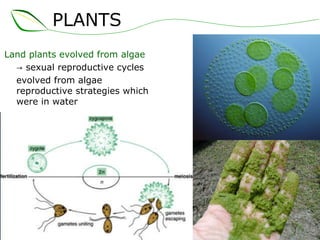
Land plants evolved from algae ->  sexual reproductive cycles  evolved from algae reproductive strategies which were in water PLANTS
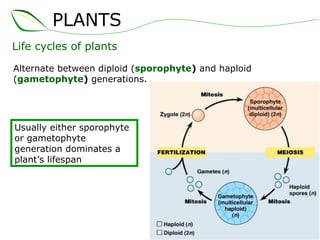
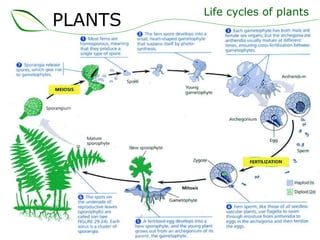
Life cycles of plants Alternate between diploid ( sporophyte )  and haploid ( gametophyte )  generations. Usually either sporophyte or gametophyte generation dominates a plant’s lifespan PLANTS
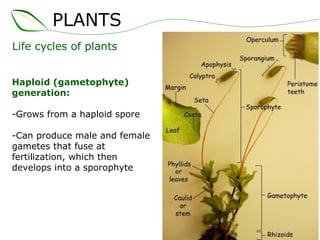
Life cycles of plants Haploid (gametophyte) generation: Grows from a haploid spore -Can produce male and female gametes that fuse at fertilization, which then develops into a sporophyte PLANTS
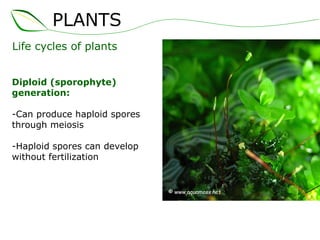
Life cycles of plants Diploid (sporophyte) generation: -Can produce haploid spores through meiosis -Haploid spores can develop without fertilization PLANTS
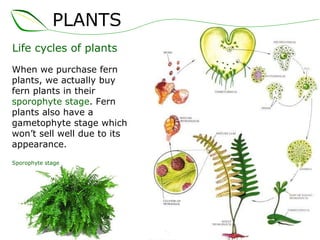
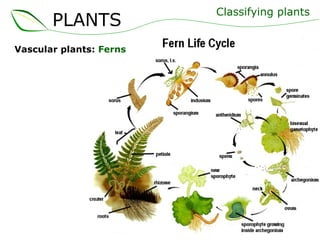
Life cycles of plants When we purchase fern plants, we actually buy fern plants in their  sporophyte stage . Fern plants also have a gametophyte stage which won’t sell well due to its appearance. Sporophyte stage PLANTS
Life cycles of plants PLANTS
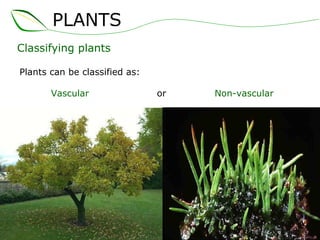
Classifying plants Plants can be classified as: Vascular   or  Non-vascular PLANTS
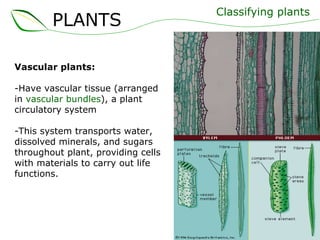
Classifying plants Vascular plants: Have   vascular tissue (arranged in  vascular bundles ), a plant circulatory system This system transports water, dissolved minerals, and sugars throughout plant, providing cells with materials to carry out life functions. PLANTS
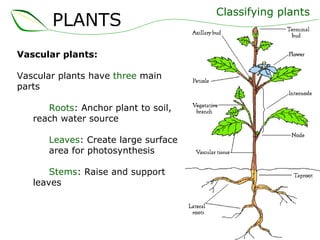
Vascular plants: Vascular plants have  three  main parts Roots : Anchor plant to soil,  reach water source Leaves : Create large surface  area for photosynthesis Stems : Raise and support  leaves Classifying plants PLANTS
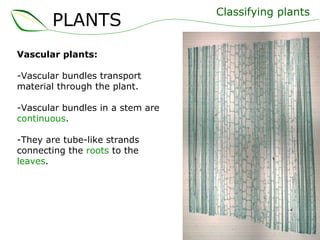
Vascular plants: Vascular bundles transport material through the plant. -Vascular bundles in a stem are  continuous .  -They are tube-like strands connecting the  roots  to the  leaves . Classifying plants PLANTS
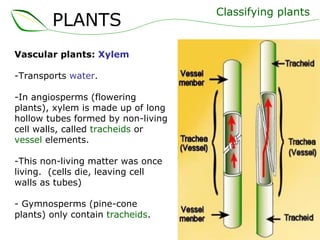
Vascular plants:  Xylem -Transports  water . In angiosperms (flowering plants), xylem is made up of long hollow tubes formed by non-living cell walls, called  tracheids  or  vessel  elements. -This non-living matter was once living.  (cells die, leaving cell walls as tubes) - Gymnosperms (pine-cone plants) only contain  tracheids . Classifying plants PLANTS
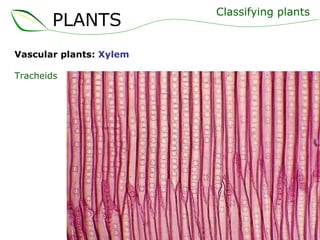
Vascular plants:  Xylem Tracheids Classifying plants PLANTS
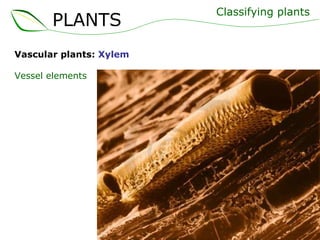
Vascular plants:  Xylem Vessel elements Classifying plants PLANTS
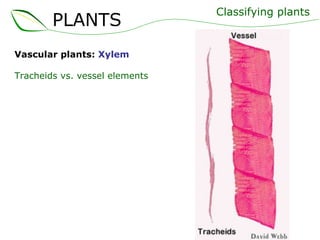
Vascular plants:  Xylem Tracheids vs. vessel elements Classifying plants PLANTS
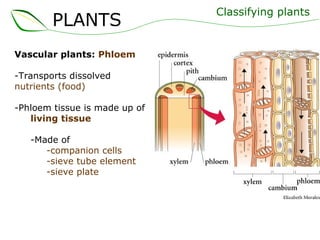
Vascular plants:  Phloem Transports dissolved  nutrients (food) -Phloem tissue is made up of  living tissue -Made of -companion cells -sieve tube element -sieve plate Classifying plants PLANTS
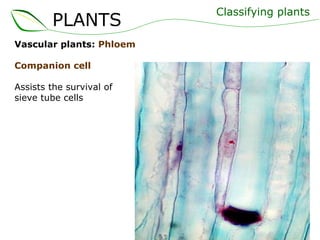
Vascular plants:  Phloem Companion cell Assists the survival of sieve tube cells Classifying plants PLANTS
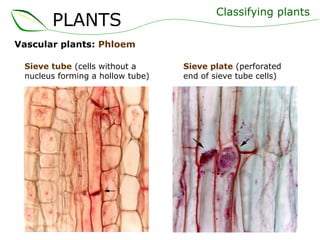
Vascular plants:  Phloem Classifying plants Sieve tube  (cells without a nucleus forming a hollow tube) Sieve plate  (perforated end of sieve tube cells) PLANTS
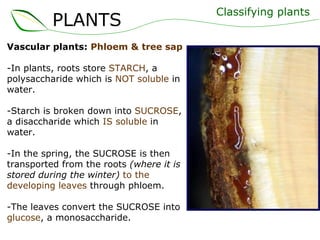
Vascular plants:  Phloem & tree sap -In plants, roots store  STARCH , a polysaccharide which is  NOT soluble  in water. -Starch is broken down into  SUCROSE , a disaccharide which  IS soluble  in water. -In the spring, the SUCROSE is then transported from the roots  (where it is stored during the winter)   to the developing leaves  through phloem. -The leaves convert the SUCROSE into  glucose , a monosaccharide. Classifying plants PLANTS
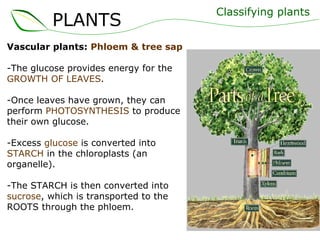
Vascular plants:  Phloem & tree sap -The glucose provides energy for the  GROWTH OF LEAVES . -Once leaves have grown, they can perform  PHOTOSYNTHESIS  to produce their own glucose. -Excess  glucose  is converted into  STARCH  in the chloroplasts (an organelle). -The STARCH is then converted into  sucrose , which is transported to the ROOTS through the phloem. Classifying plants PLANTS
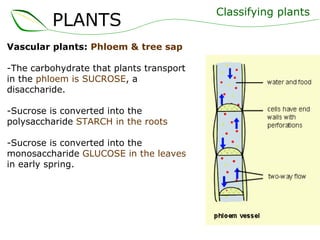
Vascular plants:  Phloem & tree sap -The carbohydrate that plants transport in the  phloem is SUCROSE , a disaccharide. -Sucrose is converted into the polysaccharide  STARCH in the roots -Sucrose is converted into the monosaccharide  GLUCOSE in the leaves  in early spring. Classifying plants PLANTS
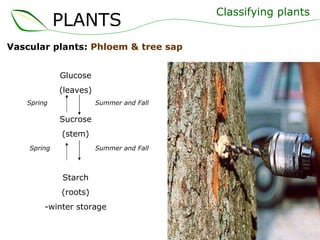
Vascular plants:  Phloem & tree sap Classifying plants Glucose (leaves) Sucrose (stem) Starch (roots) -winter storage Summer and Fall Summer and Fall Spring Spring PLANTS
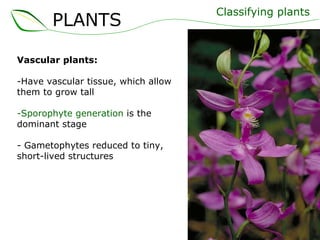
Vascular plants: Have vascular tissue, which allow them to grow tall Sporophyte generation  is the dominant stage - Gametophytes reduced to tiny, short-lived structures  Classifying plants PLANTS
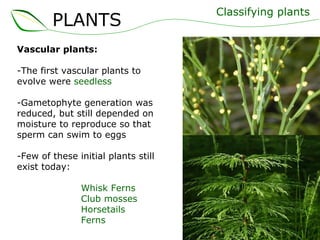
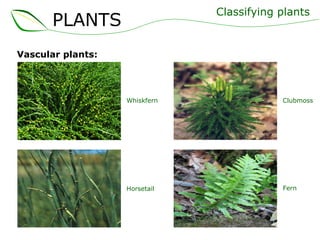
Vascular plants: The first vascular plants to evolve were  seedless Gametophyte generation was reduced, but still depended on moisture to reproduce so that sperm can swim to eggs Few of these initial plants still exist today: Whisk Ferns Club mosses Horsetails Ferns Classifying plants PLANTS
Vascular plants: Whiskfern Clubmoss Horsetail Fern Classifying plants PLANTS
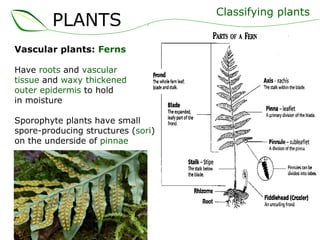
Vascular plants:  Ferns Have  roots  and  vascular  tissue  and  waxy thickened  outer epidermis  to hold  in moisture Sporophyte plants have small spore-producing structures ( sori ) on the underside of  pinnae Classifying plants PLANTS
Vascular plants:  Ferns Classifying plants PLANTS
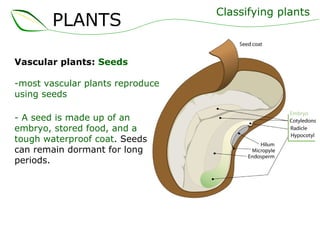
Vascular plants:  Seeds -most vascular plants reproduce using seeds - A seed is made up of an embryo, stored food, and a tough waterproof coat . Seeds can remain dormant for long periods. Classifying plants PLANTS
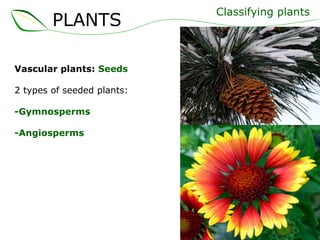
Vascular plants:  Seeds 2 types of seeded plants: -Gymnosperms -Angiosperms Classifying plants PLANTS
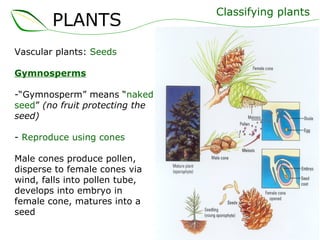
Vascular plants:  Seeds Gymnosperms “ Gymnosperm” means “ naked seed ”  (no fruit protecting the seed) -  Reproduce using cones Male cones produce pollen,  disperse to female cones via  wind, falls into pollen tube, develops into embryo in  female cone, matures into a  seed Classifying plants PLANTS
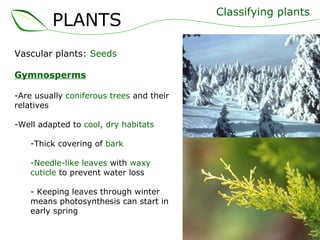
Vascular plants:  Seeds Gymnosperms Are usually  coniferous trees  and their relatives Well adapted to  cool, dry habitats Thick covering of  bark Needle-like leaves  with  waxy cuticle  to prevent water loss - Keeping leaves through winter means photosynthesis can start in early spring Classifying plants PLANTS
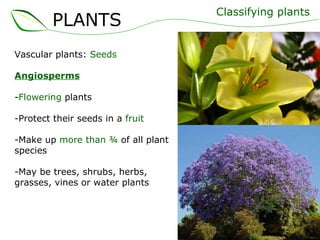
Vascular plants:  Seeds Angiosperms - Flowering  plants -Protect their seeds in a  fruit -Make up  more than ¾  of all plant species -May be trees, shrubs, herbs, grasses, vines or water plants Classifying plants PLANTS
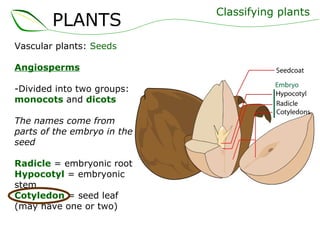
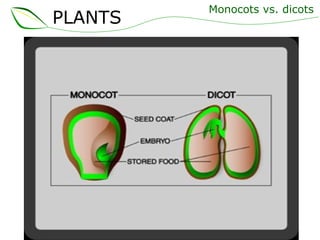
Vascular plants:  Seeds Angiosperms -Divided into two groups:  monocots  and  dicots The names come from parts of the embryo in the seed Radicle  = embryonic root Hypocotyl  = embryonic stem Cotyledon  = seed leaf (may have one or two) Classifying plants PLANTS
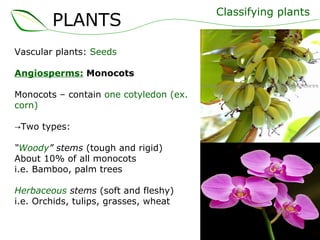
Vascular plants:  Seeds Angiosperms:   Monocots Monocots – contain  one cotyledon (ex. corn) -> Two types: “ Woody ” stems  (tough and rigid) About 10% of all monocots i.e. Bamboo, palm trees  Herbaceous  stems  (soft and fleshy) i.e. Orchids, tulips, grasses, wheat Classifying plants PLANTS
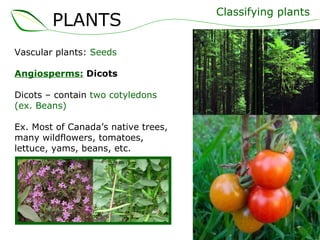
Vascular plants:  Seeds Angiosperms:   Dicots Dicots – contain  two cotyledons (ex. Beans) Ex. Most of Canada’s native trees, many wildflowers, tomatoes, lettuce, yams, beans, etc. Classifying plants PLANTS
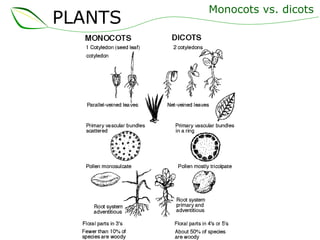
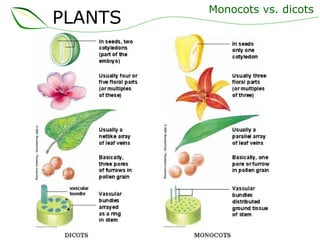
Monocots vs. dicots PLANTS
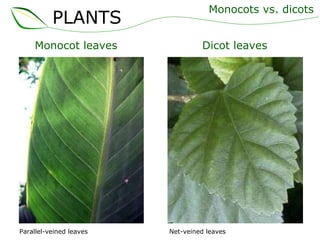
Monocots vs. dicots Monocot leaves    Dicot leaves Parallel-veined leaves   Net-veined leaves PLANTS
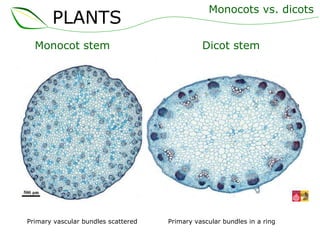
Monocots vs. dicots Monocot stem    Dicot stem Primary vascular bundles scattered   Primary vascular bundles in a ring PLANTS
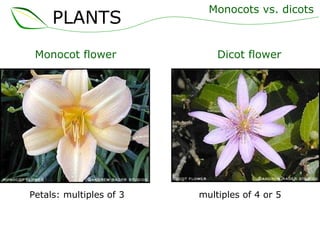
Monocots vs. dicots Monocot flower    Dicot flower Petals: multiples of 3   multiples of 4 or 5 PLANTS
Monocots vs. dicots PLANTS
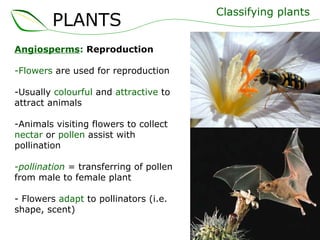
Angiosperms :  Reproduction Flowers  are used for reproduction Usually  colourful  and  attractive  to attract animals Animals visiting flowers to collect  nectar  or  pollen  assist with pollination pollination  = transferring of pollen from male to female plant - Flowers  adapt  to pollinators (i.e. shape, scent) Classifying plants PLANTS
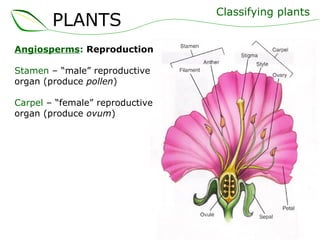
Angiosperms :  Reproduction Stamen  – “male” reproductive organ (produce  pollen ) Carpel  – “female” reproductive organ (produce  ovum ) Classifying plants PLANTS
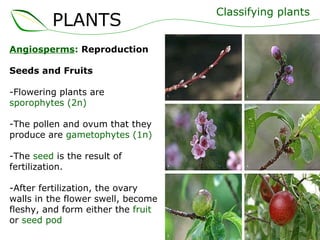
Angiosperms :  Reproduction Seeds and Fruits -Flowering plants are  sporophytes (2n) -The pollen and ovum that they produce are  gametophytes (1n) -The  seed  is the result of fertilization. -After fertilization, the ovary walls in the flower swell, become fleshy, and form either the  fruit  or  seed pod Classifying plants PLANTS
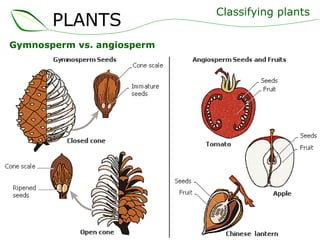
Gymnosperm vs. angiosperm Classifying plants PLANTS

01 plants part 1 (slideshare)

  • 1.
  • 2.
    Land plants evolvedfrom algae -> sexual reproductive cycles evolved from algae reproductive strategies which were in water PLANTS
  • 3.
    Life cycles ofplants Alternate between diploid ( sporophyte ) and haploid ( gametophyte ) generations. Usually either sporophyte or gametophyte generation dominates a plant’s lifespan PLANTS
  • 4.
    Life cycles ofplants Haploid (gametophyte) generation: Grows from a haploid spore -Can produce male and female gametes that fuse at fertilization, which then develops into a sporophyte PLANTS
  • 5.
    Life cycles ofplants Diploid (sporophyte) generation: -Can produce haploid spores through meiosis -Haploid spores can develop without fertilization PLANTS
  • 6.
    Life cycles ofplants When we purchase fern plants, we actually buy fern plants in their sporophyte stage . Fern plants also have a gametophyte stage which won’t sell well due to its appearance. Sporophyte stage PLANTS
  • 7.
    Life cycles ofplants PLANTS
  • 8.
    Classifying plants Plantscan be classified as: Vascular or Non-vascular PLANTS
  • 9.
    Classifying plants Vascularplants: Have vascular tissue (arranged in vascular bundles ), a plant circulatory system This system transports water, dissolved minerals, and sugars throughout plant, providing cells with materials to carry out life functions. PLANTS
  • 10.
    Vascular plants: Vascularplants have three main parts Roots : Anchor plant to soil, reach water source Leaves : Create large surface area for photosynthesis Stems : Raise and support leaves Classifying plants PLANTS
  • 11.
    Vascular plants: Vascularbundles transport material through the plant. -Vascular bundles in a stem are continuous . -They are tube-like strands connecting the roots to the leaves . Classifying plants PLANTS
  • 12.
    Vascular plants: Xylem -Transports water . In angiosperms (flowering plants), xylem is made up of long hollow tubes formed by non-living cell walls, called tracheids or vessel elements. -This non-living matter was once living. (cells die, leaving cell walls as tubes) - Gymnosperms (pine-cone plants) only contain tracheids . Classifying plants PLANTS
  • 13.
    Vascular plants: Xylem Tracheids Classifying plants PLANTS
  • 14.
    Vascular plants: Xylem Vessel elements Classifying plants PLANTS
  • 15.
    Vascular plants: Xylem Tracheids vs. vessel elements Classifying plants PLANTS
  • 16.
    Vascular plants: Phloem Transports dissolved nutrients (food) -Phloem tissue is made up of living tissue -Made of -companion cells -sieve tube element -sieve plate Classifying plants PLANTS
  • 17.
    Vascular plants: Phloem Companion cell Assists the survival of sieve tube cells Classifying plants PLANTS
  • 18.
    Vascular plants: Phloem Classifying plants Sieve tube (cells without a nucleus forming a hollow tube) Sieve plate (perforated end of sieve tube cells) PLANTS
  • 19.
    Vascular plants: Phloem & tree sap -In plants, roots store STARCH , a polysaccharide which is NOT soluble in water. -Starch is broken down into SUCROSE , a disaccharide which IS soluble in water. -In the spring, the SUCROSE is then transported from the roots (where it is stored during the winter) to the developing leaves through phloem. -The leaves convert the SUCROSE into glucose , a monosaccharide. Classifying plants PLANTS
  • 20.
    Vascular plants: Phloem & tree sap -The glucose provides energy for the GROWTH OF LEAVES . -Once leaves have grown, they can perform PHOTOSYNTHESIS to produce their own glucose. -Excess glucose is converted into STARCH in the chloroplasts (an organelle). -The STARCH is then converted into sucrose , which is transported to the ROOTS through the phloem. Classifying plants PLANTS
  • 21.
    Vascular plants: Phloem & tree sap -The carbohydrate that plants transport in the phloem is SUCROSE , a disaccharide. -Sucrose is converted into the polysaccharide STARCH in the roots -Sucrose is converted into the monosaccharide GLUCOSE in the leaves in early spring. Classifying plants PLANTS
  • 22.
    Vascular plants: Phloem & tree sap Classifying plants Glucose (leaves) Sucrose (stem) Starch (roots) -winter storage Summer and Fall Summer and Fall Spring Spring PLANTS
  • 23.
    Vascular plants: Havevascular tissue, which allow them to grow tall Sporophyte generation is the dominant stage - Gametophytes reduced to tiny, short-lived structures Classifying plants PLANTS
  • 24.
    Vascular plants: Thefirst vascular plants to evolve were seedless Gametophyte generation was reduced, but still depended on moisture to reproduce so that sperm can swim to eggs Few of these initial plants still exist today: Whisk Ferns Club mosses Horsetails Ferns Classifying plants PLANTS
  • 25.
    Vascular plants: WhiskfernClubmoss Horsetail Fern Classifying plants PLANTS
  • 26.
    Vascular plants: Ferns Have roots and vascular tissue and waxy thickened outer epidermis to hold in moisture Sporophyte plants have small spore-producing structures ( sori ) on the underside of pinnae Classifying plants PLANTS
  • 27.
    Vascular plants: Ferns Classifying plants PLANTS
  • 28.
    Vascular plants: Seeds -most vascular plants reproduce using seeds - A seed is made up of an embryo, stored food, and a tough waterproof coat . Seeds can remain dormant for long periods. Classifying plants PLANTS
  • 29.
    Vascular plants: Seeds 2 types of seeded plants: -Gymnosperms -Angiosperms Classifying plants PLANTS
  • 30.
    Vascular plants: Seeds Gymnosperms “ Gymnosperm” means “ naked seed ” (no fruit protecting the seed) - Reproduce using cones Male cones produce pollen, disperse to female cones via wind, falls into pollen tube, develops into embryo in female cone, matures into a seed Classifying plants PLANTS
  • 31.
    Vascular plants: Seeds Gymnosperms Are usually coniferous trees and their relatives Well adapted to cool, dry habitats Thick covering of bark Needle-like leaves with waxy cuticle to prevent water loss - Keeping leaves through winter means photosynthesis can start in early spring Classifying plants PLANTS
  • 32.
    Vascular plants: Seeds Angiosperms - Flowering plants -Protect their seeds in a fruit -Make up more than ¾ of all plant species -May be trees, shrubs, herbs, grasses, vines or water plants Classifying plants PLANTS
  • 33.
    Vascular plants: Seeds Angiosperms -Divided into two groups: monocots and dicots The names come from parts of the embryo in the seed Radicle = embryonic root Hypocotyl = embryonic stem Cotyledon = seed leaf (may have one or two) Classifying plants PLANTS
  • 34.
    Vascular plants: Seeds Angiosperms: Monocots Monocots – contain one cotyledon (ex. corn) -> Two types: “ Woody ” stems (tough and rigid) About 10% of all monocots i.e. Bamboo, palm trees Herbaceous stems (soft and fleshy) i.e. Orchids, tulips, grasses, wheat Classifying plants PLANTS
  • 35.
    Vascular plants: Seeds Angiosperms: Dicots Dicots – contain two cotyledons (ex. Beans) Ex. Most of Canada’s native trees, many wildflowers, tomatoes, lettuce, yams, beans, etc. Classifying plants PLANTS
  • 36.
  • 37.
  • 38.
    Monocots vs. dicotsMonocot leaves Dicot leaves Parallel-veined leaves Net-veined leaves PLANTS
  • 39.
    Monocots vs. dicotsMonocot stem Dicot stem Primary vascular bundles scattered Primary vascular bundles in a ring PLANTS
  • 40.
    Monocots vs. dicotsMonocot flower Dicot flower Petals: multiples of 3 multiples of 4 or 5 PLANTS
  • 41.
  • 42.
    Angiosperms : Reproduction Flowers are used for reproduction Usually colourful and attractive to attract animals Animals visiting flowers to collect nectar or pollen assist with pollination pollination = transferring of pollen from male to female plant - Flowers adapt to pollinators (i.e. shape, scent) Classifying plants PLANTS
  • 43.
    Angiosperms : Reproduction Stamen – “male” reproductive organ (produce pollen ) Carpel – “female” reproductive organ (produce ovum ) Classifying plants PLANTS
  • 44.
    Angiosperms : Reproduction Seeds and Fruits -Flowering plants are sporophytes (2n) -The pollen and ovum that they produce are gametophytes (1n) -The seed is the result of fertilization. -After fertilization, the ovary walls in the flower swell, become fleshy, and form either the fruit or seed pod Classifying plants PLANTS
  • 45.
    Gymnosperm vs. angiospermClassifying plants PLANTS