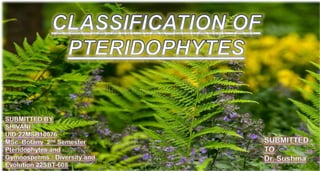
 A Pteridophyte is a vascular
plant (with xylem and phloem) that disperses spores.
Because pteridophytes produce
neither flowers nor seeds, they are sometimes
referred to as "cryptogams", meaning that their
means of reproduction is
hidden. Ferns, horsetails (often treated as ferns),
and lycophytes (clubmosses, spikemosses,
and quillworts) are all pteridophytes.
Psilophyta
(Whisk fern)
Lycophyta
(Club
mosses)
Sphenophyta
(horse tail)
Pterophyta
(fern )
Psilophyta (whisk fern )
 Division : Psilophyta Class 1- Psilophytopsida Class 2-
Psilopsida
Order- Psilophytaceae Order-Psilotales
Family- Rhyniaceae Family-Psilotaceae
They are seedless plants.
They are rootless plants. Rhizomes exist as underground stems where
the sporophyte is anchored.
The shoots grow aerially and branch into smaller stems.
Rhizomes have hair-like structures called rhizoids which are responsible
for the absorption of water and nutrients.
 The vascular system is very simple,
primitive and protostelic.
 The plant is usually leafless, and leaves, if
present, are in the appearance of scaly
appendages or foliage leaves.
 The plant grows as a sporophyte.
 Secondary growth is not present.
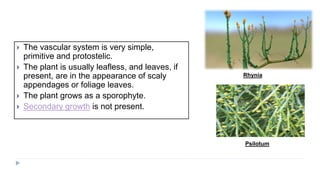
Rhynia
Psilotum
 Division : Class1: Eligulopsida Class 2 : ligulopsida
Order: lycopodiales Order : Selaginellales
Order : Isoetales
Order: lepidodendrales
Order : pleuromelales
 The division Lycophytes includes both living and extinct plants.
 Well-differentiated plant body with adventitious root, stem,
rhizophores and leaves.
Leaves are simple and small (microphyllous).A few fossil members
had a long leaves .
The sporophyte is homosporous or heterosporous.

 They have dichotomously branching stems bearing simple leaves
called microphylls and reproduce by means of spores borne
in sporangia on the sides of the stems at the bases of the leaves.
 Examples- Selaginella, Lycopodium.
Selaginella Lycopodium
 Division : Class1 – Sphenophyllopsida Class 2- Calamopsida
Order –Sphenophyllales Order-Calamitales
Order-Hyeniales
Order- Equisetales
The division Sphenophyta (also called Arthrophyta and
Calamophyta ) includes most of the genera which are known
only for fossils remains .
Well-differentiated plant body with roots arising from nodes of
the underground rhizome, stem and scaly leaves.
Homosporous, sporangia are borne on strobili.
Examples- Equisetum.
Equisetum
 Division : Class-Eusporangiopsida 2Order : Ophioglossales
Class- Protoleptosporangiopsida 1Order : Osmundales
Class- Leptosporangiopsida 3Order : Filicales
Class-Primoteropsida 2Order : Cladoxylales
The Division –Filicophyta is the largest group of
vascular cryptogamy.
Well-differentiated plant body with roots, stem
and leaves.
The sporophyte is homosporous or
heterosporous.
Antherozoids are multiflagellate.
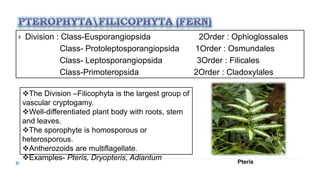
Examples- Pteris, Dryopteris, Adiantum Pteris
Classifications of pteridophytes