Plants Organ System
Plants Major Organ System
1.
Plants Major Organ
Roots
Stems
Leaves
Reproductive Structures
The Importance of Plants
1. Photosynthesis sustains life on Earth.
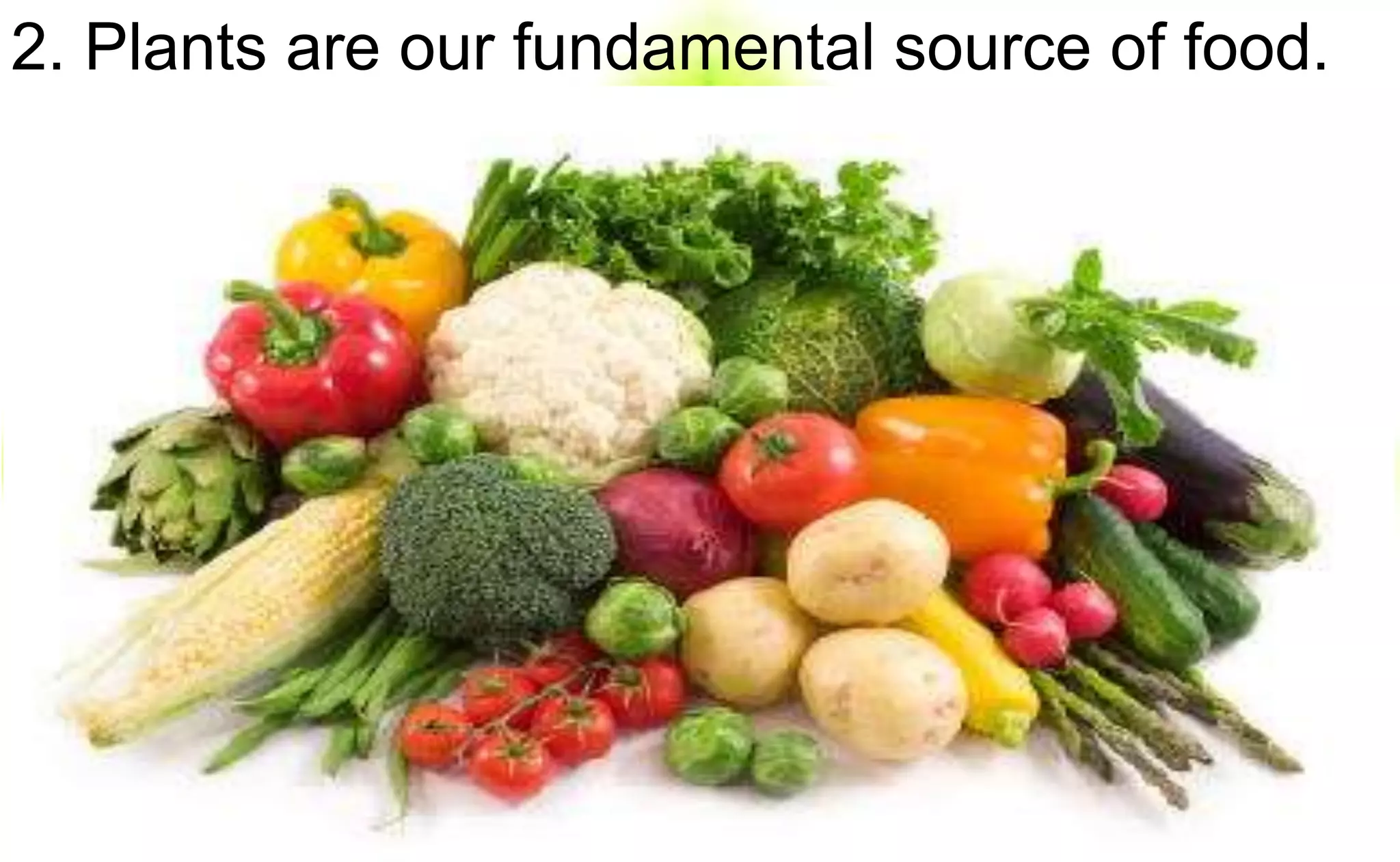
2. Plants are our fundamental source of food.
3. Many medicines come from plants.
4. Plants provide fuel, shelter, and paper
products
4. Plants provide fuel, shelter, and paper
products
6. Biotechnology seeks to develop new plants
products.
Tissues
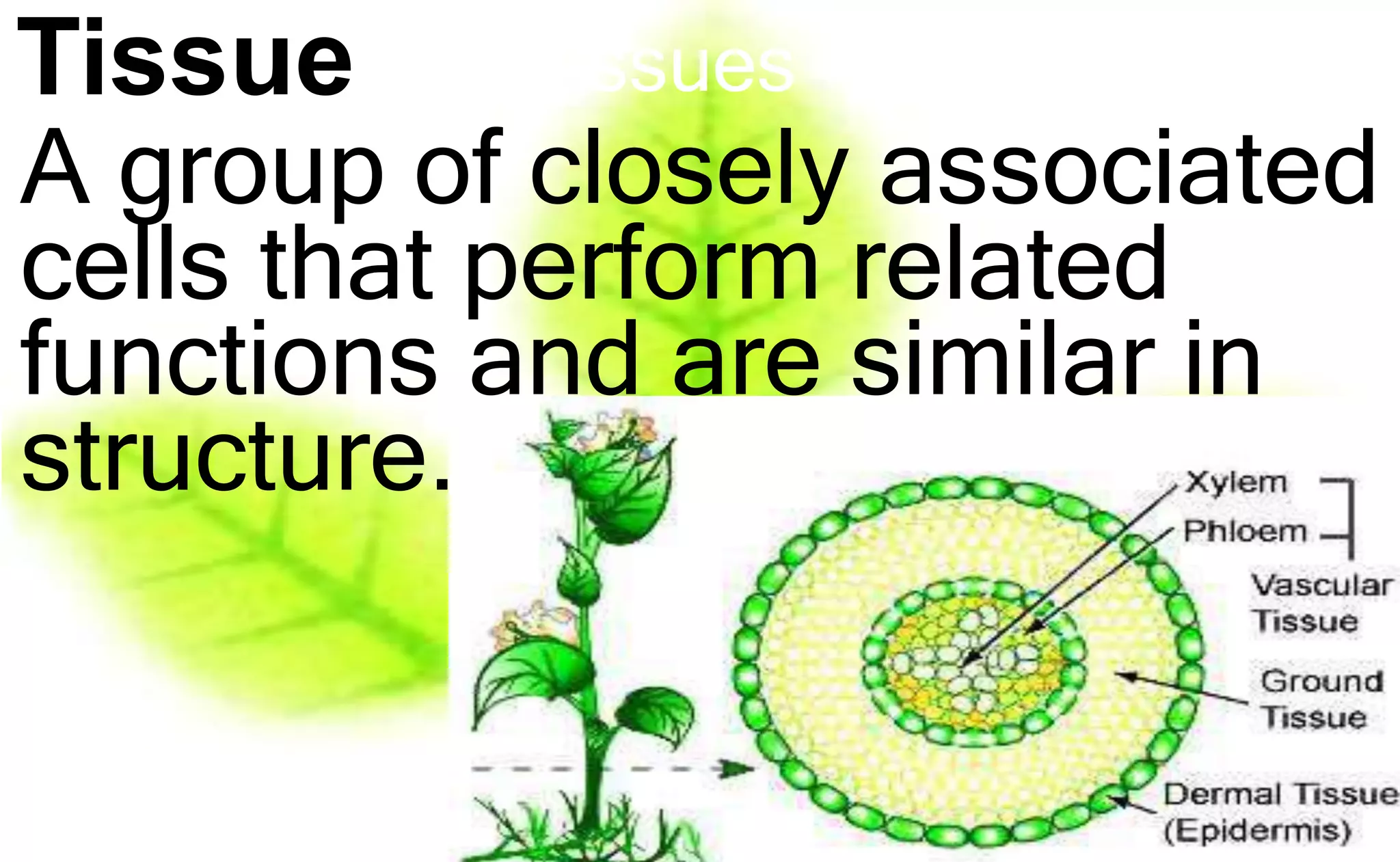
A group of closely associated
cells that perform related
functions and are similar in
structure.
Tissue
Plant Tissues
Tissues in plants that divide
throughout their life.
Plant tissues can be
classified as:
Growing tissue
Permanent tissue
Meristematic tissues
The growth of plants occurs
in certain specific regions.
This is because the
dividing tissue,
Known as meristematic
tissue
Meristematic tissues
Composed of actively
dividing ceIIs, responsible
for the production of ceIIs.
Kinds of meristems:
•Apical meristems – found at
the tip of stems & roots
•Lateral meristems – a.k.a.
cambia
-found along the sides of
roots & stems
-increase width or diameter of
stems & roots
•Intercallary meristems –
found at the bases of young
leaves & internodes
-responsible for further
lengthening of stems &
leaves
Permanent tissues
Tissues that attained their
mature form and perform
pacific functions.
They stop dividing
A. Dermal / surface tissue
-external tissues
-forms protective covering
of the plant body
a. Epidermis b. Periderm
Dermal / surface tissue
•Epidermis
-the outermost layer of the
primary plant body
-covers the leaves, floral
parts, fruits, seeds,
tems and roots
-contains trichomes,
stomata, buIIiform ceIIs (in
grasses)
Plant Cell Types
(Support and Storage)
Parenchyma cells are the
most numerous type of cell in
young plants.
Mature parenchyma cells
have primary walls that are
relatively thin and flexible,
and most lack secondary
walls.
Most parenchyma cells retain
the ability to divide and
differentiate into other types
of plant cells under particular
conditions—during wound
repair, for example.
Parenchyma cells perform
most of the metabolic
functions of the plant,
synthesizing and storing
various organic products.
Collenchyma cells help
support young parts of the
plant shoot. Collenchyma
cells are generally elongated
cells that have thicker
primary walls than paren-
chyma cells.
Young stems and petioles
often have strands of
collenchyma cells just below
their epidermis. Collenchyma
cells provide flexible support
without restraining growth.
At maturity, these cells are
living and flexible, elongating
with the stems and leaves
they support—unlike
sclerenchyma cells, which we
discuss next.
Sclerenchyma cells also
function as supporting
elements in the plant, but
are much more rigid than
collenchyma cells.
The secondary walls of
sclerenchyma cells are thick
and contain large amounts
of lignin. This relatively
indigestible strengthening
the dry mass of wood.
Mature sclerenchyma cells
cannot elongate, and they
occur in regions of the plant
that have stopped growing in
length.
Sclerenchyma cells are so
specialized for support that
many are dead at functional
maturity, The rigid walls
remain as a “skeleton” that
supports the plant
Two types of sclerenchyma
cells, known as sclereids
and fibers, are specialized
entirely for support and
strengthening.
ROOTS
Anchor the plant in the soil
Absorb water and minerals
Roots
Taproot systems usually penetration more
deeply than fibrous root systems.
Longitudinal section of roots
Root cap
Zone of cell division
Zone of elongation
Zone of maturation
Zone of cell division
- actively-dividing cells of the
root meristem, which
contains undifferentiated
cells of the germinating
plant.
Zone of elongation
- the newly-formed cells
increase in length, thereby
lengthening the root.
- the first root hair is the
zone of cell maturation
where the root cells
differentiate into specialized
cell types.
Zone of maturation
Vascular tissue system
Absorption of water and minerals occurs
mainly through the roots hairs.
Some roots have specialized functions in ad-
dition to anchoring the plant and absorbing
water and minerals
Stem
•Support the plant
•Transport nutrients to the
rest of the plant
•Compete for sunlight by
holding leaves higher
Stems orient the
leaves toward
the light with
minimal overlap
among the
leaves.
tomato
Opuntia -prickly pear
The stem does
photosynthesis
and stores
water.
peyote
PART
OF
STEM
 Stems are divided into
segments called internodes.
 A node is at the end of each
internode.
 At the point of attachment,
each leaf has bud.
 A bud is capable of
developing into a new
shoot. The bud has apical
meristem enclosed in
special leaves called bud
scales.
 At the tip of each stem
there is usually a terminal
bud. Each spring when
growth resumes, the
terminal bud opens.
Coconut Guava
Bamboo Carrot
Narra Rice
Evolutionary
adaptations of stems
Rhizomes. A horizontal shoot
that grows just below the
surface. Vertical shoots
emerge from axillary buds on
the rhizome.
Some stems have specialized functions in
addition to support and conduction
Bulbs are vertical under-
ground shoots consisting
mostly of the enlarged bases
of leaves that store food. The
modified leaves attached to
the short stem.
Stolon's are horizontal
shoots that grow along the
surface. These “runners”
enable a plant to reproduce
asexually, as plantlets form
at nodes along each runner.
Tubers, such as these
potatoes, are enlarged ends
of rhizomes or stolons spe-
cialized for storing food. The
“eyes” of a potato are
clusters of axillary buds that
mark the nodes.
Some stems have specialized functions in
addition to support and conduction
Leaves
The leaf epidermis provides protection and
regulates exchange of gas.
Leaves
The leaf is the main
photosynthetic organ,
although green stems also
perform photosynthesis.
Leaves
Leaves vary extensively in
form but generally consist of
a flattened blade and a stalk,
the petiole, which joins the
leaf to the stem at a node.
Leaves
The leaf epidermis provides protection and
regulates exchange of gas.
Evolutionary
adaptations of leaves
The tendrils by which this pea
plant clings to a support are
modified leaves. After it has
“lassoed” a support, a tendril
forms a coil that brings the
plant closer to the support.
The spines of cacti, such as
this prickly pear, are actually
leaves; photosynthesis is
carried out by the fleshy
green stems.
caCTUS
Storage leaves. Most
succulents, such as ice
plant, have leaves adapted
for storing water.
• Storage leaves
Reproductive leaves. The
leaves of some succulents,
such as Kalanchoe, produce
adventitious plantlets, which
fall off the leaf and take root
in the soil.
kalanchoe
kalanchoe
Bract. Often mistaken for
petals,. Such brightly
colored leaves attract
pollinators.
Leaf shapes and
arrangements have
environmental significance
Some leaves have
specialized functions in
addition to photosynthesis
and transmission.
Some leaves have specialized functions
addition to photosynthesis and transmis
FLOWERS
The life cycles of plants are
characterized by an
alternation of generations, in
which multicellular haploid (n)
and diploid (2n).
The diploid plant, the
sporophyte, produces haploid
spores by meiosis. These
spores divide by mitosis,
giving rise to the multicellular
gametophytes.
Flowers, the reproductive
shoots of angiosperm
sporophytes, are typically
composed of four whorls of
modified leaves called floral
organs.
Unlike vegetative shoots,
flowers are determinate
shoots; they cease growing
after the flower and fruit are
formed.
Floral organs—sepals,
petals, stamens, and
carpels—are attached to a
part of the stem called the
receptacle.
Sepals, which enclose and
protect unopened floral
buds, are usually more
leafy in appearance than
the other floral organs.
Petals are typically more
brightly colored than sepals
and advertise the flower to
insects and other
pollinators.
A stamen consists of a stalk
called the filament and a
terminal structure called the
anther; within the anther are
chambers called microspo-
rangia (pollen sacs) that
produce pollen.
A carpel has an ovary at its
base and a long, slender
neck called the style. At the
top of the style is a generally
sticky structure called the
stigma that captures pollen.
Within the ovary are one or
more ovules; the number of
ovules depends on the
species.
Complete flowers have all
four basic floral organs.
Some species have
incomplete flowers, lack- ing
sepals, petals, stamens, or
carpels.
Exploring Flower
Pollination
The flowers of wind-
pollinated species are often
small, green, and
inconspicuous, and they pro-
duce neither nectar nor
scent.
Abiotic Pollination by Wind
PICTURE
Pollination by
Wind
Bees are attracted to bright
colors, primarily yellow and
blue. Red appears dull to
them, but they can see
ultraviolet radiation.
Pollination by Bees
Bees are attracted to bright
colors, primarily yellow and
blue. Red appears dull to
them, but they can see
ultraviolet radiation.
Pollination by Bees
Moths and butterflies detect
odors, and the flowers they
pollinate are often sweetly
fragrant.
Pollination by Butterfly
and Moth
Butterflies perceive many
bright colors, but moths
pollinated flowers are usually
white or yellow.
Pollination by Butterfly
and Moth
BUTTERFLY &
MOTH POLLIN
PICTURE
Pollination by Flies
Blowflies visiting carrion
flowers (Stapelia species)
mistake the flower for a
rotting corpse and lay their
eggs on it.
The blowflies become dusted
with pollen that they carry to
other flowers. When the eggs
hatch, the larvae find no
carrion to eat and therefore
die.
Pollination by Bats
 Pollination by Birds
Seeds
 A
fertilized
ovule
Parts of a Seed
 Seed coat
 Endosperm – food store
 Embryo – the baby plant
Seed coat
 Protects the
seed
 Consists of 2
layers
Tegmen (inner;
colorless)
Testa (outer;
colored)
Seed coat
A scar
called hilum
can be seen.
It’s the mark left by the
funiculus that attaches the
ovule to the ovary
Pedicarp
 Stores food
 Nourishes
the seed
Embryo
 The miniature (baby)
 Has two basic parts:
hypocotyl and epicotyl
Embryo
 Epicotyl – will become
shoot (leaves and stems) via
plumule; grows above plant
axis
 Hypocotyl – connection
between cotyledon (seed
leaf) and radicle (baby root);
grows below plant axis
the bud of the
ascending
axis ofha plant
while still in
the embryo
Seed Germination
 The process in which the
embryonic plant contained
within the seed grows.
 The first to emerge is the
hypocotyl, then the epicotyl.
Seed Germination
 The process in which the
embryonic plant contained
within the seed grows.
 The first to emerge is the
hypocotyl, then the epicotyl.
Seed Germination
 The process in which the
embryonic plant contained
within the seed grows.
 The first to emerge is the
hypocotyl, then the epicotyl.
Factors Affecting Seed
Germination
 Water - causes seeds to
swell and break open; when
H2O enters, it activates
enzyme and the food is
broken down to useful
chemicals for the new plant
 Oxygen – for cellular
metabolism; when the seed
breaks open, gas exchange
can occur
 Temperature – each plant
species has a temperature
range within which the seeds
will germinate
 As the seedling emerges
from the seed coat sending
out roots and leaves, the
stored food is exhausted
(used up).
Seed Germination
When these factors (water,
oxygen, temperature) are
met, the seed could
germinate into a
new plant.
Plants organ system
Plants organ system
Plants organ system
Plants organ system
Plants organ system
Plants organ system

Plants organ system