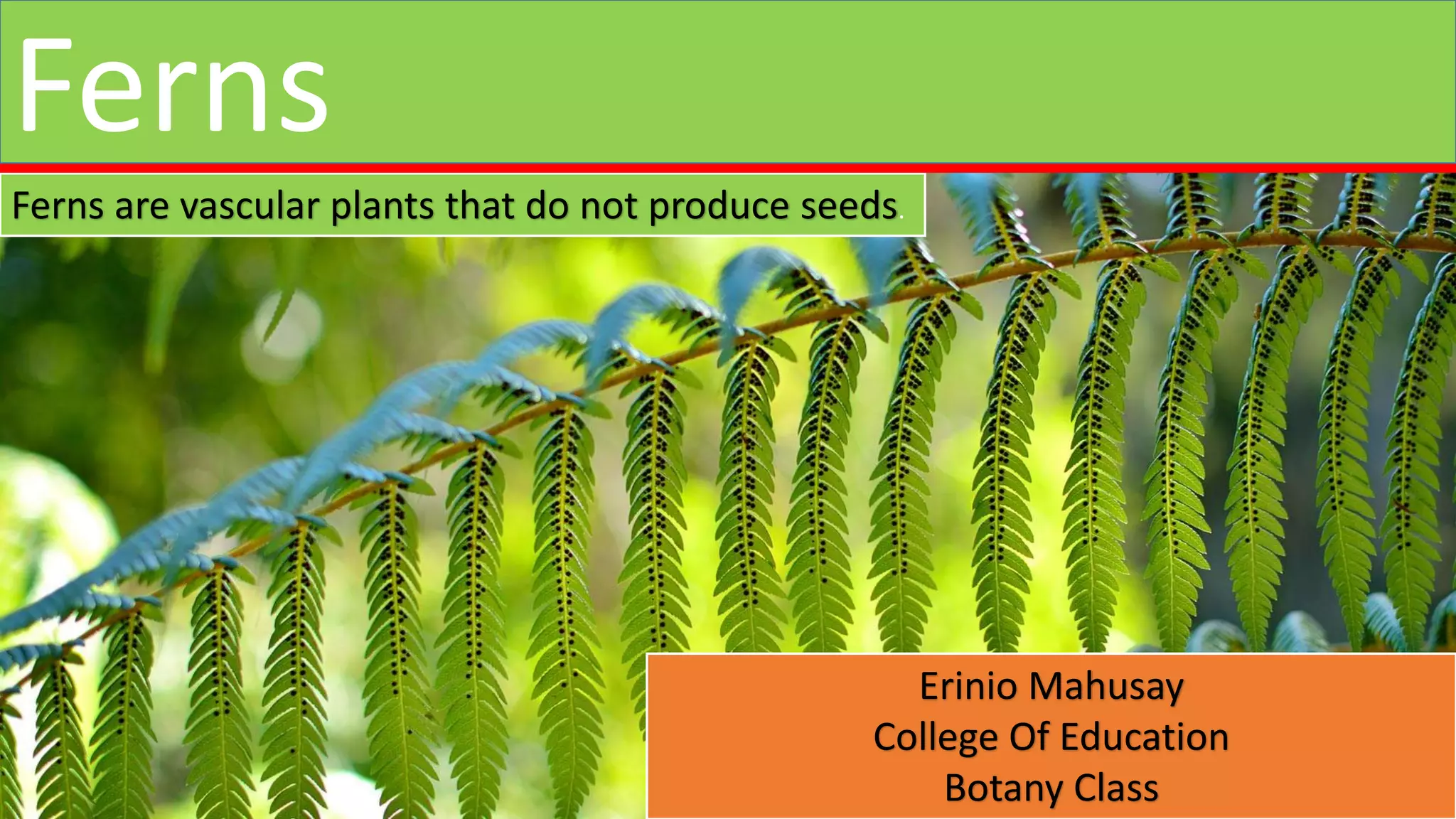
Ferns are vascular plants that do not produce seeds.
Ferns
Erinio Mahusay
College Of Education
Botany Class
Learning Outcomes
Expected that, at the end of discussion 100% of the student, are going to cope up
the topic;
 To distinguish the different forms of ferns allies (classified with ferns)
 how the life cycle of ferns being process
 To discuss how ferns are being reproduced or their reproduction
Ferns
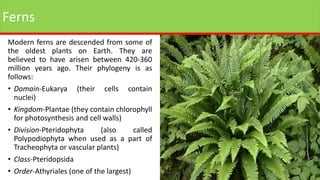
Modern ferns are descended from some of
the oldest plants on Earth. They are
believed to have arisen between 420-360
million years ago. Their phylogeny is as
follows:
• Domain-Eukarya (their cells contain
nuclei)
• Kingdom-Plantae (they contain chlorophyll
for photosynthesis and cell walls)
• Division-Pteridophyta (also called
Polypodiophyta when used as a part of
Tracheophyta or vascular plants)
• Class-Pteridopsida
• Order-Athyriales (one of the largest)
Ferns
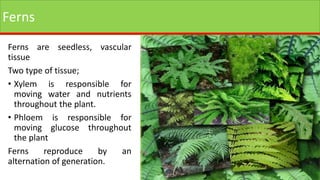
Ferns are seedless, vascular
tissue
Two type of tissue;
• Xylem is responsible for
moving water and nutrients
throughout the plant.
• Phloem is responsible for
moving glucose throughout
the plant
Ferns reproduce by an
alternation of generation.
Fern Allies
• Largely due to having a similar appearance and way of reproducing
themselves, a group called the “fern allies” is classified with the
ferns.
• These allies are a diverse group of interesting plants.
• although more recent research has shown that these plants are not
as closely related to ferns as scientists previously thought.
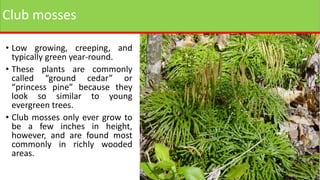
Club mosses
• Low growing, creeping, and
typically green year-round.
• These plants are commonly
called “ground cedar” or
“princess pine” because they
look so similar to young
evergreen trees.
• Club mosses only ever grow to
be a few inches in height,
however, and are found most
commonly in richly wooded
areas.
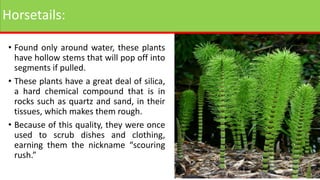
Horsetails:
• Found only around water, these plants
have hollow stems that will pop off into
segments if pulled.
• These plants have a great deal of silica,
a hard chemical compound that is in
rocks such as quartz and sand, in their
tissues, which makes them rough.
• Because of this quality, they were once
used to scrub dishes and clothing,
earning them the nickname “scouring
rush.”
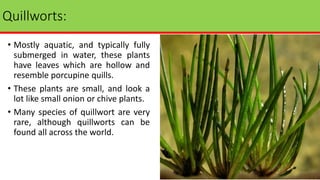
Quillworts:
• Mostly aquatic, and typically fully
submerged in water, these plants
have leaves which are hollow and
resemble porcupine quills.
• These plants are small, and look a
lot like small onion or chive plants.
• Many species of quillwort are very
rare, although quillworts can be
found all across the world.
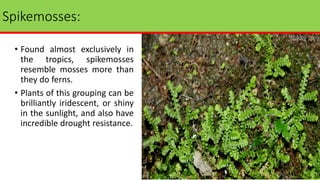
Spikemosses:
• Found almost exclusively in
the tropics, spikemosses
resemble mosses more than
they do ferns.
• Plants of this grouping can be
brilliantly iridescent, or shiny
in the sunlight, and also have
incredible drought resistance.
Ferns
Ferns are only capable of primary
growth i.e. growing upward.
• They do not increase in diameter,
a type of growth known as
secondary growth.
• This primary growth occurs at the
tips of the plants shoots and
roots within areas called apical
meristems
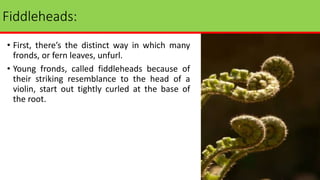
Fiddleheads:
• First, there’s the distinct way in which many
fronds, or fern leaves, unfurl.
• Young fronds, called fiddleheads because of
their striking resemblance to the head of a
violin, start out tightly curled at the base of
the root.
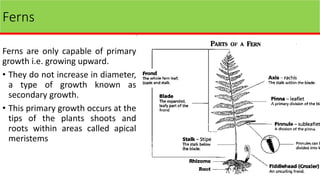
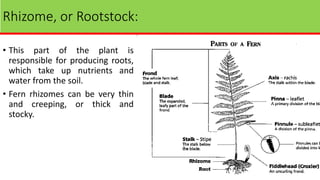
Rhizome, or Rootstock:
• This part of the plant is
responsible for producing roots,
which take up nutrients and
water from the soil.
• Fern rhizomes can be very thin
and creeping, or thick and
stocky.
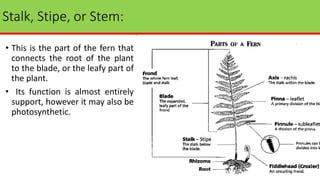
Stalk, Stipe, or Stem:
• This is the part of the fern that
connects the root of the plant
to the blade, or the leafy part of
the plant.
• Its function is almost entirely
support, however it may also be
photosynthetic.
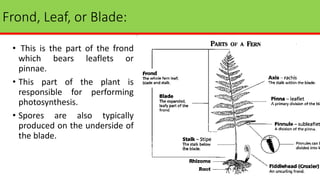
Frond, Leaf, or Blade:
• This is the part of the frond
which bears leaflets or
pinnae.
• This part of the plant is
responsible for performing
photosynthesis.
• Spores are also typically
produced on the underside of
the blade.
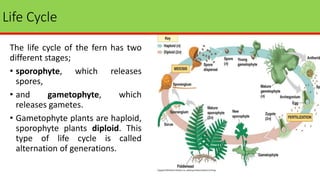
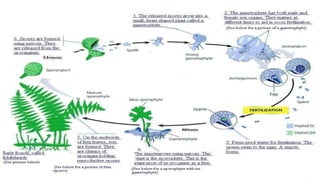
Life Cycle of Ferns
Life Cycle
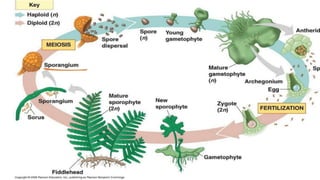
The life cycle of the fern has two
different stages;
• sporophyte, which releases
spores,
• and gametophyte, which
releases gametes.
• Gametophyte plants are haploid,
sporophyte plants diploid. This
type of life cycle is called
alternation of generations.
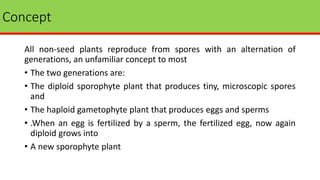
Concept
All non-seed plants reproduce from spores with an alternation of
generations, an unfamiliar concept to most
• The two generations are:
• The diploid sporophyte plant that produces tiny, microscopic spores
and
• The haploid gametophyte plant that produces eggs and sperms
• .When an egg is fertilized by a sperm, the fertilized egg, now again
diploid grows into
• A new sporophyte plant
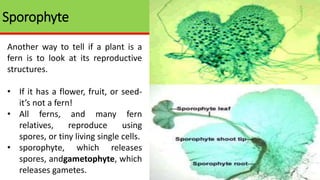
Sporophyte
Another way to tell if a plant is a
fern is to look at its reproductive
structures.
• If it has a flower, fruit, or seed-
it’s not a fern!
• All ferns, and many fern
relatives, reproduce using
spores, or tiny living single cells.
• sporophyte, which releases
spores, andgametophyte, which
releases gametes.
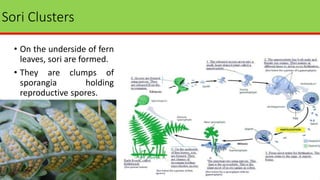
Sori Clusters
• On the underside of fern
leaves, sori are formed.
• They are clumps of
sporangia holding
reproductive spores.
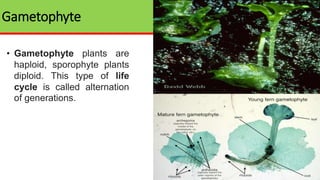
Gametophyte
• Gametophyte plants are
haploid, sporophyte plants
diploid. This type of life
cycle is called alternation
of generations.
Daghang Salamat!!!
Ferns are vascular plants that do not produce seeds.
Ferns

Fern

  • 1.
    Ferns are vascularplants that do not produce seeds. Ferns Erinio Mahusay College Of Education Botany Class
  • 2.
    Learning Outcomes Expected that,at the end of discussion 100% of the student, are going to cope up the topic;  To distinguish the different forms of ferns allies (classified with ferns)  how the life cycle of ferns being process  To discuss how ferns are being reproduced or their reproduction
  • 3.
    Ferns Modern ferns aredescended from some of the oldest plants on Earth. They are believed to have arisen between 420-360 million years ago. Their phylogeny is as follows: • Domain-Eukarya (their cells contain nuclei) • Kingdom-Plantae (they contain chlorophyll for photosynthesis and cell walls) • Division-Pteridophyta (also called Polypodiophyta when used as a part of Tracheophyta or vascular plants) • Class-Pteridopsida • Order-Athyriales (one of the largest)
  • 4.
    Ferns Ferns are seedless,vascular tissue Two type of tissue; • Xylem is responsible for moving water and nutrients throughout the plant. • Phloem is responsible for moving glucose throughout the plant Ferns reproduce by an alternation of generation.
  • 5.
    Fern Allies • Largelydue to having a similar appearance and way of reproducing themselves, a group called the “fern allies” is classified with the ferns. • These allies are a diverse group of interesting plants. • although more recent research has shown that these plants are not as closely related to ferns as scientists previously thought.
  • 6.
    Club mosses • Lowgrowing, creeping, and typically green year-round. • These plants are commonly called “ground cedar” or “princess pine” because they look so similar to young evergreen trees. • Club mosses only ever grow to be a few inches in height, however, and are found most commonly in richly wooded areas.
  • 7.
    Horsetails: • Found onlyaround water, these plants have hollow stems that will pop off into segments if pulled. • These plants have a great deal of silica, a hard chemical compound that is in rocks such as quartz and sand, in their tissues, which makes them rough. • Because of this quality, they were once used to scrub dishes and clothing, earning them the nickname “scouring rush.”
  • 8.
    Quillworts: • Mostly aquatic,and typically fully submerged in water, these plants have leaves which are hollow and resemble porcupine quills. • These plants are small, and look a lot like small onion or chive plants. • Many species of quillwort are very rare, although quillworts can be found all across the world.
  • 9.
    Spikemosses: • Found almostexclusively in the tropics, spikemosses resemble mosses more than they do ferns. • Plants of this grouping can be brilliantly iridescent, or shiny in the sunlight, and also have incredible drought resistance.
  • 10.
    Ferns Ferns are onlycapable of primary growth i.e. growing upward. • They do not increase in diameter, a type of growth known as secondary growth. • This primary growth occurs at the tips of the plants shoots and roots within areas called apical meristems
  • 11.
    Fiddleheads: • First, there’sthe distinct way in which many fronds, or fern leaves, unfurl. • Young fronds, called fiddleheads because of their striking resemblance to the head of a violin, start out tightly curled at the base of the root.
  • 12.
    Rhizome, or Rootstock: •This part of the plant is responsible for producing roots, which take up nutrients and water from the soil. • Fern rhizomes can be very thin and creeping, or thick and stocky.
  • 13.
    Stalk, Stipe, orStem: • This is the part of the fern that connects the root of the plant to the blade, or the leafy part of the plant. • Its function is almost entirely support, however it may also be photosynthetic.
  • 14.
    Frond, Leaf, orBlade: • This is the part of the frond which bears leaflets or pinnae. • This part of the plant is responsible for performing photosynthesis. • Spores are also typically produced on the underside of the blade.
  • 15.
  • 16.
    Life Cycle The lifecycle of the fern has two different stages; • sporophyte, which releases spores, • and gametophyte, which releases gametes. • Gametophyte plants are haploid, sporophyte plants diploid. This type of life cycle is called alternation of generations.
  • 18.
    Concept All non-seed plantsreproduce from spores with an alternation of generations, an unfamiliar concept to most • The two generations are: • The diploid sporophyte plant that produces tiny, microscopic spores and • The haploid gametophyte plant that produces eggs and sperms • .When an egg is fertilized by a sperm, the fertilized egg, now again diploid grows into • A new sporophyte plant
  • 19.
    Sporophyte Another way totell if a plant is a fern is to look at its reproductive structures. • If it has a flower, fruit, or seed- it’s not a fern! • All ferns, and many fern relatives, reproduce using spores, or tiny living single cells. • sporophyte, which releases spores, andgametophyte, which releases gametes.
  • 20.
    Sori Clusters • Onthe underside of fern leaves, sori are formed. • They are clumps of sporangia holding reproductive spores.
  • 21.
    Gametophyte • Gametophyte plantsare haploid, sporophyte plants diploid. This type of life cycle is called alternation of generations.
  • 23.
    Daghang Salamat!!! Ferns arevascular plants that do not produce seeds. Ferns

Editor's Notes

  • #18 The life cycle of the fern has two different stages; sporophyte, which releases spores, and gametophyte, which releases gametes. Gametophyte plants are haploid, sporophyte plants diploid. This type of life cycle is called alternation of generations.