FUNDAMENTALS OFFUNDAMENTALS OF
PLANT BIOLOGYPLANT BIOLOGY
(Bio 103)(Bio 103)
Nanette Hope N. Sumaya, MSc
Department of Biological Sciences
CSM, MSU-IIT, Iligan City ,
Philippines
COURSE DESCRIPTIONCOURSE DESCRIPTION
Overview of plant body, plant
functioning, reproduction and
embryonic development, growth and
development
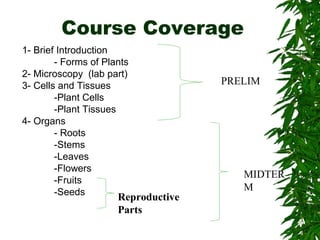
Course Coverage
1- Brief Introduction
- Forms of Plants
2- Microscopy (lab part)
3- Cells and Tissues
-Plant Cells
-Plant Tissues
4- Organs
- Roots
-Stems
-Leaves
-Flowers
-Fruits
-Seeds
Reproductive
Parts
PRELIM
MIDTER
M
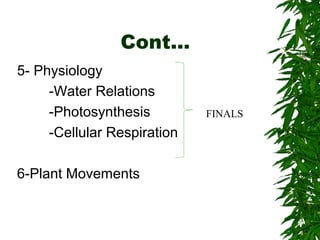
Cont...
5- Physiology
-Water Relations
-Photosynthesis
-Cellular Respiration
6-Plant Movements
FINALS
 Examination – 60%
 Quizzes – 15 %
 Reporting/Oral - 10%
 Attendance and
Assignments- 15%
TOTAL – 100%
GradingGrading
SystemSystem
Course Materials
References:
 Mauseth, J.D. 1998. Botany: an introduction
to plant biology—2/e, Multimedia enhanced
ed. Jones and Bartlett Publishers. Sudbury,
Massachusetts.
 Raven, P.H., R.F. Evert, and S.E. Eichorn.
1999. Biology of Plants. 6th
Edition. W.H.
Freeman and Co., New York.
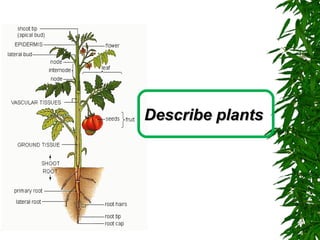
Describe plantsDescribe plants
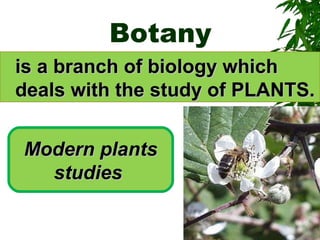
Botany
is a branch of biology whichis a branch of biology which
deals with the study of PLANTS.deals with the study of PLANTS.
Modern plantsModern plants
studiesstudies
 Kingdom Plantae
 Over 325, 000 species of plants known
 Have different characteristics with different sizes
ranging from microscopic to macroscopic
 Diversity of plant forms leads to classification
 Various classification scheme
- based on water requirements
- based on habitat or environment location
-based on life duration
-based on natural system classification
-based on their habit of body appearance
FORM OF PLANTS
Autotrophic or independent plants
- Can manufacture their own food
- Include ALL green plants which make
their organic food
by PHOTOSYNTHESIS
- Also few non-green plants just like
bacteria which manufacture their
organic food
A. Based on Water
Requirements
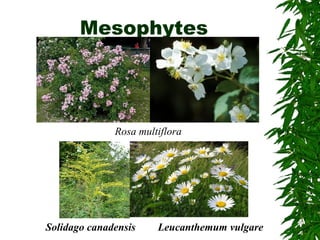
1. Mesophytes – those which require
moderate supply of water.
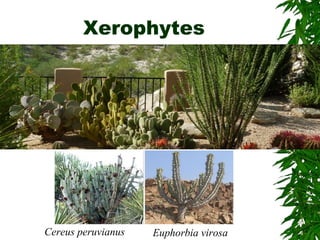
2. Xerophytes – those which live in deserts
or dry places and can withstand
scanty supply of water.
3. Hydrophytes – those which thrive in
watery or moist places and require
abundant supply of water.
4. Halophytes- those which live in watery
places, but in which the water is
Mesophytes
Rosa multiflora
Leucanthemum vulgareSolidago canadensis
Xerophytes
Cereus peruvianus Euphorbia virosa
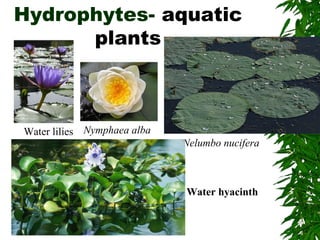
Hydrophytes- aquatic
plants
Water lilies Nymphaea alba
Nelumbo nucifera
Water hyacinth
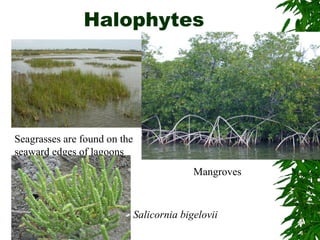
Halophytes
Seagrasses are found on the
seaward edges of lagoons
Mangroves
Salicornia bigelovii
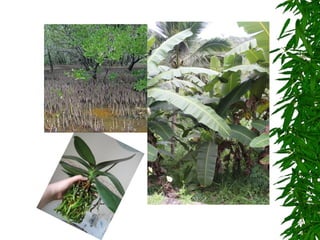
B. Based on their habitat or
environment location
1. Aquatic plants- live in water
2. Terrestrial plants- live on land
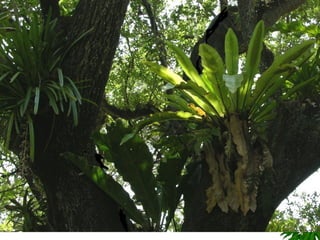
3. Aerial plants- are above-
ground and attached to
other plants
C. Based on their life
duration
1. Annual plants – live for one year or only one
growing season
2. Biennial plants – live for two years. The first
year is mainly limited to
vegetative growth, and the
second year is its reproductive
year
3. Perennial plants – live from year to year or
more than two years
Examples:
 annual plants - corn, wheat, rice, lettuce, peas,
watermelon, beans, zinnia, marigold and etc.
 biennial plants - onion, parsley, carrot, and etc.
 perennial plants – fruits like avocado,pineapple,
strawberry, banana,apple,tomato and etc..
-herbs like garlic, basil, oregano,
ginger, black pepper and etc...
-vegetables like okra, potato, gabi,
camote, eggplant and etc
- shrubs and trees
D. Based on their habit of
body appearance
1. Trees – woody plants with single main
stem which is commonly about
20 ft in length
2. Shrubs– woody plants in a relatively short
3. Herbs – plants with soft or succulent
stems
4. Vines- climbing or twining plants, with
stems which may be tender or
tough
Nonvascular Plants- lack vascular plants´
specialized means of transporting water and
organic nutrients, do not have true roots, stems
and leaves.
a. Division Hepatophyta (liverworts)
b. Division Bryophyta (mosses)
c. Division Anthocerophyta (hornworts)
E. Based on natural
systems of classification
Seedless Vascular Plants:
a. Division Psilotophyta (whisk ferns)
b. Division Lycopodophyta (club mosses)
c. Division Equisetophyta (horsetails)
d. Division Pteridophyta (ferns)
Seed Vascular Plants:
Gymnosperms
a. Division Pinophyta (conifers)
b. Division Cycadophyta (cycads)
c. Division Gingkophyta (maidenhair tree)
d. Division Gnetphyta (gnetophytes)
Angiosperms
a. Division Magnoliophyta (flowering plants)
Class Magnoliopsida (dicots)
Class Liliopsida (monocots)
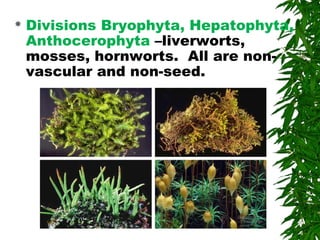
 Divisions Bryophyta, Hepatophyta,
Anthocerophyta –liverworts,
mosses, hornworts. All are non-
vascular and non-seed.
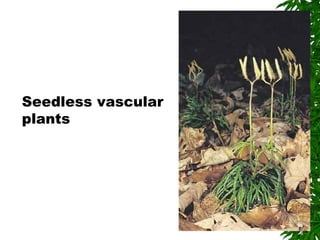
Seedless vascular
plants
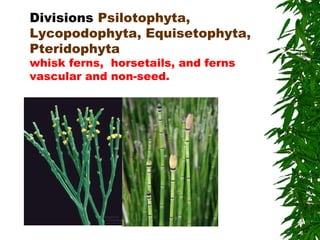
Divisions Psilotophyta,
Lycopodophyta, Equisetophyta,
Pteridophyta
whisk ferns, horsetails, and ferns
vascular and non-seed.
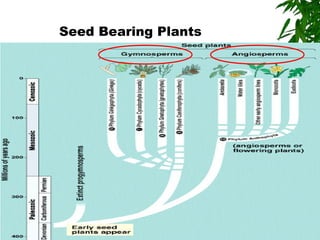
Seed Bearing Plants
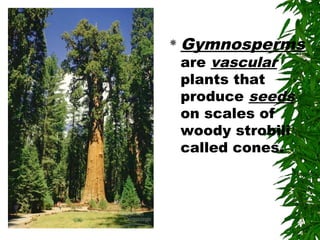
 Gymnosperms
are vascular
plants that
produce seeds
on scales of
woody strobili
called cones.
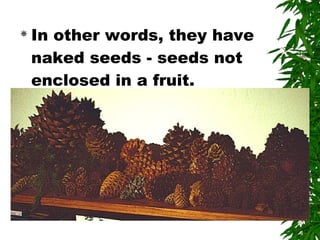
 In other words, they have
naked seeds - seeds not
enclosed in a fruit.
 The four divisions of Gymnosperms
are:
–Cycadophyta
–Ginkgophyta
–Gnetophyta
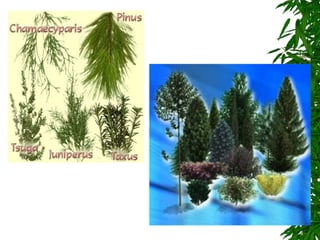
–Pinophyta
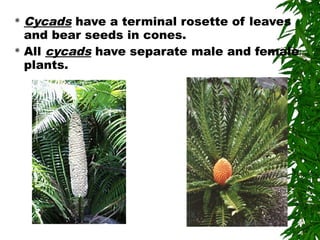
 Cycads have a terminal rosette of leaves
and bear seeds in cones.
 All cycads have separate male and female
plants.
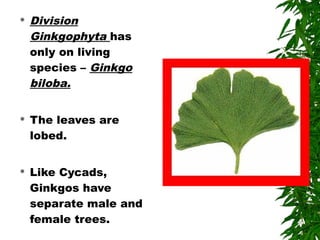
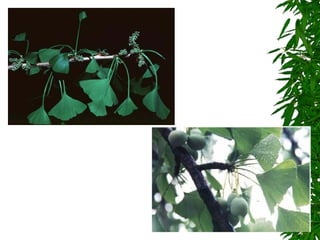
 Division
Ginkgophyta has
only on living
species – Ginkgo
biloba.
 The leaves are
lobed.
 Like Cycads,
Ginkgos have
separate male and
female trees.
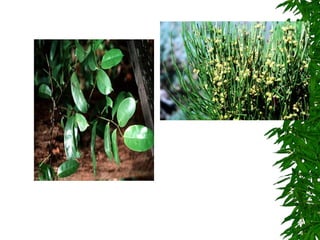
 Division Gnetophyta has 3 genera:
– Gnetum
– Ephedra
– Welwitschia
 Pinophyta is the largest and most
diverse division of the gymnosperms.
 Most are evergreen – keeping their
leaves year-round.
 A very few are deciduous – dropping all
of their leaves at
the same time
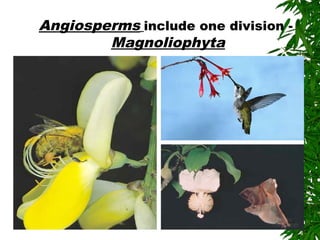
Angiosperms include one division -
Magnoliophyta
 Though there is only one division of
angiosperms, Magnoliophyta ….
 It is the largest and most diverse group
of seed plants on Earth.
 Magnoliophytes produce flowers, then
seeds enclosed in a fruit.
 Magnoliophytes can be annuals,
biennials, or perennials.
THANK YOU!!!

Lec 1 intro to botany

  • 1.
    FUNDAMENTALS OFFUNDAMENTALS OF PLANTBIOLOGYPLANT BIOLOGY (Bio 103)(Bio 103) Nanette Hope N. Sumaya, MSc Department of Biological Sciences CSM, MSU-IIT, Iligan City , Philippines
  • 3.
    COURSE DESCRIPTIONCOURSE DESCRIPTION Overviewof plant body, plant functioning, reproduction and embryonic development, growth and development
  • 4.
    Course Coverage 1- BriefIntroduction - Forms of Plants 2- Microscopy (lab part) 3- Cells and Tissues -Plant Cells -Plant Tissues 4- Organs - Roots -Stems -Leaves -Flowers -Fruits -Seeds Reproductive Parts PRELIM MIDTER M
  • 5.
  • 6.
     Examination –60%  Quizzes – 15 %  Reporting/Oral - 10%  Attendance and Assignments- 15% TOTAL – 100% GradingGrading SystemSystem
  • 7.
    Course Materials References:  Mauseth,J.D. 1998. Botany: an introduction to plant biology—2/e, Multimedia enhanced ed. Jones and Bartlett Publishers. Sudbury, Massachusetts.  Raven, P.H., R.F. Evert, and S.E. Eichorn. 1999. Biology of Plants. 6th Edition. W.H. Freeman and Co., New York.
  • 8.
  • 9.
    Botany is a branchof biology whichis a branch of biology which deals with the study of PLANTS.deals with the study of PLANTS. Modern plantsModern plants studiesstudies
  • 10.
     Kingdom Plantae Over 325, 000 species of plants known  Have different characteristics with different sizes ranging from microscopic to macroscopic  Diversity of plant forms leads to classification  Various classification scheme - based on water requirements - based on habitat or environment location -based on life duration -based on natural system classification -based on their habit of body appearance FORM OF PLANTS
  • 11.
    Autotrophic or independentplants - Can manufacture their own food - Include ALL green plants which make their organic food by PHOTOSYNTHESIS - Also few non-green plants just like bacteria which manufacture their organic food
  • 14.
    A. Based onWater Requirements 1. Mesophytes – those which require moderate supply of water. 2. Xerophytes – those which live in deserts or dry places and can withstand scanty supply of water. 3. Hydrophytes – those which thrive in watery or moist places and require abundant supply of water. 4. Halophytes- those which live in watery places, but in which the water is
  • 15.
  • 16.
  • 17.
    Hydrophytes- aquatic plants Water liliesNymphaea alba Nelumbo nucifera Water hyacinth
  • 18.
    Halophytes Seagrasses are foundon the seaward edges of lagoons Mangroves Salicornia bigelovii
  • 19.
    B. Based ontheir habitat or environment location 1. Aquatic plants- live in water 2. Terrestrial plants- live on land 3. Aerial plants- are above- ground and attached to other plants
  • 22.
    C. Based ontheir life duration 1. Annual plants – live for one year or only one growing season 2. Biennial plants – live for two years. The first year is mainly limited to vegetative growth, and the second year is its reproductive year 3. Perennial plants – live from year to year or more than two years
  • 23.
    Examples:  annual plants- corn, wheat, rice, lettuce, peas, watermelon, beans, zinnia, marigold and etc.  biennial plants - onion, parsley, carrot, and etc.  perennial plants – fruits like avocado,pineapple, strawberry, banana,apple,tomato and etc.. -herbs like garlic, basil, oregano, ginger, black pepper and etc... -vegetables like okra, potato, gabi, camote, eggplant and etc - shrubs and trees
  • 24.
    D. Based ontheir habit of body appearance 1. Trees – woody plants with single main stem which is commonly about 20 ft in length 2. Shrubs– woody plants in a relatively short 3. Herbs – plants with soft or succulent stems 4. Vines- climbing or twining plants, with stems which may be tender or tough
  • 26.
    Nonvascular Plants- lackvascular plants´ specialized means of transporting water and organic nutrients, do not have true roots, stems and leaves. a. Division Hepatophyta (liverworts) b. Division Bryophyta (mosses) c. Division Anthocerophyta (hornworts) E. Based on natural systems of classification
  • 27.
    Seedless Vascular Plants: a.Division Psilotophyta (whisk ferns) b. Division Lycopodophyta (club mosses) c. Division Equisetophyta (horsetails) d. Division Pteridophyta (ferns) Seed Vascular Plants: Gymnosperms a. Division Pinophyta (conifers) b. Division Cycadophyta (cycads) c. Division Gingkophyta (maidenhair tree) d. Division Gnetphyta (gnetophytes) Angiosperms a. Division Magnoliophyta (flowering plants) Class Magnoliopsida (dicots) Class Liliopsida (monocots)
  • 28.
     Divisions Bryophyta,Hepatophyta, Anthocerophyta –liverworts, mosses, hornworts. All are non- vascular and non-seed.
  • 29.
  • 30.
    Divisions Psilotophyta, Lycopodophyta, Equisetophyta, Pteridophyta whiskferns, horsetails, and ferns vascular and non-seed.
  • 31.
  • 32.
     Gymnosperms are vascular plantsthat produce seeds on scales of woody strobili called cones.
  • 33.
     In otherwords, they have naked seeds - seeds not enclosed in a fruit.
  • 34.
     The fourdivisions of Gymnosperms are: –Cycadophyta –Ginkgophyta –Gnetophyta –Pinophyta
  • 35.
     Cycads havea terminal rosette of leaves and bear seeds in cones.  All cycads have separate male and female plants.
  • 36.
     Division Ginkgophyta has onlyon living species – Ginkgo biloba.  The leaves are lobed.  Like Cycads, Ginkgos have separate male and female trees.
  • 38.
     Division Gnetophytahas 3 genera: – Gnetum – Ephedra – Welwitschia
  • 40.
     Pinophyta isthe largest and most diverse division of the gymnosperms.  Most are evergreen – keeping their leaves year-round.  A very few are deciduous – dropping all of their leaves at the same time
  • 42.
    Angiosperms include onedivision - Magnoliophyta
  • 43.
     Though thereis only one division of angiosperms, Magnoliophyta ….  It is the largest and most diverse group of seed plants on Earth.  Magnoliophytes produce flowers, then seeds enclosed in a fruit.  Magnoliophytes can be annuals, biennials, or perennials.
  • 44.

Editor's Notes

  • #23 In gardening, annual often refers to a plant grown outdoors in the spring and summer and surviving just for one growing season. Many food plants are, or are grown as, annuals, including virtually all domesticated grains A biennial plant is a flowering plant that takes two years to complete its biological lifecycle.[1] In the first year the plant grows leaves, stems, and roots (vegetative structures), then it enters a period of dormancy over the colder months. Usually the stem remains very short and the leaves are low to the ground, forming a rosette. Many biennials require a cold treatment, or vernalization, before they will flower. During the next spring or summer, the stem of the biennial plant elongates greatly, or "bolts". The plant then flowers, producing fruits and seeds before it finally dies. There are far fewer biennials than either perennial plants or annual plants. A perennial plant or simply perennial (Latin per, "through", annus, "year") is a plant that lives for more than two years.[1] The term is often used to differentiate a plant from shorter lived annuals and biennials. The term is sometimes misused by commercial gardeners or horticulturalists to describe only herbaceous perennials. More correctly, woody plants like shrubs and trees are also perennials.