Lecture 7:
Plants and Fungi
Fungi

Not plants, not animals
Multicellular eukaryotes
Not closely related to either animals or
plants
Fungus
Made of hyphae, which are thin cell
filaments packed closely together
Mycelium is the main body of the
fungus- it penetrates whatever the
fungus is growing on
They can be HUGE in the soil and cover
giant areas
Mushrooms


The part we eat is a fruiting body- it is
the part that produces spores, one way in
which fungi reproduce
Fungi in the Ecosystem
Most are decomposers that break down
organic waste in the soil
Can also feed on live animals and
plants (ringworm, for example)
Fungi also occur in mutualistic
relationships: lichen, mycorrhizal fungi
Economic Benefits

Make cheese, beer, bread, wine, soy sauce
Use to make medicines
Of course we also just eat them
Can break down some pollutants with
organic sources
Fungal Diseases
Can damage crops- corn smut
Candida- yeast infections, oral thrush
   Can damage heart and brain if untreated
Tinea- ringworm, athlete’s foot
Batrachochytrium dendrobatidis- chytrid
fungus in frogs
Histoplasma- from bird droppings
Plants
Multicellular, eukaryotic, photosynthetic
Challenge: live on land, avoid drying out
Plants evolved from algae ~500 mya
5 main groups of plants
  Each associated with an evolutionary
  event
The 5 groups
Mosses: No way to transport water, but can
avoid drying out if in a moist area
Lycophytes: Have a vascular system to
transport water
Ferns: Have large leaves, allows more
photosynthesis
Gymnosperms: Have seeds
Angiosperms: Have flowers
Plant reproduction
                        Alternation of
                         Generations


                        A plant has two
                     forms: one is diploid
                        and the other is
                            haploid
Plant Reproduction
  Dominant generation: The one we
  recognize as the plant itself.
  In vascular plants, this is the
  sporophyte - only this generation
  evolved vascular tissue. The
  gametophytes are typically microscopic
  In nonvascular plants, this is the
  gametophyte
Nonvascular plants

Also called bryophytes
No true roots, stems or leaves- these
would require vascularity
Liverworts and mosses
Vascular Plants
Have roots, stems, and leaves
Roots absorb water from the soil, send it
up the stem to the leaves
Leaves covered by waxy cuticle to prevent
dehydration, except for stomata- pores
that allow for gas exchange
Vascular Plants
Vascular tissue is a big advantage, plant can live
further away from water, can get water out of the
soil
Vascular tissue has two parts:
   Xylem- brings water and minerals up from soil
   Phloem- brings organic nutrients form one part
   of plant to another
   Lignin- found in cell walls and makes them
   very strong
Lycophytes
Also sometimes called club moss
Probably the first plants to develop
vascular tissue
Leaves are very small and each have a
single vein with xylem and phloem
Do not produce seeds
Ferns
Have megaphylls- large leaves with branched veins
   These provide larger surface area for
   photosynthesis
Do not produce seeds
During the Carboniferous period, the ferns and
lycophytes were the size of trees
   When they fell, they were covered by water and
   did not decompose completely- they were slowly
   compressed to form....COAL
Seed Plants
Most plentiful plants today
Seeds consist of embryo (sporophyte), seed coat,
and stored food
   Coat allows seed to stay dormant until
   conditions are favorable to growth- some seeds
   can be dormant for decades
Seed plants produce male and female
gametophytes: pollen is male, ovule (seed origin)
is female
Gymnosperms
Ovules and seeds are exposed on a cone
scale
Conifers (pines, cypress, firs, etc) are the
most common gymnosperms today
Well adapted to dry conditions
   Needlelike leaves resist dessication
   Can live in very cold regions
Angiosperms

Flowering plants
240,000 living species
The flowers are really the sex organs of
the plant
Flower Anatomy


Stamen
Contains
 pollen
                            Stigma is sticky;
                              accepts pollen
                                 grains
Angiosperms
The flower produces a seed; it is enclosed
by fruit
In order to angiosperms to reproduce,
they must spread pollen and then seeds
around
  Flowers help to do this
Adaptations of Angiosperms
Wind-pollenated flowers- small and dull
Insect or bird pollenated- usually colorful and
larger
Bee-pollenated have ultraviolet colors to lead bees to
pollen
Night- blooming flowers to attract nocturnal
animals
Fruits enhance seed spread because eaten by
animals and thus dispersed
Importance of Plants
Food source
Wood products
Pharmaceuticals
Plants produce O2
Plants carry out carbon and water cycles
Some can absorb toxic chemicals
Aesthetic value
Flowering Plant Anatomy

Shoot System: stem, leaves and flowers
Root System: the roots
Terminal Bud: at tip of main stem or
root where primary growth occurs
  Grow in both directions this way
Flowering Plant Anatomy
Leaves
  Usually primary place for
  photosynthesis
  Require sunlight, CO2, and water
  Can be highly modified
    Cactus spines, tendrils, flytraps
Flowering Plant Anatomy

Stems
  Supports leaves, transport between
  roots and leaves, produces new tissue
  Some stems do other things: cactus,
  etc.
Flowering Plant Anatomy
Roots:
  Supports and anchors the plant
  Absorbs water and minerals from the
  soil
  Different structures: root hairs,
  taproots, etc.
Monocots and Eudicots
Two types of flowering plants
Named after number of cotyledons-
embryonic leaves, in the seed.
  Monocots have one, eudicots have two
Many differences between the two types
  Monocots: grass, corn, lilies, palms, wheat
  Eudicots: dandelions, oak trees, potatos
Monocots                       Eudicots

       One cotyledon                 Two cotyledons

     Parallel leaf veins            Net veined leaves

 Vasc. bundles in stems are   Vasc. bundles in stems are in
         scattered                      a circle
     Flower parts in 3’s        Flower parts in 4’s or 5’s

Seed chambers in fruit in 3s Seed chambers in fruit in 4’s
                                       or 5’s
      Tap root system             Fibrous root systsem
Plant Tissue
3 Specialized tissues:
  Epidermal tissue- outer protective
  covering “skin”
  Ground tissue: Interior of a plant,
  carries out functions
  Vascular tissue: Transports water and
  nutrients, provides support
Plant Tissue

Plants continue to grow their entire lives
because they have merisetm tissue:
embryonic tissue that divides and can
produce any of the three specialized
types
Epidermis
The outer layer
Outside that is exposed to air is covered by
waxy cuticle- minimizes water loss
Protects plant from pathogens
In leaves, contain stomata- openings for gas
exchange to occur
In trees, cork replaces epidermis to help form
bark
Ground Tissue
Most of the plant is ground tissue- 3 kinds of
cells:
   Parenchyma: least specialized cells, found
   everywhere
   Collenchyma: give flexible support to plant-
   strands in celery, for example
   Sclerenchyma: have cell walls that contain
   lignin, makes them strong- mostly dead cells
   like in nut shells, cotton and flax fibers
Vascular Tissue
Two types, usually found together
  Xylem: water and minerals from roots
  to leaves
  Phloem: sugar, etc. from leaves to roots
  X up, P down!
In the stem and roots, and the veins of
leaves
More About Leaves
Flat part is blade, stem that attaches leaf
to rest of plant is the petiole
Simple leaves- undivided
Compound leaves- several leaflets make
up one leaf
Most of the time, the cells that carry out
photosynthesis are in the leaves
More About Stems

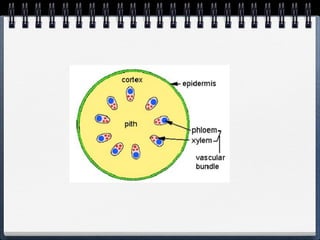
Nonwoody stems- Herbaceous plants
Have vascular bundles that contain
xylem and phloem
Monocot stems are less organized than
eudicot stems- see book
More About Stems
Woody stems, such as in trees, have secondary
growth that increases the girth of the plant
Phloem is in the bark, so removing the bark
prevents transport of nutrients
Wood is secondary xylem, that increases year by
year- the wood is what carries enough water to get
all the way up to the leaves on the tree
Can tell a tree’s age by looking at annual rings
in the trunk
More About Roots


Very nice list of root structure and
function in book on page 351, please
refer to that for next slide
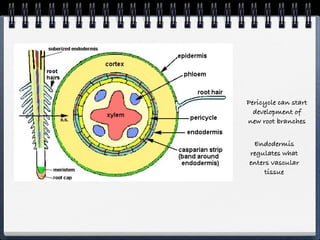
Pericycle can start
  development of
new root branches


 Endodermis
regulates what
enters vascular
     tissue
Roots and Nutrients
Plants (and therefore all animals too) rely
on bacteria in the soil to fix N
  Have a symbiotic relationship- the
  bacteria take N from the soil, the plant
  provides food for the bacteria
Plants also rely on fungus: mycorrhizal
association, to increase water uptake and
break down nutrients for the plant
Water transport in plants
How does water get from roots to leaves
without a heart or other organ to push it?
Cohesion-tension model
See book; drawing on board
LOTS of water lost from plants through
transpiration
Transpiration

Reduces flooding
Returns water to the water cycle from the
soil
Why plants need more water as they
grow- they are losing it all the time
Movement in Phloem
Pressure-flow model
1. Plants make sugar
2. It is transported to phloem through active transport
3. As it accumulates in phloem, water follows due to
osmotic pressure
4. Starts flow
5. Tissues without sugar are a SINK- they take up
sugar

Plants

  • 1.
  • 2.
    Fungi Not plants, notanimals Multicellular eukaryotes Not closely related to either animals or plants
  • 3.
    Fungus Made of hyphae,which are thin cell filaments packed closely together Mycelium is the main body of the fungus- it penetrates whatever the fungus is growing on They can be HUGE in the soil and cover giant areas
  • 4.
    Mushrooms The part weeat is a fruiting body- it is the part that produces spores, one way in which fungi reproduce
  • 5.
    Fungi in theEcosystem Most are decomposers that break down organic waste in the soil Can also feed on live animals and plants (ringworm, for example) Fungi also occur in mutualistic relationships: lichen, mycorrhizal fungi
  • 6.
    Economic Benefits Make cheese,beer, bread, wine, soy sauce Use to make medicines Of course we also just eat them Can break down some pollutants with organic sources
  • 7.
    Fungal Diseases Can damagecrops- corn smut Candida- yeast infections, oral thrush Can damage heart and brain if untreated Tinea- ringworm, athlete’s foot Batrachochytrium dendrobatidis- chytrid fungus in frogs Histoplasma- from bird droppings
  • 8.
    Plants Multicellular, eukaryotic, photosynthetic Challenge:live on land, avoid drying out Plants evolved from algae ~500 mya 5 main groups of plants Each associated with an evolutionary event
  • 9.
    The 5 groups Mosses:No way to transport water, but can avoid drying out if in a moist area Lycophytes: Have a vascular system to transport water Ferns: Have large leaves, allows more photosynthesis Gymnosperms: Have seeds Angiosperms: Have flowers
  • 10.
    Plant reproduction Alternation of Generations A plant has two forms: one is diploid and the other is haploid
  • 11.
    Plant Reproduction Dominant generation: The one we recognize as the plant itself. In vascular plants, this is the sporophyte - only this generation evolved vascular tissue. The gametophytes are typically microscopic In nonvascular plants, this is the gametophyte
  • 12.
    Nonvascular plants Also calledbryophytes No true roots, stems or leaves- these would require vascularity Liverworts and mosses
  • 13.
    Vascular Plants Have roots,stems, and leaves Roots absorb water from the soil, send it up the stem to the leaves Leaves covered by waxy cuticle to prevent dehydration, except for stomata- pores that allow for gas exchange
  • 14.
    Vascular Plants Vascular tissueis a big advantage, plant can live further away from water, can get water out of the soil Vascular tissue has two parts: Xylem- brings water and minerals up from soil Phloem- brings organic nutrients form one part of plant to another Lignin- found in cell walls and makes them very strong
  • 15.
    Lycophytes Also sometimes calledclub moss Probably the first plants to develop vascular tissue Leaves are very small and each have a single vein with xylem and phloem Do not produce seeds
  • 16.
    Ferns Have megaphylls- largeleaves with branched veins These provide larger surface area for photosynthesis Do not produce seeds During the Carboniferous period, the ferns and lycophytes were the size of trees When they fell, they were covered by water and did not decompose completely- they were slowly compressed to form....COAL
  • 17.
    Seed Plants Most plentifulplants today Seeds consist of embryo (sporophyte), seed coat, and stored food Coat allows seed to stay dormant until conditions are favorable to growth- some seeds can be dormant for decades Seed plants produce male and female gametophytes: pollen is male, ovule (seed origin) is female
  • 18.
    Gymnosperms Ovules and seedsare exposed on a cone scale Conifers (pines, cypress, firs, etc) are the most common gymnosperms today Well adapted to dry conditions Needlelike leaves resist dessication Can live in very cold regions
  • 19.
    Angiosperms Flowering plants 240,000 livingspecies The flowers are really the sex organs of the plant
  • 20.
    Flower Anatomy Stamen Contains pollen Stigma is sticky; accepts pollen grains
  • 21.
    Angiosperms The flower producesa seed; it is enclosed by fruit In order to angiosperms to reproduce, they must spread pollen and then seeds around Flowers help to do this
  • 22.
    Adaptations of Angiosperms Wind-pollenatedflowers- small and dull Insect or bird pollenated- usually colorful and larger Bee-pollenated have ultraviolet colors to lead bees to pollen Night- blooming flowers to attract nocturnal animals Fruits enhance seed spread because eaten by animals and thus dispersed
  • 23.
    Importance of Plants Foodsource Wood products Pharmaceuticals Plants produce O2 Plants carry out carbon and water cycles Some can absorb toxic chemicals Aesthetic value
  • 24.
    Flowering Plant Anatomy ShootSystem: stem, leaves and flowers Root System: the roots Terminal Bud: at tip of main stem or root where primary growth occurs Grow in both directions this way
  • 25.
    Flowering Plant Anatomy Leaves Usually primary place for photosynthesis Require sunlight, CO2, and water Can be highly modified Cactus spines, tendrils, flytraps
  • 26.
    Flowering Plant Anatomy Stems Supports leaves, transport between roots and leaves, produces new tissue Some stems do other things: cactus, etc.
  • 27.
    Flowering Plant Anatomy Roots: Supports and anchors the plant Absorbs water and minerals from the soil Different structures: root hairs, taproots, etc.
  • 28.
    Monocots and Eudicots Twotypes of flowering plants Named after number of cotyledons- embryonic leaves, in the seed. Monocots have one, eudicots have two Many differences between the two types Monocots: grass, corn, lilies, palms, wheat Eudicots: dandelions, oak trees, potatos
  • 29.
    Monocots Eudicots One cotyledon Two cotyledons Parallel leaf veins Net veined leaves Vasc. bundles in stems are Vasc. bundles in stems are in scattered a circle Flower parts in 3’s Flower parts in 4’s or 5’s Seed chambers in fruit in 3s Seed chambers in fruit in 4’s or 5’s Tap root system Fibrous root systsem
  • 30.
    Plant Tissue 3 Specializedtissues: Epidermal tissue- outer protective covering “skin” Ground tissue: Interior of a plant, carries out functions Vascular tissue: Transports water and nutrients, provides support
  • 31.
    Plant Tissue Plants continueto grow their entire lives because they have merisetm tissue: embryonic tissue that divides and can produce any of the three specialized types
  • 32.
    Epidermis The outer layer Outsidethat is exposed to air is covered by waxy cuticle- minimizes water loss Protects plant from pathogens In leaves, contain stomata- openings for gas exchange to occur In trees, cork replaces epidermis to help form bark
  • 33.
    Ground Tissue Most ofthe plant is ground tissue- 3 kinds of cells: Parenchyma: least specialized cells, found everywhere Collenchyma: give flexible support to plant- strands in celery, for example Sclerenchyma: have cell walls that contain lignin, makes them strong- mostly dead cells like in nut shells, cotton and flax fibers
  • 34.
    Vascular Tissue Two types,usually found together Xylem: water and minerals from roots to leaves Phloem: sugar, etc. from leaves to roots X up, P down! In the stem and roots, and the veins of leaves
  • 35.
    More About Leaves Flatpart is blade, stem that attaches leaf to rest of plant is the petiole Simple leaves- undivided Compound leaves- several leaflets make up one leaf Most of the time, the cells that carry out photosynthesis are in the leaves
  • 37.
    More About Stems Nonwoodystems- Herbaceous plants Have vascular bundles that contain xylem and phloem Monocot stems are less organized than eudicot stems- see book
  • 39.
    More About Stems Woodystems, such as in trees, have secondary growth that increases the girth of the plant Phloem is in the bark, so removing the bark prevents transport of nutrients Wood is secondary xylem, that increases year by year- the wood is what carries enough water to get all the way up to the leaves on the tree Can tell a tree’s age by looking at annual rings in the trunk
  • 41.
    More About Roots Verynice list of root structure and function in book on page 351, please refer to that for next slide
  • 42.
    Pericycle can start development of new root branches Endodermis regulates what enters vascular tissue
  • 43.
    Roots and Nutrients Plants(and therefore all animals too) rely on bacteria in the soil to fix N Have a symbiotic relationship- the bacteria take N from the soil, the plant provides food for the bacteria Plants also rely on fungus: mycorrhizal association, to increase water uptake and break down nutrients for the plant
  • 44.
    Water transport inplants How does water get from roots to leaves without a heart or other organ to push it? Cohesion-tension model See book; drawing on board LOTS of water lost from plants through transpiration
  • 45.
    Transpiration Reduces flooding Returns waterto the water cycle from the soil Why plants need more water as they grow- they are losing it all the time
  • 46.
    Movement in Phloem Pressure-flowmodel 1. Plants make sugar 2. It is transported to phloem through active transport 3. As it accumulates in phloem, water follows due to osmotic pressure 4. Starts flow 5. Tissues without sugar are a SINK- they take up sugar