Plant
Kingdo
Basic Plant Characteristics

1)    Multicellular
2)    Eukaryotic
3)    Cell walls contain cellulose
4)    Autotrophic  make food
     by photosynthesis using
     chlorophyll
What Plants Need
  to Survive…

• Sunlight
• Water
• Vitamins/Minerals
• Gas Exchange (O2 and CO2)
• A method of transport to move
  water and other materials to
  all parts of plant.
Evolutionary Trends and Plants…

• Ancestors of 1st plants were multicellular
  green algae
• Plants have evolved specific adaptations
  to help them survive in a variety of
  different climates.
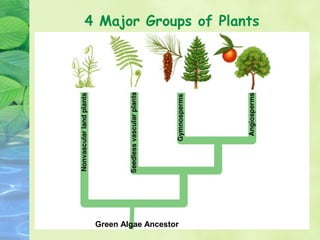
• There are 4 major groups of plants which
  are separated by three distinct features:
      1) vascular tissue
      2) Seeds
      3) flowers
4 Major Groups of Plants


 Green Algae Ancestor
Plant Review
         • Four main groups of plants
           1. Bryophytes (Moss)
 NO
 SEEDS     2. Seedless vascular plants
              (Ferns)
           3. Gymnosperms (Cone bearing
SEED          plants)
PLANTS
             •   Form seeds in “cones.”
           1. Angiosperms (Flowering plants)
             •   Form seeds inside of “flowers.”
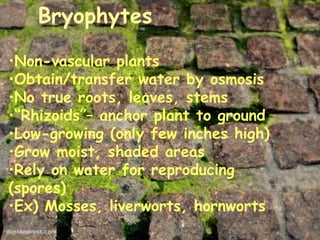
Bryophytes

•Non-vascular plants
•Obtain/transfer water by osmosis
•No true roots, leaves, stems
•“Rhizoids”– anchor plant to ground
•Low-growing (only few inches high)
•Grow moist, shaded areas
•Rely on water for reproducing
(spores)
•Ex) Mosses, liverworts, hornworts
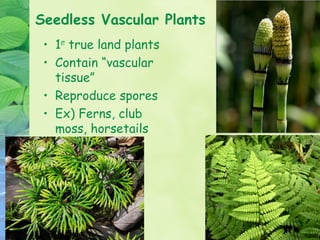
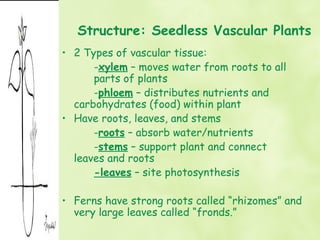
Seedless Vascular Plants
 • 1st true land plants
 • Contain “vascular
   tissue”
 • Reproduce spores
 • Ex) Ferns, club
   moss, horsetails
Structure: Seedless Vascular Plants
• 2 Types of vascular tissue:
      -xylem – moves water from roots to all
      parts of plants
      -phloem – distributes nutrients and
  carbohydrates (food) within plant
• Have roots, leaves, and stems
      -roots – absorb water/nutrients
      -stems – support plant and connect
  leaves and roots
      -leaves – site photosynthesis

• Ferns have strong roots called “rhizomes” and
  very large leaves called “fronds.”
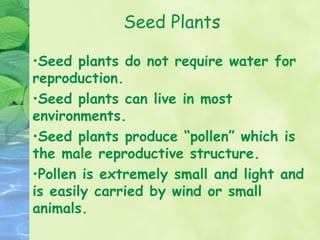
Seed Plants

•Seed plants do not require water for
reproduction.
•Seed plants can live in most
environments.
•Seed plants produce “pollen” which is
the male reproductive structure.
•Pollen is extremely small and light and
is easily carried by wind or small
animals.
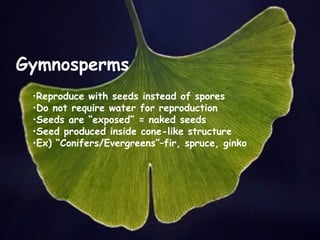
Gymnosperms
 •Reproduce with seeds instead of spores
 •Do not require water for reproduction
 •Seeds are “exposed” = naked seeds
 •Seed produced inside cone-like structure
 •Ex) “Conifers/Evergreens”–fir, spruce, ginko
Angiosperms
• Most common of all land plants.
• Seeds develop inside ovary within a
  “flower”
• Flowers attract animals to support
  pollination.
• After “fertilization” seed within flower
  develops into “fruit.”
• Angiosperms = “enclosed seed”
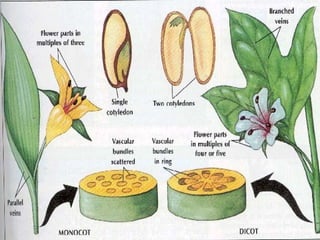
• 2 groups angiosperms:
  1) Monocots
  2) Dicots
Life Spans Angiosperms
• Annuals- survive one season
• Biennials- take 2 years to complete
  life cycle
• Perennials- live many years
Seeds
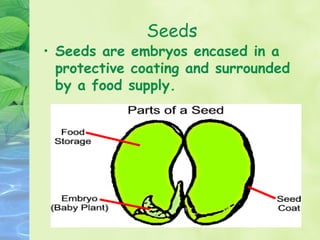
• Seeds are embryos encased in a
  protective coating and surrounded
  by a food supply.
Plant kingdom2.pptrb[1]

Plant kingdom2.pptrb[1]

  • 1.
  • 2.
    Basic Plant Characteristics 1) Multicellular 2) Eukaryotic 3) Cell walls contain cellulose 4) Autotrophic  make food by photosynthesis using chlorophyll
  • 3.
    What Plants Need to Survive… • Sunlight • Water • Vitamins/Minerals • Gas Exchange (O2 and CO2) • A method of transport to move water and other materials to all parts of plant.
  • 4.
    Evolutionary Trends andPlants… • Ancestors of 1st plants were multicellular green algae • Plants have evolved specific adaptations to help them survive in a variety of different climates. • There are 4 major groups of plants which are separated by three distinct features: 1) vascular tissue 2) Seeds 3) flowers
  • 5.
    4 Major Groupsof Plants Green Algae Ancestor
  • 6.
    Plant Review • Four main groups of plants 1. Bryophytes (Moss) NO SEEDS 2. Seedless vascular plants (Ferns) 3. Gymnosperms (Cone bearing SEED plants) PLANTS • Form seeds in “cones.” 1. Angiosperms (Flowering plants) • Form seeds inside of “flowers.”
  • 7.
    Bryophytes •Non-vascular plants •Obtain/transfer waterby osmosis •No true roots, leaves, stems •“Rhizoids”– anchor plant to ground •Low-growing (only few inches high) •Grow moist, shaded areas •Rely on water for reproducing (spores) •Ex) Mosses, liverworts, hornworts
  • 8.
    Seedless Vascular Plants • 1st true land plants • Contain “vascular tissue” • Reproduce spores • Ex) Ferns, club moss, horsetails
  • 9.
    Structure: Seedless VascularPlants • 2 Types of vascular tissue: -xylem – moves water from roots to all parts of plants -phloem – distributes nutrients and carbohydrates (food) within plant • Have roots, leaves, and stems -roots – absorb water/nutrients -stems – support plant and connect leaves and roots -leaves – site photosynthesis • Ferns have strong roots called “rhizomes” and very large leaves called “fronds.”
  • 10.
    Seed Plants •Seed plantsdo not require water for reproduction. •Seed plants can live in most environments. •Seed plants produce “pollen” which is the male reproductive structure. •Pollen is extremely small and light and is easily carried by wind or small animals.
  • 11.
    Gymnosperms •Reproduce withseeds instead of spores •Do not require water for reproduction •Seeds are “exposed” = naked seeds •Seed produced inside cone-like structure •Ex) “Conifers/Evergreens”–fir, spruce, ginko
  • 12.
    Angiosperms • Most commonof all land plants. • Seeds develop inside ovary within a “flower” • Flowers attract animals to support pollination. • After “fertilization” seed within flower develops into “fruit.” • Angiosperms = “enclosed seed” • 2 groups angiosperms: 1) Monocots 2) Dicots
  • 14.
    Life Spans Angiosperms •Annuals- survive one season • Biennials- take 2 years to complete life cycle • Perennials- live many years
  • 15.
    Seeds • Seeds areembryos encased in a protective coating and surrounded by a food supply.

Editor's Notes

  • #2 To insert this slide into your presentation Save this template as a presentation (.ppt file) on your computer. Open the presentation that will contain the image slide. On the Slides tab, place your insertion point after the slide that will precede the image slide. (Make sure you don't select a slide. Your insertion point should be between the slides.) On the Insert menu, click Slides from Files . In the Slide Finder dialog box, click the Find Presentation tab. Click Browse , locate and select the presentation that contains the image slide, and then click Open . In the Slides from Files dialog box, select the image slide. Select the Keep source formatting check box. If you do not select this check box, the copied slide will inherit the design of the slide that precedes it in the presentation. Click Insert . Click Close .