Plant Vocabulary
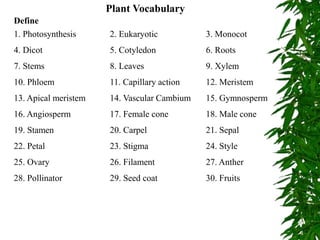
1. Photosynthesis 2. Eukaryotic 3. Monocot
4. Dicot 5. Cotyledon 6. Roots
7. Stems 8. Leaves 9. Xylem
10. Phloem 11. Capillary action 12. Meristem
13. Apical meristem 14. Vascular Cambium 15. Gymnosperm
16. Angiosperm 17. Female cone 18. Male cone
19. Stamen 20. Carpel 21. Sepal
22. Petal 23. Stigma 24. Style
25. Ovary 26. Filament 27. Anther
28. Pollinator 29. Seed coat 30. Fruits
Define
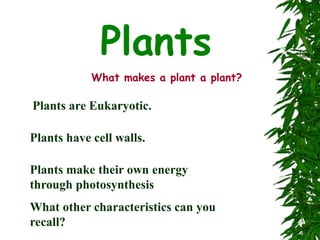
Plants
What makes a plant a plant?
Plants are Eukaryotic.
Plants have cell walls.
Plants make their own energy
through photosynthesis
What other characteristics can you
recall?
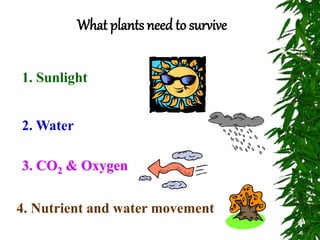
What plants need to survive
1. Sunlight
2. Water
3. CO2 & Oxygen
4. Nutrient and water movement
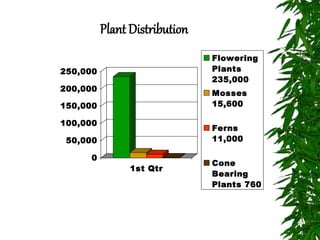
Plant Distribution
0
50,000
100,000
150,000
200,000
250,000
1st Qtr
Flowering
Plants
235,000
Mosses
15,600
Ferns
11,000
Cone
Bearing
Plants 760
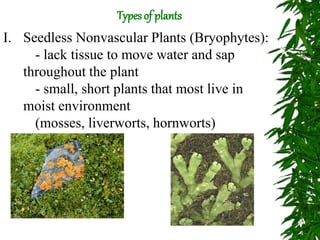
I. Seedless Nonvascular Plants (Bryophytes):
- lack tissue to move water and sap
throughout the plant
- small, short plants that most live in
moist environment
(mosses, liverworts, hornworts)
Types of plants
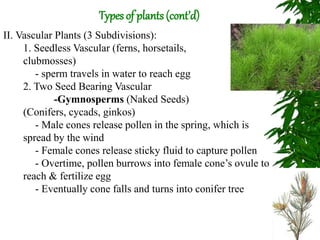
II. Vascular Plants (3 Subdivisions):
1. Seedless Vascular (ferns, horsetails,
clubmosses)
- sperm travels in water to reach egg
2. Two Seed Bearing Vascular
-Gymnosperms (Naked Seeds)
(Conifers, cycads, ginkos)
- Male cones release pollen in the spring, which is
spread by the wind
- Female cones release sticky fluid to capture pollen
- Overtime, pollen burrows into female cone’s ovule to
reach & fertilize egg
- Eventually cone falls and turns into conifer tree
Types of plants (cont’d)
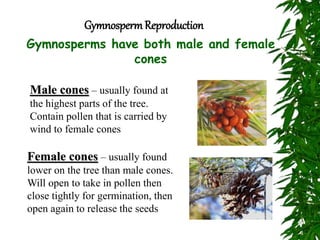
GymnospermReproduction
Gymnosperms have both male and female
cones
Male cones – usually found at
the highest parts of the tree.
Contain pollen that is carried by
wind to female cones
Female cones – usually found
lower on the tree than male cones.
Will open to take in pollen then
close tightly for germination, then
open again to release the seeds
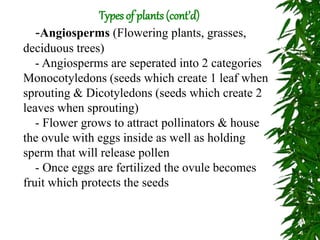
-Angiosperms (Flowering plants, grasses,
deciduous trees)
- Angiosperms are seperated into 2 categories
Monocotyledons (seeds which create 1 leaf when
sprouting & Dicotyledons (seeds which create 2
leaves when sprouting)
- Flower grows to attract pollinators & house
the ovule with eggs inside as well as holding
sperm that will release pollen
- Once eggs are fertilized the ovule becomes
fruit which protects the seeds
Types of plants (cont’d)
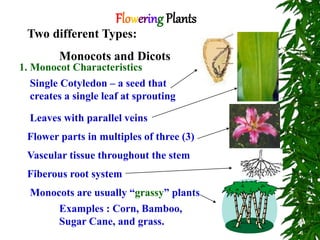
Flowering Plants
Two different Types:
Monocots and Dicots
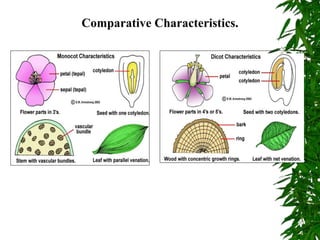
1. Monocot Characteristics
Single Cotyledon – a seed that
creates a single leaf at sprouting
Leaves with parallel veins
Flower parts in multiples of three (3)
Vascular tissue throughout the stem
Fiberous root system
Monocots are usually “grassy” plants
Examples : Corn, Bamboo,
Sugar Cane, and grass.
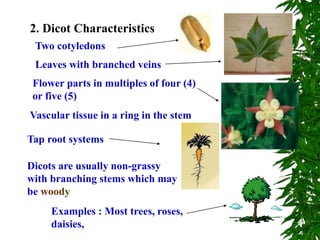
2. Dicot Characteristics
Two cotyledons
Leaves with branched veins
Flower parts in multiples of four (4)
or five (5)
Vascular tissue in a ring in the stem
Tap root systems
Dicots are usually non-grassy
with branching stems which may
be woody
Examples : Most trees, roses,
daisies,
Comparative Characteristics.
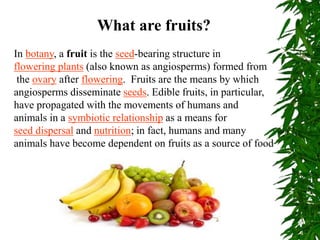
What are fruits?
In botany, a fruit is the seed-bearing structure in
flowering plants (also known as angiosperms) formed from
the ovary after flowering. Fruits are the means by which
angiosperms disseminate seeds. Edible fruits, in particular,
have propagated with the movements of humans and
animals in a symbiotic relationship as a means for
seed dispersal and nutrition; in fact, humans and many
animals have become dependent on fruits as a source of food
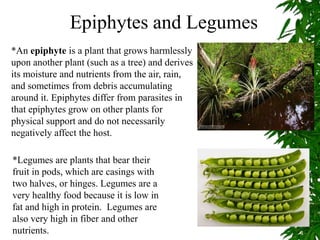
Epiphytes and Legumes
*An epiphyte is a plant that grows harmlessly
upon another plant (such as a tree) and derives
its moisture and nutrients from the air, rain,
and sometimes from debris accumulating
around it. Epiphytes differ from parasites in
that epiphytes grow on other plants for
physical support and do not necessarily
negatively affect the host.
*Legumes are plants that bear their
fruit in pods, which are casings with
two halves, or hinges. Legumes are a
very healthy food because it is low in
fat and high in protein. Legumes are
also very high in fiber and other
nutrients.
Plant Type Questions
1. What is a gymnosperm? Angiosperm?
2. Define Xylem and Phloem.
3. Differentiate nonvascular and vascular
plant.
4. Why most nonvascular plants live so close
to water?
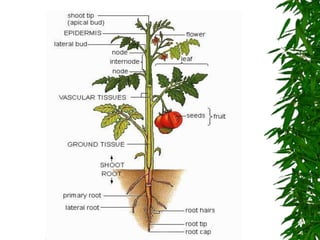
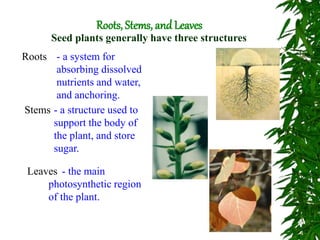
Roots, Stems, and Leaves
Seed plants generally have three structures
Roots - a system for
absorbing dissolved
nutrients and water,
and anchoring.
Stems - a structure used to
support the body of
the plant, and store
sugar.
Leaves - the main
photosynthetic region
of the plant.
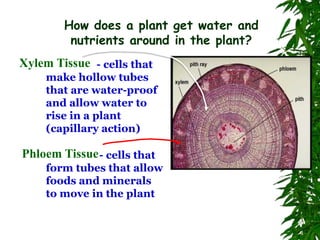
How does a plant get water and
nutrients around in the plant?
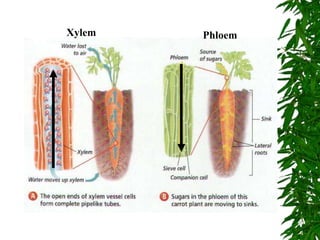
Xylem Tissue - cells that
make hollow tubes
that are water-proof
and allow water to
rise in a plant
(capillary action)
Phloem Tissue- cells that
form tubes that allow
foods and minerals
to move in the plant
Xylem Phloem
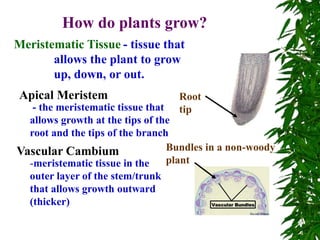
How do plants grow?
Meristematic Tissue - tissue that
allows the plant to grow
up, down, or out.
Apical Meristem
- the meristematic tissue that
allows growth at the tips of the
root and the tips of the branch
Vascular Cambium
-meristematic tissue in the
outer layer of the stem/trunk
that allows growth outward
(thicker)
Root
tip
Bundles in a non-woody
plant
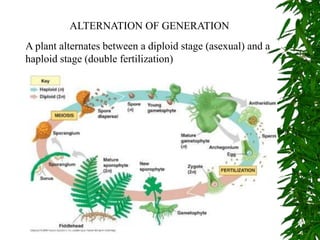
ALTERNATION OF GENERATION
A plant alternates between a diploid stage (asexual) and a
haploid stage (double fertilization)
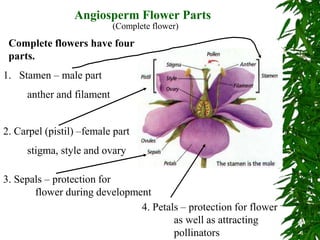
Angiosperm Flower Parts
(Complete flower)
Complete flowers have four
parts.
1. Stamen – male part
anther and filament
2. Carpel (pistil) –female part
stigma, style and ovary
4. Petals – protection for flower
as well as attracting
pollinators
3. Sepals – protection for
flower during development
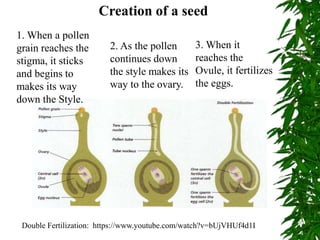
1. When a pollen
grain reaches the
stigma, it sticks
and begins to
makes its way
down the Style.
Creation of a seed
2. As the pollen
continues down
the style makes its
way to the ovary.
3. When it
reaches the
Ovule, it fertilizes
the eggs.
Double Fertilization: https://www.youtube.com/watch?v=bUjVHUf4d1I

Plants.ppt

  • 1.
    Plant Vocabulary 1. Photosynthesis2. Eukaryotic 3. Monocot 4. Dicot 5. Cotyledon 6. Roots 7. Stems 8. Leaves 9. Xylem 10. Phloem 11. Capillary action 12. Meristem 13. Apical meristem 14. Vascular Cambium 15. Gymnosperm 16. Angiosperm 17. Female cone 18. Male cone 19. Stamen 20. Carpel 21. Sepal 22. Petal 23. Stigma 24. Style 25. Ovary 26. Filament 27. Anther 28. Pollinator 29. Seed coat 30. Fruits Define
  • 2.
    Plants What makes aplant a plant? Plants are Eukaryotic. Plants have cell walls. Plants make their own energy through photosynthesis What other characteristics can you recall?
  • 3.
    What plants needto survive 1. Sunlight 2. Water 3. CO2 & Oxygen 4. Nutrient and water movement
  • 4.
  • 5.
    I. Seedless NonvascularPlants (Bryophytes): - lack tissue to move water and sap throughout the plant - small, short plants that most live in moist environment (mosses, liverworts, hornworts) Types of plants
  • 6.
    II. Vascular Plants(3 Subdivisions): 1. Seedless Vascular (ferns, horsetails, clubmosses) - sperm travels in water to reach egg 2. Two Seed Bearing Vascular -Gymnosperms (Naked Seeds) (Conifers, cycads, ginkos) - Male cones release pollen in the spring, which is spread by the wind - Female cones release sticky fluid to capture pollen - Overtime, pollen burrows into female cone’s ovule to reach & fertilize egg - Eventually cone falls and turns into conifer tree Types of plants (cont’d)
  • 7.
    GymnospermReproduction Gymnosperms have bothmale and female cones Male cones – usually found at the highest parts of the tree. Contain pollen that is carried by wind to female cones Female cones – usually found lower on the tree than male cones. Will open to take in pollen then close tightly for germination, then open again to release the seeds
  • 8.
    -Angiosperms (Flowering plants,grasses, deciduous trees) - Angiosperms are seperated into 2 categories Monocotyledons (seeds which create 1 leaf when sprouting & Dicotyledons (seeds which create 2 leaves when sprouting) - Flower grows to attract pollinators & house the ovule with eggs inside as well as holding sperm that will release pollen - Once eggs are fertilized the ovule becomes fruit which protects the seeds Types of plants (cont’d)
  • 9.
    Flowering Plants Two differentTypes: Monocots and Dicots 1. Monocot Characteristics Single Cotyledon – a seed that creates a single leaf at sprouting Leaves with parallel veins Flower parts in multiples of three (3) Vascular tissue throughout the stem Fiberous root system Monocots are usually “grassy” plants Examples : Corn, Bamboo, Sugar Cane, and grass.
  • 10.
    2. Dicot Characteristics Twocotyledons Leaves with branched veins Flower parts in multiples of four (4) or five (5) Vascular tissue in a ring in the stem Tap root systems Dicots are usually non-grassy with branching stems which may be woody Examples : Most trees, roses, daisies,
  • 11.
  • 12.
    What are fruits? Inbotany, a fruit is the seed-bearing structure in flowering plants (also known as angiosperms) formed from the ovary after flowering. Fruits are the means by which angiosperms disseminate seeds. Edible fruits, in particular, have propagated with the movements of humans and animals in a symbiotic relationship as a means for seed dispersal and nutrition; in fact, humans and many animals have become dependent on fruits as a source of food
  • 13.
    Epiphytes and Legumes *Anepiphyte is a plant that grows harmlessly upon another plant (such as a tree) and derives its moisture and nutrients from the air, rain, and sometimes from debris accumulating around it. Epiphytes differ from parasites in that epiphytes grow on other plants for physical support and do not necessarily negatively affect the host. *Legumes are plants that bear their fruit in pods, which are casings with two halves, or hinges. Legumes are a very healthy food because it is low in fat and high in protein. Legumes are also very high in fiber and other nutrients.
  • 14.
    Plant Type Questions 1.What is a gymnosperm? Angiosperm? 2. Define Xylem and Phloem. 3. Differentiate nonvascular and vascular plant. 4. Why most nonvascular plants live so close to water?
  • 16.
    Roots, Stems, andLeaves Seed plants generally have three structures Roots - a system for absorbing dissolved nutrients and water, and anchoring. Stems - a structure used to support the body of the plant, and store sugar. Leaves - the main photosynthetic region of the plant.
  • 17.
    How does aplant get water and nutrients around in the plant? Xylem Tissue - cells that make hollow tubes that are water-proof and allow water to rise in a plant (capillary action) Phloem Tissue- cells that form tubes that allow foods and minerals to move in the plant
  • 18.
  • 19.
    How do plantsgrow? Meristematic Tissue - tissue that allows the plant to grow up, down, or out. Apical Meristem - the meristematic tissue that allows growth at the tips of the root and the tips of the branch Vascular Cambium -meristematic tissue in the outer layer of the stem/trunk that allows growth outward (thicker) Root tip Bundles in a non-woody plant
  • 20.
    ALTERNATION OF GENERATION Aplant alternates between a diploid stage (asexual) and a haploid stage (double fertilization)
  • 21.
    Angiosperm Flower Parts (Completeflower) Complete flowers have four parts. 1. Stamen – male part anther and filament 2. Carpel (pistil) –female part stigma, style and ovary 4. Petals – protection for flower as well as attracting pollinators 3. Sepals – protection for flower during development
  • 22.
    1. When apollen grain reaches the stigma, it sticks and begins to makes its way down the Style. Creation of a seed 2. As the pollen continues down the style makes its way to the ovary. 3. When it reaches the Ovule, it fertilizes the eggs. Double Fertilization: https://www.youtube.com/watch?v=bUjVHUf4d1I