AUTOPSY
1
Synonyms:
 Post Mortem
 Necropsy
 Thanatopsy
2
3
Post------after
Mortem------Death
External examination of dead body
without incisions, fluids can be collected with
the help of needle .
e.g.
Blood, bile, Urine
Post Mortem
POST MORTEM
4
Auto --- Self
Opis --- view / Examination
(self examination)
It may be defined as, The detailed scrutiny of
both external surfaces and internal
contents of dead body after opening its
cavities including further examination,
such as histology, biochemistry and
toxicology of collected material.
AUTOPSY
NECROPSY
Necro ---- Dead
Opsy---- examination / to see
(Examination of Dead)
Thanatopsy:
Thantopsy: Thantose  means death opsy view or
to see.
5
AUTOPSY
TYPES:
i. Medical /clinical/ pathological / hospital autopsy.
ii. Anatomical autopsy
iii. Psychological autopsy
iv. Postmortem examination
v. Virtual Autopsy
vi. Medico-legal autopsy
6
I.MEDICAL/ACADEMIC AUTOPSY:
7
Carried on a patient
who dies in a hospital
during course of treatment.
Objectives
 1. To determine the cause of death.
 2. To confirm or establish the clinical diagnosis
 3. To evaluate the effects of treatment given
during life.
 Performed by a pathologist with consent of
relatives.
8
II.ANATOMICAL AUTOPSY
 It is performed to study normal structure of human
body.
 Mostly on unclaimed dead bodies
 Anatomist and medical students perform this.
9
III. PSYCHOLOGICAL AUTOPSY
10
 It is undertaken on alleged cases of
suicide to know about the mental
status of deceased at the time of
death.
 It is perform to know about:
 Background of person
 His habits ,mental status, personality,
character.
 Relation to others
Sources of collection of information
are
 Family members, friends, professional
colleagues, teachers and physicians
 NOT THE POLICE ..
IV.POSTMORTEM EXAMINATION
 Examination of external surfaces of corpse by
inspection without giving incision for systemic
examination.
 However specimen of body fluids like blood bile
urine may be collected.
11
V. VIRTUAL AUTOPSY
 It is a postmortem examination without
compromising the integrity of the body, even
without collection of sample.
 Due to some reason or disease the autopsy of dead
body is not possible then by the help of radiological
examination we can detect the cause of death.
 Methods
 X-rays, ultrasound, CT scan
MRI.
12
VI. MEDICO-LEGAL AUTOPSY
Essential examination of dead body,
to rule out or establish foul play in death.
13
II. MEDICO-LEGAL AUTOPSY
14
It is perform in pursuance of law
to establish the cause and
manner of death and also to
establish or rule out foul play.
HISTORY:
 The medicolegal autopsy was first time
introduced in 1302 AD in ITALY.
 This procedure was carried out by physician
(BARTOLONEO DE VARIGNANA) and
surgeons.
 Autopsy Performed by specialists in
developed countries.
 In Spain, Germany, Scotland, by two
specialists.
 In Pakistan mostly by
Untrained medical officers.
15
OBJECTIVES OF MEDICOLEGAL AUTOPSY
TO ESTABLISH
1. To determine identity of deceased.
2. To establish cause and manner of death,
3. To establish and rule out foul play.
4. To determine time since death.
5. To identify weapon, person or poison
responsible for death.
6. In case of new born infant to determine
issue of live or still birth and viability.
16
CORPUS DELICTI
17
 In a criminal charge of
homicide.
A. Positive identification of
victim
B. Proof of death by criminal
act of accused .
 This is collectively termed as
CORPUS DELICTI.
 It is performed by medicolegal expert but due to
lack of qualified experts, all authorized medical
officer of Govt. can perform it.
 It is performed under section 174 CrPC of
Pakistan and police rules 1934 section 25.34 and
25.36
18
AUTOPSY RATE
AUTOPSY RATE
 It is proportion of autopsies carried out on
deaths notified to the authorities.
AUTOPSY INDEX
 It is the proportion of medico-legal autopsies
carried out on total deaths in a community.
19
PRE AUTOPSY FORMALITIES/
PROTOCOL OF AUTOPSY
1. VISIT OF SCENE OF CRIME
2. TRANSPOSITION OF CORPS
3. REGISTRATION OF DEAD BODIES
4. STORAGE OF DEAD BODIES
5. LEGAL FORMALITIES
6. OTHER FORMALITIES
7. PLACE OF PERFORMING AUTOPSY
20
A. VISIT OF SCENE OF CRIME
21
 Not done in our country
but in European countries
the autopsy surgeon
visits the scene of crime.
The action done there
are
1. Cordening of scene.
2. Position in relation to
surrounding objects
3. Presence of or position of
weapons, blood
stains, marks of struggle
4. Preservation of foot prints
and other trace
evidence.
5. Photography of scene.
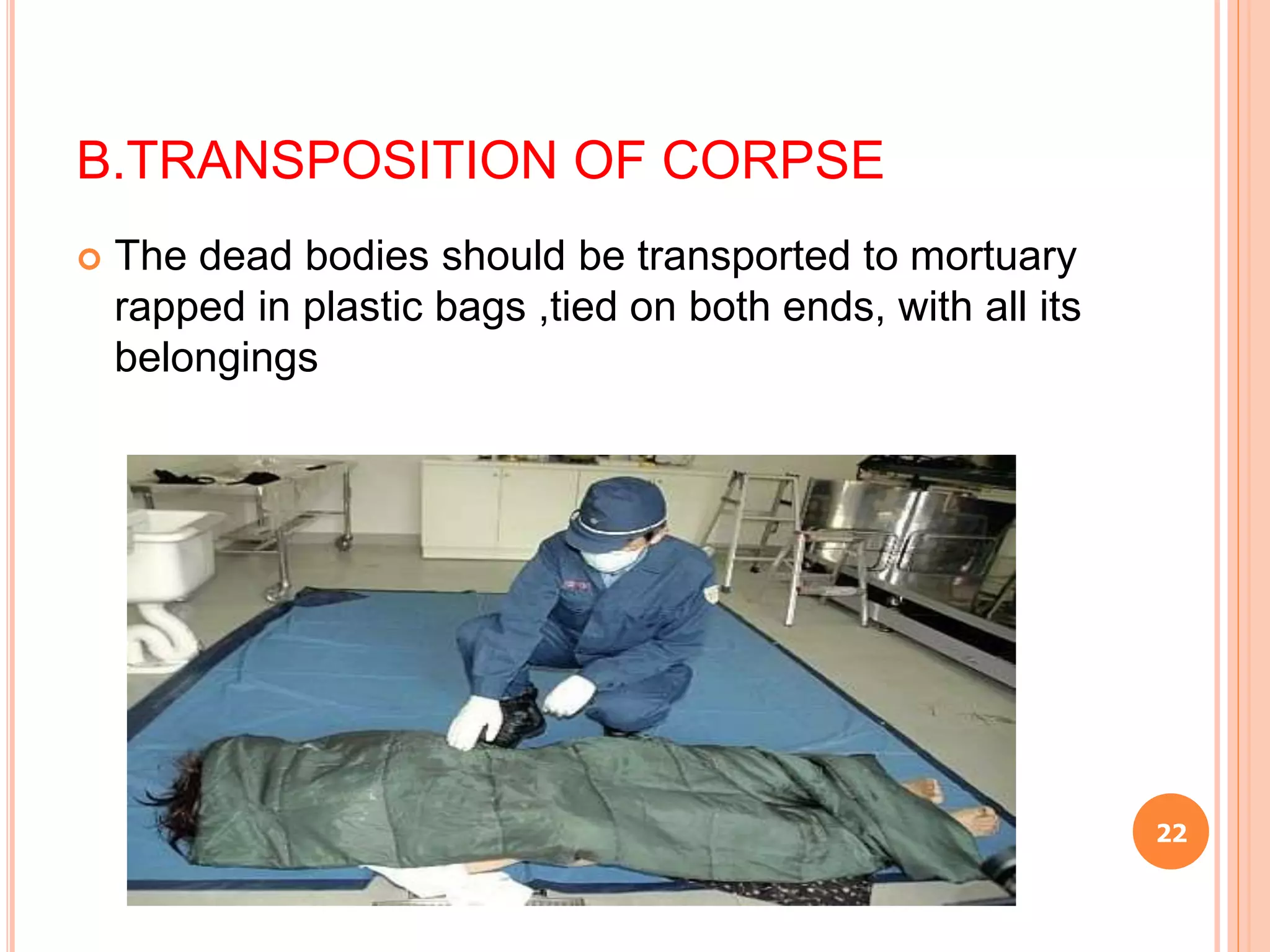
B.TRANSPOSITION OF CORPSE
 The dead bodies should be transported to mortuary
rapped in plastic bags ,tied on both ends, with all its
belongings
22
C.REGISTRATION OF DEAD BODIES
 On receipt of corp. authorized staff should make
entries in two registers
1. General Register
2. Autopsy Register
23
COLUMNS OF GENERAL REGISTER ARE
1. Serial numbers
2. Date and time of receipt of corpse
3. Name and ID of diseased
4. Name and No of police officials and his police
station
5. Date and time of delivery of corpse
24
COLUMNS OF AUTOPSY REGISTER ARE
1. Yearly No.
2. Autopsy No.
3. Name, date and time of autopsy.
4. Details about specimen collected and lab where
sent.
5. Provisional /final conclusion regarding cause of
death.
25
STORAGE OF DEAD BODIES
 There are two types of storage..
 Long term at -20 0C [for preservation]
 Short term +4 0C[for autopsy purpose]
26
LEGAL FORMALITIES
 SECRUITINY OF POLICE PAPERS
1. Authorization orders /police docket
2. Inquest report
3. The copy of FIR
4. Form ,,,,,(alf. bay. Jeem.)
5. Initial MLC /treatment notes/ hospital notes.
Lab/X-ray/ MRI etc. reports. Any operation notes.
(All papers must be examined & signed).
27
AUTHORIZATION
28
Examination of police papers
Police docket police request for autopsy or
it is a requisition submitted by the investigating
police officer to a medical officer while handing
over the dead body for a postmortem
examination.
CONTAINS:
FIR
 Complete information name, age, sex, height
 Number of injuries & location
 State of body, State of clothing's
 Site of recovery, Sketch of area
 Weapon, Apparent cause of death.
29
INQUEST REPORT
 Inquest report is a report which contains
1. Available Hx of the case.
2. Circumstances under which body was found.
3. Opinion of witnesses & the police officer regarding
injuries, manner of their causation, cause of death &
any indication of suspected foul play.
30
INQUEST REPORT
Three types of printed forms
depending upon apparent manner of death
 1. Form A. For those types of deaths which
appear to be natural
 2. Form B. For those cases in which death
has occurred due to assault.
 3. Form C. For those cases in which death
appears to be due to poisoning
31
OTHER FORMALITIES
 Identification:- The dead body should be identified
prior to autopsy, this is necessary because in a
mortuary where serial autopsies are done chances
of performing autopsy on wrong body do exist.
 This can be prevented by appropriate identification.
 If known confirm identity by police or by relatives
always take signature of identifiers.
 Write name with address, & No of police officer with
police station.
32
IDENTIFICATION
 IF UNKNOWN
 1Ask the police to take photographs
 2.Note particular of dress worn and tailor tag,
belongings ,facial features, and identification
marks
 3.Note the finger print details
 Giving an advertisement on newspaper.
33
INITIAL MLR / TREATMENT NOTES
 Where there has been a period of treatment
between an act of violence or between the accident
and death.
 Such documents are necessary as to enable the
doctor to concentrate on the organ or the part of
body most suspected & likely to serve as a guide to
retain or send appropriate part to FSL
34
PLACE OF PERFORMING AUTOPSY
MORTUARY: is a room or a building usually part of the
hospital to which dead bodies are taken to be kept for until
their burial or some other disposal. Autopsy room is that part
of the mortuary where dead bodies are dissected.
35
Dr.MudaserHussainAbbasi/Departmentof
ForensicMedicine&Toxicology
36
37
38
INSTRUMENTS COMMONLY USED IN
AUTOPSY
39
 Surgical blade/knife
 Scissors
 Probe
 Dissecting forceps
 Cartilage knife
 Rib shears
 Chisel
 Hammer
 Saw
 Bone forceps
 Skull elevator
 Brain knife
 Scalpel
 Knife
 Measuring jug
 Weighing machine
 Magnifying lens
 Trays (steel)
INSTRUMENTS COMMONLY USED IN
AUTOPSY
40
 Surgical hand gloves
 Sewing material
 Preservatives
 Labeling / sealing material

Autopsy

  • 1.
  • 2.
    Synonyms:  Post Mortem Necropsy  Thanatopsy 2
  • 3.
    3 Post------after Mortem------Death External examination ofdead body without incisions, fluids can be collected with the help of needle . e.g. Blood, bile, Urine Post Mortem POST MORTEM
  • 4.
    4 Auto --- Self Opis--- view / Examination (self examination) It may be defined as, The detailed scrutiny of both external surfaces and internal contents of dead body after opening its cavities including further examination, such as histology, biochemistry and toxicology of collected material. AUTOPSY
  • 5.
    NECROPSY Necro ---- Dead Opsy----examination / to see (Examination of Dead) Thanatopsy: Thantopsy: Thantose  means death opsy view or to see. 5
  • 6.
    AUTOPSY TYPES: i. Medical /clinical/pathological / hospital autopsy. ii. Anatomical autopsy iii. Psychological autopsy iv. Postmortem examination v. Virtual Autopsy vi. Medico-legal autopsy 6
  • 7.
    I.MEDICAL/ACADEMIC AUTOPSY: 7 Carried ona patient who dies in a hospital during course of treatment.
  • 8.
    Objectives  1. Todetermine the cause of death.  2. To confirm or establish the clinical diagnosis  3. To evaluate the effects of treatment given during life.  Performed by a pathologist with consent of relatives. 8
  • 9.
    II.ANATOMICAL AUTOPSY  Itis performed to study normal structure of human body.  Mostly on unclaimed dead bodies  Anatomist and medical students perform this. 9
  • 10.
    III. PSYCHOLOGICAL AUTOPSY 10 It is undertaken on alleged cases of suicide to know about the mental status of deceased at the time of death.  It is perform to know about:  Background of person  His habits ,mental status, personality, character.  Relation to others Sources of collection of information are  Family members, friends, professional colleagues, teachers and physicians  NOT THE POLICE ..
  • 11.
    IV.POSTMORTEM EXAMINATION  Examinationof external surfaces of corpse by inspection without giving incision for systemic examination.  However specimen of body fluids like blood bile urine may be collected. 11
  • 12.
    V. VIRTUAL AUTOPSY It is a postmortem examination without compromising the integrity of the body, even without collection of sample.  Due to some reason or disease the autopsy of dead body is not possible then by the help of radiological examination we can detect the cause of death.  Methods  X-rays, ultrasound, CT scan MRI. 12
  • 13.
    VI. MEDICO-LEGAL AUTOPSY Essentialexamination of dead body, to rule out or establish foul play in death. 13
  • 14.
    II. MEDICO-LEGAL AUTOPSY 14 Itis perform in pursuance of law to establish the cause and manner of death and also to establish or rule out foul play.
  • 15.
    HISTORY:  The medicolegalautopsy was first time introduced in 1302 AD in ITALY.  This procedure was carried out by physician (BARTOLONEO DE VARIGNANA) and surgeons.  Autopsy Performed by specialists in developed countries.  In Spain, Germany, Scotland, by two specialists.  In Pakistan mostly by Untrained medical officers. 15
  • 16.
    OBJECTIVES OF MEDICOLEGALAUTOPSY TO ESTABLISH 1. To determine identity of deceased. 2. To establish cause and manner of death, 3. To establish and rule out foul play. 4. To determine time since death. 5. To identify weapon, person or poison responsible for death. 6. In case of new born infant to determine issue of live or still birth and viability. 16
  • 17.
    CORPUS DELICTI 17  Ina criminal charge of homicide. A. Positive identification of victim B. Proof of death by criminal act of accused .  This is collectively termed as CORPUS DELICTI.
  • 18.
     It isperformed by medicolegal expert but due to lack of qualified experts, all authorized medical officer of Govt. can perform it.  It is performed under section 174 CrPC of Pakistan and police rules 1934 section 25.34 and 25.36 18
  • 19.
    AUTOPSY RATE AUTOPSY RATE It is proportion of autopsies carried out on deaths notified to the authorities. AUTOPSY INDEX  It is the proportion of medico-legal autopsies carried out on total deaths in a community. 19
  • 20.
    PRE AUTOPSY FORMALITIES/ PROTOCOLOF AUTOPSY 1. VISIT OF SCENE OF CRIME 2. TRANSPOSITION OF CORPS 3. REGISTRATION OF DEAD BODIES 4. STORAGE OF DEAD BODIES 5. LEGAL FORMALITIES 6. OTHER FORMALITIES 7. PLACE OF PERFORMING AUTOPSY 20
  • 21.
    A. VISIT OFSCENE OF CRIME 21  Not done in our country but in European countries the autopsy surgeon visits the scene of crime. The action done there are 1. Cordening of scene. 2. Position in relation to surrounding objects 3. Presence of or position of weapons, blood stains, marks of struggle 4. Preservation of foot prints and other trace evidence. 5. Photography of scene.
  • 22.
    B.TRANSPOSITION OF CORPSE The dead bodies should be transported to mortuary rapped in plastic bags ,tied on both ends, with all its belongings 22
  • 23.
    C.REGISTRATION OF DEADBODIES  On receipt of corp. authorized staff should make entries in two registers 1. General Register 2. Autopsy Register 23
  • 24.
    COLUMNS OF GENERALREGISTER ARE 1. Serial numbers 2. Date and time of receipt of corpse 3. Name and ID of diseased 4. Name and No of police officials and his police station 5. Date and time of delivery of corpse 24
  • 25.
    COLUMNS OF AUTOPSYREGISTER ARE 1. Yearly No. 2. Autopsy No. 3. Name, date and time of autopsy. 4. Details about specimen collected and lab where sent. 5. Provisional /final conclusion regarding cause of death. 25
  • 26.
    STORAGE OF DEADBODIES  There are two types of storage..  Long term at -20 0C [for preservation]  Short term +4 0C[for autopsy purpose] 26
  • 27.
    LEGAL FORMALITIES  SECRUITINYOF POLICE PAPERS 1. Authorization orders /police docket 2. Inquest report 3. The copy of FIR 4. Form ,,,,,(alf. bay. Jeem.) 5. Initial MLC /treatment notes/ hospital notes. Lab/X-ray/ MRI etc. reports. Any operation notes. (All papers must be examined & signed). 27
  • 28.
  • 29.
    Examination of policepapers Police docket police request for autopsy or it is a requisition submitted by the investigating police officer to a medical officer while handing over the dead body for a postmortem examination. CONTAINS: FIR  Complete information name, age, sex, height  Number of injuries & location  State of body, State of clothing's  Site of recovery, Sketch of area  Weapon, Apparent cause of death. 29
  • 30.
    INQUEST REPORT  Inquestreport is a report which contains 1. Available Hx of the case. 2. Circumstances under which body was found. 3. Opinion of witnesses & the police officer regarding injuries, manner of their causation, cause of death & any indication of suspected foul play. 30
  • 31.
    INQUEST REPORT Three typesof printed forms depending upon apparent manner of death  1. Form A. For those types of deaths which appear to be natural  2. Form B. For those cases in which death has occurred due to assault.  3. Form C. For those cases in which death appears to be due to poisoning 31
  • 32.
    OTHER FORMALITIES  Identification:-The dead body should be identified prior to autopsy, this is necessary because in a mortuary where serial autopsies are done chances of performing autopsy on wrong body do exist.  This can be prevented by appropriate identification.  If known confirm identity by police or by relatives always take signature of identifiers.  Write name with address, & No of police officer with police station. 32
  • 33.
    IDENTIFICATION  IF UNKNOWN 1Ask the police to take photographs  2.Note particular of dress worn and tailor tag, belongings ,facial features, and identification marks  3.Note the finger print details  Giving an advertisement on newspaper. 33
  • 34.
    INITIAL MLR /TREATMENT NOTES  Where there has been a period of treatment between an act of violence or between the accident and death.  Such documents are necessary as to enable the doctor to concentrate on the organ or the part of body most suspected & likely to serve as a guide to retain or send appropriate part to FSL 34
  • 35.
    PLACE OF PERFORMINGAUTOPSY MORTUARY: is a room or a building usually part of the hospital to which dead bodies are taken to be kept for until their burial or some other disposal. Autopsy room is that part of the mortuary where dead bodies are dissected. 35
  • 36.
  • 37.
  • 38.
  • 39.
    INSTRUMENTS COMMONLY USEDIN AUTOPSY 39  Surgical blade/knife  Scissors  Probe  Dissecting forceps  Cartilage knife  Rib shears  Chisel  Hammer  Saw  Bone forceps  Skull elevator  Brain knife  Scalpel  Knife  Measuring jug  Weighing machine  Magnifying lens  Trays (steel)
  • 40.
    INSTRUMENTS COMMONLY USEDIN AUTOPSY 40  Surgical hand gloves  Sewing material  Preservatives  Labeling / sealing material