EXHUMATION
DISINTERMENT
REPOST-MORTEM
EXHUMATION
 DEFINITION
 Exhumation is defined as lawful disinterment or
digging out of already buried dead bodies from
the grave for autopsy examination. OR
 Removal of corps from grave for determination
of cause of death.
OBJECTIVES
1-for purposes of identification
2. Second autopsy when the first report is ambiguous.
3-to determine the cause, manner of death , when foul play
is suspected.
e.g. homicide, disputed case of death or poisoning.
4-may also be required to recover some paper or
documents or other evidential material buried with dead
body.
PROCEDURE
 AUTHORIZATION
 Can be carried out only with proper authorization.
 LEGAL REQUIREMENTS
 The exhumation is performed under section 176 Cr.Pc
and police rules 1934 section 25.36.
 The exhumation is performed in the early morning in
the presence of duty magistrate and police.
 High court, district magistrate, district and session
judges, judicial magistrate are specially empowered
to order for exhumation.
TIME LIMIT FOR
EXHUMATION
 1. The statute law is silent
about the period during
which exhumation is allowed.
 2. The soft tissues of dead
body of an adult take about
five years and of child take
about ½ of this time to
decompose to skeleton .
 3. The bony frame does not
decompose and persist for
hundred of years in the
grave.
 Pakistan  No limit.
 France  10yrs
 Scotland  20 yrs
 Germany  30yrs
ARRANGEMENTS OF
EXHUMATION
1. To make the
arrangements of
exhumation and
postmortem in the grave
yard is the duty of
investigation police
officer.
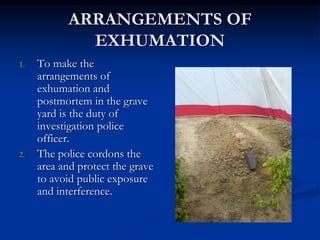
2. The police cordons the
area and protect the grave
to avoid public exposure
and interference.
ARRANGEMENTS OF
EXHUMATION
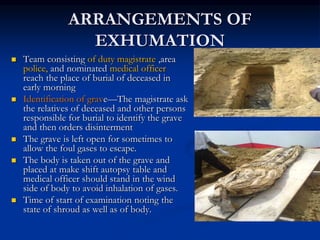
 Team consisting of duty magistrate ,area
police, and nominated medical officer
reach the place of burial of deceased in
early morning
 Identification of grave—The magistrate ask
the relatives of deceased and other persons
responsible for burial to identify the grave
and then orders disinterment
 The grave is left open for sometimes to
allow the foul gases to escape.
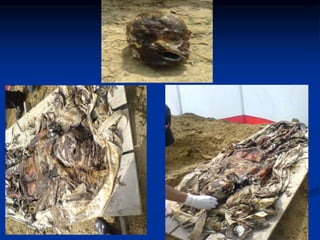
 The body is taken out of the grave and
placed at make shift autopsy table and
medical officer should stand in the wind
side of body to avoid inhalation of gases.
 Time of start of examination noting the
state of shroud as well as of body.
Precautions
I. Adequate light & ventilation.
II. The workers should be in complete coverings like:
Protective masks, clothing, long shoes, goggles & gloves.
SAMPLES
 Sampling should be as much as possible.
 These are,
 1. Earth sample—are collected from above , beneath , and
both sides of coffin and from far areas of grave yard for
control ,500 g each.
 2. Hair from head and pubic area should be preserved in a
dry clean glass bottle.
 A search should also be made for recent or old injuries
such as fractures.
 3. Nails, teeth, and bones.
 4. Viscerae and material from sites of viscerae like liver, spleen
, kidney, stomach, intestine.
 5. A portion of burial shroud (coffin).
In case of suspected metal poisoning such as
arsenic, lead & antimony hairs, nails & long
bone should be preserved.
Sample then forwarded duly labeled & sealed
to forensic science laboratory.
Autopsy Artifacts
Artefact
 DICTIONARY MEANING:
 An artifact is an artificial product , any structure,
or feature, that is not natural but has been
altered by processing.
Autopsy Artefact/ Medico legal
Artefact.
 DEFINITION:
o Any change or feature introduced into a body
after death that is likely to lead to
misinterpretation of medico legally significant
ante mortem findings.
Autopsy Artifacts
 Two groups
1. Artifacts introduced between death and autopsy
2. Artifacts introduced during autopsy.
1. ARTIFACTS INTRODUCED
BETWEEN DEATH AND AUTOPSY
 These can be divided in to following
1. Agonal artifacts
2. Resuscitation artifacts
3. Embalming artifacts
4. Intermittent and exhumation artifacts
5. Artifacts due to handling of body
6. Artifacts due to rigor mortis and postmortem staining.
7. Decomposition artifacts
8. Toxicological artifacts
9. Miscellaneous artifacts
1. AGONAL ARTIFACTS
 Regurgitation and aspiration of gastric contents,
 Regurgitation or aspiration of gastric contents may
occur as terminal event in the natural death or from
handling of body or resuscitation.
 Physician when see regurgitated material in
mouth or nose may give it as a cause of death
and an autopsy surgeon may fall in to the trap of
misinterpreting the finding of aspirated material
in air passages
2. RESUSCITATION ARTIFACTS.
 The resuscitation procedure may reveal injection marks , bruises, and
fractures,
 1. Intra cardiac injections may be accompanied by bruising of the
heart and sometimes intra pericardial hemorrhage.
 2. Injection marks may be accompanied by postmortem bruise.
 3. A ring like bruise on chest is sometimes seen due to application of
defibrillator.
 4. Ribs and even sternum are usually fractured during cardiac
massage.
 To avoid confusion history of resuscitative measures should be
carefully noted.
 Resuscitative contusion of soft tissues of neck can raise suspicion of
homicidal strangulation e.g., trying to introduce tube in airway
3. EMBALMING ARTEFACTS
 The embalming is done through incision at the
site of approachable arteries with a trochar.
 The embalmer may enlarge a homicidal stab
wound to approach the artery or may introduce
a trochar through gun shot wound and may
change its dimension.
4. EXHUMATION ARTEFACTS
 In exhumed bodies, fungus growth is common
on body orifices, eyes and sites of open injuries
and when the fungus is removed underlying skin
presents discoloration simulating bruise.
5. ARTEFACTS DUE TO HANDLING OF
BODY
 Rough handling of body can result in fracture of
cervical spine and absence of significant
hemorrhage helps to identify the fractures on
postmortem.
 A post mortem bruise on region of occiput of
head can result due to careless bumping of head
on stature.
6. ARTIFACTS RELATED TO RIGOR/
POSTMORTEM STAINING
 1. Breaking of rigor mortis during handling of
body may cause a confusion of time since death.
 2. Localized areas of post mortem staining may
resemble a bruise.
7. DECOMPOSITION ARTEFACTS
 Advanced decomposition causes swelling of lips, nose,
eyelids protrusion of eyes, distension of chest, and
abdomen and swelling of extremities which may lead to
impression of ante mortem obesity.
 Presence of bloody fluid in mouth and nose is common
findings in decomposition which may lead to wrong
conclusion that person died of excessive hemorrhage.
 Decomposition blebs may sometimes be misinterpreted
as vesication from burns.
7. DECOMPOSITION ARTEFACTS
 The deep groove found around neck of
decomposed body due to tight buttons of shirt
may simulate ligature mark of strangulation.
 The presence of gas in right side of heart due to
decomposition may give false impression of air
embolism.
8. MISCELLANEOUS ARTEFACTS
1. Wounds caused by animal bites may create confusion.
2. Postmortem hemorrhage
Under normal circumstances blood in the body
remains in fluid state for sometimes, during this time
postmortem injury may open a blood vessel and lead
to postmortem hemorrhage.
3. Discoloration of liver.
9. ARTEFACTS INTRODUCED DURING
AUTOPSY
 1. One of the most common artefact is
introduction of air bubbles in to the vessels of
top of brain while the dura is being pulled in
sagital line.
 Post mortem introduction of air in to the neck
veins during reflection of skin may cause
confusion because air bubbles in vessels of neck
and brain are seen in death due to air embolism
following attempt at criminal abortion
9. ARTEFACTS INTRODUCED DURING
AUTOPSY
 2. Forceful pulling of skull cap sometimes lead
to fracture of skull.
 3.Postmortem tears of midbrain may also be
caused during removal of brain from cranium.
 4.Handling of organs and incision of vessels
during postmortem examination often result in
extravasations of blood in cavities.
Medicolegally
 misinterpretation may lead to
1.Wrong cause of death
2.Wrong manner of death
3. Undue suspicion of criminal offence
Negative Autopsy
Definition
 When the gross and microscopic findings fail to
reveal any apparent cause of death, along with
the other laboratory examination termed as
negative autopsy.
INCIDENCE:
 In best centers of medicolegal examination the
rate of negative autopsy ranges from 2 to 10
percent of total autopsies.
CAUSES OF NEGATIVE AUTOPSY
1. Inadequate history.
2. Lack of proper external examination.
3. Inadequate/improper internal examination.
4. Insufficient histological examination
5. Inadequate pathologist`s training.
1. Inadequate history
 A complete history of event leading to death should be
obtained.
 Example; vagal inhibition, epilepsy, laryngeal spasm,
electrocution…
 Death due to hyper sensitivity reaction may not present
enough evidence to explain the cause of death.
 In case of drowning when death is caused by laryngeal spasm
no positive postmortem change is present.
2. Lack of proper external examination.
 If the external examination is not made carefully the
cause of death may be missed.
 In death of drug addict the presence of new and old
prick marks may be missed on external examination.
 The death from snake bite can not be explained
without proper identification of external lesion.
 The death from electrocution demand a careful external
examination so that the electric burns and cause of
death may not be missed.
3. INADEQUATE INTERNAL
EXAMINATION
 Two conditions most often be missed if careful
internal examination is not done, these are,
 1.Air embolism
 2.Pneumothorax
4. INSUFFICIENT HISTOLOGICAL
EXAMINATION
 If careless and insufficient histological
examination is done, microscopic lesions which
account for death may be missed.
5. Inadequate pathologist`s
training.
 The training of doctors conducting autopsy is
an important factor.
Obscure Autopsy
 The autopsy is termed as obscure, when
there is no definite or obscure cause of
death.
Causes of Obscure Autopsy
1. Concealed trauma
2. Cardiac lesions
3. Reflex Vagal inhibition
1.Concealed Trauma
 Injury to the cervical spine causing fracture dislocation
and injury to the spinal cord can cause instantaneous
death with out any obvious injuries.
2. Cardiac lesions
 1. In blunt force injury to heart it may stop
functioning without any visible signs.
 Cardiac arrest can occur during or immediately
following heavy exercises in which there is
increase in heart rate and systolic pressure with
progressive ischemia leading to cardiac arrest.
 Cardiac arrhythmias which may be precipitated
by emotional excitement can cause physiological
asystole and may lead to death.
3. Reflex vagal Inhibition
 This can be due to pressure on neck, blows on
the larynx, chest, abdomen and genital organs.
 It may occur during drowning, when the body is
subjected to very cold temperature .
 Any manipulation of external auditory meatus
may also lead to death due to vagal inhibition.

Negative autopsy & post mortem artifacts

  • 1.
  • 2.
    EXHUMATION  DEFINITION  Exhumationis defined as lawful disinterment or digging out of already buried dead bodies from the grave for autopsy examination. OR  Removal of corps from grave for determination of cause of death.
  • 3.
    OBJECTIVES 1-for purposes ofidentification 2. Second autopsy when the first report is ambiguous. 3-to determine the cause, manner of death , when foul play is suspected. e.g. homicide, disputed case of death or poisoning. 4-may also be required to recover some paper or documents or other evidential material buried with dead body.
  • 4.
    PROCEDURE  AUTHORIZATION  Canbe carried out only with proper authorization.  LEGAL REQUIREMENTS  The exhumation is performed under section 176 Cr.Pc and police rules 1934 section 25.36.  The exhumation is performed in the early morning in the presence of duty magistrate and police.  High court, district magistrate, district and session judges, judicial magistrate are specially empowered to order for exhumation.
  • 5.
    TIME LIMIT FOR EXHUMATION 1. The statute law is silent about the period during which exhumation is allowed.  2. The soft tissues of dead body of an adult take about five years and of child take about ½ of this time to decompose to skeleton .  3. The bony frame does not decompose and persist for hundred of years in the grave.  Pakistan  No limit.  France  10yrs  Scotland  20 yrs  Germany  30yrs
  • 6.
    ARRANGEMENTS OF EXHUMATION 1. Tomake the arrangements of exhumation and postmortem in the grave yard is the duty of investigation police officer. 2. The police cordons the area and protect the grave to avoid public exposure and interference.
  • 7.
    ARRANGEMENTS OF EXHUMATION  Teamconsisting of duty magistrate ,area police, and nominated medical officer reach the place of burial of deceased in early morning  Identification of grave—The magistrate ask the relatives of deceased and other persons responsible for burial to identify the grave and then orders disinterment  The grave is left open for sometimes to allow the foul gases to escape.  The body is taken out of the grave and placed at make shift autopsy table and medical officer should stand in the wind side of body to avoid inhalation of gases.  Time of start of examination noting the state of shroud as well as of body.
  • 8.
    Precautions I. Adequate light& ventilation. II. The workers should be in complete coverings like: Protective masks, clothing, long shoes, goggles & gloves.
  • 9.
    SAMPLES  Sampling shouldbe as much as possible.  These are,  1. Earth sample—are collected from above , beneath , and both sides of coffin and from far areas of grave yard for control ,500 g each.  2. Hair from head and pubic area should be preserved in a dry clean glass bottle.  A search should also be made for recent or old injuries such as fractures.  3. Nails, teeth, and bones.  4. Viscerae and material from sites of viscerae like liver, spleen , kidney, stomach, intestine.  5. A portion of burial shroud (coffin).
  • 10.
    In case ofsuspected metal poisoning such as arsenic, lead & antimony hairs, nails & long bone should be preserved. Sample then forwarded duly labeled & sealed to forensic science laboratory.
  • 12.
  • 13.
    Artefact  DICTIONARY MEANING: An artifact is an artificial product , any structure, or feature, that is not natural but has been altered by processing.
  • 14.
    Autopsy Artefact/ Medicolegal Artefact.  DEFINITION: o Any change or feature introduced into a body after death that is likely to lead to misinterpretation of medico legally significant ante mortem findings.
  • 15.
    Autopsy Artifacts  Twogroups 1. Artifacts introduced between death and autopsy 2. Artifacts introduced during autopsy.
  • 16.
    1. ARTIFACTS INTRODUCED BETWEENDEATH AND AUTOPSY  These can be divided in to following 1. Agonal artifacts 2. Resuscitation artifacts 3. Embalming artifacts 4. Intermittent and exhumation artifacts 5. Artifacts due to handling of body 6. Artifacts due to rigor mortis and postmortem staining. 7. Decomposition artifacts 8. Toxicological artifacts 9. Miscellaneous artifacts
  • 17.
    1. AGONAL ARTIFACTS Regurgitation and aspiration of gastric contents,  Regurgitation or aspiration of gastric contents may occur as terminal event in the natural death or from handling of body or resuscitation.  Physician when see regurgitated material in mouth or nose may give it as a cause of death and an autopsy surgeon may fall in to the trap of misinterpreting the finding of aspirated material in air passages
  • 18.
    2. RESUSCITATION ARTIFACTS. The resuscitation procedure may reveal injection marks , bruises, and fractures,  1. Intra cardiac injections may be accompanied by bruising of the heart and sometimes intra pericardial hemorrhage.  2. Injection marks may be accompanied by postmortem bruise.  3. A ring like bruise on chest is sometimes seen due to application of defibrillator.  4. Ribs and even sternum are usually fractured during cardiac massage.  To avoid confusion history of resuscitative measures should be carefully noted.  Resuscitative contusion of soft tissues of neck can raise suspicion of homicidal strangulation e.g., trying to introduce tube in airway
  • 19.
    3. EMBALMING ARTEFACTS The embalming is done through incision at the site of approachable arteries with a trochar.  The embalmer may enlarge a homicidal stab wound to approach the artery or may introduce a trochar through gun shot wound and may change its dimension.
  • 20.
    4. EXHUMATION ARTEFACTS In exhumed bodies, fungus growth is common on body orifices, eyes and sites of open injuries and when the fungus is removed underlying skin presents discoloration simulating bruise.
  • 21.
    5. ARTEFACTS DUETO HANDLING OF BODY  Rough handling of body can result in fracture of cervical spine and absence of significant hemorrhage helps to identify the fractures on postmortem.  A post mortem bruise on region of occiput of head can result due to careless bumping of head on stature.
  • 22.
    6. ARTIFACTS RELATEDTO RIGOR/ POSTMORTEM STAINING  1. Breaking of rigor mortis during handling of body may cause a confusion of time since death.  2. Localized areas of post mortem staining may resemble a bruise.
  • 23.
    7. DECOMPOSITION ARTEFACTS Advanced decomposition causes swelling of lips, nose, eyelids protrusion of eyes, distension of chest, and abdomen and swelling of extremities which may lead to impression of ante mortem obesity.  Presence of bloody fluid in mouth and nose is common findings in decomposition which may lead to wrong conclusion that person died of excessive hemorrhage.  Decomposition blebs may sometimes be misinterpreted as vesication from burns.
  • 24.
    7. DECOMPOSITION ARTEFACTS The deep groove found around neck of decomposed body due to tight buttons of shirt may simulate ligature mark of strangulation.  The presence of gas in right side of heart due to decomposition may give false impression of air embolism.
  • 25.
    8. MISCELLANEOUS ARTEFACTS 1.Wounds caused by animal bites may create confusion. 2. Postmortem hemorrhage Under normal circumstances blood in the body remains in fluid state for sometimes, during this time postmortem injury may open a blood vessel and lead to postmortem hemorrhage. 3. Discoloration of liver.
  • 26.
    9. ARTEFACTS INTRODUCEDDURING AUTOPSY  1. One of the most common artefact is introduction of air bubbles in to the vessels of top of brain while the dura is being pulled in sagital line.  Post mortem introduction of air in to the neck veins during reflection of skin may cause confusion because air bubbles in vessels of neck and brain are seen in death due to air embolism following attempt at criminal abortion
  • 27.
    9. ARTEFACTS INTRODUCEDDURING AUTOPSY  2. Forceful pulling of skull cap sometimes lead to fracture of skull.  3.Postmortem tears of midbrain may also be caused during removal of brain from cranium.  4.Handling of organs and incision of vessels during postmortem examination often result in extravasations of blood in cavities.
  • 28.
    Medicolegally  misinterpretation maylead to 1.Wrong cause of death 2.Wrong manner of death 3. Undue suspicion of criminal offence
  • 29.
  • 30.
    Definition  When thegross and microscopic findings fail to reveal any apparent cause of death, along with the other laboratory examination termed as negative autopsy.
  • 31.
    INCIDENCE:  In bestcenters of medicolegal examination the rate of negative autopsy ranges from 2 to 10 percent of total autopsies.
  • 32.
    CAUSES OF NEGATIVEAUTOPSY 1. Inadequate history. 2. Lack of proper external examination. 3. Inadequate/improper internal examination. 4. Insufficient histological examination 5. Inadequate pathologist`s training.
  • 33.
    1. Inadequate history A complete history of event leading to death should be obtained.  Example; vagal inhibition, epilepsy, laryngeal spasm, electrocution…  Death due to hyper sensitivity reaction may not present enough evidence to explain the cause of death.  In case of drowning when death is caused by laryngeal spasm no positive postmortem change is present.
  • 34.
    2. Lack ofproper external examination.  If the external examination is not made carefully the cause of death may be missed.  In death of drug addict the presence of new and old prick marks may be missed on external examination.  The death from snake bite can not be explained without proper identification of external lesion.  The death from electrocution demand a careful external examination so that the electric burns and cause of death may not be missed.
  • 35.
    3. INADEQUATE INTERNAL EXAMINATION Two conditions most often be missed if careful internal examination is not done, these are,  1.Air embolism  2.Pneumothorax
  • 36.
    4. INSUFFICIENT HISTOLOGICAL EXAMINATION If careless and insufficient histological examination is done, microscopic lesions which account for death may be missed.
  • 37.
    5. Inadequate pathologist`s training. The training of doctors conducting autopsy is an important factor.
  • 38.
    Obscure Autopsy  Theautopsy is termed as obscure, when there is no definite or obscure cause of death.
  • 39.
    Causes of ObscureAutopsy 1. Concealed trauma 2. Cardiac lesions 3. Reflex Vagal inhibition
  • 40.
    1.Concealed Trauma  Injuryto the cervical spine causing fracture dislocation and injury to the spinal cord can cause instantaneous death with out any obvious injuries.
  • 41.
    2. Cardiac lesions 1. In blunt force injury to heart it may stop functioning without any visible signs.  Cardiac arrest can occur during or immediately following heavy exercises in which there is increase in heart rate and systolic pressure with progressive ischemia leading to cardiac arrest.  Cardiac arrhythmias which may be precipitated by emotional excitement can cause physiological asystole and may lead to death.
  • 42.
    3. Reflex vagalInhibition  This can be due to pressure on neck, blows on the larynx, chest, abdomen and genital organs.  It may occur during drowning, when the body is subjected to very cold temperature .  Any manipulation of external auditory meatus may also lead to death due to vagal inhibition.