THERMAL INJURIES
Definition:
• It is defined as tissue injury due to
application of heat in any form to the external
or internal body surfaces.
 General Classification
◦ Dry Heat - flame
◦ Moist Heat - scalds
◦ Cold injuries
◦ Chemicals - corrosives
◦ Electric Contact
◦ Radiation Burns - x-rays, ultraviolet
rays.
•Heat injuries – general ( hyperpyrexia) and
local injuries ( burn )
•Cold injuries – general and local injuries.
 Dry lesion
 Does not bleed
 Hard to touch
 Very painful
 Erythema
 Coagulated and
roasted patches
area
 Singing of hair
 Burnt cloths
 Carbon material in
air passages
 Vesicles not appear /
small
 Dry cooked
appearance of
muscles
 Dry and coagulated
blood and pink
tissues
 Liquids / pressure steam at high temp.
 Erythema
 Extensive vesication of large sizes
 No singing / burning of hair / clothes
 Clothes wet
 No deposit of carbonaceous material
 Limited to skin / mouth or throat
 Skin and mucosa blister
 Strong acids / alkalis
 Destroying texture of tissue
 Vitriolage
 Depending on the depth of burn:
◦ Epidermal (first degree)
◦ Dermo – Epidermal (second degree)
◦ Deep (third degree)
 Rule of Nine: To see the extent or percentage of
Body surface bearing Burns.
- In adults
- 9% for head
- 9% + 9% for arms
- 9 + 9% for front of trunk
9 + 9% for back of trunk
- 9% + 9% for front and back of right leg
9% + 9% for front and back of left leg
- 1% for perineum.
Roughly
- One palm of individual is equal to 1% burn area.
If burn area > 15% in an adults and > 10% in a child then the
loss of blood must be replaced.
- Scarring less in scalds than in dry burns
- Curling’s ulcer occasionally seen in gastric
and duodenal mucosa.
◦ Superficial circular Less than 1mm Diameter.
 Classified according to severity of condition
and effects on body
 HEAT STROKE
 HEAT CRAMPS
 HEAT EXHAUSATION
 Immediately redness
 2 to 3 hours, vesication
 36 to 72 hours, purulent inflammation
 1to 2 week, sloughing
 After 2 weeks, granulation tissue formation
 End result,Scar formulation
External appearances:
 Skin blackening
 Shortening of muscles
 Pugilistic attitude
 Skin splits
 Presence of burnt material
 Distribution of burns on Clothes
 Presence of Smell
 Burnt areas (Blister)
 Marked Pallor of LIVER and KIDNEY
 dry and cooked muscles
 dry and coagulated blood
 soot particles in air passages
 Curling Ulcers
 Heat fractures, heat hematoma
 Surface area involved is more than one third
of total body surface
GENERAL EFFECT
 PRIMARY SHOCK due to fear or pain
 SECONDARY SHOCK due to hypovolemia.
 TOXEMIA
 SEPTICEMIA
 Asphyxia: due to inhalation of smoke, CO
and CO2.
 Cyanide Intoxication
 Fat Embolism
 ACCIDENTAL Mostly
 SUICIDAL Occasionally
 HOMICIDAL
 CONCEALMENT OF CRIME
Antimortem BURN
 Vital Reaction
 Soot Particles
 There is complete absence of sweating and
Body Temp raised to 1060F and may go
upto1110F.
 Results from a combination of high temp
and Humidity.
 High air temp increasing Body temp by
CONDUCTION
 Humidity impairing cooling mech. by
arresting the process of EVAPORATION of
SWEAT.
 High Mortality
 DEATH occurs with in one to two days
SYMPTOMS:
 Dryness of Skin and Mouth
 Extensive Thirst
 Nausea ,Vomiting
 Myalgia
 Mental Confusion, Headache
 Attacks of Faintness
 Rapid Pulse, hypotension,
 Delayed Death 3-4 Days extends upto 7
days
 Shift to Cooler and well ventilated Place
 Cold Water Sponging
 I/V fluids and electrolyte therapy.
 Antibiotics
 Steroids
 Also called Miner`s cramps, Stoker`s cramps.
 The painful spasm of voluntary muscles
during physical activity in a hot environment.
 Depletion of salt is main cause.
 Flushing of face and dilatation of pupils
occurs.
 Treatment: salt intake in food
 I/v physiological saline.
 Caused by Gradual loss of Water and Salts
from body
 Due to Prolonged exposure to Dry, High
Environmental Temp
 PULSE weak, Rapid
 RESP - Shallow
 B.P Low
 Temp. - May or may not rise.
 Oliguria
 Death results from heart failure.
 Rehydration
 Salt Supplements
 Shifting to Cooler Environment
 Non Specific
 All Organs Show EDEMA,CONGESTION and
PET. HAEMORRHAGES
 Brain congested CEREBRUM Shows Flattening
of Gyri
 LUNG carries FROTHY Heamorrhagic FLUID in
air passages
 HEART manifests EPI/ENDOCARDIAL
Hemorrhages
 Produced by Prolonged Exposure to Cold.
 Cooling of the body < 95F (35C)
 Causes Failure of Temp Regulation Mechanism.
 Depending upon the Recorded Temp of the
Body and the severity of Symptoms
 DEGREE 1
 9O-950F
 Shivering
 Increased Voluntary Activity
 Cutaneous Vasoconstriction
 DEGREE II
 75-890F
 Cessation of shivering
 Fall in Basal Metabolic Rate
 Fall in B.P
 Deterioration of Consciousness
 DEGREE III
 750F or Below
 Complete Failure of Temp Regulating
Mechanism
 Complete Loss of Consciousness
 Irreversible Fall in Body Temp
 Body cold to touch, stiffing of neck
muscles,
 Shallow and irregular resp. movements
 Semiconscious and responding only to
painful stimuli.
 hypotension,
 Skin- pallor , red patches over the skin.
 Hemorrhagic tendency- blood stained
vomiting and diarrhea
 Chest infection
 Frost bite: Exposure to dry cold.
 the exposed parts such as ears, nose, fingers
and toes may show localized effects.
 Lesions (blisters) may superficial involving
skin and subcutaneous tissue.
 Necrosis of tissues.
 Temp. usually below 0C.
 Immersion foot / trench foot: prolonged
exposure of extremities to cold sea water or
cold trenches for many hours produces
immersion foot.
 Temp. usually above 0 C.
 Hospitalization
 O2 inhalation
 Gradual re-warming
 Antibiotics
 Steroids
EXTERNAL INTERNAL
 Pink skin
 Cutaneous
erythematous patches
on face
 Gangrene of fingers
and toes
 Edematous face, arms
and legs
 Congestion of internal
organs
 Focal hemorrhages of
pancreas
 Cardiac dilatation
 Hemorrhagic erosion
of G.I. Mucosa
 Droplets of fats in
liver/ spleen / kidney
 Electric current may be direct or Alternating.
 Alternating current is more dangerous than
direct current.
 Current 220 – 240 volts is domestic supply ,
usually causes death.
 Less then 50 volts death is uncommon.
 CONTACT BURN
 Due to close contact
 POINT OF ENTRY Raised Blister containing GAS
or FLUID
 POINT OF EXIT Punctured or lacerated Wound
 SPARK BURN
 Due to poor or intermittent contact
 Dry Pitted Lesion Surround by Yellow Parchment
Scab
 FLASH BURN
 Due to without actual contact with very high
voltage, more then 1000 volts.
 Local whitening
 Zone of hyperemia
 Chain of blisters
 Dried and wrinkled skin
 Scorched and blackened skin.
 Explosively splitting of clothes.
 Charring of tissues with carbonisation is
common.
 Brownish discoloration of skin.
 Arborescent pattern due to passage of
current through blood vessels.
(Branches of tree)
 Crocodile skin – multiple spark burns over
large areas of skin.
 Low voltage current injuries:
 Voltage is less then 1000.
 Causes generalized muscular spasm which cause
grasp the conductor firmly.
 Sudden death may occur if the current passes
through the heart and respiratory centers.
 The burn area is dry, charred and insensitive.
 Signs of inflammation are devoid and line of
demarcation is seen.
 Skin ridges are flattened.
 Metallization may present.
 High voltage injuries.
 The voltage is more then 1000.
 Injuries are resembling to bullet, stab or cut
wounds.
 Small balls of molten metals may carried deep into
tissues, called current pearls.
 Conduction of current through blood stream
causes coagulation of blood and blockage of
vessels leading to gangrene.
 A natural electric discharge in the
atmosphere is called lightning or lightning
flash.
 It is electric discharge from cloud to earth.
 Lightning has 100-1000 million volts.
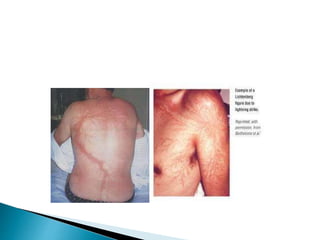
 Charred body and skin Burns
 Arborescent marking due to passage of
current through blood vessels.
(Branches of tree)
 Megnitisation of metallic articles e.g rings,
spectacle frames, keys, watches etc. due to
tremendous heat.
 Cardiac failure.
 Rupture of tympanic membrane is common.
 Bone fractures.
 Torn clothes
EXTERNAL INTERNAL
• Body signs.
• Rigor mortis appear
soon and pass off
quickly.
• Pulmonary hemorrhages
• Pulmonary edema.
• Parenchymal necrosis
• Fracture of bones.

Thermal injury

  • 1.
    THERMAL INJURIES Definition: • Itis defined as tissue injury due to application of heat in any form to the external or internal body surfaces.
  • 2.
     General Classification ◦Dry Heat - flame ◦ Moist Heat - scalds ◦ Cold injuries ◦ Chemicals - corrosives ◦ Electric Contact ◦ Radiation Burns - x-rays, ultraviolet rays.
  • 3.
    •Heat injuries –general ( hyperpyrexia) and local injuries ( burn ) •Cold injuries – general and local injuries.
  • 4.
     Dry lesion Does not bleed  Hard to touch  Very painful  Erythema  Coagulated and roasted patches area  Singing of hair  Burnt cloths  Carbon material in air passages  Vesicles not appear / small  Dry cooked appearance of muscles  Dry and coagulated blood and pink tissues
  • 5.
     Liquids /pressure steam at high temp.  Erythema  Extensive vesication of large sizes  No singing / burning of hair / clothes  Clothes wet  No deposit of carbonaceous material  Limited to skin / mouth or throat  Skin and mucosa blister
  • 6.
     Strong acids/ alkalis  Destroying texture of tissue  Vitriolage
  • 7.
     Depending onthe depth of burn: ◦ Epidermal (first degree) ◦ Dermo – Epidermal (second degree) ◦ Deep (third degree)
  • 8.
     Rule ofNine: To see the extent or percentage of Body surface bearing Burns. - In adults - 9% for head - 9% + 9% for arms - 9 + 9% for front of trunk 9 + 9% for back of trunk - 9% + 9% for front and back of right leg 9% + 9% for front and back of left leg - 1% for perineum. Roughly - One palm of individual is equal to 1% burn area. If burn area > 15% in an adults and > 10% in a child then the loss of blood must be replaced.
  • 9.
    - Scarring lessin scalds than in dry burns - Curling’s ulcer occasionally seen in gastric and duodenal mucosa. ◦ Superficial circular Less than 1mm Diameter.
  • 10.
     Classified accordingto severity of condition and effects on body  HEAT STROKE  HEAT CRAMPS  HEAT EXHAUSATION
  • 11.
     Immediately redness 2 to 3 hours, vesication  36 to 72 hours, purulent inflammation  1to 2 week, sloughing  After 2 weeks, granulation tissue formation  End result,Scar formulation
  • 12.
    External appearances:  Skinblackening  Shortening of muscles  Pugilistic attitude  Skin splits
  • 13.
     Presence ofburnt material  Distribution of burns on Clothes  Presence of Smell  Burnt areas (Blister)
  • 14.
     Marked Pallorof LIVER and KIDNEY  dry and cooked muscles  dry and coagulated blood  soot particles in air passages  Curling Ulcers  Heat fractures, heat hematoma
  • 15.
     Surface areainvolved is more than one third of total body surface GENERAL EFFECT  PRIMARY SHOCK due to fear or pain  SECONDARY SHOCK due to hypovolemia.  TOXEMIA  SEPTICEMIA  Asphyxia: due to inhalation of smoke, CO and CO2.  Cyanide Intoxication  Fat Embolism
  • 16.
     ACCIDENTAL Mostly SUICIDAL Occasionally  HOMICIDAL  CONCEALMENT OF CRIME Antimortem BURN  Vital Reaction  Soot Particles
  • 17.
     There iscomplete absence of sweating and Body Temp raised to 1060F and may go upto1110F.  Results from a combination of high temp and Humidity.  High air temp increasing Body temp by CONDUCTION  Humidity impairing cooling mech. by arresting the process of EVAPORATION of SWEAT.  High Mortality  DEATH occurs with in one to two days
  • 18.
    SYMPTOMS:  Dryness ofSkin and Mouth  Extensive Thirst  Nausea ,Vomiting  Myalgia  Mental Confusion, Headache  Attacks of Faintness  Rapid Pulse, hypotension,  Delayed Death 3-4 Days extends upto 7 days
  • 19.
     Shift toCooler and well ventilated Place  Cold Water Sponging  I/V fluids and electrolyte therapy.  Antibiotics  Steroids
  • 20.
     Also calledMiner`s cramps, Stoker`s cramps.  The painful spasm of voluntary muscles during physical activity in a hot environment.  Depletion of salt is main cause.  Flushing of face and dilatation of pupils occurs.  Treatment: salt intake in food  I/v physiological saline.
  • 21.
     Caused byGradual loss of Water and Salts from body  Due to Prolonged exposure to Dry, High Environmental Temp  PULSE weak, Rapid  RESP - Shallow  B.P Low  Temp. - May or may not rise.  Oliguria  Death results from heart failure.
  • 22.
     Rehydration  SaltSupplements  Shifting to Cooler Environment
  • 23.
     Non Specific All Organs Show EDEMA,CONGESTION and PET. HAEMORRHAGES  Brain congested CEREBRUM Shows Flattening of Gyri  LUNG carries FROTHY Heamorrhagic FLUID in air passages  HEART manifests EPI/ENDOCARDIAL Hemorrhages
  • 24.
     Produced byProlonged Exposure to Cold.  Cooling of the body < 95F (35C)  Causes Failure of Temp Regulation Mechanism.
  • 25.
     Depending uponthe Recorded Temp of the Body and the severity of Symptoms  DEGREE 1  9O-950F  Shivering  Increased Voluntary Activity  Cutaneous Vasoconstriction
  • 26.
     DEGREE II 75-890F  Cessation of shivering  Fall in Basal Metabolic Rate  Fall in B.P  Deterioration of Consciousness
  • 27.
     DEGREE III 750F or Below  Complete Failure of Temp Regulating Mechanism  Complete Loss of Consciousness  Irreversible Fall in Body Temp
  • 28.
     Body coldto touch, stiffing of neck muscles,  Shallow and irregular resp. movements  Semiconscious and responding only to painful stimuli.  hypotension,  Skin- pallor , red patches over the skin.  Hemorrhagic tendency- blood stained vomiting and diarrhea  Chest infection
  • 29.
     Frost bite:Exposure to dry cold.  the exposed parts such as ears, nose, fingers and toes may show localized effects.  Lesions (blisters) may superficial involving skin and subcutaneous tissue.  Necrosis of tissues.  Temp. usually below 0C.
  • 30.
     Immersion foot/ trench foot: prolonged exposure of extremities to cold sea water or cold trenches for many hours produces immersion foot.  Temp. usually above 0 C.
  • 32.
     Hospitalization  O2inhalation  Gradual re-warming  Antibiotics  Steroids
  • 33.
    EXTERNAL INTERNAL  Pinkskin  Cutaneous erythematous patches on face  Gangrene of fingers and toes  Edematous face, arms and legs  Congestion of internal organs  Focal hemorrhages of pancreas  Cardiac dilatation  Hemorrhagic erosion of G.I. Mucosa  Droplets of fats in liver/ spleen / kidney
  • 34.
     Electric currentmay be direct or Alternating.  Alternating current is more dangerous than direct current.  Current 220 – 240 volts is domestic supply , usually causes death.  Less then 50 volts death is uncommon.
  • 35.
     CONTACT BURN Due to close contact  POINT OF ENTRY Raised Blister containing GAS or FLUID  POINT OF EXIT Punctured or lacerated Wound  SPARK BURN  Due to poor or intermittent contact  Dry Pitted Lesion Surround by Yellow Parchment Scab  FLASH BURN  Due to without actual contact with very high voltage, more then 1000 volts.
  • 36.
     Local whitening Zone of hyperemia  Chain of blisters  Dried and wrinkled skin  Scorched and blackened skin.  Explosively splitting of clothes.
  • 37.
     Charring oftissues with carbonisation is common.  Brownish discoloration of skin.  Arborescent pattern due to passage of current through blood vessels. (Branches of tree)  Crocodile skin – multiple spark burns over large areas of skin.
  • 38.
     Low voltagecurrent injuries:  Voltage is less then 1000.  Causes generalized muscular spasm which cause grasp the conductor firmly.  Sudden death may occur if the current passes through the heart and respiratory centers.  The burn area is dry, charred and insensitive.  Signs of inflammation are devoid and line of demarcation is seen.  Skin ridges are flattened.  Metallization may present.
  • 39.
     High voltageinjuries.  The voltage is more then 1000.  Injuries are resembling to bullet, stab or cut wounds.  Small balls of molten metals may carried deep into tissues, called current pearls.  Conduction of current through blood stream causes coagulation of blood and blockage of vessels leading to gangrene.
  • 40.
     A naturalelectric discharge in the atmosphere is called lightning or lightning flash.  It is electric discharge from cloud to earth.  Lightning has 100-1000 million volts.
  • 41.
     Charred bodyand skin Burns  Arborescent marking due to passage of current through blood vessels. (Branches of tree)  Megnitisation of metallic articles e.g rings, spectacle frames, keys, watches etc. due to tremendous heat.  Cardiac failure.  Rupture of tympanic membrane is common.  Bone fractures.  Torn clothes
  • 43.
    EXTERNAL INTERNAL • Bodysigns. • Rigor mortis appear soon and pass off quickly. • Pulmonary hemorrhages • Pulmonary edema. • Parenchymal necrosis • Fracture of bones.