Identification
from skeletal
remains
 Age
 Sex
 Race
 Stature
Race
 Race can be determine from the
examination of :
1. Skull
2. Mandible
3. Teeth
4. Limb bones.
Skull
Certain differences exist between
 Negroid (Black )
 Caucasoid ( Europeans ).
 Mongoloid ( Native Americans,
Koreans, Japanese, Chinese, South
east Asians )
Race can be determine by:
1. Cephalic index.
( breadth index ).
2. Height index.
3. Nasal index.
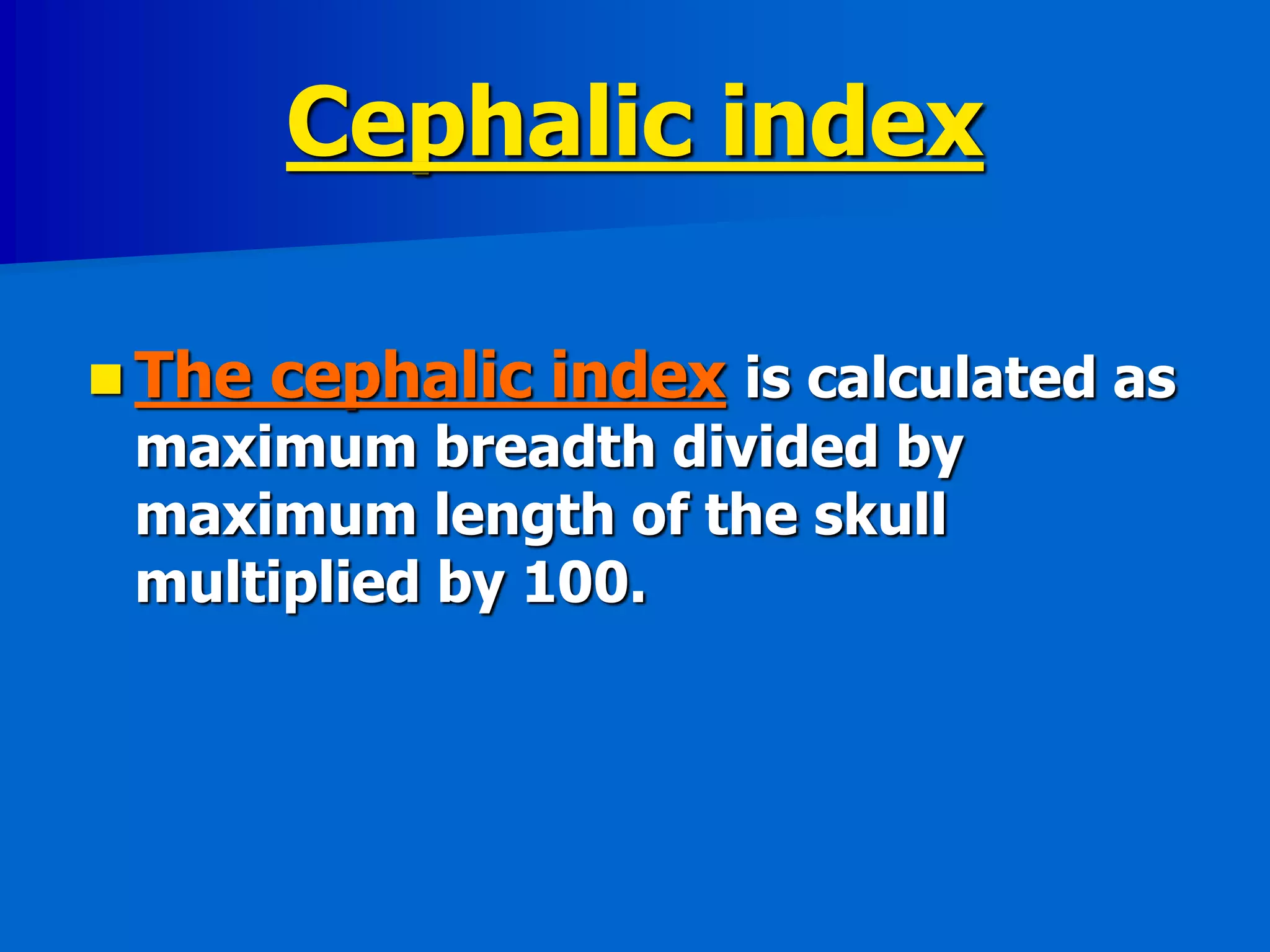
Cephalic index
 The cephalic index is calculated as
maximum breadth divided by
maximum length of the skull
multiplied by 100.
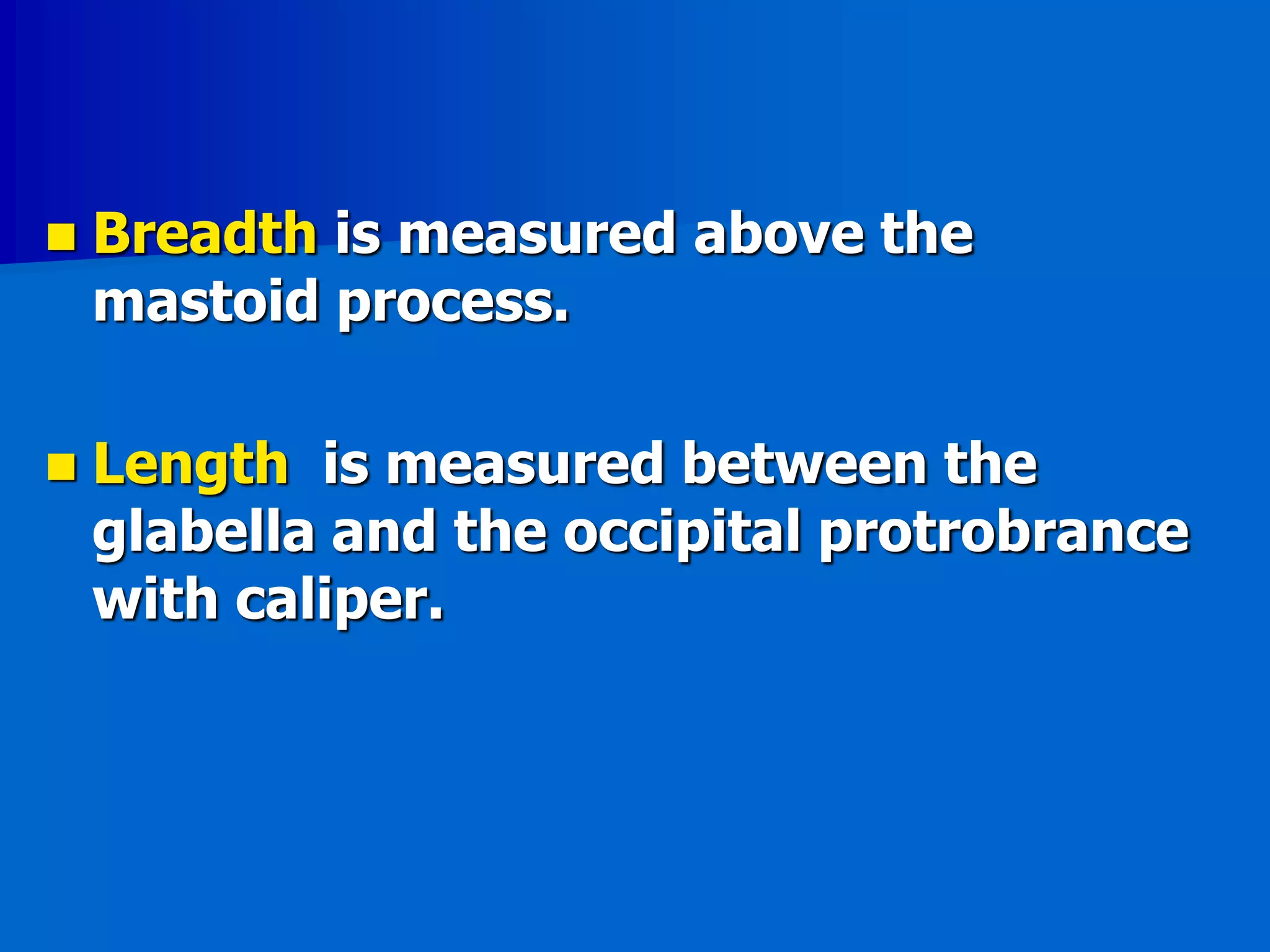
 Breadth is measured above the
mastoid process.
 Length is measured between the
glabella and the occipital protrobrance
with caliper.
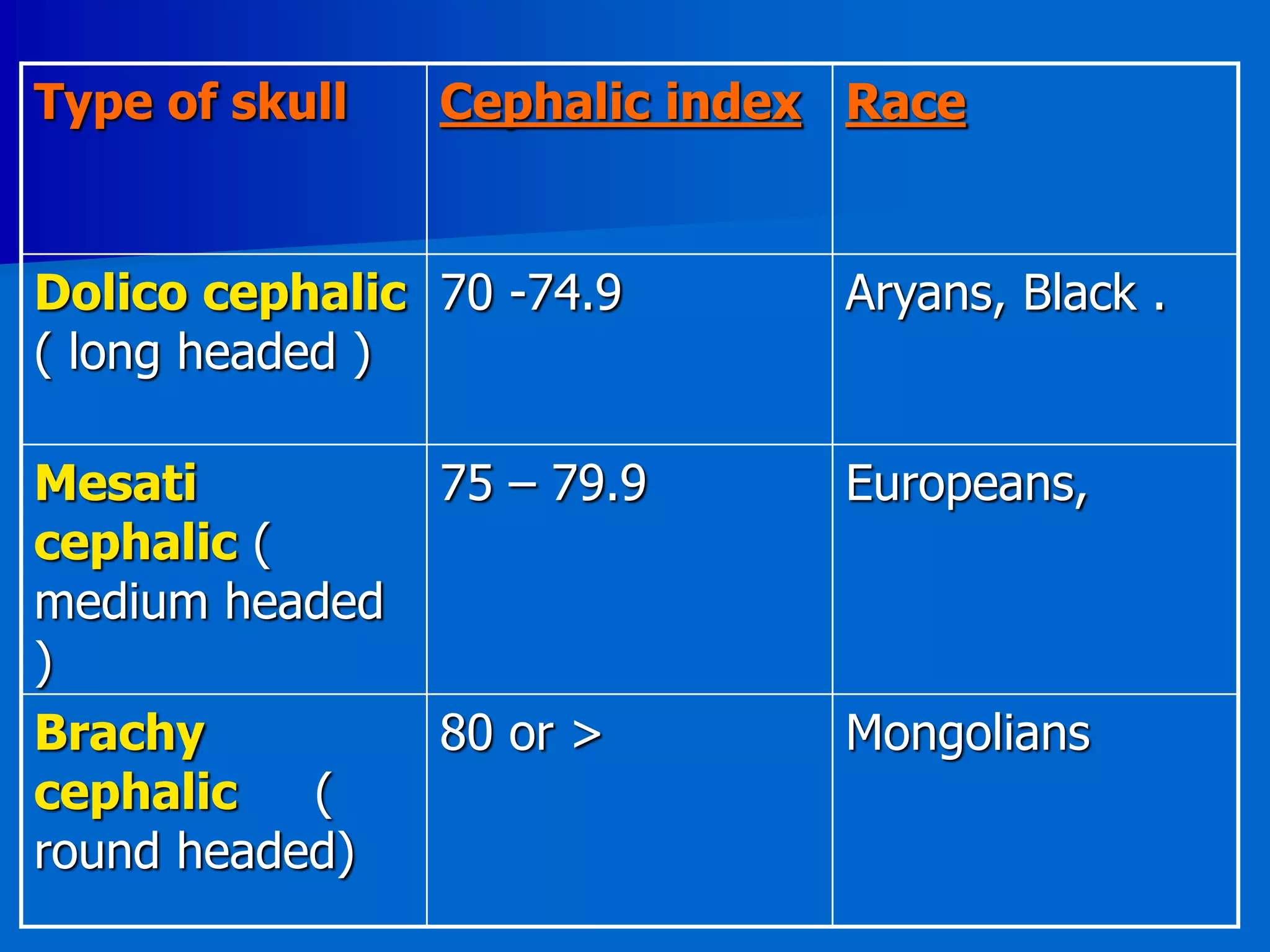
Type of skull Cephalic index Race
Dolico cephalic
( long headed )
70 -74.9 Aryans, Black .
Mesati
cephalic (
medium headed
)
75 – 79.9 Europeans,
Brachy
cephalic (
round headed)
80 or > Mongolians
Height index
 The height index is calculated as
height of the skull divided by length
of the skull, multiplied by 100.
Nasal index
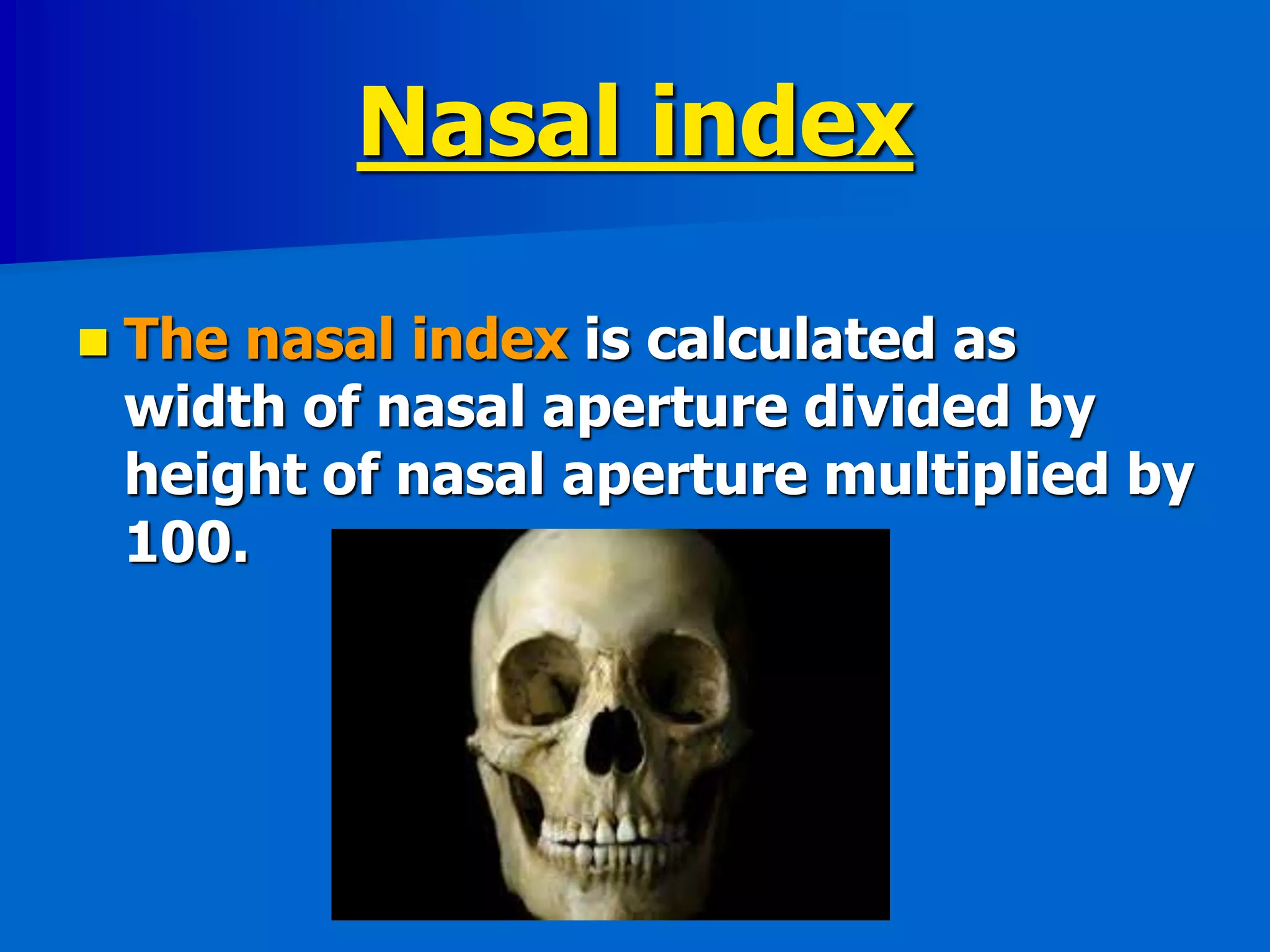
 The nasal index is calculated as
width of nasal aperture divided by
height of nasal aperture multiplied by
100.
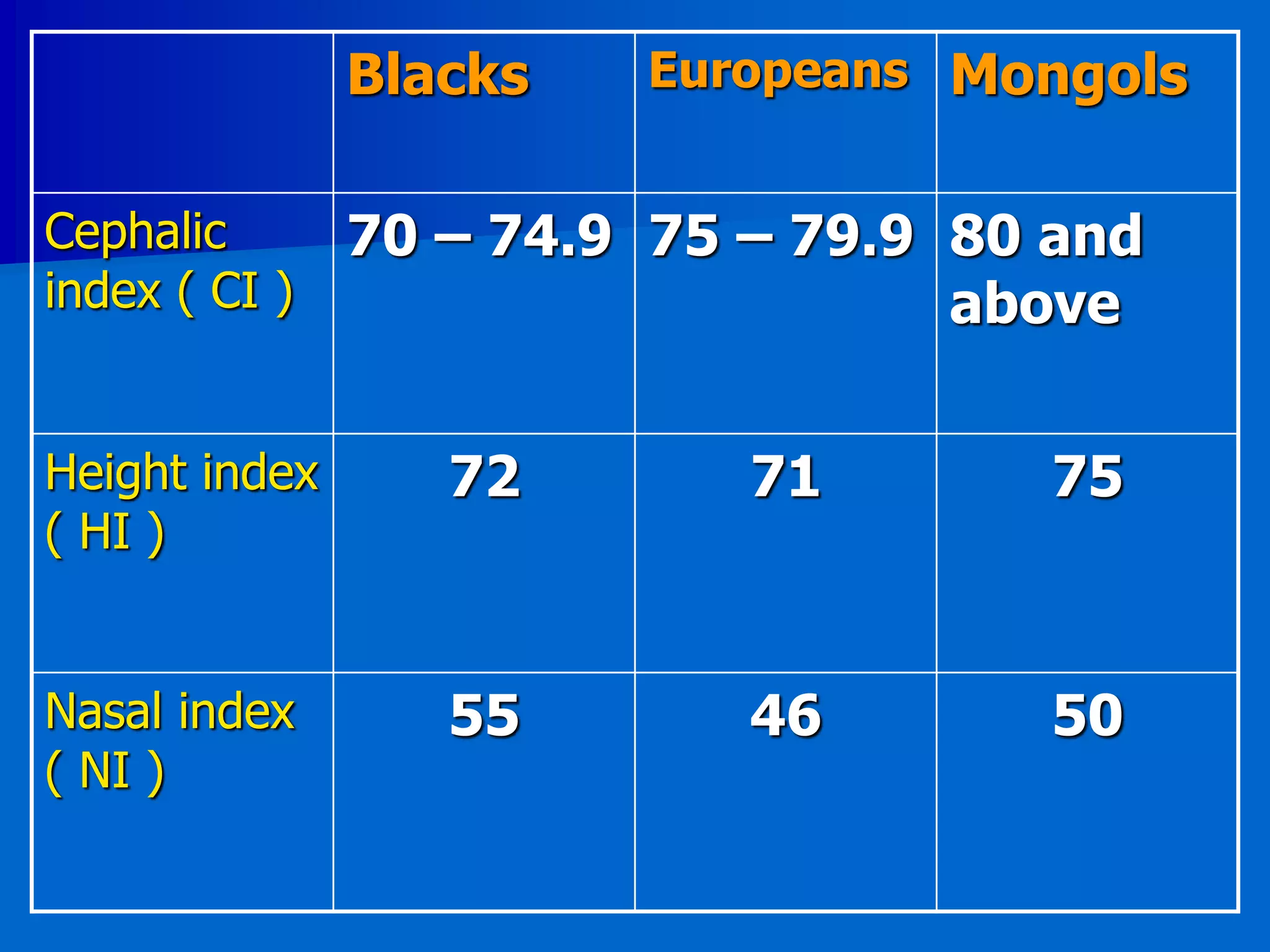
Blacks Europeans Mongols
Cephalic
index ( CI )
70 – 74.9 75 – 79.9 80 and
above
Height index
( HI )
72 71 75
Nasal index
( NI )
55 46 50
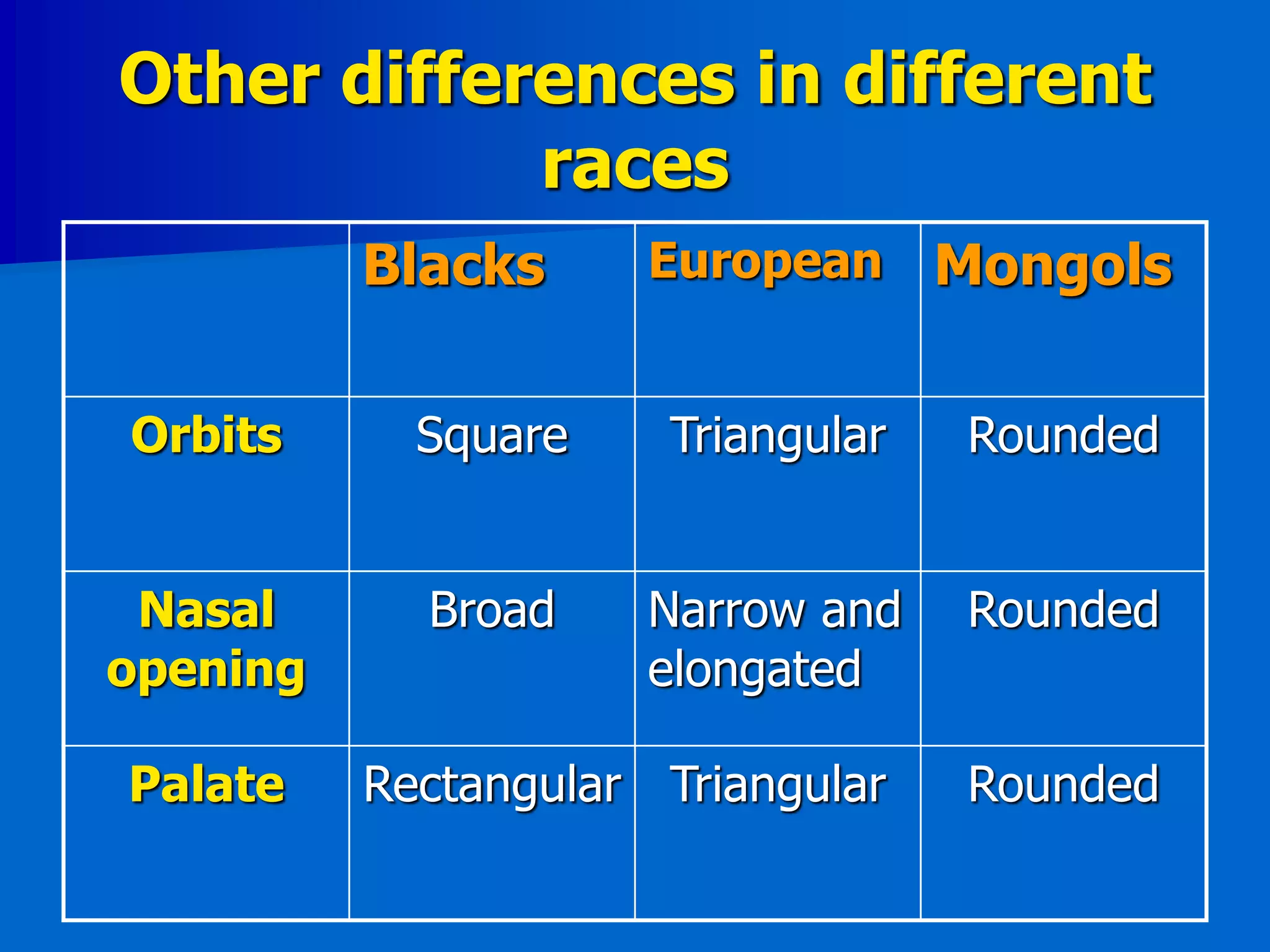
Other differences in different
races
Blacks European Mongols
Orbits Square Triangular Rounded
Nasal
opening
Broad Narrow and
elongated
Rounded
Palate Rectangular Triangular Rounded
 The cheek bones or zygomatic arches
are prominent in mongols.
 in mongols, unlike other groups, the
face width generally exceeds the
head width.
Mandible and teeth
In Blacks
 lower jaw is strongly prognathic .
 Third molar is bigger than the first two
molars.
In Mongols:
 Shovel shaped of upper central incisors.
 Enamel pearls: are small nodules of
enamel on the tooth surface.
 Taurodontism ( bull tooth ): these are
common in Mongols. The pulp cavity is
wide and deep and roots are fused.
 Congenital lack of third upper molar is
common.
In white Races
 Carbelli`s cusp: Small nodules on lingual
surface of maxillary molar is common.
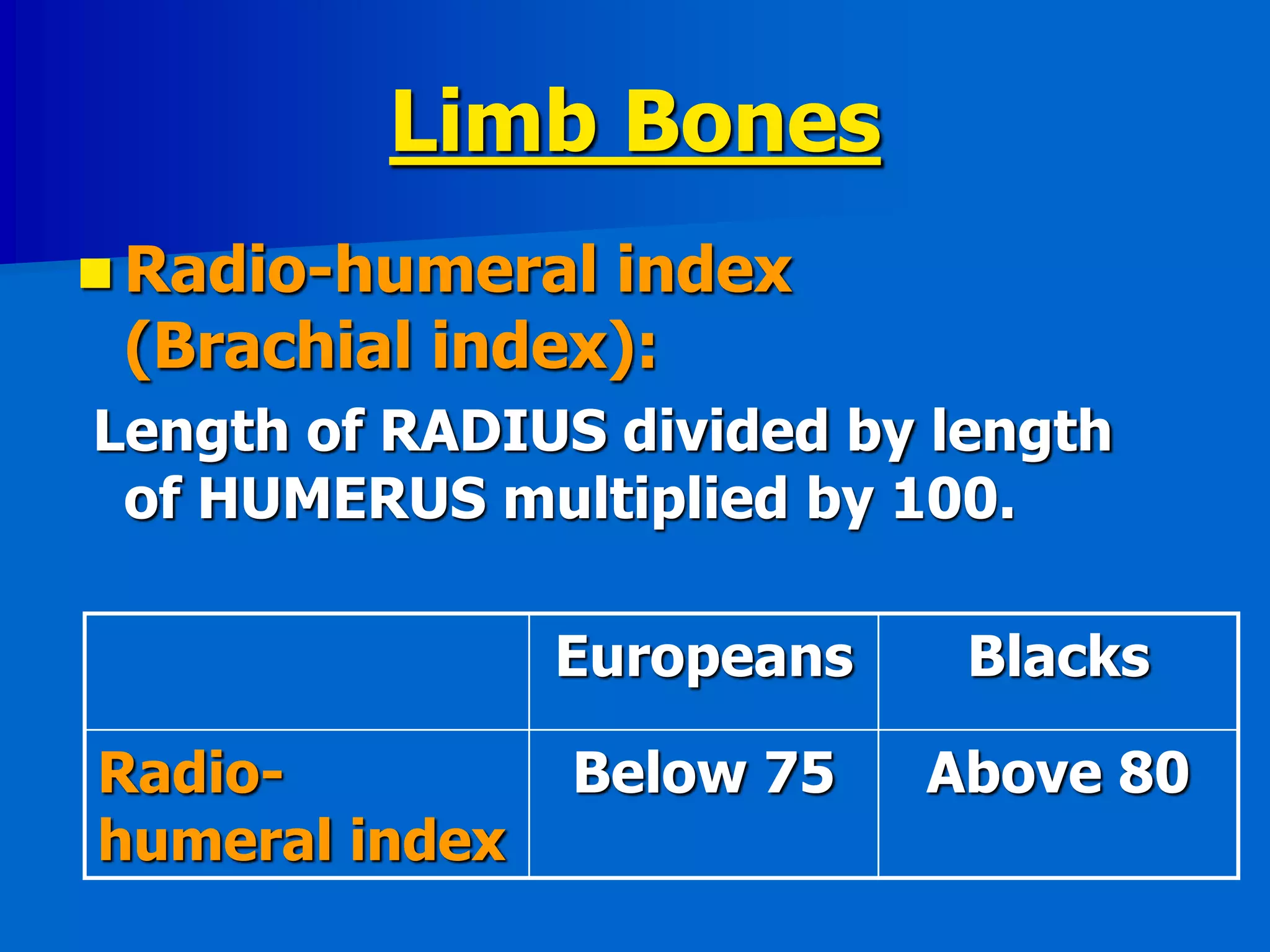
Limb Bones
 Radio-humeral index
(Brachial index):
Length of RADIUS divided by length
of HUMERUS multiplied by 100.
Europeans Blacks
Radio-
humeral index
Below 75 Above 80
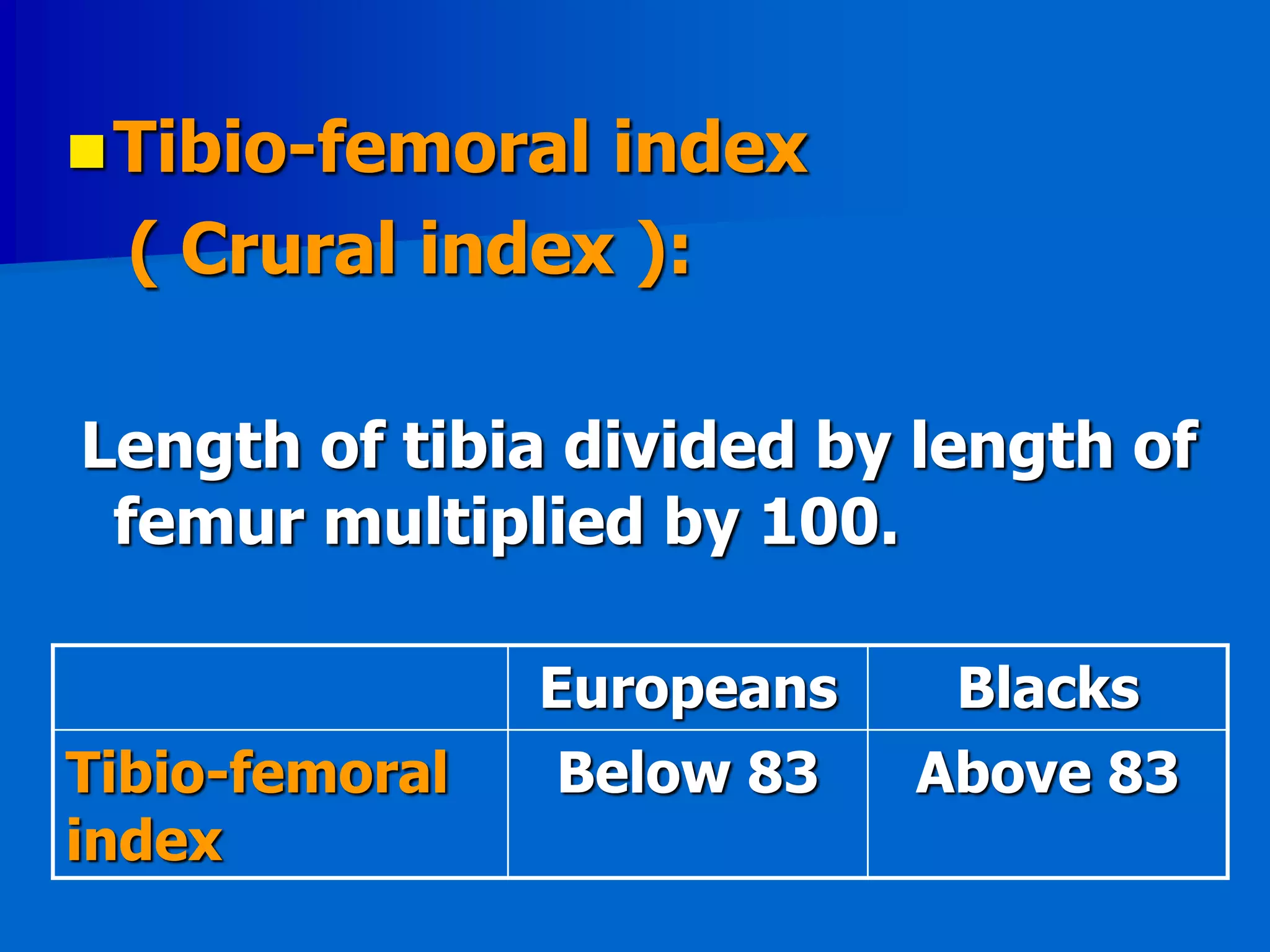
Tibio-femoral index
( Crural index ):
Length of tibia divided by length of
femur multiplied by 100.
Europeans Blacks
Tibio-femoral
index
Below 83 Above 83
Sex determination
from skeleton
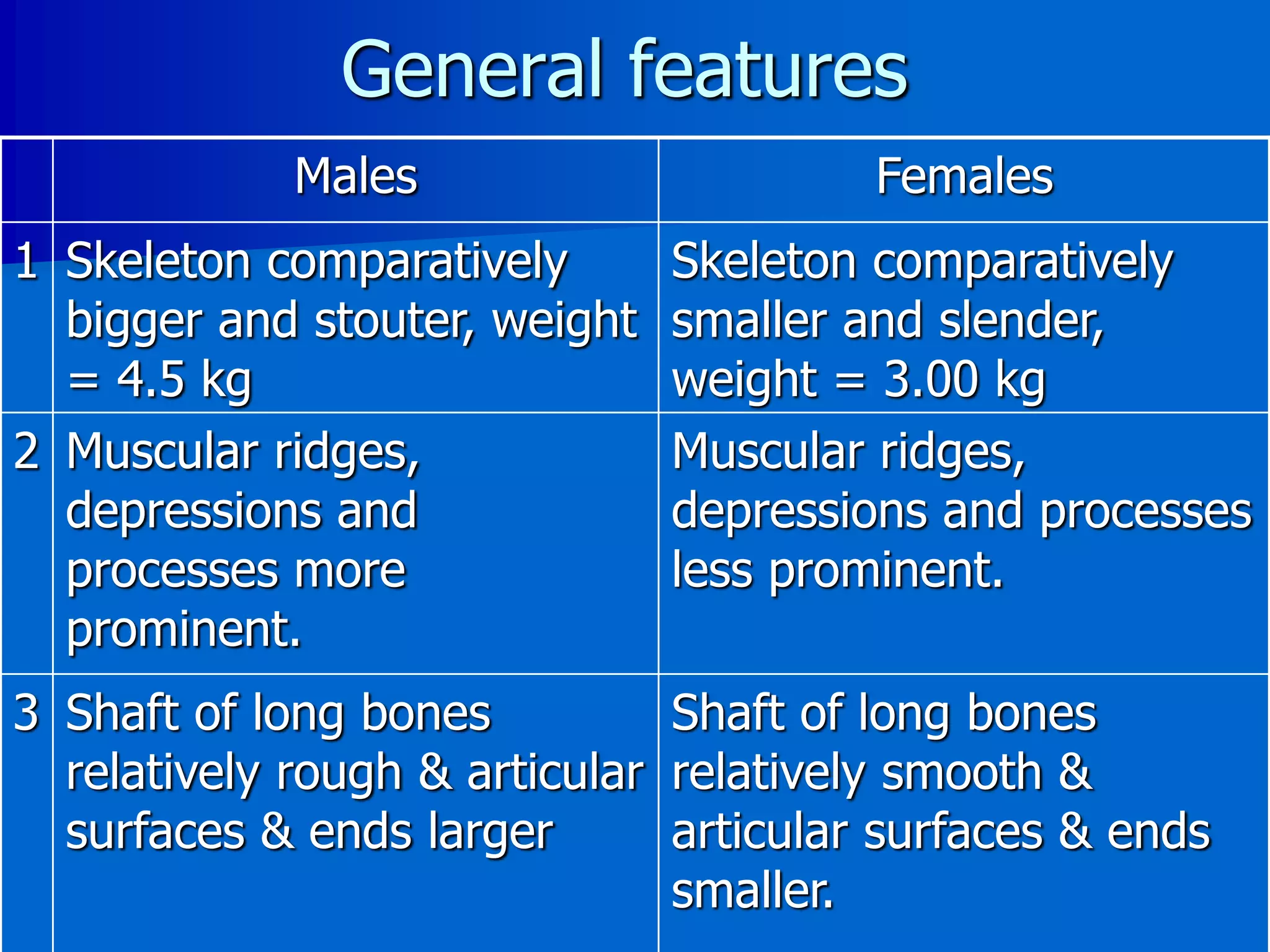
General features
Males Females
1 Skeleton comparatively
bigger and stouter, weight
= 4.5 kg
Skeleton comparatively
smaller and slender,
weight = 3.00 kg
2 Muscular ridges,
depressions and
processes more
prominent.
Muscular ridges,
depressions and processes
less prominent.
3 Shaft of long bones
relatively rough & articular
surfaces & ends larger
Shaft of long bones
relatively smooth &
articular surfaces & ends
smaller.
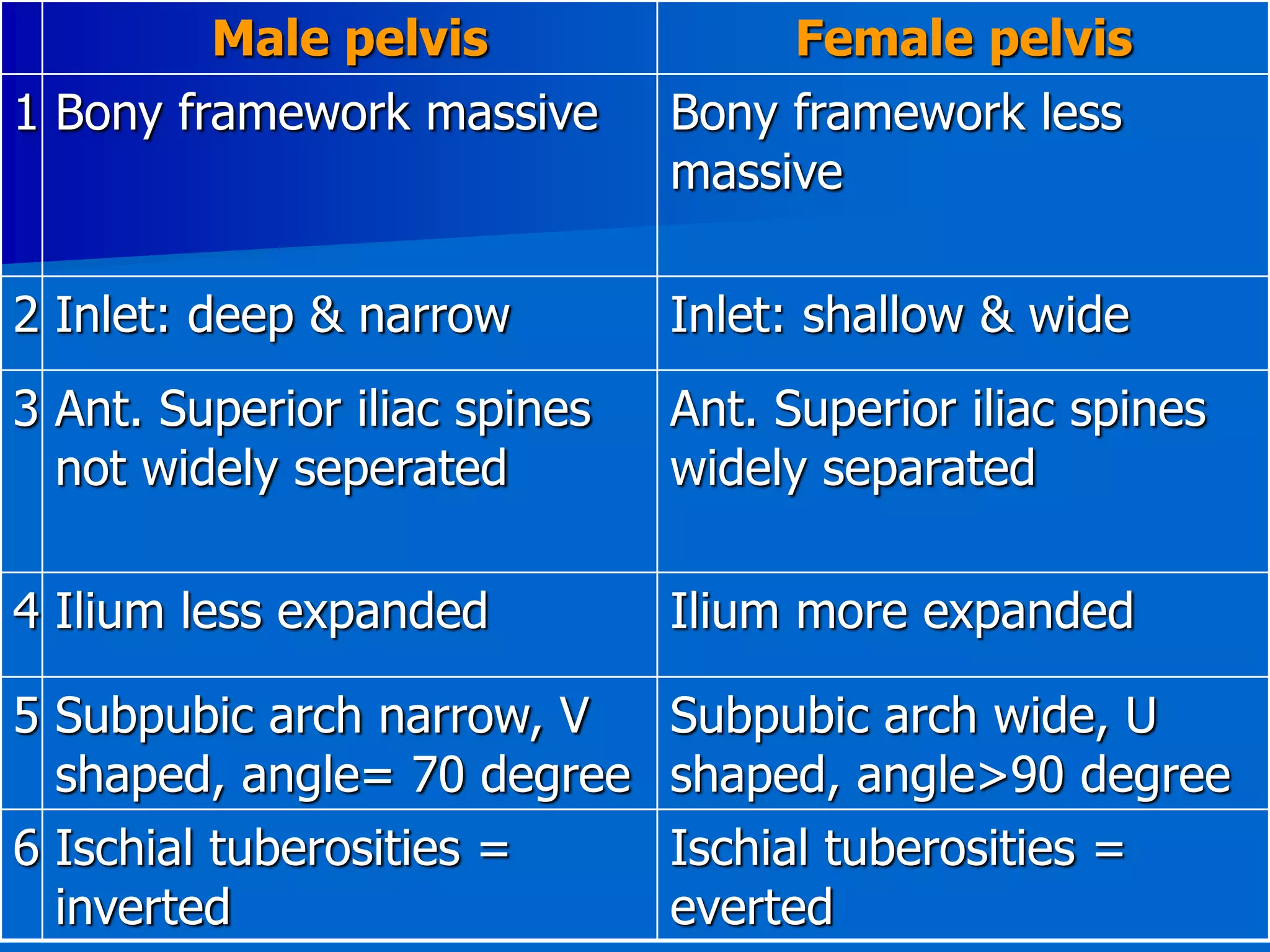
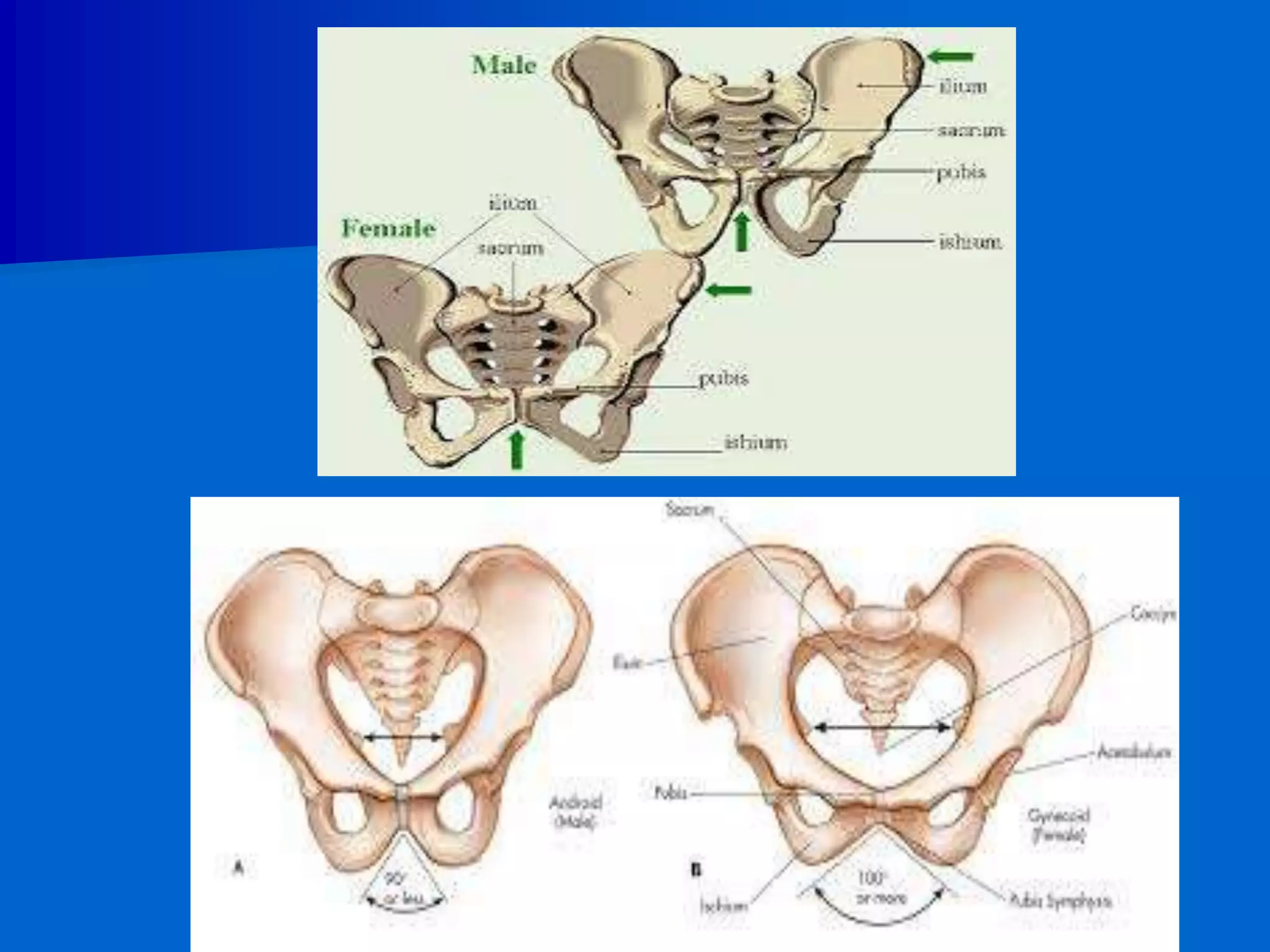
Male pelvis Female pelvis
1 Bony framework massive Bony framework less
massive
2 Inlet: deep & narrow Inlet: shallow & wide
3 Ant. Superior iliac spines
not widely seperated
Ant. Superior iliac spines
widely separated
4 Ilium less expanded Ilium more expanded
5 Subpubic arch narrow, V
shaped, angle= 70 degree
Subpubic arch wide, U
shaped, angle>90 degree
6 Ischial tuberosities =
inverted
Ischial tuberosities =
everted
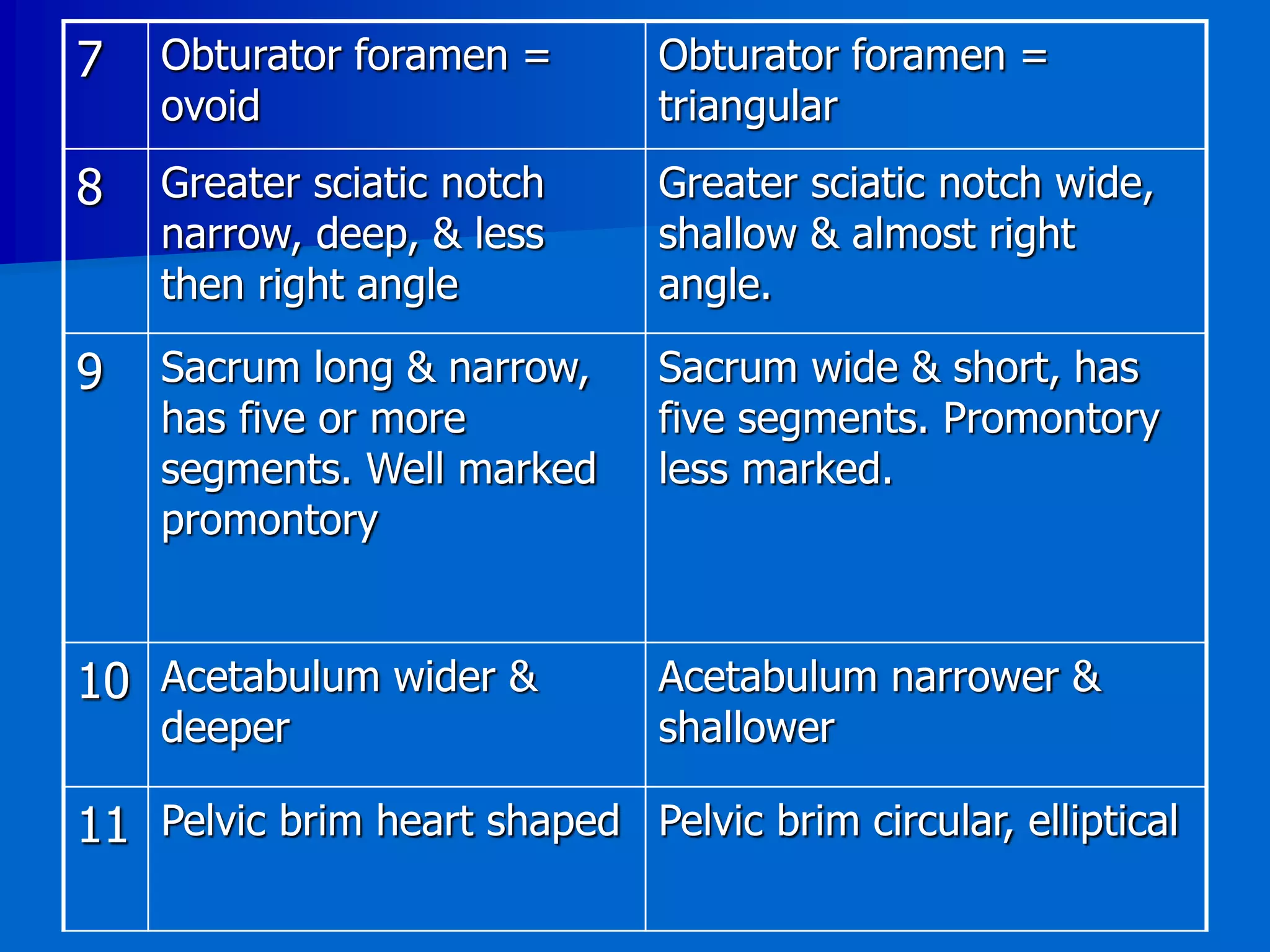
7 Obturator foramen =
ovoid
Obturator foramen =
triangular
8 Greater sciatic notch
narrow, deep, & less
then right angle
Greater sciatic notch wide,
shallow & almost right
angle.
9 Sacrum long & narrow,
has five or more
segments. Well marked
promontory
Sacrum wide & short, has
five segments. Promontory
less marked.
10 Acetabulum wider &
deeper
Acetabulum narrower &
shallower
11 Pelvic brim heart shaped Pelvic brim circular, elliptical
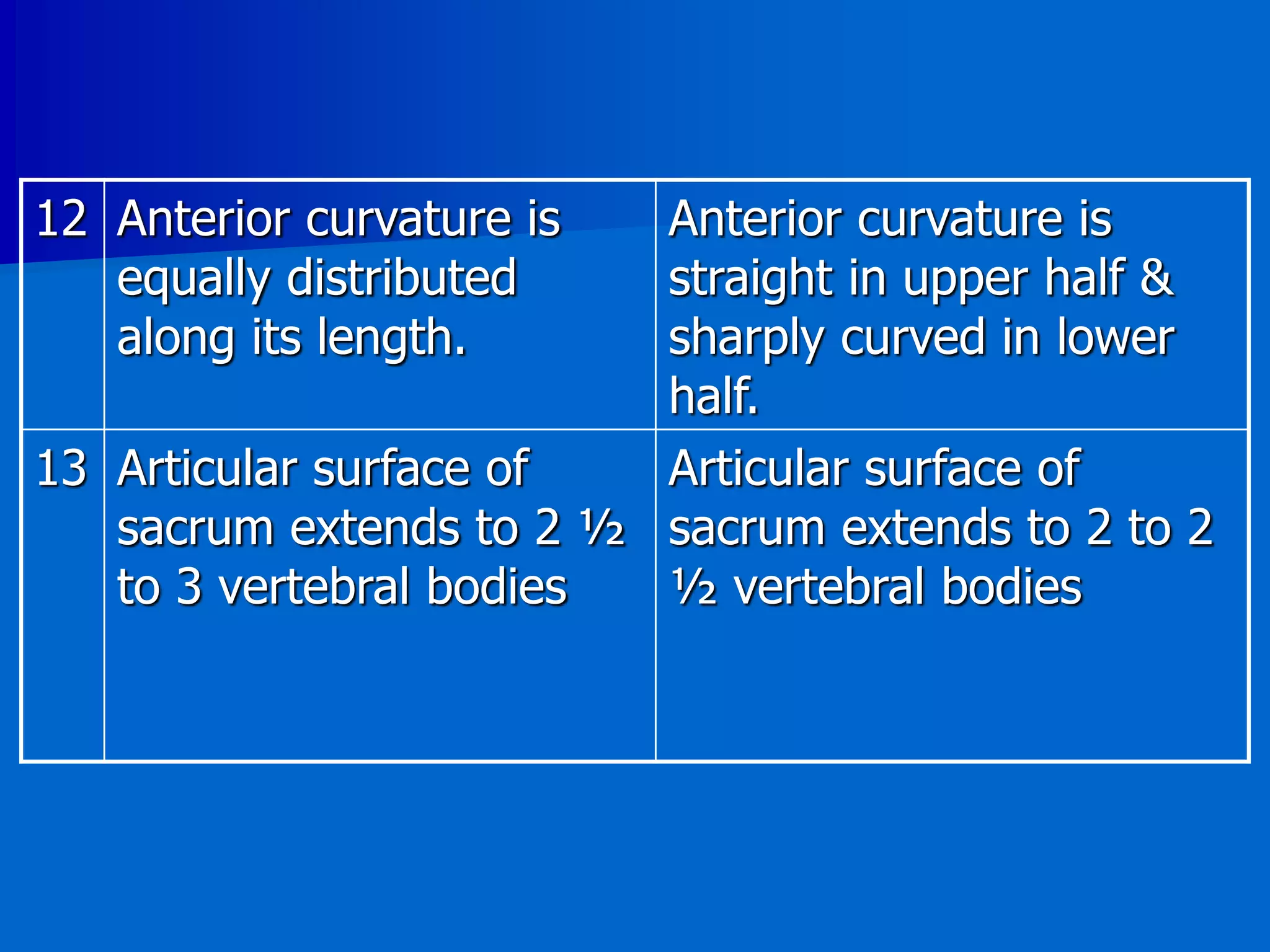
12 Anterior curvature is
equally distributed
along its length.
Anterior curvature is
straight in upper half &
sharply curved in lower
half.
13 Articular surface of
sacrum extends to 2 ½
to 3 vertebral bodies
Articular surface of
sacrum extends to 2 to 2
½ vertebral bodies
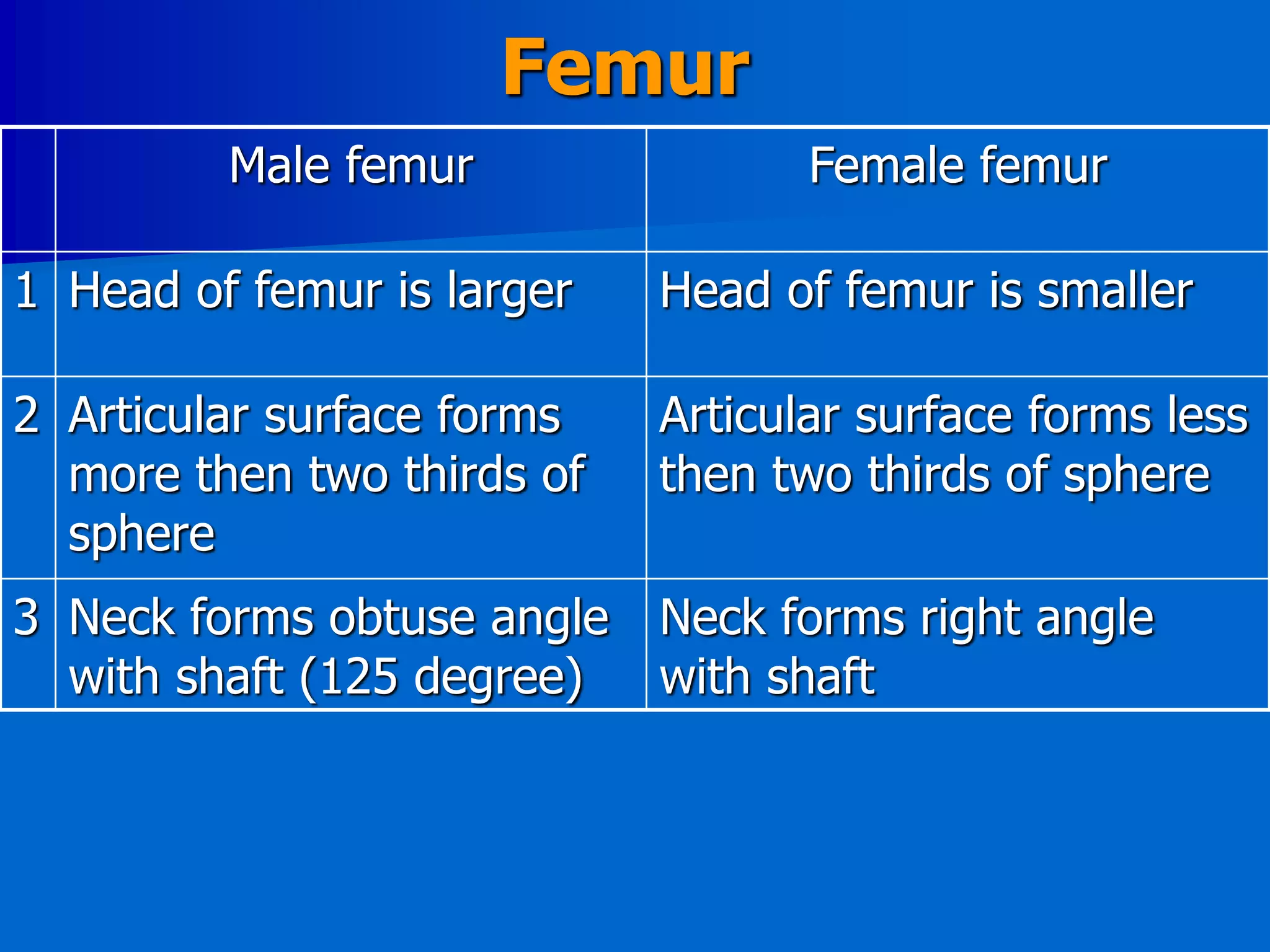
Femur
Male femur Female femur
1 Head of femur is larger Head of femur is smaller
2 Articular surface forms
more then two thirds of
sphere
Articular surface forms less
then two thirds of sphere
3 Neck forms obtuse angle
with shaft (125 degree)
Neck forms right angle
with shaft
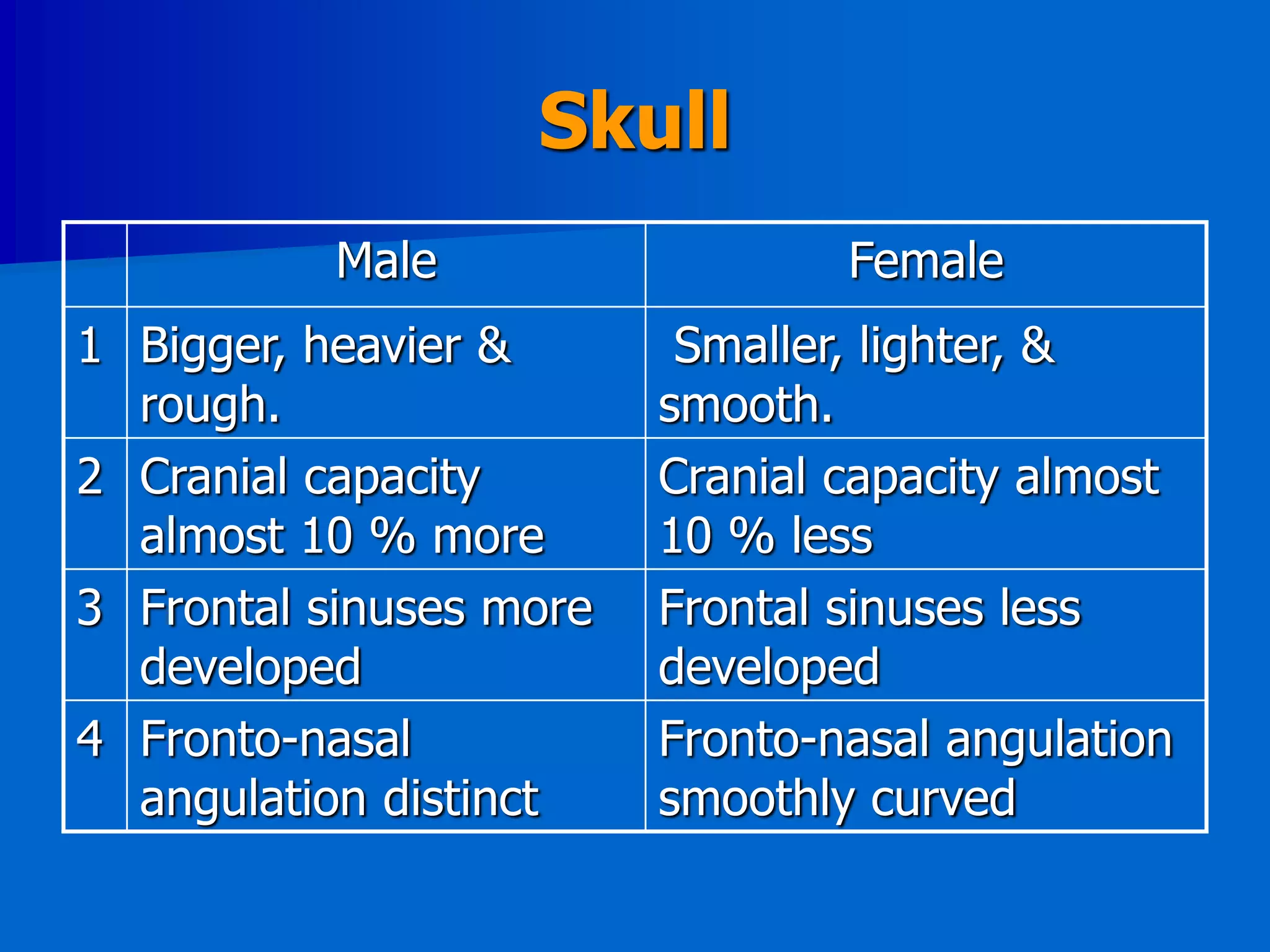
Skull
Male Female
1 Bigger, heavier &
rough.
Smaller, lighter, &
smooth.
2 Cranial capacity
almost 10 % more
Cranial capacity almost
10 % less
3 Frontal sinuses more
developed
Frontal sinuses less
developed
4 Fronto-nasal
angulation distinct
Fronto-nasal angulation
smoothly curved
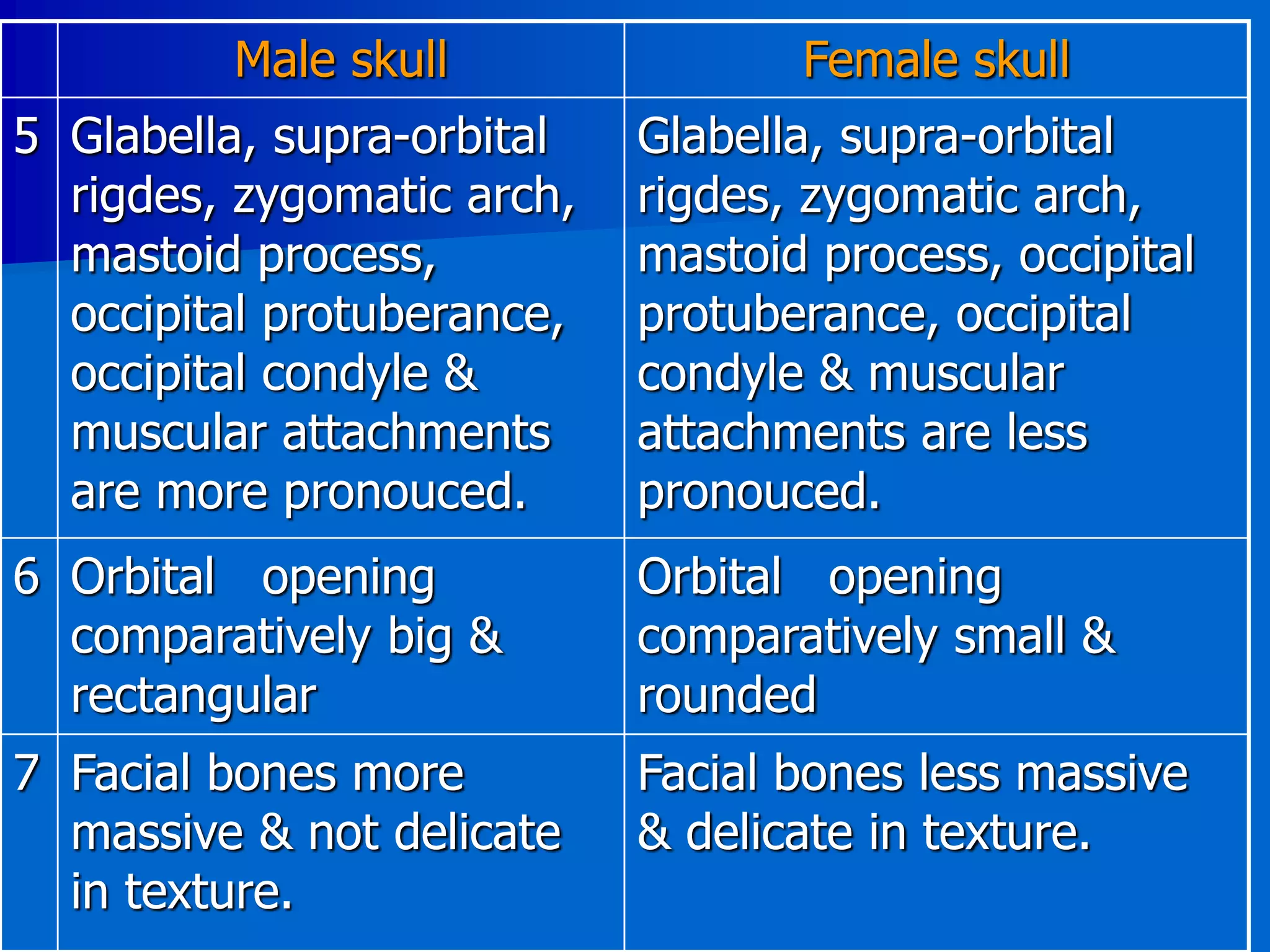
Male skull Female skull
5 Glabella, supra-orbital
rigdes, zygomatic arch,
mastoid process,
occipital protuberance,
occipital condyle &
muscular attachments
are more pronouced.
Glabella, supra-orbital
rigdes, zygomatic arch,
mastoid process, occipital
protuberance, occipital
condyle & muscular
attachments are less
pronouced.
6 Orbital opening
comparatively big &
rectangular
Orbital opening
comparatively small &
rounded
7 Facial bones more
massive & not delicate
in texture.
Facial bones less massive
& delicate in texture.
Spinal column
Male Female
1 Mean breadth of first
cervical vertebra
83 mm
Mean breadth of first
cervical vertebra
72mm
2 Lumbar lordosis less
marked
Lumbar lordosis more
marked
Mandible
Male Female
1 Lower jaw more
massive
Lower jaw less massive
2 Chin - square Chin – pointed or
rounded
3 Symphyseal height
more
Symphyseal height less
4 Ramus – more broad Ramus – less broad
5 Angle region - everted Angle region – not
everted
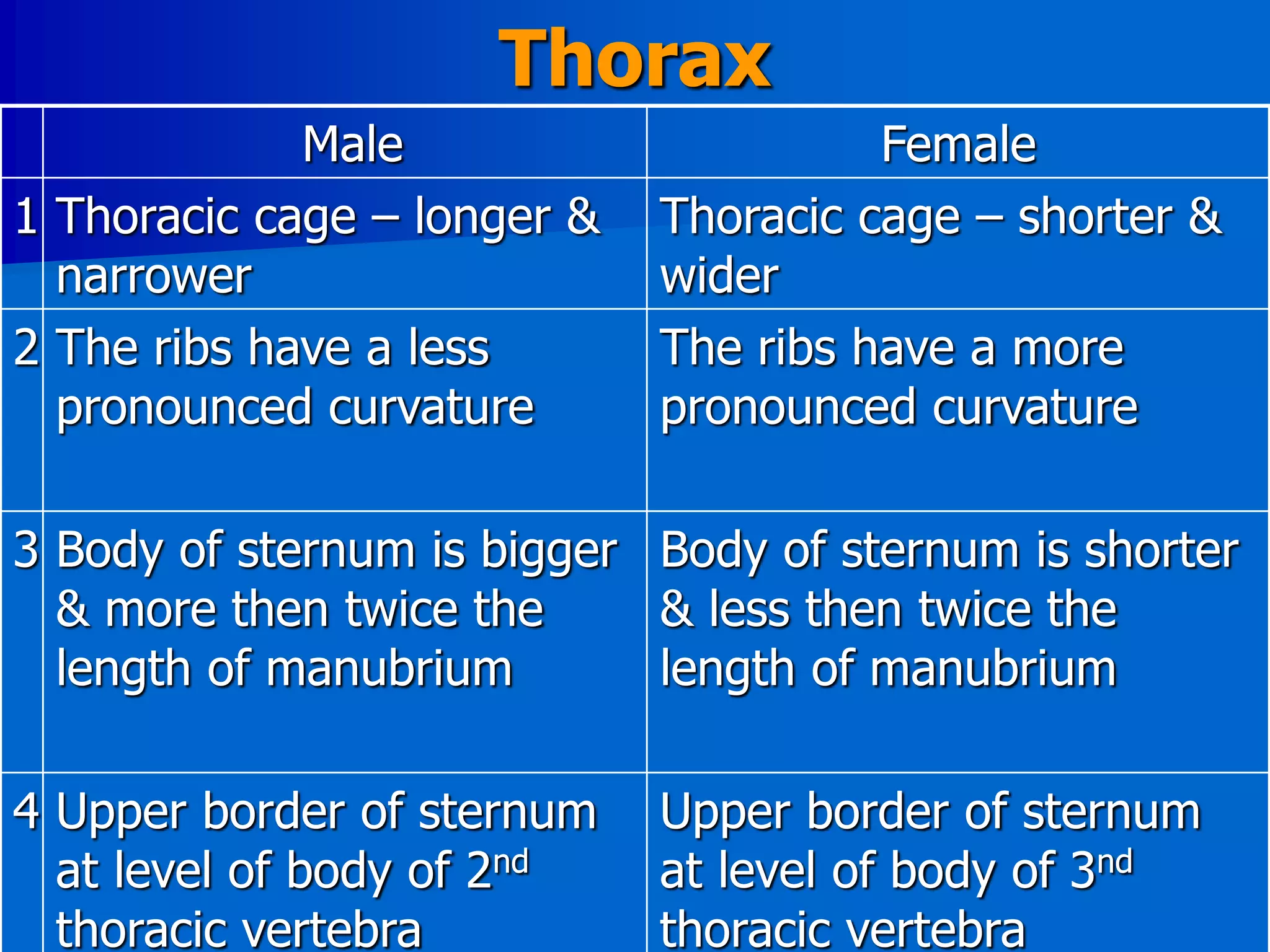
Thorax
Male Female
1 Thoracic cage – longer &
narrower
Thoracic cage – shorter &
wider
2 The ribs have a less
pronounced curvature
The ribs have a more
pronounced curvature
3 Body of sternum is bigger
& more then twice the
length of manubrium
Body of sternum is shorter
& less then twice the
length of manubrium
4 Upper border of sternum
at level of body of 2nd
thoracic vertebra
Upper border of sternum
at level of body of 3nd
thoracic vertebra
Sacral index
 Sacral index ( SI ): calculated as breadth of base
divided by anterior length of sacrum multiplied by 100.
Male Female
Sacral index 112 116
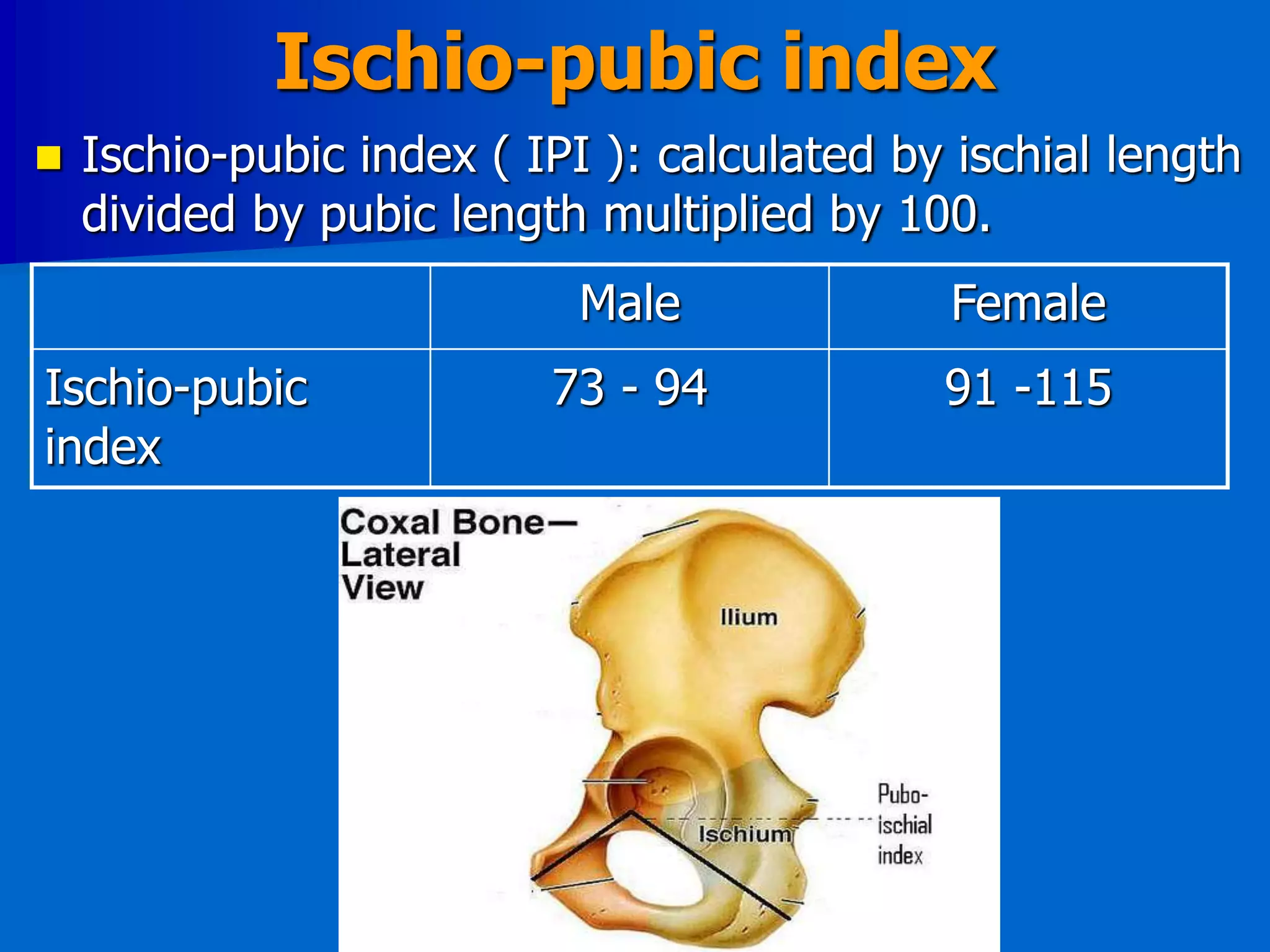
Ischio-pubic index
 Ischio-pubic index ( IPI ): calculated by ischial length
divided by pubic length multiplied by 100.
Male Female
Ischio-pubic
index
73 - 94 91 -115
According to Krogman, degree of
accuracy to determine sex from
bone
Entire skeleton 100 %
Pelvis & skull 98 %
Pelvis alone 95 %
Skull alone 90 %
Long bones alone 80 %
Age
determination
from skeleton
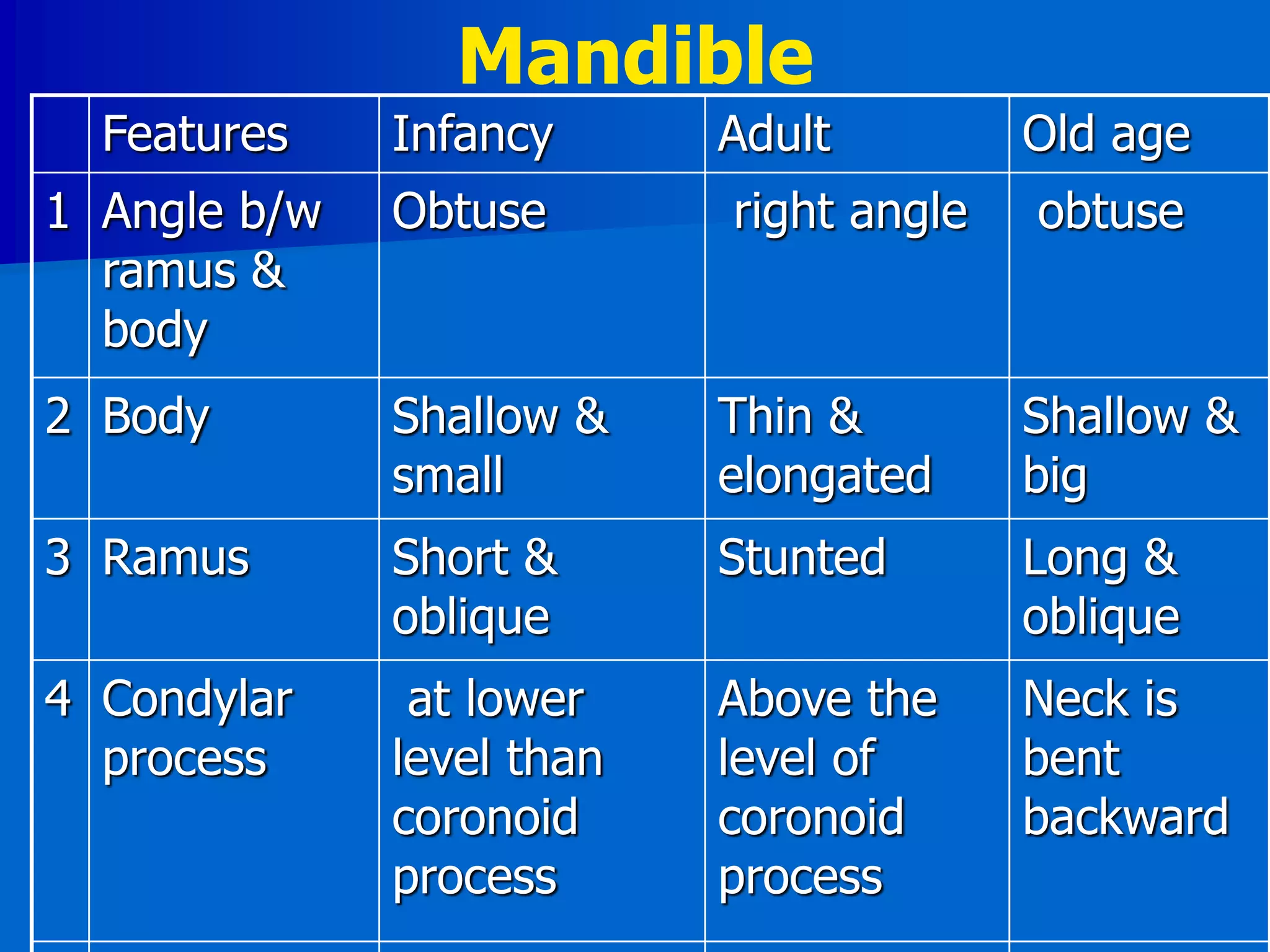
Mandible
Features Infancy Adult Old age
1 Angle b/w
ramus &
body
Obtuse right angle obtuse
2 Body Shallow &
small
Thin &
elongated
Shallow &
big
3 Ramus Short &
oblique
Stunted Long &
oblique
4 Condylar
process
at lower
level than
coronoid
process
Above the
level of
coronoid
process
Neck is
bent
backward
5 Mental
formamen
Placed near
to the lower
border
Midway b/w
upper &
lower border
Near the
alveolar
margin
Spinal column
 In youth : upper and lower surfaces of bodies
of the vertebrae bear radial markings, at age of
10 years.
 By the age of 30 years, they begin to fade and
disappear.
 The osteophytic outgrowths from the anterior
and lateral margins of the intervertebral discs
become visible by 40 years.
 The disc undergoes atrophic changes by
about 40 – 45 years.

Identification from skeletal remains

  • 1.
  • 2.
     Age  Sex Race  Stature
  • 3.
    Race  Race canbe determine from the examination of : 1. Skull 2. Mandible 3. Teeth 4. Limb bones.
  • 4.
    Skull Certain differences existbetween  Negroid (Black )  Caucasoid ( Europeans ).  Mongoloid ( Native Americans, Koreans, Japanese, Chinese, South east Asians )
  • 5.
    Race can bedetermine by: 1. Cephalic index. ( breadth index ). 2. Height index. 3. Nasal index.
  • 6.
    Cephalic index  Thecephalic index is calculated as maximum breadth divided by maximum length of the skull multiplied by 100.
  • 7.
     Breadth ismeasured above the mastoid process.  Length is measured between the glabella and the occipital protrobrance with caliper.
  • 8.
    Type of skullCephalic index Race Dolico cephalic ( long headed ) 70 -74.9 Aryans, Black . Mesati cephalic ( medium headed ) 75 – 79.9 Europeans, Brachy cephalic ( round headed) 80 or > Mongolians
  • 9.
    Height index  Theheight index is calculated as height of the skull divided by length of the skull, multiplied by 100.
  • 10.
    Nasal index  Thenasal index is calculated as width of nasal aperture divided by height of nasal aperture multiplied by 100.
  • 11.
    Blacks Europeans Mongols Cephalic index( CI ) 70 – 74.9 75 – 79.9 80 and above Height index ( HI ) 72 71 75 Nasal index ( NI ) 55 46 50
  • 12.
    Other differences indifferent races Blacks European Mongols Orbits Square Triangular Rounded Nasal opening Broad Narrow and elongated Rounded Palate Rectangular Triangular Rounded
  • 13.
     The cheekbones or zygomatic arches are prominent in mongols.  in mongols, unlike other groups, the face width generally exceeds the head width.
  • 14.
    Mandible and teeth InBlacks  lower jaw is strongly prognathic .  Third molar is bigger than the first two molars.
  • 15.
    In Mongols:  Shovelshaped of upper central incisors.  Enamel pearls: are small nodules of enamel on the tooth surface.  Taurodontism ( bull tooth ): these are common in Mongols. The pulp cavity is wide and deep and roots are fused.  Congenital lack of third upper molar is common.
  • 16.
    In white Races Carbelli`s cusp: Small nodules on lingual surface of maxillary molar is common.
  • 17.
    Limb Bones  Radio-humeralindex (Brachial index): Length of RADIUS divided by length of HUMERUS multiplied by 100. Europeans Blacks Radio- humeral index Below 75 Above 80
  • 18.
    Tibio-femoral index ( Cruralindex ): Length of tibia divided by length of femur multiplied by 100. Europeans Blacks Tibio-femoral index Below 83 Above 83
  • 19.
  • 20.
    General features Males Females 1Skeleton comparatively bigger and stouter, weight = 4.5 kg Skeleton comparatively smaller and slender, weight = 3.00 kg 2 Muscular ridges, depressions and processes more prominent. Muscular ridges, depressions and processes less prominent. 3 Shaft of long bones relatively rough & articular surfaces & ends larger Shaft of long bones relatively smooth & articular surfaces & ends smaller.
  • 21.
    Male pelvis Femalepelvis 1 Bony framework massive Bony framework less massive 2 Inlet: deep & narrow Inlet: shallow & wide 3 Ant. Superior iliac spines not widely seperated Ant. Superior iliac spines widely separated 4 Ilium less expanded Ilium more expanded 5 Subpubic arch narrow, V shaped, angle= 70 degree Subpubic arch wide, U shaped, angle>90 degree 6 Ischial tuberosities = inverted Ischial tuberosities = everted
  • 23.
    7 Obturator foramen= ovoid Obturator foramen = triangular 8 Greater sciatic notch narrow, deep, & less then right angle Greater sciatic notch wide, shallow & almost right angle. 9 Sacrum long & narrow, has five or more segments. Well marked promontory Sacrum wide & short, has five segments. Promontory less marked. 10 Acetabulum wider & deeper Acetabulum narrower & shallower 11 Pelvic brim heart shaped Pelvic brim circular, elliptical
  • 24.
    12 Anterior curvatureis equally distributed along its length. Anterior curvature is straight in upper half & sharply curved in lower half. 13 Articular surface of sacrum extends to 2 ½ to 3 vertebral bodies Articular surface of sacrum extends to 2 to 2 ½ vertebral bodies
  • 25.
    Femur Male femur Femalefemur 1 Head of femur is larger Head of femur is smaller 2 Articular surface forms more then two thirds of sphere Articular surface forms less then two thirds of sphere 3 Neck forms obtuse angle with shaft (125 degree) Neck forms right angle with shaft
  • 26.
    Skull Male Female 1 Bigger,heavier & rough. Smaller, lighter, & smooth. 2 Cranial capacity almost 10 % more Cranial capacity almost 10 % less 3 Frontal sinuses more developed Frontal sinuses less developed 4 Fronto-nasal angulation distinct Fronto-nasal angulation smoothly curved
  • 27.
    Male skull Femaleskull 5 Glabella, supra-orbital rigdes, zygomatic arch, mastoid process, occipital protuberance, occipital condyle & muscular attachments are more pronouced. Glabella, supra-orbital rigdes, zygomatic arch, mastoid process, occipital protuberance, occipital condyle & muscular attachments are less pronouced. 6 Orbital opening comparatively big & rectangular Orbital opening comparatively small & rounded 7 Facial bones more massive & not delicate in texture. Facial bones less massive & delicate in texture.
  • 28.
    Spinal column Male Female 1Mean breadth of first cervical vertebra 83 mm Mean breadth of first cervical vertebra 72mm 2 Lumbar lordosis less marked Lumbar lordosis more marked
  • 29.
    Mandible Male Female 1 Lowerjaw more massive Lower jaw less massive 2 Chin - square Chin – pointed or rounded 3 Symphyseal height more Symphyseal height less 4 Ramus – more broad Ramus – less broad 5 Angle region - everted Angle region – not everted
  • 30.
    Thorax Male Female 1 Thoraciccage – longer & narrower Thoracic cage – shorter & wider 2 The ribs have a less pronounced curvature The ribs have a more pronounced curvature 3 Body of sternum is bigger & more then twice the length of manubrium Body of sternum is shorter & less then twice the length of manubrium 4 Upper border of sternum at level of body of 2nd thoracic vertebra Upper border of sternum at level of body of 3nd thoracic vertebra
  • 31.
    Sacral index  Sacralindex ( SI ): calculated as breadth of base divided by anterior length of sacrum multiplied by 100. Male Female Sacral index 112 116
  • 32.
    Ischio-pubic index  Ischio-pubicindex ( IPI ): calculated by ischial length divided by pubic length multiplied by 100. Male Female Ischio-pubic index 73 - 94 91 -115
  • 33.
    According to Krogman,degree of accuracy to determine sex from bone Entire skeleton 100 % Pelvis & skull 98 % Pelvis alone 95 % Skull alone 90 % Long bones alone 80 %
  • 34.
  • 35.
    Mandible Features Infancy AdultOld age 1 Angle b/w ramus & body Obtuse right angle obtuse 2 Body Shallow & small Thin & elongated Shallow & big 3 Ramus Short & oblique Stunted Long & oblique 4 Condylar process at lower level than coronoid process Above the level of coronoid process Neck is bent backward
  • 36.
    5 Mental formamen Placed near tothe lower border Midway b/w upper & lower border Near the alveolar margin
  • 37.
    Spinal column  Inyouth : upper and lower surfaces of bodies of the vertebrae bear radial markings, at age of 10 years.  By the age of 30 years, they begin to fade and disappear.  The osteophytic outgrowths from the anterior and lateral margins of the intervertebral discs become visible by 40 years.
  • 38.
     The discundergoes atrophic changes by about 40 – 45 years.