By: Dr Muhammad Fadhil Bin Shamsudin
Forensic Department
Hospital Kulim
 Somatic death (clinical death)
◦ Irreversible loss of:
 Sentient personality
 Unable to be aware of environment
 Unable to appreciate any sensory stimuli
 Unable to initiate any voluntary movement
reflexes may still be present, respiratory may still persist
with help of artificial support
 Cells and tissues are still alive and
functioning apart from damaged tissues
 Following ISCHEMIA and ANOXIA, tissues and
constituents are dead due to
cardiorespiratory failure
 Takes place 1-2H after death
 No longer have aerobic metabolic activities
 Cortical death
 Brainstem death
 Combination of both
 Due to period of hypoxia, trauma or toxic
insult,
◦ Higher cerebral activities are lost
◦ Brainstem is preserved, therefore cardiopulmonary
functions are maintained
◦ Mostly pt will be in vegetative state
◦ Pt can be in deep coma for indefinite time,
sometimes for years
 Loss of vital centres that control respiration
and RAAS system (loss of spontaneous
breathing and consciousness)
◦ Without medical intervention, hypoxic cardiac arrest
inevitably follows within minutes
◦ Cardiac may still function with help of mechanical
assisted ventilation
◦ majority of brainstem-dead patients suffer a
cardiac arrest within 48–72 hours
 Already dead in somatic sense, but not yet
dead in cellular sense
 Unconsciousness
 Loss of all reflexes
◦ Pain stimuli, cornea reflex, gag reflex, light reflex
 Muscle flaccidity
◦ Rarely, there may be post mortem coordinated
muscle group activity up to 1 hour after death
 Cessation of heart and respiratory movement
 Mode:
◦ Abnormal patophysiological state
◦ No info on underlying pathological condition
◦ Eg: Coma, Congestive Heart Failure, APO, Syncopal
attack
 Manner:
◦ The way death has occurred
◦ Eg: Suicidal, homicidal, natural
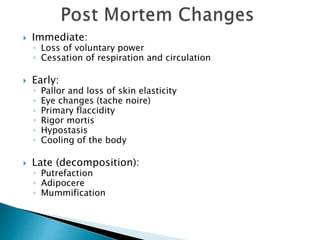
 Immediate:
◦ Loss of voluntary power
◦ Cessation of respiration and circulation
 Early:
◦ Pallor and loss of skin elasticity
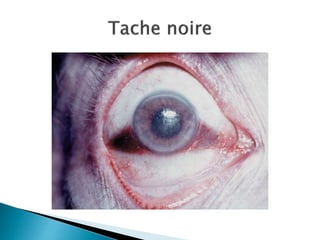
◦ Eye changes (tache noire)
◦ Primary flaccidity
◦ Rigor mortis
◦ Hypostasis
◦ Cooling of the body
 Late (decomposition):
◦ Putrefaction
◦ Adipocere
◦ Mummification
Tache
noire
Primary
flaccidity
Rigor
mortis
Livor
mortis
Algor
mortis
 Flaccid period starts immediately after death
 All the muscles begin to relax.
◦ Lower jaw begins to fall
◦ Eyelids loose tension
◦ Joints are flexible
 Extends 3-6 hours after death before stiffening
occurs
 Muscle irritability and response to electrical or
mechanical stimuli still persist
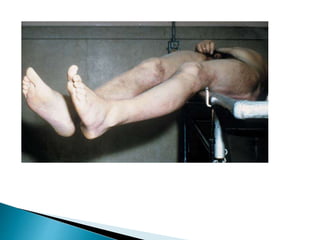
 Stiffening of muscles (voluntary and
involuntary muscles), sometimes slight
shortening of muscle fibres
 Stiffness first apparent in smaller joints
◦ Lower jaw
◦ Facial muscle, neck
◦ Wrist, ankle
 Happens simultaneously through all the
muscles
 Onset of rigor mortis generally 6-12 hours,
and may persist from 18-36 hours
 Mechanism:
◦ Muscle fibres –actin + myosin = actomyosin
◦ ATP  ADP + lactic acid + glycogen + energy
◦ ATP plays role in elasticity and plasticity of muscles
◦ In death, level of ATP falls. Rigor starts when ATP <
15% and reaches maximum when ATP < 85%
(Batesmith, 1949)
 Age
◦ Occurs rapidly in children and old age
 Nature of death
◦ Diseases causing exhaustion and wasting (eg:
cholera, cancer, TB) or violent death (eg:
electrocution) onset of rigor is early and duration is
shorter.
◦ In asphyxial death, onset is delayed
◦ Widespread bacterial infection (eg sepsis) onset is
very rapid
 Muscular state
◦ When muscle is at reast and healthy prior to death,
onset is slow and duration is long.
◦ When muscle is exhausted (eg: exercise prior to
death) onset is more rapid.
 Atmospheric conditions
◦ Cold weather: onset slow and duration is longer
◦ Hot weather, on set is rapid due to increased
breakdown of ATP
 Hot stiffening
◦ When exposed to temperatutre >65celsius, rigidity
is produced (more than marked in rigor mortis)
 Cold stiffening
◦ Upon exposure to freezing temperature, tissues are
frozen and stiff, body fluids are freezing.
◦ Once replaced in a warm temperature, stiffness will
vanish, flaccidity occurs and not long after that
rigor mortis occurs
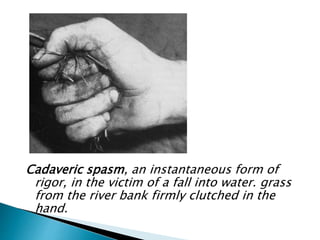
 In midst of intense emotional;/physical
activity, failure of normal relaxation occurs
 Affects only small number of group muscle
◦ Flexor of one arm
 Eg. Fall from cliff into cold water, suicidal
gunshot to the head
Cadaveric spasm, an instantaneous form of
rigor, in the victim of a fall into water. grass
from the river bank firmly clutched in the
hand.
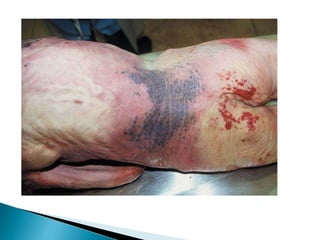
 Lucidity, staining, cogitation
 Occurs when circulation ceases  no arterial
propulsion or venous return  stagnant
blood
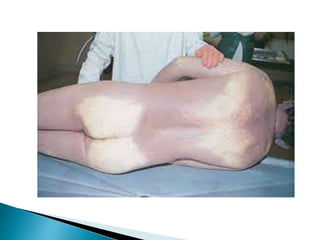
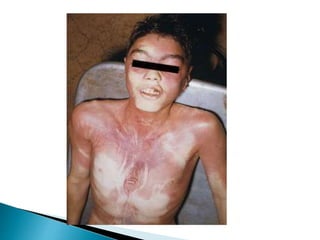
 Gravity pulls the blood into its lowest
accessible area
 Visible at skin as bluish-red discoloration
 Hypostasis starts at 30mins – 4 hours after
death, and reaches maximum at 6-12 hours
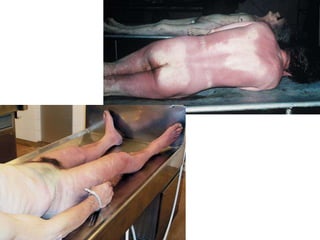
 Pattern/distribution of hypostasis
◦ Depends on posture after death
◦ Supine: hypostasis over back area in exception of
shoulder, buttock, calves (pressed against surface
compressing vascular channel)
◦ Vertical: hypostasis over feet, leg, distal part of
hand and arm
 Colours of hypostasis
◦ Usually bluish-red
◦ CO2 poisoning: cherry red
◦ Cyanide poisoning: dark blue-pink
◦ Aniline, nitrite & chlorate poisoning: brownish red
◦ Phosphorus poisoning: dark brown
◦ Anaerobic septicaemia: bronze
 Hypostasis in organs:
◦ Intestine: discontinuous marked discoloration of
jejunum and ileum
◦ Lung: dark blue in posterior edges, pale over
anterior edges
 Fluid/congestion/edema will be more apparent @
posterior part
◦ Myocardium: dark patches in posterior wall
◦ Esophagus: hemorrhage behind esophagus
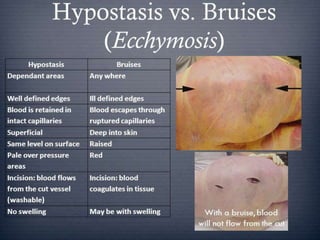
 How to differentiate between hypostasis and
contusion?
 Incise the suspected area
◦ Intravascular  hypostasis
◦ Infiltrating surrounding tissue outside vessel 
contusion
◦ Send for HPE for confirmation
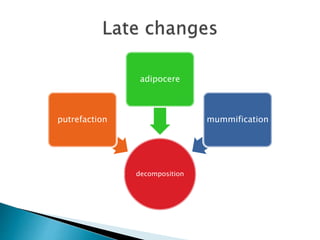
decomposition
putrefaction
adipocere
mummification
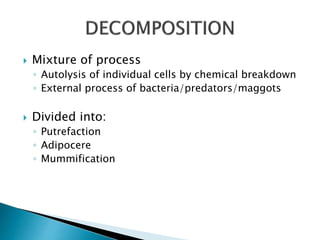
 Mixture of process
◦ Autolysis of individual cells by chemical breakdown
◦ External process of bacteria/predators/maggots
 Divided into:
◦ Putrefaction
◦ Adipocere
◦ Mummification
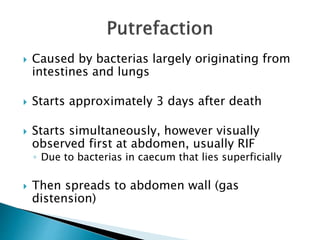
 Caused by bacterias largely originating from
intestines and lungs
 Starts approximately 3 days after death
 Starts simultaneously, however visually
observed first at abdomen, usually RIF
◦ Due to bacterias in caecum that lies superficially
 Then spreads to abdomen wall (gas
distension)
 Face and neck becomes reddish and swollen
 Skin form blisters a upper epidermis is
loosened
 Scrotum and penis may swell
 Tissue liquefaction from orifices such as
nostrils, anus, vagina, mouth
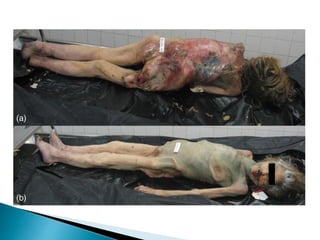
 After several weeks, reddish green colour will
turn black or dark with heavy maggots
infestation
 After several months, soft tissue and viscera
progressively disintegrates
 12-18 months  skeleton + tendons
 3 years  skeleton
 Waxy substance derived from body fat
◦ caused by hydrolysis and hydrogenation of adipose
tissues
 Contains primarily palmitic, oleic and stearic
acid + glycerol
 Requires moist environment
◦ Mostly occur in wet graves, damp vaults, cold water
◦ Clostridium perfringes said to be assisting in
hydrolysis and hydrogenation process
 Importance of Adipocere:
◦ Once formed, it may preserve body for decades or
centuries
◦ Hence preserving marks of injuries (eg: bullet holes)
 Total time required is 3-12months
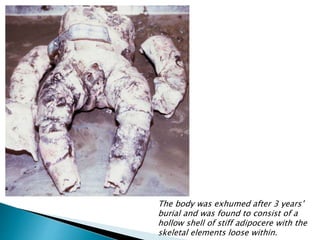
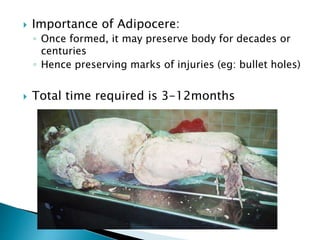
The body was exhumed after 3 years’
burial and was found to consist of a
hollow shell of stiff adipocere with the
skeletal elements loose within.
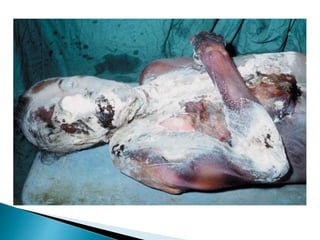
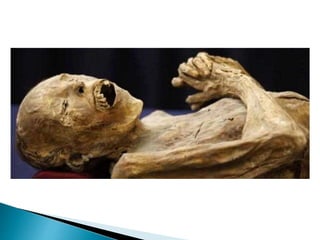
 Drying of tissues in place of liquefying
putrefaction
 Can co-exist with other form of
decomposition, or form at some parts of the
body
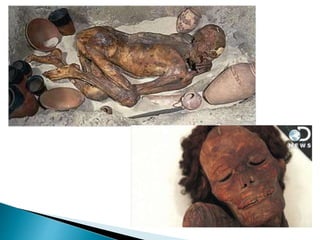
 Mostly occurs in dry and hot environment 
evaporation from body surface
◦ Hot desert, closet, cupboards, closed room,
beneath floors
 Skin and tissues will be hardened due to
drying
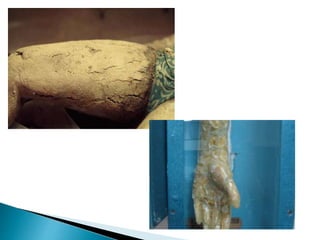
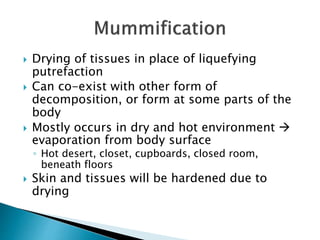
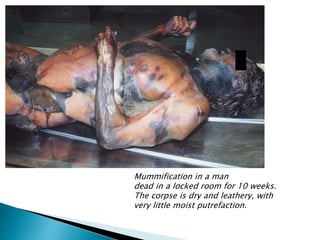
Mummification in a man
dead in a locked room for 10 weeks.
The corpse is dry and leathery, with
very little moist putrefaction.
 Decomposition in immersed body has slower
rate of decomposition
◦ Reduced temperature
◦ Protection against insects/maggots
 Decomposition in buried bodies is slower
than body immersed in water or in room air
◦ Reduced temperature
◦ No predators
◦ Low oxygen level
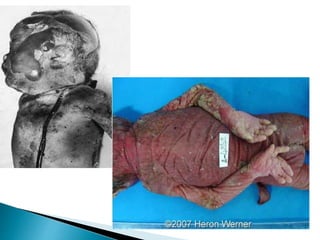
 Aseptic autolysis of a fetus, which has died in
utero and remained within the closed
amniotic sac
 occurring as early as 6 hours of death and
most definitely within 12 hours
 With slippage of the epidermis from the
dermis, the dermis takes on a red color
 If the fetus is retained in utero for 7 to 10
days, color changes to a purple to brown
 Typically within 2 to 3 days of death in utero
the fetus will lose firmness of its tissues,
which manifest by a generalized softness on
palpation.
 At the 7 to 10 day mark the skin has a slimy-
like feel. The limbs are very loose, which in
some cases will easily separate from the
trunk
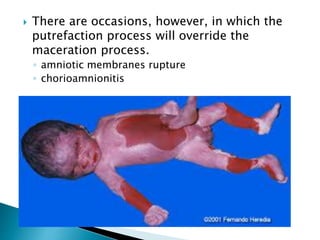
 There are occasions, however, in which the
putrefaction process will override the
maceration process.
◦ amniotic membranes rupture
◦ chorioamnionitis
 Types of predator varies with
◦ Geography
◦ Season
◦ Indoor/outdoor
 Canine/rodent  local removal of flesh with
evidence of teeth marks
 Rats and cats  crenated edge with clean cut
wounds. No bleeding or inflammation
marginal zone
 Most common: maggots (bluebottles and
flies)
◦ Lay eggs in moist areas such as wound, eyelid,
nostrils, lips
◦ Initially explores natural passage, then burrowing
under tissues excreting proteolytic enzymes
making tunnels and sinuses
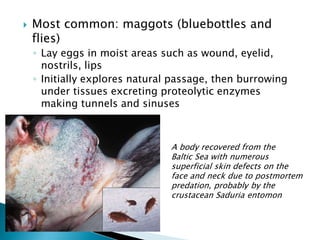
A body recovered from the
Baltic Sea with numerous
superficial skin defects on the
face and neck due to postmortem
predation, probably by the
crustacean Saduria entomon
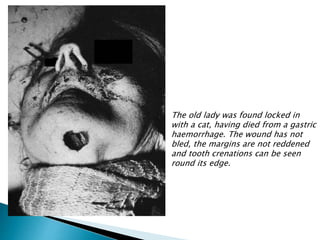
The old lady was found locked in
with a cat, having died from a gastric
haemorrhage. The wound has not
bled, the margins are not reddened
and tooth crenations can be seen
round its edge.
 Cooling of body is a complex process. The
rate of cooling is not same in every different
body
 Body cools more rapidly on the surface, and
slowly in the interiors
 Body heat loss is via conduction, convection
and radiation
 Initial body temperature
 Body dimension
◦ Mass vs surface area
 Posture upon death
◦ Straight vs curled position
 Clothing and coverage
◦ Type of clothing, clothing material
 Ambient temperature
◦ Surrounding temperature
 Air movement and humidity
◦ Increased air movement increases heat radiation
 Medium around body
◦ Water vs air
 Hemorrhage
◦ Blood loss reduces body mass and heat
 Most popular used: Glaister equation
2+ [98.4 F – measured rectal temperature (F)] = Hour
1.5
or
In celcius
2 + [(36.9c – measured rectal temperature ) x 1.2]
 Many natural chemical substances rapidly
distorted by post mortem autolysis
 Serum urea/creatinin are stable with little
variation up to 100 hours
 Most commonly taken is vitreous humor
 Glucose level in VH drops dramatically within
hours
 According to Loe, 1993:
◦ Nitrogen: PM serum and VH levels are stable
◦ Sodium: reduced in serum after death whereas
stable in VH in early PM
◦ Cloride: decreases in serum after PM but only
slightly reduced in VH
◦ Potassium: very high in serum after death but
increases in VH in a linear fashion THUS
◦ 5.26 x K (mmol/l) – 30.9 (Madea, 2002)
Post mortem changes

Post mortem changes

  • 1.
    By: Dr MuhammadFadhil Bin Shamsudin Forensic Department Hospital Kulim
  • 2.
     Somatic death(clinical death) ◦ Irreversible loss of:  Sentient personality  Unable to be aware of environment  Unable to appreciate any sensory stimuli  Unable to initiate any voluntary movement reflexes may still be present, respiratory may still persist with help of artificial support  Cells and tissues are still alive and functioning apart from damaged tissues
  • 3.
     Following ISCHEMIAand ANOXIA, tissues and constituents are dead due to cardiorespiratory failure  Takes place 1-2H after death  No longer have aerobic metabolic activities
  • 4.
     Cortical death Brainstem death  Combination of both
  • 5.
     Due toperiod of hypoxia, trauma or toxic insult, ◦ Higher cerebral activities are lost ◦ Brainstem is preserved, therefore cardiopulmonary functions are maintained ◦ Mostly pt will be in vegetative state ◦ Pt can be in deep coma for indefinite time, sometimes for years
  • 6.
     Loss ofvital centres that control respiration and RAAS system (loss of spontaneous breathing and consciousness) ◦ Without medical intervention, hypoxic cardiac arrest inevitably follows within minutes ◦ Cardiac may still function with help of mechanical assisted ventilation ◦ majority of brainstem-dead patients suffer a cardiac arrest within 48–72 hours  Already dead in somatic sense, but not yet dead in cellular sense
  • 7.
     Unconsciousness  Lossof all reflexes ◦ Pain stimuli, cornea reflex, gag reflex, light reflex  Muscle flaccidity ◦ Rarely, there may be post mortem coordinated muscle group activity up to 1 hour after death  Cessation of heart and respiratory movement
  • 8.
     Mode: ◦ Abnormalpatophysiological state ◦ No info on underlying pathological condition ◦ Eg: Coma, Congestive Heart Failure, APO, Syncopal attack  Manner: ◦ The way death has occurred ◦ Eg: Suicidal, homicidal, natural
  • 9.
     Immediate: ◦ Lossof voluntary power ◦ Cessation of respiration and circulation  Early: ◦ Pallor and loss of skin elasticity ◦ Eye changes (tache noire) ◦ Primary flaccidity ◦ Rigor mortis ◦ Hypostasis ◦ Cooling of the body  Late (decomposition): ◦ Putrefaction ◦ Adipocere ◦ Mummification
  • 10.
  • 12.
     Flaccid periodstarts immediately after death  All the muscles begin to relax. ◦ Lower jaw begins to fall ◦ Eyelids loose tension ◦ Joints are flexible  Extends 3-6 hours after death before stiffening occurs  Muscle irritability and response to electrical or mechanical stimuli still persist
  • 13.
     Stiffening ofmuscles (voluntary and involuntary muscles), sometimes slight shortening of muscle fibres  Stiffness first apparent in smaller joints ◦ Lower jaw ◦ Facial muscle, neck ◦ Wrist, ankle  Happens simultaneously through all the muscles
  • 14.
     Onset ofrigor mortis generally 6-12 hours, and may persist from 18-36 hours  Mechanism: ◦ Muscle fibres –actin + myosin = actomyosin ◦ ATP  ADP + lactic acid + glycogen + energy ◦ ATP plays role in elasticity and plasticity of muscles ◦ In death, level of ATP falls. Rigor starts when ATP < 15% and reaches maximum when ATP < 85% (Batesmith, 1949)
  • 16.
     Age ◦ Occursrapidly in children and old age  Nature of death ◦ Diseases causing exhaustion and wasting (eg: cholera, cancer, TB) or violent death (eg: electrocution) onset of rigor is early and duration is shorter. ◦ In asphyxial death, onset is delayed ◦ Widespread bacterial infection (eg sepsis) onset is very rapid
  • 17.
     Muscular state ◦When muscle is at reast and healthy prior to death, onset is slow and duration is long. ◦ When muscle is exhausted (eg: exercise prior to death) onset is more rapid.  Atmospheric conditions ◦ Cold weather: onset slow and duration is longer ◦ Hot weather, on set is rapid due to increased breakdown of ATP
  • 18.
     Hot stiffening ◦When exposed to temperatutre >65celsius, rigidity is produced (more than marked in rigor mortis)  Cold stiffening ◦ Upon exposure to freezing temperature, tissues are frozen and stiff, body fluids are freezing. ◦ Once replaced in a warm temperature, stiffness will vanish, flaccidity occurs and not long after that rigor mortis occurs
  • 19.
     In midstof intense emotional;/physical activity, failure of normal relaxation occurs  Affects only small number of group muscle ◦ Flexor of one arm  Eg. Fall from cliff into cold water, suicidal gunshot to the head
  • 20.
    Cadaveric spasm, aninstantaneous form of rigor, in the victim of a fall into water. grass from the river bank firmly clutched in the hand.
  • 21.
     Lucidity, staining,cogitation  Occurs when circulation ceases  no arterial propulsion or venous return  stagnant blood  Gravity pulls the blood into its lowest accessible area  Visible at skin as bluish-red discoloration
  • 23.
     Hypostasis startsat 30mins – 4 hours after death, and reaches maximum at 6-12 hours  Pattern/distribution of hypostasis ◦ Depends on posture after death ◦ Supine: hypostasis over back area in exception of shoulder, buttock, calves (pressed against surface compressing vascular channel) ◦ Vertical: hypostasis over feet, leg, distal part of hand and arm
  • 27.
     Colours ofhypostasis ◦ Usually bluish-red ◦ CO2 poisoning: cherry red ◦ Cyanide poisoning: dark blue-pink ◦ Aniline, nitrite & chlorate poisoning: brownish red ◦ Phosphorus poisoning: dark brown ◦ Anaerobic septicaemia: bronze
  • 28.
     Hypostasis inorgans: ◦ Intestine: discontinuous marked discoloration of jejunum and ileum ◦ Lung: dark blue in posterior edges, pale over anterior edges  Fluid/congestion/edema will be more apparent @ posterior part ◦ Myocardium: dark patches in posterior wall ◦ Esophagus: hemorrhage behind esophagus  How to differentiate between hypostasis and contusion?
  • 29.
     Incise thesuspected area ◦ Intravascular  hypostasis ◦ Infiltrating surrounding tissue outside vessel  contusion ◦ Send for HPE for confirmation
  • 30.
  • 31.
     Mixture ofprocess ◦ Autolysis of individual cells by chemical breakdown ◦ External process of bacteria/predators/maggots  Divided into: ◦ Putrefaction ◦ Adipocere ◦ Mummification
  • 32.
     Caused bybacterias largely originating from intestines and lungs  Starts approximately 3 days after death  Starts simultaneously, however visually observed first at abdomen, usually RIF ◦ Due to bacterias in caecum that lies superficially  Then spreads to abdomen wall (gas distension)
  • 33.
     Face andneck becomes reddish and swollen  Skin form blisters a upper epidermis is loosened  Scrotum and penis may swell  Tissue liquefaction from orifices such as nostrils, anus, vagina, mouth  After several weeks, reddish green colour will turn black or dark with heavy maggots infestation
  • 37.
     After severalmonths, soft tissue and viscera progressively disintegrates  12-18 months  skeleton + tendons  3 years  skeleton
  • 38.
     Waxy substancederived from body fat ◦ caused by hydrolysis and hydrogenation of adipose tissues  Contains primarily palmitic, oleic and stearic acid + glycerol  Requires moist environment ◦ Mostly occur in wet graves, damp vaults, cold water ◦ Clostridium perfringes said to be assisting in hydrolysis and hydrogenation process
  • 39.
     Importance ofAdipocere: ◦ Once formed, it may preserve body for decades or centuries ◦ Hence preserving marks of injuries (eg: bullet holes)  Total time required is 3-12months
  • 40.
    The body wasexhumed after 3 years’ burial and was found to consist of a hollow shell of stiff adipocere with the skeletal elements loose within.
  • 42.
     Drying oftissues in place of liquefying putrefaction  Can co-exist with other form of decomposition, or form at some parts of the body  Mostly occurs in dry and hot environment  evaporation from body surface ◦ Hot desert, closet, cupboards, closed room, beneath floors  Skin and tissues will be hardened due to drying
  • 43.
    Mummification in aman dead in a locked room for 10 weeks. The corpse is dry and leathery, with very little moist putrefaction.
  • 47.
     Decomposition inimmersed body has slower rate of decomposition ◦ Reduced temperature ◦ Protection against insects/maggots  Decomposition in buried bodies is slower than body immersed in water or in room air ◦ Reduced temperature ◦ No predators ◦ Low oxygen level
  • 48.
     Aseptic autolysisof a fetus, which has died in utero and remained within the closed amniotic sac  occurring as early as 6 hours of death and most definitely within 12 hours  With slippage of the epidermis from the dermis, the dermis takes on a red color
  • 49.
     If thefetus is retained in utero for 7 to 10 days, color changes to a purple to brown  Typically within 2 to 3 days of death in utero the fetus will lose firmness of its tissues, which manifest by a generalized softness on palpation.  At the 7 to 10 day mark the skin has a slimy- like feel. The limbs are very loose, which in some cases will easily separate from the trunk
  • 50.
     There areoccasions, however, in which the putrefaction process will override the maceration process. ◦ amniotic membranes rupture ◦ chorioamnionitis
  • 52.
     Types ofpredator varies with ◦ Geography ◦ Season ◦ Indoor/outdoor  Canine/rodent  local removal of flesh with evidence of teeth marks  Rats and cats  crenated edge with clean cut wounds. No bleeding or inflammation marginal zone
  • 53.
     Most common:maggots (bluebottles and flies) ◦ Lay eggs in moist areas such as wound, eyelid, nostrils, lips ◦ Initially explores natural passage, then burrowing under tissues excreting proteolytic enzymes making tunnels and sinuses A body recovered from the Baltic Sea with numerous superficial skin defects on the face and neck due to postmortem predation, probably by the crustacean Saduria entomon
  • 54.
    The old ladywas found locked in with a cat, having died from a gastric haemorrhage. The wound has not bled, the margins are not reddened and tooth crenations can be seen round its edge.
  • 56.
     Cooling ofbody is a complex process. The rate of cooling is not same in every different body  Body cools more rapidly on the surface, and slowly in the interiors  Body heat loss is via conduction, convection and radiation
  • 57.
     Initial bodytemperature  Body dimension ◦ Mass vs surface area  Posture upon death ◦ Straight vs curled position  Clothing and coverage ◦ Type of clothing, clothing material  Ambient temperature ◦ Surrounding temperature
  • 58.
     Air movementand humidity ◦ Increased air movement increases heat radiation  Medium around body ◦ Water vs air  Hemorrhage ◦ Blood loss reduces body mass and heat
  • 59.
     Most popularused: Glaister equation 2+ [98.4 F – measured rectal temperature (F)] = Hour 1.5 or In celcius 2 + [(36.9c – measured rectal temperature ) x 1.2]
  • 60.
     Many naturalchemical substances rapidly distorted by post mortem autolysis  Serum urea/creatinin are stable with little variation up to 100 hours  Most commonly taken is vitreous humor
  • 61.
     Glucose levelin VH drops dramatically within hours  According to Loe, 1993: ◦ Nitrogen: PM serum and VH levels are stable ◦ Sodium: reduced in serum after death whereas stable in VH in early PM ◦ Cloride: decreases in serum after PM but only slightly reduced in VH ◦ Potassium: very high in serum after death but increases in VH in a linear fashion THUS ◦ 5.26 x K (mmol/l) – 30.9 (Madea, 2002)