PRESENTED BY
TEJASVI BHATIA
AUTOPSY:
OBJECTIVES, FORMALITIES
AND PROCEDURE
Contents
 DEFINATION
 TYPES
 WHY IS FORENSIC AUTOPSY PERFORMED?
 BENEFITS OF AN AUTOPSY
 OBJECTIVES OF MEDICO LEGAL AUTOPSY
 PRELIMINARY OF MEDICO LEGAL AUTOPSY
 PROTOCOL FOR PERFORMING FORENSIC AUTOPSY
 EXAMINATION OF DEAD BODY
 EXTERNAL EXAMINATION
 INTERNAL EXAMINATION
 WHAT IS THE NEED OF AUTOPSY FOR..?
 LIMITATIONS OF THE AUTOPSY
 REFERENCES
Introduction
To The Autopsy
WHAT IS AN AUTOPSY?
• An autopsy is a post mortem examination preformed on a
corpse to determine the cause and manner of death.
• Two types of autopies:
CLINICAL or ACADEMIC.
MEDICOLEGAL or FORENSIC
Why is a Forensic Autopsy
preformed?
• Forensic autopsies are preformed when the cause of death
of a victim may be a criminal case, often involving foul
play.
• A forensic autopsy applies science to legal law.
Benefits of an Autopsy
• Providing family members information about potential
genetic diseases that may have implications for them.
• Medical education, training and research leading to
improved health care.
• Providing information about preventable causes of disease
and accident and other public health hazards
• To determine identity of deceased.
• To determine cause of death.
• To determine time since death.
• To obtain samples of tissues/body fluids for examination.
• In case of newborn infants , to determine issue of live birth
and viability.
• To describe all external and internal injuries.
Objectives of medicolegal
autopsy
• A medico legal autopsy is to
be carried out at the behest
of appropriate legal
authority-
Type of case Authority officer
Routine
case(suicidal/accid
ental)
Police sub
inspector
Homicidal death Station house
officer
Exhumation Circle inspector of
police
*Death in prison
*Death in police
custody
*Death in police
firing
Executive
magistrate of class
1
Preliminary to medico legal
autopsy
Contd…
• With the requisition a copy of inquest , a dead body challan ,
hospital record and any other relevant paper are necessary
• Medico legal postmortem examination can be performed only
in authorized centre
• No unauthorized person/police official should be present while
autopsy is being conducted
• All the details should be noted there and then in postmortem
register
• Always handover the report immediately after conducting the
postmortem
Experts Who Perform Forensic
Autopsies
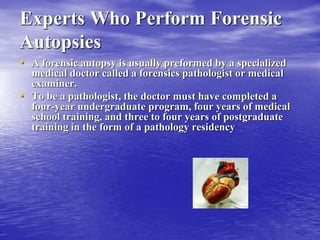
• A forensic autopsy is usually preformed by a specialized
medical doctor called a forensics pathologist or medical
examiner.
• To be a pathologist, the doctor must have completed a
four-year undergraduate program, four years of medical
school training, and three to four years of postgraduate
training in the form of a pathology residency
Protocol for Performing A
Forensic Autopsy
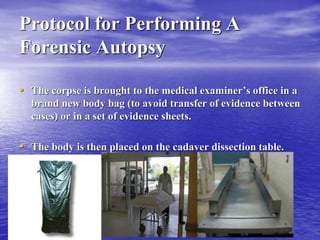
• The corpse is brought to the medical examiner’s office in a
brand new body bag (to avoid transfer of evidence between
cases) or in a set of evidence sheets.
• The body is then placed on the cadaver dissection table.
Examination of dead body is performed in two steps :
• External Examination
• Internal Examination
Examination of dead body:
• Body is sent to medical examiners or hospital in a body bag
or evidence sheet.
• Body will be refrigerated if autopsy is not performed
immediately.
• New body bag is used for each person.
• Evidence sheets are an alternate way to transport body.
• The sheet covers the body while it is moved.
External examination
Contd…
• Dieners (morgue attendants ) transport the body.
• Seals of the body bag are broken.
• Body is photographed .
• Clues found directly on the body (ex. Hair strands) are
collected and examined.
• Body is x-rayed for any internal injuries.
• Body is weighed and measured.
Contd…
• At this time, all the general information of the deceased is
gathered:
– Race
– Sex
– Hair colour
– Eye colour
– Age
– Features
I. V-shaped incision
ІІ. Shoulders to
manubrium sterni incision
ІІІ. Standard midline incision
Internal examination
• .
• .
BRAIN EXAMINATION
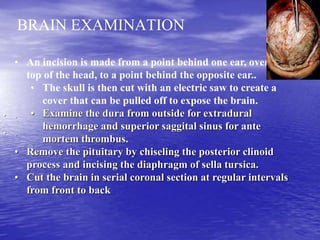
• An incision is made from a point behind one ear, over the
top of the head, to a point behind the opposite ear..
• The skull is then cut with an electric saw to create a
cover that can be pulled off to expose the brain.
• Examine the dura from outside for extradural
hemorrhage and superior saggital sinus for ante
mortem thrombus.
• Remove the pituitary by chiseling the posterior clinoid
process and incising the diaphragm of sella tursica.
• Cut the brain in serial coronal section at regular intervals
from front to back
• Make a middle incision from the base of skull to sacrum.
• Carry out laminectomy by sawing through the entire
length of spine ; laminae are then removed with the help of
bone shears which exposes the spinal canal.
• Examine the dura for any pathological condition.
• Separate the cord at the foramen magnum , carefully lift it
from vertebral Column and place it on table examination .
SPINE & SPINAL CORD
• For exposing structures of neck , I-shaped incision serves
the purpose.
• The structures are examined layer by layer as they are
being dissected.
• In case of death due to alleged pressure upon the neck ,
carefully examine the carotids , hyoid bone and the thyroid
cartilage for any injury or abnormality.
NECK
• After the routine midline incision, reflect the skin and
muscle mass from the thoracic cage laterally.
• Cut the rib cartilages on either side obliquely to avoid
cutting the lungs.
• Open the pericardial sac by an anterior midline cut.
• The intra thoracic organs should then be removed.
• The heart is held at the apex and lifted upwards.
• The isolated heart is then inspected and cut along direction
of blood flow.
THORAX
• Abdomen is opened by a midline incision.
• The cavity as such is examined for any pus , blood,
exudation .
• Both the small and large intestines should be removed by
cutting mesentery and freeing other attachments.
• The liver should be cut open by deep incision at several
places, and the color and consistency noted.
• The gall bladder , pancreas, spleen should also be
examined.
• Kidneys are exposed by incising their capsules.
• The bladder is to be examined for congestion ,
hemorrhage etc.
• In female bodies, the uterus should always be examined for
its size and shape.
ABDOMEN
What is the need of autopsy for…??
 Law enforcement officials:
 Attempts to clarify the circumstances of violent and
unexplained deaths.
 Provides documentation of the injuries.
:
Provides a final determination of the diagnosis.
Provides explanation of doubtful observations.
Provides evaluation of treatment.
Primary-care physicians and non-surgical consultants
 Surgical specialists:
Provides information on such matters as why a
postoperative death occurred, the condition of the suture
lines, and the completeness of removal of a lesion
 Medical staff of a hospital, Hospital
Administrator and governmental agencies
monitoring health care:
Medical student - a first understanding of the
effects of disease.
Student, house staff and attending physician alike -
the meaning of certain observations unexplained
during life, such as a heart murmur, a shadow in a
chest x-ray, or an abnormal laboratory result.
 Researcher:
 A source of new ideas as to cause of disease.
 May also provide an evaluation of new procedures and
new therapeutic agents, and an explanation of adverse
reactions, with the hope that they can be prevented in
the future.
Society in general:
• Benefits if autopsies could be used to compare the
incidence of particular diseases in different geographic
areas.
• To survey the changing status of health and disease in
the popular year to year.
• To evaluate the impact of environmental hazards.
• To determine priorities among various research programs
and effectiveness of sanitary measures in force
Limitations of the Autopsy
• Necessity of viewing care in “retrospect”.
• Lessons learned may not carry over to current patients.
• Cannot answer questions that you may have about your
patient’s disease process unless you communicate with the
pathologist.
• In 1 to 2 percent of cases a definitive cause of death cannot
be found.
REFERENCE
• Modi’s: Medical Jurisprudence & Toxicology; M.
M. Trirathi Press Ltd. Allahabad, 1988.
• Vij Krishan (2001): Textbook Of Forensic
Medicine And Toxicology; B. I. Churchill
Livingstone Pvt Ltd. New Delhi.
• Simpson, Keith: Forensic Medicine; The English
Book Society and Edward Arnold (Publishers)
Ltd.
• www.scribd.com
• www.forensicindia.com
Closing Quote
The search for truth is the essence of forensic science.
This truth forms an essential link between the
enforcement of law and the protection of the public
in the administration of justice

Tejasvi

  • 1.
  • 2.
    Contents  DEFINATION  TYPES WHY IS FORENSIC AUTOPSY PERFORMED?  BENEFITS OF AN AUTOPSY  OBJECTIVES OF MEDICO LEGAL AUTOPSY  PRELIMINARY OF MEDICO LEGAL AUTOPSY  PROTOCOL FOR PERFORMING FORENSIC AUTOPSY  EXAMINATION OF DEAD BODY  EXTERNAL EXAMINATION  INTERNAL EXAMINATION  WHAT IS THE NEED OF AUTOPSY FOR..?  LIMITATIONS OF THE AUTOPSY  REFERENCES
  • 3.
  • 4.
    WHAT IS ANAUTOPSY? • An autopsy is a post mortem examination preformed on a corpse to determine the cause and manner of death. • Two types of autopies: CLINICAL or ACADEMIC. MEDICOLEGAL or FORENSIC
  • 5.
    Why is aForensic Autopsy preformed? • Forensic autopsies are preformed when the cause of death of a victim may be a criminal case, often involving foul play. • A forensic autopsy applies science to legal law.
  • 6.
    Benefits of anAutopsy • Providing family members information about potential genetic diseases that may have implications for them. • Medical education, training and research leading to improved health care. • Providing information about preventable causes of disease and accident and other public health hazards
  • 7.
    • To determineidentity of deceased. • To determine cause of death. • To determine time since death. • To obtain samples of tissues/body fluids for examination. • In case of newborn infants , to determine issue of live birth and viability. • To describe all external and internal injuries. Objectives of medicolegal autopsy
  • 8.
    • A medicolegal autopsy is to be carried out at the behest of appropriate legal authority- Type of case Authority officer Routine case(suicidal/accid ental) Police sub inspector Homicidal death Station house officer Exhumation Circle inspector of police *Death in prison *Death in police custody *Death in police firing Executive magistrate of class 1 Preliminary to medico legal autopsy
  • 9.
    Contd… • With therequisition a copy of inquest , a dead body challan , hospital record and any other relevant paper are necessary • Medico legal postmortem examination can be performed only in authorized centre • No unauthorized person/police official should be present while autopsy is being conducted • All the details should be noted there and then in postmortem register • Always handover the report immediately after conducting the postmortem
  • 10.
    Experts Who PerformForensic Autopsies • A forensic autopsy is usually preformed by a specialized medical doctor called a forensics pathologist or medical examiner. • To be a pathologist, the doctor must have completed a four-year undergraduate program, four years of medical school training, and three to four years of postgraduate training in the form of a pathology residency
  • 11.
    Protocol for PerformingA Forensic Autopsy • The corpse is brought to the medical examiner’s office in a brand new body bag (to avoid transfer of evidence between cases) or in a set of evidence sheets. • The body is then placed on the cadaver dissection table.
  • 14.
    Examination of deadbody is performed in two steps : • External Examination • Internal Examination Examination of dead body:
  • 16.
    • Body issent to medical examiners or hospital in a body bag or evidence sheet. • Body will be refrigerated if autopsy is not performed immediately. • New body bag is used for each person. • Evidence sheets are an alternate way to transport body. • The sheet covers the body while it is moved. External examination
  • 17.
    Contd… • Dieners (morgueattendants ) transport the body. • Seals of the body bag are broken. • Body is photographed . • Clues found directly on the body (ex. Hair strands) are collected and examined. • Body is x-rayed for any internal injuries. • Body is weighed and measured.
  • 18.
    Contd… • At thistime, all the general information of the deceased is gathered: – Race – Sex – Hair colour – Eye colour – Age – Features
  • 19.
    I. V-shaped incision ІІ.Shoulders to manubrium sterni incision ІІІ. Standard midline incision Internal examination
  • 20.
    • . • . BRAINEXAMINATION • An incision is made from a point behind one ear, over the top of the head, to a point behind the opposite ear.. • The skull is then cut with an electric saw to create a cover that can be pulled off to expose the brain. • Examine the dura from outside for extradural hemorrhage and superior saggital sinus for ante mortem thrombus. • Remove the pituitary by chiseling the posterior clinoid process and incising the diaphragm of sella tursica. • Cut the brain in serial coronal section at regular intervals from front to back
  • 22.
    • Make amiddle incision from the base of skull to sacrum. • Carry out laminectomy by sawing through the entire length of spine ; laminae are then removed with the help of bone shears which exposes the spinal canal. • Examine the dura for any pathological condition. • Separate the cord at the foramen magnum , carefully lift it from vertebral Column and place it on table examination . SPINE & SPINAL CORD
  • 23.
    • For exposingstructures of neck , I-shaped incision serves the purpose. • The structures are examined layer by layer as they are being dissected. • In case of death due to alleged pressure upon the neck , carefully examine the carotids , hyoid bone and the thyroid cartilage for any injury or abnormality. NECK
  • 24.
    • After theroutine midline incision, reflect the skin and muscle mass from the thoracic cage laterally. • Cut the rib cartilages on either side obliquely to avoid cutting the lungs. • Open the pericardial sac by an anterior midline cut. • The intra thoracic organs should then be removed. • The heart is held at the apex and lifted upwards. • The isolated heart is then inspected and cut along direction of blood flow. THORAX
  • 25.
    • Abdomen isopened by a midline incision. • The cavity as such is examined for any pus , blood, exudation . • Both the small and large intestines should be removed by cutting mesentery and freeing other attachments. • The liver should be cut open by deep incision at several places, and the color and consistency noted. • The gall bladder , pancreas, spleen should also be examined. • Kidneys are exposed by incising their capsules. • The bladder is to be examined for congestion , hemorrhage etc. • In female bodies, the uterus should always be examined for its size and shape. ABDOMEN
  • 26.
    What is theneed of autopsy for…??  Law enforcement officials:  Attempts to clarify the circumstances of violent and unexplained deaths.  Provides documentation of the injuries. : Provides a final determination of the diagnosis. Provides explanation of doubtful observations. Provides evaluation of treatment. Primary-care physicians and non-surgical consultants
  • 27.
     Surgical specialists: Providesinformation on such matters as why a postoperative death occurred, the condition of the suture lines, and the completeness of removal of a lesion  Medical staff of a hospital, Hospital Administrator and governmental agencies monitoring health care: Medical student - a first understanding of the effects of disease. Student, house staff and attending physician alike - the meaning of certain observations unexplained during life, such as a heart murmur, a shadow in a chest x-ray, or an abnormal laboratory result.
  • 28.
     Researcher:  Asource of new ideas as to cause of disease.  May also provide an evaluation of new procedures and new therapeutic agents, and an explanation of adverse reactions, with the hope that they can be prevented in the future.
  • 29.
    Society in general: •Benefits if autopsies could be used to compare the incidence of particular diseases in different geographic areas. • To survey the changing status of health and disease in the popular year to year. • To evaluate the impact of environmental hazards. • To determine priorities among various research programs and effectiveness of sanitary measures in force
  • 30.
    Limitations of theAutopsy • Necessity of viewing care in “retrospect”. • Lessons learned may not carry over to current patients. • Cannot answer questions that you may have about your patient’s disease process unless you communicate with the pathologist. • In 1 to 2 percent of cases a definitive cause of death cannot be found.
  • 31.
    REFERENCE • Modi’s: MedicalJurisprudence & Toxicology; M. M. Trirathi Press Ltd. Allahabad, 1988. • Vij Krishan (2001): Textbook Of Forensic Medicine And Toxicology; B. I. Churchill Livingstone Pvt Ltd. New Delhi. • Simpson, Keith: Forensic Medicine; The English Book Society and Edward Arnold (Publishers) Ltd. • www.scribd.com • www.forensicindia.com
  • 32.
    Closing Quote The searchfor truth is the essence of forensic science. This truth forms an essential link between the enforcement of law and the protection of the public in the administration of justice