EXHUMATION
MEDICAL AND LEGAL
ASPECTS
PRESENTER: Dr.RAJKUMAR.M.G
MODERATOR: Dr.UMESH BABU.R
DEFINITION
• The word Exhumation comes from Latin words ex meaning
"out of", and humus, meaning "ground". Thus the word
literally means "out of ground".
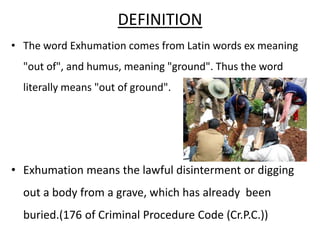
• Exhumation means the lawful disinterment or digging
out a body from a grave, which has already been
buried.(176 of Criminal Procedure Code (Cr.P.C.))
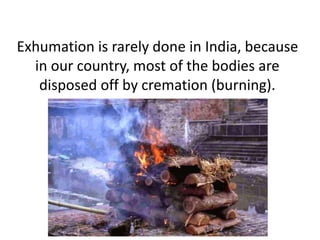
Exhumation is rarely done in India, because
in our country, most of the bodies are
disposed off by cremation (burning).
Exhumation vs. retrieval of a clandestinely
buried body:
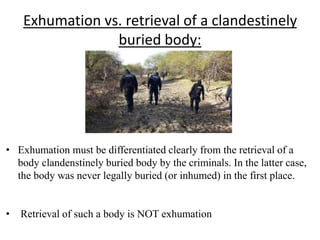
• Exhumation must be differentiated clearly from the retrieval of a
body clandenstinely buried body by the criminals. In the latter case,
the body was never legally buried (or inhumed) in the first place.
• Retrieval of such a body is NOT exhumation
OBJECTIVES
1.for purposes of identification .
2.to determine the cause of death , when foul
play is suspected.
•e.g. homicide,disputed case of death or
poisoning ,exhumation post-mortem is done to
know cause , manner nature of death .
3.may also be required to recover some paper or
documents or other evidential material buried
with dead body.
4.Second autopsy: When the first autopsy report is being
challenged or is ambiguous.
RULES
• District Magistrate/Sub-Divisional Magistrate /Executive
Magistrate are empowered to order for the exhumation.
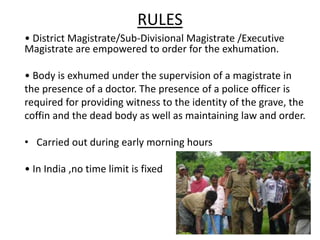
• Body is exhumed under the supervision of a magistrate in
the presence of a doctor. The presence of a police officer is
required for providing witness to the identity of the grave, the
coffin and the dead body as well as maintaining law and order.
• Carried out during early morning hours
• In India ,no time limit is fixed
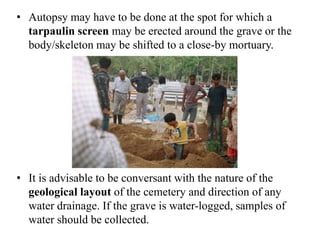
• Autopsy may have to be done at the spot for which a
tarpaulin screen may be erected around the grave or the
body/skeleton may be shifted to a close-by mortuary.
• It is advisable to be conversant with the nature of the
geological layout of the cemetery and direction of any
water drainage. If the grave is water-logged, samples of
water should be collected.
IDENTIFICATION & OPENING THE GRAVE
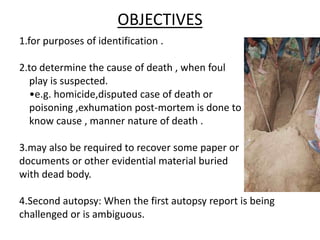
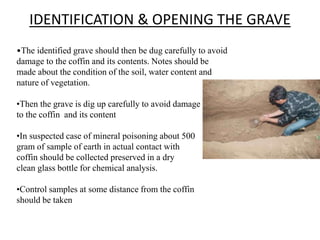
•The identified grave should then be dug carefully to avoid
damage to the coffin and its contents. Notes should be
made about the condition of the soil, water content and
nature of vegetation.
•Then the grave is dig up carefully to avoid damage
to the coffin and its content
•In suspected case of mineral poisoning about 500
gram of sample of earth in actual contact with
coffin should be collected preserved in a dry
clean glass bottle for chemical analysis.
•Control samples at some distance from the coffin
should be taken
EXAMINATION
• If interment has been recent then post mortem is carried
in usual manner
• After the dirt has been removed from above and around
the corpse, it needs to be photographed. A drawing of the
grave and body or skeleton should be made noting all the
details.
• In case of bodies which has been underground for a
sufficiently long time undergone putrefaction, an attempt
should be made to determine
- sex
- stature
- marks of identification
EXAMINATION:contd,.
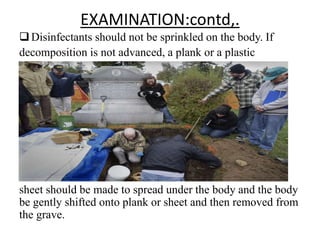
Disinfectants should not be sprinkled on the body. If
decomposition is not advanced, a plank or a plastic
sheet should be made to spread under the body and the body
be gently shifted onto plank or sheet and then removed from
the grave.
EXAMINATION:contd,.
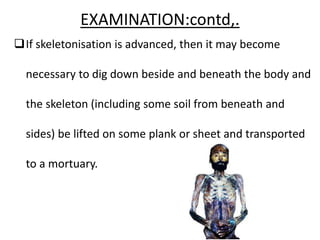
If skeletonisation is advanced, then it may become
necessary to dig down beside and beneath the body and
the skeleton (including some soil from beneath and
sides) be lifted on some plank or sheet and transported
to a mortuary.
EXAMINATION:contd,.
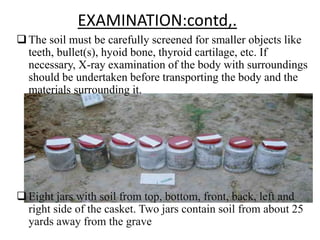
The soil must be carefully screened for smaller objects like
teeth, bullet(s), hyoid bone, thyroid cartilage, etc. If
necessary, X-ray examination of the body with surroundings
should be undertaken before transporting the body and the
materials surrounding it.
Eight jars with soil from top, bottom, front, back, left and
right side of the casket. Two jars contain soil from about 25
yards away from the grave
EXAMINATION:CONTD.,
•Hairs found on body should be preserved in a dry clean glass
bottle for subsequent identification chemical analysis.
•A search should also be made for recent or old injuries such
as fractures
•All the cavities should be examined as many viscera as can be
obtained , should be preserved
•In case of suspected mineral poisoning such as arsenic
antimony hairs, nails long bone should be preserved.
•Sample then forwarded duly labeled sealed to
forensic science laboratory
EXAMINATION:CONTD.,
In a case of suspected poisoning, viscera (if present and
identifiable) should be preserved for chemical analysis. If
viscera are not distinguishable, masses obtained from the
areas of these organs should be preserved. If viscera/
masses are not present, then hair, nails, teeth, bones and
skin should be preserved.
TIME LIMIT FOR EXHUMATION
•In India ,England there is no time limit is fixed
for disinterment of body
•In France period is limited to 10 years and in
Germany 30 years
Exhumed Bones
• If only bones are recovered in exhumation (as in
very old graves), the bones must be boiled before
examination. Maceration by this process may reveal
diagnosis not available otherwise by ordinary
examination. Maceration by this process is
recommended not only in medicolegal autopsies,
but also in historical material.
THANK YOU
REFERENCES:
• Dr.K.S.N.Reddy.The Essentials of Forensic
Medicine and Toxicology.33rd edition
• Krishnan viz.The Textbook of Forensic
Medicine and Toxicology.6th edition .
• Anil Aggrawal's Internet Journal of Forensic
Medicine and Toxicology

Exhumation

  • 1.
    EXHUMATION MEDICAL AND LEGAL ASPECTS PRESENTER:Dr.RAJKUMAR.M.G MODERATOR: Dr.UMESH BABU.R
  • 2.
    DEFINITION • The wordExhumation comes from Latin words ex meaning "out of", and humus, meaning "ground". Thus the word literally means "out of ground". • Exhumation means the lawful disinterment or digging out a body from a grave, which has already been buried.(176 of Criminal Procedure Code (Cr.P.C.))
  • 3.
    Exhumation is rarelydone in India, because in our country, most of the bodies are disposed off by cremation (burning).
  • 4.
    Exhumation vs. retrievalof a clandestinely buried body: • Exhumation must be differentiated clearly from the retrieval of a body clandenstinely buried body by the criminals. In the latter case, the body was never legally buried (or inhumed) in the first place. • Retrieval of such a body is NOT exhumation
  • 5.
    OBJECTIVES 1.for purposes ofidentification . 2.to determine the cause of death , when foul play is suspected. •e.g. homicide,disputed case of death or poisoning ,exhumation post-mortem is done to know cause , manner nature of death . 3.may also be required to recover some paper or documents or other evidential material buried with dead body. 4.Second autopsy: When the first autopsy report is being challenged or is ambiguous.
  • 6.
    RULES • District Magistrate/Sub-DivisionalMagistrate /Executive Magistrate are empowered to order for the exhumation. • Body is exhumed under the supervision of a magistrate in the presence of a doctor. The presence of a police officer is required for providing witness to the identity of the grave, the coffin and the dead body as well as maintaining law and order. • Carried out during early morning hours • In India ,no time limit is fixed
  • 7.
    • Autopsy mayhave to be done at the spot for which a tarpaulin screen may be erected around the grave or the body/skeleton may be shifted to a close-by mortuary. • It is advisable to be conversant with the nature of the geological layout of the cemetery and direction of any water drainage. If the grave is water-logged, samples of water should be collected.
  • 8.
    IDENTIFICATION & OPENINGTHE GRAVE •The identified grave should then be dug carefully to avoid damage to the coffin and its contents. Notes should be made about the condition of the soil, water content and nature of vegetation. •Then the grave is dig up carefully to avoid damage to the coffin and its content •In suspected case of mineral poisoning about 500 gram of sample of earth in actual contact with coffin should be collected preserved in a dry clean glass bottle for chemical analysis. •Control samples at some distance from the coffin should be taken
  • 9.
    EXAMINATION • If intermenthas been recent then post mortem is carried in usual manner • After the dirt has been removed from above and around the corpse, it needs to be photographed. A drawing of the grave and body or skeleton should be made noting all the details. • In case of bodies which has been underground for a sufficiently long time undergone putrefaction, an attempt should be made to determine - sex - stature - marks of identification
  • 10.
    EXAMINATION:contd,. Disinfectants should notbe sprinkled on the body. If decomposition is not advanced, a plank or a plastic sheet should be made to spread under the body and the body be gently shifted onto plank or sheet and then removed from the grave.
  • 11.
    EXAMINATION:contd,. If skeletonisation isadvanced, then it may become necessary to dig down beside and beneath the body and the skeleton (including some soil from beneath and sides) be lifted on some plank or sheet and transported to a mortuary.
  • 12.
    EXAMINATION:contd,. The soil mustbe carefully screened for smaller objects like teeth, bullet(s), hyoid bone, thyroid cartilage, etc. If necessary, X-ray examination of the body with surroundings should be undertaken before transporting the body and the materials surrounding it. Eight jars with soil from top, bottom, front, back, left and right side of the casket. Two jars contain soil from about 25 yards away from the grave
  • 13.
    EXAMINATION:CONTD., •Hairs found onbody should be preserved in a dry clean glass bottle for subsequent identification chemical analysis. •A search should also be made for recent or old injuries such as fractures •All the cavities should be examined as many viscera as can be obtained , should be preserved •In case of suspected mineral poisoning such as arsenic antimony hairs, nails long bone should be preserved. •Sample then forwarded duly labeled sealed to forensic science laboratory
  • 14.
    EXAMINATION:CONTD., In a caseof suspected poisoning, viscera (if present and identifiable) should be preserved for chemical analysis. If viscera are not distinguishable, masses obtained from the areas of these organs should be preserved. If viscera/ masses are not present, then hair, nails, teeth, bones and skin should be preserved.
  • 15.
    TIME LIMIT FOREXHUMATION •In India ,England there is no time limit is fixed for disinterment of body •In France period is limited to 10 years and in Germany 30 years
  • 16.
    Exhumed Bones • Ifonly bones are recovered in exhumation (as in very old graves), the bones must be boiled before examination. Maceration by this process may reveal diagnosis not available otherwise by ordinary examination. Maceration by this process is recommended not only in medicolegal autopsies, but also in historical material.
  • 17.
  • 18.
    REFERENCES: • Dr.K.S.N.Reddy.The Essentialsof Forensic Medicine and Toxicology.33rd edition • Krishnan viz.The Textbook of Forensic Medicine and Toxicology.6th edition . • Anil Aggrawal's Internet Journal of Forensic Medicine and Toxicology