RIGOR MORTIS 
PRESENTER: 
DR.RAJKUMAR. M.G. 
PG IN FORENSIC 
MEDICINE 
SDUMC,KOLAR 
DR.KIRAN.J 
Prof . &HOD 
DEPT. OF FORENSIC 
MEDICINE 
SDUMC,KOLAR 
1 
MODERATOR:
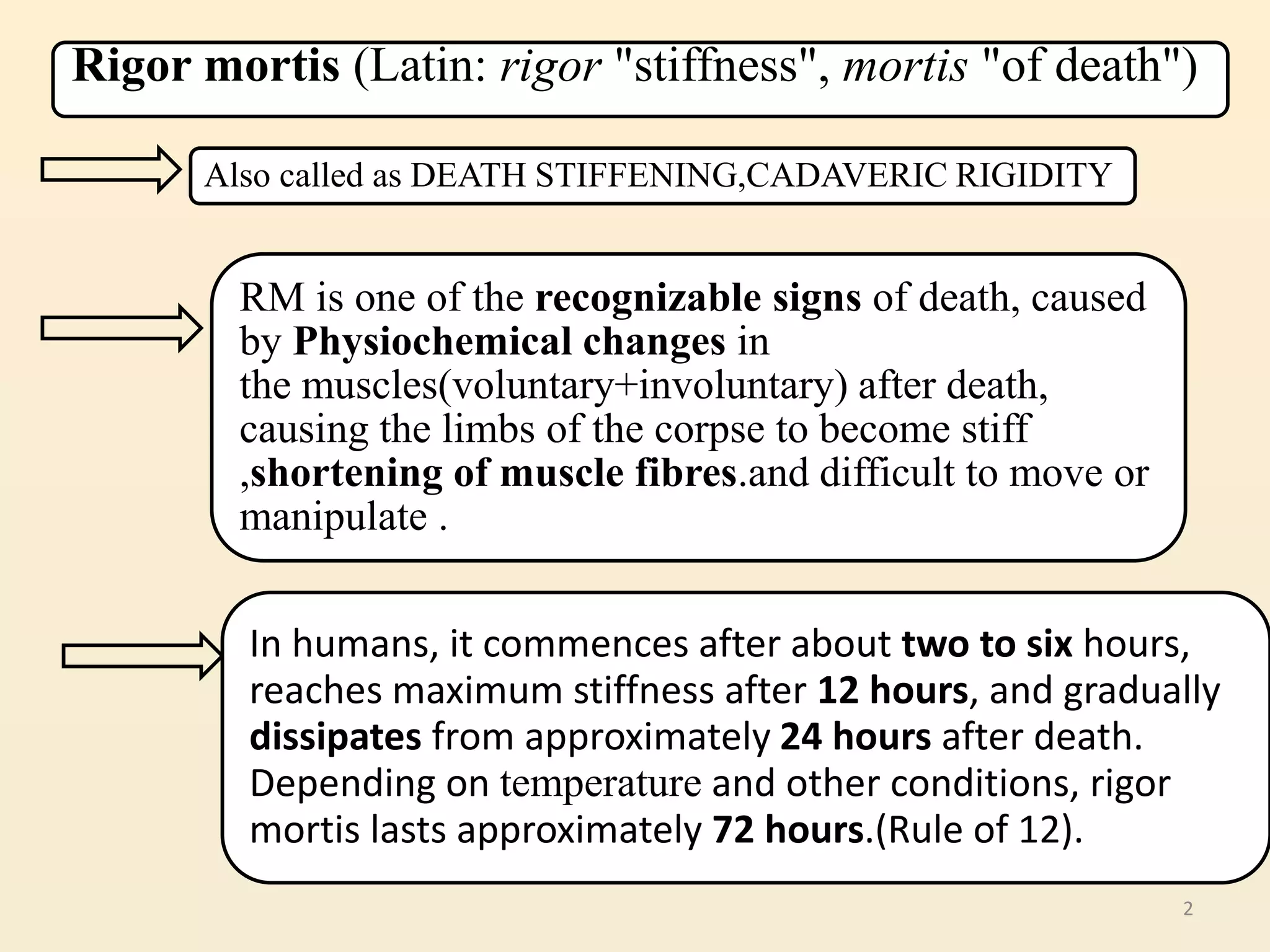
Rigor mortis (Latin: rigor "stiffness", mortis "of death") 
2 
Also called as DEATH STIFFENING,CADAVERIC RIGIDITY 
RM is one of the recognizable signs of death, caused 
by Physiochemical changes in 
the muscles(voluntary+involuntary) after death, 
causing the limbs of the corpse to become stiff 
,shortening of muscle fibres.and difficult to move or 
manipulate . 
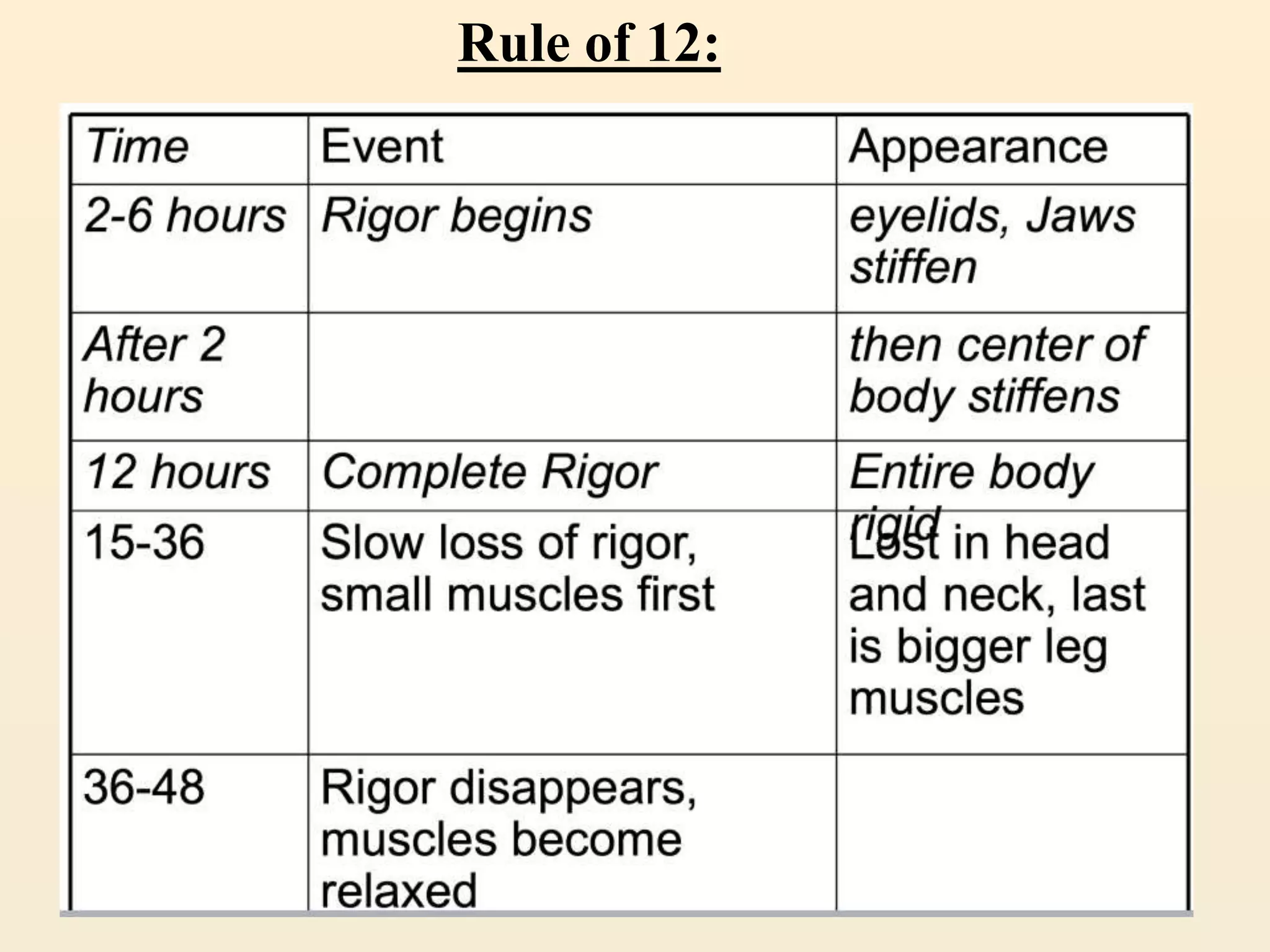
In humans, it commences after about two to six hours, 
reaches maximum stiffness after 12 hours, and gradually 
dissipates from approximately 24 hours after death. 
Depending on temperature and other conditions, rigor 
mortis lasts approximately 72 hours.(Rule of 12).
MECHANISM/PATHOPHYSIOLOGY: 
3 
Death 
cessation of respiration 
depletion of oxygen used in making of ATP 
ATP no longer provided to operate the SERCA pumps in 
the membrane of the sarcoplasmic reticulum,which pump 
calcium ions into the terminal cisternae 
calcium ions diffuse from the terminal cisternae and extra 
cellular fluid to the sarcomere 
Calcium binds with Troponin 
Crossbridging between myosin and actin filaments.
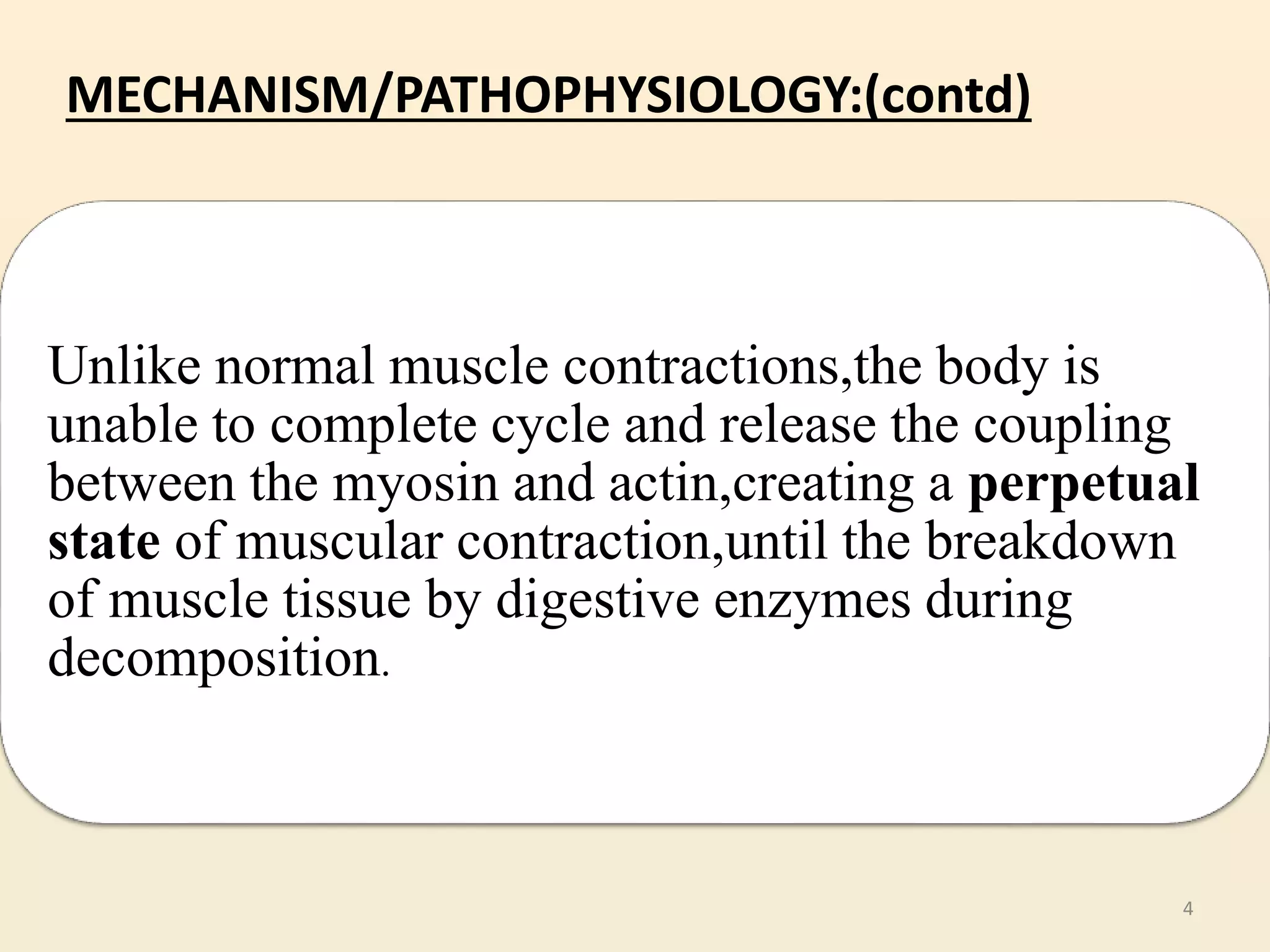
Unlike normal muscle contractions,the body is 
unable to complete cycle and release the coupling 
between the myosin and actin,creating a perpetual 
state of muscular contraction,until the breakdown 
of muscle tissue by digestive enzymes during 
decomposition. 
4 
MECHANISM/PATHOPHYSIOLOGY:(contd)
5
6
7
Signal from NERVOUS SYSTEM to contract MUSCLE 
8
9 
Muscle-->Myofibril-->Sarcomere(contractile unit)
10 
Myosin-Thick filament/ATP dependent 
motor protein. 
Actin-Thin filament/Contractile filament 
Of muscle cells.
Thick filaments- Myosin are anchored to M line(center) 
11
Actin filaments are anchored to outer edge of Sarcomere-Z Line 
12
13 
Myosin pulls Actin filaments along its length: 
POWER STROKE
14 
Sliding filament mechanism: 
Lengths of filaments do not change 
Sarcomere shortens 
Causes shortening of muscle fiber and muscle
15 
ATP is responsible for elasticity and plasticity of muscle during life. 
ATP hydrolysis=ADP+Inorganic phosphate 
*Hydrolysis energy=>Power stroke action of Myosin. 
 SUPPLY OF ATP IN MUSCLES DURING LIFE: 
1. Phosphagen System 
2. Glycogen-lactic acid system 
3. Aerobic system.
16 
Muscle contractions are controlled by Calcium ions
Regulatory Proteins on Actin :TROPONIN and TROPOMYOSIN 
17 
At RELAXED STATE: 
Tropomyosin blocks CROSSBRIDGES,
When calcium levels are high enough and ATP is present , 
Calcium binds to Troponin and displaces Tropomyosin and 
Helps in formation of Cross bridges. 
18
T-tubule(myofibril)======>>>CALCIUM released. 
19 
Neuromuscular junction 
Signal from Nervous system to CONTRACT=>Calcium 
Released from sarcoplsamic reticulum.
20 
Muscle contraction 
Z-Lines draw close to M –Lines=shortening of muscle fiber
21
22 
Rigor mortis -VIDEO
AFTER DEATH: 
PHYSIOCHEMICAL CHANGES IN MUSCLE 
23 
ATP is progressively and irreversibly destroyed accumulation 
of lactates and phosphates in muscles. 
No Resynthesis of ATP 
Postmortem SARCOPLASMIC DISRUPTION Flooding of 
Calcium Ions into SARCOMERES Initiating the binding of 
Actin and Myosin MIMICKING NORMAL CONTRACTION. 
Rigor Mortis sets in when ATP is reduced to a critical level(85% of 
-normal).Rigidity is MAXIMUM when ATP depletion is 15%. 
Rigormortis is lost when putrefaction starts Proteolytic detachment 
Loss of Structural Integrity muscles soften and relax.
24 
ORDER OF APPEARANCE: 
Nysten’s Rule:Rigormortis does not start in all muscles 
simultaneously. 
Shapiro(1950):Rigormortis mostly likely to develop 
simultaneously in all muscles.smaller muscles>larger. 
Involuntary muscles(myocardium=½hr)>Voluntary muscles> 
Eyelids>Neck>Lower Jaw>Face>Chest>Upper Limb> 
Abdomen>Lower Limbs>Fingers and Toes. 
RM disappears in same order of appearance.
25 
Rule of 12:
26 
Development of Rigormortis: 
RM is independent of the integrity of nervous system, 
concerned only with muscles. 
RM occurs in different times with different types of 
muscles.(red muscles and white muscles) 
Frequent handling of the body breaks rigor in certain 
places leaving a patchy distribution.
27 
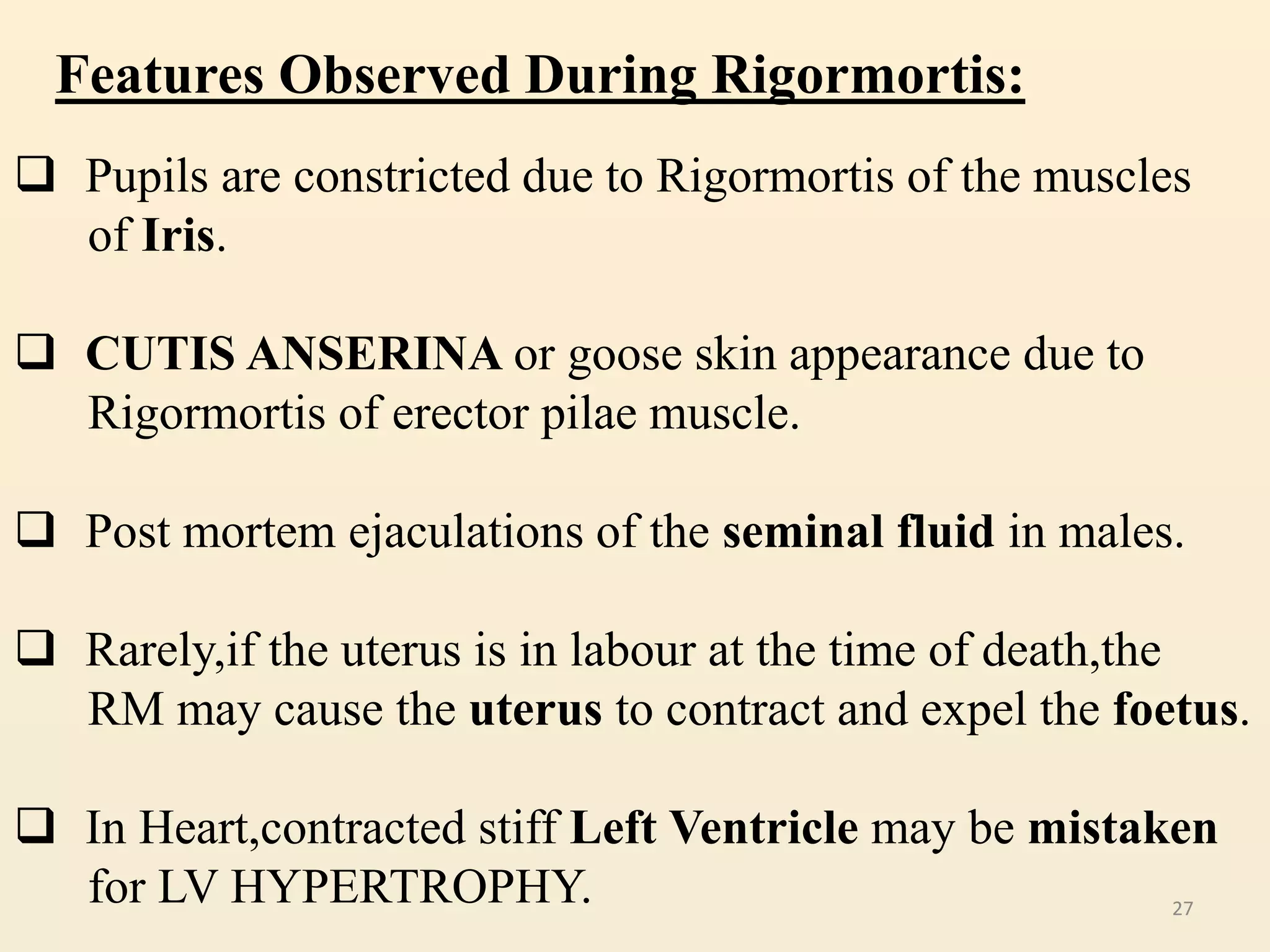
Features Observed During Rigormortis: 
 Pupils are constricted due to Rigormortis of the muscles 
of Iris. 
 CUTIS ANSERINA or goose skin appearance due to 
Rigormortis of erector pilae muscle. 
 Post mortem ejaculations of the seminal fluid in males. 
 Rarely,if the uterus is in labour at the time of death,the 
RM may cause the uterus to contract and expel the foetus. 
 In Heart,contracted stiff Left Ventricle may be mistaken 
for LV HYPERTROPHY.
28 
Time Of Onset: 
Time Factor is VARIABLE,beacause of many extrinsic and 
intrinsic factors. 
When Rigor sets in early,it passes off quickly and vice versa. 
In India ,usually it lasts for 24 to 48 hours in WINTER and 
18 to 36 hours in SUMMER.It may begin to disappear in 
about 12 hrs. 
Rule of FIVE:In some states like kerala( moisture),RM sets 
in 5hrs - stays for 5hrs –disappears in 5hrs.
29 
Conditions Altering the Onset and Duration:
30 
Conditions Altering the Onset and Duration: 
Age: 
•RM does not occur in a foetus less than 7 months. 
•commonly found in stillborn infants at full term, 
but it is earlier to appear and also to disappear, so 
it has no value as a sign of live birth. 
•children & old people:feeble and rapid 
Nature Of Death: 
1)Diseases causing great exhaustion and wasting(cholera, 
typhoid,tuberculosis,cancer, etc) and Violent Deaths(cut 
-throat,electrocution,firearms,lightiningStrychnine poisoning) 
-»RM EARLY ONSET AND SHORT DURATION.
31 
Nature Of Death (contd,) 
2)POISONING: 
• OP poisoning-»rigidity appears early 
• CO poisoning-»delays disappearance 
• Strychnine and HCN poisoning»»starts early and persists 
longer. 
3) Asphyxia,severe haemorrhage,apoplexy,pneumonia and 
nervous disease causing muscle paralysis -»onset delayed. 
4)Widespread bacterial infection, gas gangrene-» 
disappear Very rapidly. 
*RIGOR MORTIS is frequently absent in septicaemia 
deaths.
32 
Conditions Altering the Onset and 
Duration:(contd.) 
MUSCULAR STATE: 
• Healthy muscles and at rest before Death:slow onset &long 
duration of RM. 
• Heavy exercise ,Severe Convulsions:Rapid onset and short 
duration of RM. 
•In a Person who run prior to death,rigor may develop earlier 
and rapid in legs,compared to other parts. 
•In Emaciated persons:Rigor may be very weak or delayed.
33 
Conditions Altering the Onset and 
Duration:(contd.) 
ATMOSPHERIC CONDITIONS: 
 Cold Weather--->slow onset and long duration. 
 Rigor persists longer in colder wet air ˃fresh dry air. 
prolonged by dry cold air and cold water. 
 Hot environment:Rapid onset and shorter duration due 
to increased breakdown ATP. 
 Because of the number variability of the factors which 
influence the development of RM,it is not possible to 
draw any general rule for rate of onset, duration and 
disappearance.
34 
Conditions SIMULATING Rigor mortis: 
1)Heat Stiffening: 
Exposure of a Body to intense temperature(>65ºC) 
Denaturation&Coagulation of muscular proteins 
Muscular shortening(contracted,dessicated,carbonised) 
Seen in burning,high voltage electrocution,falling into 
hot liquid. 
A zone of brownish pink “cooked meat” is seen under 
contracted muscle. 
Changes in posture,especially flexion of limbs 
Normal rigor mortis do not occur.
35 
Conditions SIMULATING Rigor mortis:(contd) 
2)Cold Stiffening: 
Exposure of a Body to extreme cold(<-5ºC) 
Solidification of subcutaneous fat and muscles, 
freezing of synovial fluid in joints. 
Rigor mortis is halted until thawing occurs,after which 
it develops very rapidly and passes off quickly. 
When joints forcibly flexed->sudden sharp sound d/t 
ice breakage in synovial fluid. 
Subcutaneous fat hardening may be mistaken for 
ligature mark,especially in infants.
Conditions SIMULATING Rigor mortis:(contd) 
3)Cadaveric spasm: 
Also known as Instantaneous rigor,cataleptic rigidity or 
instantaneous rigidity. 
Rare form of muscular rigidity that occurs at the moment of 
the death,persists into the period of Rigor mortis and can be 
mistaken for RM. 
36 
The cause is unknown,but usually a/w violent deaths 
happening with intense emotion(possibly neurogenic), 
adrenocortical exhaustion(impairing resynthesis of ATP) 
No other condition simulates CS and it cannot be produced 
by any method after death.
37 
3)Cadaveric spasm:(contd,) 
May affect all muscles in the body,but typically only groups 
such as-forearms/hands 
Seen in cases of cases of drowning victims when grass ,weeds 
roots or other materials are clutched and provides proof of 
life at the time of entry into the water.
3)Cadaveric spasm:(contd,) 
Often demonstrates the last activity one did prior to death 
and therefore significant in forensic investigations..eg.clinging 
on a knife tightly. 
38
39
RIGOR MORTIS Vs. CADAVERIC SPASM 
RIGOR MORTIS 
• Muscle stiffening not marked 
• Molecular Death occurs 
• BODY heat –Cold 
• Muscles do not respond to 
Electrical stimuli 
• Muscular Reaction-ACIDIC 
• MLI:Indicates time of death 
CADAVERIC SPASM 
• Muscle stiffening MARKED 
• Does not occur 
• BODY heat-Warm 
• Muscles respond. 
• ALKALINE 
• MODE of DEATH-i, 
e,homicide/suicide/accide4n0 t
Testing RIGOR MORTIS: 
41 
 Tested by trying to lift 
eyelids 
 Depressing jaws 
 Gently bending the 
Neck 
 Try flexing/extending 
various joints of body. 
Degree->absent/minimal/moderate/advanced/complete. 
Distribution->patchy/complete
42 
Medico legal Importance:Rigor mortis 
1) It is a sign Of Death 
2) Its extent helps in estimating the time of death. 
3)It indicates the position of body at the time of Death.
43 
TIME OF DEATH 
Best done at scene,sooner the better. 
Worst estimate is done at the time of autopsy.
44 
KEY QUESTIONS; 
?When was person last seen alive? 
?When was body found dead?
DISCUSSION 
45 
THANK YOU
46 
References: 
THE ESSENTIALS OF FORENSIC MEDICINE AND 
TOXICOLOGY by K.S.NARAYAN REDDY. 
TEXT BOOK OF FORENSIC MEDICINE BY KRISHNAN 
VIJ. 
BERNARD KNIGHTS FORENSIC PATHOLOGY.
47 
Appendix
48 
Appendix

RIGOR MORTIS by rajkumar malur

  • 1.
    RIGOR MORTIS PRESENTER: DR.RAJKUMAR. M.G. PG IN FORENSIC MEDICINE SDUMC,KOLAR DR.KIRAN.J Prof . &HOD DEPT. OF FORENSIC MEDICINE SDUMC,KOLAR 1 MODERATOR:
  • 2.
    Rigor mortis (Latin:rigor "stiffness", mortis "of death") 2 Also called as DEATH STIFFENING,CADAVERIC RIGIDITY RM is one of the recognizable signs of death, caused by Physiochemical changes in the muscles(voluntary+involuntary) after death, causing the limbs of the corpse to become stiff ,shortening of muscle fibres.and difficult to move or manipulate . In humans, it commences after about two to six hours, reaches maximum stiffness after 12 hours, and gradually dissipates from approximately 24 hours after death. Depending on temperature and other conditions, rigor mortis lasts approximately 72 hours.(Rule of 12).
  • 3.
    MECHANISM/PATHOPHYSIOLOGY: 3 Death cessation of respiration depletion of oxygen used in making of ATP ATP no longer provided to operate the SERCA pumps in the membrane of the sarcoplasmic reticulum,which pump calcium ions into the terminal cisternae calcium ions diffuse from the terminal cisternae and extra cellular fluid to the sarcomere Calcium binds with Troponin Crossbridging between myosin and actin filaments.
  • 4.
    Unlike normal musclecontractions,the body is unable to complete cycle and release the coupling between the myosin and actin,creating a perpetual state of muscular contraction,until the breakdown of muscle tissue by digestive enzymes during decomposition. 4 MECHANISM/PATHOPHYSIOLOGY:(contd)
  • 5.
  • 6.
  • 7.
  • 8.
    Signal from NERVOUSSYSTEM to contract MUSCLE 8
  • 9.
  • 10.
    10 Myosin-Thick filament/ATPdependent motor protein. Actin-Thin filament/Contractile filament Of muscle cells.
  • 11.
    Thick filaments- Myosinare anchored to M line(center) 11
  • 12.
    Actin filaments areanchored to outer edge of Sarcomere-Z Line 12
  • 13.
    13 Myosin pullsActin filaments along its length: POWER STROKE
  • 14.
    14 Sliding filamentmechanism: Lengths of filaments do not change Sarcomere shortens Causes shortening of muscle fiber and muscle
  • 15.
    15 ATP isresponsible for elasticity and plasticity of muscle during life. ATP hydrolysis=ADP+Inorganic phosphate *Hydrolysis energy=>Power stroke action of Myosin.  SUPPLY OF ATP IN MUSCLES DURING LIFE: 1. Phosphagen System 2. Glycogen-lactic acid system 3. Aerobic system.
  • 16.
    16 Muscle contractionsare controlled by Calcium ions
  • 17.
    Regulatory Proteins onActin :TROPONIN and TROPOMYOSIN 17 At RELAXED STATE: Tropomyosin blocks CROSSBRIDGES,
  • 18.
    When calcium levelsare high enough and ATP is present , Calcium binds to Troponin and displaces Tropomyosin and Helps in formation of Cross bridges. 18
  • 19.
    T-tubule(myofibril)======>>>CALCIUM released. 19 Neuromuscular junction Signal from Nervous system to CONTRACT=>Calcium Released from sarcoplsamic reticulum.
  • 20.
    20 Muscle contraction Z-Lines draw close to M –Lines=shortening of muscle fiber
  • 21.
  • 22.
  • 23.
    AFTER DEATH: PHYSIOCHEMICALCHANGES IN MUSCLE 23 ATP is progressively and irreversibly destroyed accumulation of lactates and phosphates in muscles. No Resynthesis of ATP Postmortem SARCOPLASMIC DISRUPTION Flooding of Calcium Ions into SARCOMERES Initiating the binding of Actin and Myosin MIMICKING NORMAL CONTRACTION. Rigor Mortis sets in when ATP is reduced to a critical level(85% of -normal).Rigidity is MAXIMUM when ATP depletion is 15%. Rigormortis is lost when putrefaction starts Proteolytic detachment Loss of Structural Integrity muscles soften and relax.
  • 24.
    24 ORDER OFAPPEARANCE: Nysten’s Rule:Rigormortis does not start in all muscles simultaneously. Shapiro(1950):Rigormortis mostly likely to develop simultaneously in all muscles.smaller muscles>larger. Involuntary muscles(myocardium=½hr)>Voluntary muscles> Eyelids>Neck>Lower Jaw>Face>Chest>Upper Limb> Abdomen>Lower Limbs>Fingers and Toes. RM disappears in same order of appearance.
  • 25.
  • 26.
    26 Development ofRigormortis: RM is independent of the integrity of nervous system, concerned only with muscles. RM occurs in different times with different types of muscles.(red muscles and white muscles) Frequent handling of the body breaks rigor in certain places leaving a patchy distribution.
  • 27.
    27 Features ObservedDuring Rigormortis:  Pupils are constricted due to Rigormortis of the muscles of Iris.  CUTIS ANSERINA or goose skin appearance due to Rigormortis of erector pilae muscle.  Post mortem ejaculations of the seminal fluid in males.  Rarely,if the uterus is in labour at the time of death,the RM may cause the uterus to contract and expel the foetus.  In Heart,contracted stiff Left Ventricle may be mistaken for LV HYPERTROPHY.
  • 28.
    28 Time OfOnset: Time Factor is VARIABLE,beacause of many extrinsic and intrinsic factors. When Rigor sets in early,it passes off quickly and vice versa. In India ,usually it lasts for 24 to 48 hours in WINTER and 18 to 36 hours in SUMMER.It may begin to disappear in about 12 hrs. Rule of FIVE:In some states like kerala( moisture),RM sets in 5hrs - stays for 5hrs –disappears in 5hrs.
  • 29.
    29 Conditions Alteringthe Onset and Duration:
  • 30.
    30 Conditions Alteringthe Onset and Duration: Age: •RM does not occur in a foetus less than 7 months. •commonly found in stillborn infants at full term, but it is earlier to appear and also to disappear, so it has no value as a sign of live birth. •children & old people:feeble and rapid Nature Of Death: 1)Diseases causing great exhaustion and wasting(cholera, typhoid,tuberculosis,cancer, etc) and Violent Deaths(cut -throat,electrocution,firearms,lightiningStrychnine poisoning) -»RM EARLY ONSET AND SHORT DURATION.
  • 31.
    31 Nature OfDeath (contd,) 2)POISONING: • OP poisoning-»rigidity appears early • CO poisoning-»delays disappearance • Strychnine and HCN poisoning»»starts early and persists longer. 3) Asphyxia,severe haemorrhage,apoplexy,pneumonia and nervous disease causing muscle paralysis -»onset delayed. 4)Widespread bacterial infection, gas gangrene-» disappear Very rapidly. *RIGOR MORTIS is frequently absent in septicaemia deaths.
  • 32.
    32 Conditions Alteringthe Onset and Duration:(contd.) MUSCULAR STATE: • Healthy muscles and at rest before Death:slow onset &long duration of RM. • Heavy exercise ,Severe Convulsions:Rapid onset and short duration of RM. •In a Person who run prior to death,rigor may develop earlier and rapid in legs,compared to other parts. •In Emaciated persons:Rigor may be very weak or delayed.
  • 33.
    33 Conditions Alteringthe Onset and Duration:(contd.) ATMOSPHERIC CONDITIONS:  Cold Weather--->slow onset and long duration.  Rigor persists longer in colder wet air ˃fresh dry air. prolonged by dry cold air and cold water.  Hot environment:Rapid onset and shorter duration due to increased breakdown ATP.  Because of the number variability of the factors which influence the development of RM,it is not possible to draw any general rule for rate of onset, duration and disappearance.
  • 34.
    34 Conditions SIMULATINGRigor mortis: 1)Heat Stiffening: Exposure of a Body to intense temperature(>65ºC) Denaturation&Coagulation of muscular proteins Muscular shortening(contracted,dessicated,carbonised) Seen in burning,high voltage electrocution,falling into hot liquid. A zone of brownish pink “cooked meat” is seen under contracted muscle. Changes in posture,especially flexion of limbs Normal rigor mortis do not occur.
  • 35.
    35 Conditions SIMULATINGRigor mortis:(contd) 2)Cold Stiffening: Exposure of a Body to extreme cold(<-5ºC) Solidification of subcutaneous fat and muscles, freezing of synovial fluid in joints. Rigor mortis is halted until thawing occurs,after which it develops very rapidly and passes off quickly. When joints forcibly flexed->sudden sharp sound d/t ice breakage in synovial fluid. Subcutaneous fat hardening may be mistaken for ligature mark,especially in infants.
  • 36.
    Conditions SIMULATING Rigormortis:(contd) 3)Cadaveric spasm: Also known as Instantaneous rigor,cataleptic rigidity or instantaneous rigidity. Rare form of muscular rigidity that occurs at the moment of the death,persists into the period of Rigor mortis and can be mistaken for RM. 36 The cause is unknown,but usually a/w violent deaths happening with intense emotion(possibly neurogenic), adrenocortical exhaustion(impairing resynthesis of ATP) No other condition simulates CS and it cannot be produced by any method after death.
  • 37.
    37 3)Cadaveric spasm:(contd,) May affect all muscles in the body,but typically only groups such as-forearms/hands Seen in cases of cases of drowning victims when grass ,weeds roots or other materials are clutched and provides proof of life at the time of entry into the water.
  • 38.
    3)Cadaveric spasm:(contd,) Oftendemonstrates the last activity one did prior to death and therefore significant in forensic investigations..eg.clinging on a knife tightly. 38
  • 39.
  • 40.
    RIGOR MORTIS Vs.CADAVERIC SPASM RIGOR MORTIS • Muscle stiffening not marked • Molecular Death occurs • BODY heat –Cold • Muscles do not respond to Electrical stimuli • Muscular Reaction-ACIDIC • MLI:Indicates time of death CADAVERIC SPASM • Muscle stiffening MARKED • Does not occur • BODY heat-Warm • Muscles respond. • ALKALINE • MODE of DEATH-i, e,homicide/suicide/accide4n0 t
  • 41.
    Testing RIGOR MORTIS: 41  Tested by trying to lift eyelids  Depressing jaws  Gently bending the Neck  Try flexing/extending various joints of body. Degree->absent/minimal/moderate/advanced/complete. Distribution->patchy/complete
  • 42.
    42 Medico legalImportance:Rigor mortis 1) It is a sign Of Death 2) Its extent helps in estimating the time of death. 3)It indicates the position of body at the time of Death.
  • 43.
    43 TIME OFDEATH Best done at scene,sooner the better. Worst estimate is done at the time of autopsy.
  • 44.
    44 KEY QUESTIONS; ?When was person last seen alive? ?When was body found dead?
  • 45.
  • 46.
    46 References: THEESSENTIALS OF FORENSIC MEDICINE AND TOXICOLOGY by K.S.NARAYAN REDDY. TEXT BOOK OF FORENSIC MEDICINE BY KRISHNAN VIJ. BERNARD KNIGHTS FORENSIC PATHOLOGY.
  • 47.
  • 48.