
APPLIED
FORENSIC
RESEARCH
SCIENCES
POST
MORTEM
EXAMINATION
PRESENTED BY POOJA KUMARI
VOLUNTEER OF APPLIED FORENSIC
RESEARCH SCIENCES
THE AUTOPSY TELLS US EVERYTHING
- John Pierce
3
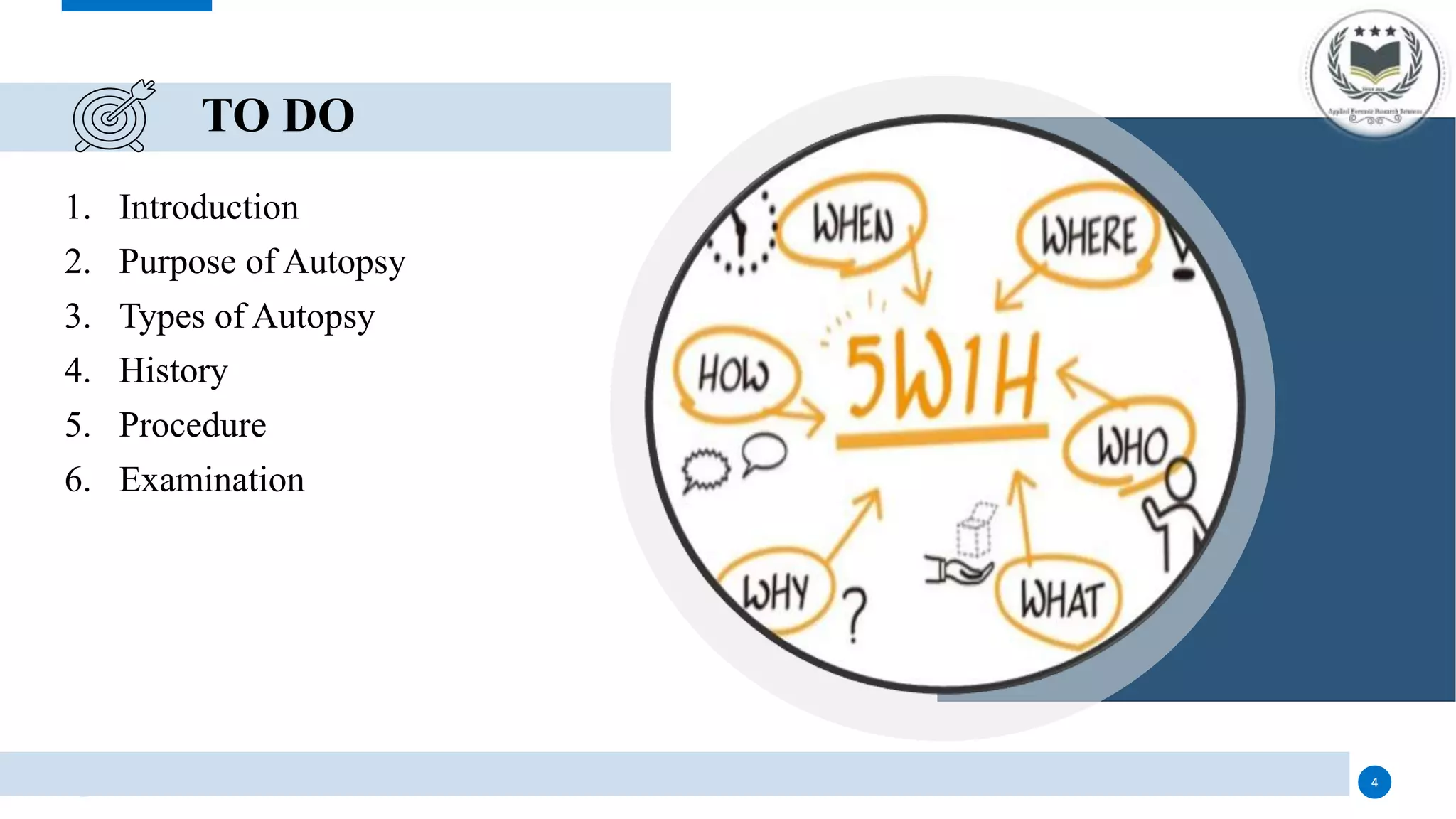
TO DO
4
1. Introduction
2. Purpose of Autopsy
3. Types of Autopsy
4. History
5. Procedure
6. Examination
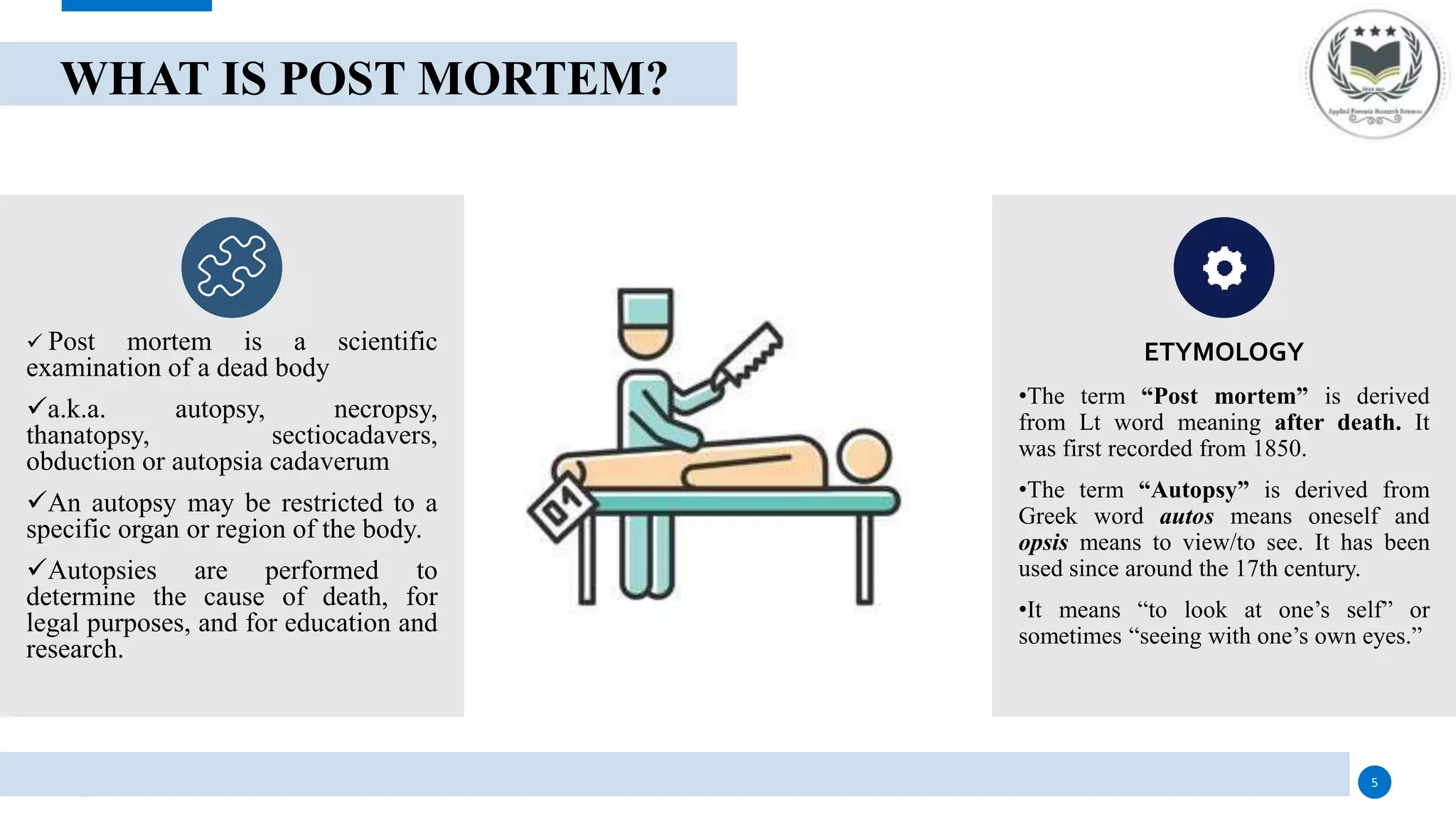
WHAT IS POST MORTEM?
 Post mortem is a scientific
examination of a dead body
a.k.a. autopsy, necropsy,
thanatopsy, sectiocadavers,
obduction or autopsia cadaverum
An autopsy may be restricted to a
specific organ or region of the body.
Autopsies are performed to
determine the cause of death, for
legal purposes, and for education and
research.
ETYMOLOGY
•The term “Post mortem” is derived
from Lt word meaning after death. It
was first recorded from 1850.
•The term “Autopsy” is derived from
Greek word autos means oneself and
opsis means to view/to see. It has been
used since around the 17th century.
•It means “to look at one’s self” or
sometimes “seeing with one’s own eyes.”
5
6
PURPOSE OF AUTOPSY
1. Cause of death
2. Mode of death
3. Manner of death
4. Identity
5. Injuries/ Poison/ weapon
6. Force of injury/trauma
7. Time of death
8. Place of death
9. Newborns
7
TYPES OFAUTOPSY
1. Academic/ Anatomical Autopsy
2. Pathological/ Clinical/hospital Autopsy
3. Medico legal/Forensic/coroner’s Autopsy
4. Psychological Autopsy
5. Virtual/Digital Autopsy
6. Endoscopic Autopsy
The post mortem should be carried out by the registered and authorized medical
practitioner, preferably with training in forensic medicine.
MEDICO LEGALAUTOPSY VS CLINICAL
AUTOPSY
MEDICO LEGAL AUTOPSY
Purpose: to determine mode,
manner, cause of death and
answer questions of interest of
legal system
Consent: from police/magistrate
is required
Purpose: to gain more insight
into pathological processes and
determine what factors
contributed to a patient's death.
Consent: from family of the
deceased person
CLINICAL AUTOPSY
8
9
HISTORY
Around 3000 BC, ancient Egyptians were one amongst the primary civilizations to practice the evisceration of
humans in the religious practice of mummification.
In 44 BC, Autistics was the first to examine Julius Caesar's body, after his assassination, he determined which of
the 23 stab wound was fatal. It was the wound of the chest
Dissection, 19th century US
Source: Wikipedia
• In the mid-19th century, Carl von Rokitansky and colleagues at
the Second Vienna Medical School began to undertake dissections as
a way to enhance diagnostic medicine.
• The 19th-century medical researcher Rudolf Virchow, established
and published specific autopsy protocols (one such protocol still bears
his name). He additionally developed the concept of pathological
processes.
• During the twentieth century, the Scotland Yard created the Office of
the Forensic Pathologist, a medical examiner trained in medicine,
charged with investigating the cause of all unnatural deaths, as well as
accidents, homicides, suicides, etc.
10
PROCEDURE
1. Authorization:
• It should be conducted only when there is an official order authorizing the autopsy, from the police or
Magistrate.
• All registered medical practitioners in government service can conduct the examination.
• No unauthorized person should be present at the autopsy.
• The medico-legal autopsy should be conducted in an authorized centre. The body should never be embalmed
before autopsy.
• It should be performed as soon as possible after receiving the requisition, without undue delay.
• The autopsy should be conducted in daylight
• Sometimes, if the body is received in the mortuary at night, it is preserved at 4°C after a preliminary
examination is done to note external appearances, body temperature, extent of postmortem staining and rigor
mortis.
2. Identification:
• A policeman or any other authorized person and 2 relatives should establish the identify the dead body, in front
of the autopsy surgeon.
11
PROCEDURE
3. Chain of evidence:
• It’s fully essential to preserve the chain of evidence by identifying the body and maintaining
absolute control of specimens removed at autopsy.
4. List of articles:
• A list is formed of all the articles removed from the body, e.g. clothes, jewelry, bullets, etc. They’re
labeled, sealed, within the report and handed over to the police constable after obtaining a receipt.
5. Visit to the scene of crime:
• If a visit to the scene of crime can be arranged, it is well worth undertaking in certain cases, such
as murder, poisoning, traffic accidents, firearm injuries and sexual offences.
12
EXAMINATION
I. EXTERNAL
 Clothing descriptions
 Height, weight, age, sex of deceased
 General features
 Check hands
 Skin color/ PM staining
 Eyes
 Temperature by palpating abdomen
 Injury
II. INTERNAL
• This includes dissection & examination of three major body
cavities and their contents.
 Cranial Cavity
 Thoracic Cavity
 Abdominal Cavity
• It is convenient to start the examination with the cavity
chiefly affected. The choice as to which part of the body is to
be opened first- skull/body cavities is left to the dissector.
• In suspected head injury-> Skull open first then thorax
and abdomen.
• In suspected asphyxial deaths-> Skull and abdomen are
opened first followed by dissection of neck.
•In all other cases-> thorax and abdomen are opened first
and then skull.
13
SKIN INCISION
Skin incisions are of three types:
i. I-shaped incision
• extending from the chin straight down to the symphysis pubis and avoiding the umbilicus
• Most common
ii. Y-shaped incision
• starts from two mastoid processes move medially to meet at the level of xipjisternum, from where
it goesd downwards exactly as I- shaped incision
• Uses in cases of neck trauma
iii. Modified Y-shaped incision
• Starts from below both anterior axillary folds, goes below the breasts, meets at xiphoid process and
moves down to symphysis pubis.
• Used in females
14
SKIN INCISION
THANKYOU!
afrsciences@gmail.com

Post Mortem Examination

  • 1.
  • 2.
    POST MORTEM EXAMINATION PRESENTED BY POOJAKUMARI VOLUNTEER OF APPLIED FORENSIC RESEARCH SCIENCES
  • 3.
    THE AUTOPSY TELLSUS EVERYTHING - John Pierce 3
  • 4.
    TO DO 4 1. Introduction 2.Purpose of Autopsy 3. Types of Autopsy 4. History 5. Procedure 6. Examination
  • 5.
    WHAT IS POSTMORTEM?  Post mortem is a scientific examination of a dead body a.k.a. autopsy, necropsy, thanatopsy, sectiocadavers, obduction or autopsia cadaverum An autopsy may be restricted to a specific organ or region of the body. Autopsies are performed to determine the cause of death, for legal purposes, and for education and research. ETYMOLOGY •The term “Post mortem” is derived from Lt word meaning after death. It was first recorded from 1850. •The term “Autopsy” is derived from Greek word autos means oneself and opsis means to view/to see. It has been used since around the 17th century. •It means “to look at one’s self” or sometimes “seeing with one’s own eyes.” 5
  • 6.
    6 PURPOSE OF AUTOPSY 1.Cause of death 2. Mode of death 3. Manner of death 4. Identity 5. Injuries/ Poison/ weapon 6. Force of injury/trauma 7. Time of death 8. Place of death 9. Newborns
  • 7.
    7 TYPES OFAUTOPSY 1. Academic/Anatomical Autopsy 2. Pathological/ Clinical/hospital Autopsy 3. Medico legal/Forensic/coroner’s Autopsy 4. Psychological Autopsy 5. Virtual/Digital Autopsy 6. Endoscopic Autopsy The post mortem should be carried out by the registered and authorized medical practitioner, preferably with training in forensic medicine.
  • 8.
    MEDICO LEGALAUTOPSY VSCLINICAL AUTOPSY MEDICO LEGAL AUTOPSY Purpose: to determine mode, manner, cause of death and answer questions of interest of legal system Consent: from police/magistrate is required Purpose: to gain more insight into pathological processes and determine what factors contributed to a patient's death. Consent: from family of the deceased person CLINICAL AUTOPSY 8
  • 9.
    9 HISTORY Around 3000 BC,ancient Egyptians were one amongst the primary civilizations to practice the evisceration of humans in the religious practice of mummification. In 44 BC, Autistics was the first to examine Julius Caesar's body, after his assassination, he determined which of the 23 stab wound was fatal. It was the wound of the chest Dissection, 19th century US Source: Wikipedia • In the mid-19th century, Carl von Rokitansky and colleagues at the Second Vienna Medical School began to undertake dissections as a way to enhance diagnostic medicine. • The 19th-century medical researcher Rudolf Virchow, established and published specific autopsy protocols (one such protocol still bears his name). He additionally developed the concept of pathological processes. • During the twentieth century, the Scotland Yard created the Office of the Forensic Pathologist, a medical examiner trained in medicine, charged with investigating the cause of all unnatural deaths, as well as accidents, homicides, suicides, etc.
  • 10.
    10 PROCEDURE 1. Authorization: • Itshould be conducted only when there is an official order authorizing the autopsy, from the police or Magistrate. • All registered medical practitioners in government service can conduct the examination. • No unauthorized person should be present at the autopsy. • The medico-legal autopsy should be conducted in an authorized centre. The body should never be embalmed before autopsy. • It should be performed as soon as possible after receiving the requisition, without undue delay. • The autopsy should be conducted in daylight • Sometimes, if the body is received in the mortuary at night, it is preserved at 4°C after a preliminary examination is done to note external appearances, body temperature, extent of postmortem staining and rigor mortis. 2. Identification: • A policeman or any other authorized person and 2 relatives should establish the identify the dead body, in front of the autopsy surgeon.
  • 11.
    11 PROCEDURE 3. Chain ofevidence: • It’s fully essential to preserve the chain of evidence by identifying the body and maintaining absolute control of specimens removed at autopsy. 4. List of articles: • A list is formed of all the articles removed from the body, e.g. clothes, jewelry, bullets, etc. They’re labeled, sealed, within the report and handed over to the police constable after obtaining a receipt. 5. Visit to the scene of crime: • If a visit to the scene of crime can be arranged, it is well worth undertaking in certain cases, such as murder, poisoning, traffic accidents, firearm injuries and sexual offences.
  • 12.
    12 EXAMINATION I. EXTERNAL  Clothingdescriptions  Height, weight, age, sex of deceased  General features  Check hands  Skin color/ PM staining  Eyes  Temperature by palpating abdomen  Injury II. INTERNAL • This includes dissection & examination of three major body cavities and their contents.  Cranial Cavity  Thoracic Cavity  Abdominal Cavity • It is convenient to start the examination with the cavity chiefly affected. The choice as to which part of the body is to be opened first- skull/body cavities is left to the dissector. • In suspected head injury-> Skull open first then thorax and abdomen. • In suspected asphyxial deaths-> Skull and abdomen are opened first followed by dissection of neck. •In all other cases-> thorax and abdomen are opened first and then skull.
  • 13.
    13 SKIN INCISION Skin incisionsare of three types: i. I-shaped incision • extending from the chin straight down to the symphysis pubis and avoiding the umbilicus • Most common ii. Y-shaped incision • starts from two mastoid processes move medially to meet at the level of xipjisternum, from where it goesd downwards exactly as I- shaped incision • Uses in cases of neck trauma iii. Modified Y-shaped incision • Starts from below both anterior axillary folds, goes below the breasts, meets at xiphoid process and moves down to symphysis pubis. • Used in females
  • 14.
  • 15.