By
  Jinosh Daniel
AN INQUEST IS AN ENQUIRY INTO THE
 CAUSE OF DEATH.

               or
AN INQUEST IS A LEGAL INQUIRY INTO THE
CIRCUMSTANCES AND THE CAUSE OF DEATH
OF A DECEASED PERSON IN CASES OF
SUDDEN, SUSPICIOUS AND UNNATURAL
DEATHS.
TYPES OF INQUEST

1.POLICE INQUEST

2.MAGISTRATE INQUEST

3.CORONER’S INQUEST

4.MEDICAL EXAMINER’S INQUEST.
At present, in India two types of inquest are
 followed,
1.POLICE INQUEST


2.MAGISTRATE’S INQUEST.
POLICE INQUEST.


 Conducted by an officer in charge of a police station.
 Its usually conducted by an officer of the rank of sub
  inspector of police.
 The police officer making the inquest is known as
  investigating officer(I.O.).
   Police inquest is conducted under S.174 of Cr PC if the
    police officer in charge receives information that a
    person has committed suicide, or has been killed by
    another or by an animal or by machinery or by an
    accident, or has died under circumstances raising a
    reasonable suspicion that some other person has
    committed an offence.
   Before the inquest is done by police it should be
    informed to the executive magistrate of the area.
   The inquest report prepared by the police is known as
    Panchnama.
   In case of any doubt regarding the cause of death or in
    case of any unnatural the body of deceased is sent by
    investigating officer for autopsy to the concerned
    medical officer with the inquest report.
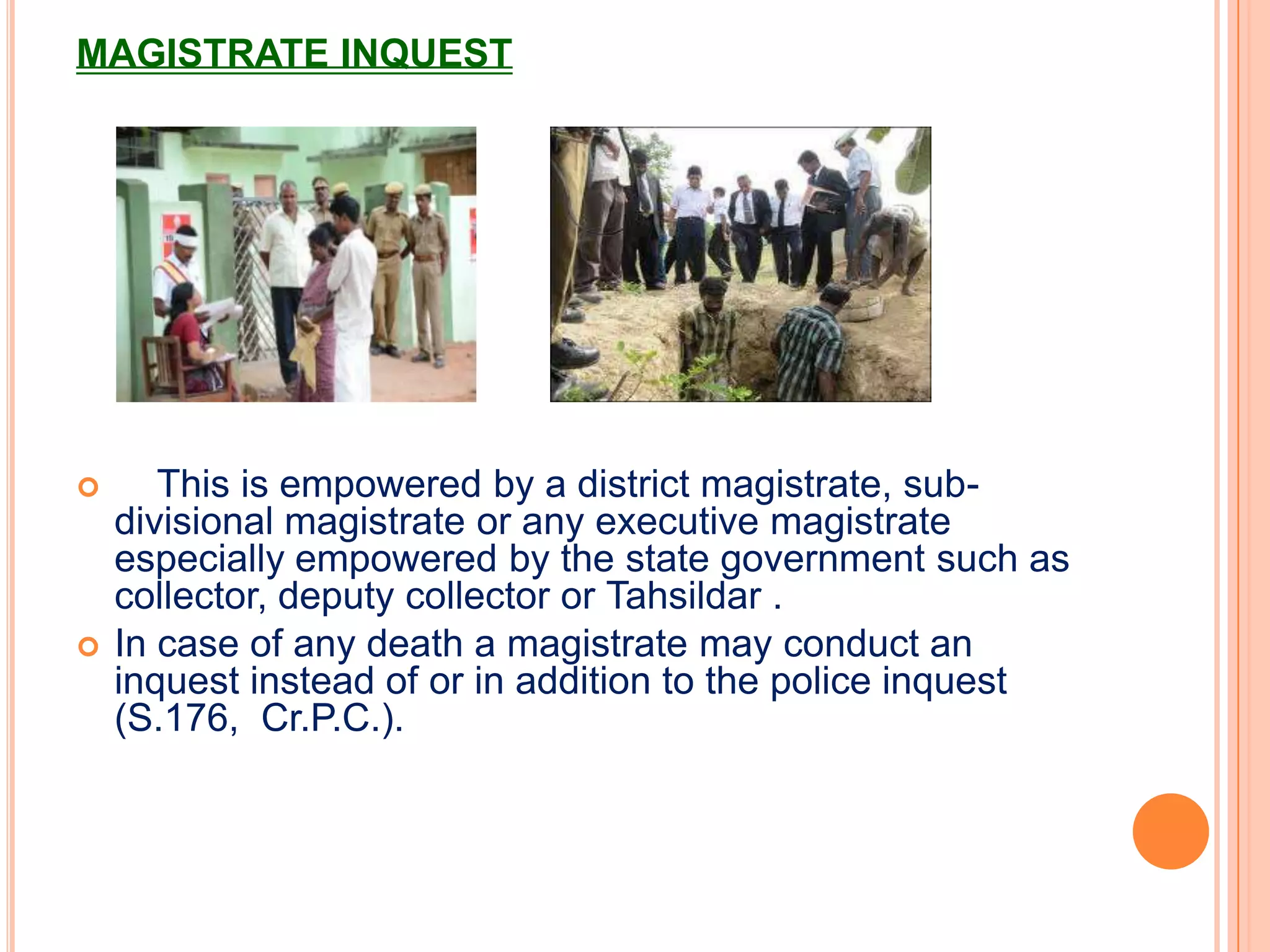
MAGISTRATE INQUEST


      This is empowered by a district magistrate, sub-
    divisional magistrate or any executive magistrate
    especially empowered by the state government such as
    collector, deputy collector or Tahsildar .
   In case of any death a magistrate may conduct an
    inquest instead of or in addition to the police inquest
    (S.176, Cr.P.C.).
Magistrate inquest is conducted in case of

   Death in prison
 Death in police custody and while under police
  interrogation
 Death due to police firing

 Death in a psychiatric hospital

 Dowry deaths

 Exhumation (S.174(4) and 176, S.CrP.C)
CORONER’S INQUEST.


    According to Coroner’s Act 1871 coroner’s inquest existed in
    Mumbai.
    Coroner used to be a special officer appointed by the
    government to inquire into causes of unnatural deaths. The
    Coroner was required to have a legal qualification and is usually
    an advocate, attorney, pleader, or first class magistrate, or a
    transferred metropolitan magistrate (all of whom must have a
    minimum of five years experience in the legal field). He held the
    rank of a First Class Judicial Magistrate.
   The coroners court was a court of inquiry and not a trial court.
    After conducting an enquiry into the cause of death, if the
    Coroner found ample evidence against some suspect, he would
    forward a copy of his inquisition report to the Commissioner of
    Police, and he would take further action in this regard
    Coroner’s court was discontinued on 29 July 1999.
Medical examiners system.


In countries like USA, Canada and Japan, medical
  examiners system is practiced. In this system all
  sudden, unnatural, unexpected or unexplained
  deaths are investigated by a medical examiner who
  is a forensic pathologist.
PROCEDURE UNDER A POLICE INQUEST.
Police inquest:


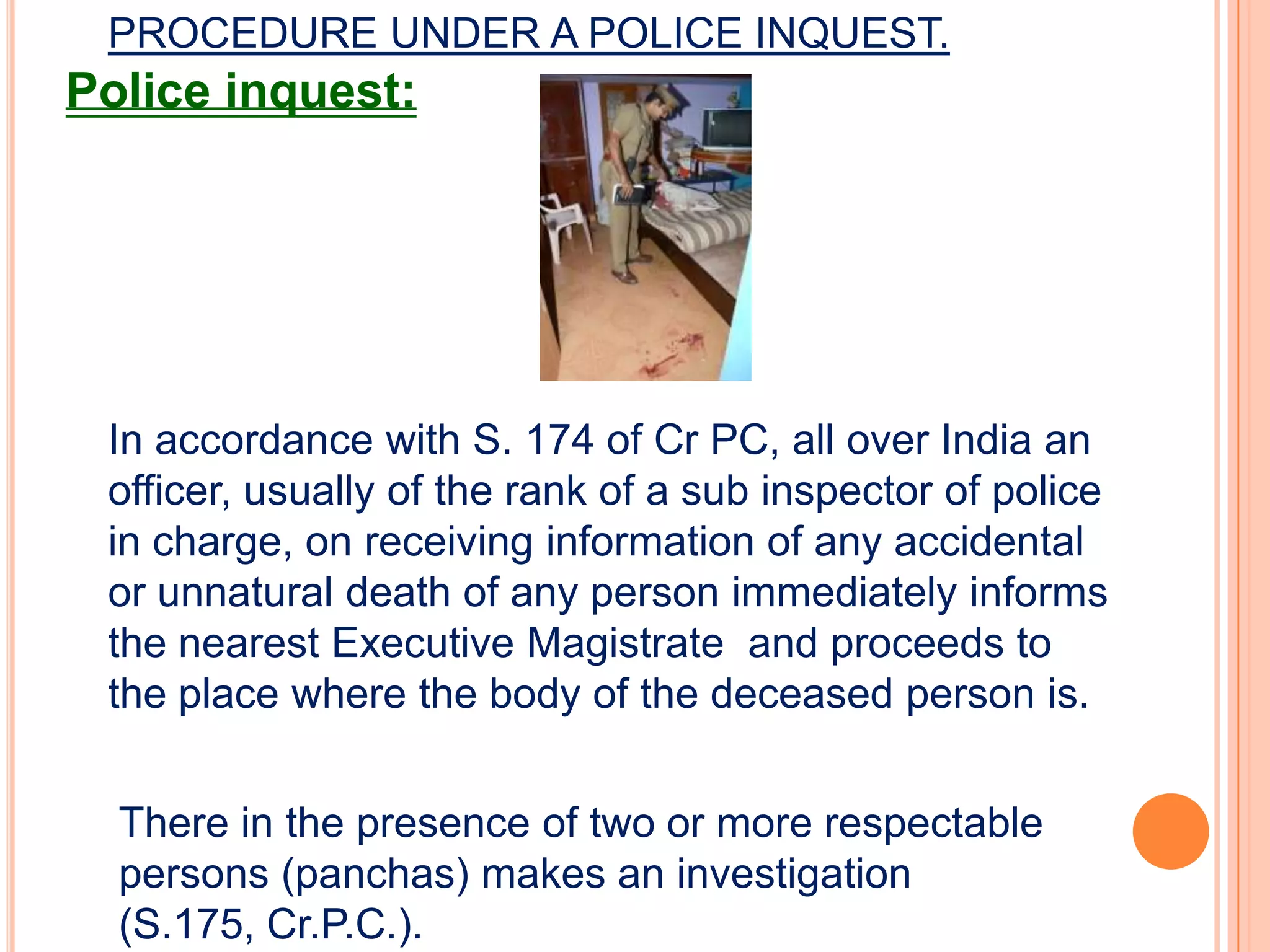
 In accordance with S. 174 of Cr PC, all over India an
 officer, usually of the rank of a sub inspector of police
 in charge, on receiving information of any accidental
 or unnatural death of any person immediately informs
 the nearest Executive Magistrate and proceeds to
 the place where the body of the deceased person is.


  There in the presence of two or more respectable
  persons (panchas) makes an investigation
  (S.175, Cr.P.C.).
He prepares report of the apparent cause of death. The
report contains (i) Brief facts of the case (ii) statements and
opinions of two or more relatives or neighbors or friends of
the deceased (iii) a sketch of the scene where the body is
lying (iv) a form filled up by the police officer himself, giving
details of injuries as visualized by him describing wounds,
fractures, bruises
,


and other marks of injury found on the body and stating in what
manner or by what weapon or instrument such injuries appear to
have been afflicted. (v) any treatment records, if the person was under
treatment for some disease or injury prior to his death (vi) a copy of the
MLC, if this was made at the time the patient was brought to the hospital
(vii) statement of the deceased prior to his death regarding his cause of
death(viii) suicide note of the deceased if this was found (ix) a copy of the
First Information Report (FIR), if this had been lodged with the police .
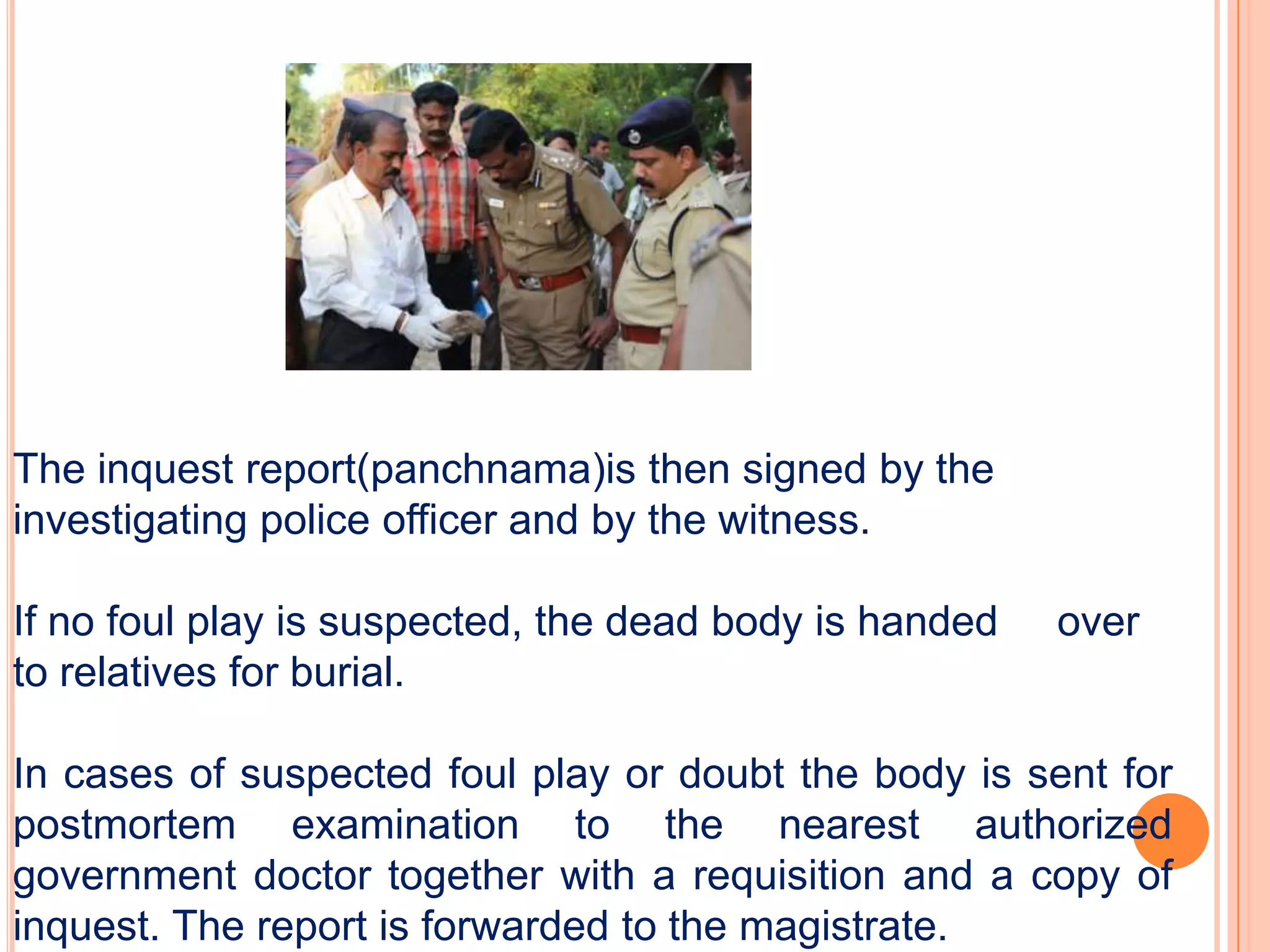
The inquest report(panchnama)is then signed by the
investigating police officer and by the witness.

If no foul play is suspected, the dead body is handed   over
to relatives for burial.

In cases of suspected foul play or doubt the body is sent for
postmortem examination to the nearest authorized
government doctor together with a requisition and a copy of
inquest. The report is forwarded to the magistrate.
According to s 162 of Cr Pc, when the investigating officer asks for
a statement, the medical officer has to give it unless otherwise
directed by any other rule prescribed by the state government.


After preparing the post-mortem report, the original is given to
the investigating officer and the duplicate is kept in the office
records for subsequent reference. It is studied by the doctor at
the time the he is summoned in that case by the court of law.


 Discrepancy between the inquest report and postmortem report.
 When the medical officer finds grave differences between the
 inquest and the autopsy, he can inform the investigating officer
 through the police constable to meet him at the earliest. Even if
 there is some discrepancy between the inquest report and the
 postmortem report, the list of injuries mentioned in the inquest
 report cannot prevail over the details of the postmortem report.
The police officer may summon the persons who appear to
know the facts of the case for investigation purposes. The
summoned person is bound to attend and answer question
put to him. Refusal to answer questions put to him is
punishable with imprisonment up to six months, under
S.179, I.P.C.
 Inquest - By Jinosh Daniel

Inquest - By Jinosh Daniel

  • 1.
    By JinoshDaniel
  • 2.
    AN INQUEST ISAN ENQUIRY INTO THE CAUSE OF DEATH. or AN INQUEST IS A LEGAL INQUIRY INTO THE CIRCUMSTANCES AND THE CAUSE OF DEATH OF A DECEASED PERSON IN CASES OF SUDDEN, SUSPICIOUS AND UNNATURAL DEATHS.
  • 3.
    TYPES OF INQUEST 1.POLICEINQUEST 2.MAGISTRATE INQUEST 3.CORONER’S INQUEST 4.MEDICAL EXAMINER’S INQUEST.
  • 4.
    At present, inIndia two types of inquest are followed, 1.POLICE INQUEST 2.MAGISTRATE’S INQUEST.
  • 5.
    POLICE INQUEST.  Conductedby an officer in charge of a police station.  Its usually conducted by an officer of the rank of sub inspector of police.  The police officer making the inquest is known as investigating officer(I.O.).
  • 6.
    Police inquest is conducted under S.174 of Cr PC if the police officer in charge receives information that a person has committed suicide, or has been killed by another or by an animal or by machinery or by an accident, or has died under circumstances raising a reasonable suspicion that some other person has committed an offence.  Before the inquest is done by police it should be informed to the executive magistrate of the area.  The inquest report prepared by the police is known as Panchnama.  In case of any doubt regarding the cause of death or in case of any unnatural the body of deceased is sent by investigating officer for autopsy to the concerned medical officer with the inquest report.
  • 7.
    MAGISTRATE INQUEST  This is empowered by a district magistrate, sub- divisional magistrate or any executive magistrate especially empowered by the state government such as collector, deputy collector or Tahsildar .  In case of any death a magistrate may conduct an inquest instead of or in addition to the police inquest (S.176, Cr.P.C.).
  • 8.
    Magistrate inquest isconducted in case of Death in prison  Death in police custody and while under police interrogation  Death due to police firing  Death in a psychiatric hospital  Dowry deaths  Exhumation (S.174(4) and 176, S.CrP.C)
  • 9.
    CORONER’S INQUEST.  According to Coroner’s Act 1871 coroner’s inquest existed in Mumbai.  Coroner used to be a special officer appointed by the government to inquire into causes of unnatural deaths. The Coroner was required to have a legal qualification and is usually an advocate, attorney, pleader, or first class magistrate, or a transferred metropolitan magistrate (all of whom must have a minimum of five years experience in the legal field). He held the rank of a First Class Judicial Magistrate.  The coroners court was a court of inquiry and not a trial court. After conducting an enquiry into the cause of death, if the Coroner found ample evidence against some suspect, he would forward a copy of his inquisition report to the Commissioner of Police, and he would take further action in this regard  Coroner’s court was discontinued on 29 July 1999.
  • 10.
    Medical examiners system. Incountries like USA, Canada and Japan, medical examiners system is practiced. In this system all sudden, unnatural, unexpected or unexplained deaths are investigated by a medical examiner who is a forensic pathologist.
  • 11.
    PROCEDURE UNDER APOLICE INQUEST. Police inquest: In accordance with S. 174 of Cr PC, all over India an officer, usually of the rank of a sub inspector of police in charge, on receiving information of any accidental or unnatural death of any person immediately informs the nearest Executive Magistrate and proceeds to the place where the body of the deceased person is. There in the presence of two or more respectable persons (panchas) makes an investigation (S.175, Cr.P.C.).
  • 12.
    He prepares reportof the apparent cause of death. The report contains (i) Brief facts of the case (ii) statements and opinions of two or more relatives or neighbors or friends of the deceased (iii) a sketch of the scene where the body is lying (iv) a form filled up by the police officer himself, giving details of injuries as visualized by him describing wounds, fractures, bruises
  • 13.
    , and other marksof injury found on the body and stating in what manner or by what weapon or instrument such injuries appear to have been afflicted. (v) any treatment records, if the person was under treatment for some disease or injury prior to his death (vi) a copy of the MLC, if this was made at the time the patient was brought to the hospital (vii) statement of the deceased prior to his death regarding his cause of death(viii) suicide note of the deceased if this was found (ix) a copy of the First Information Report (FIR), if this had been lodged with the police .
  • 14.
    The inquest report(panchnama)isthen signed by the investigating police officer and by the witness. If no foul play is suspected, the dead body is handed over to relatives for burial. In cases of suspected foul play or doubt the body is sent for postmortem examination to the nearest authorized government doctor together with a requisition and a copy of inquest. The report is forwarded to the magistrate.
  • 15.
    According to s162 of Cr Pc, when the investigating officer asks for a statement, the medical officer has to give it unless otherwise directed by any other rule prescribed by the state government. After preparing the post-mortem report, the original is given to the investigating officer and the duplicate is kept in the office records for subsequent reference. It is studied by the doctor at the time the he is summoned in that case by the court of law. Discrepancy between the inquest report and postmortem report. When the medical officer finds grave differences between the inquest and the autopsy, he can inform the investigating officer through the police constable to meet him at the earliest. Even if there is some discrepancy between the inquest report and the postmortem report, the list of injuries mentioned in the inquest report cannot prevail over the details of the postmortem report.
  • 16.
    The police officermay summon the persons who appear to know the facts of the case for investigation purposes. The summoned person is bound to attend and answer question put to him. Refusal to answer questions put to him is punishable with imprisonment up to six months, under S.179, I.P.C.