AUTOPSIES
Autopsy; also called necropsy, postmortem or postmortem
examination, is the dissection and examination of a dead body,
its organs and structures.
The term “autopsy” means “to see for oneself” and has been in
use in reference to determining cause of death by examining a
body since the 17th century.
Ancient Egyptians were one of the first civilizations to practice
the removal and examination of the internal organs of humans in
the religious practice of mummification.
Why have an Autopsy done
 Saving Lives: Autopsies can enhance our understanding of diseases
and how we die, and contribute critical medical knowledge. Forensic
pathologists have identified public health emergencies, such as the
anthrax terrorist attacks or other lethal infection diseases, as well as
public health hazards, such defective cribs that kill babies.
 Discovering Hereditary Illness: Autopsies can help family members
learn whether a relative died from an undiagnosed or misdiagnosed
illness or disease that may be hereditary. Dr. Gregory J. Davis at the
University of Kentucky College of Medicine says that 40 percent of
autopsies performed in the U.S. reveal disease states previously
unknown to physicians, in large part because the autopsy employs
techniques that cannot be used on the living.
 Providing Legal Evidence: Most of us think of autopsies in relation to
homicide cases, but there are other ways in which autopsies can provide
evidence for legal action. For example, if an autopsy determines a death to
be the result of a work or environmental hazard, it may lead to
compensation for family. If an autopsy reveals evidence of medical
malpractice, it may be the grounds for a lawsuit.
 Easing the Stress of the Unknown: Autopsies can also be an important
way for families and loved ones to seek reassurance or peace of mind after
death.
Types of Autopsies
There are two main types:
 Forensic: Examiner spends as much time on the external
surface as they do on the internal surface because that’s
where the evidence is. This is usually as a part of an overall
police investigation.
 Clinical: Usually preformed in hospitals by pathologists or the
attending physician to determine the cause of death for
research and study purposes.
Legally Defined manners of Death
 Natural- Heart attack, complications from an infection, blood
clot, pneumonia
 Accidental- Falling, Fire, Car wreck, extreme heat or cold
 Homicide- person killing another person
 Suicide- intentionally causing your own death
 Undetermined- unable to conclude how a person died
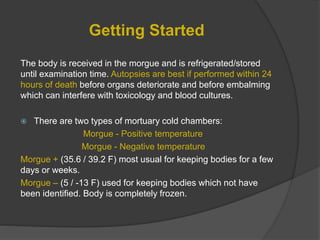
Getting Started
The body is received in the morgue and is refrigerated/stored
until examination time. Autopsies are best if performed within 24
hours of death before organs deteriorate and before embalming
which can interfere with toxicology and blood cultures.
 There are two types of mortuary cold chambers:
Morgue - Positive temperature
Morgue - Negative temperature
Morgue + (35.6 / 39.2 F) most usual for keeping bodies for a few
days or weeks.
Morgue – (5 / -13 F) used for keeping bodies which not have
been identified. Body is completely frozen.
Gather all information as possible about the deceased and
events that led to the death. This may include:
 Medical Records
 Consultation with doctor
 Interviewing family members
 Investigating the area where the person died
 Studying circumstances surrounding the death
 Consultation with police
 Body is weighed, measured and X-rayed
 Photographs are taken of the body (front, back & naked)
 Fingerprints are taken (if any missing, parts are noted)
 Scrape underneath fingernails for evidence
 Examination of clothes
 Age, sex and race are noted
 Eye color, scars, moles, tattoos are noted
 Examination of the eyes (blood spots & etc.)
 Any body secretions and gun powder residue/ bullet holes
 Body fluids are drawn from the body for testing (blood, urine, spinal
fluid, vitreous humour from the eye
 Body is cleaned and ready to be put on table
Equipment
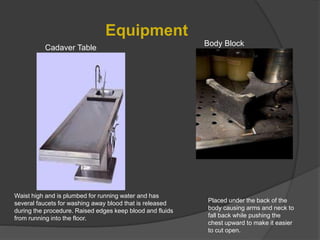
Waist high and is plumbed for running water and has
several faucets for washing away blood that is released
during the procedure. Raised edges keep blood and fluids
from running into the floor.
Body Block
Placed under the back of the
body causing arms and neck to
fall back while pushing the
chest upward to make it easier
to cut open.
Cadaver Table
Instruments
Procedure
Y-Incision: The Y-Incision is the procedure used by the
pathologist or examiner to open up the breastplate of the
deceased and gain access to the body's major organs;
heart, lungs, liver, stomach, spleen etc.
 All the organs are removed and weighed ( usually removed
in one unit but sometimes in sequence depending on the
trauma to the body).
 Slices of each organ are taken and tested
 Depending on type of death, stomach contents are removed,
examined and recorded
 If gun shot was involved, then any bullets would be removed
and documented and saved for evidence
After the main organs are examined the examiner proceeds to the
brain; (The body block is then moved to underneath the head)
 Deep incision begins behind one ear, travels over the top of the head and
behind the opposite ear.
 The scalp is pulled away from the skull in two flaps; front going over the face
and the rear going over the back of the neck so the skull is fully exposed.
 Electric saw known as the “ Stryker saw” is used to cut and remove a wedge
shape portion of the skull which exposes the brain.
 Brain is removed, weighed
and examined.
 Any findings noted
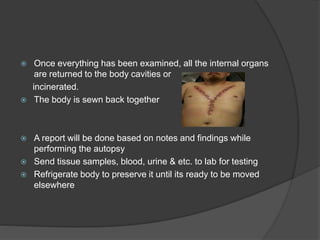
 Once everything has been examined, all the internal organs
are returned to the body cavities or
incinerated.
 The body is sewn back together
 A report will be done based on notes and findings while
performing the autopsy
 Send tissue samples, blood, urine & etc. to lab for testing
 Refrigerate body to preserve it until its ready to be moved
elsewhere
Once all test results are back, a final report will be
provided giving the findings of the autopsy and the
cause of death.
Example Autopsy Report
Interesting Facts
 In the 17th century, lacking chemical tests (and knowledge of
disease transmission mechanisms), Italian physicians and
autopsist Antonio Valsalva sometimes tasted the fluids he
encountered in cadavers in an effort to better characterize
them.
 In 1828 Irish immigrants William Burke and William Hare
partnered to murder 16 people in Scotland for cadaver
bounties paid for by a doctor who didn’t ask questions. Hare
testified against Burke who was hung in 1829. Burkes
cadaver was publicly dissected and his skeleton remains on
display at the University of Edinburg. Wallets made from his
skin which was stolen during the autopsy were offered for
sale on the streets.
 Accurately weighing small organs like the thyroid and
adrenals requires a triple-beam balance; all other organs are
plopped down on a ordinary grocer’s scale.
 At the end of an autopsy, the organs are either incinerated or
put in a bag and placed back in the body before its sewn
shut.
 In 1912, Boston physician Richard Cabot analyzed autopsies
and claimed that some diseases were being misdiagnosed at
an alarming rate of 80%. A 2005 study in Histopathology
suggests that doctors still misdiagnose fatal diseases about
a third of the time.

Autopsy Presentation.pptx

  • 1.
  • 2.
    Autopsy; also callednecropsy, postmortem or postmortem examination, is the dissection and examination of a dead body, its organs and structures.
  • 3.
    The term “autopsy”means “to see for oneself” and has been in use in reference to determining cause of death by examining a body since the 17th century. Ancient Egyptians were one of the first civilizations to practice the removal and examination of the internal organs of humans in the religious practice of mummification.
  • 4.
    Why have anAutopsy done  Saving Lives: Autopsies can enhance our understanding of diseases and how we die, and contribute critical medical knowledge. Forensic pathologists have identified public health emergencies, such as the anthrax terrorist attacks or other lethal infection diseases, as well as public health hazards, such defective cribs that kill babies.  Discovering Hereditary Illness: Autopsies can help family members learn whether a relative died from an undiagnosed or misdiagnosed illness or disease that may be hereditary. Dr. Gregory J. Davis at the University of Kentucky College of Medicine says that 40 percent of autopsies performed in the U.S. reveal disease states previously unknown to physicians, in large part because the autopsy employs techniques that cannot be used on the living.
  • 5.
     Providing LegalEvidence: Most of us think of autopsies in relation to homicide cases, but there are other ways in which autopsies can provide evidence for legal action. For example, if an autopsy determines a death to be the result of a work or environmental hazard, it may lead to compensation for family. If an autopsy reveals evidence of medical malpractice, it may be the grounds for a lawsuit.  Easing the Stress of the Unknown: Autopsies can also be an important way for families and loved ones to seek reassurance or peace of mind after death.
  • 6.
    Types of Autopsies Thereare two main types:  Forensic: Examiner spends as much time on the external surface as they do on the internal surface because that’s where the evidence is. This is usually as a part of an overall police investigation.  Clinical: Usually preformed in hospitals by pathologists or the attending physician to determine the cause of death for research and study purposes.
  • 7.
    Legally Defined mannersof Death  Natural- Heart attack, complications from an infection, blood clot, pneumonia  Accidental- Falling, Fire, Car wreck, extreme heat or cold  Homicide- person killing another person  Suicide- intentionally causing your own death  Undetermined- unable to conclude how a person died
  • 8.
    Getting Started The bodyis received in the morgue and is refrigerated/stored until examination time. Autopsies are best if performed within 24 hours of death before organs deteriorate and before embalming which can interfere with toxicology and blood cultures.  There are two types of mortuary cold chambers: Morgue - Positive temperature Morgue - Negative temperature Morgue + (35.6 / 39.2 F) most usual for keeping bodies for a few days or weeks. Morgue – (5 / -13 F) used for keeping bodies which not have been identified. Body is completely frozen.
  • 9.
    Gather all informationas possible about the deceased and events that led to the death. This may include:  Medical Records  Consultation with doctor  Interviewing family members  Investigating the area where the person died  Studying circumstances surrounding the death  Consultation with police
  • 10.
     Body isweighed, measured and X-rayed  Photographs are taken of the body (front, back & naked)  Fingerprints are taken (if any missing, parts are noted)  Scrape underneath fingernails for evidence  Examination of clothes  Age, sex and race are noted  Eye color, scars, moles, tattoos are noted  Examination of the eyes (blood spots & etc.)  Any body secretions and gun powder residue/ bullet holes  Body fluids are drawn from the body for testing (blood, urine, spinal fluid, vitreous humour from the eye  Body is cleaned and ready to be put on table
  • 12.
    Equipment Waist high andis plumbed for running water and has several faucets for washing away blood that is released during the procedure. Raised edges keep blood and fluids from running into the floor. Body Block Placed under the back of the body causing arms and neck to fall back while pushing the chest upward to make it easier to cut open. Cadaver Table
  • 13.
  • 14.
    Procedure Y-Incision: The Y-Incisionis the procedure used by the pathologist or examiner to open up the breastplate of the deceased and gain access to the body's major organs; heart, lungs, liver, stomach, spleen etc.
  • 15.
     All theorgans are removed and weighed ( usually removed in one unit but sometimes in sequence depending on the trauma to the body).  Slices of each organ are taken and tested  Depending on type of death, stomach contents are removed, examined and recorded  If gun shot was involved, then any bullets would be removed and documented and saved for evidence
  • 16.
    After the mainorgans are examined the examiner proceeds to the brain; (The body block is then moved to underneath the head)  Deep incision begins behind one ear, travels over the top of the head and behind the opposite ear.  The scalp is pulled away from the skull in two flaps; front going over the face and the rear going over the back of the neck so the skull is fully exposed.  Electric saw known as the “ Stryker saw” is used to cut and remove a wedge shape portion of the skull which exposes the brain.  Brain is removed, weighed and examined.  Any findings noted
  • 17.
     Once everythinghas been examined, all the internal organs are returned to the body cavities or incinerated.  The body is sewn back together  A report will be done based on notes and findings while performing the autopsy  Send tissue samples, blood, urine & etc. to lab for testing  Refrigerate body to preserve it until its ready to be moved elsewhere
  • 18.
    Once all testresults are back, a final report will be provided giving the findings of the autopsy and the cause of death.
  • 19.
  • 20.
    Interesting Facts  Inthe 17th century, lacking chemical tests (and knowledge of disease transmission mechanisms), Italian physicians and autopsist Antonio Valsalva sometimes tasted the fluids he encountered in cadavers in an effort to better characterize them.  In 1828 Irish immigrants William Burke and William Hare partnered to murder 16 people in Scotland for cadaver bounties paid for by a doctor who didn’t ask questions. Hare testified against Burke who was hung in 1829. Burkes cadaver was publicly dissected and his skeleton remains on display at the University of Edinburg. Wallets made from his skin which was stolen during the autopsy were offered for sale on the streets.
  • 21.
     Accurately weighingsmall organs like the thyroid and adrenals requires a triple-beam balance; all other organs are plopped down on a ordinary grocer’s scale.  At the end of an autopsy, the organs are either incinerated or put in a bag and placed back in the body before its sewn shut.  In 1912, Boston physician Richard Cabot analyzed autopsies and claimed that some diseases were being misdiagnosed at an alarming rate of 80%. A 2005 study in Histopathology suggests that doctors still misdiagnose fatal diseases about a third of the time.