MECHANICAL
INJURIES
TRAUMATOLOGY.
 The branch of forensic medicine
which deals with the study of
trauma and its effect on human
body is called TRAUMATOLOGY.
Important terms
 TRAUMA
– Insult to living tissues
– It applies as well as to emotional or
mental stress.
Important terms
 Injury: (Sec. 44 PPC)
– Any harm whatever illegally caused to a
person in body, mind, reputation or
property.
 Hurt: (Sec. 332 PPC)
– “Whoever causes pain, harm, disease,
infirmity or injury to any person or impairs,
disables or dismembers any organ of the
body or part of any person, without causing
his death is said to cause Hurt”
Important terms
 Wounds:
– A disruption of the normal structure of tissues
caused by the application of force to the body.
 Battery:
– “It is the actual application of unlawful force to
another” directly or indirectly.
CLASSIFICATION OF INJURIES
ON BASIS OF WEAPON USED
 1.Injuries caused by blunt weapon
– a. Bruise.
– b. Abrasion include scratch, graze , imprint.
– c. Laceration include evulsions , stretch, split.
 2.Injuries caused by sharp weapon
– a. Incised wound( cuts).
– b. Stab wounds ( puncture).
 3. Injuries caused by fire arms.
– a. smooth board weapon( shot gun injury).
– b. Rifled weapon include low & high velocity.
CLASSIFICATION OF INJURIES
ON BASIS OF WEAPON USED
 4. Thermal injuries
( injuries caused by heat & cold).
 5. Corrosive injuries
– a. Acid. b. Alkalies.
 6. Electricity.
– a. Low voltage. b. High voltage.
 7.Radiation injuries.
– a. Natural.
– b. Artificial.
4. Thermal injuries
1. Produced due to cold
a. local hypothermia
b. Frost bite
c. Trench foot
d. immersion foot
e. General hypothermia.
2. Produced due to heat.
a. burns
b. scalds
c. produced by gen. application of
heat.
( heat stroke, heat exhaustion, heat crams )
CLASSIFICATION OF INJURIES
ON BASIS OF Mechanics & Manner of infliction
 ON BASIS OF MECHANICS OF WOUND
PRODUCTION
– 1. Injuries caused to stationary subjects.
– 2. Injuries caused to moving subjects.
 ON BASIS OF MANNER OF INFLICTION.
– 1.Suicidal/ self inflicted.
– 2.Homicidal.
– 3. Accidental.
CLASSIFICATION OF INJURIES
ON BASIS OF Time of infliction & type of
energy
 DEPENDING UPON TIME OF INFLICTION
– 1. Ante mortem.
– 2.Postmortem.
 DEPENDING UPON TYPE OF ENERGY
– 1.Mechanical injuries.
– 2. Chemical injuries.
– 3. Electrical injuries.
– 4. Thermal injuries.
– 5. Radiation injuries.
LEGAL CLASSIFICATION
QISAS AND DIYYAT
ORDINANCE
 1.Itlaf-I- udw.
 2.Itlaf-I-salahiyat-I-udw.
 3.Shajaah
– a. Shajjah Khafifah.
– b. Shajjah Madihah.
– c. Shajjah Hashimah.
– d. Shajjah Munaqillah.
– e. Shajjah Ammah.
– f. Shajjah Damighah.
LEGAL CLASSIFICATION
QISAS AND DIYYAT
ORDINANCE
 4.Jurh.
– Jaifah.
– Ghayr Jaifah
1. damiyah
2. Badihah.
3. Mutlahimah.
4. Madihah.
5. Hashimah.
6. Munaqillah.
MECHANISM OF WOUND
PRODUCTION
FACTORS AFFECTING APPEARANCE OF
WOUND:
1) TYPES OF WEAPON.
2) EXECUTION OF MECHANICAL FORCE.
3) WEIGHT & VELOCITY OF THE AGENT.
4) ARCHITECTURAL DESIGN OF TISSUE.
5) RESISTANCE OF TISSUE.
6) MOVEMENT OF THE PART STRUCK.
1) TYPES OF WEAPON :
 DIRECTLY CONTROL SHAPE OF WOUND
e.g. INJURIES PRODUCED WITH SHARP/ BLUNT/
FIREARM WEAPONS.
2) EXECUTION OF MECHANICAL FORCE:
 INTERACTION B/W WEAPON & PART.
 TWO MANNERS OF APPLICATION OF FORCE.
i) DIRECT APPLICATION OF FORCE:
 PRODUCES WOUND AT POINT OF APPLICATION.
 IMPACT INJURIES
e.g.
 CLUB/ KICK/ BRICKS.
 LIGATURE MARKS.
 TEETH MARKS.
ii) INDIRECT APPLICATION OF FORCE
 PRODUCES WOUND AWAY FROM SITE OF IMPACT.
e.g.
 STRETCH LACERATION.
 DECELARERATION OF CRANIUM
WEIGHT & VELOCITY OF THE AGENT:
 DETERMINE THE WOUNDING POWER OF ANY MOVING
OBJECT.
 K.E = ½ mv2
 BRICK
 CLUB.
 BULLET.
 CHIEFLY PROPORTIONATE TO THEIR WEIGHT &
VELOCITY.
ARCHITECTURAL DESIGN :
 HUMAN BODY composed of DIFFERENT TISSUES
 SOFT & ELASTIC
e.g. SKIN/ FAT/ MUSCLE/ INTERNAL ORGAN.
 RIGID & LESS ELASTIC
e.g. LIGAMENT/ CARTILAGE.
 HARD HAVING LIMITED ELASTICITY e.g. BONE.
 ELASTICITY OF BONES.
 AGE OF PERSON & EXTENT OF CALCIFICATION.
 INFANTS - ELASTIC.
 ADULTS / OLD - BRITTLE. - easily break.
SHAPE OF BONE:
 LONG » LIMBS , RIBS.
 PLATE LIKE » VAULT OF SKULL/ CREST OF ILIUM.
 SHORT » BONES OF HANDS/ FEET.
PART OF BODY
 COMPACT » LIMBS
 CAVITY » ABDOMEN/ CHEST/ CRANIUM.
 ORGANS OF DIFFERENT SHAPES & CONSISTANCY.
e.g.
 SOLID » LIVER / SPLEEN / KIDNEY.
 SPONGY » LUNGS.
 HOLLOW SACS » STOMACH / INTESTINE/ HEART/ GALL
BLADDER/ URINARY BLADDER.
 IMPACT WITH SAME FORCE & SAME DIRECTION ON
DIFFERENT PARTS PRODUCE DIFFERENT INJURIES.
e.g.
 FOREHEAD » LACERATION
 BUTTOCK » BRUISE.
 RESISTANCE OF TISSUE:
 SOFT & ELASTIC TISSUE ABSORB FORCE.
 HARD & IN ELASTIC FRACTURED WITH SAME FORCE
EFFECT OF MOVEMENT OF THE PART.
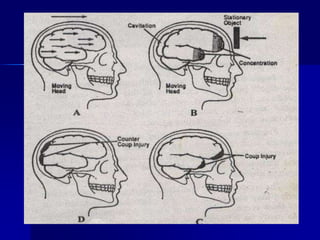
 STATIONARY PART OR IN MOTION
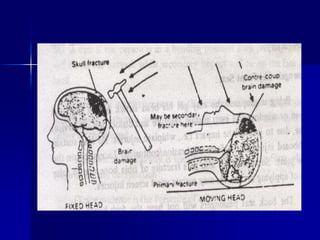
 STATIONARY HEAD PRODUCES INJURIES AT SITE OF IMPACT
 MOVING HEAD PRODUCES INJURIES ALSO OPPSITE SITE OF
THE IMPACT.
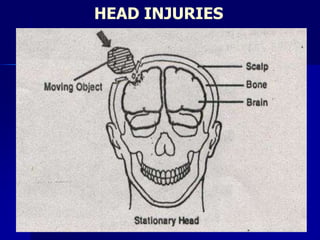
HEAD INJURIES
 COUP INJURIES
 A strike on a stationary head produces
injury of scalp, bone & brain at the
site of impact.
 CONTRE COUP INJURIES
 It is produced on the opposite side of
impact.
HEAD INJURIES
TIMING OF WOUNDS
1. NAKED EYE APPEARANCE OF WOUNDS
2. HISTOLAGICAL TIMING OF WOUNDS.
3. HISTOCHEMICAL TIMING OF WOUNDS.
4. BIOCHEMICAL TIMING OF WOUNDS.
Naked Eye appearance
of wounds
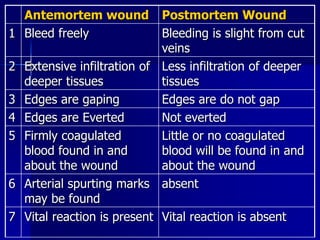
Some time it is possible to determine the
nature of wound, either antemortem or
postmortem.
Antemortem wound Postmortem Wound
1 Bleed freely Bleeding is slight from cut
veins
2 Extensive infiltration of
deeper tissues
Less infiltration of deeper
tissues
3 Edges are gaping Edges are do not gap
4 Edges are Everted Not everted
5 Firmly coagulated
blood found in and
about the wound
Little or no coagulated
blood will be found in and
about the wound
6 Arterial spurting marks
may be found
absent
7 Vital reaction is present Vital reaction is absent
Histological timing of the
Wound
 The histological estimation of the age
of injuries is based on the morphology
of various stages of wound healing.
1. Survival period less then
4 hours after injury
 No distinct histological signs of
inflammation.
 Histological distinction between
antemortem and postmortem wounds is
not possible during this period.
2. Survival period 4 to 16
hours.
 At 4 hours some neutrophil granulocytes
appear pericascularly.
 At 8-12 hours, polymorphnuclears,
macrophages and activated fibroblast
from a distinct peripheral wound zone.
 At 12- 16 hours granulocytes dominate
macrophages in the ratio of 5:1.
 Imminent necrosis in the central wound
zone.
3. Survival period 16 to 48
hours.
 At 16- 24 hours the relative number of macrophages
increases, the ratio of polymorphnuclears to
macraphages falling to 0.4.
 After 16 hours, older fibrin stains red with Martius
scarlet blue, whereas before 16 hours , newer fibrin
stains yellow.
 At 24 hours number of granulocytes and amount of
fibrin increase to maximum.
 At 24-48 hours, the epidermis grows from the
incised edge forward the centre of the wound.
 At 32 hours, necrosis is apparent in the central
wound zone.
 At 48 hours, macrophages reach their maximum
concentration in the peripheral zone.
4. Survival period 2 to 4
days
 At 2-4 days, fibroblasts migrate from the
nearby connective tissue to the wound
periphery.
 At 3-4 days, capillary buds appear.
 At 4-5 days, epithelialization of small
wounds and abrasions is complete.
5.Survival period 4 - 8
days.
 At 4 days, first collagen fibres are seen.
 At 4-5 days, there is a profuse ingrowth
of new capillaries.
 At 5-7 days, epidermal thickness
decreases to nearly normal.
 At 6 days, lymphocytes reach their
maximum concentration.
6. Survival period 8 -12
days
 At 8-12 days, there is decrease in the
number of leucocytes, fibroblasts and
capillaries.
 There is increase in the number and size
of collagen fibres.
7. Survival period over 12
days.
 At 12 days, there is definite regression of
cellular activity in the epidermis and dermis.
The vascularity of dermis diminishes.
 Collagen fibers are restored.
HISTOCHEMICAL TIMING
OF WOUNDS
 IT INVOLVES THE STUDY OF ENZYMES
IN THE WOUND REGION.
 In antemortem wounds, two distinct
zones of enzyme activity are seen.
1. The 100-300 micrometer deep
peripheral zone shows increase in
enzyme activity is called POSITIVE
VITAL REACTION.
2. The 200-500 micrometer deep central
zone shows a progressive loss of
enzyme activity is called NEGATIVE
VITAL REACTION.
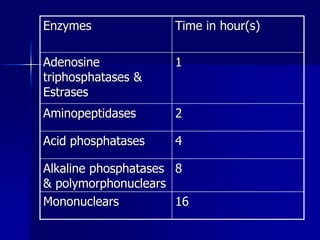
Enzymes Time in hour(s)
Adenosine
triphosphatases &
Estrases
1
Aminopeptidases 2
Acid phosphatases 4
Alkaline phosphatases
& polymorphonuclears
8
Mononuclears 16
Biochemical changes
 It depends upon the measurement of
HISTAMINE and SEROTONIN contents of
the injured skin.
Indications that the wound
was inflicted before death if :
 SEROTONIN:
The maximum increase occurs within
10 min and at least 2 fold after injury.
 HISTAMINE:
The maximum increase occurs within
20 – 30 min and 1.5 fold after injury.

Mechanical injury 1

  • 1.
  • 2.
    TRAUMATOLOGY.  The branchof forensic medicine which deals with the study of trauma and its effect on human body is called TRAUMATOLOGY.
  • 3.
    Important terms  TRAUMA –Insult to living tissues – It applies as well as to emotional or mental stress.
  • 4.
    Important terms  Injury:(Sec. 44 PPC) – Any harm whatever illegally caused to a person in body, mind, reputation or property.  Hurt: (Sec. 332 PPC) – “Whoever causes pain, harm, disease, infirmity or injury to any person or impairs, disables or dismembers any organ of the body or part of any person, without causing his death is said to cause Hurt”
  • 5.
    Important terms  Wounds: –A disruption of the normal structure of tissues caused by the application of force to the body.  Battery: – “It is the actual application of unlawful force to another” directly or indirectly.
  • 6.
    CLASSIFICATION OF INJURIES ONBASIS OF WEAPON USED  1.Injuries caused by blunt weapon – a. Bruise. – b. Abrasion include scratch, graze , imprint. – c. Laceration include evulsions , stretch, split.  2.Injuries caused by sharp weapon – a. Incised wound( cuts). – b. Stab wounds ( puncture).  3. Injuries caused by fire arms. – a. smooth board weapon( shot gun injury). – b. Rifled weapon include low & high velocity.
  • 7.
    CLASSIFICATION OF INJURIES ONBASIS OF WEAPON USED  4. Thermal injuries ( injuries caused by heat & cold).  5. Corrosive injuries – a. Acid. b. Alkalies.  6. Electricity. – a. Low voltage. b. High voltage.  7.Radiation injuries. – a. Natural. – b. Artificial.
  • 8.
    4. Thermal injuries 1.Produced due to cold a. local hypothermia b. Frost bite c. Trench foot d. immersion foot e. General hypothermia. 2. Produced due to heat. a. burns b. scalds c. produced by gen. application of heat. ( heat stroke, heat exhaustion, heat crams )
  • 9.
    CLASSIFICATION OF INJURIES ONBASIS OF Mechanics & Manner of infliction  ON BASIS OF MECHANICS OF WOUND PRODUCTION – 1. Injuries caused to stationary subjects. – 2. Injuries caused to moving subjects.  ON BASIS OF MANNER OF INFLICTION. – 1.Suicidal/ self inflicted. – 2.Homicidal. – 3. Accidental.
  • 10.
    CLASSIFICATION OF INJURIES ONBASIS OF Time of infliction & type of energy  DEPENDING UPON TIME OF INFLICTION – 1. Ante mortem. – 2.Postmortem.  DEPENDING UPON TYPE OF ENERGY – 1.Mechanical injuries. – 2. Chemical injuries. – 3. Electrical injuries. – 4. Thermal injuries. – 5. Radiation injuries.
  • 11.
    LEGAL CLASSIFICATION QISAS ANDDIYYAT ORDINANCE  1.Itlaf-I- udw.  2.Itlaf-I-salahiyat-I-udw.  3.Shajaah – a. Shajjah Khafifah. – b. Shajjah Madihah. – c. Shajjah Hashimah. – d. Shajjah Munaqillah. – e. Shajjah Ammah. – f. Shajjah Damighah.
  • 12.
    LEGAL CLASSIFICATION QISAS ANDDIYYAT ORDINANCE  4.Jurh. – Jaifah. – Ghayr Jaifah 1. damiyah 2. Badihah. 3. Mutlahimah. 4. Madihah. 5. Hashimah. 6. Munaqillah.
  • 13.
  • 14.
    FACTORS AFFECTING APPEARANCEOF WOUND: 1) TYPES OF WEAPON. 2) EXECUTION OF MECHANICAL FORCE. 3) WEIGHT & VELOCITY OF THE AGENT. 4) ARCHITECTURAL DESIGN OF TISSUE. 5) RESISTANCE OF TISSUE. 6) MOVEMENT OF THE PART STRUCK.
  • 15.
    1) TYPES OFWEAPON :  DIRECTLY CONTROL SHAPE OF WOUND e.g. INJURIES PRODUCED WITH SHARP/ BLUNT/ FIREARM WEAPONS. 2) EXECUTION OF MECHANICAL FORCE:  INTERACTION B/W WEAPON & PART.
  • 16.
     TWO MANNERSOF APPLICATION OF FORCE. i) DIRECT APPLICATION OF FORCE:  PRODUCES WOUND AT POINT OF APPLICATION.  IMPACT INJURIES e.g.  CLUB/ KICK/ BRICKS.  LIGATURE MARKS.  TEETH MARKS. ii) INDIRECT APPLICATION OF FORCE  PRODUCES WOUND AWAY FROM SITE OF IMPACT. e.g.  STRETCH LACERATION.  DECELARERATION OF CRANIUM
  • 17.
    WEIGHT & VELOCITYOF THE AGENT:  DETERMINE THE WOUNDING POWER OF ANY MOVING OBJECT.  K.E = ½ mv2  BRICK  CLUB.  BULLET.  CHIEFLY PROPORTIONATE TO THEIR WEIGHT & VELOCITY.
  • 18.
    ARCHITECTURAL DESIGN : HUMAN BODY composed of DIFFERENT TISSUES  SOFT & ELASTIC e.g. SKIN/ FAT/ MUSCLE/ INTERNAL ORGAN.  RIGID & LESS ELASTIC e.g. LIGAMENT/ CARTILAGE.  HARD HAVING LIMITED ELASTICITY e.g. BONE.  ELASTICITY OF BONES.  AGE OF PERSON & EXTENT OF CALCIFICATION.  INFANTS - ELASTIC.  ADULTS / OLD - BRITTLE. - easily break.
  • 19.
    SHAPE OF BONE: LONG » LIMBS , RIBS.  PLATE LIKE » VAULT OF SKULL/ CREST OF ILIUM.  SHORT » BONES OF HANDS/ FEET. PART OF BODY  COMPACT » LIMBS  CAVITY » ABDOMEN/ CHEST/ CRANIUM.  ORGANS OF DIFFERENT SHAPES & CONSISTANCY. e.g.  SOLID » LIVER / SPLEEN / KIDNEY.  SPONGY » LUNGS.  HOLLOW SACS » STOMACH / INTESTINE/ HEART/ GALL BLADDER/ URINARY BLADDER.
  • 20.
     IMPACT WITHSAME FORCE & SAME DIRECTION ON DIFFERENT PARTS PRODUCE DIFFERENT INJURIES. e.g.  FOREHEAD » LACERATION  BUTTOCK » BRUISE.  RESISTANCE OF TISSUE:  SOFT & ELASTIC TISSUE ABSORB FORCE.  HARD & IN ELASTIC FRACTURED WITH SAME FORCE
  • 21.
    EFFECT OF MOVEMENTOF THE PART.  STATIONARY PART OR IN MOTION  STATIONARY HEAD PRODUCES INJURIES AT SITE OF IMPACT  MOVING HEAD PRODUCES INJURIES ALSO OPPSITE SITE OF THE IMPACT.
  • 22.
    HEAD INJURIES  COUPINJURIES  A strike on a stationary head produces injury of scalp, bone & brain at the site of impact.  CONTRE COUP INJURIES  It is produced on the opposite side of impact.
  • 23.
  • 26.
    TIMING OF WOUNDS 1.NAKED EYE APPEARANCE OF WOUNDS 2. HISTOLAGICAL TIMING OF WOUNDS. 3. HISTOCHEMICAL TIMING OF WOUNDS. 4. BIOCHEMICAL TIMING OF WOUNDS.
  • 27.
    Naked Eye appearance ofwounds Some time it is possible to determine the nature of wound, either antemortem or postmortem.
  • 28.
    Antemortem wound PostmortemWound 1 Bleed freely Bleeding is slight from cut veins 2 Extensive infiltration of deeper tissues Less infiltration of deeper tissues 3 Edges are gaping Edges are do not gap 4 Edges are Everted Not everted 5 Firmly coagulated blood found in and about the wound Little or no coagulated blood will be found in and about the wound 6 Arterial spurting marks may be found absent 7 Vital reaction is present Vital reaction is absent
  • 29.
    Histological timing ofthe Wound  The histological estimation of the age of injuries is based on the morphology of various stages of wound healing.
  • 30.
    1. Survival periodless then 4 hours after injury  No distinct histological signs of inflammation.  Histological distinction between antemortem and postmortem wounds is not possible during this period.
  • 31.
    2. Survival period4 to 16 hours.  At 4 hours some neutrophil granulocytes appear pericascularly.  At 8-12 hours, polymorphnuclears, macrophages and activated fibroblast from a distinct peripheral wound zone.  At 12- 16 hours granulocytes dominate macrophages in the ratio of 5:1.  Imminent necrosis in the central wound zone.
  • 32.
    3. Survival period16 to 48 hours.  At 16- 24 hours the relative number of macrophages increases, the ratio of polymorphnuclears to macraphages falling to 0.4.  After 16 hours, older fibrin stains red with Martius scarlet blue, whereas before 16 hours , newer fibrin stains yellow.  At 24 hours number of granulocytes and amount of fibrin increase to maximum.  At 24-48 hours, the epidermis grows from the incised edge forward the centre of the wound.  At 32 hours, necrosis is apparent in the central wound zone.  At 48 hours, macrophages reach their maximum concentration in the peripheral zone.
  • 33.
    4. Survival period2 to 4 days  At 2-4 days, fibroblasts migrate from the nearby connective tissue to the wound periphery.  At 3-4 days, capillary buds appear.  At 4-5 days, epithelialization of small wounds and abrasions is complete.
  • 34.
    5.Survival period 4- 8 days.  At 4 days, first collagen fibres are seen.  At 4-5 days, there is a profuse ingrowth of new capillaries.  At 5-7 days, epidermal thickness decreases to nearly normal.  At 6 days, lymphocytes reach their maximum concentration.
  • 35.
    6. Survival period8 -12 days  At 8-12 days, there is decrease in the number of leucocytes, fibroblasts and capillaries.  There is increase in the number and size of collagen fibres.
  • 36.
    7. Survival periodover 12 days.  At 12 days, there is definite regression of cellular activity in the epidermis and dermis. The vascularity of dermis diminishes.  Collagen fibers are restored.
  • 37.
    HISTOCHEMICAL TIMING OF WOUNDS IT INVOLVES THE STUDY OF ENZYMES IN THE WOUND REGION.  In antemortem wounds, two distinct zones of enzyme activity are seen.
  • 38.
    1. The 100-300micrometer deep peripheral zone shows increase in enzyme activity is called POSITIVE VITAL REACTION. 2. The 200-500 micrometer deep central zone shows a progressive loss of enzyme activity is called NEGATIVE VITAL REACTION.
  • 39.
    Enzymes Time inhour(s) Adenosine triphosphatases & Estrases 1 Aminopeptidases 2 Acid phosphatases 4 Alkaline phosphatases & polymorphonuclears 8 Mononuclears 16
  • 40.
    Biochemical changes  Itdepends upon the measurement of HISTAMINE and SEROTONIN contents of the injured skin.
  • 41.
    Indications that thewound was inflicted before death if :  SEROTONIN: The maximum increase occurs within 10 min and at least 2 fold after injury.  HISTAMINE: The maximum increase occurs within 20 – 30 min and 1.5 fold after injury.