LACERATED WOUNDS,
INCISED WOUNDS
STAB WOUNDS
FABRICATED WOUNDS
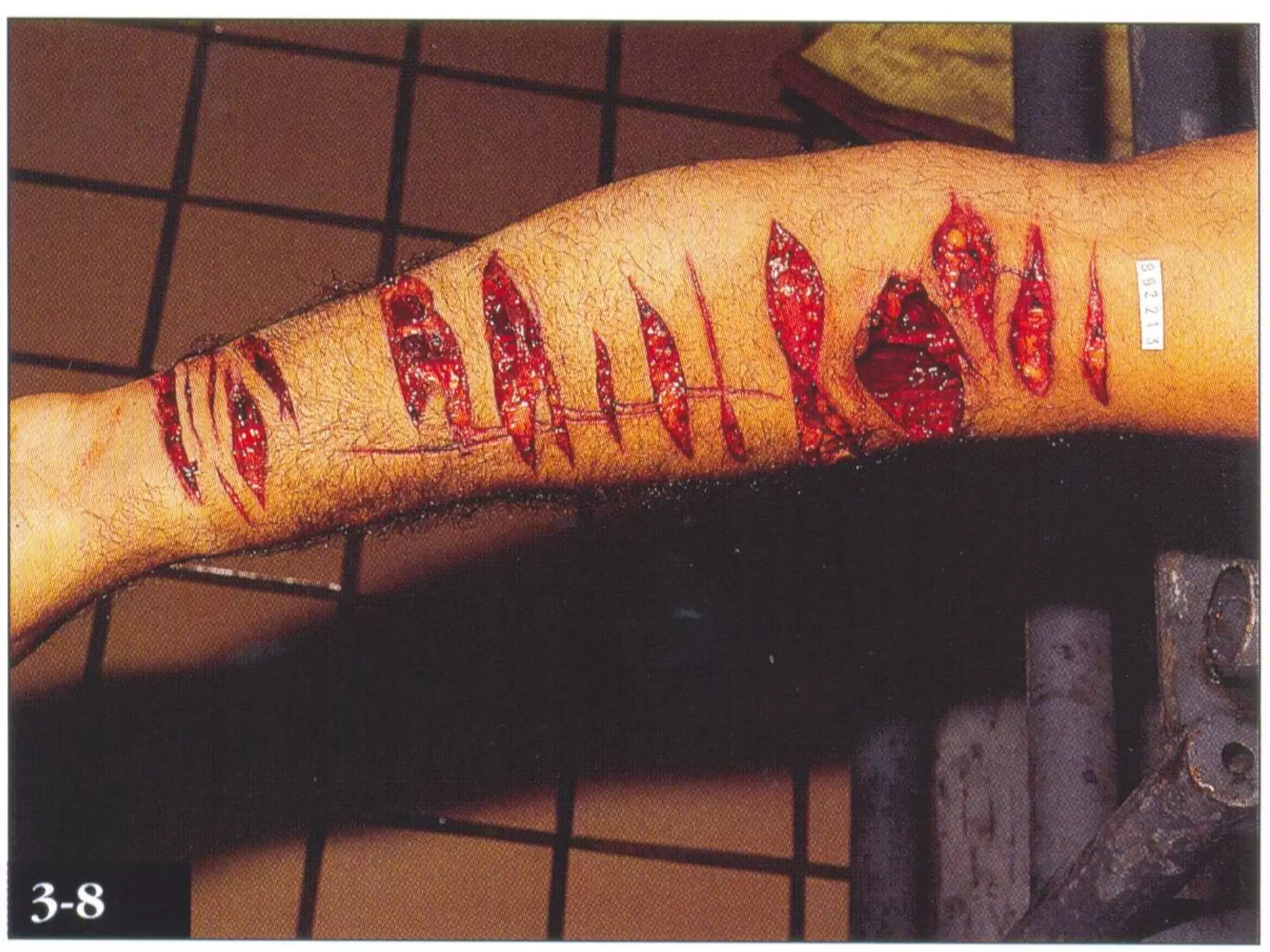
LACERATION:
DEFINITION: A laceration is a rupture or tear or a split
in the skin, mucous membrane, muscle, any
internal organ or underlying tissues as a result of
application of blunt force.
CAUSATIVE WEAPON:
Blows with club, stones, bricks, punch, kicks, iron
bars.
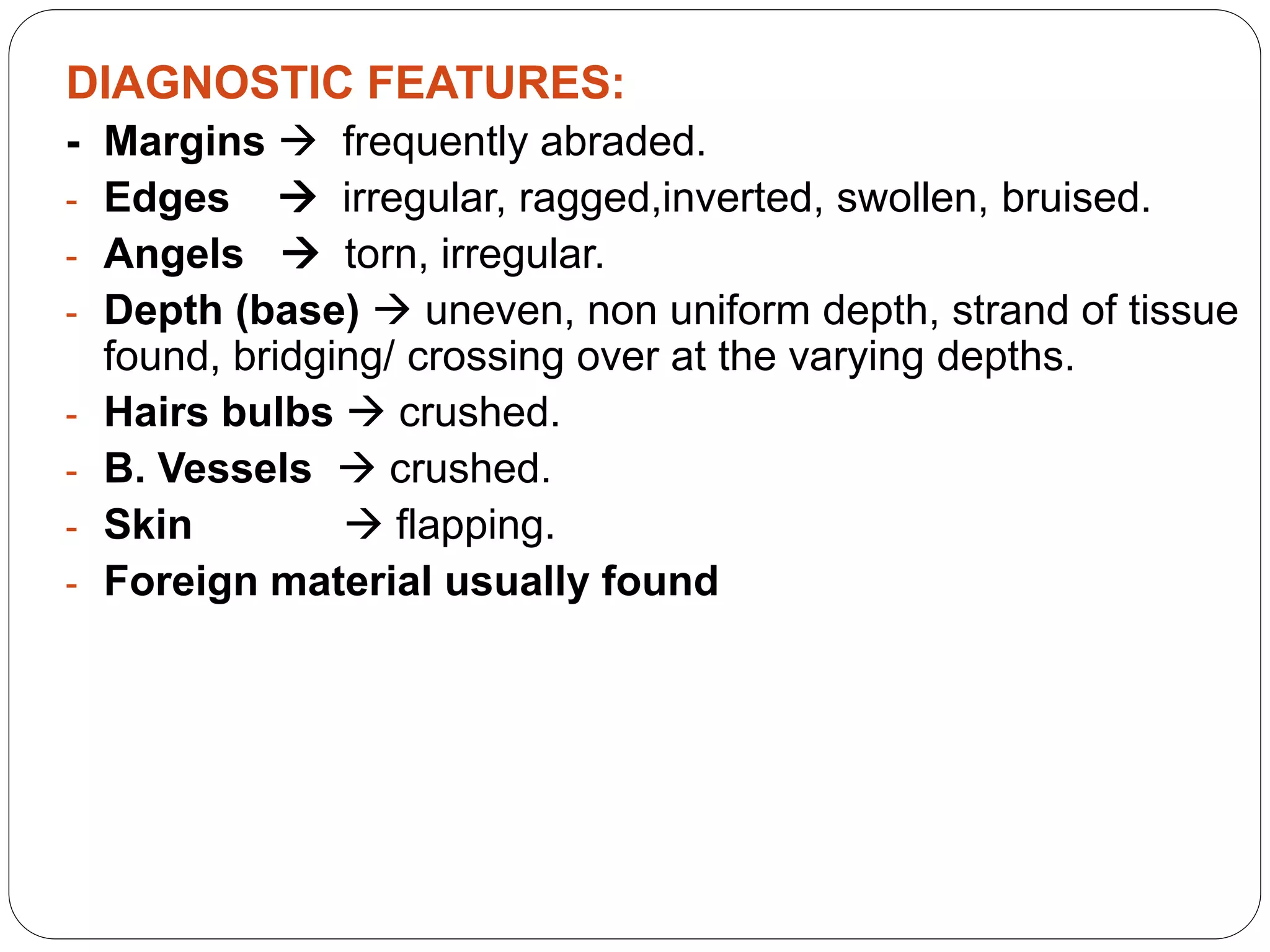
DIAGNOSTIC FEATURES:
- Margins  frequently abraded.
- Edges  irregular, ragged,inverted, swollen, bruised.
- Angels  torn, irregular.
- Depth (base)  uneven, non uniform depth, strand of tissue
found, bridging/ crossing over at the varying depths.
- Hairs bulbs  crushed.
- B. Vessels  crushed.
- Skin  flapping.
- Foreign material usually found
4
Besides blows from blunt objects
Lacerations are also caused by
 Fall on hard surfaces
 Machinery
 Traffic accidents
MECHANISM OF CAUSATION OR TYPES:
On the basis of mechanism of causation
laceration.
 1) Split / slit laceration.
 2) Stretch laceration
 3) Avulsion/grinding compression of skin
 4) Tears
 5) INTERNAL LACERATIONS
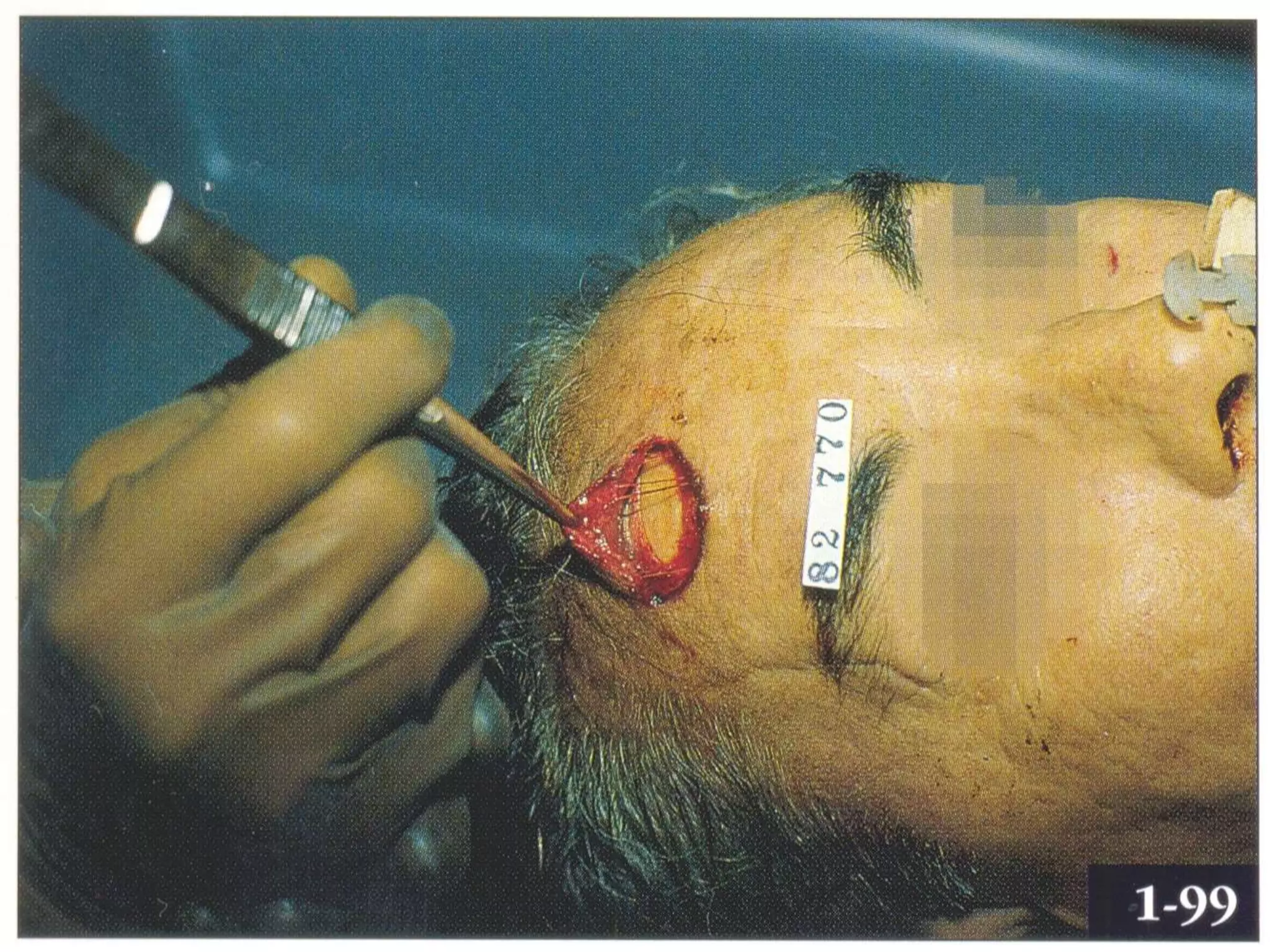
1) split / slit laceration.
Splitting of skin and underlying tissues occur, when there
is compression/ crushing of the affected tissue between
two hard objects that is bone & blunt instrument or ground.
Impact is perpendicular.
Example: commonly seen over scalp, cheek (zygomatic
arches) chin, eye brow etc.
Resemblance: apparently or on cursory examination they are
confused with incised wounds.
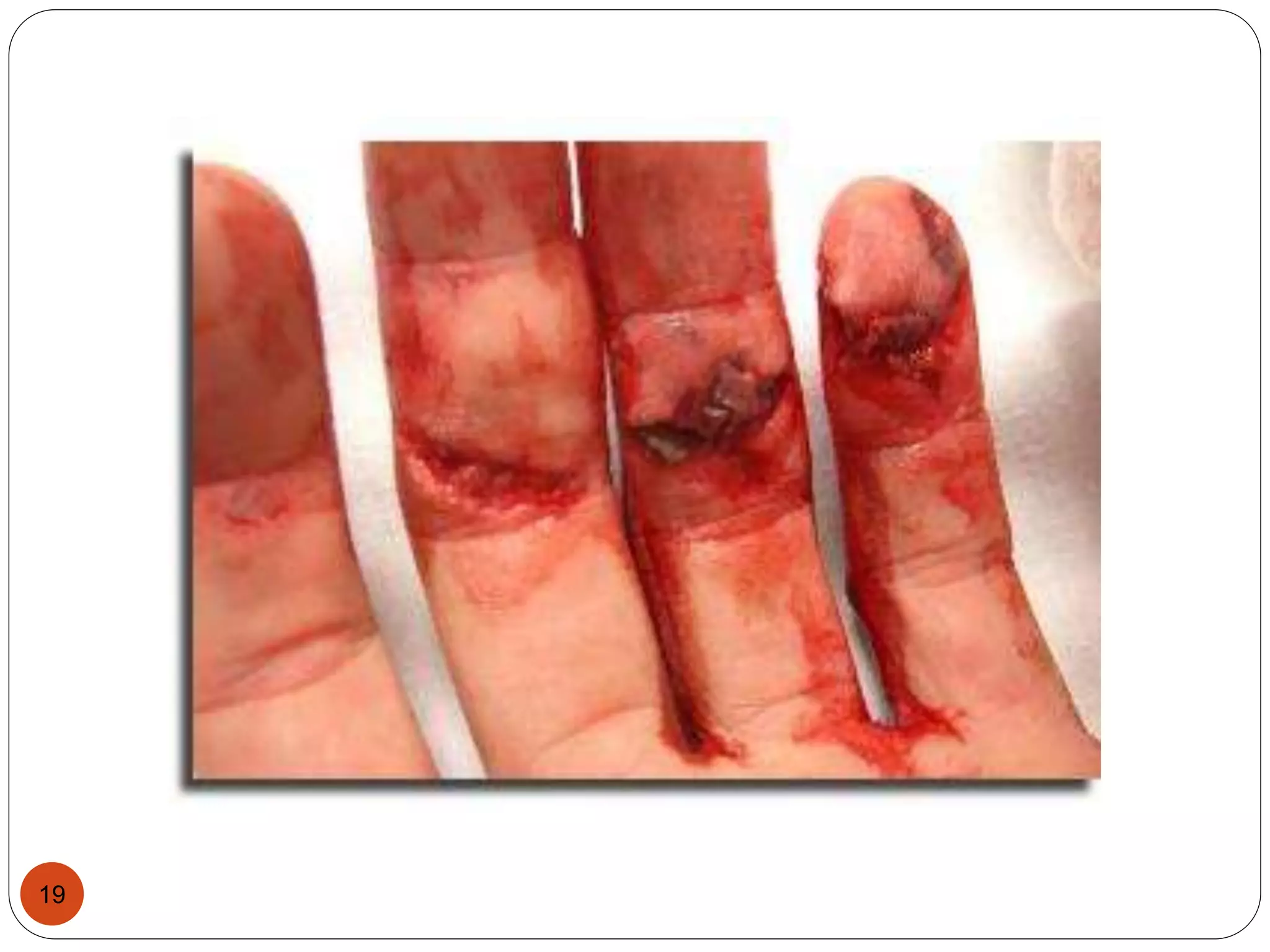
2) STRETCH LACERATION
2) STRETCH LACERATION:-
It refers to laceration caused by overstretching of the
skin to produce a flap by Blunt tangential impact.
PRODUCED BY
 Blunt tangential impact
 Sudden deformity of bone occurring after fracture.
 Glancing kicks with a boot
9
COMMONLY SEEN IN
 Areas of body where skin is supported
loosely like wrist, forearm, axilla, abdomen
 Industry - when parts of body get trapped in
running belts.
 Road traffic accidents
10
3) AVULSION/GRINDING COMPRESSION OF SKIN
 It refers to the lacerations caused by grinding
compression of tissues causing de-gloving of skin and
crushing of the underlying muscles. These result from
Horizontal impact.
 Localized pressure due to heavy weight causes tearing of
skin, crushing of muscles & separation of skin from the
underlying tissues, forming a space.
 There will be extravasation of blood, foreign bodies in the
potential space. Impact is horizontal.
12
 The underlying muscles are crushed.
 The bones may be fractured.
4) TEARS:
There is irregular tearing of skin & tissues.
lacerations caused by impact against irregular or sharp projecting
object.
This is another form of over stretching.
Example: broken bottles or motor car door handles.
14
5. INTERNAL LACERATIONS
 Blunt force exceeds the tensile strength
and elasticity of an organ laceration may
produced.
 May or may not be an abrasion at the site
of impact.
15
MEDICO-LEGAL IMPORTANCE
OF LACERATION
 May Indicate:
 The cause of the injury
 The shape of the blunt weapon e.g Hammer-crescentic
laceration
 Blunt pointed rod – stellate laceration
16
ANTE-MORTEM / POST-MORTEM
 Can be easily ascertained
Accidental Laceration (most common)
 Exposed parts of the body
Homicidal Laceration
 Usually seen on the head
Suicidal Laceration (rare)
 Seen in mental patients
18
19
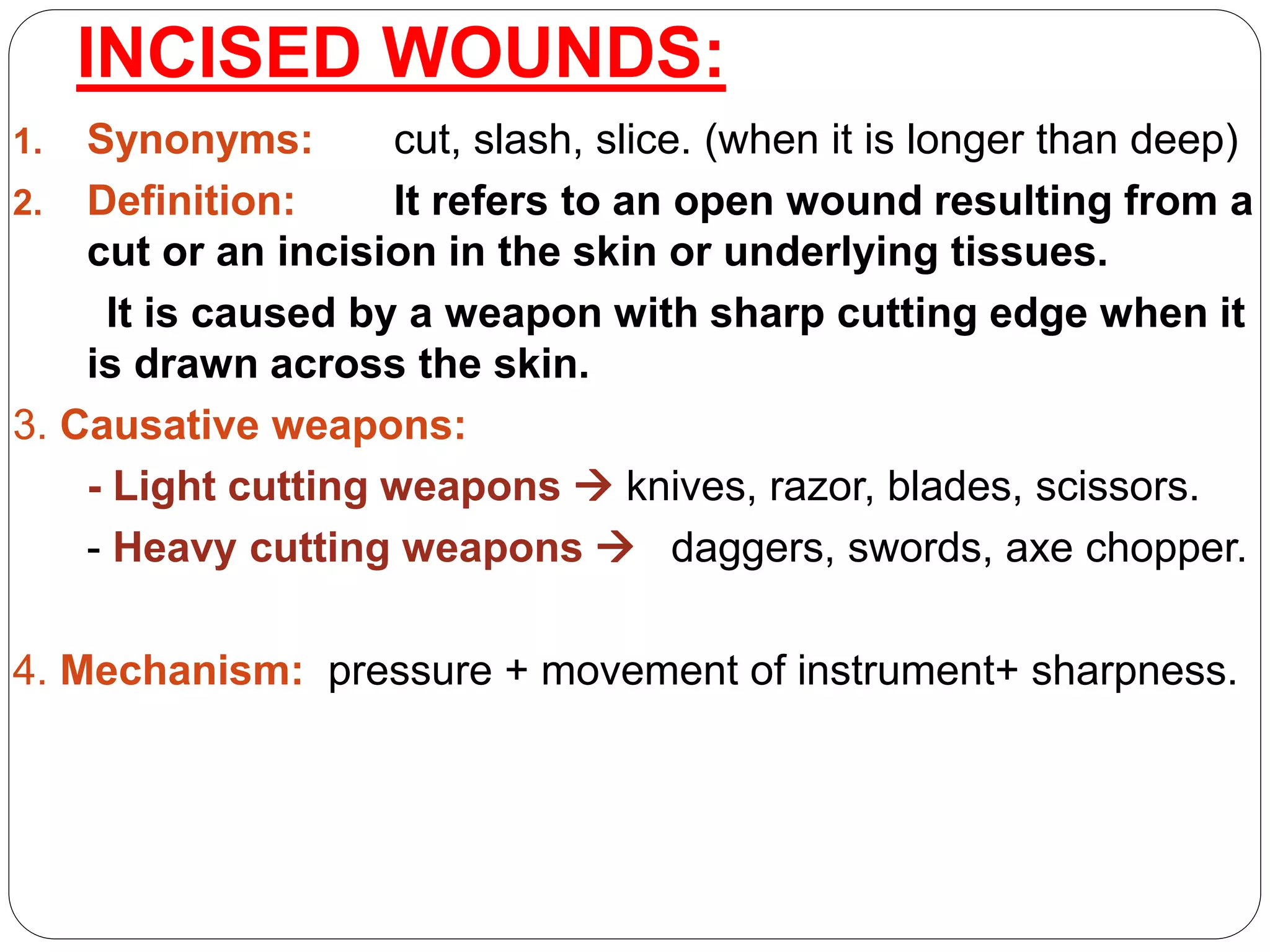
INCISED WOUNDS:
1. Synonyms: cut, slash, slice. (when it is longer than deep)
2. Definition: It refers to an open wound resulting from a
cut or an incision in the skin or underlying tissues.
It is caused by a weapon with sharp cutting edge when it
is drawn across the skin.
3. Causative weapons:
- Light cutting weapons  knives, razor, blades, scissors.
- Heavy cutting weapons  daggers, swords, axe chopper.
4. Mechanism: pressure + movement of instrument+ sharpness.
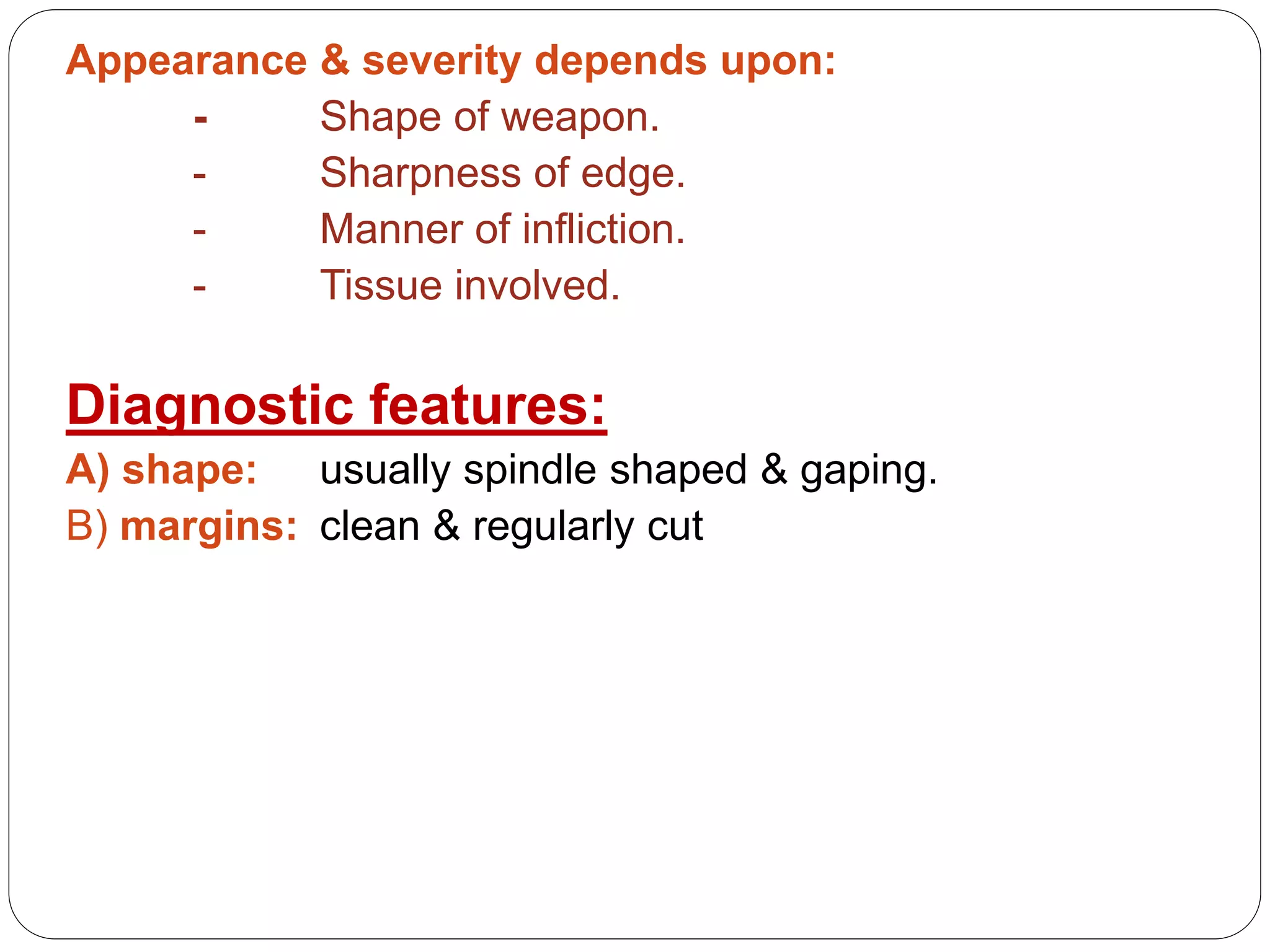
Appearance & severity depends upon:
- Shape of weapon.
- Sharpness of edge.
- Manner of infliction.
- Tissue involved.
Diagnostic features:
A) shape: usually spindle shaped & gaping.
B) margins: clean & regularly cut
C) edges: sharp, evenly divided, everted, smooth,
D) angles: sharp , acute.
E) base: intervening deeper tissues are cleanly & evenly
divided.
F) dimensions: length is greater than depth and Width of wound
is.
G) bleeding: bleed freely & profusely (vessels are cut).
H) tailing: gradual decrease in depth of wound is seen towards
terminal end. So a superficial wound involving only skin is seen.
This is called “ tailing of the wound”. Tailing indicates direction of
force.
I) clothes: cuts on clothes may correspond with the wound but
if the clothes are loose, folded or drawn up during struggle, cuts
in clothes may not coincide with the wounds.
MEDICOLEGAL ASPECTS
 SURGICAL
 ACCIDENTAL
 HOMICIDAL
 DISFIGURMENT
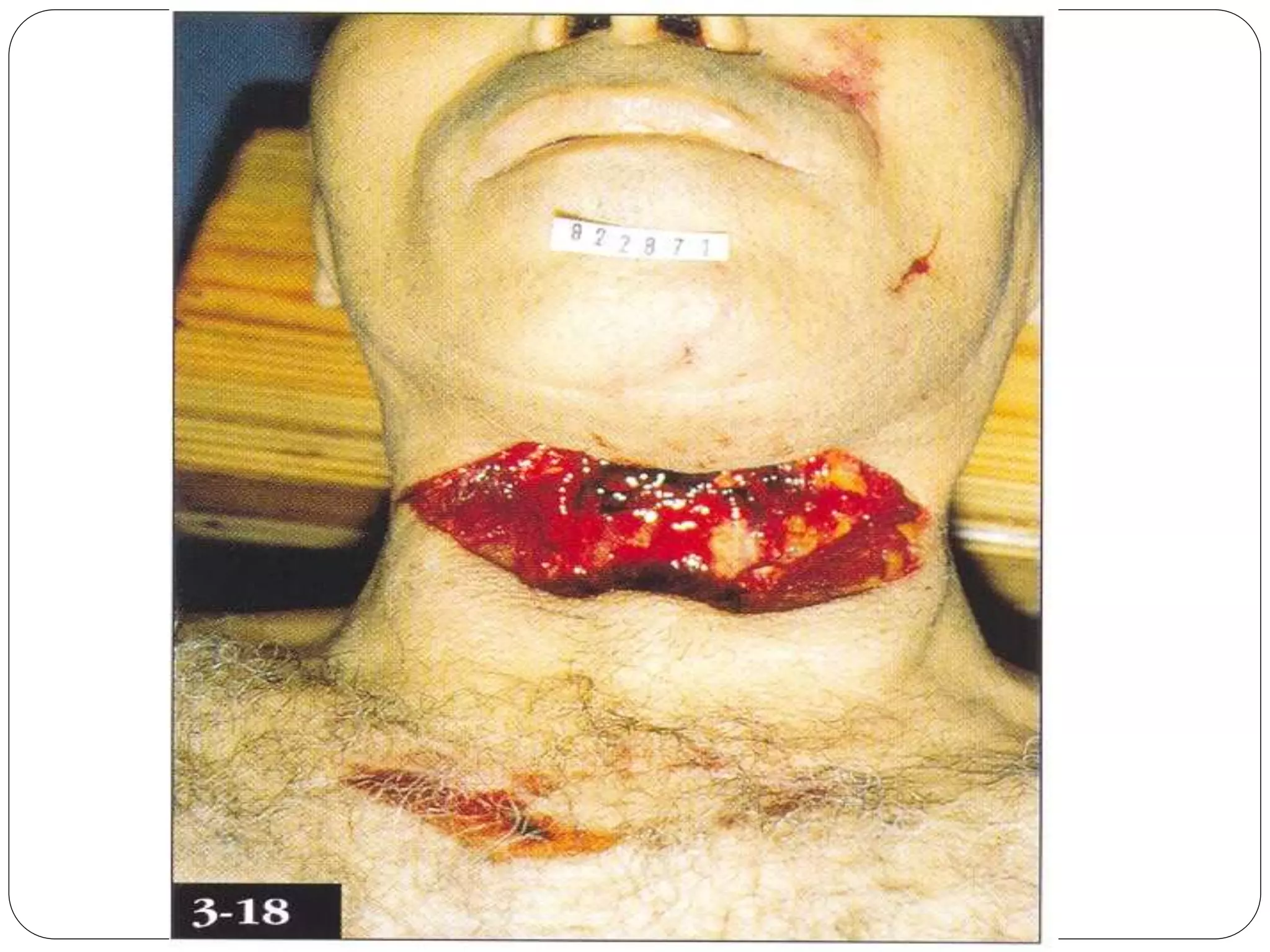
SUICIDAL: FOUND ON CERTAIN ELECTIVE SITES.
= SIDES + FRONT OF NECK.
= FRONT OF WRIST (RADIAL ARTERY).
= FRONT OF THIGH (FEMORAL).
= FRONT OF CHEST (HEART).
FEATURES:
MULTIPLE,
SUPER IMPOSED,
PARALLEL OF VARYING DEPTHS
FOUND ON OPPOSITE SIDE OF THE WORKING,
HESITATION OR TENTATIVE CUTS.
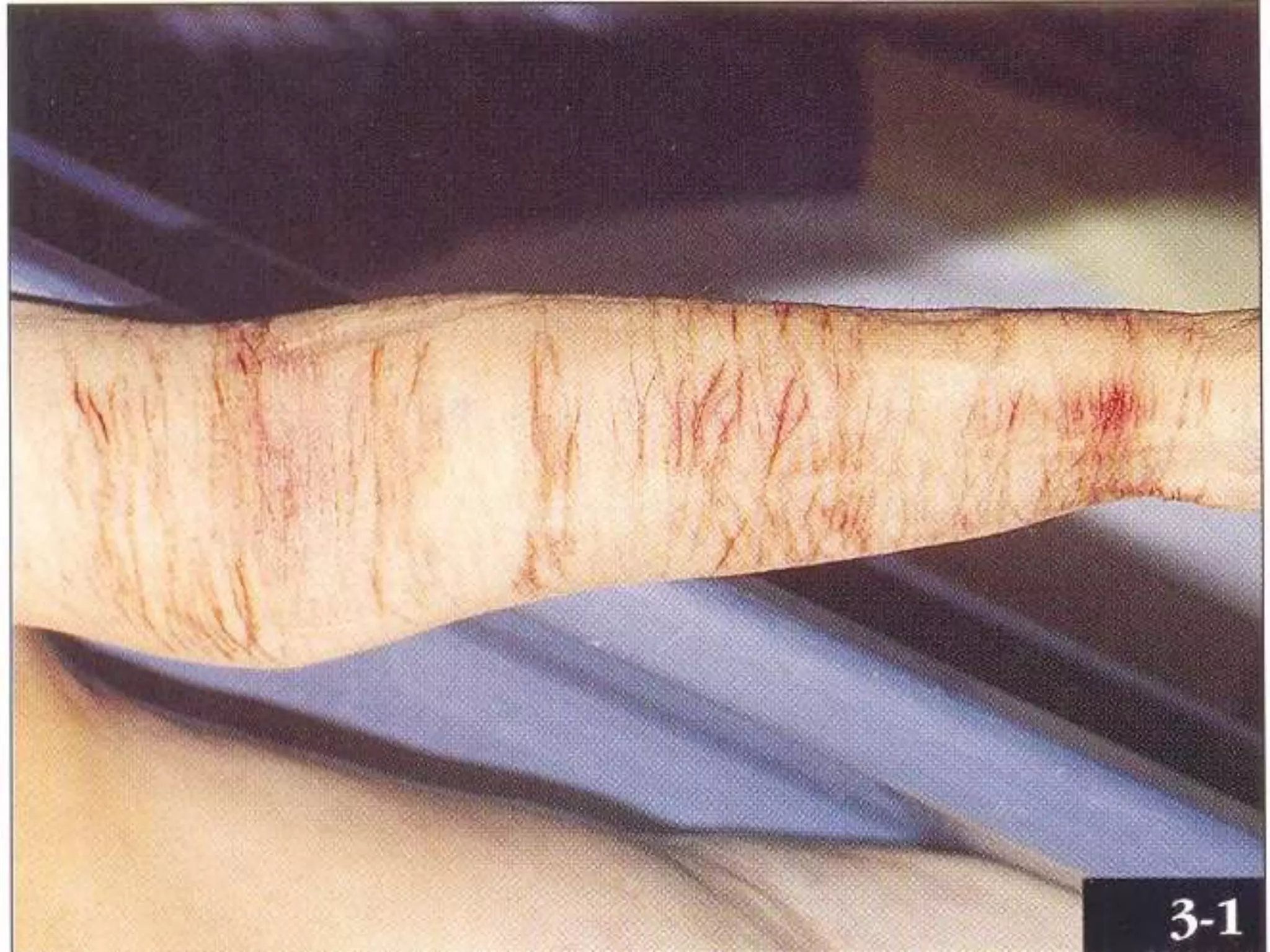
Hesitation Cuts Or tentative cuts
It refers to the preliminary cuts made by a person
intending to commit suicide by a cutting instrument
before gathering a sufficient courage to make a final
deep incision.
CHARACTERISTICS OF HESITATION OR TENTATIVE
CUTS.
These are generally small, multiple superficial cuts
found at the commencement of incised wound & merging
with the main incision.
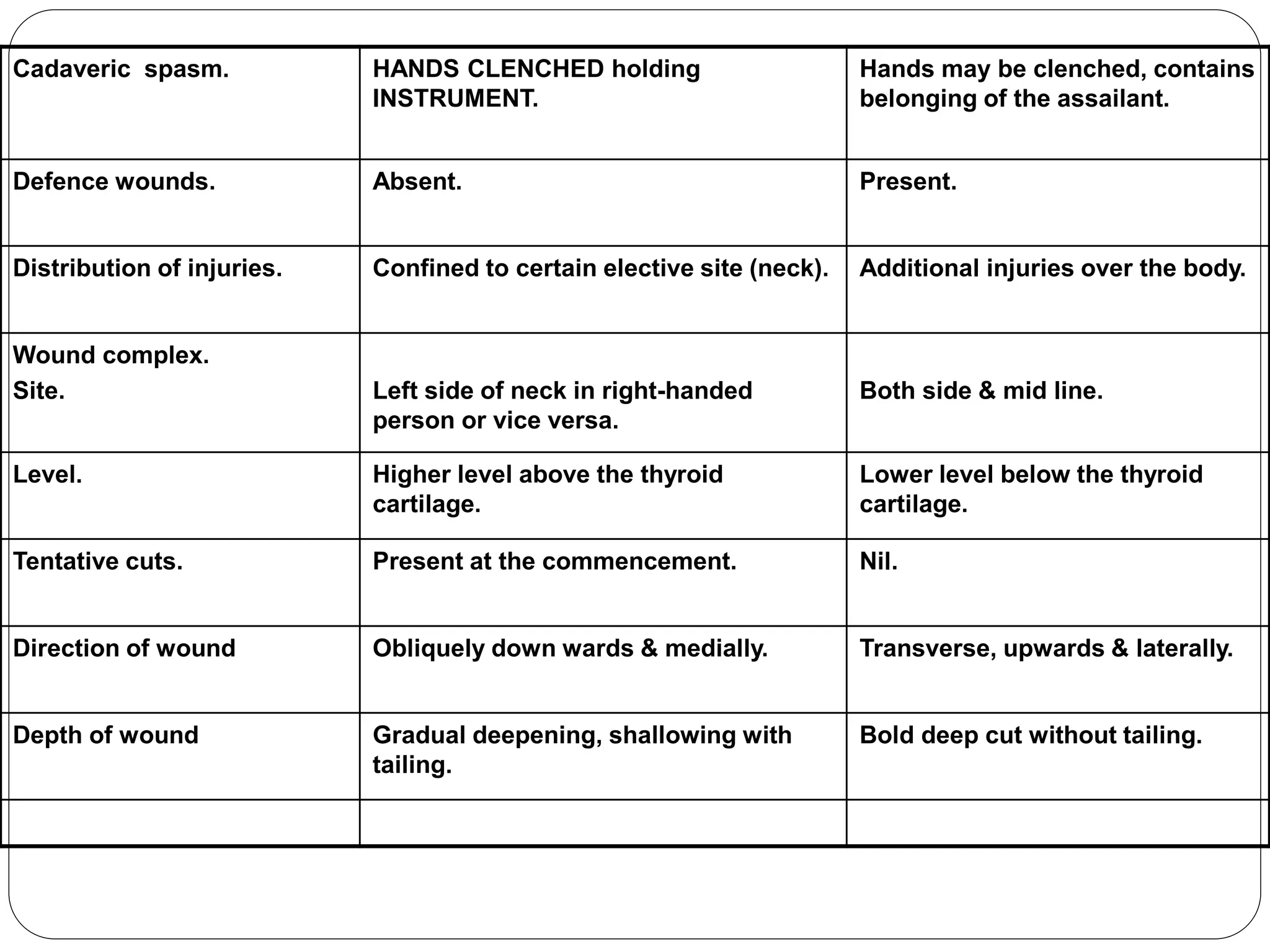
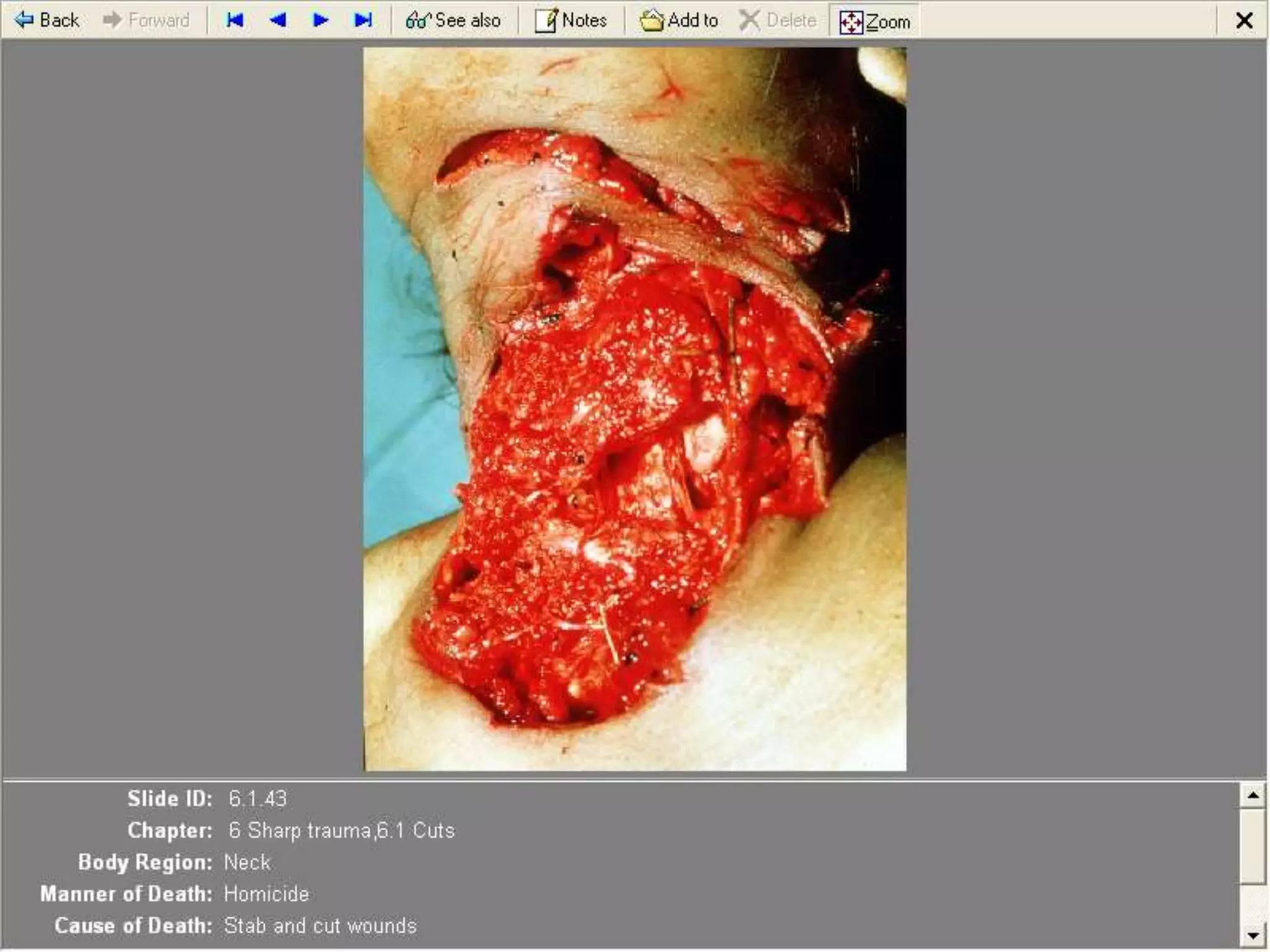
DIFFERENTIATION B/W SUICIDAL & HOMICIDAL CUT THROAT.
1.CIRCUMSTANTIAL EVIDENCE (EXTRA CORPORAL EVIDENCE).
INDICATOR SUICIDAL CUT
THROAT
HOMICIDAL CUT THROAT.
Place segregated lonely. Not necessary.
Scene. Undisturbed. Disturbed.
Selection of weapon Light, sharp edge. Heavy with sharp edge.
Presence of weapon at
the scene.
Present. Usually absent.
Clothes. Orderly. Blood stained on
anterior portions of
clothes.
Deranges suggesting scuffle. Blood
stained on back of neck.
Farwell letters. Mostly present. Absent. If present, compare
hand writing.
Personality trait. Depressed. Normal.
Cadaveric spasm. HANDS CLENCHED holding
INSTRUMENT.
Hands may be clenched, contains
belonging of the assailant.
Defence wounds. Absent. Present.
Distribution of injuries. Confined to certain elective site (neck). Additional injuries over the body.
Wound complex.
Site. Left side of neck in right-handed
person or vice versa.
Both side & mid line.
Level. Higher level above the thyroid
cartilage.
Lower level below the thyroid
cartilage.
Tentative cuts. Present at the commencement. Nil.
Direction of wound Obliquely down wards & medially. Transverse, upwards & laterally.
Depth of wound Gradual deepening, shallowing with
tailing.
Bold deep cut without tailing.
Differentiate between Incised &
Lacerated wound
Features Incised wound Lacerated
wound
Site Any where in the body Over bony prominences
Edges Clean cut Lacerated
Bruising of Margins No bruising Present
Injury to blood vessels &
Nerves
Clean cut Crushed
Hair Bulbs Clean cut Crushed
Bleeding More Less
Stab wound:
Definition: wound caused by a sharp pointed weapon driven in
the body, the depth of wound being the greatest dimension.
Substituting words:
Penetrating wound: It refers to injury when a weapon enters
into the body cavity such as thorax or abdomen.
Perforating wound: It refers to the injury when a weapon after
penetrating the tissues comes out from the other side
making an exit wound.
- Flat, pointed objects_____ knife, dagger,
.
- Sharp, rounded objects____needles, ice picks.
DIAGNOSTIC FEATURES:
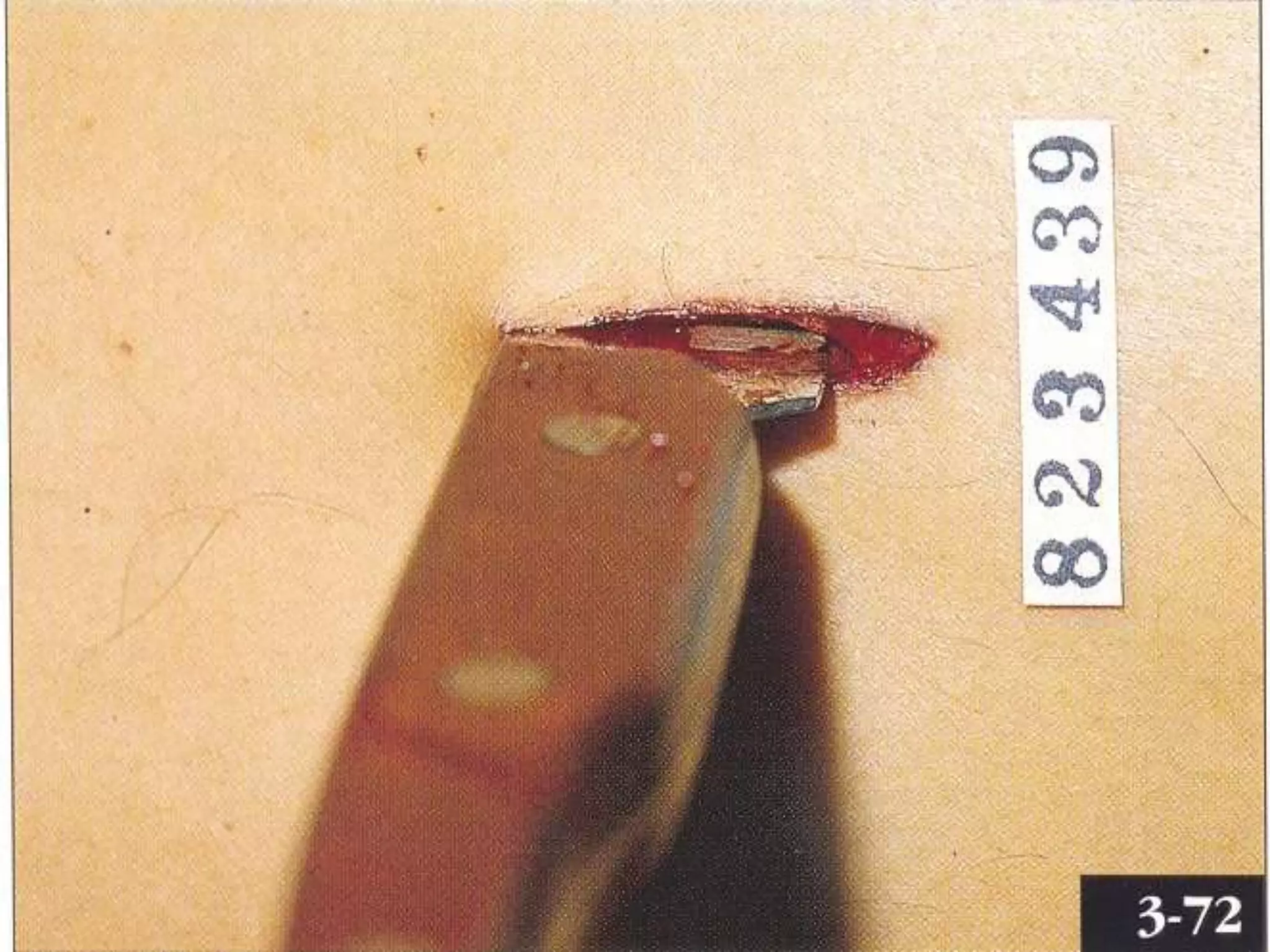
HAVING ALL THE FEATURES OF INCISED WOUND, BUT
DEPTH IS MORE THAN OTHER DIMENSIONS.
EXAMPLE:
WOUND OF EXIT:
SMALLER WITH EVERTED MARGINS.
CLOTH FIBERS ARE DIRECTED OUT WARDS.
WEAPON SHAPE OF WOUND
Single sharp
Edged weapon.
Wedge shape
Double sharp edged weapon Elliptical shape
Rounded pointed Circular
Pointed square Cruciate
Double edged blunt Circular with bruising
Instrument twisted before with drawl. Triangular or cruciate.Or fish tail injury
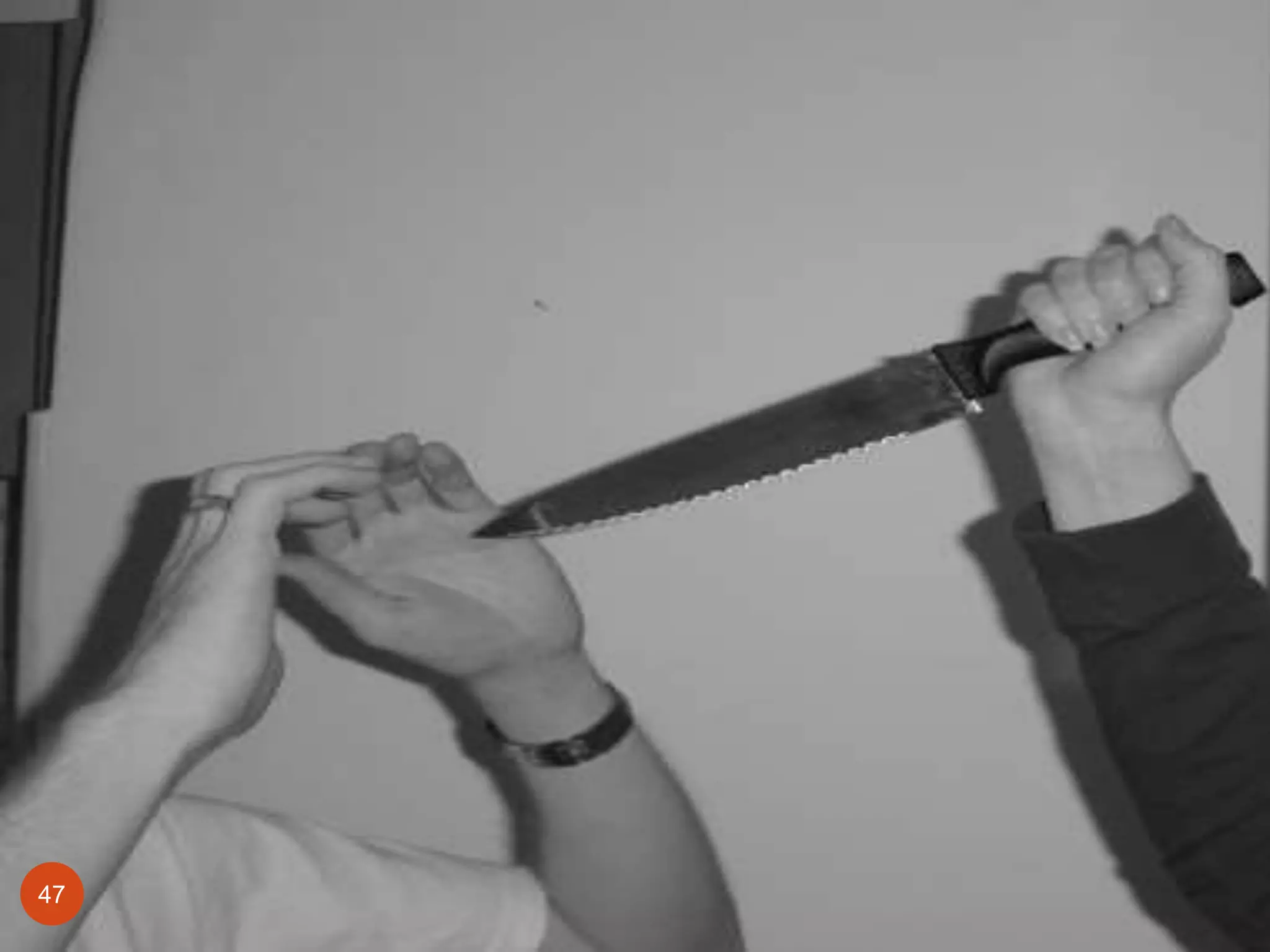
DEFENSE WOUNDS.
WOUNDS CAUSED AS A RESULT OF IMMEDIATE REACTION OF VICTIM
TO SAVE HIM FROM THE ATTACKING WEAPON, EITHER BY
RAISING THE ARM OR BY GRASPING THE WEAPON.
SITES:
MEDICO LEGAL IMPORTANCE:
1. INDICATIVE HOMICIDE.
2. VICTIM WAS ALIVE & CONSCIOUS.
WEAPON TYPE LOCATION
BLUNT BRUISE DORSUM OF HANDS, FORE
ARMS
SHARP EDGES. INCISED WOUNDS PALM OF HANDS, ULNER
BORDER OF FOREARM.
47
48
49
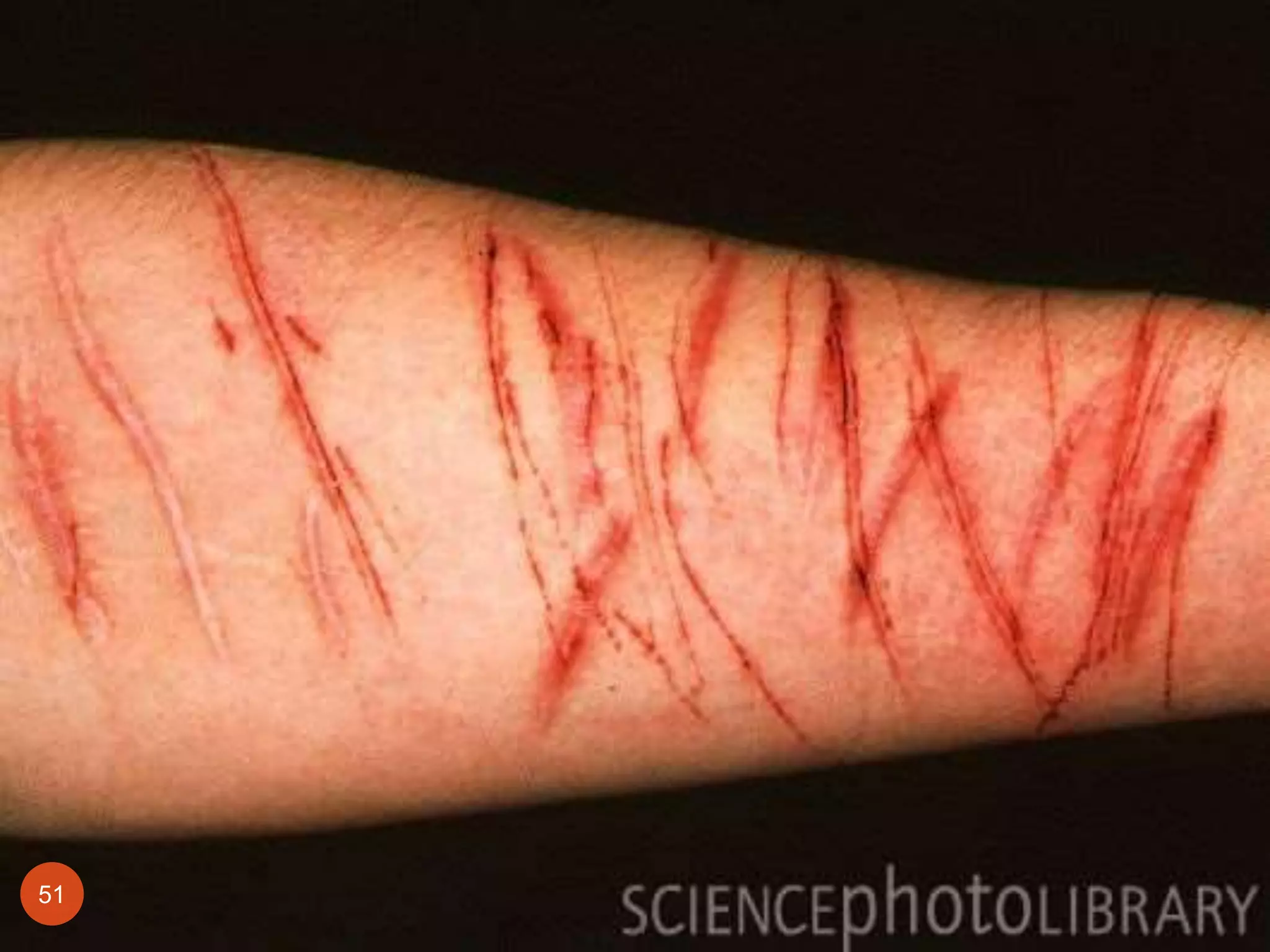
FABRICATED (FICTITIOUS. FORGED SELF-INFLICTED
INJURIES, INVENTED WOUNDS.
DEFINITION: THE WOUNDS INFLICTED ON THE BODY, BY THE PERSON
HIMSELF OR BY ANOTHER PERSON TO MISGUIDE THE
INVESTIGATORS, WITH SOME MALAFIDE INTENTIONS.
MOTIVES:
1. TO BRING A CHARGE AGAINST A PERSON OR TO IMPLICATE AN
INNOCENT PERSON IN A FALSE CASE.
2. TO ACCUSE POLICE OF MALTREATMENT DURING CUSTODY.
3. POLICE/WATCHMAN/GUARDS CLAIM EFFICIENCY DURING
CATCHING/ENCOUNTERS WITH CRIMINALS.
4. MURDERER MISGUIDING THE INVESTIGATORS, THAT KILLING WAS
IN SELF-DEFENSE.
51
Weapons used:
1. Sharp edge light cutting weapon_____ commonly used.
2. Fire arms (shot gun)______ rarely used
3. Chemicals _______ marking nut juice very rarely used.
4. Blunt weapons_______ very rarely uses
o Injuries sustained due to fall are claimed to be caused by
blows.
o Tooth shed due to disease is claimed to caused by blunt
trauma.
Elective sites:
1. Accessible/non vital areas. Top of head/fore head, outer
side of left arm. Front of left forearm, front of
chest/abdomen, front & outer part of thigh.
Examination of clothes:
o Clothes are spared usually.
The wound:
o Superficial, multiple, made half heartedly.
o Seen on accessible, non-vital less functioning areas.
o Caused by light, cutting instruments.
o Shot guns are used.
o Cartridge discharging small pallets is used.
o Wound may be incised & pellets are kept manually.
o After x-ray (certificate) they are removed.

Mechanical injury 3

  • 1.
    LACERATED WOUNDS, INCISED WOUNDS STABWOUNDS FABRICATED WOUNDS
  • 2.
    LACERATION: DEFINITION: A lacerationis a rupture or tear or a split in the skin, mucous membrane, muscle, any internal organ or underlying tissues as a result of application of blunt force. CAUSATIVE WEAPON: Blows with club, stones, bricks, punch, kicks, iron bars.
  • 3.
    DIAGNOSTIC FEATURES: - Margins frequently abraded. - Edges  irregular, ragged,inverted, swollen, bruised. - Angels  torn, irregular. - Depth (base)  uneven, non uniform depth, strand of tissue found, bridging/ crossing over at the varying depths. - Hairs bulbs  crushed. - B. Vessels  crushed. - Skin  flapping. - Foreign material usually found
  • 4.
    4 Besides blows fromblunt objects Lacerations are also caused by  Fall on hard surfaces  Machinery  Traffic accidents
  • 5.
    MECHANISM OF CAUSATIONOR TYPES: On the basis of mechanism of causation laceration.  1) Split / slit laceration.  2) Stretch laceration  3) Avulsion/grinding compression of skin  4) Tears  5) INTERNAL LACERATIONS
  • 6.
    1) split /slit laceration. 1) split / slit laceration. Splitting of skin and underlying tissues occur, when there is compression/ crushing of the affected tissue between two hard objects that is bone & blunt instrument or ground. Impact is perpendicular. Example: commonly seen over scalp, cheek (zygomatic arches) chin, eye brow etc. Resemblance: apparently or on cursory examination they are confused with incised wounds.
  • 8.
    2) STRETCH LACERATION 2)STRETCH LACERATION:- It refers to laceration caused by overstretching of the skin to produce a flap by Blunt tangential impact. PRODUCED BY  Blunt tangential impact  Sudden deformity of bone occurring after fracture.  Glancing kicks with a boot
  • 9.
    9 COMMONLY SEEN IN Areas of body where skin is supported loosely like wrist, forearm, axilla, abdomen  Industry - when parts of body get trapped in running belts.  Road traffic accidents
  • 10.
  • 11.
    3) AVULSION/GRINDING COMPRESSIONOF SKIN  It refers to the lacerations caused by grinding compression of tissues causing de-gloving of skin and crushing of the underlying muscles. These result from Horizontal impact.  Localized pressure due to heavy weight causes tearing of skin, crushing of muscles & separation of skin from the underlying tissues, forming a space.  There will be extravasation of blood, foreign bodies in the potential space. Impact is horizontal.
  • 12.
    12  The underlyingmuscles are crushed.  The bones may be fractured.
  • 13.
    4) TEARS: There isirregular tearing of skin & tissues. lacerations caused by impact against irregular or sharp projecting object. This is another form of over stretching. Example: broken bottles or motor car door handles.
  • 14.
    14 5. INTERNAL LACERATIONS Blunt force exceeds the tensile strength and elasticity of an organ laceration may produced.  May or may not be an abrasion at the site of impact.
  • 15.
    15 MEDICO-LEGAL IMPORTANCE OF LACERATION May Indicate:  The cause of the injury  The shape of the blunt weapon e.g Hammer-crescentic laceration  Blunt pointed rod – stellate laceration
  • 16.
    16 ANTE-MORTEM / POST-MORTEM Can be easily ascertained Accidental Laceration (most common)  Exposed parts of the body Homicidal Laceration  Usually seen on the head Suicidal Laceration (rare)  Seen in mental patients
  • 18.
  • 19.
  • 22.
    INCISED WOUNDS: 1. Synonyms:cut, slash, slice. (when it is longer than deep) 2. Definition: It refers to an open wound resulting from a cut or an incision in the skin or underlying tissues. It is caused by a weapon with sharp cutting edge when it is drawn across the skin. 3. Causative weapons: - Light cutting weapons  knives, razor, blades, scissors. - Heavy cutting weapons  daggers, swords, axe chopper. 4. Mechanism: pressure + movement of instrument+ sharpness.
  • 23.
    Appearance & severitydepends upon: - Shape of weapon. - Sharpness of edge. - Manner of infliction. - Tissue involved. Diagnostic features: A) shape: usually spindle shaped & gaping. B) margins: clean & regularly cut
  • 24.
    C) edges: sharp,evenly divided, everted, smooth, D) angles: sharp , acute. E) base: intervening deeper tissues are cleanly & evenly divided. F) dimensions: length is greater than depth and Width of wound is.
  • 25.
    G) bleeding: bleedfreely & profusely (vessels are cut). H) tailing: gradual decrease in depth of wound is seen towards terminal end. So a superficial wound involving only skin is seen. This is called “ tailing of the wound”. Tailing indicates direction of force. I) clothes: cuts on clothes may correspond with the wound but if the clothes are loose, folded or drawn up during struggle, cuts in clothes may not coincide with the wounds.
  • 26.
    MEDICOLEGAL ASPECTS  SURGICAL ACCIDENTAL  HOMICIDAL  DISFIGURMENT
  • 27.
    SUICIDAL: FOUND ONCERTAIN ELECTIVE SITES. = SIDES + FRONT OF NECK. = FRONT OF WRIST (RADIAL ARTERY). = FRONT OF THIGH (FEMORAL). = FRONT OF CHEST (HEART). FEATURES: MULTIPLE, SUPER IMPOSED, PARALLEL OF VARYING DEPTHS FOUND ON OPPOSITE SIDE OF THE WORKING, HESITATION OR TENTATIVE CUTS.
  • 28.
    Hesitation Cuts Ortentative cuts It refers to the preliminary cuts made by a person intending to commit suicide by a cutting instrument before gathering a sufficient courage to make a final deep incision. CHARACTERISTICS OF HESITATION OR TENTATIVE CUTS. These are generally small, multiple superficial cuts found at the commencement of incised wound & merging with the main incision.
  • 29.
    DIFFERENTIATION B/W SUICIDAL& HOMICIDAL CUT THROAT. 1.CIRCUMSTANTIAL EVIDENCE (EXTRA CORPORAL EVIDENCE). INDICATOR SUICIDAL CUT THROAT HOMICIDAL CUT THROAT. Place segregated lonely. Not necessary. Scene. Undisturbed. Disturbed. Selection of weapon Light, sharp edge. Heavy with sharp edge. Presence of weapon at the scene. Present. Usually absent. Clothes. Orderly. Blood stained on anterior portions of clothes. Deranges suggesting scuffle. Blood stained on back of neck. Farwell letters. Mostly present. Absent. If present, compare hand writing. Personality trait. Depressed. Normal.
  • 30.
    Cadaveric spasm. HANDSCLENCHED holding INSTRUMENT. Hands may be clenched, contains belonging of the assailant. Defence wounds. Absent. Present. Distribution of injuries. Confined to certain elective site (neck). Additional injuries over the body. Wound complex. Site. Left side of neck in right-handed person or vice versa. Both side & mid line. Level. Higher level above the thyroid cartilage. Lower level below the thyroid cartilage. Tentative cuts. Present at the commencement. Nil. Direction of wound Obliquely down wards & medially. Transverse, upwards & laterally. Depth of wound Gradual deepening, shallowing with tailing. Bold deep cut without tailing.
  • 31.
    Differentiate between Incised& Lacerated wound Features Incised wound Lacerated wound Site Any where in the body Over bony prominences Edges Clean cut Lacerated Bruising of Margins No bruising Present Injury to blood vessels & Nerves Clean cut Crushed Hair Bulbs Clean cut Crushed Bleeding More Less
  • 40.
    Stab wound: Definition: woundcaused by a sharp pointed weapon driven in the body, the depth of wound being the greatest dimension. Substituting words: Penetrating wound: It refers to injury when a weapon enters into the body cavity such as thorax or abdomen. Perforating wound: It refers to the injury when a weapon after penetrating the tissues comes out from the other side making an exit wound. - Flat, pointed objects_____ knife, dagger, . - Sharp, rounded objects____needles, ice picks.
  • 42.
    DIAGNOSTIC FEATURES: HAVING ALLTHE FEATURES OF INCISED WOUND, BUT DEPTH IS MORE THAN OTHER DIMENSIONS.
  • 43.
    EXAMPLE: WOUND OF EXIT: SMALLERWITH EVERTED MARGINS. CLOTH FIBERS ARE DIRECTED OUT WARDS. WEAPON SHAPE OF WOUND Single sharp Edged weapon. Wedge shape Double sharp edged weapon Elliptical shape Rounded pointed Circular Pointed square Cruciate Double edged blunt Circular with bruising Instrument twisted before with drawl. Triangular or cruciate.Or fish tail injury
  • 46.
    DEFENSE WOUNDS. WOUNDS CAUSEDAS A RESULT OF IMMEDIATE REACTION OF VICTIM TO SAVE HIM FROM THE ATTACKING WEAPON, EITHER BY RAISING THE ARM OR BY GRASPING THE WEAPON. SITES: MEDICO LEGAL IMPORTANCE: 1. INDICATIVE HOMICIDE. 2. VICTIM WAS ALIVE & CONSCIOUS. WEAPON TYPE LOCATION BLUNT BRUISE DORSUM OF HANDS, FORE ARMS SHARP EDGES. INCISED WOUNDS PALM OF HANDS, ULNER BORDER OF FOREARM.
  • 47.
  • 48.
  • 49.
  • 50.
    FABRICATED (FICTITIOUS. FORGEDSELF-INFLICTED INJURIES, INVENTED WOUNDS. DEFINITION: THE WOUNDS INFLICTED ON THE BODY, BY THE PERSON HIMSELF OR BY ANOTHER PERSON TO MISGUIDE THE INVESTIGATORS, WITH SOME MALAFIDE INTENTIONS. MOTIVES: 1. TO BRING A CHARGE AGAINST A PERSON OR TO IMPLICATE AN INNOCENT PERSON IN A FALSE CASE. 2. TO ACCUSE POLICE OF MALTREATMENT DURING CUSTODY. 3. POLICE/WATCHMAN/GUARDS CLAIM EFFICIENCY DURING CATCHING/ENCOUNTERS WITH CRIMINALS. 4. MURDERER MISGUIDING THE INVESTIGATORS, THAT KILLING WAS IN SELF-DEFENSE.
  • 51.
  • 52.
    Weapons used: 1. Sharpedge light cutting weapon_____ commonly used. 2. Fire arms (shot gun)______ rarely used 3. Chemicals _______ marking nut juice very rarely used. 4. Blunt weapons_______ very rarely uses o Injuries sustained due to fall are claimed to be caused by blows. o Tooth shed due to disease is claimed to caused by blunt trauma.
  • 53.
    Elective sites: 1. Accessible/nonvital areas. Top of head/fore head, outer side of left arm. Front of left forearm, front of chest/abdomen, front & outer part of thigh.
  • 54.
    Examination of clothes: oClothes are spared usually. The wound: o Superficial, multiple, made half heartedly. o Seen on accessible, non-vital less functioning areas. o Caused by light, cutting instruments. o Shot guns are used. o Cartridge discharging small pallets is used. o Wound may be incised & pellets are kept manually. o After x-ray (certificate) they are removed.