PUTREFACTION
SUBMITTED TO : Mr. Sudhanshu shekhar Tiwari SUBMITTED BY: Shivani Rana
CONTENT
1.Introduction
2.Characteristics features
3.Factors affecting (external and internal)
4.Putrefaction in water
5.skeletonisation
INTRODUCTION
 Final stage following death, in which
destruction of soft tissues of body occurs
by bacteria.
 Disappearance of rigor mortis.
 Occurs 4 to 10 days after death.
Characteristics features
 1. Changes in color of the tissues.
 2. Evolution of gasses giving foul smell.
 3. Liquefaction of tissues.
1. Changes in the color of the
tissues
 EXTERNAL
 At an early stage of putrefaction, haemoglobin diffuses through the
vessels and stains the surrounding tissue a red or reddish brown colour.
 Colour appears in 12 to 18 hours in summer and in 1 to 2 days in winter.
 Green colouration spreads – abdomen->external genitals->chest->neck-
>face->arms->legs.(dark green->purple->dark blue)
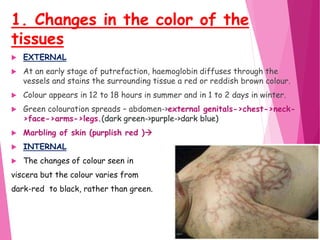
 Marbling of skin (purplish red )
 INTERNAL
 The changes of colour seen in
viscera but the colour varies from
dark-red to black, rather than green.
2. Evolution of gasses giving foul smell.
 Reduction of complicated protein and carbohydrates take place.
 Leads to formation of simpler compounds of amino acids,
ammonia,
CO,
CO2,
H2S,
PH3,
CH4 and Mercaptans.
 Gas collect in intestine in 12 -18 hours
summer and 1-2 days in winter.
 Bloating
Contd
.
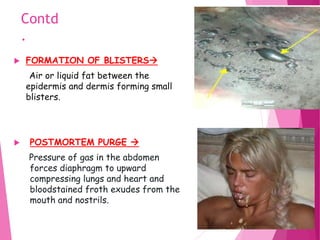
 FORMATION OF BLISTERS
Air or liquid fat between the
epidermis and dermis forming small
blisters.
 POSTMORTEM PURGE 
Pressure of gas in the abdomen
forces diaphragm to upward
compressing lungs and heart and
bloodstained froth exudes from the
mouth and nostrils.
Contd.
 MAGGOTS accumulation of
large no. of maggots on one area may
indicate a pre-existing ante mortem
wound.
 Create holes that may resembles
gun shot wounds.
 After 3 days, face becomes so discoloured and bloated that identification
becomes very difficult.
 Bloodstained fluid may leak from
mouth, nostrils, rectum and vagina.
3. LIQUEFACTION OF TISSUES
 The tissues become soft, loose and are converted onto
thick, semi-fluid, black mass and are separated from the
bones and fall off.
 Decomposition may differ from body to body and
environment to environment.
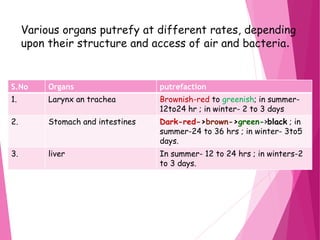
Various organs putrefy at different rates, depending
upon their structure and access of air and bacteria.
S.No Organs putrefaction
1. Larynx an trachea Brownish-red to greenish; in summer-
12to24 hr ; in winter- 2 to 3 days
2. Stomach and intestines Dark-red->brown->green->black ; in
summer-24 to 36 hrs ; in winter- 3to5
days.
3. liver In summer- 12 to 24 hrs ; in winters-2
to 3 days.
3.FACTORS AFFECTING PUTREFACTION
EXTERNAL
1. Temperature
2. Moisture
3. Air
4. Clothing
5. Manner of burial
INTERNAL
1. Age
2. Sex
3. Cause of death
4. mutilation
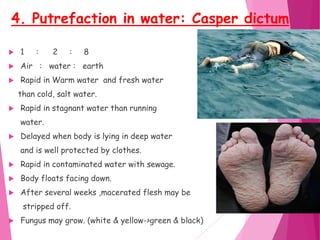
4. Putrefaction in water: Casper dictum
 1 : 2 : 8
 Air : water : earth
 Rapid in Warm water and fresh water
than cold, salt water.
 Rapid in stagnant water than running
water.
 Delayed when body is lying in deep water
and is well protected by clothes.
 Rapid in contaminated water with sewage.
 Body floats facing down.
 After several weeks ,macerated flesh may be
stripped off.
 Fungus may grow. (white & yellow->green & black)
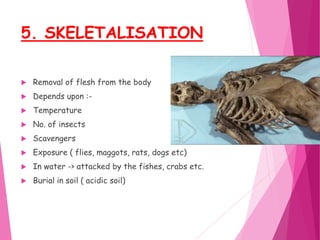
5. SKELETALISATION
 Removal of flesh from the body
 Depends upon :-
 Temperature
 No. of insects
 Scavengers
 Exposure ( flies, maggots, rats, dogs etc)
 In water -> attacked by the fishes, crabs etc.
 Burial in soil ( acidic soil)
Forensic medicene,putrefaction

Forensic medicene,putrefaction

  • 1.
    PUTREFACTION SUBMITTED TO :Mr. Sudhanshu shekhar Tiwari SUBMITTED BY: Shivani Rana
  • 2.
    CONTENT 1.Introduction 2.Characteristics features 3.Factors affecting(external and internal) 4.Putrefaction in water 5.skeletonisation
  • 3.
    INTRODUCTION  Final stagefollowing death, in which destruction of soft tissues of body occurs by bacteria.  Disappearance of rigor mortis.  Occurs 4 to 10 days after death.
  • 4.
    Characteristics features  1.Changes in color of the tissues.  2. Evolution of gasses giving foul smell.  3. Liquefaction of tissues.
  • 5.
    1. Changes inthe color of the tissues  EXTERNAL  At an early stage of putrefaction, haemoglobin diffuses through the vessels and stains the surrounding tissue a red or reddish brown colour.  Colour appears in 12 to 18 hours in summer and in 1 to 2 days in winter.  Green colouration spreads – abdomen->external genitals->chest->neck- >face->arms->legs.(dark green->purple->dark blue)  Marbling of skin (purplish red )  INTERNAL  The changes of colour seen in viscera but the colour varies from dark-red to black, rather than green.
  • 6.
    2. Evolution ofgasses giving foul smell.  Reduction of complicated protein and carbohydrates take place.  Leads to formation of simpler compounds of amino acids, ammonia, CO, CO2, H2S, PH3, CH4 and Mercaptans.  Gas collect in intestine in 12 -18 hours summer and 1-2 days in winter.  Bloating
  • 7.
    Contd .  FORMATION OFBLISTERS Air or liquid fat between the epidermis and dermis forming small blisters.  POSTMORTEM PURGE  Pressure of gas in the abdomen forces diaphragm to upward compressing lungs and heart and bloodstained froth exudes from the mouth and nostrils.
  • 8.
    Contd.  MAGGOTS accumulationof large no. of maggots on one area may indicate a pre-existing ante mortem wound.  Create holes that may resembles gun shot wounds.  After 3 days, face becomes so discoloured and bloated that identification becomes very difficult.  Bloodstained fluid may leak from mouth, nostrils, rectum and vagina.
  • 9.
    3. LIQUEFACTION OFTISSUES  The tissues become soft, loose and are converted onto thick, semi-fluid, black mass and are separated from the bones and fall off.  Decomposition may differ from body to body and environment to environment.
  • 10.
    Various organs putrefyat different rates, depending upon their structure and access of air and bacteria. S.No Organs putrefaction 1. Larynx an trachea Brownish-red to greenish; in summer- 12to24 hr ; in winter- 2 to 3 days 2. Stomach and intestines Dark-red->brown->green->black ; in summer-24 to 36 hrs ; in winter- 3to5 days. 3. liver In summer- 12 to 24 hrs ; in winters-2 to 3 days.
  • 11.
    3.FACTORS AFFECTING PUTREFACTION EXTERNAL 1.Temperature 2. Moisture 3. Air 4. Clothing 5. Manner of burial INTERNAL 1. Age 2. Sex 3. Cause of death 4. mutilation
  • 12.
    4. Putrefaction inwater: Casper dictum  1 : 2 : 8  Air : water : earth  Rapid in Warm water and fresh water than cold, salt water.  Rapid in stagnant water than running water.  Delayed when body is lying in deep water and is well protected by clothes.  Rapid in contaminated water with sewage.  Body floats facing down.  After several weeks ,macerated flesh may be stripped off.  Fungus may grow. (white & yellow->green & black)
  • 13.
    5. SKELETALISATION  Removalof flesh from the body  Depends upon :-  Temperature  No. of insects  Scavengers  Exposure ( flies, maggots, rats, dogs etc)  In water -> attacked by the fishes, crabs etc.  Burial in soil ( acidic soil)