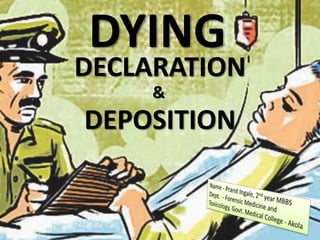
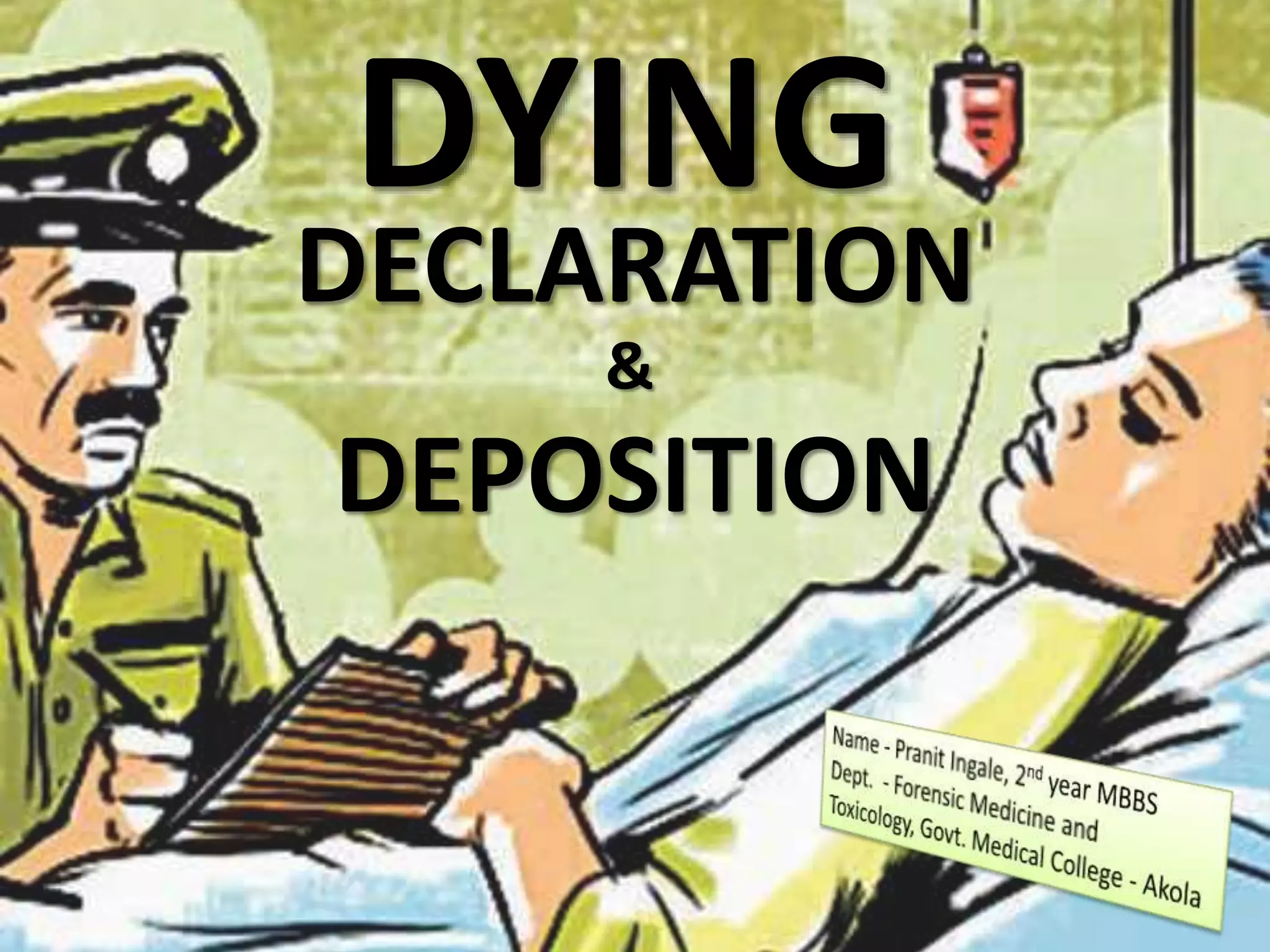
DYING
DECLARATION
&
DEPOSITION
DYING
DECLARATION
According to S.32, I.E.A.
Dying Declaration is a written or oral
statement of a person who is dying as a
result of some unlawful act, relating to the
material facts of cause of his death or
bearing on the circumstances.
If the person manages or is
in the condition to speak
he/she will give the
statement,
which is to be recorded
–
 The doctor should certify that the person is conscious
and his mental faculties are normal
 If there is time Executive Magistrate should be called
to record the declaration.
If condition of the victim is serious and there is no
time to call a Magistrate, the doctor should take the
declaration infront of the two witnesses.
While recording the dying
declaration, oath is not
administered, because of the
belief that dying person tells the
truth
 The statement should be recorded in the mans own
words, without any alteration in terms or phrases.
 Leading questions should not be put.
 The declarant should not be under any influence,
prompting or influence.
 If the point is not clear, question may be asked to
make it clear, but the actual question and the answer
given is to be recorded.
After Completion
 If the statement is written by the doctor it should be
signed by –
 Doctor
 Witnesses
 If the statement is written by the declarant himself,
it should be signed by -
 Declarant
 Doctor
 Witnesses
If dying person is unable to speak but
is able to make signs in answer to
questions put to him, this can be
recorded and it is considered as a
VERBAL STATEMENT
 The declaration is admissible not only against an
accused who killed the declarant, but also against all
other persons involved in the same incident which
resulted in his death.
 In India, if the declarant is in sound state at the
time of declaration, it is admissible in court as
evidence even if the declarant was not under
expectation of death at that time.
The Declaration is sent to the magistrate in the sealed cover.
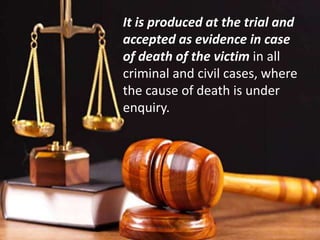
It is produced at the trial and
accepted as evidence in case
of death of the victim in all
criminal and civil cases, where
the cause of death is under
enquiry.
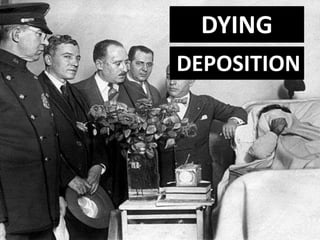
DYING
DEPOSITION
Definition :
Dying Deposition is a statement of
person on oath, recorded by the
magistrate, in the presence of the
accused or his lawyer, who is allowed to
cross- examine the witness.
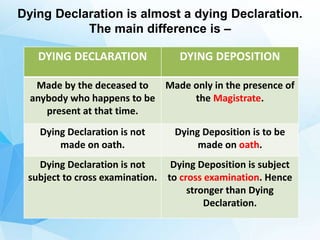
Dying Declaration is almost a dying Declaration.
The main difference is –
DYING DECLARATION DYING DEPOSITION
Made by the deceased to
anybody who happens to be
present at that time.
Made only in the presence of
the Magistrate.
Dying Declaration is not
made on oath.
Dying Deposition is to be
made on oath.
Dying Declaration is not
subject to cross examination.
Dying Deposition is subject
to cross examination. Hence
stronger than Dying
Declaration.
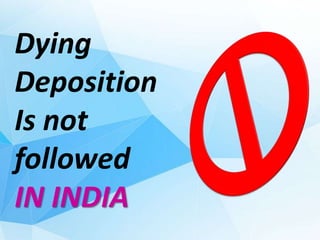
Dying
Deposition
Is not
followed
IN INDIA
REFERENCES :
• Forensic Medicine And Toxicology (29th edition) By
DR. K.S. Narayan Reddy
• www.legalserviceindia.com
• www.indiankanoon.org
Dying declaration and Dying Deposition

Dying declaration and Dying Deposition

  • 1.
  • 2.
  • 3.
    According to S.32,I.E.A. Dying Declaration is a written or oral statement of a person who is dying as a result of some unlawful act, relating to the material facts of cause of his death or bearing on the circumstances.
  • 4.
    If the personmanages or is in the condition to speak he/she will give the statement, which is to be recorded
  • 5.
    –  The doctorshould certify that the person is conscious and his mental faculties are normal  If there is time Executive Magistrate should be called to record the declaration. If condition of the victim is serious and there is no time to call a Magistrate, the doctor should take the declaration infront of the two witnesses.
  • 6.
    While recording thedying declaration, oath is not administered, because of the belief that dying person tells the truth
  • 7.
     The statementshould be recorded in the mans own words, without any alteration in terms or phrases.  Leading questions should not be put.  The declarant should not be under any influence, prompting or influence.  If the point is not clear, question may be asked to make it clear, but the actual question and the answer given is to be recorded.
  • 8.
    After Completion  Ifthe statement is written by the doctor it should be signed by –  Doctor  Witnesses  If the statement is written by the declarant himself, it should be signed by -  Declarant  Doctor  Witnesses
  • 9.
    If dying personis unable to speak but is able to make signs in answer to questions put to him, this can be recorded and it is considered as a VERBAL STATEMENT
  • 10.
     The declarationis admissible not only against an accused who killed the declarant, but also against all other persons involved in the same incident which resulted in his death.  In India, if the declarant is in sound state at the time of declaration, it is admissible in court as evidence even if the declarant was not under expectation of death at that time. The Declaration is sent to the magistrate in the sealed cover.
  • 11.
    It is producedat the trial and accepted as evidence in case of death of the victim in all criminal and civil cases, where the cause of death is under enquiry.
  • 12.
  • 13.
    Definition : Dying Depositionis a statement of person on oath, recorded by the magistrate, in the presence of the accused or his lawyer, who is allowed to cross- examine the witness.
  • 14.
    Dying Declaration isalmost a dying Declaration. The main difference is – DYING DECLARATION DYING DEPOSITION Made by the deceased to anybody who happens to be present at that time. Made only in the presence of the Magistrate. Dying Declaration is not made on oath. Dying Deposition is to be made on oath. Dying Declaration is not subject to cross examination. Dying Deposition is subject to cross examination. Hence stronger than Dying Declaration.
  • 15.
  • 16.
    REFERENCES : • ForensicMedicine And Toxicology (29th edition) By DR. K.S. Narayan Reddy • www.legalserviceindia.com • www.indiankanoon.org