Forensic Autopsy
Waoud Makhdom
Objectives
By the end of this lecture you’ll be ableto:
O Understand the fundamentals of the forensic
autopsy.
O Illustrate how to identify cadavers and the
mortuary process.
O Recognize dealing with high risk cases.
O The importance of external and internal
examination.
O Explain the process following postmortem
autopsy.
Category of death
O Natural causes
O Accident
O Suicide
O Homicide
Autopsy
O Autopsy is defined as “scientificdissection
of the dead body”.
O There are two types of autopsies in practice:
i. Pathological autopsy
ii. Medicolegal autopsy
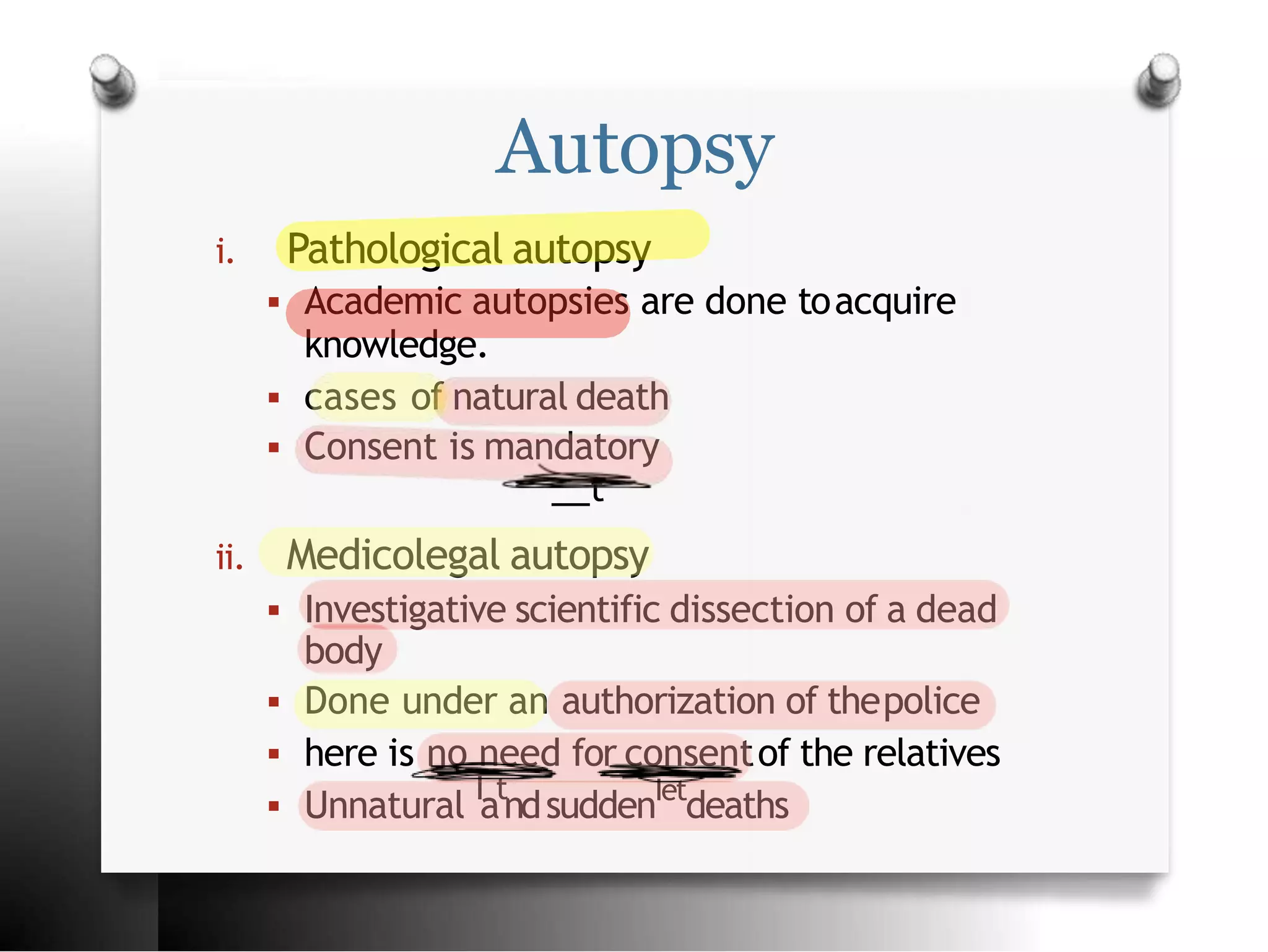
Autopsy
i. Pathological autopsy
 Academic autopsies are done toacquire
knowledge.
 cases of natural death
 Consent is mandatory
t
ii. Medicolegal autopsy
 Investigative scientific dissection of a dead
body
 Done under an authorization of thepolice
 here is no need for consentof the relatives
 Unnatural I
at
ndsuddenIet
deaths
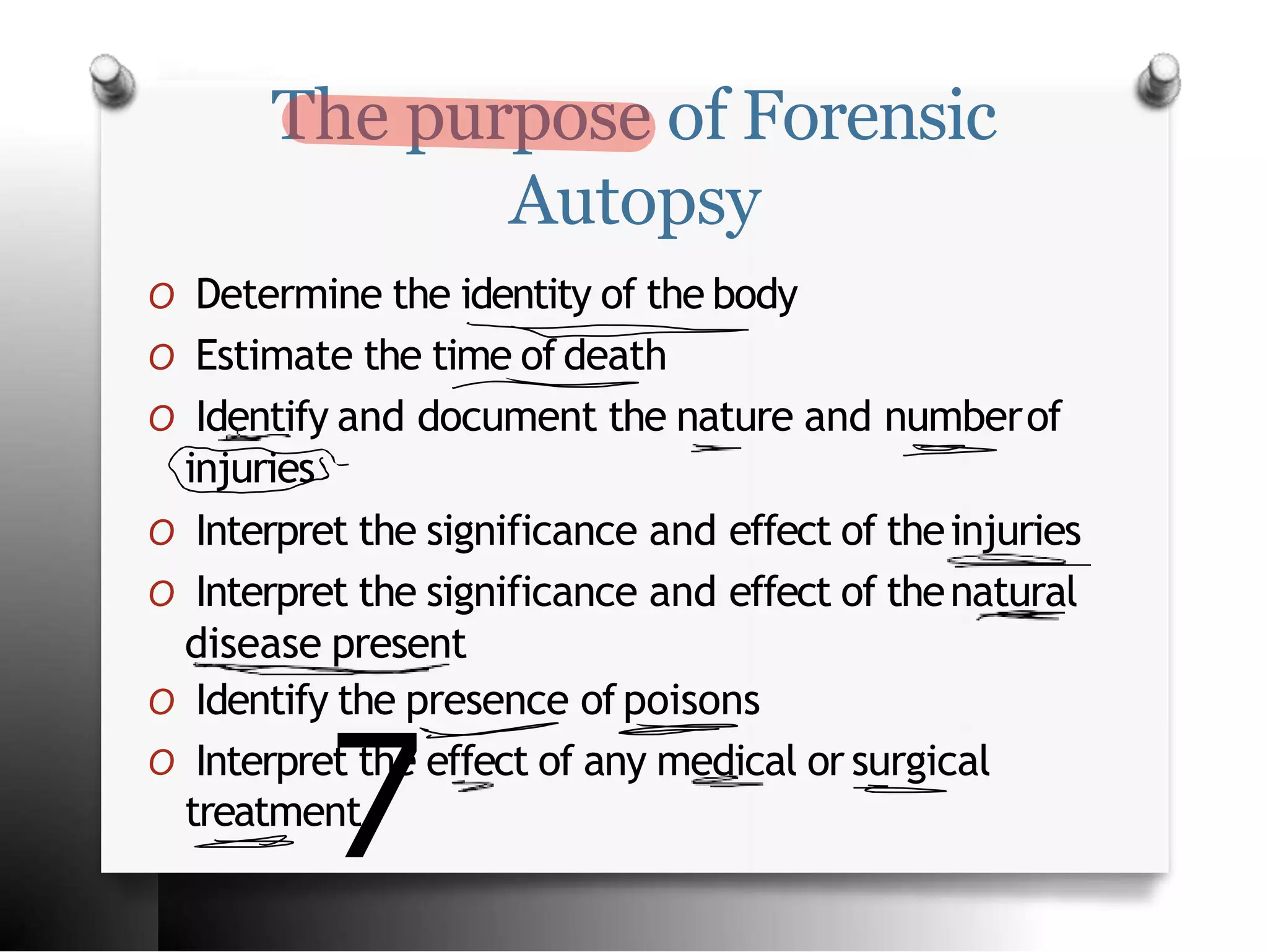
The purpose of Forensic
Autopsy
O Determine the identity of the body
O Estimate the time ofdeath
O Identify and document the nature and numberof
injuries
O Interpret the significance and effect of theinjuries
O Interpret the significance and effect of thenatural
disease present
O Identify the presence ofpoisons
O Interpret the effect of any medical or surgical
treatment
7
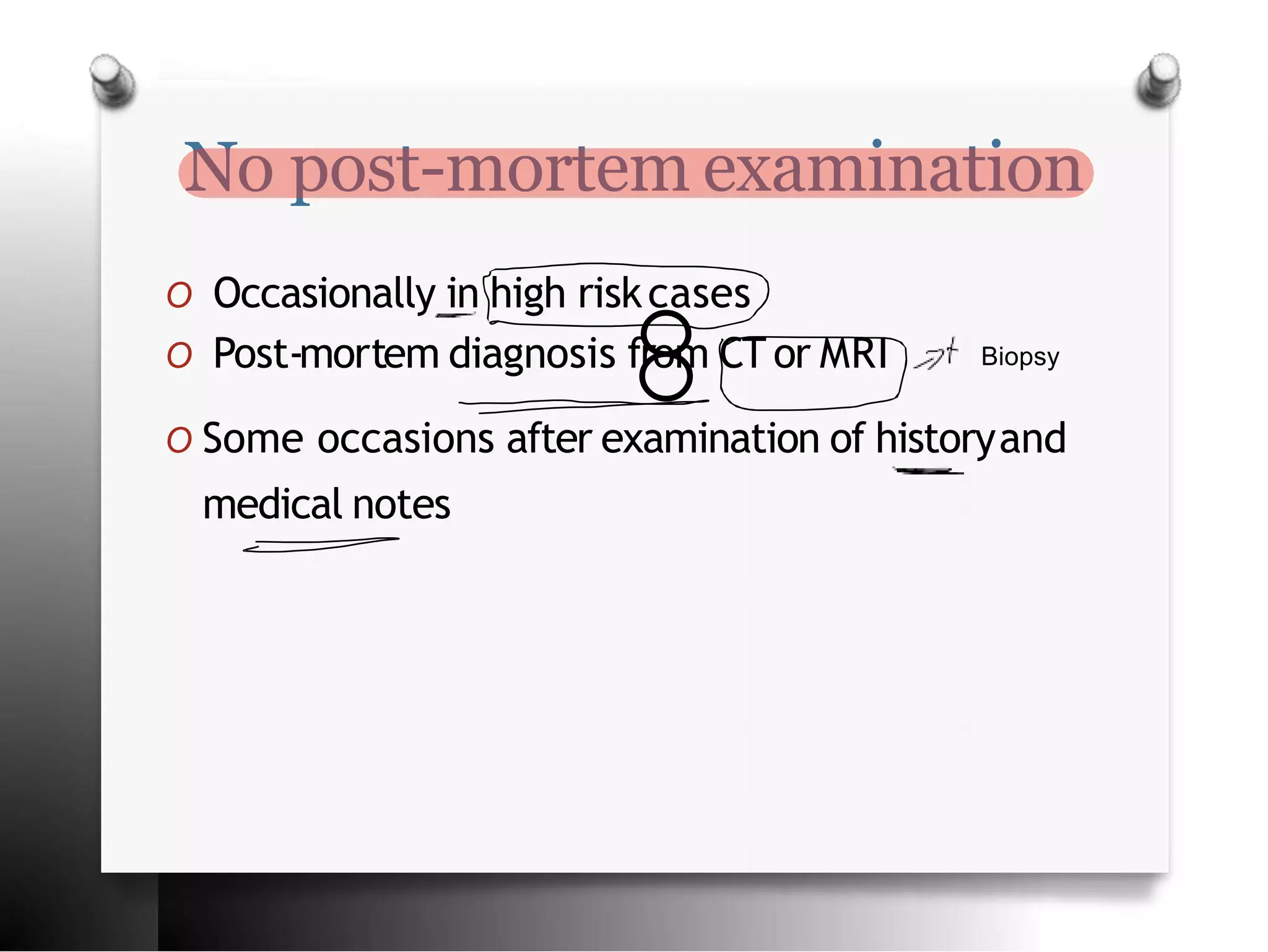
No post-mortem examination
O Occasionally in high riskcases
O Some occasions after examination of historyand
medical notes
O Post-mortem diagnosis
8
from CT or MRI Biopsy
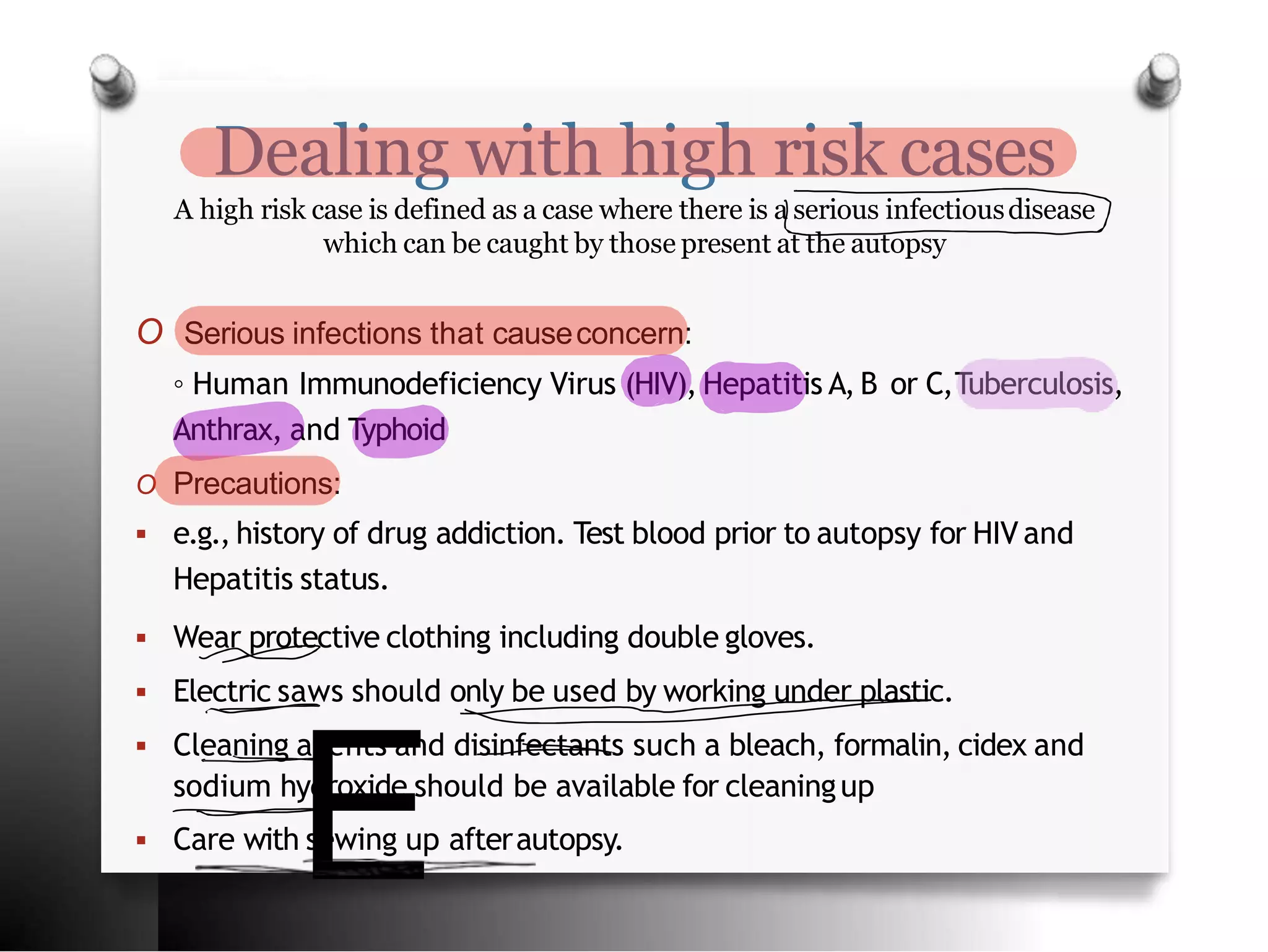
Dealing with high risk cases
A high risk case is defined as a case where there is a serious infectiousdisease
which can be caught by those present at the autopsy
O Serious infections that causeconcern:
◦ Human Immunodeficiency Virus (HIV), Hepatitis A, B or C,Tuberculosis,
Anthrax, and Typhoid
O Precautions:
 e.g., history of drug addiction. Test blood prior to autopsy for HIV and
Hepatitis status.
 Wear protective clothing including double gloves.
 Electric saws should only be used by working under plastic.
 Cleaning agents and disinfectants such a bleach, formalin, cidex and
sodium hydroxide should be available for cleaningup
 Care with sewing up afterautopsy.
E
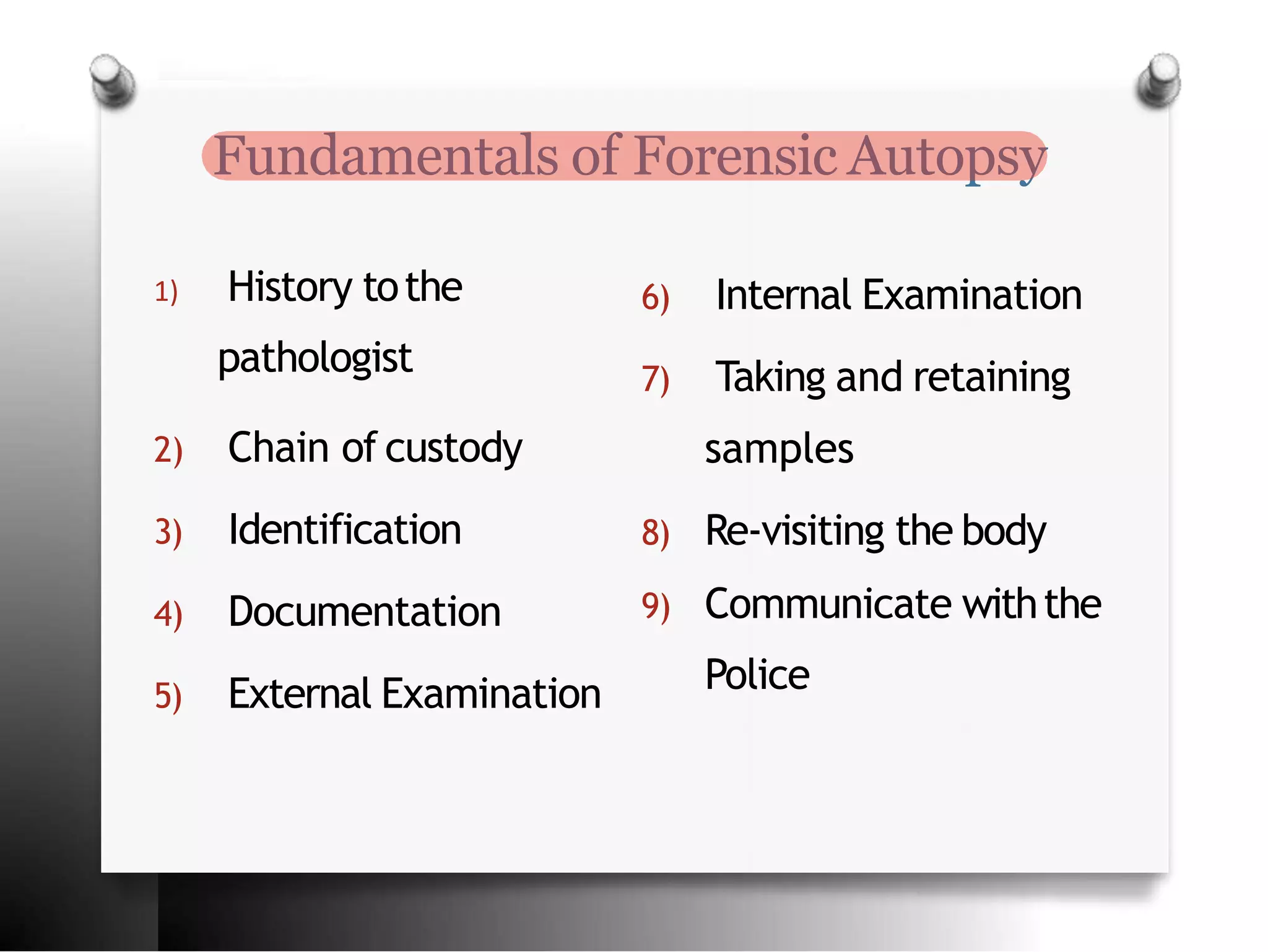
Fundamentals of Forensic Autopsy
1) History tothe
pathologist
2) Chain of custody
3) Identification
4) Documentation
5) External Examination
6) Internal Examination
7) Taking and retaining
samples
8) Re-visiting the body
9) Communicate withthe
Police
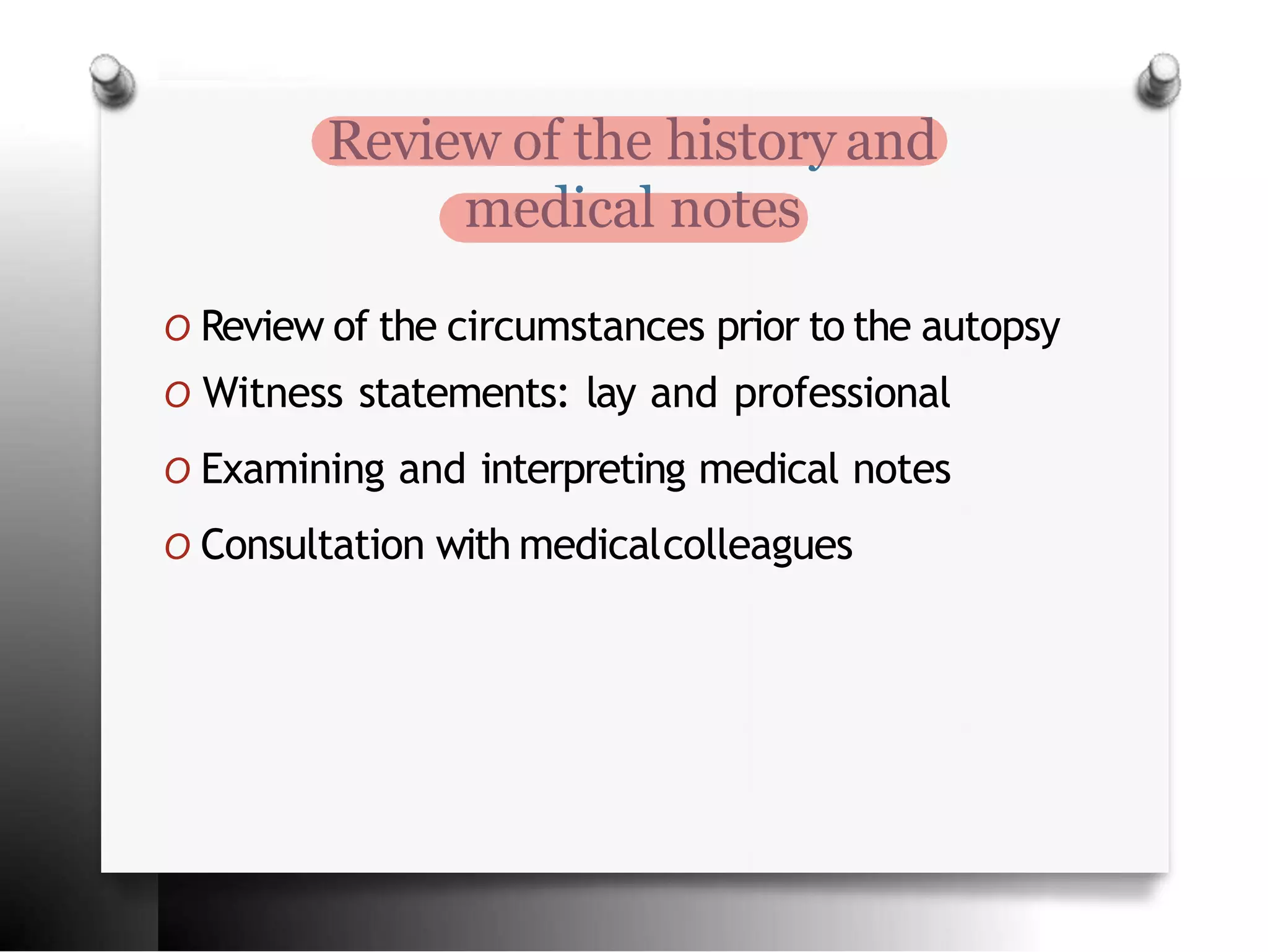
Review of the history and
medical notes
O Review of the circumstances prior to the autopsy
O Witness statements: lay and professional
O Examining and interpreting medical notes
O Consultation with medicalcolleagues
Identification
“Essential to identify body in any
investigation”
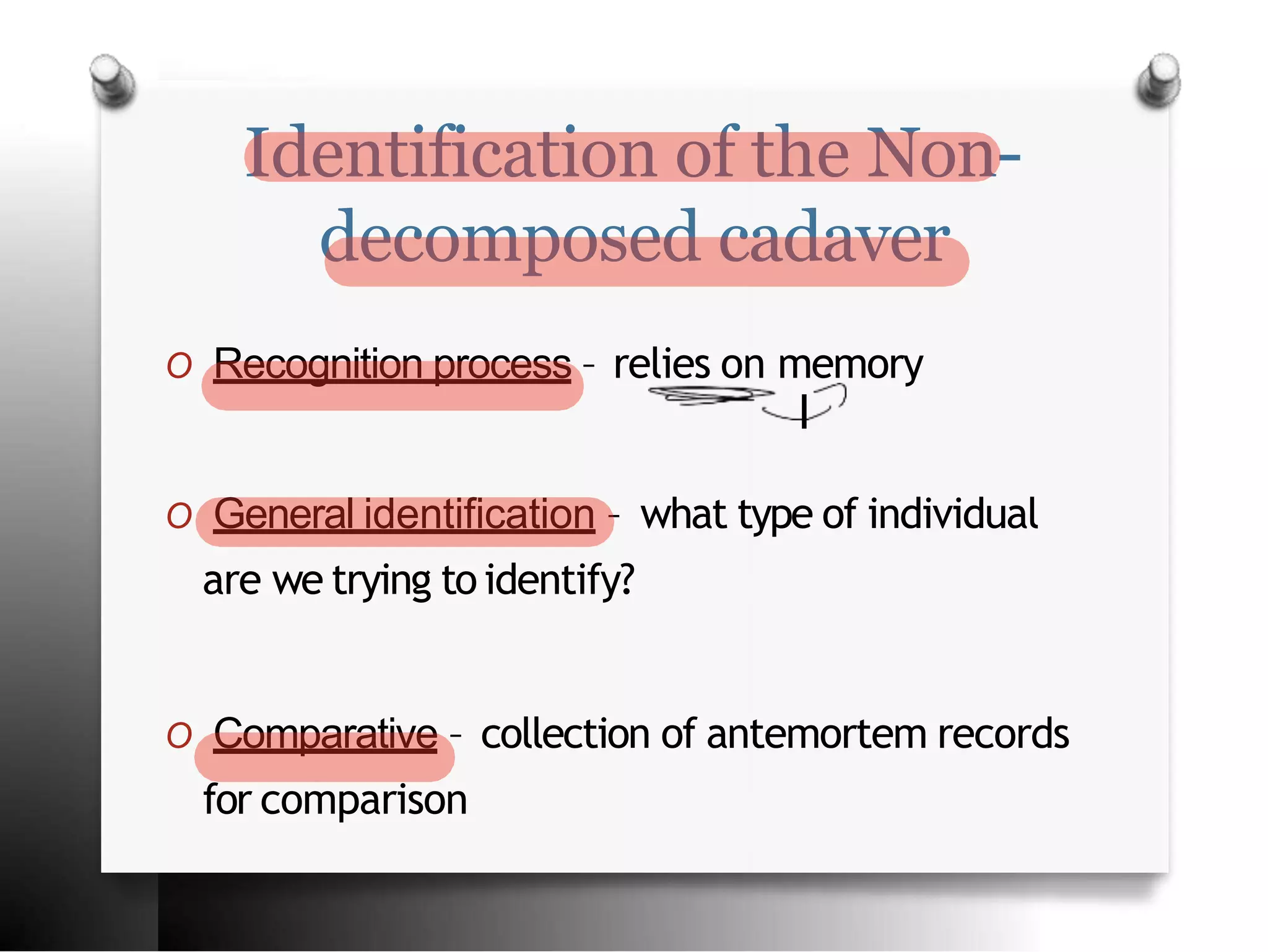
Identification of the Non-
decomposed cadaver
O Recognition process – relies on memory
I
O General identification – what type of individual
are we trying to identify?
O Comparative – collection of antemortem records
for comparison
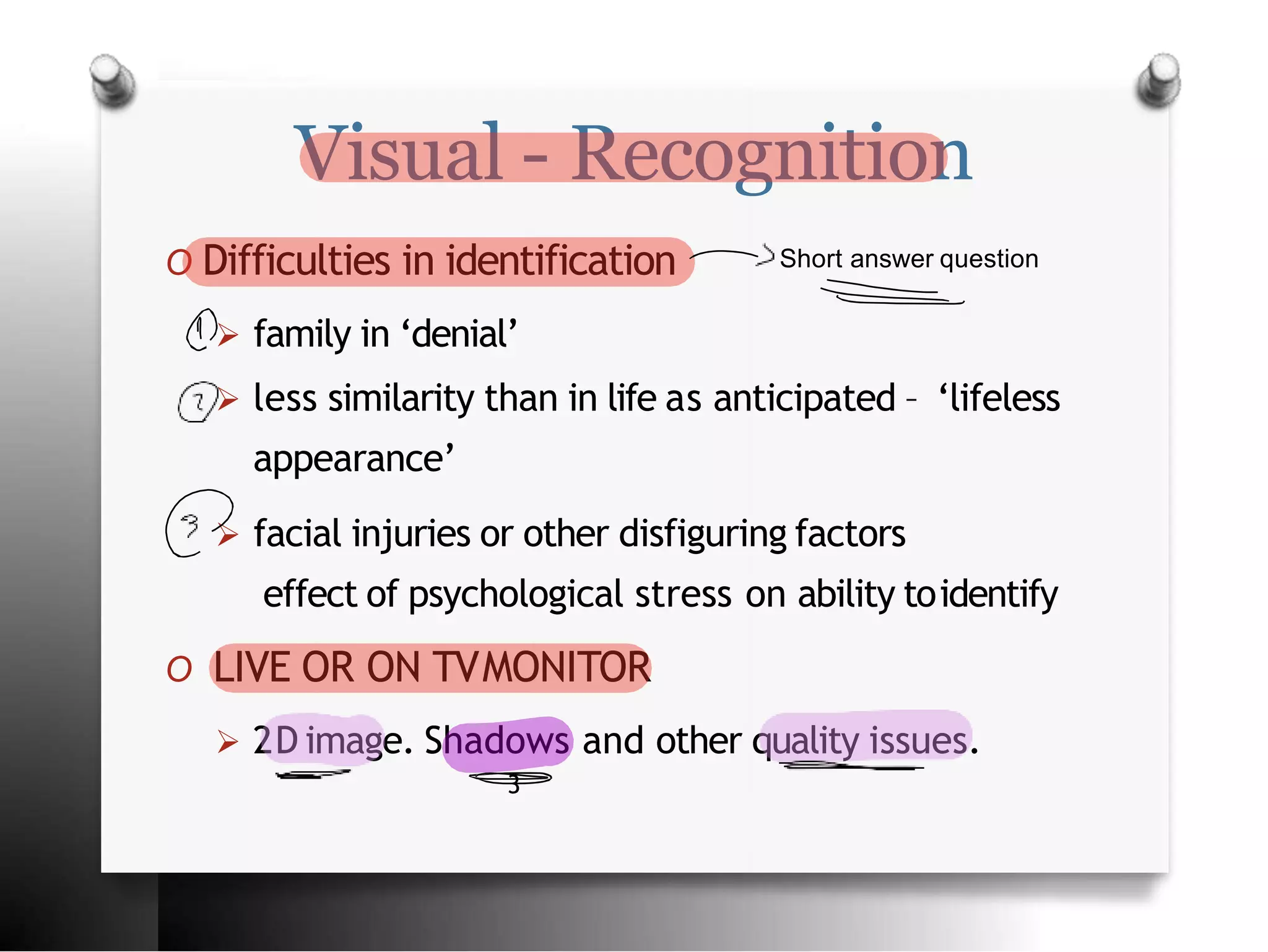
Visual - Recognition
O Difficulties in identification
 family in ‘denial’
 less similarity than in life as anticipated – ‘lifeless
appearance’
 facial injuries or other disfiguring factors
effect of psychological stress on ability toidentify
O LIVE OR ON TVMONITOR
 2D image. Shadows and other quality issues.
3
Short answer question
Documentation
O Needs to be accurate, ordered,retrievable,
transmissible, secure and consistent.
O One person to coordinate informationUnique
and clear identifiers
Photography
O The post-mortem findings and photographs are
taken at the direction of thepathologist.
O It is essential to take general views of the body,
dressed and undressed, front and back, then all
injuries, with a scale.
O Internal photographs of the body are also taken,
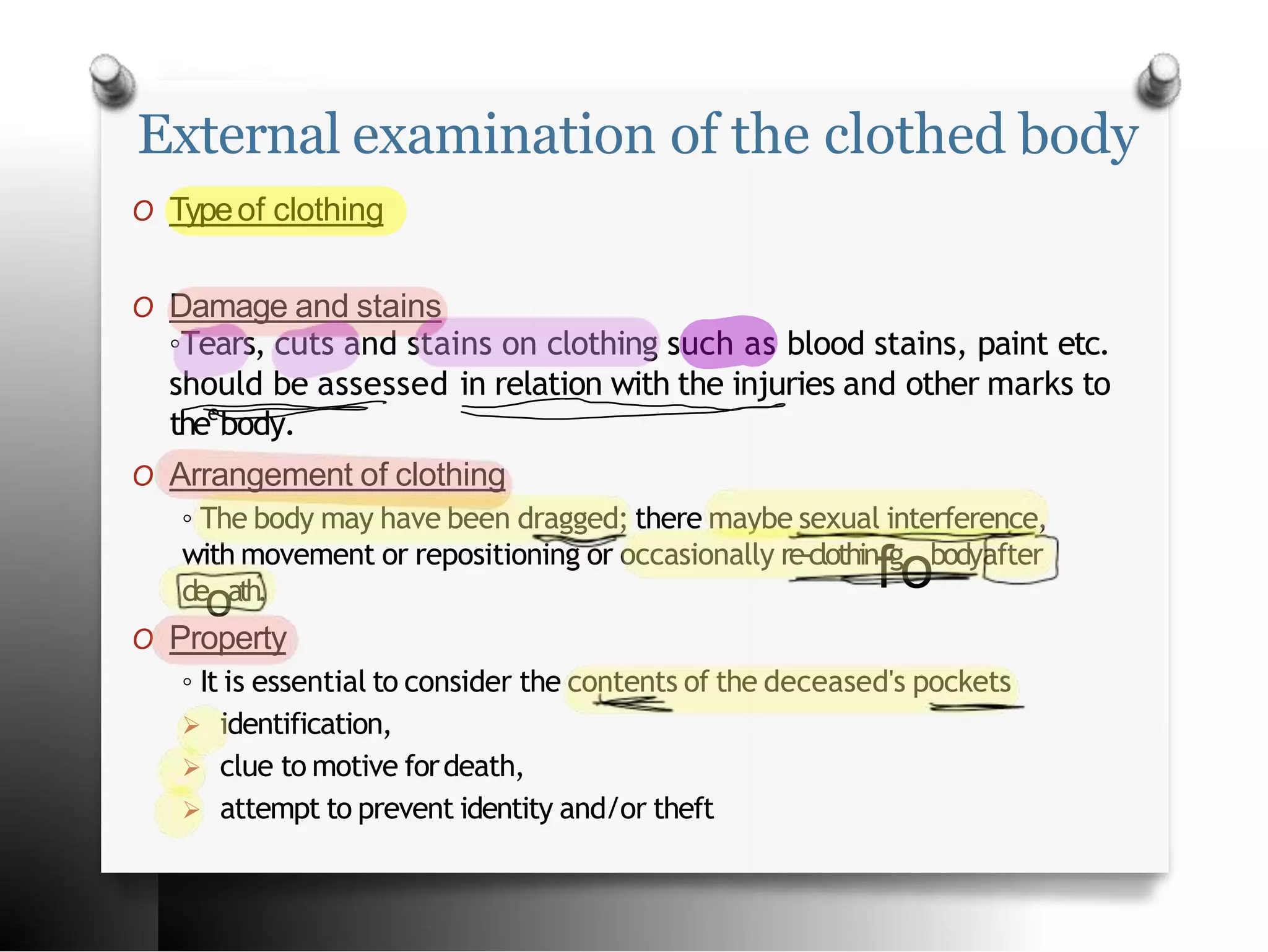
External examination of the clothed body
O Typeof clothing
O Property
◦ It is essential to consider the contents of the deceased's pockets
 identification,
 clue to motive fordeath,
 attempt to prevent identity and/or theft
O Damage and stains
◦Tears, cuts and stains on clothing such as blood stains, paint etc.
should be assessed in relation with the injuries and other marks to
thee
body.
O Arrangement of clothing
◦ The body may have been dragged; there maybe sexual interference,
de
oath.
with movement or repositioning or occasionally re-clothin
fg
obodyafter
External examination of the unclothed body
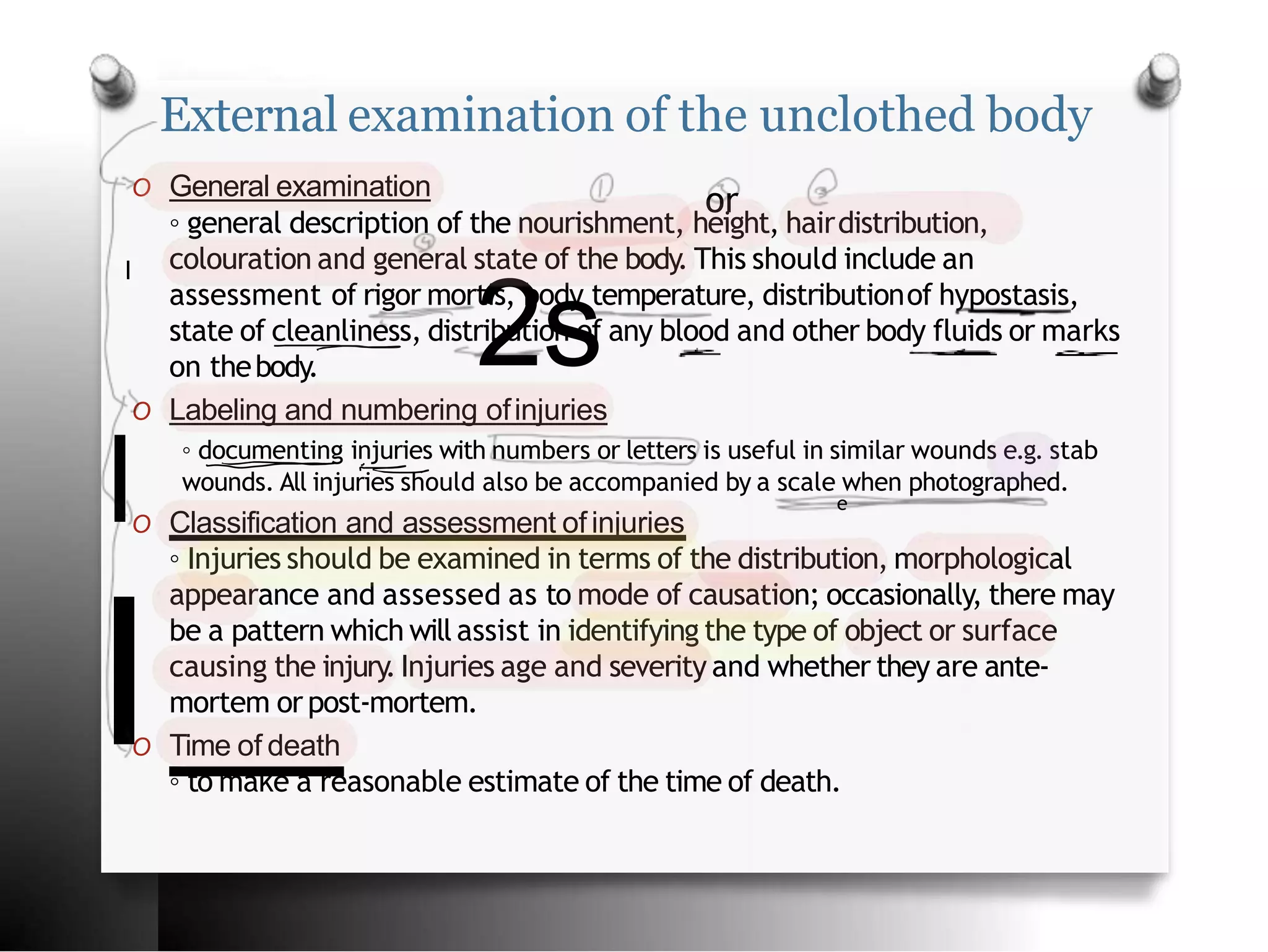
O General examination
◦ general description of the nourishment, height, hairdistribution,
colouration and general state of the body. This should include an
assessment of rigor mortis, body temperature, distributionof hypostasis,
state of cleanliness, distribution of any blood and other body fluids or marks
on thebody.
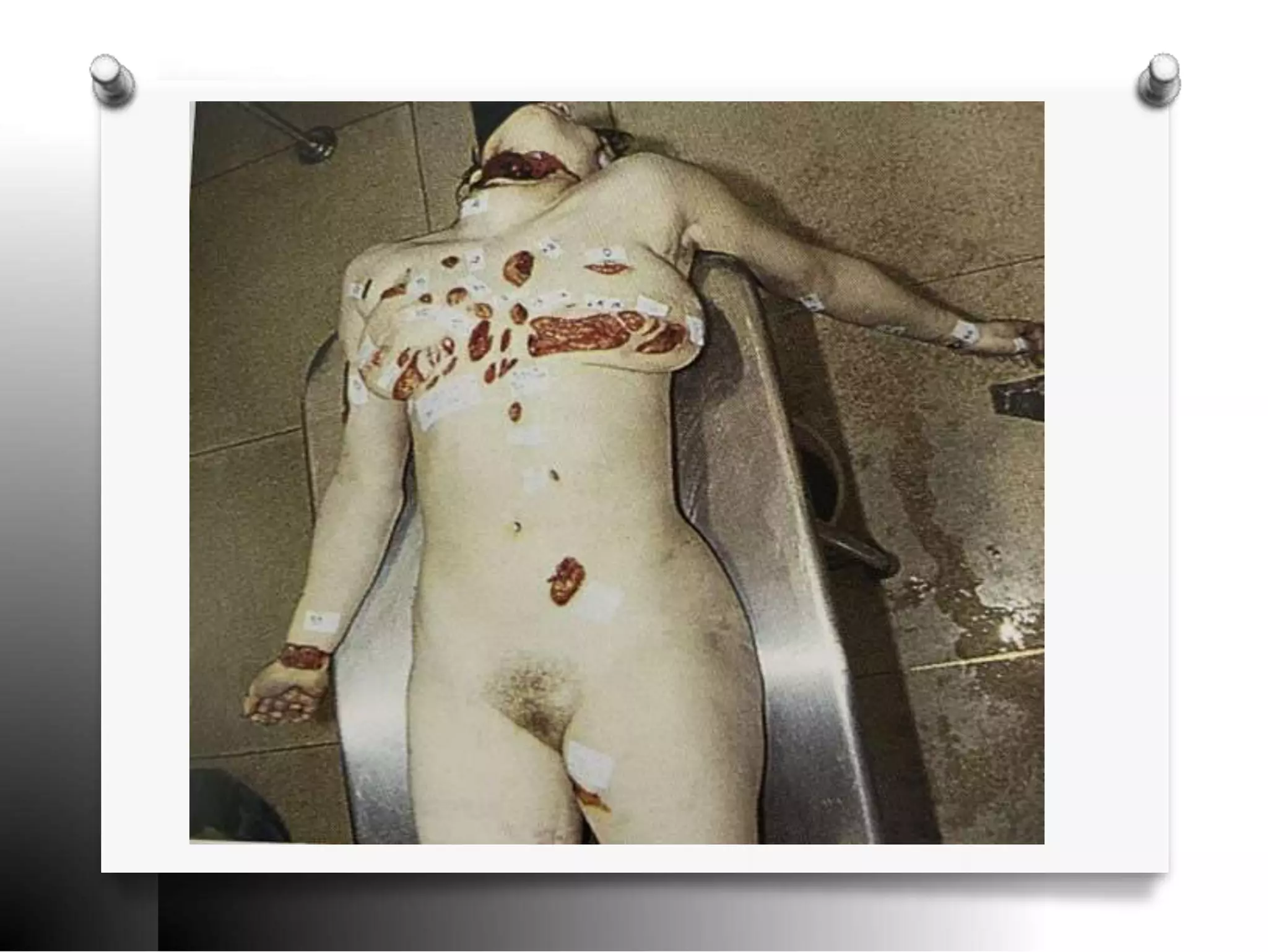
O Labeling and numbering ofinjuries
◦ documenting injuries with numbers or letters is useful in similar wounds e.g. stab
wounds. All injuries should also be accompanied by a scale when photographed.
O Classification and assessment of injuries
◦ Injuries should be examined in terms of the distribution, morphological
appearance and assessed as to mode of causation; occasionally, there may
be a pattern which will assist in identifying the type of object or surface
causing the injury.Injuries age and severity and whether they are ante-
mortem orpost-mortem.
O Time of death
◦ to make a reasonable estimate of the time of death.
or
I
2s
l e
I
The internal examination
 T
odetermine extent and severity of injury in cases
involving trauma.
 If cases with a number of injuries, to determinethe
role of each in causing death.
 T
odetermine the cause of death.
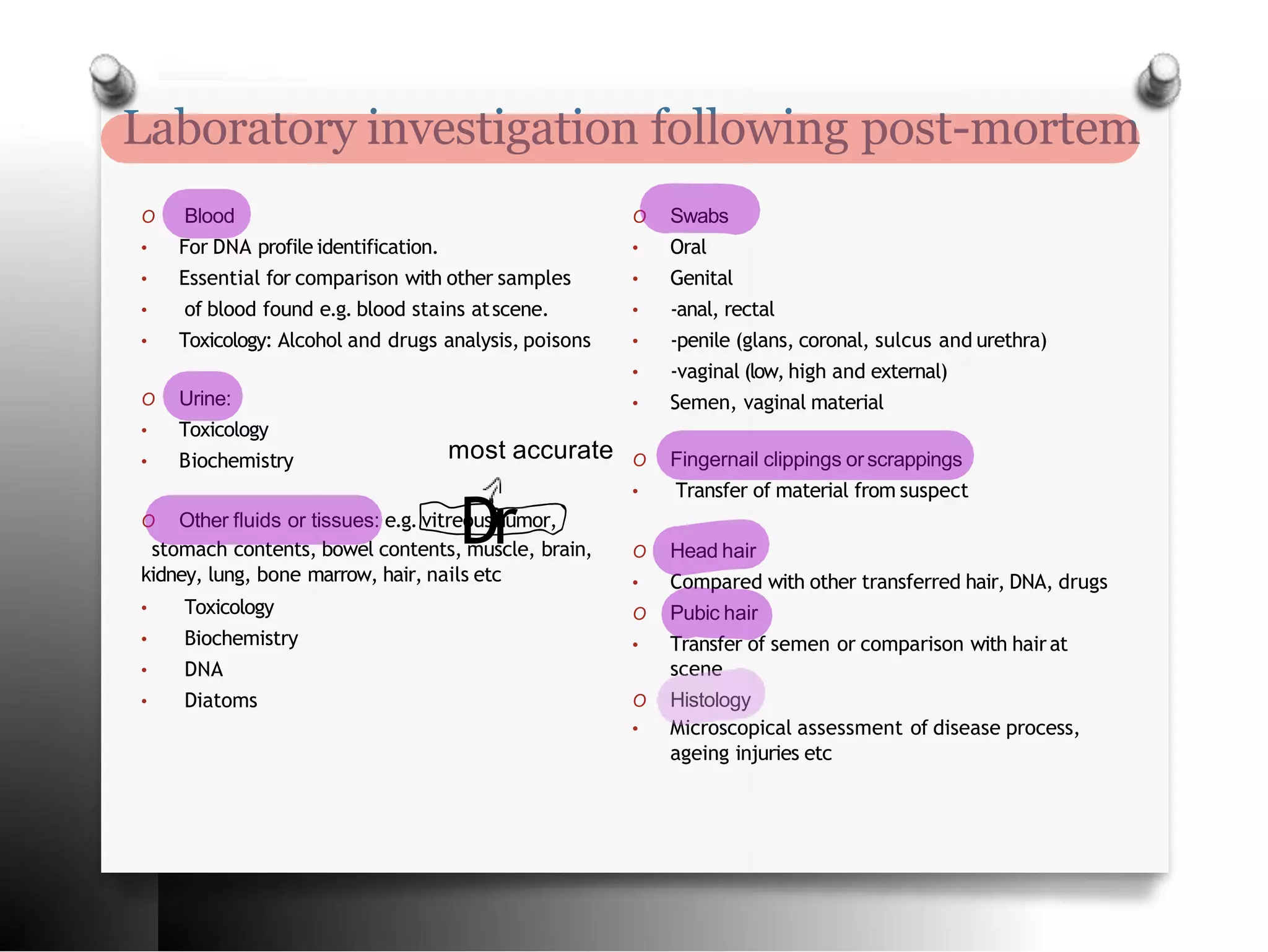
Laboratory investigation following post-mortem
O Blood
• For DNA profile identification.
• Essential for comparison with other samples
• of blood found e.g. blood stains atscene.
• Toxicology: Alcohol and drugs analysis, poisons
O Urine:
• Toxicology
• Biochemistry
O Other fluids or tissues: e.g. vitreoushumor,
stomach contents, bowel contents, muscle, brain,
kidney, lung, bone marrow, hair, nails etc
• Toxicology
• Biochemistry
• DNA
• Diatoms
O Swabs
• Oral
• Genital
• -anal, rectal
• -penile (glans, coronal, sulcus and urethra)
• -vaginal (low, high and external)
• Semen, vaginal material
O Fingernail clippings orscrappings
• Transfer of material from suspect
O Head hair
• Compared with other transferred hair, DNA, drugs
O Pubic hair
• Transfer of semen or comparison with hairat
scene
O Histology
• Microscopical assessment of disease process,
ageing injuries etc
Dr
most accurate
Samples – Packaging
O Aim to prevent destruction and contamination
O New containers must be used, sterile ones with
some evidence
O Seal at crimescene/mortuary
O Drying of biological fluids, prevents destruction or
contamination by bacteria
Sending the tissues ororgans
for analysis:
Histopathology:
O The tissues are preserved using formalinas
preservative (10% formaldehyde).
O Labeled and sent to the pathology lab,with
description of autopsy findings concerned
with that particular organ.
Further action after theautopsy
O Pathologist will initially identify key issues at thepost
mortem and from background information
O Pathologist discussing the post mortem findingswith
next of kin is good practice and provides a better
understanding of the cause ofdeath
O Obtaining assistance from other experts/
multidisciplinary approach is essential in somecases
Preparation of reports and presentation
of evidence
Reports should be prepared, taking into accountthe
following:
• Authority to carry out autopsy
• Identification methodology
• Documentation of evidence
• Chain of custody
• Statement of facts
• Statement of opinions including cause ofdeath
• Further reports/conferences as required toclarify
issues
THANK YOU

Forensic Autopsy

  • 1.
  • 2.
    Objectives By the endof this lecture you’ll be ableto: O Understand the fundamentals of the forensic autopsy. O Illustrate how to identify cadavers and the mortuary process. O Recognize dealing with high risk cases. O The importance of external and internal examination. O Explain the process following postmortem autopsy.
  • 3.
    Category of death ONatural causes O Accident O Suicide O Homicide
  • 4.
    Autopsy O Autopsy isdefined as “scientificdissection of the dead body”. O There are two types of autopsies in practice: i. Pathological autopsy ii. Medicolegal autopsy
  • 5.
    Autopsy i. Pathological autopsy Academic autopsies are done toacquire knowledge.  cases of natural death  Consent is mandatory t ii. Medicolegal autopsy  Investigative scientific dissection of a dead body  Done under an authorization of thepolice  here is no need for consentof the relatives  Unnatural I at ndsuddenIet deaths
  • 6.
    The purpose ofForensic Autopsy O Determine the identity of the body O Estimate the time ofdeath O Identify and document the nature and numberof injuries O Interpret the significance and effect of theinjuries O Interpret the significance and effect of thenatural disease present O Identify the presence ofpoisons O Interpret the effect of any medical or surgical treatment 7
  • 7.
    No post-mortem examination OOccasionally in high riskcases O Some occasions after examination of historyand medical notes O Post-mortem diagnosis 8 from CT or MRI Biopsy
  • 8.
    Dealing with highrisk cases A high risk case is defined as a case where there is a serious infectiousdisease which can be caught by those present at the autopsy O Serious infections that causeconcern: ◦ Human Immunodeficiency Virus (HIV), Hepatitis A, B or C,Tuberculosis, Anthrax, and Typhoid O Precautions:  e.g., history of drug addiction. Test blood prior to autopsy for HIV and Hepatitis status.  Wear protective clothing including double gloves.  Electric saws should only be used by working under plastic.  Cleaning agents and disinfectants such a bleach, formalin, cidex and sodium hydroxide should be available for cleaningup  Care with sewing up afterautopsy. E
  • 9.
    Fundamentals of ForensicAutopsy 1) History tothe pathologist 2) Chain of custody 3) Identification 4) Documentation 5) External Examination 6) Internal Examination 7) Taking and retaining samples 8) Re-visiting the body 9) Communicate withthe Police
  • 10.
    Review of thehistory and medical notes O Review of the circumstances prior to the autopsy O Witness statements: lay and professional O Examining and interpreting medical notes O Consultation with medicalcolleagues
  • 11.
    Identification “Essential to identifybody in any investigation”
  • 12.
    Identification of theNon- decomposed cadaver O Recognition process – relies on memory I O General identification – what type of individual are we trying to identify? O Comparative – collection of antemortem records for comparison
  • 13.
    Visual - Recognition ODifficulties in identification  family in ‘denial’  less similarity than in life as anticipated – ‘lifeless appearance’  facial injuries or other disfiguring factors effect of psychological stress on ability toidentify O LIVE OR ON TVMONITOR  2D image. Shadows and other quality issues. 3 Short answer question
  • 14.
    Documentation O Needs tobe accurate, ordered,retrievable, transmissible, secure and consistent. O One person to coordinate informationUnique and clear identifiers
  • 15.
    Photography O The post-mortemfindings and photographs are taken at the direction of thepathologist. O It is essential to take general views of the body, dressed and undressed, front and back, then all injuries, with a scale. O Internal photographs of the body are also taken,
  • 16.
    External examination ofthe clothed body O Typeof clothing O Property ◦ It is essential to consider the contents of the deceased's pockets  identification,  clue to motive fordeath,  attempt to prevent identity and/or theft O Damage and stains ◦Tears, cuts and stains on clothing such as blood stains, paint etc. should be assessed in relation with the injuries and other marks to thee body. O Arrangement of clothing ◦ The body may have been dragged; there maybe sexual interference, de oath. with movement or repositioning or occasionally re-clothin fg obodyafter
  • 17.
    External examination ofthe unclothed body O General examination ◦ general description of the nourishment, height, hairdistribution, colouration and general state of the body. This should include an assessment of rigor mortis, body temperature, distributionof hypostasis, state of cleanliness, distribution of any blood and other body fluids or marks on thebody. O Labeling and numbering ofinjuries ◦ documenting injuries with numbers or letters is useful in similar wounds e.g. stab wounds. All injuries should also be accompanied by a scale when photographed. O Classification and assessment of injuries ◦ Injuries should be examined in terms of the distribution, morphological appearance and assessed as to mode of causation; occasionally, there may be a pattern which will assist in identifying the type of object or surface causing the injury.Injuries age and severity and whether they are ante- mortem orpost-mortem. O Time of death ◦ to make a reasonable estimate of the time of death. or I 2s l e I
  • 19.
    The internal examination T odetermine extent and severity of injury in cases involving trauma.  If cases with a number of injuries, to determinethe role of each in causing death.  T odetermine the cause of death.
  • 20.
    Laboratory investigation followingpost-mortem O Blood • For DNA profile identification. • Essential for comparison with other samples • of blood found e.g. blood stains atscene. • Toxicology: Alcohol and drugs analysis, poisons O Urine: • Toxicology • Biochemistry O Other fluids or tissues: e.g. vitreoushumor, stomach contents, bowel contents, muscle, brain, kidney, lung, bone marrow, hair, nails etc • Toxicology • Biochemistry • DNA • Diatoms O Swabs • Oral • Genital • -anal, rectal • -penile (glans, coronal, sulcus and urethra) • -vaginal (low, high and external) • Semen, vaginal material O Fingernail clippings orscrappings • Transfer of material from suspect O Head hair • Compared with other transferred hair, DNA, drugs O Pubic hair • Transfer of semen or comparison with hairat scene O Histology • Microscopical assessment of disease process, ageing injuries etc Dr most accurate
  • 21.
    Samples – Packaging OAim to prevent destruction and contamination O New containers must be used, sterile ones with some evidence O Seal at crimescene/mortuary O Drying of biological fluids, prevents destruction or contamination by bacteria
  • 22.
    Sending the tissuesororgans for analysis: Histopathology: O The tissues are preserved using formalinas preservative (10% formaldehyde). O Labeled and sent to the pathology lab,with description of autopsy findings concerned with that particular organ.
  • 23.
    Further action aftertheautopsy O Pathologist will initially identify key issues at thepost mortem and from background information O Pathologist discussing the post mortem findingswith next of kin is good practice and provides a better understanding of the cause ofdeath O Obtaining assistance from other experts/ multidisciplinary approach is essential in somecases
  • 24.
    Preparation of reportsand presentation of evidence Reports should be prepared, taking into accountthe following: • Authority to carry out autopsy • Identification methodology • Documentation of evidence • Chain of custody • Statement of facts • Statement of opinions including cause ofdeath • Further reports/conferences as required toclarify issues
  • 25.