Infective Endocarditis
Dr abid naeem
Definition
• Infection of the endocardial surface of heart characterized
by
1-Colonization or invasion of the heart valves (native or
prosthetic) or by a microbe, leading to formation of bulky,
friable vegetation composed of thrombotic debris and
organisms
2-Associated with destruction of underlying cardiac tissue.
Sites involved
1-Heart valves
2-Ventricular septum defects
3-Mural endocardium
4-Intracardiac devices
Classification
Acute Endocarditis
1-Destructive and infection,
frequently of a previously
normal heart valve, with a
highly virulent organism
2-Hematogenous seeds
3- If untreated, leads to death
within weeks
SUBACUTE ENDOCARDITIS
1-Organisms of low virulence
causing infection in a
previously abnormal heart,
particularly on deformed
valves.
2- Appear insidiously and pursue
a protracted course of weeks
to moths.
3- Responds to appropriate
antibiotic treatment
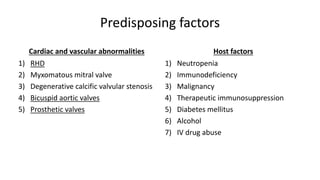
Predisposing factors
Cardiac and vascular abnormalities
1) RHD
2) Myxomatous mitral valve
3) Degenerative calcific valvular stenosis
4) Bicuspid aortic valves
5) Prosthetic valves
Host factors
1) Neutropenia
2) Immunodeficiency
3) Malignancy
4) Therapeutic immunosuppression
5) Diabetes mellitus
6) Alcohol
7) IV drug abuse
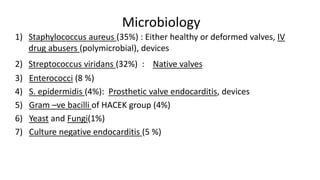
Microbiology
1) Staphylococcus aureus (35%) : Either healthy or deformed valves, IV
drug abusers (polymicrobial), devices
2) Streptococcus viridans (32%) : Native valves
3) Enterococci (8 %)
4) S. epidermidis (4%): Prosthetic valve endocarditis, devices
5) Gram –ve bacilli of HACEK group (4%)
6) Yeast and Fungi(1%)
7) Culture negative endocarditis (5 %)
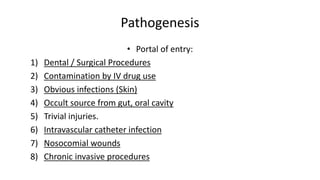
Pathogenesis
• Portal of entry:
1) Dental / Surgical Procedures
2) Contamination by IV drug use
3) Obvious infections (Skin)
4) Occult source from gut, oral cavity
5) Trivial injuries.
6) Intravascular catheter infection
7) Nosocomial wounds
8) Chronic invasive procedures
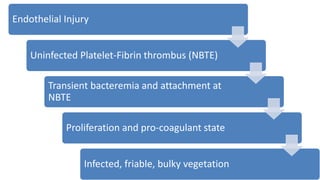
Endothelial Injury
Uninfected Platelet-Fibrin thrombus (NBTE)
Transient bacteremia and attachment at
NBTE
Proliferation and pro-coagulant state
Infected, friable, bulky vegetation
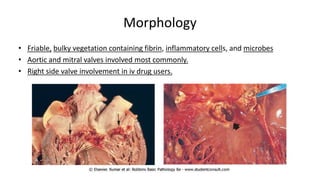
Morphology
• Friable, bulky vegetation containing fibrin, inflammatory cells, and microbes
• Aortic and mitral valves involved most commonly.
• Right side valve involvement in iv drug users.
Clinical features
Constitutional symptoms
Cytokine release ?
Symptoms
1) Damage to intracardiac
structures
2) Embolization of vegetation
fragments
3) Hematogenous infection
4) Immune complex
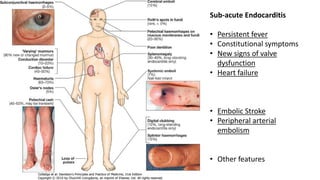
Sub-acute Endocarditis
• Persistent fever
• Constitutional symptoms
• New signs of valve
dysfunction
• Heart failure
• Embolic Stroke
• Peripheral arterial
embolism
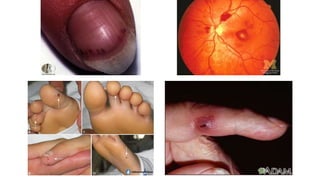
• Other features
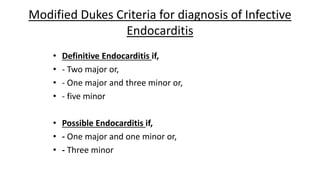
Modified Dukes Criteria for diagnosis of Infective
Endocarditis
• Definitive Endocarditis if,
• - Two major or,
• - One major and three minor or,
• - five minor
• Possible Endocarditis if,
• - One major and one minor or,
• - Three minor
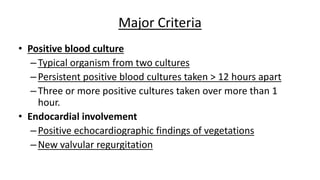
Major Criteria
• Positive blood culture
–Typical organism from two cultures
–Persistent positive blood cultures taken > 12 hours apart
–Three or more positive cultures taken over more than 1
hour.
• Endocardial involvement
–Positive echocardiographic findings of vegetations
–New valvular regurgitation
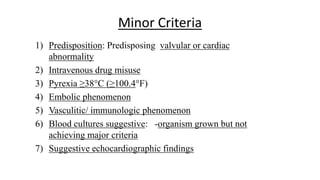
Minor Criteria
1) Predisposition: Predisposing valvular or cardiac
abnormality
2) Intravenous drug misuse
3) Pyrexia ≥38°C (≥100.4°F)
4) Embolic phenomenon
5) Vasculitic/ immunologic phenomenon
6) Blood cultures suggestive: -organism grown but not
achieving major criteria
7) Suggestive echocardiographic findings
INVESTIGATIONS
.
Microbiology
 Blood cultures:
 Key diagnostic investigation in infective endocarditis.
 Isolation of microorganism from culture is important
for diagnosis and also for treatment.
 At least 3 sets of samples should be taken from
different venepuncture sites over 24 hours.
.
 Serology
 Can be sent when the diagnosis is suspected and
the cultures are negative.
 They aid in cases where the organisms will not grow
in blood cultures (Coxiella,Legionella,Bartonella)
 ECG
To detect complications like MI, conduction
abnormalities.
 CHEST X RAY
.
 Echocardiography
 It can identify the presence and size of vegetations,
detect intracardiac complications and assess cardiac
function.
 Transthoracic echocardiography is noninvasive and has
high specificity for visualising vegetations.
 Transoesophageal echocardiography is more sensitive
than TTE.It can detect small vegetations,prosthetic
endocarditis and intra cardiac complications.
. Complete blood counts
may show anamia and increased WBC counts.
 Urea and Creatinine:
may be elevated due to glomerulonephritis
 Liver biochemistry:
Serum alkaline phosphatase may be increased
 Inflammatory markers
CRP, ESR are increased in infection . CRP also helps
in monotoring response to therapy.
 Urine
proteinuria and hematuria occur frequently.
TREATMENT
Antimicrobial Therapy
• Therapy requires identification of specific pathogen
and its susceptibility to antimicrobials.
• Empirical therapy should be started as soon as
possible targeting most likely pathogens.
• Bactericidal drugs should be used.
.
• Resolution of fever occurs in 5 to 7 days. if fever
persists patient should be evaluated for
complications like paravalvular abscess and extra
cardiac abscess.
• Serologic abnormalities resolve slowly and do not
reflect response to treatment.
.
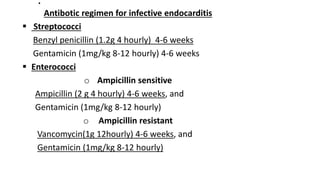
Antibotic regimen for infective endocarditis
 Streptococci
Benzyl penicillin (1.2g 4 hourly) 4-6 weeks
Gentamicin (1mg/kg 8-12 hourly) 4-6 weeks
 Enterococci
o Ampicillin sensitive
Ampicillin (2 g 4 hourly) 4-6 weeks, and
Gentamicin (1mg/kg 8-12 hourly)
o Ampicillin resistant
Vancomycin(1g 12hourly) 4-6 weeks, and
Gentamicin (1mg/kg 8-12 hourly)
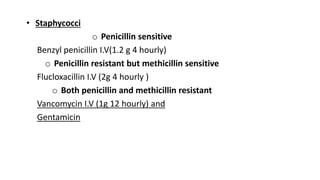
• Staphycocci
o Penicillin sensitive
Benzyl penicillin I.V(1.2 g 4 hourly)
o Penicillin resistant but methicillin sensitive
Flucloxacillin I.V (2g 4 hourly )
o Both penicillin and methicillin resistant
Vancomycin I.V (1g 12 hourly) and
Gentamicin
.
Surgery
• Indications
1) patients with direct extension of infection to myocardial
structures.
2) Prosthetic valve dysfunction.
3) Congestive heart failure.
4) Badly damaged valves.
5) IE caused by fungi or gram-ve or resistant organisms.
6) On Echocardiography Large vegetations
7) Recurrent embolic attacks.
8) abscess formation. Conductions defects
• Prophylaxis
High risk category
1) Prosthetic Cardiac Valves
2) Previous bacterial endocarditis, even in absence of
heart disease.
3) Complex cyanotic congenital heart disease(
TGA,TOF)
4) Surgically constructed systemic pulmonary shunts.
Moderate risk category
1) Rheumatic and other valvular dysfunction
2) Congenital cardiac malformations
3) Hypertrophic cardiomyopathy
4) Mitral valve prolapse with valvular regurgitation
Regimen for IE prophylaxis
• Standard oral regime
Amoxicillin 2 g 1hr before procedure
• Inability to take oral medication
Ampicillin 2g IV or IM 1hr before procedure
 Penicillin allergy
Clindamycin 600 mg
Clarithromycin 500 mg
Cephalexin 2 g.
Thank you.

Infective endocarditis

  • 1.
  • 2.
    Definition • Infection ofthe endocardial surface of heart characterized by 1-Colonization or invasion of the heart valves (native or prosthetic) or by a microbe, leading to formation of bulky, friable vegetation composed of thrombotic debris and organisms 2-Associated with destruction of underlying cardiac tissue.
  • 3.
    Sites involved 1-Heart valves 2-Ventricularseptum defects 3-Mural endocardium 4-Intracardiac devices
  • 4.
    Classification Acute Endocarditis 1-Destructive andinfection, frequently of a previously normal heart valve, with a highly virulent organism 2-Hematogenous seeds 3- If untreated, leads to death within weeks SUBACUTE ENDOCARDITIS 1-Organisms of low virulence causing infection in a previously abnormal heart, particularly on deformed valves. 2- Appear insidiously and pursue a protracted course of weeks to moths. 3- Responds to appropriate antibiotic treatment
  • 5.
    Predisposing factors Cardiac andvascular abnormalities 1) RHD 2) Myxomatous mitral valve 3) Degenerative calcific valvular stenosis 4) Bicuspid aortic valves 5) Prosthetic valves Host factors 1) Neutropenia 2) Immunodeficiency 3) Malignancy 4) Therapeutic immunosuppression 5) Diabetes mellitus 6) Alcohol 7) IV drug abuse
  • 6.
    Microbiology 1) Staphylococcus aureus(35%) : Either healthy or deformed valves, IV drug abusers (polymicrobial), devices 2) Streptococcus viridans (32%) : Native valves 3) Enterococci (8 %) 4) S. epidermidis (4%): Prosthetic valve endocarditis, devices 5) Gram –ve bacilli of HACEK group (4%) 6) Yeast and Fungi(1%) 7) Culture negative endocarditis (5 %)
  • 7.
    Pathogenesis • Portal ofentry: 1) Dental / Surgical Procedures 2) Contamination by IV drug use 3) Obvious infections (Skin) 4) Occult source from gut, oral cavity 5) Trivial injuries. 6) Intravascular catheter infection 7) Nosocomial wounds 8) Chronic invasive procedures
  • 8.
    Endothelial Injury Uninfected Platelet-Fibrinthrombus (NBTE) Transient bacteremia and attachment at NBTE Proliferation and pro-coagulant state Infected, friable, bulky vegetation
  • 9.
    Morphology • Friable, bulkyvegetation containing fibrin, inflammatory cells, and microbes • Aortic and mitral valves involved most commonly. • Right side valve involvement in iv drug users.
  • 10.
    Clinical features Constitutional symptoms Cytokinerelease ? Symptoms 1) Damage to intracardiac structures 2) Embolization of vegetation fragments 3) Hematogenous infection 4) Immune complex
  • 11.
    Sub-acute Endocarditis • Persistentfever • Constitutional symptoms • New signs of valve dysfunction • Heart failure • Embolic Stroke • Peripheral arterial embolism • Other features
  • 13.
    Modified Dukes Criteriafor diagnosis of Infective Endocarditis • Definitive Endocarditis if, • - Two major or, • - One major and three minor or, • - five minor • Possible Endocarditis if, • - One major and one minor or, • - Three minor
  • 14.
    Major Criteria • Positiveblood culture –Typical organism from two cultures –Persistent positive blood cultures taken > 12 hours apart –Three or more positive cultures taken over more than 1 hour. • Endocardial involvement –Positive echocardiographic findings of vegetations –New valvular regurgitation
  • 15.
    Minor Criteria 1) Predisposition:Predisposing valvular or cardiac abnormality 2) Intravenous drug misuse 3) Pyrexia ≥38°C (≥100.4°F) 4) Embolic phenomenon 5) Vasculitic/ immunologic phenomenon 6) Blood cultures suggestive: -organism grown but not achieving major criteria 7) Suggestive echocardiographic findings
  • 16.
  • 17.
    . Microbiology  Blood cultures: Key diagnostic investigation in infective endocarditis.  Isolation of microorganism from culture is important for diagnosis and also for treatment.  At least 3 sets of samples should be taken from different venepuncture sites over 24 hours.
  • 18.
    .  Serology  Canbe sent when the diagnosis is suspected and the cultures are negative.  They aid in cases where the organisms will not grow in blood cultures (Coxiella,Legionella,Bartonella)  ECG To detect complications like MI, conduction abnormalities.  CHEST X RAY
  • 19.
    .  Echocardiography  Itcan identify the presence and size of vegetations, detect intracardiac complications and assess cardiac function.  Transthoracic echocardiography is noninvasive and has high specificity for visualising vegetations.  Transoesophageal echocardiography is more sensitive than TTE.It can detect small vegetations,prosthetic endocarditis and intra cardiac complications.
  • 20.
    . Complete bloodcounts may show anamia and increased WBC counts.  Urea and Creatinine: may be elevated due to glomerulonephritis  Liver biochemistry: Serum alkaline phosphatase may be increased  Inflammatory markers CRP, ESR are increased in infection . CRP also helps in monotoring response to therapy.  Urine proteinuria and hematuria occur frequently.
  • 21.
    TREATMENT Antimicrobial Therapy • Therapyrequires identification of specific pathogen and its susceptibility to antimicrobials. • Empirical therapy should be started as soon as possible targeting most likely pathogens. • Bactericidal drugs should be used.
  • 22.
    . • Resolution offever occurs in 5 to 7 days. if fever persists patient should be evaluated for complications like paravalvular abscess and extra cardiac abscess. • Serologic abnormalities resolve slowly and do not reflect response to treatment.
  • 23.
    . Antibotic regimen forinfective endocarditis  Streptococci Benzyl penicillin (1.2g 4 hourly) 4-6 weeks Gentamicin (1mg/kg 8-12 hourly) 4-6 weeks  Enterococci o Ampicillin sensitive Ampicillin (2 g 4 hourly) 4-6 weeks, and Gentamicin (1mg/kg 8-12 hourly) o Ampicillin resistant Vancomycin(1g 12hourly) 4-6 weeks, and Gentamicin (1mg/kg 8-12 hourly)
  • 24.
    • Staphycocci o Penicillinsensitive Benzyl penicillin I.V(1.2 g 4 hourly) o Penicillin resistant but methicillin sensitive Flucloxacillin I.V (2g 4 hourly ) o Both penicillin and methicillin resistant Vancomycin I.V (1g 12 hourly) and Gentamicin
  • 25.
    . Surgery • Indications 1) patientswith direct extension of infection to myocardial structures. 2) Prosthetic valve dysfunction. 3) Congestive heart failure. 4) Badly damaged valves. 5) IE caused by fungi or gram-ve or resistant organisms. 6) On Echocardiography Large vegetations 7) Recurrent embolic attacks. 8) abscess formation. Conductions defects
  • 26.
    • Prophylaxis High riskcategory 1) Prosthetic Cardiac Valves 2) Previous bacterial endocarditis, even in absence of heart disease. 3) Complex cyanotic congenital heart disease( TGA,TOF) 4) Surgically constructed systemic pulmonary shunts.
  • 27.
    Moderate risk category 1)Rheumatic and other valvular dysfunction 2) Congenital cardiac malformations 3) Hypertrophic cardiomyopathy 4) Mitral valve prolapse with valvular regurgitation
  • 28.
    Regimen for IEprophylaxis • Standard oral regime Amoxicillin 2 g 1hr before procedure • Inability to take oral medication Ampicillin 2g IV or IM 1hr before procedure  Penicillin allergy Clindamycin 600 mg Clarithromycin 500 mg Cephalexin 2 g.
  • 29.