Nikhil Oza
Roll No. 62
IV Semester
Presented By-
Forensic Medicine
Specific Learning Objectives (SLOs)
1) Case Presentation I
2) Circumstances for Preservation of Viscera
3) Routine Viscera Preserved
4) Special Preservations
5) Collection
6) Preservatives Used
7) Dispatch of Viscera
8) Case Presentation II
Case Presentation I
 Deceased Abdul Hafeej aged 54 years was admitted to
the hospital in unconscious state with the history of
ingestion of massage oil named ‘Rogan Phosphorous’
before three days of admission. On resuscitation he
became conscious and narrated the same history. He
died after 3 days.
 Postmortem Findings: On examination both eyes
were having sub-conjunctival hemorrhage and
patechial hemorrhage on internal organs. The injuries
were noted in form of multiple contusions, abrasion
taking rail pattern on left deltoid region.
 Contusion on neck, right ear, with massive ecchymosis
underneath the scalp on left temporo parietal region
as well as ribbon muscles of the neck (Para-tracheal)
and right sternocleidomastoid muscle with right
cornua of thyroid cartilage found fractured.
 The stomach finding revealed bloody liquid about 20
cc with mucosa severely congested and hemorrhagic.
 Viscera Analysis: The preserved viscera was analyzed
in the department and found positive for
phosphorous.
 So, according to viscera analysis the death was
declared as Homicidal.
Circumstances of Preservation
1) When the medical officer suspects the presence of
poison by its smell or by some other evidence while
conducting autopsy.
2) When the cause of death could not be found out
after a full autopsy and there is no natural disease or
injury
3) In decomposed bodies
4) In Spot death in burns
5) When an investigating officer requests so
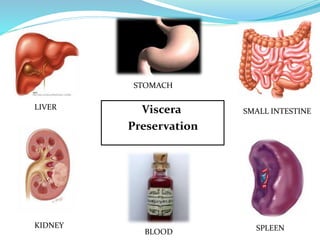
Viscera
Preservation
STOMACH
LIVER
SPLEEN
SMALL INTESTINE
KIDNEY
BLOOD
Routine Viscera Preserved
 Bottle I- Stomach with its contents and
proximal 1/3rd (30 cms) of the intestine with
its contents.
 Bottle II- Half of each kidney and 500 gm.
of liver.
 Bottle III- 100 ml blood (or minimum 10
ml)
 Bottle IV- only the preservative; acts as a
control.
Special Preservations :
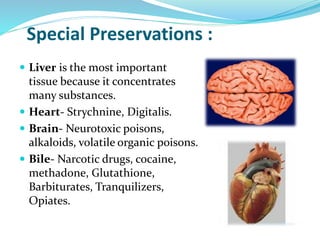
 Liver is the most important
tissue because it concentrates
many substances.
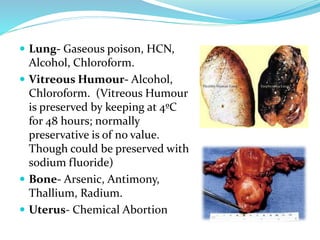
 Heart- Strychnine, Digitalis.
 Brain- Neurotoxic poisons,
alkaloids, volatile organic poisons.
 Bile- Narcotic drugs, cocaine,
methadone, Glutathione,
Barbiturates, Tranquilizers,
Opiates.
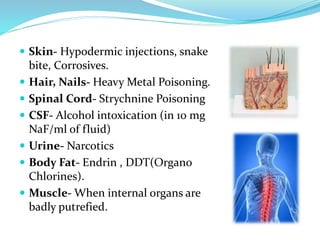
 Lung- Gaseous poison, HCN,
Alcohol, Chloroform.
 Vitreous Humour- Alcohol,
Chloroform. (Vitreous Humour
is preserved by keeping at 4ºC
for 48 hours; normally
preservative is of no value.
Though could be preserved with
sodium fluoride)
 Bone- Arsenic, Antimony,
Thallium, Radium.
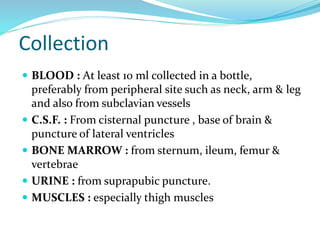
 Uterus- Chemical Abortion
 Skin- Hypodermic injections, snake
bite, Corrosives.
 Hair, Nails- Heavy Metal Poisoning.
 Spinal Cord- Strychnine Poisoning
 CSF- Alcohol intoxication (in 10 mg
NaF/ml of fluid)
 Urine- Narcotics
 Body Fat- Endrin , DDT(Organo
Chlorines).
 Muscle- When internal organs are
badly putrefied.
Collection
 BLOOD : At least 10 ml collected in a bottle,
preferably from peripheral site such as neck, arm & leg
and also from subclavian vessels
 C.S.F. : From cisternal puncture , base of brain &
puncture of lateral ventricles
 BONE MARROW : from sternum, ileum, femur &
vertebrae
 URINE : from suprapubic puncture.
 MUSCLES : especially thigh muscles
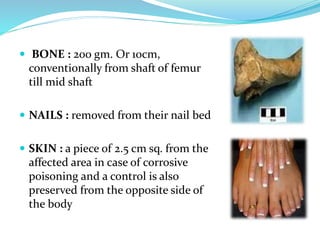
 BONE : 200 gm. Or 10cm,
conventionally from shaft of femur
till mid shaft
 NAILS : removed from their nail bed
 SKIN : a piece of 2.5 cm sq. from the
affected area in case of corrosive
poisoning and a control is also
preserved from the opposite side of
the body
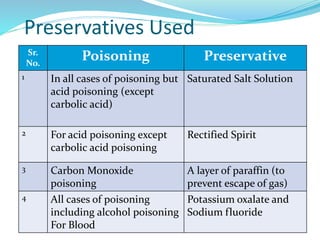
Preservatives Used
Sr.
No.
Poisoning Preservative
1 In all cases of poisoning but
acid poisoning (except
carbolic acid)
Saturated Salt Solution
2 For acid poisoning except
carbolic acid poisoning
Rectified Spirit
3 Carbon Monoxide
poisoning
A layer of paraffin (to
prevent escape of gas)
4 All cases of poisoning
including alcohol poisoning
For Blood
Potassium oxalate and
Sodium fluoride
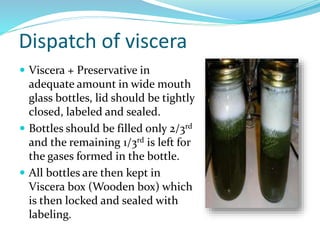
Dispatch of viscera
 Viscera + Preservative in
adequate amount in wide mouth
glass bottles, lid should be tightly
closed, labeled and sealed.
 Bottles should be filled only 2/3rd
and the remaining 1/3rd is left for
the gases formed in the bottle.
 All bottles are then kept in
Viscera box (Wooden box) which
is then locked and sealed with
labeling.
 The keys of the box are then kept in an envelope,
which is also sealed and then handed over to the
Police Constable in exchange for a receipt.
 The Police Constable then carries it to the Forensic
Science Laboratory.
 Along with the keys and Viscera box the following
documents also are sent- A copy of Panchanama,
Autopsy report, Requisition letter by MO to FSL to
conduct Chemical Analysis.
Case Presentation II
 Napoleon Bonaparte after the defeat at
the battle of Waterloo in 1815, was
exiled to St. Helena where six years
later he died a mysterious death.
 The British claimed his death to be
due to Stomach Cancer; however the
symptoms described by his personal
physician Dr.Antommarchi were
strongly suggestive of Chronic Arsenic
poisoning.
 Immediately after the death of Napoleon, his valet cut
some hair from the scalp and gave it to
Dr.Antommarchi, which were then submitted to
Harwell Nuclear Research Lab in London.
 Neutron activation analysis was done, which revealed
fluctuating levels of Arsenic from 4.4 to 33.3 ppm,
while any level above 10 ppm is indicative of significant
toxicity.
 Henceforth, this indicates the importance of
preservation of viscera in determining the cause of
death.
Preservation of viscera

Preservation of viscera

  • 1.
    Nikhil Oza Roll No.62 IV Semester Presented By- Forensic Medicine
  • 2.
    Specific Learning Objectives(SLOs) 1) Case Presentation I 2) Circumstances for Preservation of Viscera 3) Routine Viscera Preserved 4) Special Preservations 5) Collection 6) Preservatives Used 7) Dispatch of Viscera 8) Case Presentation II
  • 3.
    Case Presentation I Deceased Abdul Hafeej aged 54 years was admitted to the hospital in unconscious state with the history of ingestion of massage oil named ‘Rogan Phosphorous’ before three days of admission. On resuscitation he became conscious and narrated the same history. He died after 3 days.  Postmortem Findings: On examination both eyes were having sub-conjunctival hemorrhage and patechial hemorrhage on internal organs. The injuries were noted in form of multiple contusions, abrasion taking rail pattern on left deltoid region.
  • 4.
     Contusion onneck, right ear, with massive ecchymosis underneath the scalp on left temporo parietal region as well as ribbon muscles of the neck (Para-tracheal) and right sternocleidomastoid muscle with right cornua of thyroid cartilage found fractured.  The stomach finding revealed bloody liquid about 20 cc with mucosa severely congested and hemorrhagic.  Viscera Analysis: The preserved viscera was analyzed in the department and found positive for phosphorous.  So, according to viscera analysis the death was declared as Homicidal.
  • 5.
    Circumstances of Preservation 1)When the medical officer suspects the presence of poison by its smell or by some other evidence while conducting autopsy. 2) When the cause of death could not be found out after a full autopsy and there is no natural disease or injury 3) In decomposed bodies 4) In Spot death in burns 5) When an investigating officer requests so
  • 6.
  • 7.
    Routine Viscera Preserved Bottle I- Stomach with its contents and proximal 1/3rd (30 cms) of the intestine with its contents.  Bottle II- Half of each kidney and 500 gm. of liver.  Bottle III- 100 ml blood (or minimum 10 ml)  Bottle IV- only the preservative; acts as a control.
  • 8.
    Special Preservations : Liver is the most important tissue because it concentrates many substances.  Heart- Strychnine, Digitalis.  Brain- Neurotoxic poisons, alkaloids, volatile organic poisons.  Bile- Narcotic drugs, cocaine, methadone, Glutathione, Barbiturates, Tranquilizers, Opiates.
  • 9.
     Lung- Gaseouspoison, HCN, Alcohol, Chloroform.  Vitreous Humour- Alcohol, Chloroform. (Vitreous Humour is preserved by keeping at 4ºC for 48 hours; normally preservative is of no value. Though could be preserved with sodium fluoride)  Bone- Arsenic, Antimony, Thallium, Radium.  Uterus- Chemical Abortion
  • 10.
     Skin- Hypodermicinjections, snake bite, Corrosives.  Hair, Nails- Heavy Metal Poisoning.  Spinal Cord- Strychnine Poisoning  CSF- Alcohol intoxication (in 10 mg NaF/ml of fluid)  Urine- Narcotics  Body Fat- Endrin , DDT(Organo Chlorines).  Muscle- When internal organs are badly putrefied.
  • 11.
    Collection  BLOOD :At least 10 ml collected in a bottle, preferably from peripheral site such as neck, arm & leg and also from subclavian vessels  C.S.F. : From cisternal puncture , base of brain & puncture of lateral ventricles  BONE MARROW : from sternum, ileum, femur & vertebrae  URINE : from suprapubic puncture.  MUSCLES : especially thigh muscles
  • 12.
     BONE :200 gm. Or 10cm, conventionally from shaft of femur till mid shaft  NAILS : removed from their nail bed  SKIN : a piece of 2.5 cm sq. from the affected area in case of corrosive poisoning and a control is also preserved from the opposite side of the body
  • 13.
    Preservatives Used Sr. No. Poisoning Preservative 1In all cases of poisoning but acid poisoning (except carbolic acid) Saturated Salt Solution 2 For acid poisoning except carbolic acid poisoning Rectified Spirit 3 Carbon Monoxide poisoning A layer of paraffin (to prevent escape of gas) 4 All cases of poisoning including alcohol poisoning For Blood Potassium oxalate and Sodium fluoride
  • 14.
    Dispatch of viscera Viscera + Preservative in adequate amount in wide mouth glass bottles, lid should be tightly closed, labeled and sealed.  Bottles should be filled only 2/3rd and the remaining 1/3rd is left for the gases formed in the bottle.  All bottles are then kept in Viscera box (Wooden box) which is then locked and sealed with labeling.
  • 15.
     The keysof the box are then kept in an envelope, which is also sealed and then handed over to the Police Constable in exchange for a receipt.  The Police Constable then carries it to the Forensic Science Laboratory.  Along with the keys and Viscera box the following documents also are sent- A copy of Panchanama, Autopsy report, Requisition letter by MO to FSL to conduct Chemical Analysis.
  • 16.
    Case Presentation II Napoleon Bonaparte after the defeat at the battle of Waterloo in 1815, was exiled to St. Helena where six years later he died a mysterious death.  The British claimed his death to be due to Stomach Cancer; however the symptoms described by his personal physician Dr.Antommarchi were strongly suggestive of Chronic Arsenic poisoning.
  • 17.
     Immediately afterthe death of Napoleon, his valet cut some hair from the scalp and gave it to Dr.Antommarchi, which were then submitted to Harwell Nuclear Research Lab in London.  Neutron activation analysis was done, which revealed fluctuating levels of Arsenic from 4.4 to 33.3 ppm, while any level above 10 ppm is indicative of significant toxicity.  Henceforth, this indicates the importance of preservation of viscera in determining the cause of death.