PHYSICS(2110011)
Active Learning Assignment(ala)
Topic: blueled
Guided By:
Prof. NIRAV PANDYA
Branch : Electrical Engineering Div: F(G1)
>Darshil Shah(140120109050)
>BHUSHAN BORSE(140120109002)
>Krupal Patel(140120109034)
The History of LED’S
• 1929 - Soviet patent granted for a “ light relay.”
• 1961-Modern LED invented at Texas
Instruments.
• 1962 -Red LED invented.- First mass produced
“indicator lights.”
• 1990-First blue LED with vastly increased
light output.
• - RGB becomes practical.
• - mainly used theatrically.
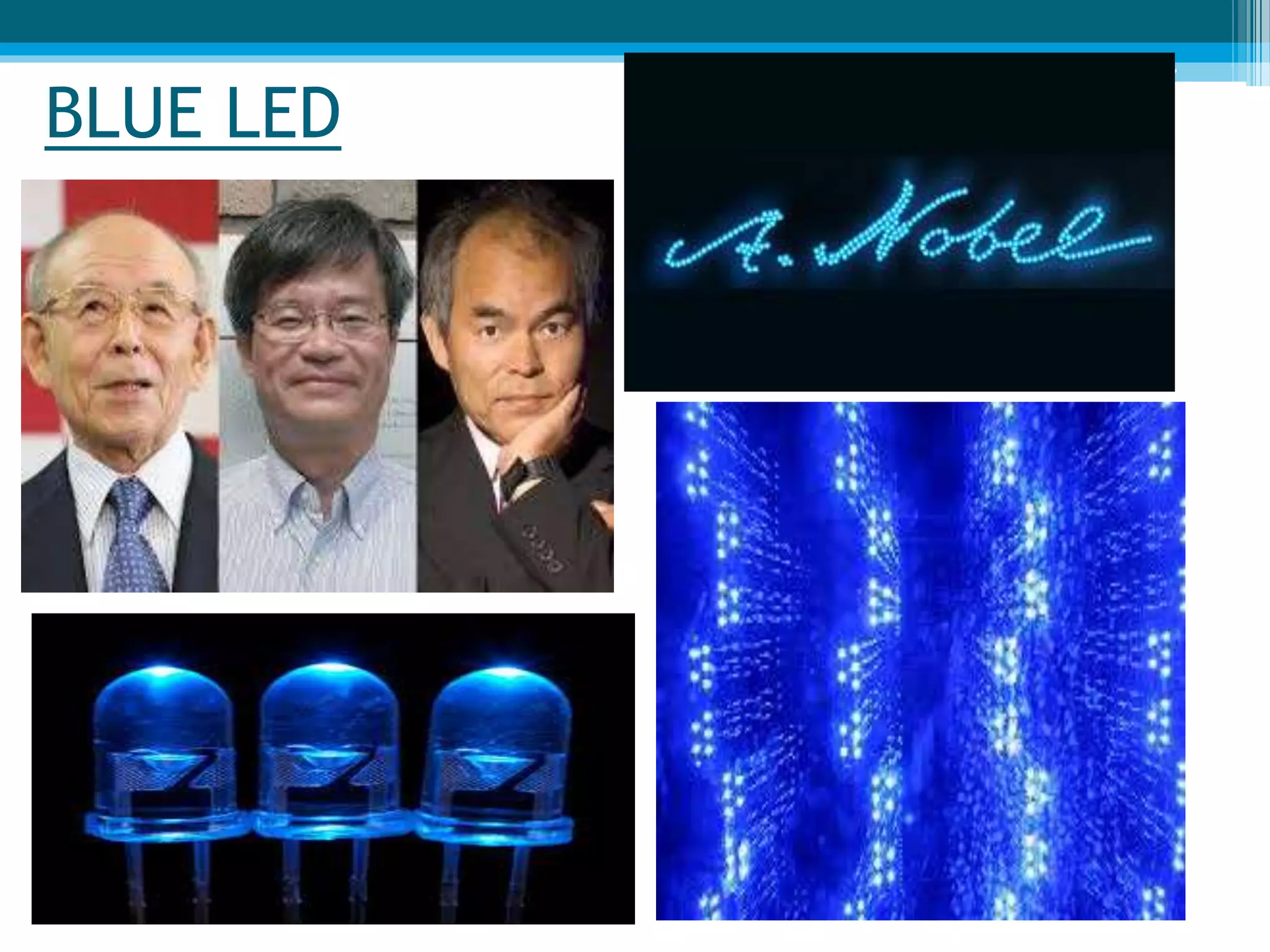
Blue Led’s -Filling the world with
a new light
• Isamu Akasaki, Hiroshi Amano and Shuji
Nakamura are rewarded for inventing a new
energy-efficient and environment friendly light
source- the blue light emitting diode (LED) in
early of 1990’s.
• In the spirit of Alfred Nobel, the prize awards an
invention of greatest benefit to mankind; by
using blue LEDs, white light can be created in a
new way.
BLUE LED
Making of Blue LED
• Gallium nitride (GaN), which is the material
used to create blue LEDs, is hard to grow. In
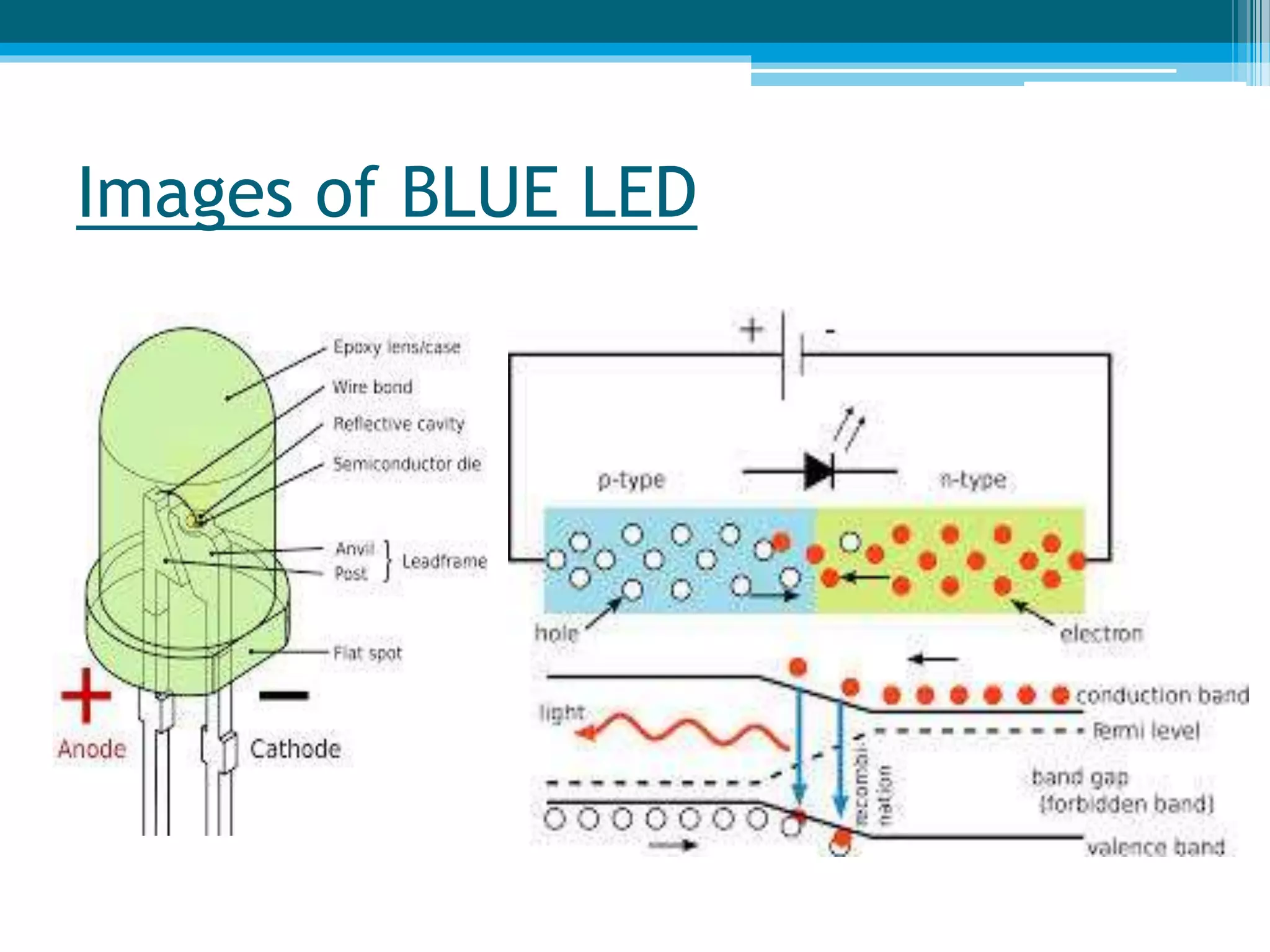
order to make an LED you need to make a P-N
junction, meaning a layer of p-type material
(positively doped) on top of n-type material
(negatively-doped).
Gallium Nitride
> Gallium nitride is
used in blue led. The
molar mass of gallium
nitride is 83.73 g/mol
> Band gap of gallium nitride is 3.4 ev (300
k,direct)
Circuit Diagram of Blue Led:
BLUE LED for Saving Energy and
Resourses
• A light-emitting diode consists of a number of layered semiconductor
materials. In the LED, electricity is directly converted into light particles,
photons, leading to efficiency gains compared to other light sources where
most of the electricity is converted to heat and only a small amount into
light. In incandescent bulbs, as well as in halogen lamps, electric current is
used to heat a wire filament, making it glow.
• The new LEDs require less energy in order to emit light compared to older
light sources. Moreover, they are constantly improved, getting more
efficient with higher luminous flux (measured in lumen) per unit electrical
input power (measured in watt).
• The most recent record is just over 300 lumen/watt, which can be
compared to 16 for regular light bulbs and close to 70 for fluorescent lamps.
As about one fourth of world electricity consumption is used for lighting
purposes, the highly energy-efficient LEDs contribute to saving the Earth’s
resources.
PUPOSE OF BLUE LED
• Although red and green LEDs had been around for many
years, blue LEDs were a long-standing challenge for scientists
in both academic and industry.
• White LED lamps, meanwhile, deliver light to many offices
and households. They use much less energy than both
incandescent and fluorescent lamps.
• In the future, engineers may make white LEDs by combining
red, green, and blue ones, which would make a light with
tunable colors, the Nobel Committee wrote.
Images of BLUE LED
Applications
• Status lights.
• Off / on indicator.
• Background illumination.
• Readout lights.
• Maintenance lights.
• Legend light.
REFERENCES
• Wikipedia of Blue LED.
• Google.
Thank You

Blue led

  • 1.
    PHYSICS(2110011) Active Learning Assignment(ala) Topic:blueled Guided By: Prof. NIRAV PANDYA Branch : Electrical Engineering Div: F(G1)
  • 2.
  • 3.
    The History ofLED’S • 1929 - Soviet patent granted for a “ light relay.” • 1961-Modern LED invented at Texas Instruments. • 1962 -Red LED invented.- First mass produced “indicator lights.” • 1990-First blue LED with vastly increased light output. • - RGB becomes practical. • - mainly used theatrically.
  • 4.
    Blue Led’s -Fillingthe world with a new light • Isamu Akasaki, Hiroshi Amano and Shuji Nakamura are rewarded for inventing a new energy-efficient and environment friendly light source- the blue light emitting diode (LED) in early of 1990’s. • In the spirit of Alfred Nobel, the prize awards an invention of greatest benefit to mankind; by using blue LEDs, white light can be created in a new way.
  • 5.
  • 6.
    Making of BlueLED • Gallium nitride (GaN), which is the material used to create blue LEDs, is hard to grow. In order to make an LED you need to make a P-N junction, meaning a layer of p-type material (positively doped) on top of n-type material (negatively-doped).
  • 7.
    Gallium Nitride > Galliumnitride is used in blue led. The molar mass of gallium nitride is 83.73 g/mol > Band gap of gallium nitride is 3.4 ev (300 k,direct)
  • 8.
  • 9.
    BLUE LED forSaving Energy and Resourses • A light-emitting diode consists of a number of layered semiconductor materials. In the LED, electricity is directly converted into light particles, photons, leading to efficiency gains compared to other light sources where most of the electricity is converted to heat and only a small amount into light. In incandescent bulbs, as well as in halogen lamps, electric current is used to heat a wire filament, making it glow. • The new LEDs require less energy in order to emit light compared to older light sources. Moreover, they are constantly improved, getting more efficient with higher luminous flux (measured in lumen) per unit electrical input power (measured in watt). • The most recent record is just over 300 lumen/watt, which can be compared to 16 for regular light bulbs and close to 70 for fluorescent lamps. As about one fourth of world electricity consumption is used for lighting purposes, the highly energy-efficient LEDs contribute to saving the Earth’s resources.
  • 10.
    PUPOSE OF BLUELED • Although red and green LEDs had been around for many years, blue LEDs were a long-standing challenge for scientists in both academic and industry. • White LED lamps, meanwhile, deliver light to many offices and households. They use much less energy than both incandescent and fluorescent lamps. • In the future, engineers may make white LEDs by combining red, green, and blue ones, which would make a light with tunable colors, the Nobel Committee wrote.
  • 11.
  • 12.
    Applications • Status lights. •Off / on indicator. • Background illumination. • Readout lights. • Maintenance lights. • Legend light.
  • 13.
    REFERENCES • Wikipedia ofBlue LED. • Google.
  • 14.