CONTENTS
 WHAT IS ANTENNA
 TRANSMITTER ANTENNA
 RECEIVER ANTENNA
 YAGI-UDA ANTENNA
 LOG – PERIODIC ANTENNA
 HELIX ANTENNA
 PARABOLIC ANTENNA
 LOOP ANTENNA
 ANTENNA ARRARY
ANTENNA
 An antenna is an electrical device which converts
  electric energy into radio waves, and vice versa. It is
  usually used with a radio transmitter or radio receiver.

 An antenna is a device for sending or receiving
  electromagnetic waves.
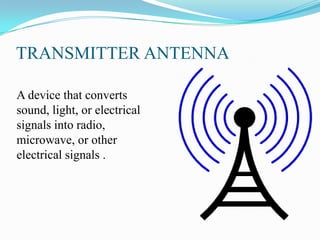
TRANSMITTER ANTENNA

A device that converts
sound, light, or electrical
signals into radio,
microwave, or other
electrical signals .
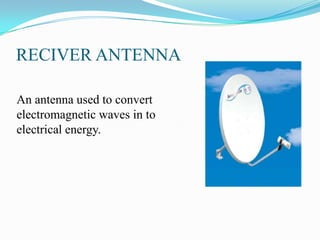
RECIVER ANTENNA

An antenna used to convert
electromagnetic waves in to
electrical energy.
TYPES OF ANTENNA
 YAGI – UDA ANTENNA
 LOG – PERIODIC ANTENNA
 HELIX ANTENNA
 PARABOLIC ANTENNA
 LOOP ANTENNA
YAGI – UDA ANTENNA
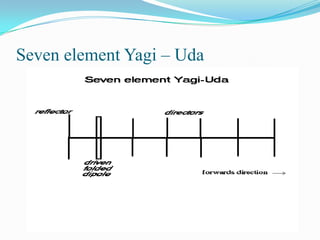
 Yagi-Uda antenna consist of reflector, director and
  driven element.
 It is unidirectional antenna.
 Frequency range – 300MHz-3GHz
Seven element Yagi – Uda
Yagi – Uda advantage
 High gain and good front to back ratio.
 It has narrow bandwidth.
 It is fixed frequency device.
 Grater directivity due to director and reflector.
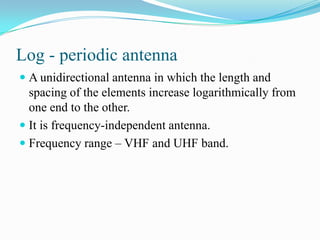
Log - periodic antenna
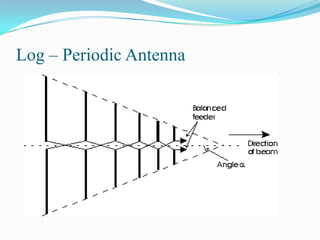
 A unidirectional antenna in which the length and
  spacing of the elements increase logarithmically from
  one end to the other.
 It is frequency-independent antenna.
 Frequency range – VHF and UHF band.
Log – Periodic Antenna
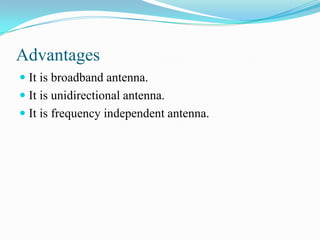
Advantages
 It is broadband antenna.
 It is unidirectional antenna.
 It is frequency independent antenna.
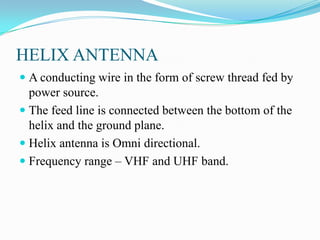
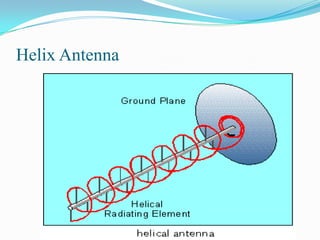
HELIX ANTENNA
 A conducting wire in the form of screw thread fed by
  power source.
 The feed line is connected between the bottom of the
  helix and the ground plane.
 Helix antenna is Omni directional.
 Frequency range – VHF and UHF band.
Helix Antenna
Application
 Satellite communication.
 Space communication & space probes.
 For telemetry applications.
PARABOLIC REFLECTOR
ANTENNA
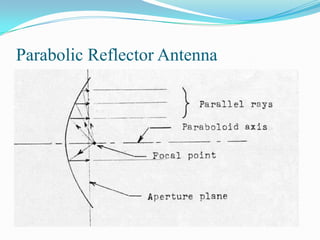
 This is used to convert spherical wave into plane wave
 The feed antenna is called primary antenna and
  reflector is secondary antenna.
 Frequency range - 3GHz-30GHz
Parabolic Reflector Antenna
Application
 Radar communication.
 Satellite communication.
LOOP ANTENNA
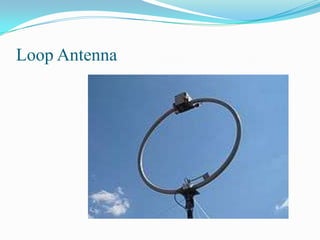
 A directional-type antenna consisting of one or more
  complete turns of a conductor.
 It determine the direction of arrival of radio signals.
 Frequency range – 500-1600KHz.
Loop Antenna
Application
 Direction finding of signal propagation.
 Radio(AM/FM)reception.
 Long distance point to point communication.
Antenna Arrays
 Arrays are used to increase diretivity and gain in
  desired direction.

 Eliminate the radiation in undesired direction.
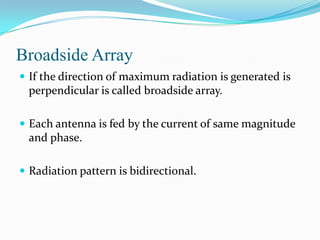
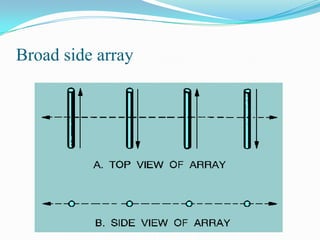
Broadside Array
 If the direction of maximum radiation is generated is
  perpendicular is called broadside array.

 Each antenna is fed by the current of same magnitude
  and phase.

 Radiation pattern is bidirectional.
Broad side array
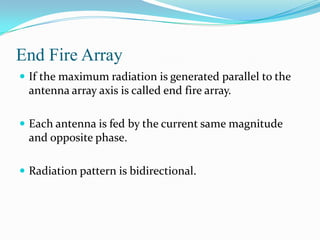
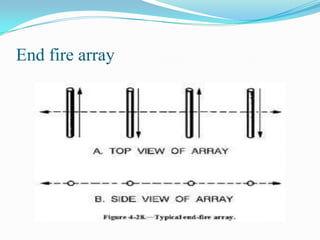
End Fire Array
 If the maximum radiation is generated parallel to the
  antenna array axis is called end fire array.

 Each antenna is fed by the current same magnitude
  and opposite phase.

 Radiation pattern is bidirectional.
End fire array
CONCLUSION
 All the antenna are very useful in all the application
  such as transmitter and receiver.
 Antenna are used to convert electrical energy to
  electromagnetic energy.

Antenna

  • 2.
    CONTENTS  WHAT ISANTENNA  TRANSMITTER ANTENNA  RECEIVER ANTENNA  YAGI-UDA ANTENNA  LOG – PERIODIC ANTENNA  HELIX ANTENNA  PARABOLIC ANTENNA  LOOP ANTENNA  ANTENNA ARRARY
  • 3.
    ANTENNA  An antennais an electrical device which converts electric energy into radio waves, and vice versa. It is usually used with a radio transmitter or radio receiver.  An antenna is a device for sending or receiving electromagnetic waves.
  • 4.
    TRANSMITTER ANTENNA A devicethat converts sound, light, or electrical signals into radio, microwave, or other electrical signals .
  • 5.
    RECIVER ANTENNA An antennaused to convert electromagnetic waves in to electrical energy.
  • 6.
    TYPES OF ANTENNA YAGI – UDA ANTENNA  LOG – PERIODIC ANTENNA  HELIX ANTENNA  PARABOLIC ANTENNA  LOOP ANTENNA
  • 7.
    YAGI – UDAANTENNA  Yagi-Uda antenna consist of reflector, director and driven element.  It is unidirectional antenna.  Frequency range – 300MHz-3GHz
  • 8.
  • 9.
    Yagi – Udaadvantage  High gain and good front to back ratio.  It has narrow bandwidth.  It is fixed frequency device.  Grater directivity due to director and reflector.
  • 10.
    Log - periodicantenna  A unidirectional antenna in which the length and spacing of the elements increase logarithmically from one end to the other.  It is frequency-independent antenna.  Frequency range – VHF and UHF band.
  • 11.
  • 12.
    Advantages  It isbroadband antenna.  It is unidirectional antenna.  It is frequency independent antenna.
  • 13.
    HELIX ANTENNA  Aconducting wire in the form of screw thread fed by power source.  The feed line is connected between the bottom of the helix and the ground plane.  Helix antenna is Omni directional.  Frequency range – VHF and UHF band.
  • 14.
  • 15.
    Application  Satellite communication. Space communication & space probes.  For telemetry applications.
  • 16.
    PARABOLIC REFLECTOR ANTENNA  Thisis used to convert spherical wave into plane wave  The feed antenna is called primary antenna and reflector is secondary antenna.  Frequency range - 3GHz-30GHz
  • 17.
  • 18.
  • 19.
    LOOP ANTENNA  Adirectional-type antenna consisting of one or more complete turns of a conductor.  It determine the direction of arrival of radio signals.  Frequency range – 500-1600KHz.
  • 20.
  • 21.
    Application  Direction findingof signal propagation.  Radio(AM/FM)reception.  Long distance point to point communication.
  • 22.
    Antenna Arrays  Arraysare used to increase diretivity and gain in desired direction.  Eliminate the radiation in undesired direction.
  • 23.
    Broadside Array  Ifthe direction of maximum radiation is generated is perpendicular is called broadside array.  Each antenna is fed by the current of same magnitude and phase.  Radiation pattern is bidirectional.
  • 24.
  • 25.
    End Fire Array If the maximum radiation is generated parallel to the antenna array axis is called end fire array.  Each antenna is fed by the current same magnitude and opposite phase.  Radiation pattern is bidirectional.
  • 26.
  • 27.
    CONCLUSION  All theantenna are very useful in all the application such as transmitter and receiver.  Antenna are used to convert electrical energy to electromagnetic energy.