PRESENTATİON BY  DUJON C SMITH LIGHT EMITTING DIODES
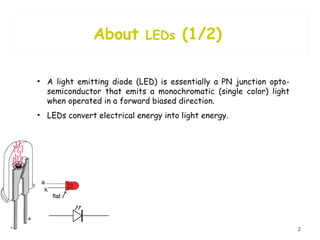
A light emitting diode (LED) is essentially a PN junction  opto- semiconductor   that emits a monochromatic (single color) light when operated in a forward biased direction.  LEDs convert electrical energy into light energy.  About  LEDs  (1/2)
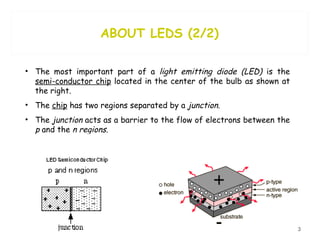
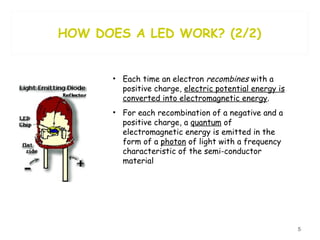
ABOUT LEDS ( 2 /2) The most important part of a  light emitting diode (LED)  is the  semi-conductor chip  located in the center of the bulb as shown at the right.  The  chip  has two regions separated by a  junction.   The  junction  acts as a barrier to the flow of electrons between the  p  and the  n regions.
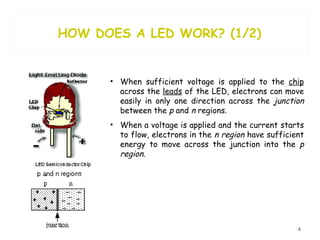
HOW DOES A LED WORK? (1/2) When sufficient voltage is applied to the  chip  across the  leads  of the LED, electrons can move easily in only one direction across the  junction  between the  p  and  n  regions. When a voltage is applied and the current starts to flow, electrons in the  n region  have sufficient energy to move across the junction into the  p region .
HOW DOES A LED WORK? (2/2) Each time an electron  recombines  with a positive charge,  electric potential energy is converted into electromagnetic energy .  For each recombination of a negative and a positive charge, a  quantum  of electromagnetic energy is emitted in the form of a  photon  of light with a frequency characteristic of the semi-conductor material
H OW  M UCH  ENERGY DOES AN LED EMIT? The energy ( E ) of the light emitted by an LED is related to the electric charge ( q ) of an electron and the voltage ( V ) required to light the LED by the expression:  E = qV  Joules.  This expression simply says that the voltage is proportional to the electric energy The constant  q  is the electric charge of a single electron, -1.6 x 10 -19   Coulomb .
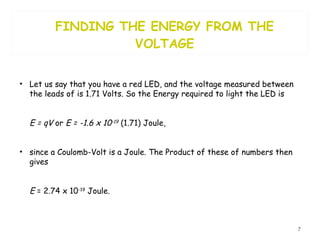
FINDING THE ENERGY FROM THE VOLTAGE Let us say that you have a red LED, and the voltage measured between the leads of is 1.71 Volts. So the Energy required to light the LED is E = qV  or  E = -1.6 x 10 -19  (1.71) Joule, since a Coulomb-Volt is a Joule. The Product of these of numbers then gives  E  = 2.74 x 10 -19  Joule.
APPLİCATİONS Sensor Applications Mobile Applications Sign Applications Automative Uses LED Signals Illuminations Indicators
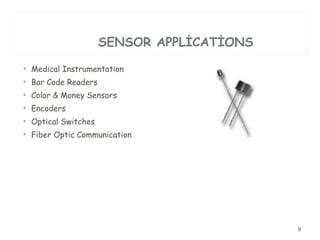
SENSOR APPLİCATİONS Medical Instrumentation  Bar Code Readers  Color & Money Sensors  Encoders  Optical Switches  Fiber Optic Communication                                 
MOBİLE APPLİCATİONS Mobile Phone  PDA's  Digital Cameras  Lap Tops  General Backlighting
SİGN APPLİCATİONS Full Color Video  Monochrome Message Boards  Traffic/VMS  Transportation - Passenger Information
AUTOMATİVE APPLİCATİONS Interior Lighting - Instrument Panels & Switches, Courtesy Lighting  Exterior Lighting - CHMSL, Rear Stop/Turn/Tail  Truck/Bus Lighting - Retrofits, New Turn/Tail/Marker Lights
SİGNAL APPİCATİONS Traffic  Rail  Aviation  Tower Lights  Runway Lights  Emergency/Police Vehicle Lighting  LEDs offer enormous benefits over traditional incandescent lamps including:  Energy savings (up to 85% less power than incandescent)  Reduction in maintenance costs  Increased visibility in daylight and adverse weather conditions
ILLUMİNATİON (1/2) Architectural Lighting  Signage (Channel Letters)  Machine Vision  Retail Displays  Emergency Lighting (Exit Signs)  Neon Replacement  Bulb Replacements  Flashlights  Outdoor Accent Lighting - Pathway, Marker Lights
ILLUMİNATİON (2/2) Studies have shown that the use of LEDs in illumination applications can offer:  Greater visual appeal  Reduced energy costs  Increased attention capture  Savings in maintenance and lighting replacements
INDİCATİON Household appliances  VCR/ DVD/ Stereo and other audio and video devices  Toys/Games  Instrumentation  Security Equipment  Switche s
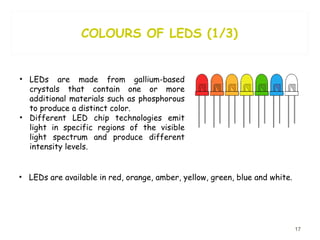
COLOURS OF LEDS (1/3) LEDs are available in red, orange, amber, yellow, green, blue and white.  LEDs are made from gallium-based crystals that contain one or more additional materials such as phosphorous to produce a distinct color.  Different LED chip technologies emit light in specific regions of the visible light spectrum and produce different intensity levels.
COLOURS OF LEDS (2/3) Tri-colour LEDs The most popular type of tri-colour LED has a red and a green LED combined in one package with three leads..  There are  different lengths of the three leads.
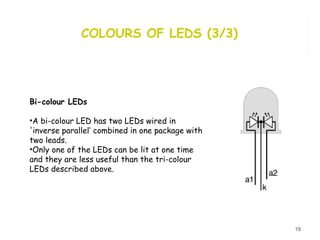
COLOURS OF LEDS (3/3) Bi-colour LEDs A bi-colour LED has two LEDs wired in 'inverse parallel‘   combined in one package with two leads.  Only one of the LEDs can be lit at one time and they are less useful than the tri-colour LEDs described above.
LED PERFORMANCE (1/8) Color White light Intensity Eye safety information Visibility Operating Life Voltage/Design Current LED performance is  based on a few primary   characteristics:
LED PERFORMANCE (2/8) Colour Peak wavelength is a function of the LED chip material. Although process variations are ±10 NM, the 565 to 600 NM wavelength spectral regions is where the sensitivity level of the human eye is highest. Therefore, it is easier to perceive color variations in yellow and amber LEDs than other colors.
LED PERFORMANCE (3/8) White Light When light from all parts of the visible spectrum   overlap one   another, the additive mixture of colors appears white.  Primary colors from   the upper, middle, and lower parts of the spectrum (red, green,   and blue), when combined, appear whit e.
LED PERFORMANCE (4/8) Intensity LED light output varies with the type of chip, encapsulation,   efficiency   of individual wafer lots and other variables.  Several LED   manufacturers use terms such as "super-bright," and "ultra-bright“   to describe LED intensity.
LED PERFORMANCE (5/8) Eye Safety The need to place eye safety labeling on LED products is dependent upon the product design and the application.  Only a few LEDs produce sufficient intensity to require eye safety labeling.
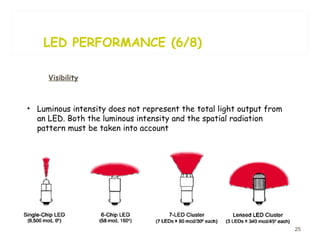
LED PERFORMANCE (6/8) Visibility Luminous intensity does not represent the total light output from an LED. Both the luminous intensity and the spatial radiation pattern must be taken into account
LED PERFORMANCE (7/8) Operating Life LEDs are designed to operate upwards of 100,000 hours at 25°C ambient temperature.  When the LED degrades to half of its original intensity after 100,000 hours it is at the end of its useful life although the LED will continue to operate as output diminishes.
LED PERFORMANCE (8/8) Voltage/Design Current LEDs are current-driven devices, not voltage driven. Although drive current and light output are directly related, exceeding the maximum current rating will produce excessive heat within the LED chip due to excessive power dissipation. The result will be reduced light output and reduced operating life. LEDs that are designed to operate at a specific voltage contain a built-in current-limiting resistor. Additional circuitry may include a protection diode for AC operation or full-bridge rectifier for bipolar operation. The operating current for a particular voltage is designed to maintain LED reliability over its operating life.
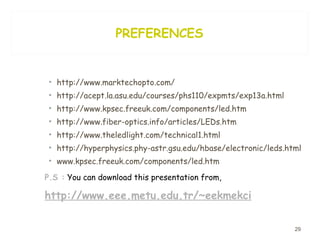
Some Types of LEDs Bargraph 7-segment Starburst Dot matrix
PREFERENCES http://www.marktechopto.com/ http://acept.la.asu.edu/courses/phs110/expmts/exp13a.html http://www.kpsec.freeuk.com/components/led.htm http://www.fiber-optics.info/articles/LEDs.htm http://www.theledlight.com/technical1.html http://hyperphysics.phy-astr.gsu.edu/hbase/electronic/leds.html www.kpsec.freeuk.com/components/led.htm P.S :  You can download this presentation from, http://www.eee.metu.edu.tr/~eekmekci
::The END:: Thank you for your Attention!

Led Ppt

  • 1.
    PRESENTATİON BY DUJON C SMITH LIGHT EMITTING DIODES
  • 2.
    A light emittingdiode (LED) is essentially a PN junction opto- semiconductor that emits a monochromatic (single color) light when operated in a forward biased direction. LEDs convert electrical energy into light energy. About LEDs (1/2)
  • 3.
    ABOUT LEDS (2 /2) The most important part of a light emitting diode (LED) is the semi-conductor chip located in the center of the bulb as shown at the right. The chip has two regions separated by a junction. The junction acts as a barrier to the flow of electrons between the p and the n regions.
  • 4.
    HOW DOES ALED WORK? (1/2) When sufficient voltage is applied to the chip across the leads of the LED, electrons can move easily in only one direction across the junction between the p and n regions. When a voltage is applied and the current starts to flow, electrons in the n region have sufficient energy to move across the junction into the p region .
  • 5.
    HOW DOES ALED WORK? (2/2) Each time an electron recombines with a positive charge, electric potential energy is converted into electromagnetic energy . For each recombination of a negative and a positive charge, a quantum of electromagnetic energy is emitted in the form of a photon of light with a frequency characteristic of the semi-conductor material
  • 6.
    H OW M UCH ENERGY DOES AN LED EMIT? The energy ( E ) of the light emitted by an LED is related to the electric charge ( q ) of an electron and the voltage ( V ) required to light the LED by the expression: E = qV Joules. This expression simply says that the voltage is proportional to the electric energy The constant q is the electric charge of a single electron, -1.6 x 10 -19 Coulomb .
  • 7.
    FINDING THE ENERGYFROM THE VOLTAGE Let us say that you have a red LED, and the voltage measured between the leads of is 1.71 Volts. So the Energy required to light the LED is E = qV or E = -1.6 x 10 -19 (1.71) Joule, since a Coulomb-Volt is a Joule. The Product of these of numbers then gives E = 2.74 x 10 -19 Joule.
  • 8.
    APPLİCATİONS Sensor ApplicationsMobile Applications Sign Applications Automative Uses LED Signals Illuminations Indicators
  • 9.
    SENSOR APPLİCATİONS MedicalInstrumentation Bar Code Readers Color & Money Sensors Encoders Optical Switches Fiber Optic Communication                                 
  • 10.
    MOBİLE APPLİCATİONS MobilePhone PDA's Digital Cameras Lap Tops General Backlighting
  • 11.
    SİGN APPLİCATİONS FullColor Video Monochrome Message Boards Traffic/VMS Transportation - Passenger Information
  • 12.
    AUTOMATİVE APPLİCATİONS InteriorLighting - Instrument Panels & Switches, Courtesy Lighting Exterior Lighting - CHMSL, Rear Stop/Turn/Tail Truck/Bus Lighting - Retrofits, New Turn/Tail/Marker Lights
  • 13.
    SİGNAL APPİCATİONS Traffic Rail Aviation Tower Lights Runway Lights Emergency/Police Vehicle Lighting LEDs offer enormous benefits over traditional incandescent lamps including: Energy savings (up to 85% less power than incandescent) Reduction in maintenance costs Increased visibility in daylight and adverse weather conditions
  • 14.
    ILLUMİNATİON (1/2) ArchitecturalLighting Signage (Channel Letters) Machine Vision Retail Displays Emergency Lighting (Exit Signs) Neon Replacement Bulb Replacements Flashlights Outdoor Accent Lighting - Pathway, Marker Lights
  • 15.
    ILLUMİNATİON (2/2) Studieshave shown that the use of LEDs in illumination applications can offer: Greater visual appeal Reduced energy costs Increased attention capture Savings in maintenance and lighting replacements
  • 16.
    INDİCATİON Household appliances VCR/ DVD/ Stereo and other audio and video devices Toys/Games Instrumentation Security Equipment Switche s
  • 17.
    COLOURS OF LEDS(1/3) LEDs are available in red, orange, amber, yellow, green, blue and white. LEDs are made from gallium-based crystals that contain one or more additional materials such as phosphorous to produce a distinct color. Different LED chip technologies emit light in specific regions of the visible light spectrum and produce different intensity levels.
  • 18.
    COLOURS OF LEDS(2/3) Tri-colour LEDs The most popular type of tri-colour LED has a red and a green LED combined in one package with three leads.. There are different lengths of the three leads.
  • 19.
    COLOURS OF LEDS(3/3) Bi-colour LEDs A bi-colour LED has two LEDs wired in 'inverse parallel‘ combined in one package with two leads. Only one of the LEDs can be lit at one time and they are less useful than the tri-colour LEDs described above.
  • 20.
    LED PERFORMANCE (1/8)Color White light Intensity Eye safety information Visibility Operating Life Voltage/Design Current LED performance is based on a few primary characteristics:
  • 21.
    LED PERFORMANCE (2/8)Colour Peak wavelength is a function of the LED chip material. Although process variations are ±10 NM, the 565 to 600 NM wavelength spectral regions is where the sensitivity level of the human eye is highest. Therefore, it is easier to perceive color variations in yellow and amber LEDs than other colors.
  • 22.
    LED PERFORMANCE (3/8)White Light When light from all parts of the visible spectrum overlap one another, the additive mixture of colors appears white. Primary colors from the upper, middle, and lower parts of the spectrum (red, green, and blue), when combined, appear whit e.
  • 23.
    LED PERFORMANCE (4/8)Intensity LED light output varies with the type of chip, encapsulation, efficiency of individual wafer lots and other variables. Several LED manufacturers use terms such as "super-bright," and "ultra-bright“ to describe LED intensity.
  • 24.
    LED PERFORMANCE (5/8)Eye Safety The need to place eye safety labeling on LED products is dependent upon the product design and the application. Only a few LEDs produce sufficient intensity to require eye safety labeling.
  • 25.
    LED PERFORMANCE (6/8)Visibility Luminous intensity does not represent the total light output from an LED. Both the luminous intensity and the spatial radiation pattern must be taken into account
  • 26.
    LED PERFORMANCE (7/8)Operating Life LEDs are designed to operate upwards of 100,000 hours at 25°C ambient temperature. When the LED degrades to half of its original intensity after 100,000 hours it is at the end of its useful life although the LED will continue to operate as output diminishes.
  • 27.
    LED PERFORMANCE (8/8)Voltage/Design Current LEDs are current-driven devices, not voltage driven. Although drive current and light output are directly related, exceeding the maximum current rating will produce excessive heat within the LED chip due to excessive power dissipation. The result will be reduced light output and reduced operating life. LEDs that are designed to operate at a specific voltage contain a built-in current-limiting resistor. Additional circuitry may include a protection diode for AC operation or full-bridge rectifier for bipolar operation. The operating current for a particular voltage is designed to maintain LED reliability over its operating life.
  • 28.
    Some Types ofLEDs Bargraph 7-segment Starburst Dot matrix
  • 29.
    PREFERENCES http://www.marktechopto.com/ http://acept.la.asu.edu/courses/phs110/expmts/exp13a.htmlhttp://www.kpsec.freeuk.com/components/led.htm http://www.fiber-optics.info/articles/LEDs.htm http://www.theledlight.com/technical1.html http://hyperphysics.phy-astr.gsu.edu/hbase/electronic/leds.html www.kpsec.freeuk.com/components/led.htm P.S : You can download this presentation from, http://www.eee.metu.edu.tr/~eekmekci
  • 30.
    ::The END:: Thankyou for your Attention!