WHITE LED
THE FUTURE LAMP
WHITE LED: THE FUTURE LAMP
A presentation by :
Sunanda Chakraborty (Roll # 118)
&
Kalyan Bosu (Roll # RL129)
Branch: ECE
Semester: 6
Content:
• Introduction
• Nobel Award on white LED
• Normal LED: Working Principle
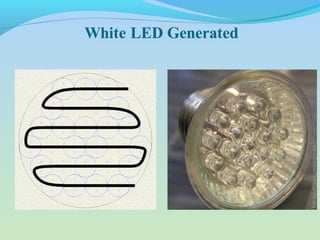
• Generation of White LED
• Manufacturing
• Quality Check: Basic Parameters
• Uses and Applications
• Advantages and Disadvantages
• Conclusion
Introduction
LED goes to revolutionize the lighting technology of
modern era.
Fourth and latest generation of light sources
The white LED lamp is equivalent to 60 watt
incandescent bulb in size and brightness but lasts 25
times longer and runs on less than 10 watts
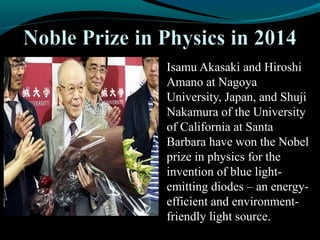
Isamu Akasaki and Hiroshi
Amano at Nagoya
University, Japan, and Shuji
Nakamura of the University
of California at Santa
Barbara have won the Nobel
prize in physics for the
invention of blue light-
emitting diodes – an energy-
efficient and environment-
friendly light source.
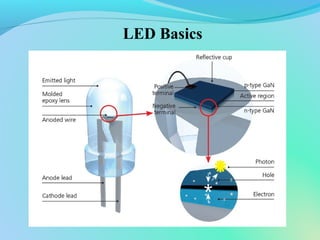
LED Basics
Working Principal of Basic LED
The LED is a semiconductor diode that emits light
when current passes through it
The n-side is heavily doped
When forward biased, the built-in potential at the
junction is reduced
The e-
from n-side get injected into p-side
 e-
combine with the holes resulting in emission of
photons i.e. light
This effect is called electroluminescence
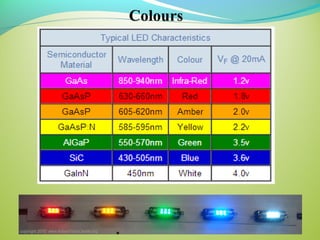
Colours
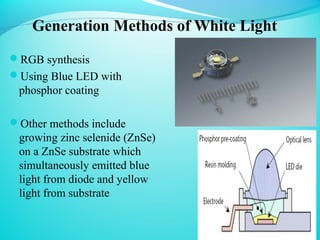
Generation Methods of White Light
RGB synthesis
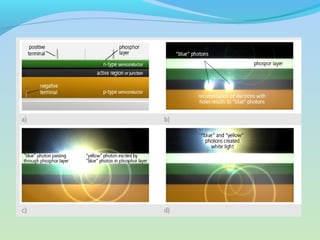
Using Blue LED with
phosphor coating
Other methods include
growing zinc selenide (ZnSe)
on a ZnSe substrate which
simultaneously emitted blue
light from diode and yellow
light from substrate
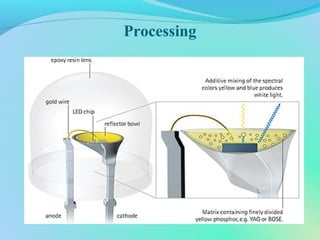
Processing
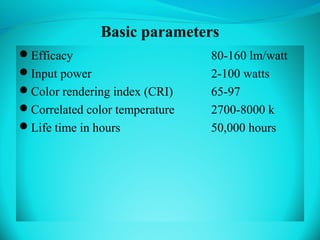
Basic parameters
Efficacy 80-160 lm/watt
Input power 2-100 watts
Color rendering index (CRI) 65-97
Correlated color temperature 2700-8000 k
Life time in hours 50,000 hours
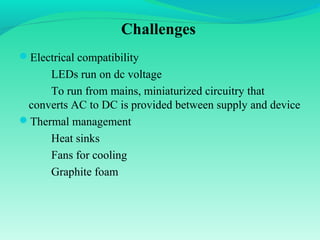
Challenges
Electrical compatibility
LEDs run on dc voltage
To run from mains, miniaturized circuitry that
converts AC to DC is provided between supply and device
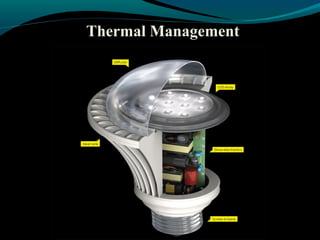
Thermal management
Heat sinks
Fans for cooling
Graphite foam
Thermal Management
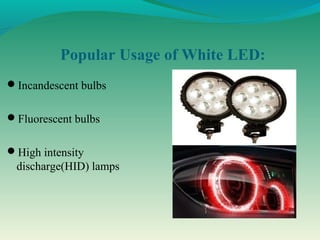
Popular Usage of White LED:
Incandescent bulbs
Fluorescent bulbs
High intensity
discharge(HID) lamps
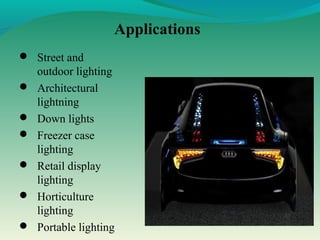
Applications
 Street and
outdoor lighting
 Architectural
lightning
 Down lights
 Freezer case
lighting
 Retail display
lighting
 Horticulture
lighting
 Portable lighting
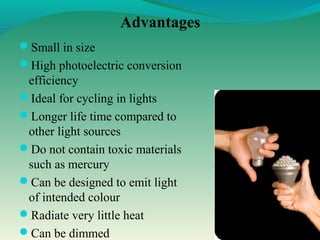
Advantages
Small in size
High photoelectric conversion
efficiency
Ideal for cycling in lights
Longer life time compared to
other light sources
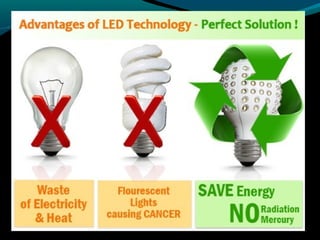
Do not contain toxic materials
such as mercury
Can be designed to emit light
of intended colour
Radiate very little heat
Can be dimmed
Disadvantages
Exceeds the safety limits of blue-light hazard
Temperature dependent
Causes more light pollution than other light sources
Voltage sensitive
High initial prices
Under cool-white LED illumination, the colour of the
objects is perceived differently
Thank You
Presentation on White LED

Presentation on White LED

  • 1.
  • 2.
    WHITE LED: THEFUTURE LAMP A presentation by : Sunanda Chakraborty (Roll # 118) & Kalyan Bosu (Roll # RL129) Branch: ECE Semester: 6
  • 3.
    Content: • Introduction • NobelAward on white LED • Normal LED: Working Principle • Generation of White LED • Manufacturing • Quality Check: Basic Parameters • Uses and Applications • Advantages and Disadvantages • Conclusion
  • 4.
    Introduction LED goes torevolutionize the lighting technology of modern era. Fourth and latest generation of light sources The white LED lamp is equivalent to 60 watt incandescent bulb in size and brightness but lasts 25 times longer and runs on less than 10 watts
  • 5.
    Isamu Akasaki andHiroshi Amano at Nagoya University, Japan, and Shuji Nakamura of the University of California at Santa Barbara have won the Nobel prize in physics for the invention of blue light- emitting diodes – an energy- efficient and environment- friendly light source.
  • 6.
  • 7.
    Working Principal ofBasic LED The LED is a semiconductor diode that emits light when current passes through it The n-side is heavily doped When forward biased, the built-in potential at the junction is reduced The e- from n-side get injected into p-side  e- combine with the holes resulting in emission of photons i.e. light This effect is called electroluminescence
  • 8.
  • 9.
    Generation Methods ofWhite Light RGB synthesis Using Blue LED with phosphor coating Other methods include growing zinc selenide (ZnSe) on a ZnSe substrate which simultaneously emitted blue light from diode and yellow light from substrate
  • 10.
  • 13.
    Basic parameters Efficacy 80-160lm/watt Input power 2-100 watts Color rendering index (CRI) 65-97 Correlated color temperature 2700-8000 k Life time in hours 50,000 hours
  • 14.
    Challenges Electrical compatibility LEDs runon dc voltage To run from mains, miniaturized circuitry that converts AC to DC is provided between supply and device Thermal management Heat sinks Fans for cooling Graphite foam
  • 15.
  • 16.
    Popular Usage ofWhite LED: Incandescent bulbs Fluorescent bulbs High intensity discharge(HID) lamps
  • 17.
    Applications  Street and outdoorlighting  Architectural lightning  Down lights  Freezer case lighting  Retail display lighting  Horticulture lighting  Portable lighting
  • 19.
    Advantages Small in size Highphotoelectric conversion efficiency Ideal for cycling in lights Longer life time compared to other light sources Do not contain toxic materials such as mercury Can be designed to emit light of intended colour Radiate very little heat Can be dimmed
  • 20.
    Disadvantages Exceeds the safetylimits of blue-light hazard Temperature dependent Causes more light pollution than other light sources Voltage sensitive High initial prices Under cool-white LED illumination, the colour of the objects is perceived differently
  • 22.