

Mohammed Mohasin Shaik
www.shaikmohasin.wordpress.com
LET ME
Know “LED“
Light Emitting Diode, a semiconductor diode that glows
when a voltage is applied. It is also called as
semiconductor light source that converts electrical energy
into light energy. LED is a tiny light source that fit easily into
an electrical circuit.
they do not have a filament that will burn out.
What is LED ?
Short History
 The LED started life in October 1962 by Nick Holonyak Jr, as a single red illumination in a
General Electric research lab in New York state.
 Monsanto develops the first commercially available LEDs for HP35 Calculator
 In 1976 – T.P.Pearsall creates the first high-brightness high efficiency LED’s for optical fiber
transmission wavelengths.
 In 1980 – LED development continues along the lines of increasing light output while
maintaining efficiency and reliability.
 In 1997 – Nicha Corporation develops the first high brightness Bluish-Green and Blue LED’s in
the world.
 Philips Lumileds introduced power LED’s capable of continuous use at 1watt in 1999. These
LED’s used much larger semiconductor die sizes to handle the large power inputs.
 Now : The LED lighting revolution begins with the first official standardizations of LED’s and
LED fixtures in many international countries. People are widely pay attention to this energy
saving technology and LED lighting begin to flowering all over the world in peoples indoor
and outdoor life.
 Dimmable
 Environmental Friendly
 Directional
 Energy Efficient
Why LED ?
 No Heat
 Quick Start
 Long Life
 Low Power Consumption
Why LED ?
 No UV
 No Noise
 No IR
 No Mercury
Why LED ?
 Long Life – 50,000
 Durable
 High Energy Efficient – Example : 120W = 250W
 Easy Installation
 Lower Maintenance
 Recyclable
 Good Visibility
 Quick Start – Quick Off
Key Features & Benefits
 Fresh Food
LED keep food fresh for longer
 No Bugs
LED do not attract bugs
LED Cool Facts
 Where maintenance is frequent
 Where there is need to reduce energy
 Where areas need better visibility
 Where areas need instant on illumination
Where to consider LED ?
“ EVERY WHERE “
Where we see LED’s
LED Indoor Applications
Indoor lighting is usually
accomplished using light fixtures,
and is a key part of interior
design.
LED can save energy in place of
using traditional lighting, which
represents a major component of
energy consumption in buildings.
LED Outdoor Applications
Outdoor lights are used to light
roadways and walkways at night.
LED and photovoltaic luminaries
to provide an energy-efficient
alternative to traditional street
light fixtures.
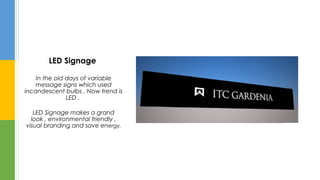
LED Signage
In the old days of variable
message signs which used
incandescent bulbs . Now trend is
LED .
LED Signage makes a grand
look , environmental friendly ,
visual branding and save energy.
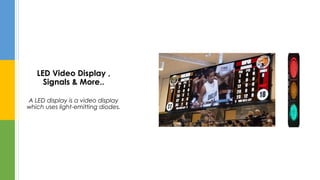
LED Video Display ,
Signals & More..
A LED display is a video display
which uses light-emitting diodes.
The Future
- Mohammed Mohasin Shaik
From traffic lights to Christmas lights and even more office lighting , roadway
lighting also home lighting, light-emitting diode lights are an energy-efficient
alternative to traditional incandescent or compact fluorescent lights and are
used in an increasing number of applications day by day.

Let me know 'led'

  • 1.
  • 2.
    Light Emitting Diode,a semiconductor diode that glows when a voltage is applied. It is also called as semiconductor light source that converts electrical energy into light energy. LED is a tiny light source that fit easily into an electrical circuit. they do not have a filament that will burn out. What is LED ?
  • 3.
    Short History  TheLED started life in October 1962 by Nick Holonyak Jr, as a single red illumination in a General Electric research lab in New York state.  Monsanto develops the first commercially available LEDs for HP35 Calculator  In 1976 – T.P.Pearsall creates the first high-brightness high efficiency LED’s for optical fiber transmission wavelengths.  In 1980 – LED development continues along the lines of increasing light output while maintaining efficiency and reliability.  In 1997 – Nicha Corporation develops the first high brightness Bluish-Green and Blue LED’s in the world.  Philips Lumileds introduced power LED’s capable of continuous use at 1watt in 1999. These LED’s used much larger semiconductor die sizes to handle the large power inputs.  Now : The LED lighting revolution begins with the first official standardizations of LED’s and LED fixtures in many international countries. People are widely pay attention to this energy saving technology and LED lighting begin to flowering all over the world in peoples indoor and outdoor life.
  • 4.
     Dimmable  EnvironmentalFriendly  Directional  Energy Efficient Why LED ?
  • 5.
     No Heat Quick Start  Long Life  Low Power Consumption Why LED ?
  • 6.
     No UV No Noise  No IR  No Mercury Why LED ?
  • 7.
     Long Life– 50,000  Durable  High Energy Efficient – Example : 120W = 250W  Easy Installation  Lower Maintenance  Recyclable  Good Visibility  Quick Start – Quick Off Key Features & Benefits
  • 8.
     Fresh Food LEDkeep food fresh for longer  No Bugs LED do not attract bugs LED Cool Facts
  • 9.
     Where maintenance is frequent Where there is need to reduce energy  Where areas need better visibility  Where areas need instant on illumination Where to consider LED ?
  • 10.
    “ EVERY WHERE“ Where we see LED’s
  • 11.
    LED Indoor Applications Indoorlighting is usually accomplished using light fixtures, and is a key part of interior design. LED can save energy in place of using traditional lighting, which represents a major component of energy consumption in buildings.
  • 12.
    LED Outdoor Applications Outdoorlights are used to light roadways and walkways at night. LED and photovoltaic luminaries to provide an energy-efficient alternative to traditional street light fixtures.
  • 13.
    LED Signage In theold days of variable message signs which used incandescent bulbs . Now trend is LED . LED Signage makes a grand look , environmental friendly , visual branding and save energy.
  • 14.
    LED Video Display, Signals & More.. A LED display is a video display which uses light-emitting diodes.
  • 15.
  • 16.
    - Mohammed MohasinShaik From traffic lights to Christmas lights and even more office lighting , roadway lighting also home lighting, light-emitting diode lights are an energy-efficient alternative to traditional incandescent or compact fluorescent lights and are used in an increasing number of applications day by day.