




1
LIGHT EMITTING DIODES
Presentation by V.S.ARJUN
2
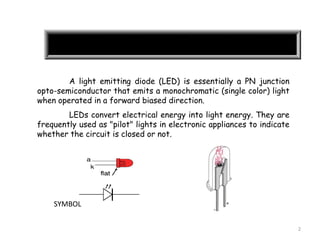
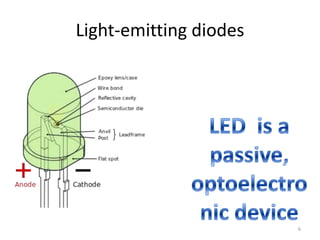
A light emitting diode (LED) is essentially a PN junction
opto-semiconductor that emits a monochromatic (single color) light
when operated in a forward biased direction.
LEDs convert electrical energy into light energy. They are
frequently used as "pilot" lights in electronic appliances to indicate
whether the circuit is closed or not.
SYMBOL
3
How Does A LED Work? (1/2)
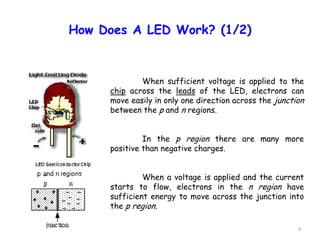
When sufficient voltage is applied to the
chip across the leads of the LED, electrons can
move easily in only one direction across the junction
between the p and n regions.
In the p region there are many more
positive than negative charges.
When a voltage is applied and the current
starts to flow, electrons in the n region have
sufficient energy to move across the junction into
the p region.
4
How Does A LED Work? (2/2)
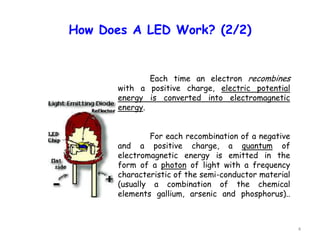
Each time an electron recombines
with a positive charge, electric potential
energy is converted into electromagnetic
energy.
For each recombination of a negative
and a positive charge, a quantum of
electromagnetic energy is emitted in the
form of a photon of light with a frequency
characteristic of the semi-conductor material
(usually a combination of the chemical
elements gallium, arsenic and phosphorus)..
5
About LEDs (1/2)
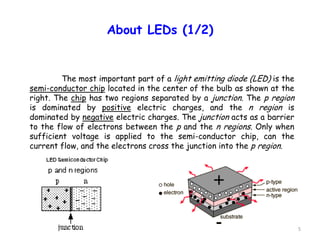
The most important part of a light emitting diode (LED) is the
semi-conductor chip located in the center of the bulb as shown at the
right. The chip has two regions separated by a junction. The p region
is dominated by positive electric charges, and the n region is
dominated by negative electric charges. The junction acts as a barrier
to the flow of electrons between the p and the n regions. Only when
sufficient voltage is applied to the semi-conductor chip, can the
current flow, and the electrons cross the junction into the p region.
6
Light-emitting diodes
7
Testing LEDs
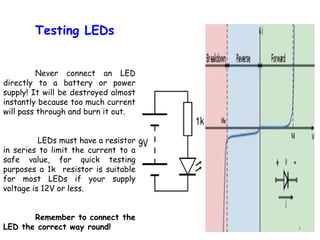
Never connect an LED
directly to a battery or power
supply! It will be destroyed almost
instantly because too much current
will pass through and burn it out.
LEDs must have a resistor
in series to limit the current to a
safe value, for quick testing
purposes a 1k resistor is suitable
for most LEDs if your supply
voltage is 12V or less.
Remember to connect the
LED the correct way round!
8
How Much Energy Does an LED Emit?
The energy (E) of the light emitted by an LED is related to the
electric charge (q) of an electron and the voltage (V) required to light the
LED by the expression: E = qV Joules.
This expression simply says that the voltage is proportional to
the electric energy, and is a general statement which applies to any
circuit, as well as to LED's. The constant q is the electric charge of a
single electron, -1.6 x 10⁻¹⁹ Coulomb.
CB
VB
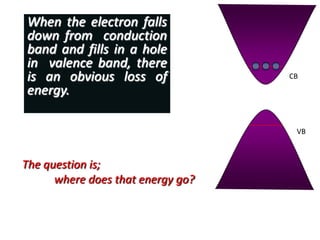
When the electron falls
down from conduction
band and fills in a hole
in valence band, there
is an obvious loss of
energy.
The question is;
where does that energy go?
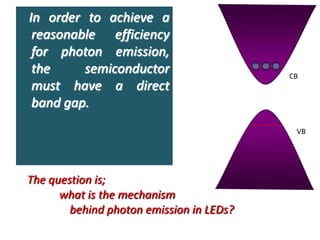
In order to achieve a
reasonable efficiency
for photon emission,
the semiconductor
must have a direct
band gap.
CB
VB
The question is;
what is the mechanism
behind photon emission in LEDs?
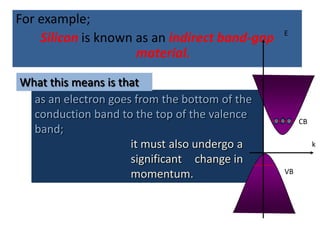
For example;
Silicon is known as an indirect band-gap
material.
as an electron goes from the bottom of the
conduction band to the top of the valence
band;
it must also undergo a
significant change in
momentum.
CB
VB
What this means is that
E
k
• As we all know, whenever something changes
state, one must conserve not only energy, but also
momentum.
• In the case of an electron going from conduction
band to the valence band in silicon, both of these
things can only be conserved:
The transition also creates a quantized
set of lattice vibrations,
called phoTons, or "heat“ .
• Photons possess both energy and momentum.
• Their creation upon the recombination of an electron
and hole allows for complete conservation of both
energy and momentum.
• All of the energy which the electron gives up in going
from the conduction band to the valence band (1.1
eV) ends up in photons, which is another way of
saying that the electron heats up the crystal.
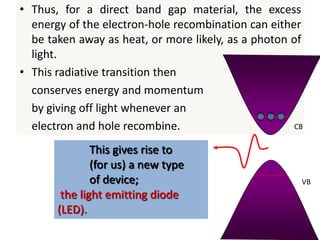
• Thus, for a direct band gap material, the excess
energy of the electron-hole recombination can either
be taken away as heat, or more likely, as a photon of
light.
• This radiative transition then
conserves energy and momentum
by giving off light whenever an
electron and hole recombine. CB
VB
This gives rise to
(for us) a new type
of device;
the light emitting diode
(LED).
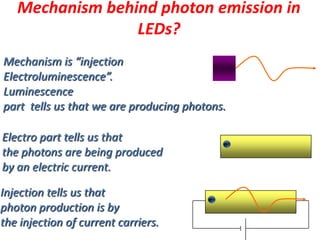
Mechanism is “injection
Electroluminescence”.
Luminescence
part tells us that we are producing photons.
Electro part tells us that
the photons are being produced
by an electric current.
e-
Injection tells us that
photon production is by
the injection of current carriers.
Mechanism behind photon emission in
LEDs?
e-
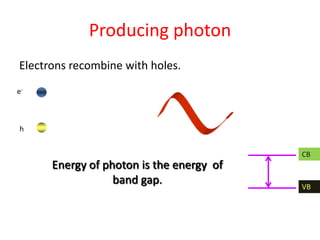
Producing photon
Electrons recombine with holes.
Energy of photon is the energy of
band gap.
CB
VB
e-
h
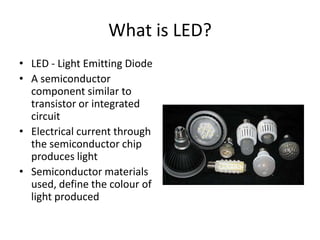
What is LED?
• LED - Light Emitting Diode
• A semiconductor
component similar to
transistor or integrated
circuit
• Electrical current through
the semiconductor chip
produces light
• Semiconductor materials
used, define the colour of
light produced
Benefits of LED
• Shock and vibration proof
• Small dimensions
• Lightweight
• Virtually no heat generation
• Accurate and well controlled beam spread
Key features of LED
• ·Longer lasting
• ·Reduced maintenance cost
• ·More energy efficient
• ·Better design flexibility
• ·Vivid colors
• ·High reliability
• ·Environmentally friendly
• They are suitable at high operating speeds
LED vs. CFL vs. Incandescent Lamps
Incandescent Lamps
• 90% of electricity used is spent producing heat, not light
• Rapidly being replaced by CFLs for lesser bills and environment friendliness
Compact Fluorescent Lamps (CFL)
• 75% less electricity needed to produce same amount of light as an incandescent
lamp
• Current estimated sale, of one brand just in Gurgaon, is around one lakh units per
month
Light-emitting Diodes (LED)
• 15-20% less electricity needed to produce same amount of light as a CFL
• Making a slow but steady entry in the market of lighting
• Opportunities exist in way too many industries
• Currently hot for home decor; Corporate office lighting space hugely untapped
• More environment friendly than CFLs
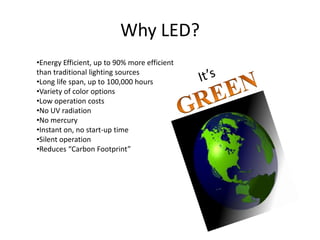
Why LED?
•Energy Efficient, up to 90% more efficient
than traditional lighting sources
•Long life span, up to 100,000 hours
•Variety of color options
•Low operation costs
•No UV radiation
•No mercury
•Instant on, no start-up time
•Silent operation
•Reduces “Carbon Footprint”
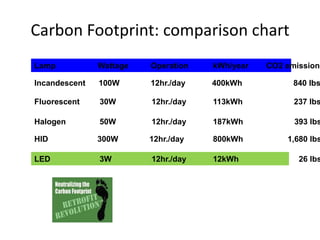
Carbon Footprint: comparison chart
Lamp Wattage Operation kWh/year CO2 emissions
Incandescent 100W 12hr./day 400kWh 840 lbs
Fluorescent 30W 12hr./day 113kWh 237 lbs
Halogen 50W 12hr./day 187kWh 393 lbs
HID 300W 12hr./day 800kWh 1,680 lbs
LED 3W 12hr./day 12kWh 26 lbs
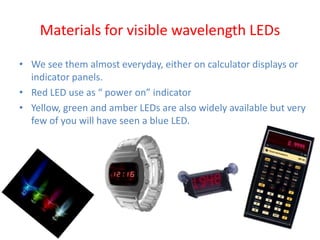
Materials for visible wavelength LEDs
• We see them almost everyday, either on calculator displays or
indicator panels.
• Red LED use as “ power on” indicator
• Yellow, green and amber LEDs are also widely available but very
few of you will have seen a blue LED.
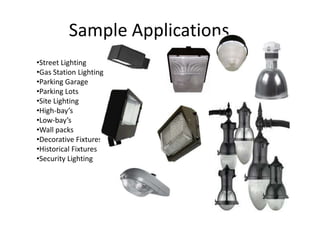
Sample Applications
•Street Lighting
•Gas Station Lighting
•Parking Garage
•Parking Lots
•Site Lighting
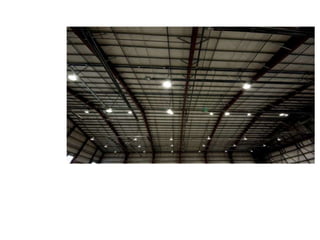
•High-bay’s
•Low-bay’s
•Wall packs
•Decorative Fixtures
•Historical Fixtures
•Security Lighting
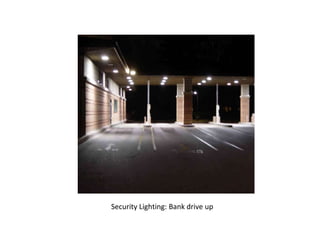
Security Lighting: Bank drive up
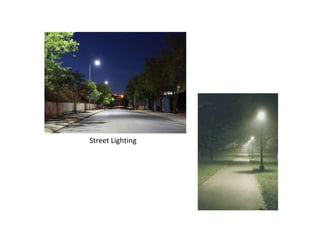
Street Lighting
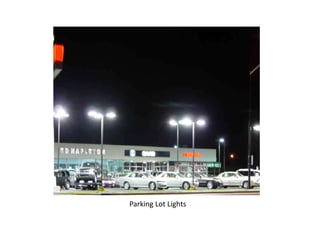
Parking Lot Lights
29
Applications
• Sensor Applications
• Mobile Applications
• Sign Applications
• Automative Uses
• LED Signals
• Illuminations
• Indicators
30
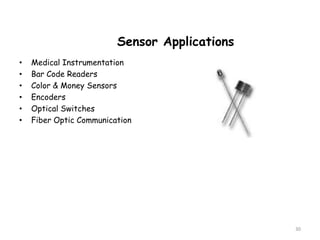
Sensor Applications
• Medical Instrumentation
• Bar Code Readers
• Color & Money Sensors
• Encoders
• Optical Switches
• Fiber Optic Communication
31
Mobile Applications
• Mobile Phone
• PDA's
• Digital Cameras
• Lap Tops
• General Backlighting
32
Sign Applications
• Full Color Video
• Monochrome Message Boards
• Traffic/VMS
• Transportation - Passenger Information
33
Automative Applications
• Interior Lighting - Instrument Panels & Switches, Courtesy Lighting
• Exterior Lighting - CHMSL, Rear Stop/Turn/Tail
• Truck/Bus Lighting - Retrofits, New Turn/Tail/Marker Lights
34
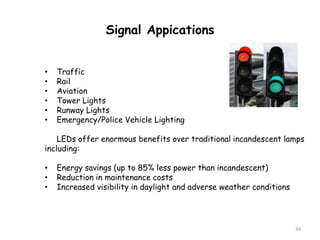
Signal Appications
• Traffic
• Rail
• Aviation
• Tower Lights
• Runway Lights
• Emergency/Police Vehicle Lighting
LEDs offer enormous benefits over traditional incandescent lamps
including:
• Energy savings (up to 85% less power than incandescent)
• Reduction in maintenance costs
• Increased visibility in daylight and adverse weather conditions
35
Indication
 Household appliances
 VCR/ DVD/ Stereo and other audio and video devices
 Toys/Games
 Instrumentation
 Security Equipment
 Switches
36
Driving LEDs
• Analog LED Drive Circuits
• Digital LED Drive Circuits
37
Colours of LEDs (1/3)
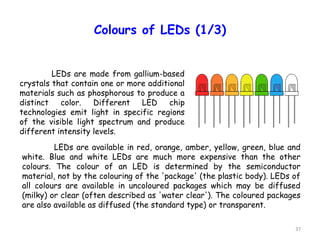
LEDs are available in red, orange, amber, yellow, green, blue and
white. Blue and white LEDs are much more expensive than the other
colours. The colour of an LED is determined by the semiconductor
material, not by the colouring of the 'package' (the plastic body). LEDs of
all colours are available in uncoloured packages which may be diffused
(milky) or clear (often described as 'water clear'). The coloured packages
are also available as diffused (the standard type) or transparent.
LEDs are made from gallium-based
crystals that contain one or more additional
materials such as phosphorous to produce a
distinct color. Different LED chip
technologies emit light in specific regions
of the visible light spectrum and produce
different intensity levels.
38
Colours of LEDs (2/3)
Tri-colour LEDs
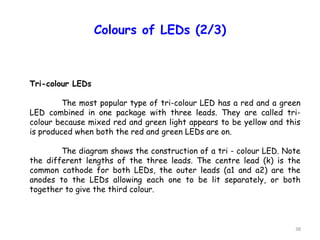
The most popular type of tri-colour LED has a red and a green
LED combined in one package with three leads. They are called tri-
colour because mixed red and green light appears to be yellow and this
is produced when both the red and green LEDs are on.
The diagram shows the construction of a tri - colour LED. Note
the different lengths of the three leads. The centre lead (k) is the
common cathode for both LEDs, the outer leads (a1 and a2) are the
anodes to the LEDs allowing each one to be lit separately, or both
together to give the third colour.
39
Colours of LEDs (3/3)
Bi-colour LEDs
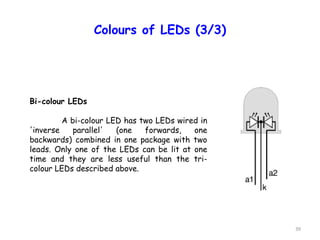
A bi-colour LED has two LEDs wired in
'inverse parallel' (one forwards, one
backwards) combined in one package with two
leads. Only one of the LEDs can be lit at one
time and they are less useful than the tri-
colour LEDs described above.
40
LED Performance (1/8)
• Color
• White light
• Intensity
• Eye safety information
• Visibility
• Operating Life
• Voltage/Design Current
LED performance is based on a few primary characteristics:
41
LED Performance (2/8)
Colour
Peak wavelength is a function of the LED chip material.
Although process variations are ±10 NM, the 565 to 600 NM
wavelength spectral region is where the sensitivity level of the
human eye is highest. Therefore, it is easier to perceive color
variations in yellow and amber LEDs than other colors.
42
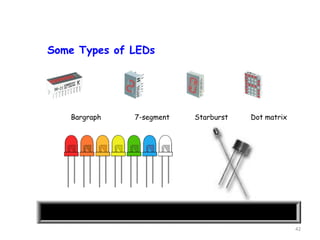
Bargraph 7-segment Starburst Dot matrix
Some Types of LEDs
Disadvantages:
1.Output power gets affected due to change in
temperature
2.Overcurrent damages the LED
3.Large power required for operation
4.Luminous efficiency is low
::The END::
Thank you for your
Attention!

V.s.arjun led

  • 1.
  • 2.
    2 A light emittingdiode (LED) is essentially a PN junction opto-semiconductor that emits a monochromatic (single color) light when operated in a forward biased direction. LEDs convert electrical energy into light energy. They are frequently used as "pilot" lights in electronic appliances to indicate whether the circuit is closed or not. SYMBOL
  • 3.
    3 How Does ALED Work? (1/2) When sufficient voltage is applied to the chip across the leads of the LED, electrons can move easily in only one direction across the junction between the p and n regions. In the p region there are many more positive than negative charges. When a voltage is applied and the current starts to flow, electrons in the n region have sufficient energy to move across the junction into the p region.
  • 4.
    4 How Does ALED Work? (2/2) Each time an electron recombines with a positive charge, electric potential energy is converted into electromagnetic energy. For each recombination of a negative and a positive charge, a quantum of electromagnetic energy is emitted in the form of a photon of light with a frequency characteristic of the semi-conductor material (usually a combination of the chemical elements gallium, arsenic and phosphorus)..
  • 5.
    5 About LEDs (1/2) Themost important part of a light emitting diode (LED) is the semi-conductor chip located in the center of the bulb as shown at the right. The chip has two regions separated by a junction. The p region is dominated by positive electric charges, and the n region is dominated by negative electric charges. The junction acts as a barrier to the flow of electrons between the p and the n regions. Only when sufficient voltage is applied to the semi-conductor chip, can the current flow, and the electrons cross the junction into the p region.
  • 6.
  • 7.
    7 Testing LEDs Never connectan LED directly to a battery or power supply! It will be destroyed almost instantly because too much current will pass through and burn it out. LEDs must have a resistor in series to limit the current to a safe value, for quick testing purposes a 1k resistor is suitable for most LEDs if your supply voltage is 12V or less. Remember to connect the LED the correct way round!
  • 8.
    8 How Much EnergyDoes an LED Emit? The energy (E) of the light emitted by an LED is related to the electric charge (q) of an electron and the voltage (V) required to light the LED by the expression: E = qV Joules. This expression simply says that the voltage is proportional to the electric energy, and is a general statement which applies to any circuit, as well as to LED's. The constant q is the electric charge of a single electron, -1.6 x 10⁻¹⁹ Coulomb.
  • 9.
    CB VB When the electronfalls down from conduction band and fills in a hole in valence band, there is an obvious loss of energy. The question is; where does that energy go?
  • 10.
    In order toachieve a reasonable efficiency for photon emission, the semiconductor must have a direct band gap. CB VB The question is; what is the mechanism behind photon emission in LEDs?
  • 11.
    For example; Silicon isknown as an indirect band-gap material. as an electron goes from the bottom of the conduction band to the top of the valence band; it must also undergo a significant change in momentum. CB VB What this means is that E k
  • 12.
    • As weall know, whenever something changes state, one must conserve not only energy, but also momentum. • In the case of an electron going from conduction band to the valence band in silicon, both of these things can only be conserved: The transition also creates a quantized set of lattice vibrations, called phoTons, or "heat“ .
  • 13.
    • Photons possessboth energy and momentum. • Their creation upon the recombination of an electron and hole allows for complete conservation of both energy and momentum. • All of the energy which the electron gives up in going from the conduction band to the valence band (1.1 eV) ends up in photons, which is another way of saying that the electron heats up the crystal.
  • 14.
    • Thus, fora direct band gap material, the excess energy of the electron-hole recombination can either be taken away as heat, or more likely, as a photon of light. • This radiative transition then conserves energy and momentum by giving off light whenever an electron and hole recombine. CB VB This gives rise to (for us) a new type of device; the light emitting diode (LED).
  • 15.
    Mechanism is “injection Electroluminescence”. Luminescence parttells us that we are producing photons. Electro part tells us that the photons are being produced by an electric current. e- Injection tells us that photon production is by the injection of current carriers. Mechanism behind photon emission in LEDs? e-
  • 16.
    Producing photon Electrons recombinewith holes. Energy of photon is the energy of band gap. CB VB e- h
  • 17.
    What is LED? •LED - Light Emitting Diode • A semiconductor component similar to transistor or integrated circuit • Electrical current through the semiconductor chip produces light • Semiconductor materials used, define the colour of light produced
  • 18.
    Benefits of LED •Shock and vibration proof • Small dimensions • Lightweight • Virtually no heat generation • Accurate and well controlled beam spread
  • 19.
    Key features ofLED • ·Longer lasting • ·Reduced maintenance cost • ·More energy efficient • ·Better design flexibility • ·Vivid colors • ·High reliability • ·Environmentally friendly • They are suitable at high operating speeds
  • 20.
    LED vs. CFLvs. Incandescent Lamps Incandescent Lamps • 90% of electricity used is spent producing heat, not light • Rapidly being replaced by CFLs for lesser bills and environment friendliness Compact Fluorescent Lamps (CFL) • 75% less electricity needed to produce same amount of light as an incandescent lamp • Current estimated sale, of one brand just in Gurgaon, is around one lakh units per month Light-emitting Diodes (LED) • 15-20% less electricity needed to produce same amount of light as a CFL • Making a slow but steady entry in the market of lighting • Opportunities exist in way too many industries • Currently hot for home decor; Corporate office lighting space hugely untapped • More environment friendly than CFLs
  • 21.
    Why LED? •Energy Efficient,up to 90% more efficient than traditional lighting sources •Long life span, up to 100,000 hours •Variety of color options •Low operation costs •No UV radiation •No mercury •Instant on, no start-up time •Silent operation •Reduces “Carbon Footprint”
  • 22.
    Carbon Footprint: comparisonchart Lamp Wattage Operation kWh/year CO2 emissions Incandescent 100W 12hr./day 400kWh 840 lbs Fluorescent 30W 12hr./day 113kWh 237 lbs Halogen 50W 12hr./day 187kWh 393 lbs HID 300W 12hr./day 800kWh 1,680 lbs LED 3W 12hr./day 12kWh 26 lbs
  • 23.
    Materials for visiblewavelength LEDs • We see them almost everyday, either on calculator displays or indicator panels. • Red LED use as “ power on” indicator • Yellow, green and amber LEDs are also widely available but very few of you will have seen a blue LED.
  • 24.
    Sample Applications •Street Lighting •GasStation Lighting •Parking Garage •Parking Lots •Site Lighting •High-bay’s •Low-bay’s •Wall packs •Decorative Fixtures •Historical Fixtures •Security Lighting
  • 25.
  • 26.
  • 27.
  • 29.
    29 Applications • Sensor Applications •Mobile Applications • Sign Applications • Automative Uses • LED Signals • Illuminations • Indicators
  • 30.
    30 Sensor Applications • MedicalInstrumentation • Bar Code Readers • Color & Money Sensors • Encoders • Optical Switches • Fiber Optic Communication
  • 31.
    31 Mobile Applications • MobilePhone • PDA's • Digital Cameras • Lap Tops • General Backlighting
  • 32.
    32 Sign Applications • FullColor Video • Monochrome Message Boards • Traffic/VMS • Transportation - Passenger Information
  • 33.
    33 Automative Applications • InteriorLighting - Instrument Panels & Switches, Courtesy Lighting • Exterior Lighting - CHMSL, Rear Stop/Turn/Tail • Truck/Bus Lighting - Retrofits, New Turn/Tail/Marker Lights
  • 34.
    34 Signal Appications • Traffic •Rail • Aviation • Tower Lights • Runway Lights • Emergency/Police Vehicle Lighting LEDs offer enormous benefits over traditional incandescent lamps including: • Energy savings (up to 85% less power than incandescent) • Reduction in maintenance costs • Increased visibility in daylight and adverse weather conditions
  • 35.
    35 Indication  Household appliances VCR/ DVD/ Stereo and other audio and video devices  Toys/Games  Instrumentation  Security Equipment  Switches
  • 36.
    36 Driving LEDs • AnalogLED Drive Circuits • Digital LED Drive Circuits
  • 37.
    37 Colours of LEDs(1/3) LEDs are available in red, orange, amber, yellow, green, blue and white. Blue and white LEDs are much more expensive than the other colours. The colour of an LED is determined by the semiconductor material, not by the colouring of the 'package' (the plastic body). LEDs of all colours are available in uncoloured packages which may be diffused (milky) or clear (often described as 'water clear'). The coloured packages are also available as diffused (the standard type) or transparent. LEDs are made from gallium-based crystals that contain one or more additional materials such as phosphorous to produce a distinct color. Different LED chip technologies emit light in specific regions of the visible light spectrum and produce different intensity levels.
  • 38.
    38 Colours of LEDs(2/3) Tri-colour LEDs The most popular type of tri-colour LED has a red and a green LED combined in one package with three leads. They are called tri- colour because mixed red and green light appears to be yellow and this is produced when both the red and green LEDs are on. The diagram shows the construction of a tri - colour LED. Note the different lengths of the three leads. The centre lead (k) is the common cathode for both LEDs, the outer leads (a1 and a2) are the anodes to the LEDs allowing each one to be lit separately, or both together to give the third colour.
  • 39.
    39 Colours of LEDs(3/3) Bi-colour LEDs A bi-colour LED has two LEDs wired in 'inverse parallel' (one forwards, one backwards) combined in one package with two leads. Only one of the LEDs can be lit at one time and they are less useful than the tri- colour LEDs described above.
  • 40.
    40 LED Performance (1/8) •Color • White light • Intensity • Eye safety information • Visibility • Operating Life • Voltage/Design Current LED performance is based on a few primary characteristics:
  • 41.
    41 LED Performance (2/8) Colour Peakwavelength is a function of the LED chip material. Although process variations are ±10 NM, the 565 to 600 NM wavelength spectral region is where the sensitivity level of the human eye is highest. Therefore, it is easier to perceive color variations in yellow and amber LEDs than other colors.
  • 42.
    42 Bargraph 7-segment StarburstDot matrix Some Types of LEDs
  • 44.
    Disadvantages: 1.Output power getsaffected due to change in temperature 2.Overcurrent damages the LED 3.Large power required for operation 4.Luminous efficiency is low
  • 45.
    ::The END:: Thank youfor your Attention!