OPTOELECTRONIC
 Optoelectronics is an interesting branch of electronics that combines both electronics
and optics.
 Optoelectronics is the study and application of electronic devices that interact with
light.
 Optoelectronic devices find varied applications in telecommunications, military services,
medical field, and automatic control systems.
2
3
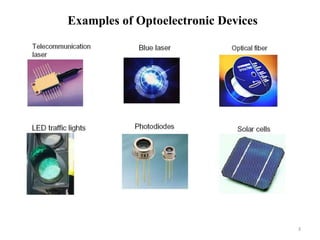
Examples of Optoelectronic Devices
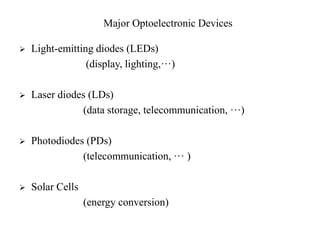
Major Optoelectronic Devices
 Light-emitting diodes (LEDs)
(display, lighting,···)
 Laser diodes (LDs)
(data storage, telecommunication, ···)
 Photodiodes (PDs)
(telecommunication, ··· )
 Solar Cells
(energy conversion)
LIGHT EMITTING DIODE
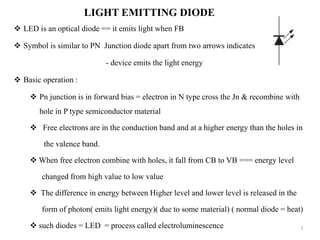
 LED is an optical diode == it emits light when FB
 Symbol is similar to PN Junction diode apart from two arrows indicates
- device emits the light energy
 Basic operation :
 Pn junction is in forward bias = electron in N type cross the Jn & recombine with
hole in P type semiconductor material
 Free electrons are in the conduction band and at a higher energy than the holes in
the valence band.
 When free electron combine with holes, it fall from CB to VB === energy level
changed from high value to low value
 The difference in energy between Higher level and lower level is released in the
form of photon( emits light energy)( due to some material) ( normal diode = heat)
 such diodes = LED = process called electroluminescence 5
LIGHT EMITTING DIODE
 Energy released in the form of light depends on the energy corresponding to forbidden
gap. Determines the wavelength of the emitted light.
 wavelength determines colour of the light. Also determines light is visible or invisible(IR)
 Various impurities are added during the doping process to control the wavelength &
colour of the emitted light
6
LIGHT EMITTING DIODE
 Normal Silicon diode, FG = 1.1ev , wavelength of emitted light correspond to IR light
spectrum. == light is not visible.
 Materials used in LED
 GaAs, GaAsP or GaP (mixures of elements gallium, arsenic and phosphorus)
 GaAs - Infrared radiation (Invisible)
 GaAsP - Red or yellow light
 GaP - Red or green light
 Some LEDs- blue & orange light(InGaN)
 LEDs emit no light when reverse biased. Operating LED in reverse direction will quickly
destroy them
7
LIGHT EMITTING DIODE
Construction of LED
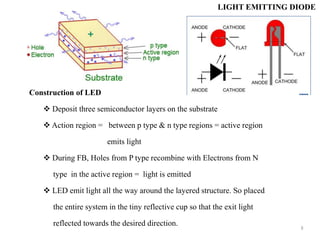
 Deposit three semiconductor layers on the substrate
 Action region = between p type & n type regions = active region
emits light
 During FB, Holes from P type recombine with Electrons from N
type in the active region = light is emitted
 LED emit light all the way around the layered structure. So placed
the entire system in the tiny reflective cup so that the exit light
reflected towards the desired direction.
8
LIGHT EMITTING DIODE
LED : voltage & current
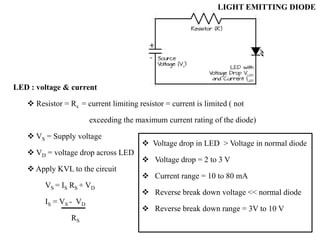
 Resistor = Rs = current limiting resistor = current is limited ( not
exceeding the maximum current rating of the diode)
 VS = Supply voltage
 VD = voltage drop across LED
 Apply KVL to the circuit
VS = IS RS + VD
IS = VS - VD
RS
9
 Voltage drop in LED > Voltage in normal diode
 Voltage drop = 2 to 3 V
 Current range = 10 to 80 mA
 Reverse break down voltage << normal diode
 Reverse break down range = 3V to 10 V
LIGHT EMITTING DIODE
Spectral output curves
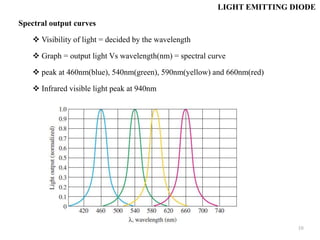
 Visibility of light = decided by the wavelength
 Graph = output light Vs wavelength(nm) = spectral curve
 peak at 460nm(blue), 540nm(green), 590nm(yellow) and 660nm(red)
 Infrared visible light peak at 940nm
10
LIGHT EMITTING DIODE
Radiation Pattern of LED
 LED = directional light source
 it emits light in a particular way which has a typical radiation pattern
 most of the energy emitted within 20˚ of the direction of maximum light
 Some LEDs = plastic lens = spread the light to greater angle to increase the
visibility
 Coloured lens are also used = to
enhance the colour
11
LIGHT EMITTING DIODEAdvantages :
 Small in size
Brightness controlled by varying current
 Fast operating devices
 light in weight
 Available in various colours
 Have long life
Cheap and readily available
 Easy to interface to various electronic devices
 used in Burglar alarm system
12
Disadvantages :
 Luminous efficiency is low
 Characteristics affected by temp
 Frequent replacement of battery
 need large power for its
operation
Applications :
 Sensor Applications
 Sign Applications
 LED Signals
Mobile Applications
 Indicators

Optoelectronics

  • 2.
    OPTOELECTRONIC  Optoelectronics isan interesting branch of electronics that combines both electronics and optics.  Optoelectronics is the study and application of electronic devices that interact with light.  Optoelectronic devices find varied applications in telecommunications, military services, medical field, and automatic control systems. 2
  • 3.
  • 4.
    Major Optoelectronic Devices Light-emitting diodes (LEDs) (display, lighting,···)  Laser diodes (LDs) (data storage, telecommunication, ···)  Photodiodes (PDs) (telecommunication, ··· )  Solar Cells (energy conversion)
  • 5.
    LIGHT EMITTING DIODE LED is an optical diode == it emits light when FB  Symbol is similar to PN Junction diode apart from two arrows indicates - device emits the light energy  Basic operation :  Pn junction is in forward bias = electron in N type cross the Jn & recombine with hole in P type semiconductor material  Free electrons are in the conduction band and at a higher energy than the holes in the valence band.  When free electron combine with holes, it fall from CB to VB === energy level changed from high value to low value  The difference in energy between Higher level and lower level is released in the form of photon( emits light energy)( due to some material) ( normal diode = heat)  such diodes = LED = process called electroluminescence 5
  • 6.
    LIGHT EMITTING DIODE Energy released in the form of light depends on the energy corresponding to forbidden gap. Determines the wavelength of the emitted light.  wavelength determines colour of the light. Also determines light is visible or invisible(IR)  Various impurities are added during the doping process to control the wavelength & colour of the emitted light 6
  • 7.
    LIGHT EMITTING DIODE Normal Silicon diode, FG = 1.1ev , wavelength of emitted light correspond to IR light spectrum. == light is not visible.  Materials used in LED  GaAs, GaAsP or GaP (mixures of elements gallium, arsenic and phosphorus)  GaAs - Infrared radiation (Invisible)  GaAsP - Red or yellow light  GaP - Red or green light  Some LEDs- blue & orange light(InGaN)  LEDs emit no light when reverse biased. Operating LED in reverse direction will quickly destroy them 7
  • 8.
    LIGHT EMITTING DIODE Constructionof LED  Deposit three semiconductor layers on the substrate  Action region = between p type & n type regions = active region emits light  During FB, Holes from P type recombine with Electrons from N type in the active region = light is emitted  LED emit light all the way around the layered structure. So placed the entire system in the tiny reflective cup so that the exit light reflected towards the desired direction. 8
  • 9.
    LIGHT EMITTING DIODE LED: voltage & current  Resistor = Rs = current limiting resistor = current is limited ( not exceeding the maximum current rating of the diode)  VS = Supply voltage  VD = voltage drop across LED  Apply KVL to the circuit VS = IS RS + VD IS = VS - VD RS 9  Voltage drop in LED > Voltage in normal diode  Voltage drop = 2 to 3 V  Current range = 10 to 80 mA  Reverse break down voltage << normal diode  Reverse break down range = 3V to 10 V
  • 10.
    LIGHT EMITTING DIODE Spectraloutput curves  Visibility of light = decided by the wavelength  Graph = output light Vs wavelength(nm) = spectral curve  peak at 460nm(blue), 540nm(green), 590nm(yellow) and 660nm(red)  Infrared visible light peak at 940nm 10
  • 11.
    LIGHT EMITTING DIODE RadiationPattern of LED  LED = directional light source  it emits light in a particular way which has a typical radiation pattern  most of the energy emitted within 20˚ of the direction of maximum light  Some LEDs = plastic lens = spread the light to greater angle to increase the visibility  Coloured lens are also used = to enhance the colour 11
  • 12.
    LIGHT EMITTING DIODEAdvantages:  Small in size Brightness controlled by varying current  Fast operating devices  light in weight  Available in various colours  Have long life Cheap and readily available  Easy to interface to various electronic devices  used in Burglar alarm system 12 Disadvantages :  Luminous efficiency is low  Characteristics affected by temp  Frequent replacement of battery  need large power for its operation Applications :  Sensor Applications  Sign Applications  LED Signals Mobile Applications  Indicators