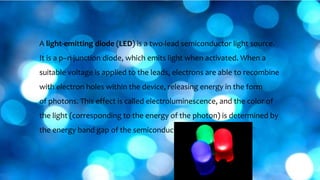
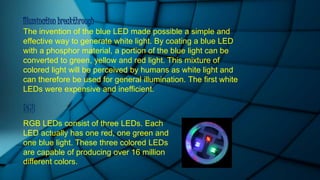
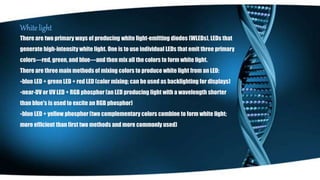
An LED is a semiconductor device that emits light when activated by electricity. Blue LEDs were first developed in 1972 but were not bright. The first high-brightness blue LED was created by Nakamura in 1994, paving the way for white LEDs through phosphor coatings. White LEDs are now commonly used and offer advantages over traditional lighting like higher efficiency, longer lifetime, and ability to emit specific colors. However, LEDs also have some disadvantages such as higher initial cost and temperature/voltage sensitivity.