Topic :
Guided By :
Branch : Batch :
Name ENROLLMENT NO.
Himal Desai 140120109008
Abhishek Chokshi
Harsh Dedakia
140120109005
140120109012
Introduction
Objective of pumping system
What are Pumping Systems
• Transfer liquid
from source to
destination
• Circulate liquid
around a system
Introduction
• Main pump components
• Pumps
• Prime movers: electric motors, diesel engines,
air system
• Piping to carry fluid
• Valves to control flow in system
• Other fittings, control, instrumentation
• End-use equipment
• Heat exchangers, tanks, hydraulic machines
What are Pumping Systems
Introduction
• Head
• Resistance of the system
• Two types: static and friction
• Static head
• Difference in height between
source and destination
• Independent of flow
Pumping System Characteristics
destination
source
Stati
c
head
Static
head
Flow
Introduction
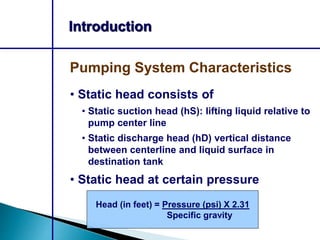
• Static head consists of
• Static suction head (hS): lifting liquid relative to
pump center line
• Static discharge head (hD) vertical distance
between centerline and liquid surface in
destination tank
• Static head at certain pressure
Pumping System Characteristics
Head (in feet) = Pressure (psi) X 2.31
Specific gravity
Introduction
• Friction head
• Resistance to flow in pipe and fittings
• Depends on size, pipes, pipe fittings, flow
rate, nature of liquid
• Proportional to square of flow rate
• Closed loop system
only has friction head
(no static head)
Pumping System Characteristics
Friction
head
Flow
Introduction
In most cases:
Total head = Static head + friction head
Pumping System Characteristics
System
head
Flow
Static head
Friction
head
System
curve
System
head
Flow
Static head
Friction
head
System
curve
• use back and forth movement of mechanical parts
 Water is for most practical purposes incompressible.
Consequently, if a close fitting piston is drawn through a pipe
full of water, it will displace water along the pipe.
 Similarly, raising a piston in a submersed pipe will draw
water up behind it to fill the vacuum which would otherwise
occurs.
 Basic relationships between the output or discharge
rate (Q), piston diameter (d), stroke or length of piston
travel (S), number of strokes per minute (n), and the
volumetric efficiency, which is the percentage of the swept
volume that is actually pumped per stroke ( η vol )
 Swept area of the piston is A =
The swept volume per stroke will be V= AS
The discharge per stroke will be q = V η vol
The pumping rate (per minute) is Q = nq
4
2πd
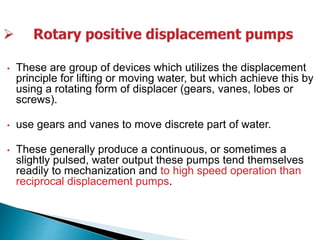
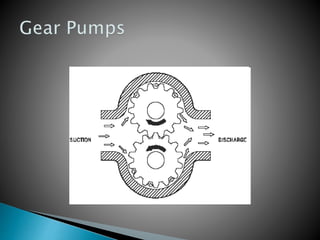
• These are group of devices which utilizes the displacement
principle for lifting or moving water, but which achieve this by
using a rotating form of displacer (gears, vanes, lobes or
screws).
• use gears and vanes to move discrete part of water.
• These generally produce a continuous, or sometimes a
slightly pulsed, water output these pumps tend themselves
readily to mechanization and to high speed operation than
reciprocal displacement pumps.
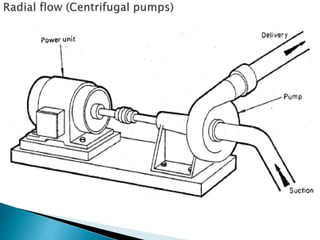
• use the centrifugal force of rotating devices (called
impellers) to increase the kinetic and pressure
energy of the water.
• Depends on propelling water using a spinning
impeller of rotor.
• There are two main types of rotodynamic
pumps (centrifugal pumps), i.e.
◦ Volute centrifugal pumps
◦ Turbine centrifugal pumps
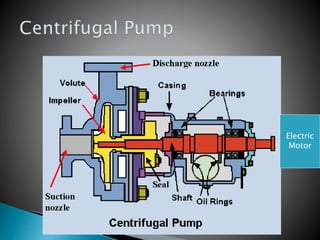
Electric Motor
Electric
Motor
 Reciprocating and rotary pumps are called positive
displacement pumps, while centrifugal pumps are
called variable displacement pumps in which the
delivery head varies with the quantity of water
pumped.
 In centrifugal pumps the energy is imparted to the water by a
unit of rotating vanes called an impeller, which are located in
a stationary body called the casing.

Water is pushed into the center or eye of the impeller by
atmospheric or water pressure and set into a rotary motion
by the impeller.
-The rotating movement causes a centrifugal force to act upon
the water, which drives the water outward, between the
vanes of the impeller, into the surrounding casing from where
it moves to the pump outlet.
-Different types of casing: a)Single volute, (b) Double volute,
and (c). Diffuser turbine casing.
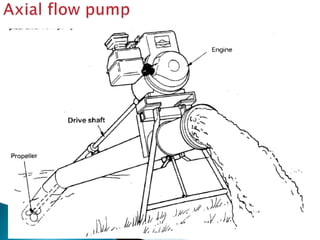
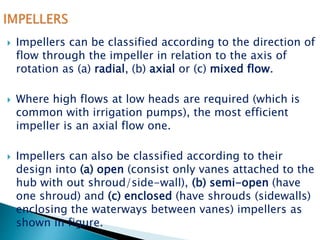
 Impellers can be classified according to the direction of
flow through the impeller in relation to the axis of
rotation as (a) radial, (b) axial or (c) mixed flow.
 Where high flows at low heads are required (which is
common with irrigation pumps), the most efficient
impeller is an axial flow one.
 Impellers can also be classified according to their
design into (a) open (consist only vanes attached to the
hub with out shroud/side-wall), (b) semi-open (have
one shroud) and (c) enclosed (have shrouds (sidewalls)
enclosing the waterways between vanes) impellers as
shown in figure.
Impellers
 Pumps can not pump vapors!
 The satisfactory operation of a pump requires that
vaporization of the liquid being pumped does not
occur at any condition of operation.
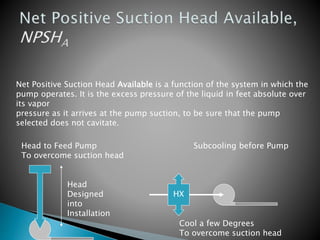
Net Positive Suction Head Available is a function of the system in which the
pump operates. It is the excess pressure of the liquid in feet absolute over
its vapor
pressure as it arrives at the pump suction, to be sure that the pump
selected does not cavitate.
Head to Feed Pump Subcooling before Pump
To overcome suction head
Head
Designed
into
Installation
HX
Cool a few Degrees
To overcome suction head
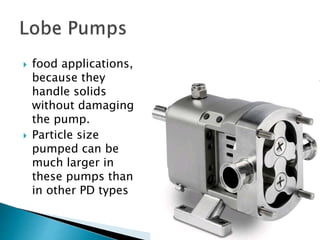
 food applications,
because they
handle solids
without damaging
the pump.
 Particle size
pumped can be
much larger in
these pumps than
in other PD types
Pumps
Pumps

Pumps

  • 1.
    Topic : Guided By: Branch : Batch :
  • 2.
    Name ENROLLMENT NO. HimalDesai 140120109008 Abhishek Chokshi Harsh Dedakia 140120109005 140120109012
  • 3.
    Introduction Objective of pumpingsystem What are Pumping Systems • Transfer liquid from source to destination • Circulate liquid around a system
  • 4.
    Introduction • Main pumpcomponents • Pumps • Prime movers: electric motors, diesel engines, air system • Piping to carry fluid • Valves to control flow in system • Other fittings, control, instrumentation • End-use equipment • Heat exchangers, tanks, hydraulic machines What are Pumping Systems
  • 5.
    Introduction • Head • Resistanceof the system • Two types: static and friction • Static head • Difference in height between source and destination • Independent of flow Pumping System Characteristics destination source Stati c head Static head Flow
  • 6.
    Introduction • Static headconsists of • Static suction head (hS): lifting liquid relative to pump center line • Static discharge head (hD) vertical distance between centerline and liquid surface in destination tank • Static head at certain pressure Pumping System Characteristics Head (in feet) = Pressure (psi) X 2.31 Specific gravity
  • 7.
    Introduction • Friction head •Resistance to flow in pipe and fittings • Depends on size, pipes, pipe fittings, flow rate, nature of liquid • Proportional to square of flow rate • Closed loop system only has friction head (no static head) Pumping System Characteristics Friction head Flow
  • 8.
    Introduction In most cases: Totalhead = Static head + friction head Pumping System Characteristics System head Flow Static head Friction head System curve System head Flow Static head Friction head System curve
  • 11.
    • use backand forth movement of mechanical parts  Water is for most practical purposes incompressible. Consequently, if a close fitting piston is drawn through a pipe full of water, it will displace water along the pipe.  Similarly, raising a piston in a submersed pipe will draw water up behind it to fill the vacuum which would otherwise occurs.
  • 12.
     Basic relationshipsbetween the output or discharge rate (Q), piston diameter (d), stroke or length of piston travel (S), number of strokes per minute (n), and the volumetric efficiency, which is the percentage of the swept volume that is actually pumped per stroke ( η vol )  Swept area of the piston is A = The swept volume per stroke will be V= AS The discharge per stroke will be q = V η vol The pumping rate (per minute) is Q = nq 4 2πd
  • 13.
    • These aregroup of devices which utilizes the displacement principle for lifting or moving water, but which achieve this by using a rotating form of displacer (gears, vanes, lobes or screws). • use gears and vanes to move discrete part of water. • These generally produce a continuous, or sometimes a slightly pulsed, water output these pumps tend themselves readily to mechanization and to high speed operation than reciprocal displacement pumps.
  • 14.
    • use thecentrifugal force of rotating devices (called impellers) to increase the kinetic and pressure energy of the water. • Depends on propelling water using a spinning impeller of rotor. • There are two main types of rotodynamic pumps (centrifugal pumps), i.e. ◦ Volute centrifugal pumps ◦ Turbine centrifugal pumps
  • 15.
  • 16.
  • 18.
     Reciprocating androtary pumps are called positive displacement pumps, while centrifugal pumps are called variable displacement pumps in which the delivery head varies with the quantity of water pumped.
  • 22.
     In centrifugalpumps the energy is imparted to the water by a unit of rotating vanes called an impeller, which are located in a stationary body called the casing.  Water is pushed into the center or eye of the impeller by atmospheric or water pressure and set into a rotary motion by the impeller. -The rotating movement causes a centrifugal force to act upon the water, which drives the water outward, between the vanes of the impeller, into the surrounding casing from where it moves to the pump outlet. -Different types of casing: a)Single volute, (b) Double volute, and (c). Diffuser turbine casing.
  • 23.
     Impellers canbe classified according to the direction of flow through the impeller in relation to the axis of rotation as (a) radial, (b) axial or (c) mixed flow.  Where high flows at low heads are required (which is common with irrigation pumps), the most efficient impeller is an axial flow one.  Impellers can also be classified according to their design into (a) open (consist only vanes attached to the hub with out shroud/side-wall), (b) semi-open (have one shroud) and (c) enclosed (have shrouds (sidewalls) enclosing the waterways between vanes) impellers as shown in figure.
  • 24.
  • 25.
     Pumps cannot pump vapors!  The satisfactory operation of a pump requires that vaporization of the liquid being pumped does not occur at any condition of operation.
  • 26.
    Net Positive SuctionHead Available is a function of the system in which the pump operates. It is the excess pressure of the liquid in feet absolute over its vapor pressure as it arrives at the pump suction, to be sure that the pump selected does not cavitate. Head to Feed Pump Subcooling before Pump To overcome suction head Head Designed into Installation HX Cool a few Degrees To overcome suction head
  • 29.
     food applications, becausethey handle solids without damaging the pump.  Particle size pumped can be much larger in these pumps than in other PD types