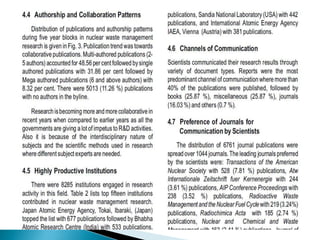
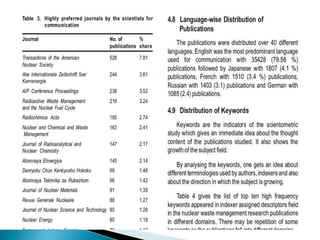
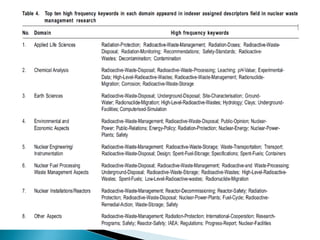
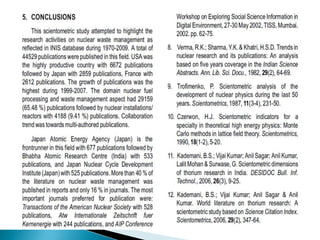
Topic :
Guided By :
Branch : Batch :
Name ENROLLMENT NO.
Himal Desai 140120109008
Abhishek Chokshi
Keval Darji
Soham Davra 140120109007
140120109005
140120109006
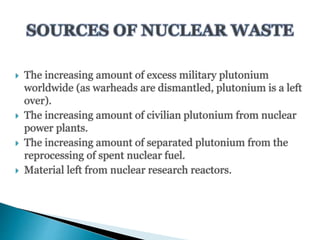
 The increasing amount of excess military plutonium
worldwide (as warheads are dismantled, plutonium is a left
over).
 The increasing amount of civilian plutonium from nuclear
power plants.
 The increasing amount of separated plutonium from the
reprocessing of spent nuclear fuel.
 Material left from nuclear research reactors.
 Very Low Level Waste (VLLW)
-Covers wastes with very low concentrations of radioactivity.
-Sources including hospitals and industry in general. Because
-VLLW contains little total radioactivity, it can be disposed of safely with
domestic refuse either directly at landfill sites or indirectly after
incineration.
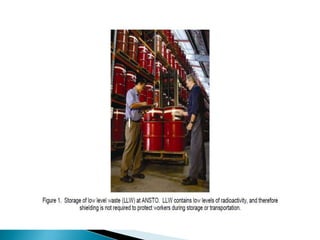
 Low Level Waste (LLW)
-Includes metals, soil, building rubble and organic materials which arise
principally as lightly contaminated miscellaneous scrap.
 - Organic materials are mainly in the form of paper towels, clothing and
laboratory equipment that have been used in areas where radioactive
materials are used - such as hospitals, research establishments and industry.
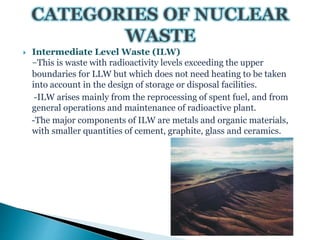
 Intermediate Level Waste (ILW)
-This is waste with radioactivity levels exceeding the upper
boundaries for LLW but which does not need heating to be taken
into account in the design of storage or disposal facilities.
-ILW arises mainly from the reprocessing of spent fuel, and from
general operations and maintenance of radioactive plant.
-The major components of ILW are metals and organic materials,
with smaller quantities of cement, graphite, glass and ceramics.
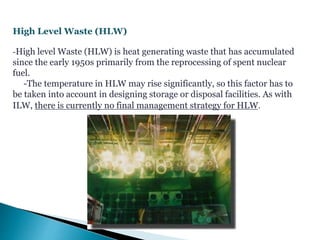
High Level Waste (HLW)
-High level Waste (HLW) is heat generating waste that has accumulated
since the early 1950s primarily from the reprocessing of spent nuclear
fuel.
-The temperature in HLW may rise significantly, so this factor has to
be taken into account in designing storage or disposal facilities. As with
ILW, there is currently no final management strategy for HLW.
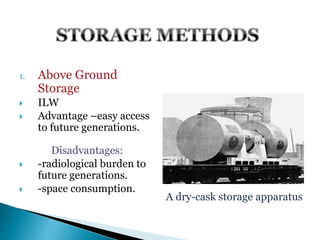
1. Above Ground
Storage
 ILW
 Advantage –easy access
to future generations.
Disadvantages:
 -radiological burden to
future generations.
 -space consumption.
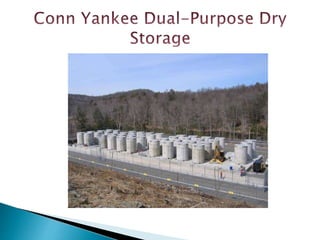
A dry-cask storage apparatus
2. Disposal at Sea
 -Used in the past but no longer legal.
3. Sub-Seabed Disposal
 -Disposal in empty off shore oil and gas fields.
 -Usually used for disposal of HLW
 -Too many rocket launches required-not economically
feasible.
 -Potential for catastrophic launch failure.
5. Ice sheets
 For disposal of HLW.
 Considered unacceptable because of lack of confidence in
these wastes.
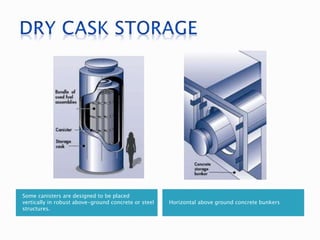
Some canisters are designed to be placed
vertically in robust above-ground concrete or steel
structures.
Horizontal above ground concrete bunkers
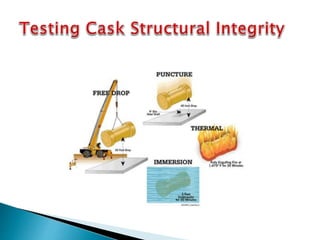
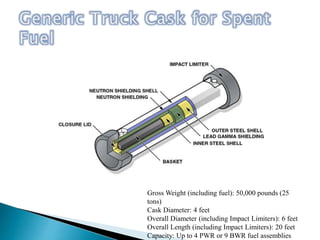
Gross Weight (including fuel): 50,000 pounds (25
tons)
Cask Diameter: 4 feet
Overall Diameter (including Impact Limiters): 6 feet
Overall Length (including Impact Limiters): 20 feet
Capacity: Up to 4 PWR or 9 BWR fuel assemblies
6. Partitioning and Transmutation (P&T)
 -Partitioning is the separation of long lived radio nuclides
from waste into short lived nuclides.(by chemical means)
 -Transmutation is the transformation of these nuclides into
shorter lives or stable nuclides. (in a reactor or particle acc.)
Practical Difficulties:
 -Requires re-handling of waste and thus further exposure to
workers to radioactivity.
 -Requires building of additional activities close to source of
waste –added expense.
 -Works only for certain short lived particles.
 Technology still under-developed
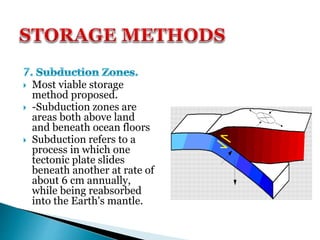
 Most viable storage
method proposed.
 -Subduction zones are
areas both above land
and beneath ocean floors
 Subduction refers to a
process in which one
tectonic plate slides
beneath another at rate of
about 6 cm annually,
while being reabsorbed
into the Earth's mantle.
 Once the waste is carried into the interior of
the Earth, it would take many millions of
years "for the waste to circulate through the
Earth's mantle.
 It could re-emerge in a diluted, chemically
and physically altered form at an oceanic
ridge.
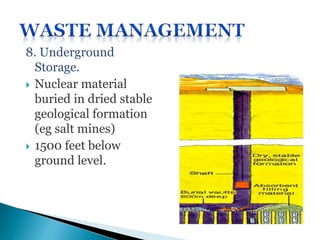
8. Underground
Storage.
 Nuclear material
buried in dried stable
geological formation
(eg salt mines)
 1500 feet below
ground level.
Layers Of Protection
The principal barriers are:
 Locate deep underground in a stable rock
structure.
 Immobilise waste in an insoluble matrix, eg
borosilicate glass, Synroc (or leave them as
uranium oxide fuel pellets - a ceramic)
 Seal inside a corrosion-resistant container, eg
stainless steel
 In wet rock: surround containers with bentonite
clay to inhibit groundwater movement
 Decay in Storage (DIS)
 Dump to Sanitary Sewer
 Only RSO may Ship to Disposal Site
 Dispose as if not radioactive
 Decay in Storage (DIS)
◦ Store waste in the laboratory if the half-life is no
more than 120 days.
◦ “DIS” Isotopes must be held for decay for at least
10 half-lives.
◦ Survey monitoring of material must read close to
background.
◦ All radioactive labeling must be defaced.
◦ Document in log
 Dump to Sanitary Sewer
◦ Must be water soluble or readily dispersible
biological material in water.
◦ Concentration per month is limited by the
regulations, check with the Radiation Safety
Officer.
◦ May obtain permission from the Radiation Safety
Office prior to dumping - Only way to know if
other people are dumping.
 Only Radiation Safety Office may Ship to
Disposal Site.
 Contact Radiation Safety Officer when you
have a full container of dry or liquid waste
 Disposal Site waste will be stored in the
radiation shed until scheduled pick-up.
 Dispose as if not Radioactive
◦ Scintillation medium containing no more than
0.05 microcuries per ml of H-3, or C-14 may be
discarded as if it was not radioactive. If
chemical solvent is disposed of properly the
radioactivity will not pose a problem.
◦ A record shall be kept of each such disposal for
the life of the license; it may be sent to the RSO
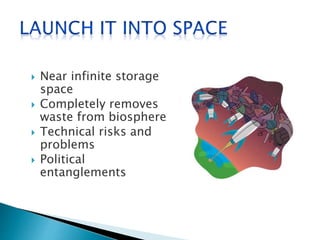
 Near infinite storage
space
 Completely removes
waste from biosphere
 Technical risks and
problems
 Political
entanglements
Nuclear  waste  management

Nuclear waste management

  • 1.
    Topic : Guided By: Branch : Batch :
  • 2.
    Name ENROLLMENT NO. HimalDesai 140120109008 Abhishek Chokshi Keval Darji Soham Davra 140120109007 140120109005 140120109006
  • 4.
     The increasingamount of excess military plutonium worldwide (as warheads are dismantled, plutonium is a left over).  The increasing amount of civilian plutonium from nuclear power plants.  The increasing amount of separated plutonium from the reprocessing of spent nuclear fuel.  Material left from nuclear research reactors.
  • 5.
     Very LowLevel Waste (VLLW) -Covers wastes with very low concentrations of radioactivity. -Sources including hospitals and industry in general. Because -VLLW contains little total radioactivity, it can be disposed of safely with domestic refuse either directly at landfill sites or indirectly after incineration.  Low Level Waste (LLW) -Includes metals, soil, building rubble and organic materials which arise principally as lightly contaminated miscellaneous scrap.  - Organic materials are mainly in the form of paper towels, clothing and laboratory equipment that have been used in areas where radioactive materials are used - such as hospitals, research establishments and industry.
  • 6.
     Intermediate LevelWaste (ILW) -This is waste with radioactivity levels exceeding the upper boundaries for LLW but which does not need heating to be taken into account in the design of storage or disposal facilities. -ILW arises mainly from the reprocessing of spent fuel, and from general operations and maintenance of radioactive plant. -The major components of ILW are metals and organic materials, with smaller quantities of cement, graphite, glass and ceramics.
  • 7.
    High Level Waste(HLW) -High level Waste (HLW) is heat generating waste that has accumulated since the early 1950s primarily from the reprocessing of spent nuclear fuel. -The temperature in HLW may rise significantly, so this factor has to be taken into account in designing storage or disposal facilities. As with ILW, there is currently no final management strategy for HLW.
  • 8.
    1. Above Ground Storage ILW  Advantage –easy access to future generations. Disadvantages:  -radiological burden to future generations.  -space consumption. A dry-cask storage apparatus
  • 9.
    2. Disposal atSea  -Used in the past but no longer legal. 3. Sub-Seabed Disposal  -Disposal in empty off shore oil and gas fields.  -Usually used for disposal of HLW
  • 10.
     -Too manyrocket launches required-not economically feasible.  -Potential for catastrophic launch failure. 5. Ice sheets  For disposal of HLW.  Considered unacceptable because of lack of confidence in these wastes.
  • 11.
    Some canisters aredesigned to be placed vertically in robust above-ground concrete or steel structures. Horizontal above ground concrete bunkers
  • 14.
    Gross Weight (includingfuel): 50,000 pounds (25 tons) Cask Diameter: 4 feet Overall Diameter (including Impact Limiters): 6 feet Overall Length (including Impact Limiters): 20 feet Capacity: Up to 4 PWR or 9 BWR fuel assemblies
  • 15.
    6. Partitioning andTransmutation (P&T)  -Partitioning is the separation of long lived radio nuclides from waste into short lived nuclides.(by chemical means)  -Transmutation is the transformation of these nuclides into shorter lives or stable nuclides. (in a reactor or particle acc.) Practical Difficulties:  -Requires re-handling of waste and thus further exposure to workers to radioactivity.  -Requires building of additional activities close to source of waste –added expense.  -Works only for certain short lived particles.  Technology still under-developed
  • 17.
     Most viablestorage method proposed.  -Subduction zones are areas both above land and beneath ocean floors  Subduction refers to a process in which one tectonic plate slides beneath another at rate of about 6 cm annually, while being reabsorbed into the Earth's mantle.
  • 19.
     Once thewaste is carried into the interior of the Earth, it would take many millions of years "for the waste to circulate through the Earth's mantle.  It could re-emerge in a diluted, chemically and physically altered form at an oceanic ridge.
  • 20.
    8. Underground Storage.  Nuclearmaterial buried in dried stable geological formation (eg salt mines)  1500 feet below ground level.
  • 21.
    Layers Of Protection Theprincipal barriers are:  Locate deep underground in a stable rock structure.  Immobilise waste in an insoluble matrix, eg borosilicate glass, Synroc (or leave them as uranium oxide fuel pellets - a ceramic)  Seal inside a corrosion-resistant container, eg stainless steel  In wet rock: surround containers with bentonite clay to inhibit groundwater movement
  • 22.
     Decay inStorage (DIS)  Dump to Sanitary Sewer  Only RSO may Ship to Disposal Site  Dispose as if not radioactive
  • 23.
     Decay inStorage (DIS) ◦ Store waste in the laboratory if the half-life is no more than 120 days. ◦ “DIS” Isotopes must be held for decay for at least 10 half-lives. ◦ Survey monitoring of material must read close to background. ◦ All radioactive labeling must be defaced. ◦ Document in log
  • 24.
     Dump toSanitary Sewer ◦ Must be water soluble or readily dispersible biological material in water. ◦ Concentration per month is limited by the regulations, check with the Radiation Safety Officer. ◦ May obtain permission from the Radiation Safety Office prior to dumping - Only way to know if other people are dumping.
  • 25.
     Only RadiationSafety Office may Ship to Disposal Site.  Contact Radiation Safety Officer when you have a full container of dry or liquid waste  Disposal Site waste will be stored in the radiation shed until scheduled pick-up.
  • 26.
     Dispose asif not Radioactive ◦ Scintillation medium containing no more than 0.05 microcuries per ml of H-3, or C-14 may be discarded as if it was not radioactive. If chemical solvent is disposed of properly the radioactivity will not pose a problem. ◦ A record shall be kept of each such disposal for the life of the license; it may be sent to the RSO
  • 27.
     Near infinitestorage space  Completely removes waste from biosphere  Technical risks and problems  Political entanglements