by 
B.GOWTHAM PATNAIK 
B.PRABHU KIRAN
INDEX
INTRODUCTION 
• Billions of visible LEDs are produced each year. 
• it area is of 2mm2 
• The emergence of high brightness AlGaAs and AlInGaP 
devices has given rise to many new markets. 
• LED technology has been spurred by the introduction of 
AlInGaP devices. 
• Recently developed AlGaInN materials have led to the 
improvements in the performance of bluish-green LEDs, 
which have luminous efficacy peaks much higher than those 
for incandescent lamps. 
• This advancement has led to the production of large-area full-color 
outdoors LED displays with diverse industrial 
applications.
HISTORY 
• In 1962, when Nick Holonyak Jr. invented first visible led, emitting red 
light but they are not enough to illuminate surroundings. 
• hence used as indicators,seven segment displays 
like(calculators,watches,tv,telephones etc..) 
• By mid 1970’s,more colours green, yellow were manufactured 
• it got somewhat succeeded with improved efficiency. 
• In early 1980’s LED were being used for messages and other outdoor 
applications. They used less power and were ten times brighter than 
previous ones. 
• By early 1990’s High brightness LED packages were developed and were 
widespread used in Traffic lights.
contd. 
• A remarkable milestone was achieved in mid 1990’s when Dr.Shuji 
Nakamura of Nichia chemical Corporation invented high brightness GaN 
blue LED. It was this LED that paved path for the development of white 
LED when coated with phosphor. By this technique white LED’s were 
produced by 1993. 
• This was the pre phase of the giant leap of LEDs, which made it possible to 
use them for illumination by invention and development of high power 
white light LEDs. 
• Today LEDs have reached performance levels far exceeding previous 
projections. Market expectations have increased and a wide range of 
applications including facade lighting, general purpose illumination.
INSIDE THE LED LIGHTINGS 
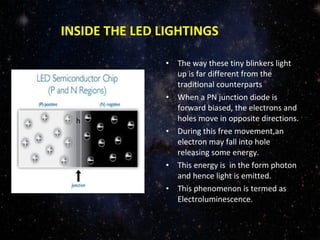
• The way these tiny blinkers light 
up is far different from the 
traditional counterparts 
• When a PN junction diode is 
forward biased, the electrons and 
holes move in opposite directions. 
• During this free movement,an 
electron may fall into hole 
releasing some energy. 
• This energy is in the form photon 
and hence light is emitted. 
• This phenomenon is termed as 
Electroluminescence. 
h
LIGHT SOURCE COMPARISION 
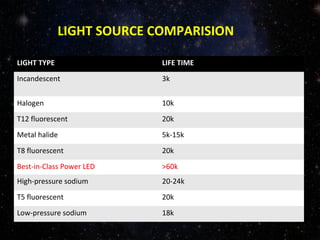
LIGHT TYPE LIFE TIME 
Incandescent 3k 
Halogen 10k 
T12 fluorescent 20k 
Metal halide 5k-15k 
T8 fluorescent 20k 
Best-in-Class Power LED >60k 
High-pressure sodium 20-24k 
T5 fluorescent 20k 
Low-pressure sodium 18k
LED TYPES 
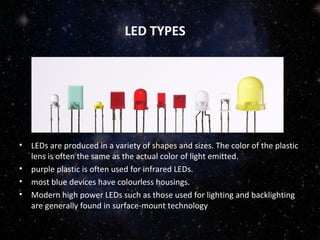
• LEDs are produced in a variety of shapes and sizes. The color of the plastic 
lens is often the same as the actual color of light emitted. 
• purple plastic is often used for infrared LEDs. 
• most blue devices have colourless housings. 
• Modern high power LEDs such as those used for lighting and backlighting 
are generally found in surface-mount technology
LED BENIFITS 
Efficiency: LEDs emit more light than incandescent light bulbs. 
The Efficiency of LED lighting is not affected by shape and size, unlike 
fluorescent light bulbs or tubes. 
Color: LEDs can emit light of an intended color without using any color filters 
as traditional lighting methods need. This is more efficient and can lower 
initial costs. 
Size: LEDs can be very small (smaller than 2mm2 and are easily attached to 
printed circuit boards. 
On/Off time: LEDs light up very quickly. LEDs used in communications devices 
can have even faster response times. 
Cycling: LEDs are ideal for uses subject to frequent on-off cycling, unlike 
fluorescent lamps that fail faster when cycled often. 
Slow failure: LEDs mostly fail by dimming over time, rather than the abrupt 
failure of incandescent bulbs.Lifetime: LEDs can have a relatively long 
useful life.
FUNCTIONING,SOLDERING&CONNECTIVITY 
Function: 
1. LEDs emit light when an electric current passes through 
them. 
Connecting and soldering: 
1. LEDs must be connected the correct way round, the 
diagram may be labelled a or + for anode and k or - for 
cathode.The cathode is the short lead and there may be a 
slight flat on the body of round LEDs. If you can see inside the 
LED the cathode is the larger electrode (but this is not an 
official identification method). 
2. LEDs can be damaged by heat when soldering, but the risk 
is small unless you are very slow. No special precautions are 
needed for soldering most LEDs.
• Testing an LED 
• Never connect an LED directly to a battery or power supply! 
• It will be destroyed almost instantly because too much current will pass through and burn it out. 
• LEDs must have a resistor in series to limit the current to a safe value, for quick testing purposes a 1k 
resistor is suitable for most LEDs if your supply voltage is 12V or less. Remember to connect the LED the 
correct way round!
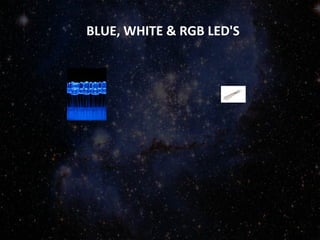
BLUE, WHITE & RGB LED'S
Thank You 
Make Presentation much more fun

Led ppt

  • 1.
    by B.GOWTHAM PATNAIK B.PRABHU KIRAN
  • 2.
  • 3.
    INTRODUCTION • Billionsof visible LEDs are produced each year. • it area is of 2mm2 • The emergence of high brightness AlGaAs and AlInGaP devices has given rise to many new markets. • LED technology has been spurred by the introduction of AlInGaP devices. • Recently developed AlGaInN materials have led to the improvements in the performance of bluish-green LEDs, which have luminous efficacy peaks much higher than those for incandescent lamps. • This advancement has led to the production of large-area full-color outdoors LED displays with diverse industrial applications.
  • 4.
    HISTORY • In1962, when Nick Holonyak Jr. invented first visible led, emitting red light but they are not enough to illuminate surroundings. • hence used as indicators,seven segment displays like(calculators,watches,tv,telephones etc..) • By mid 1970’s,more colours green, yellow were manufactured • it got somewhat succeeded with improved efficiency. • In early 1980’s LED were being used for messages and other outdoor applications. They used less power and were ten times brighter than previous ones. • By early 1990’s High brightness LED packages were developed and were widespread used in Traffic lights.
  • 5.
    contd. • Aremarkable milestone was achieved in mid 1990’s when Dr.Shuji Nakamura of Nichia chemical Corporation invented high brightness GaN blue LED. It was this LED that paved path for the development of white LED when coated with phosphor. By this technique white LED’s were produced by 1993. • This was the pre phase of the giant leap of LEDs, which made it possible to use them for illumination by invention and development of high power white light LEDs. • Today LEDs have reached performance levels far exceeding previous projections. Market expectations have increased and a wide range of applications including facade lighting, general purpose illumination.
  • 6.
    INSIDE THE LEDLIGHTINGS • The way these tiny blinkers light up is far different from the traditional counterparts • When a PN junction diode is forward biased, the electrons and holes move in opposite directions. • During this free movement,an electron may fall into hole releasing some energy. • This energy is in the form photon and hence light is emitted. • This phenomenon is termed as Electroluminescence. h
  • 7.
    LIGHT SOURCE COMPARISION LIGHT TYPE LIFE TIME Incandescent 3k Halogen 10k T12 fluorescent 20k Metal halide 5k-15k T8 fluorescent 20k Best-in-Class Power LED >60k High-pressure sodium 20-24k T5 fluorescent 20k Low-pressure sodium 18k
  • 8.
    LED TYPES •LEDs are produced in a variety of shapes and sizes. The color of the plastic lens is often the same as the actual color of light emitted. • purple plastic is often used for infrared LEDs. • most blue devices have colourless housings. • Modern high power LEDs such as those used for lighting and backlighting are generally found in surface-mount technology
  • 9.
    LED BENIFITS Efficiency:LEDs emit more light than incandescent light bulbs. The Efficiency of LED lighting is not affected by shape and size, unlike fluorescent light bulbs or tubes. Color: LEDs can emit light of an intended color without using any color filters as traditional lighting methods need. This is more efficient and can lower initial costs. Size: LEDs can be very small (smaller than 2mm2 and are easily attached to printed circuit boards. On/Off time: LEDs light up very quickly. LEDs used in communications devices can have even faster response times. Cycling: LEDs are ideal for uses subject to frequent on-off cycling, unlike fluorescent lamps that fail faster when cycled often. Slow failure: LEDs mostly fail by dimming over time, rather than the abrupt failure of incandescent bulbs.Lifetime: LEDs can have a relatively long useful life.
  • 10.
    FUNCTIONING,SOLDERING&CONNECTIVITY Function: 1.LEDs emit light when an electric current passes through them. Connecting and soldering: 1. LEDs must be connected the correct way round, the diagram may be labelled a or + for anode and k or - for cathode.The cathode is the short lead and there may be a slight flat on the body of round LEDs. If you can see inside the LED the cathode is the larger electrode (but this is not an official identification method). 2. LEDs can be damaged by heat when soldering, but the risk is small unless you are very slow. No special precautions are needed for soldering most LEDs.
  • 11.
    • Testing anLED • Never connect an LED directly to a battery or power supply! • It will be destroyed almost instantly because too much current will pass through and burn it out. • LEDs must have a resistor in series to limit the current to a safe value, for quick testing purposes a 1k resistor is suitable for most LEDs if your supply voltage is 12V or less. Remember to connect the LED the correct way round!
  • 12.
    BLUE, WHITE &RGB LED'S
  • 15.
    Thank You MakePresentation much more fun