EET 3350 Digital Systems Design

    Textbook: John Wakerly
         Chapter 9: 9.6


            FPGAs


                                  1
FPGA
• FPGA Basics
• FPGA Architecture
  – CLBs
  – I/O Blocks
  – Switch Matrix
• Xilinx FPGAs
• System Development Boards


                              2
Advantages of FPGA
• The FPGA is one of the most popular logic circuit components
  and has revolutionized the way digital systems are designed.
  Some FPGA advantages include:
  –   Low-cost
  –   Fast-turnaround prototype implementation
  –   Supported by CAD/EDA tools
  –   High density
  –   High speed
  –   Programmable and versatile
  –   Flexible
  –   Reusable
  –   Large amounts of logic gates, registers, RAM and routing resources
  –   Quick time-to-market
  –   SRAM FPGA provide the benefits of custom CMOS


                                                                           3
FPGA
• There are two primary FPGA architectures:
   – fine-grained
   – coarse-grained

• Another difference in architectures is the underlying
  technology used to manufacture the device. The
  common technologies are:
   – PROM/EPROM/EEPROM/FLASH based
   – Anti-fuse based
   – SRAM based


                                                          4
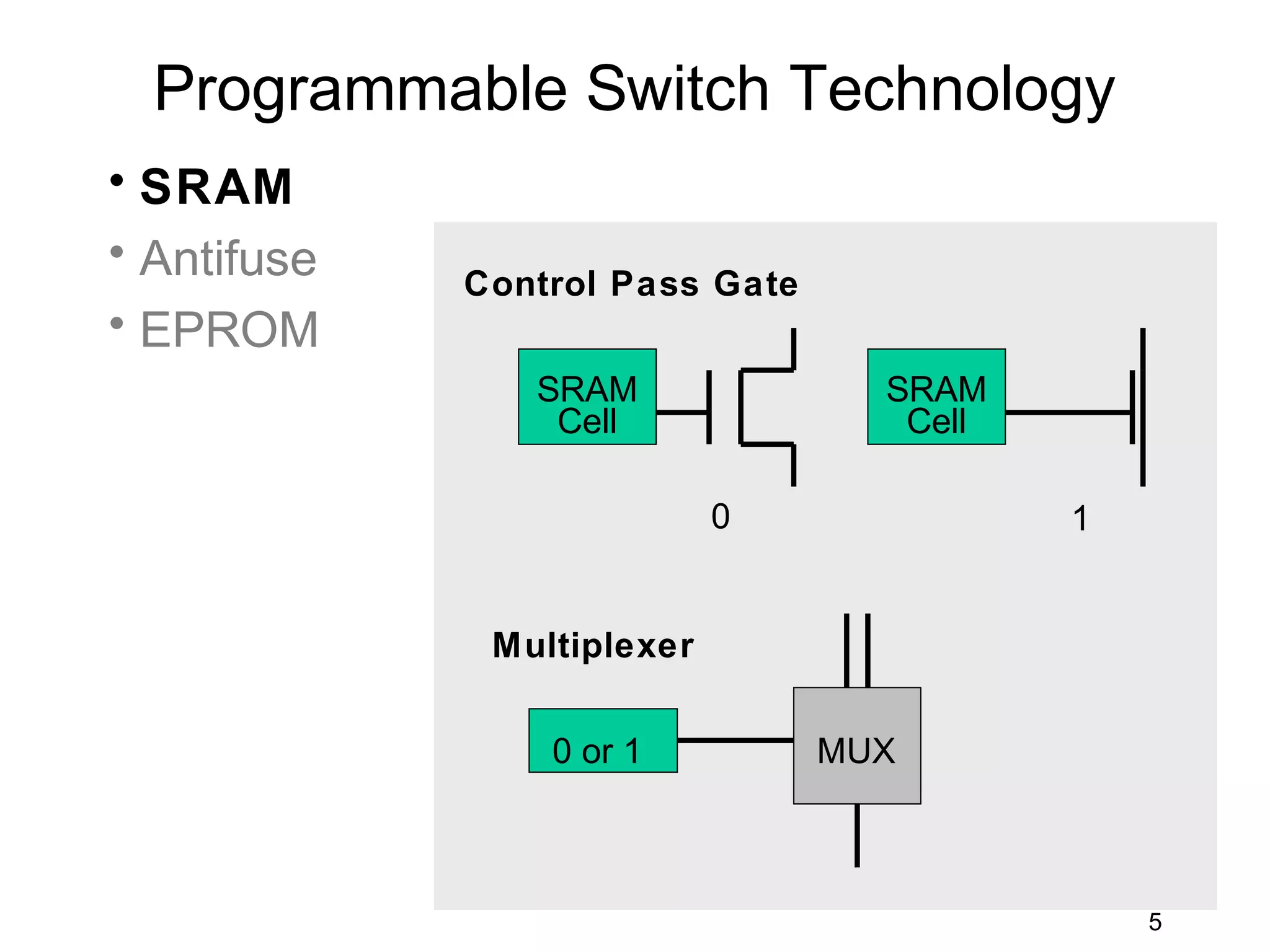
Programmable Switch Technology
• SRAM
• Antifuse
             Control Pass Gate
• EPROM
                SRAM               SRAM
                 Cell               Cell

                            0              1


              Multiplexer


                 0 or 1          MUX


                                               5
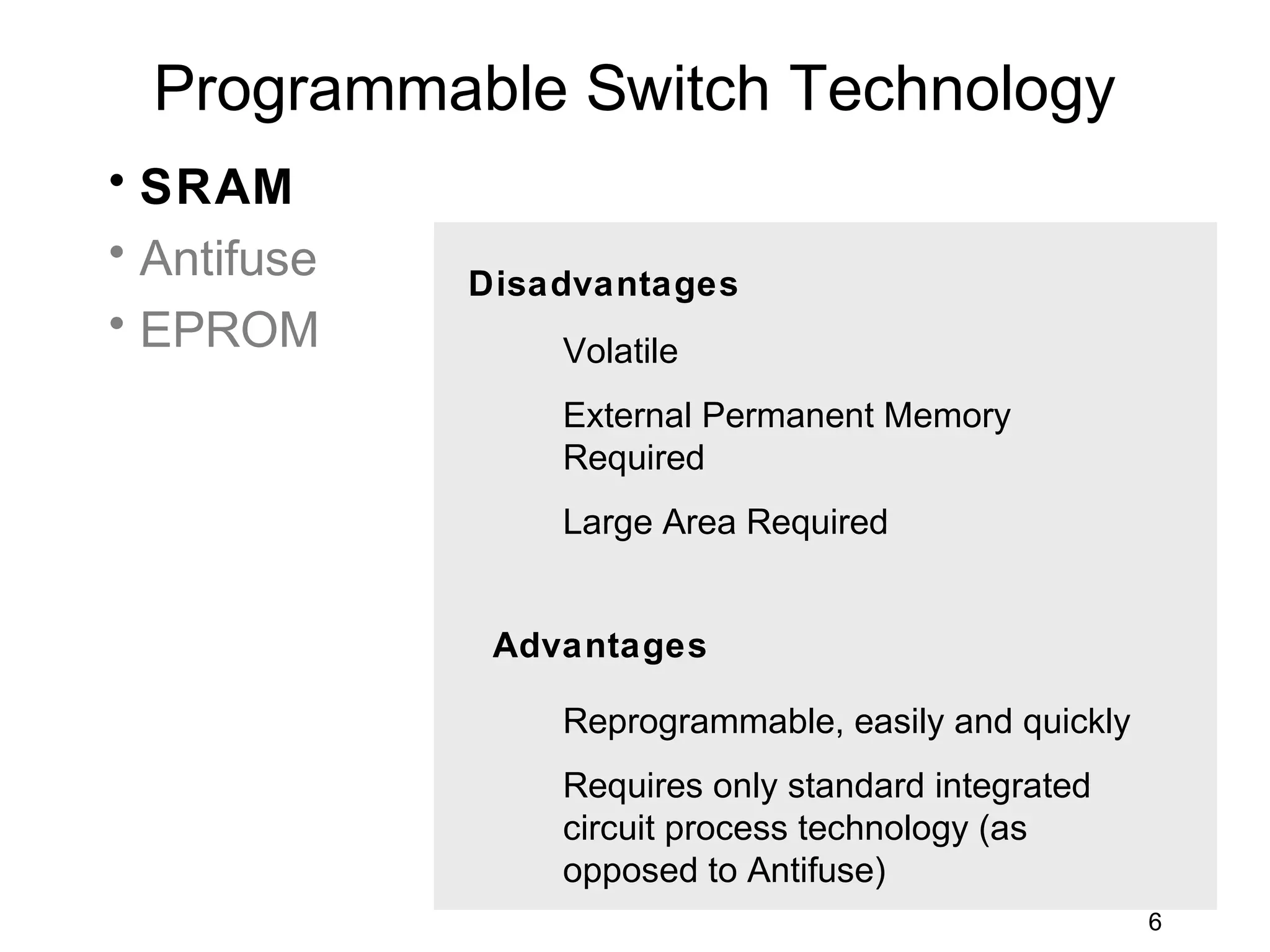
Programmable Switch Technology
• SRAM
• Antifuse
             Disadvantages
• EPROM          Volatile
                 External Permanent Memory
                 Required
                 Large Area Required


              Advantages

                 Reprogrammable, easily and quickly
                 Requires only standard integrated
                 circuit process technology (as
                 opposed to Antifuse)
                                                      6
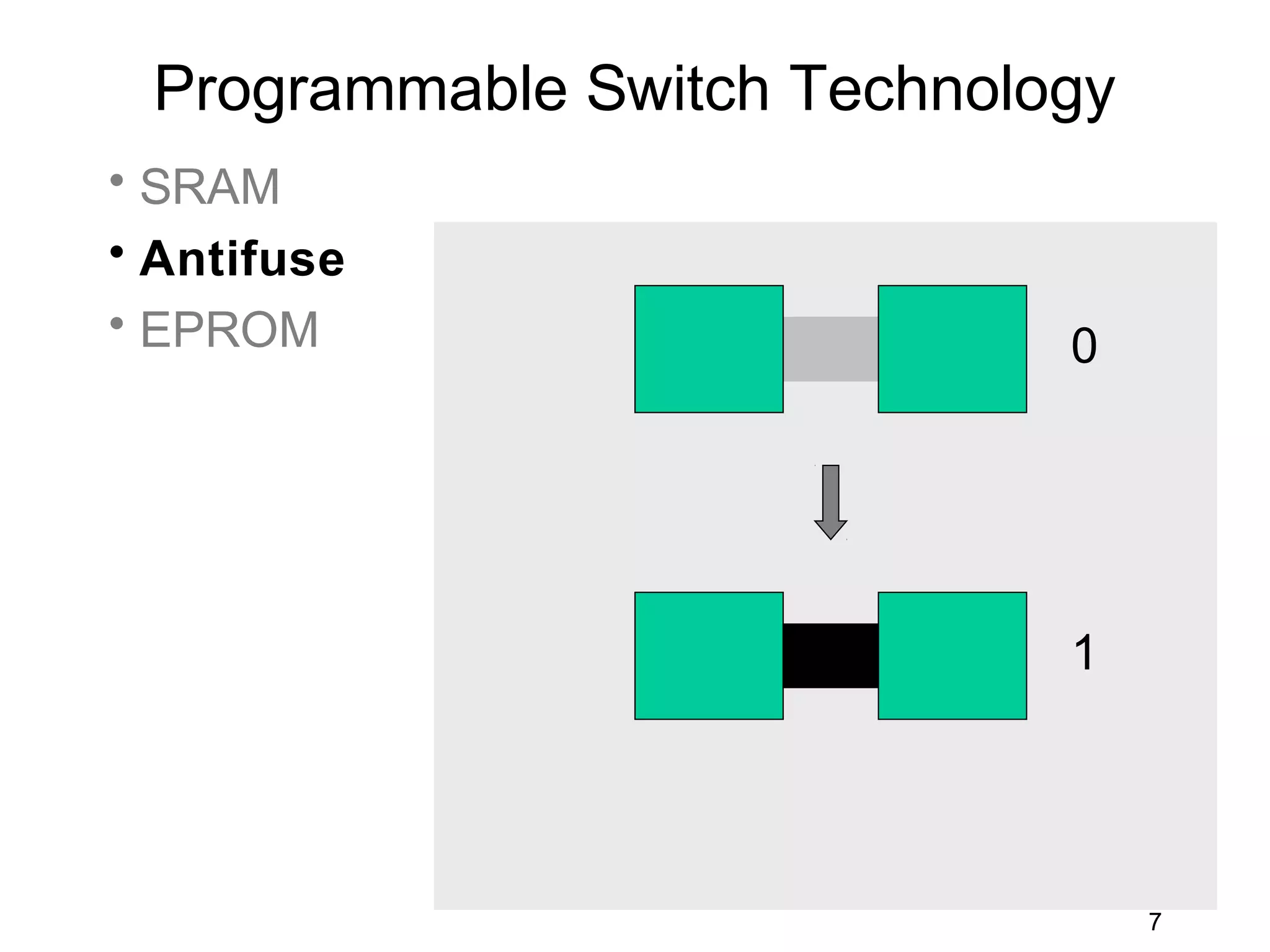
Programmable Switch Technology
• SRAM
• Antifuse
• EPROM                      0


                             1


                                  7
AntiFuse Technology
• Growing an antifuse
Programmable Switch Technology
• SRAM
• Antifuse
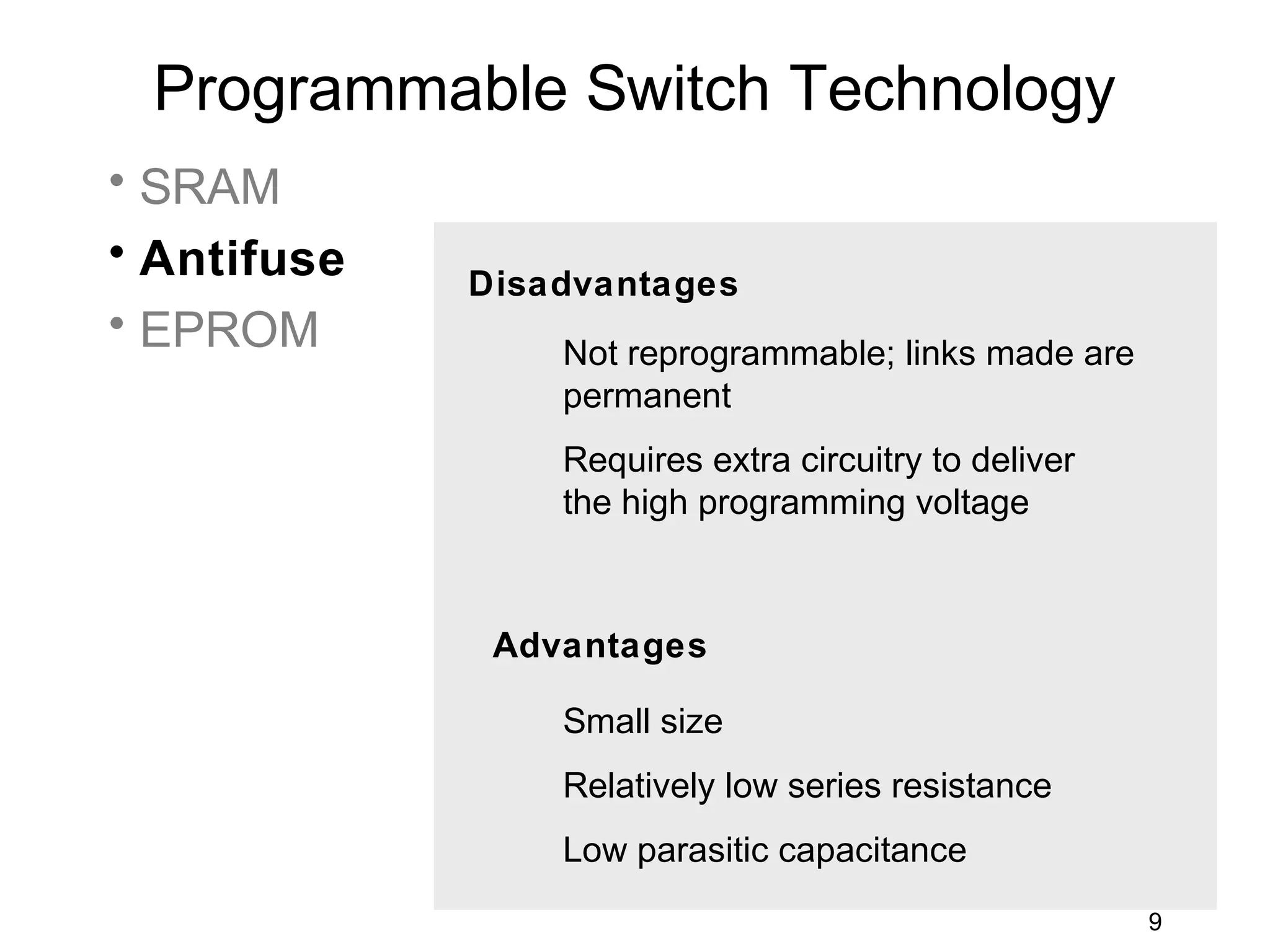
             Disadvantages
• EPROM          Not reprogrammable; links made are
                 permanent
                 Requires extra circuitry to deliver
                 the high programming voltage


              Advantages

                 Small size
                 Relatively low series resistance
                 Low parasitic capacitance
                                                       9
Programmable Switch Technology
• SRAM
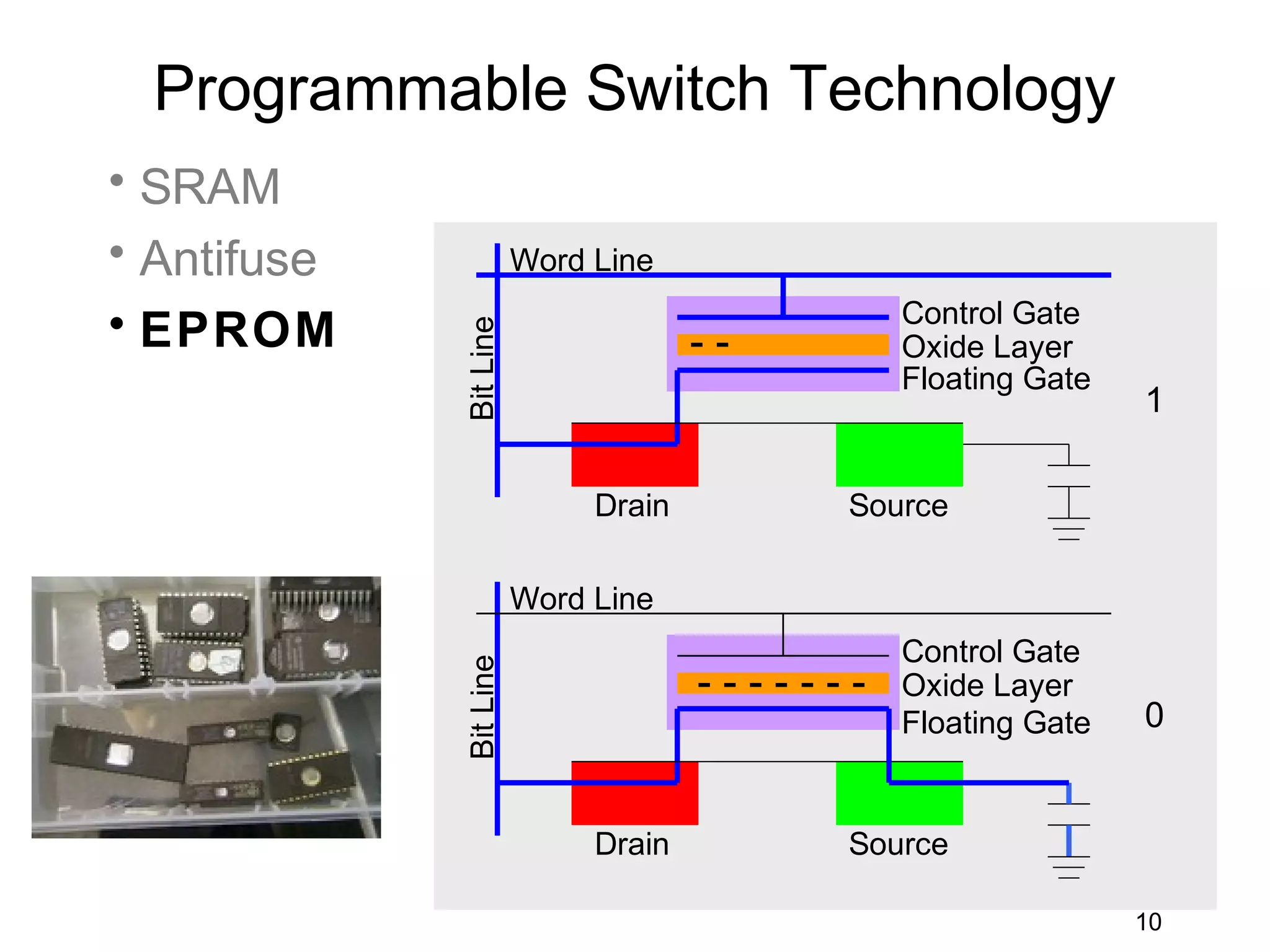
• Antifuse              Word Line
                                               Control Gate
• EPROM


             Bit Line
                                     --        Oxide Layer
                                               Floating Gate
                                                               1

                             Drain         Source

                        Word Line
                                               Control Gate
             Bit Line


                                     -------   Oxide Layer
                                               Floating Gate   0


                             Drain         Source

                                                               10
Programmable Switch Technology
• SRAM
• Antifuse
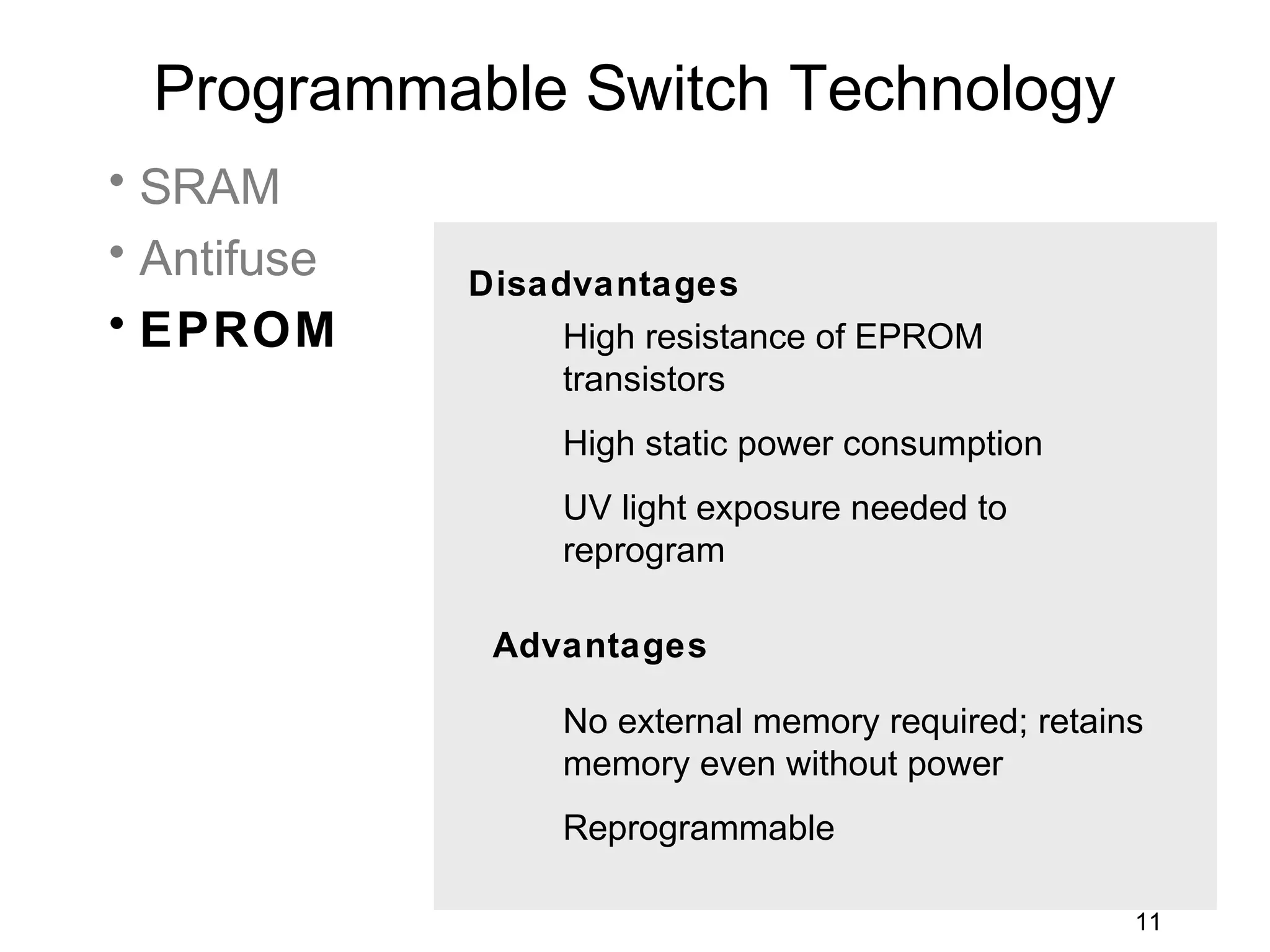
             Disadvantages
• EPROM           High resistance of EPROM
                  transistors
                  High static power consumption
                  UV light exposure needed to
                  reprogram

              Advantages

                  No external memory required; retains
                  memory even without power
                  Reprogrammable

                                                     11
Programmable Switch Technology
• A summary of programmable switches


                                       12
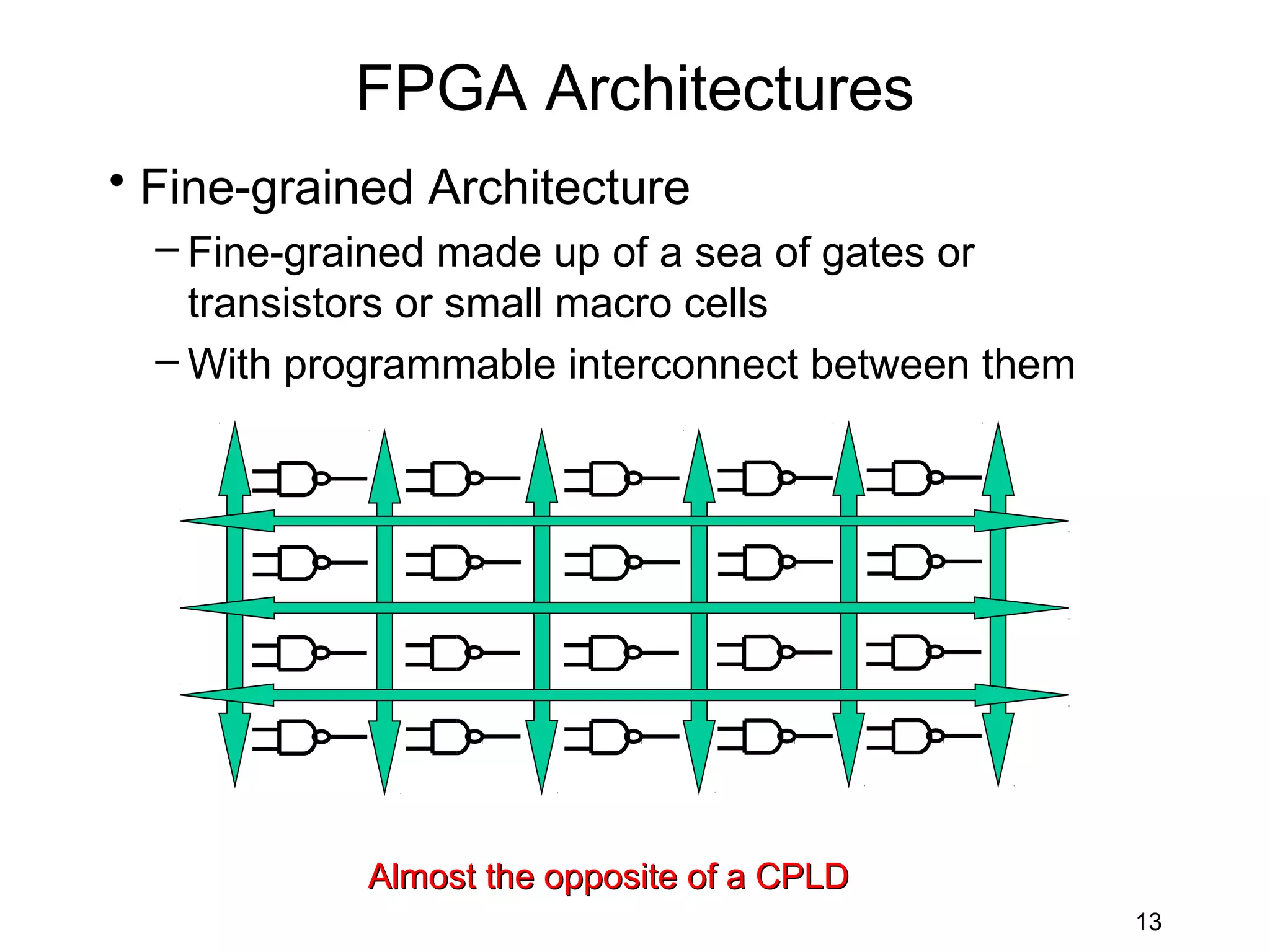
FPGA Architectures
• Fine-grained Architecture
  – Fine-grained made up of a sea of gates or
    transistors or small macro cells
  – With programmable interconnect between them


            Almost the opposite of a CPLD
                                                  13
FPGA Architectures
• Coarse-grained Architecture
  – Coarse-grained FPGAs include bigger macrocells
  – The macrocells usually include Flip-Flops and Look
    Up Tables (LUTs) which are used to implement
    combinatorial logic functions
  – In a majority of these architectures, four-input look-
    up table (think of it as a 16x1 ROM) implement the
    actual logic
  – The larger logic block usually results in improved
    performance when compared to fine-grained
    architectures


                                                         14
FPGA Process Technology
• PROM/EPROM/EEPROM/FLASH based
 – These implementations are typically programmed
   out of circuit and can or cannot be reprogrammed
   • PROM is one time programmable (OTP) device can only be
     programmed once
 – EPROM cells are electrically programmed in a
   device programmer
 – Some EPROM-based devices are erasable using
   ultra-violet (UV) lights if they are in a windowed
   package
 – EEPROMs are in low-cost plastic packaging for
   production
   • Plastic packages cannot be UV erased, they are electrically
     erased

                                                              15
FPGA Process Technology
• PROM/EPROM/EEPROM/FLASH based
 – An Electrically-Erasable-Programmable-Read-Only-
   Memory (EEPROM) memory cell is physically
   larger than an EPROM cell but offers the advantage
   of being erased electrically with no special UV
   erasers require.
   • EEPROM devices can be erased, even in low-cost plastic
     packaging.
 – FLASH-erased (or bulk erased) electrically erasable
   programmable read-only memory.
   • FLASH has the electrically erasable benefits of EEPROM
     but the small, economical cell size of EPROM technology.


                                                                16
FPGA Process Technology
• Anti-fuse based
  – Anti-fuse is a one-time programmable (OTP)
  – Fuses are permanently put in place
  – The anti-part of anti-fuse comes from its
    programming method
    • Instead of breaking a metal connection by passing current
      through it, a link is grown to make a connection
  – Anti-fuses are either amorphous silicon or metal-to-
    metal connections


                                                                  17
FPGA Process Technology
• Anti-fuse based
  – The advantages of anti-fuse FPGAs include:
    • They are usually physically quite small
    • They have low resistance interconnect
  – Disadvantages include
    • They require large programming transistors on the device
    • They cannot be reused (they are OTP)


                                                                 18
FPGA Process Technology
• SRAM based
 – SRAM cells are implemented as function generators to
   simulate combinatorial logic and also are used to
   control multiplexors and routing resources
 – This is by far the most popular process technology
 – This method is similar to the technology used in static
   RAM devices but with a few modifications
   • The RAM cells in a memory device are designed for fastest
     possible read/write performance
   • The RAM cells in a programmable device are usually designed
     for stability instead of read/write performance
   • Consequently, RAM cells in a programmable device have a
     low-impedance connect to VCC and ground to provide maximum
     stability over voltage fluctuations
                                                           19
FPGA Process Technology
• SRAM based (cont.)
  – Because static memory is volatile (the contents
    disappear when the power is turned off), SRAM-
    based devices are "booted" after power-on
  – This makes them in-system programmable and re-
    programmable, even in real-time
  – As a result, SRAM-based FPGAs are common in
    reconfigure computing applications where the
    device's function is dynamically changed


                                                      20
FPGA Process Technology
• SRAM based (cont.)
  – The configuration process typically requires only a
    few hundred milliseconds at most
  – Most SRAM-based devices can boot themselves
    automatically at power-on much like a
    microprocessor
  – Most SRAM-based devices are designed to work
    with either standard byte-wide PROMs or with
    sequential-access serial PROMs


                                                          21
FPGAs
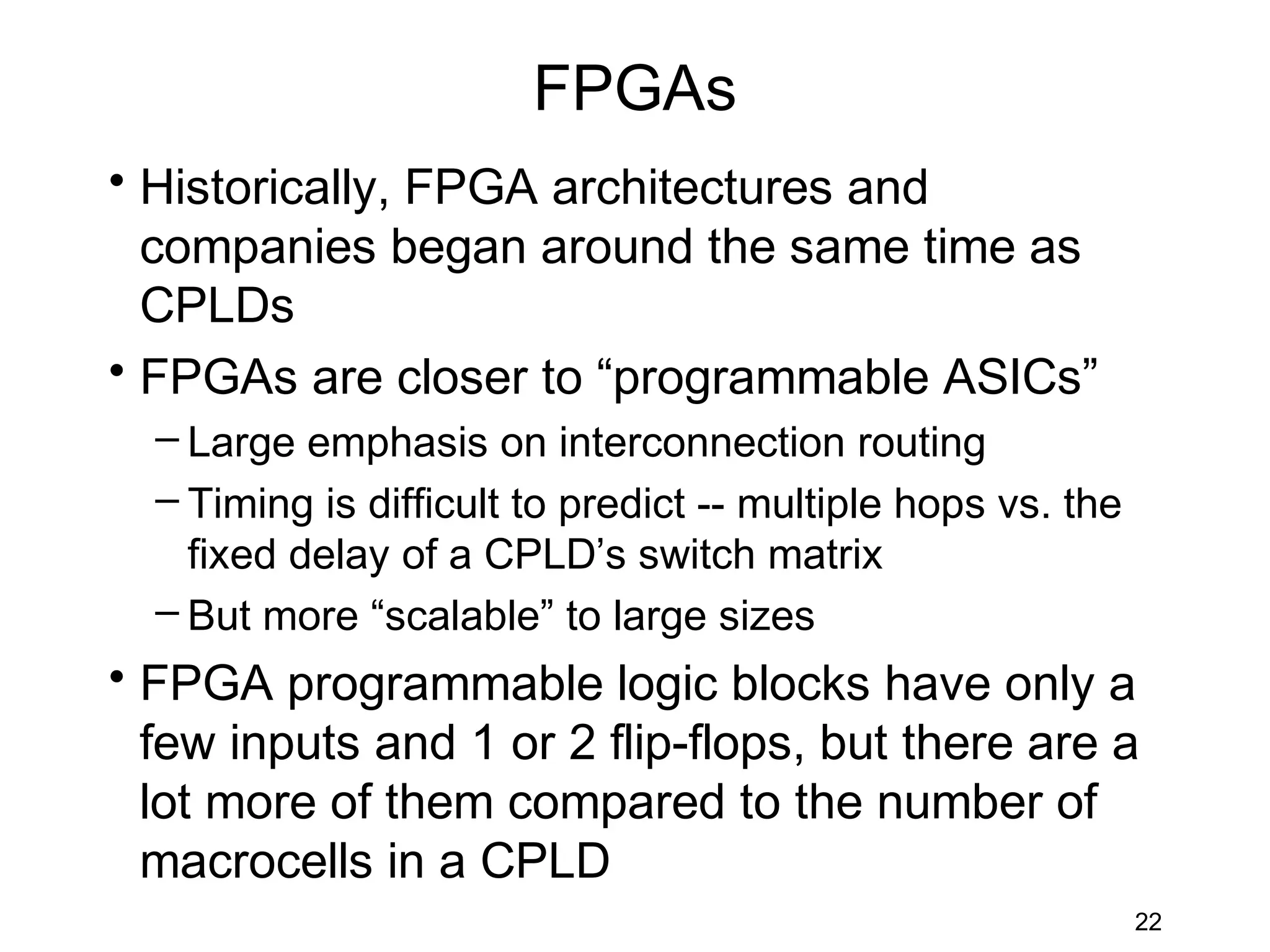
• Historically, FPGA architectures and
  companies began around the same time as
  CPLDs
• FPGAs are closer to “programmable ASICs”
  – Large emphasis on interconnection routing
  – Timing is difficult to predict -- multiple hops vs. the
    fixed delay of a CPLD’s switch matrix
  – But more “scalable” to large sizes
• FPGA programmable logic blocks have only a
  few inputs and 1 or 2 flip-flops, but there are a
  lot more of them compared to the number of
  macrocells in a CPLD
                                                              22
FPGAs
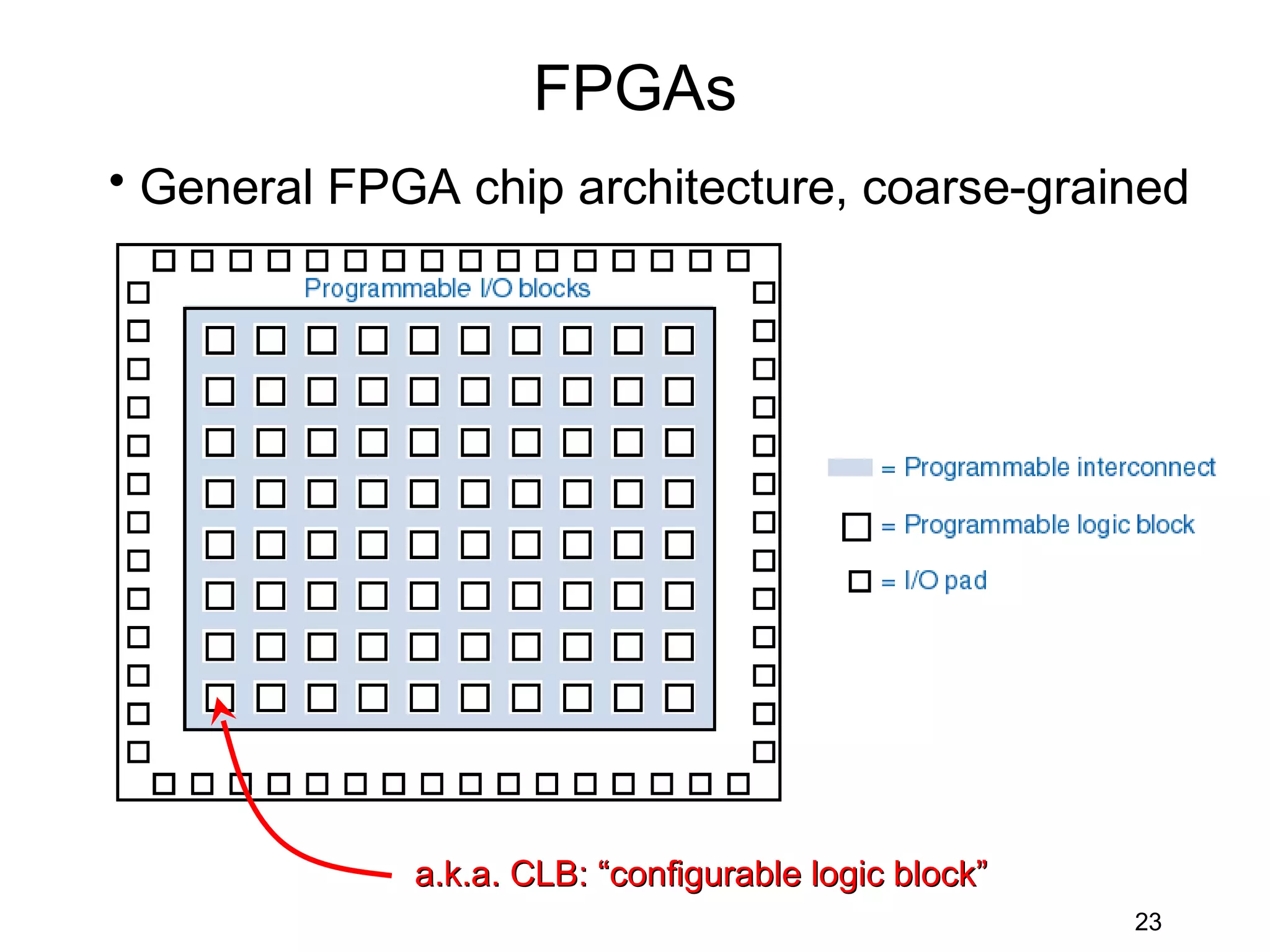
• General FPGA chip architecture, coarse-grained


             a.k.a. CLB: “configurable logic block”
                                                      23
FPGAs
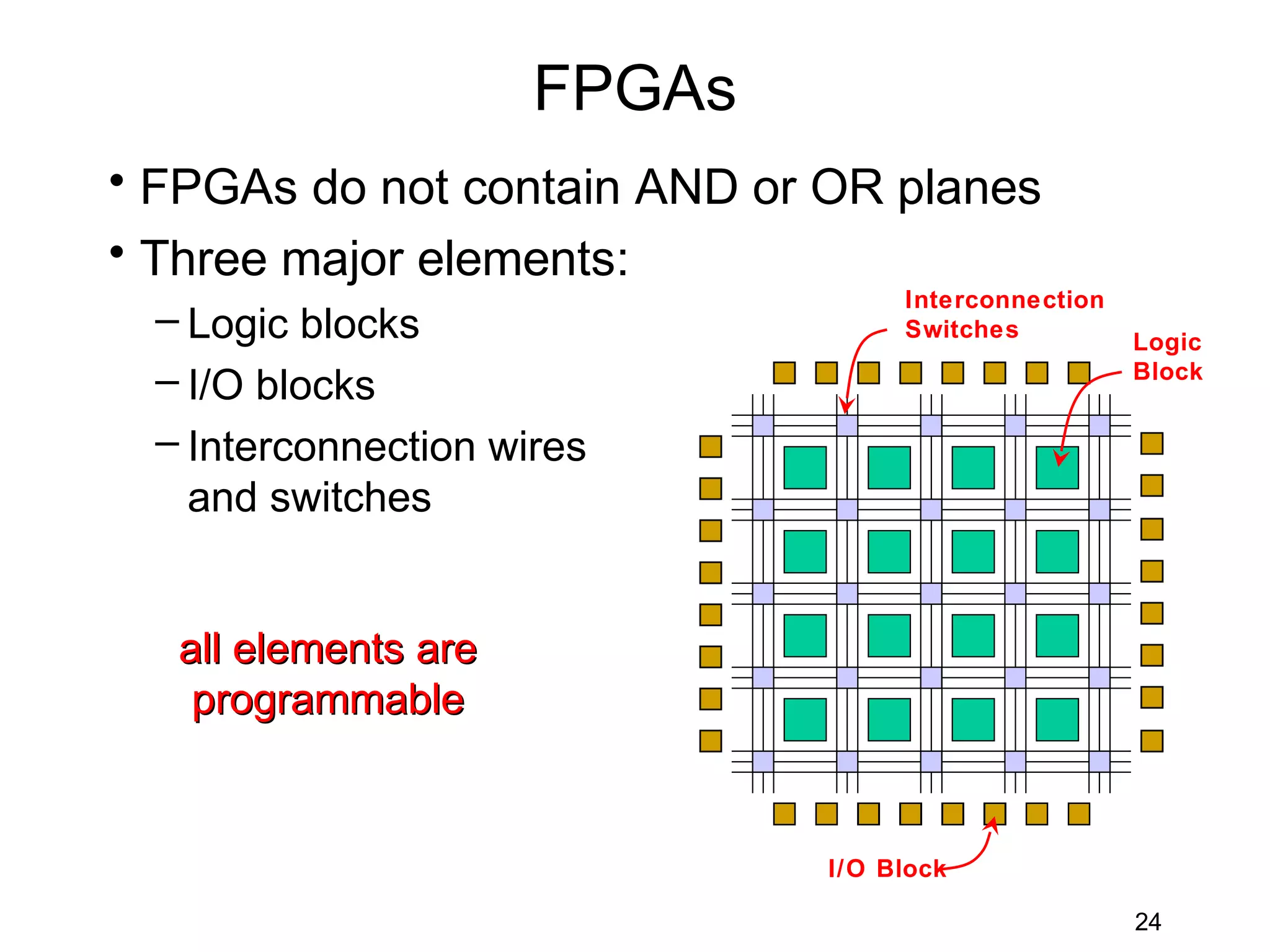
• FPGAs do not contain AND or OR planes
• Three major elements:
                                   Interconnection
 – Logic blocks                    Switches
                                                     Logic
                                                     Block
 – I/O blocks
 – Interconnection wires
   and switches


  all elements are
   programmable


                              I/O Block

                                                     24
Other FPGA Building Blocks
• Clock distribution
• Embedded memory blocks
• Special purpose blocks:
 – DSP blocks:
   • Hardware multipliers, adders and registers
 – Embedded microprocessors/microcontrollers
 – High-speed serial transceivers
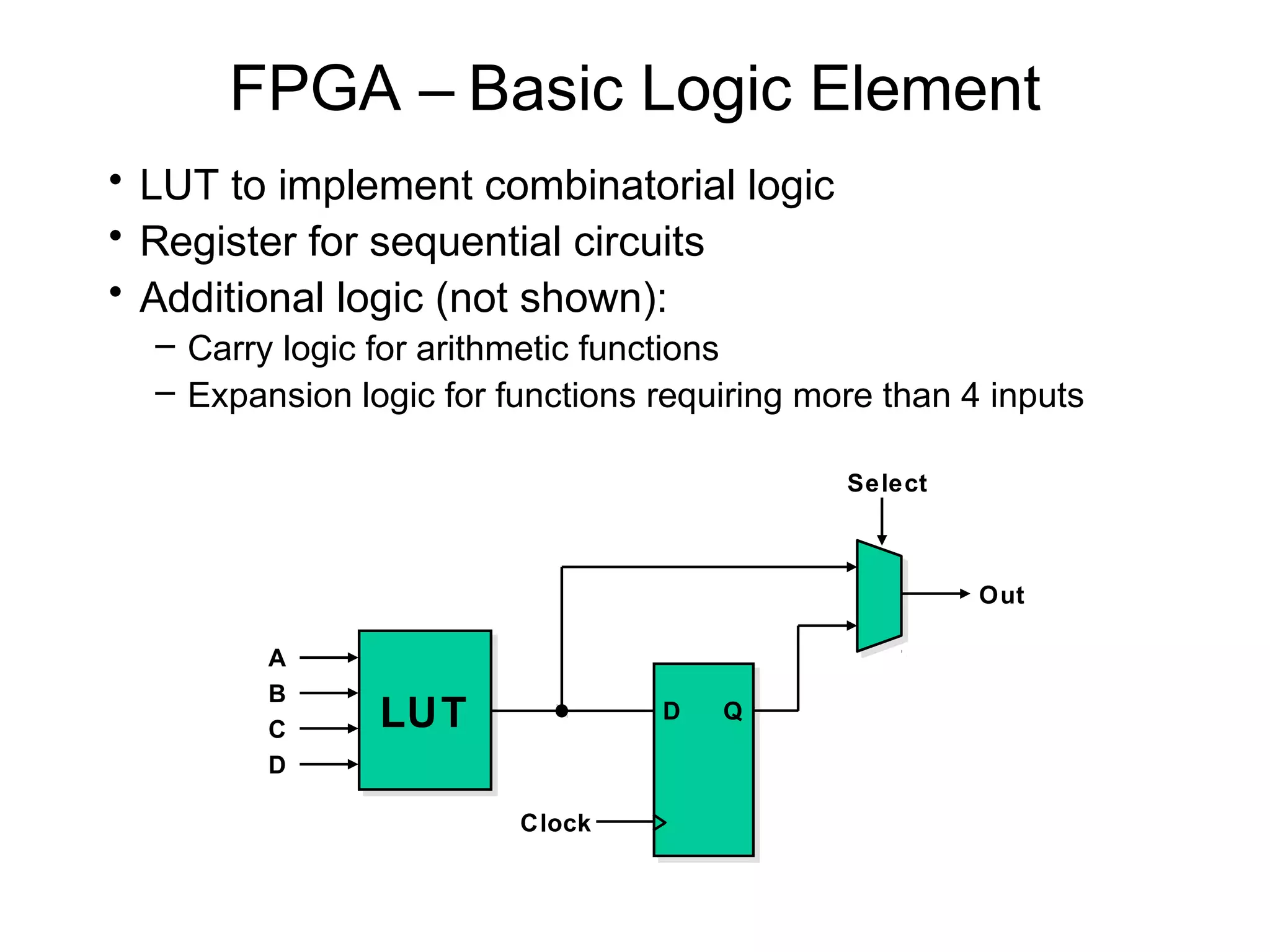
FPGA – Basic Logic Element
• LUT to implement combinatorial logic
• Register for sequential circuits
• Additional logic (not shown):
  – Carry logic for arithmetic functions
  – Expansion logic for functions requiring more than 4 inputs

                                              Select


                                                       Out

         A
         B
         C      LUT
                LUT               D   Q

         D

                         Clock
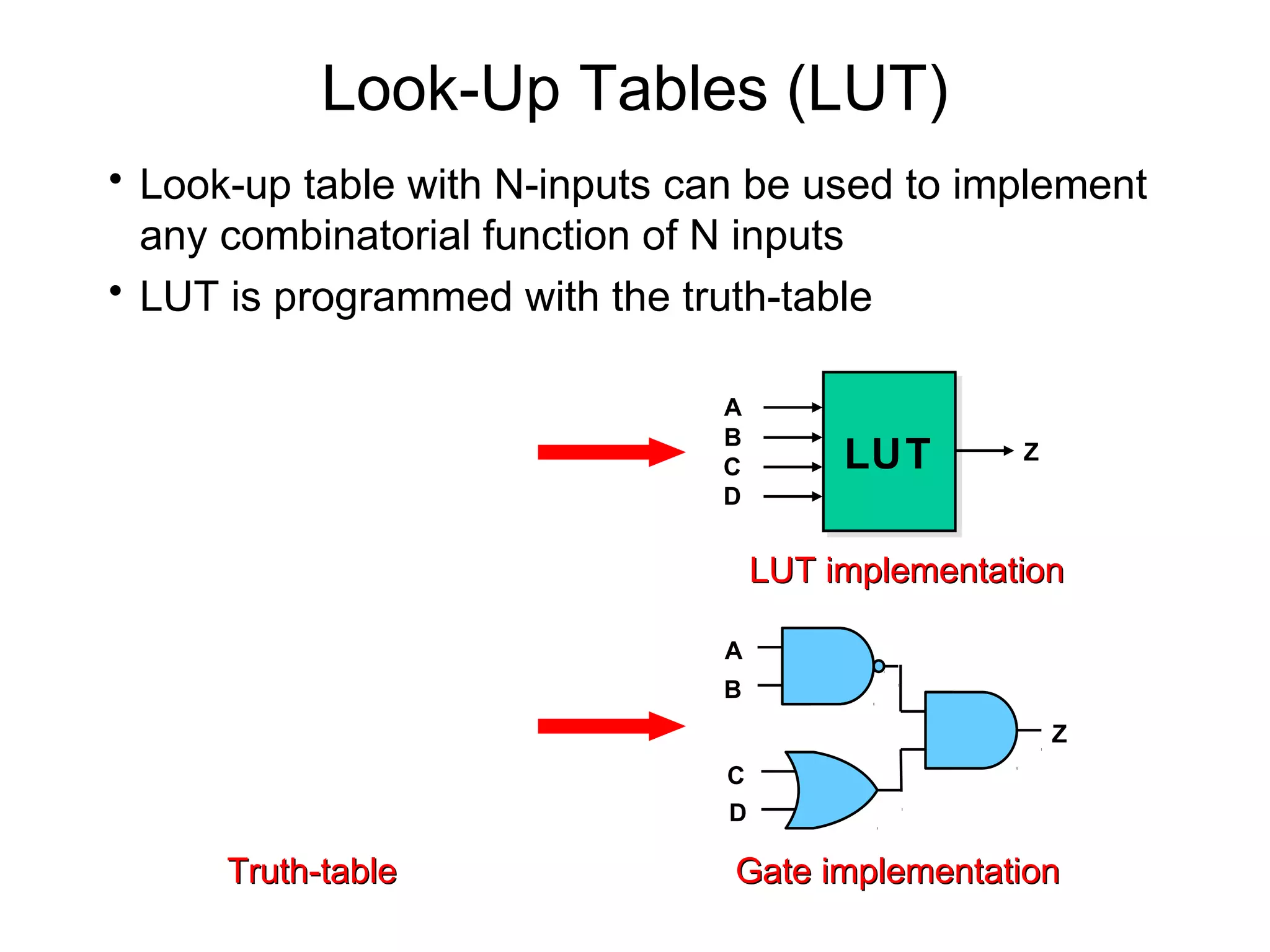
Look-Up Tables (LUT)
• Look-up table with N-inputs can be used to implement
  any combinatorial function of N inputs
• LUT is programmed with the truth-table

                               A
                               B
                               C         LUT
                                         LUT       Z
                               D


                                    LUT implementation

                                A
                                B
                                                       Z
                                C
                                D

      Truth-table               Gate implementation
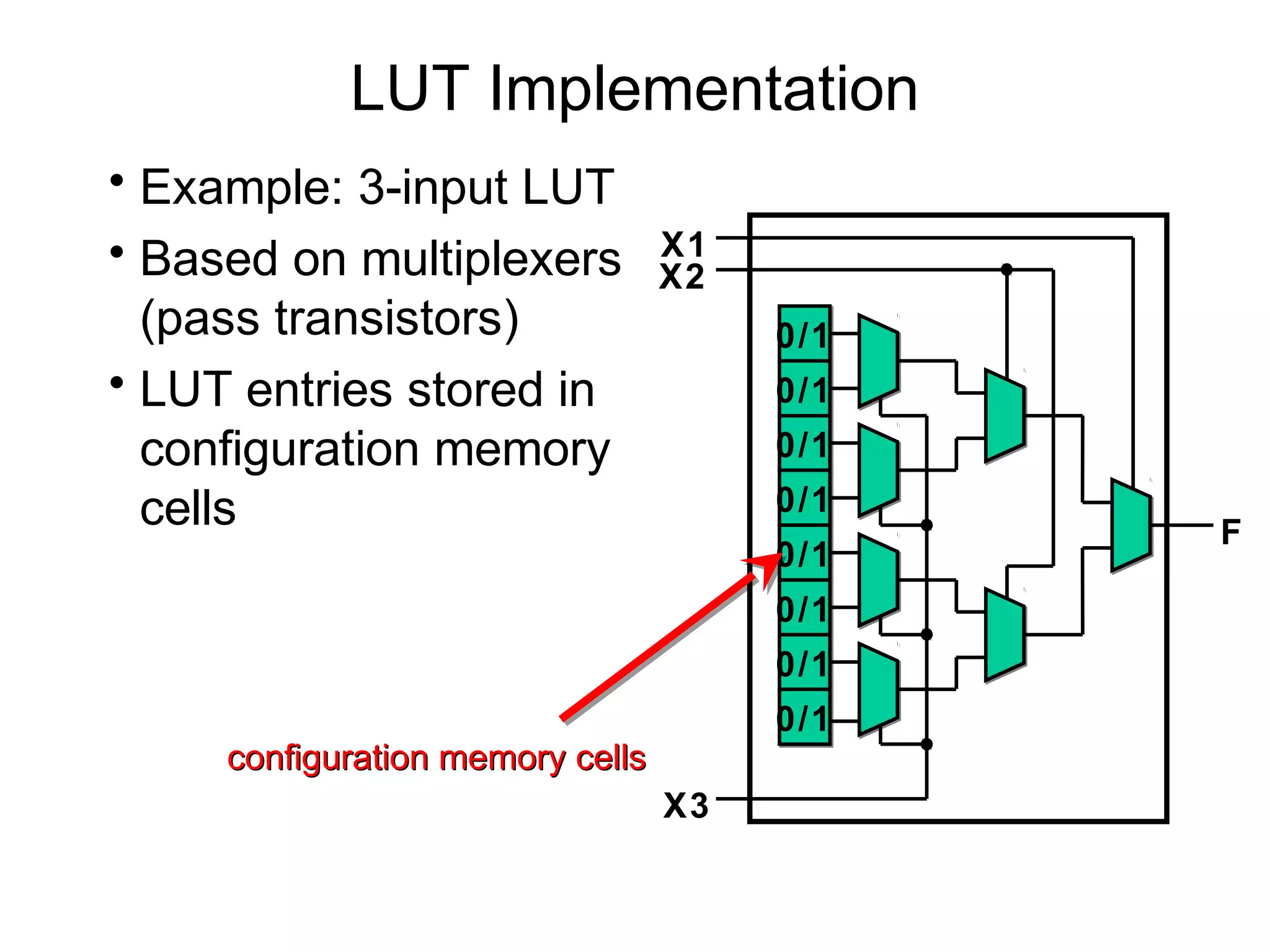
LUT Implementation
• Example: 3-input LUT
• Based on multiplexers           X1
                                  X2
  (pass transistors)                   0/1
• LUT entries stored in                0/1
  configuration memory                 0/1
  cells                                0/1
                                             F
                                       0/1
                                       0/1
                                       0/1
                                       0/1
     configuration memory cells
                                  X3
Other FPGA Building Blocks
• Clock distribution
• Embedded memory blocks
• Special purpose blocks:
 – DSP blocks:
   • Hardware multipliers, adders and registers
 – Embedded microprocessors/microcontrollers
 – High-speed serial transceivers
Special Features
• Clock management
  – PLL,DLL
  – Eliminate clock skew between external clock input
    and on-chip clock
  – Low-skew global clock distribution network
• Support for various interface standards
• High-speed serial I/Os
• Embedded processor cores
• DSP blocks
Configuration Storage Elements
• Static Random Access Memory (SRAM)
 – Logical configuration is controlled by the state of
   SRAM bits
 – FPGA needs to be configured at power-on by
   another separated ROM
• Flash Erasable Programmable ROM (Flash)
 – Logical configuration is implemented by floating-
   gate transistors that can be turned off by injecting
   charge onto its gate.
 – FPGA itself holds the program
 – reprogrammable, even in-circuit
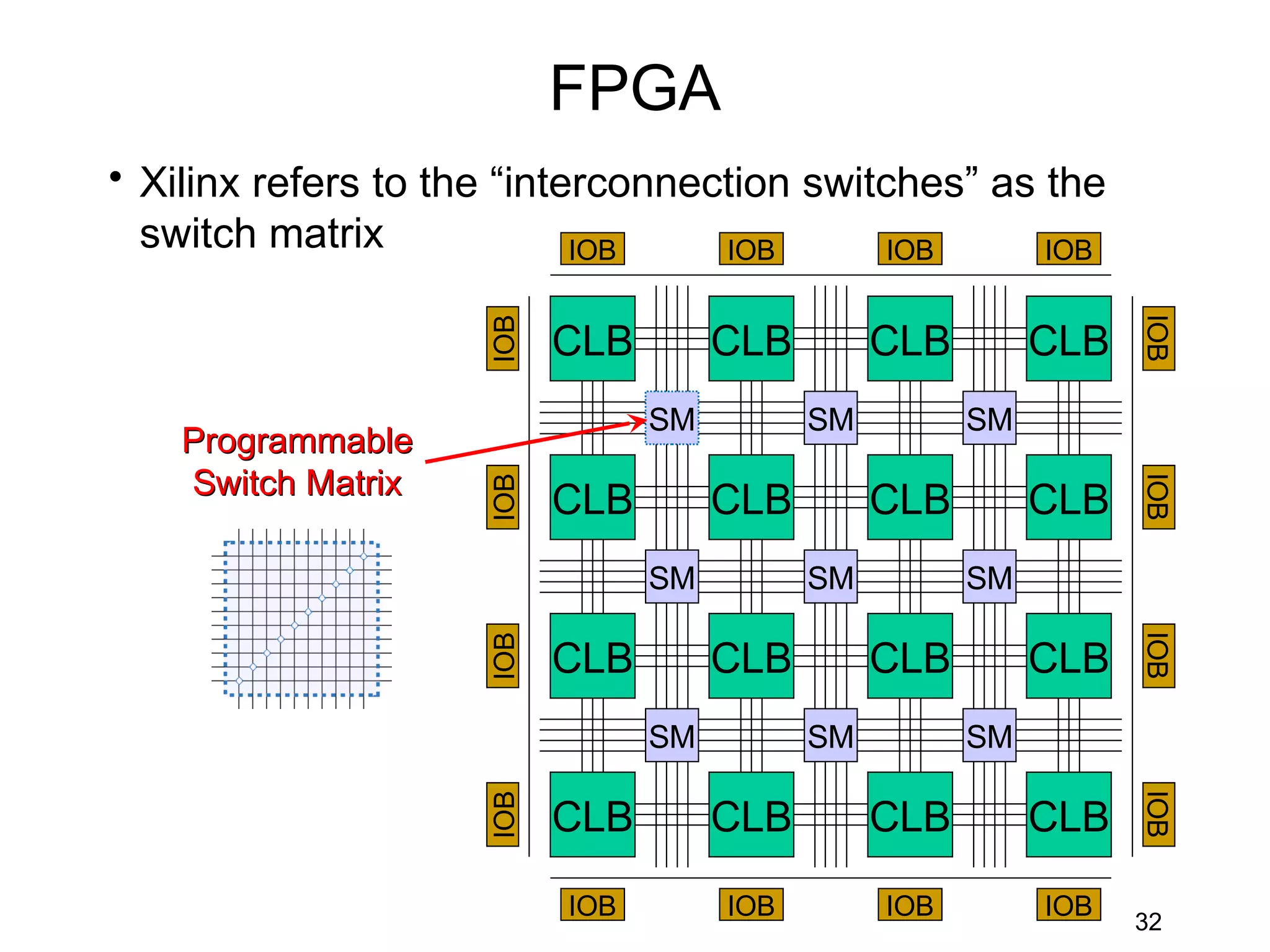
FPGA
• Xilinx refers to the “interconnection switches” as the
  switch matrix             IOB    IOB       IOB     IOB


                                                                  IOB
                     IOB
                           CLB        CLB        CLB        CLB
                                 SM         SM         SM
    Programmable
    Switch Matrix


                                                                  IOB
                     IOB   CLB        CLB        CLB        CLB
                                 SM         SM         SM


                                                                  IOB
                     IOB


                           CLB        CLB        CLB        CLB
                                 SM         SM         SM


                                                                  IOB
                     IOB


                           CLB        CLB        CLB        CLB
                           IOB        IOB        IOB        IOB
                                                                  32
FPGAs
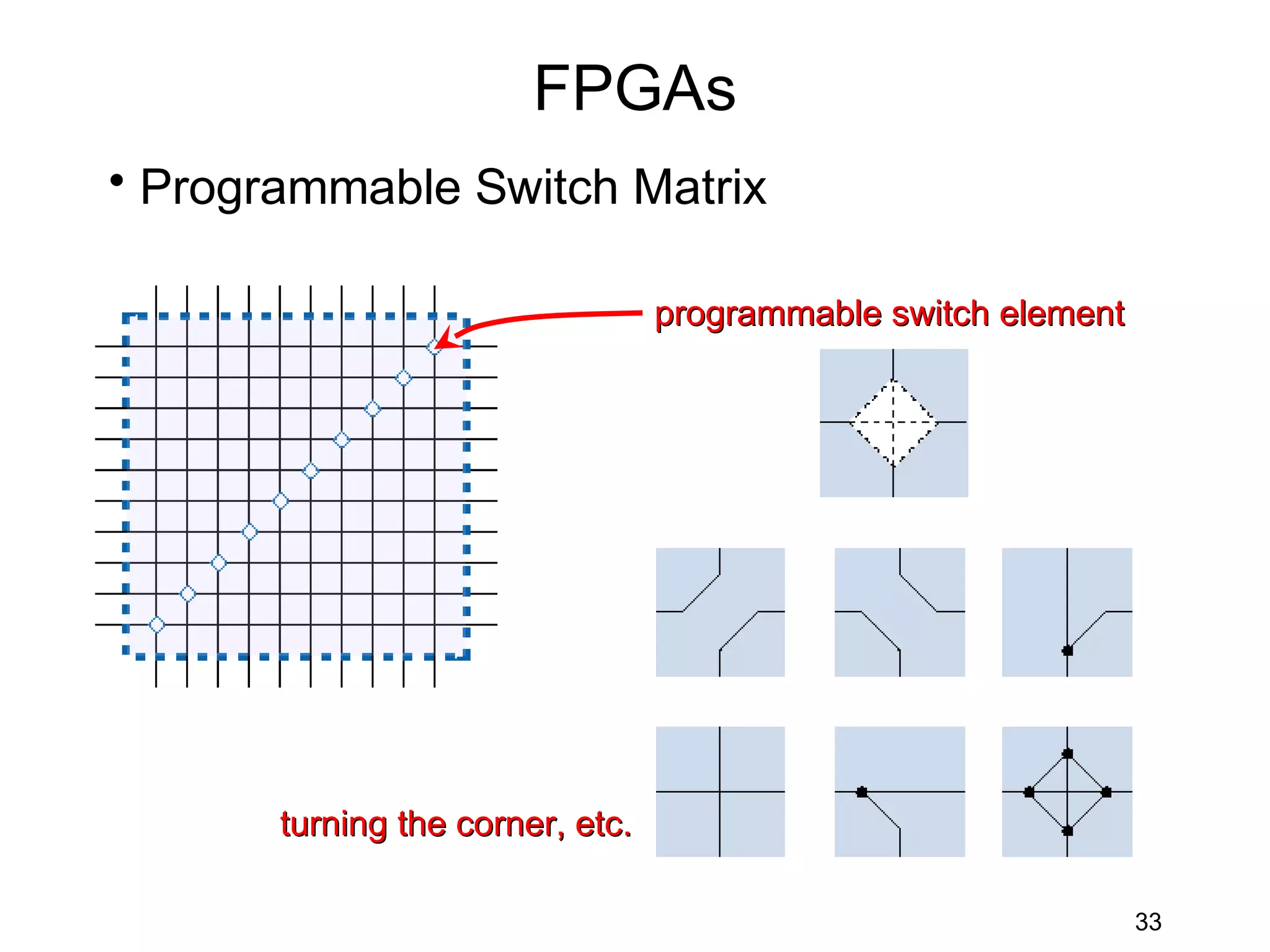
• Programmable Switch Matrix

                                  programmable switch element


       turning the corner, etc.

                                                                33
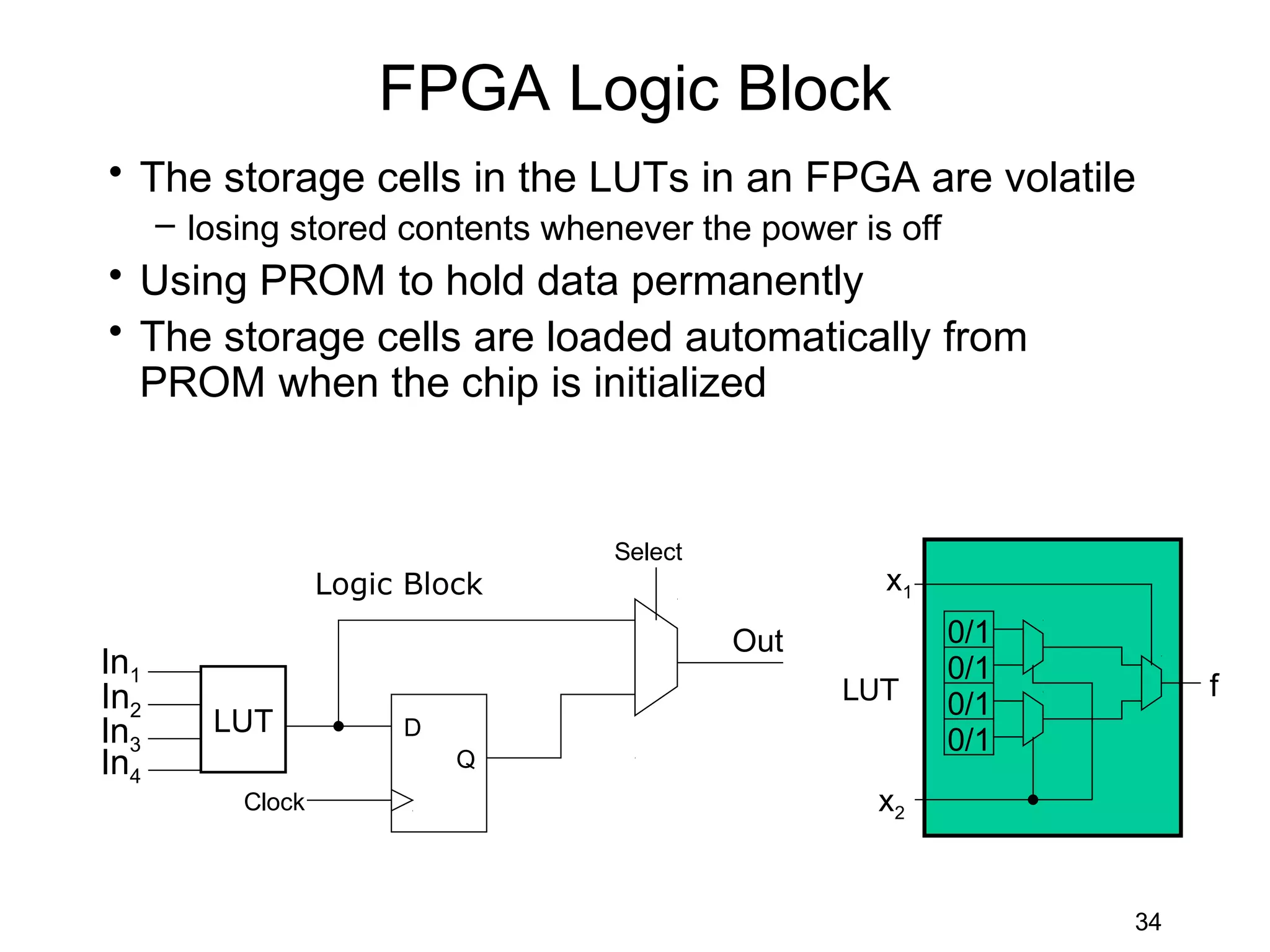
FPGA Logic Block
• The storage cells in the LUTs in an FPGA are volatile
      – losing stored contents whenever the power is off
• Using PROM to hold data permanently
• The storage cells are loaded automatically from
  PROM when the chip is initialized


                                   Select
                   Logic Block                      x1
                                            Out            0/1
In1                                                        0/1
In2                                               LUT      0/1
                                                                      f
In3      LUT            D
                                                           0/1
In4                         Q
           Clock                                    x2


                                                                 34
FPGAs
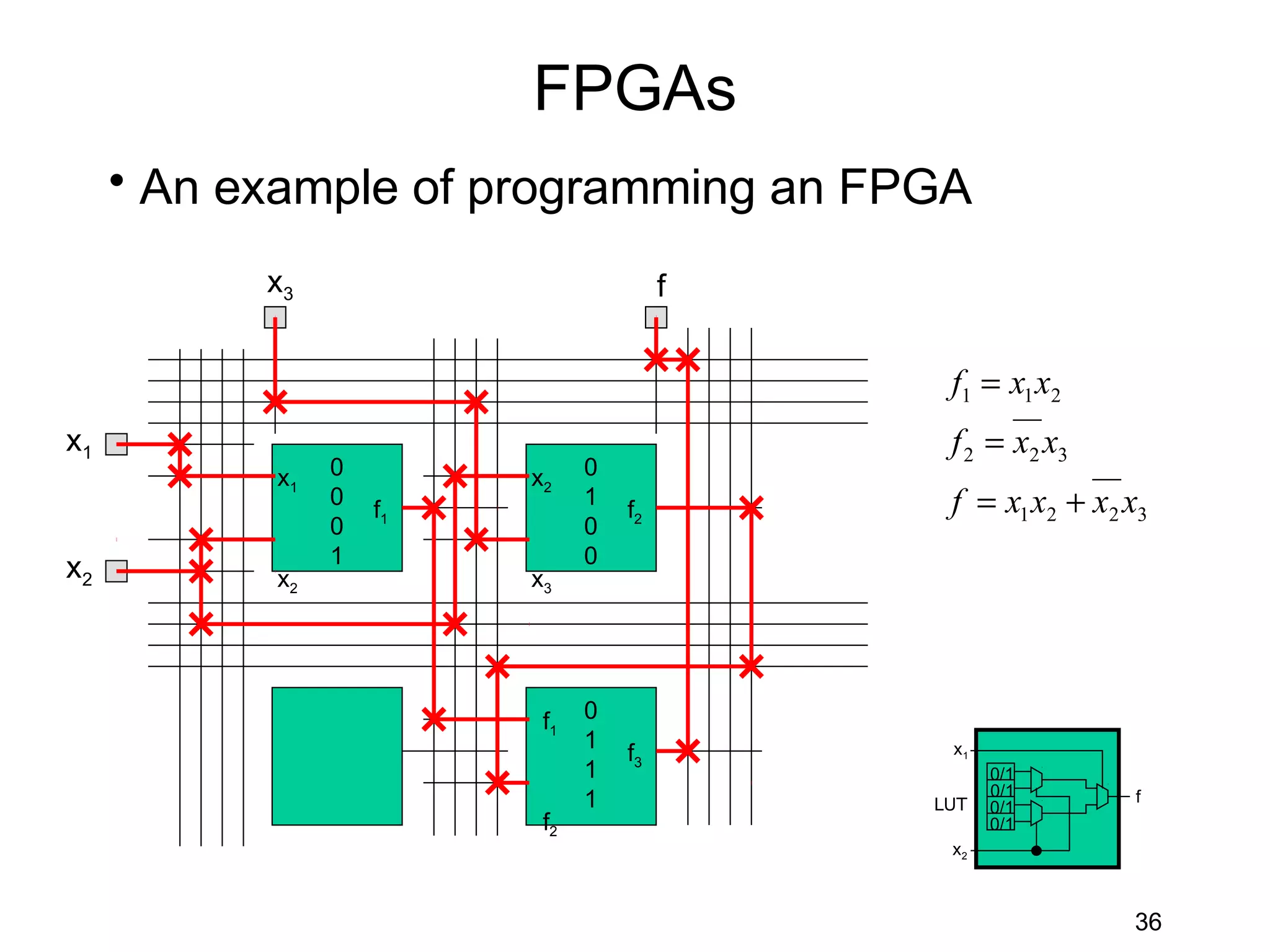
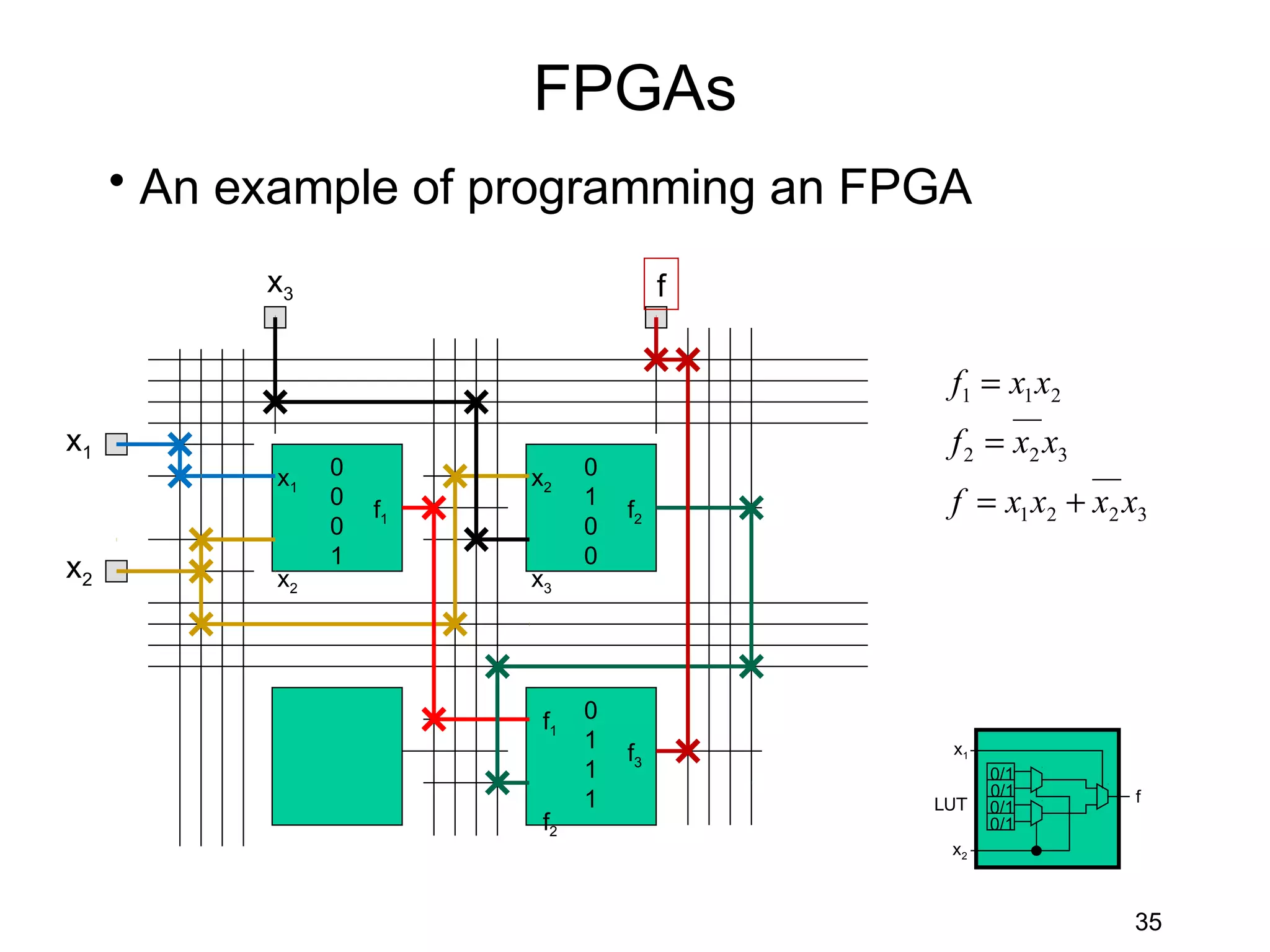
     • An example of programming an FPGA
           x3                           f


                                             f1 = x1 x2
x1                                           f 2 = x2 x3
           x1   0        x2    0
                0
                    f1
                               1
                                   f2        f = x1 x2 + x2 x3
                0              0
                1              0
x2         x2            x3


                          f1   0
                               1             x1
                                   f3
                               1                  0/1
                                                  0/1
                               1            LUT   0/1
                                                            f
                          f2                      0/1
                                             x2


                                                            35
FPGAs
     • An example of programming an FPGA
           x3                           f


                                             f1 = x1 x2
x1                                           f 2 = x2 x3
           x1   0        x2    0
                0
                    f1
                               1
                                   f2        f = x1 x2 + x2 x3
                0              0
                1              0
x2         x2            x3


                          f1   0
                               1             x1
                                   f3
                               1                  0/1
                                                  0/1
                               1            LUT   0/1
                                                            f
                          f2                      0/1
                                             x2


                                                            36
Xilinx 4000-Series FPGAs
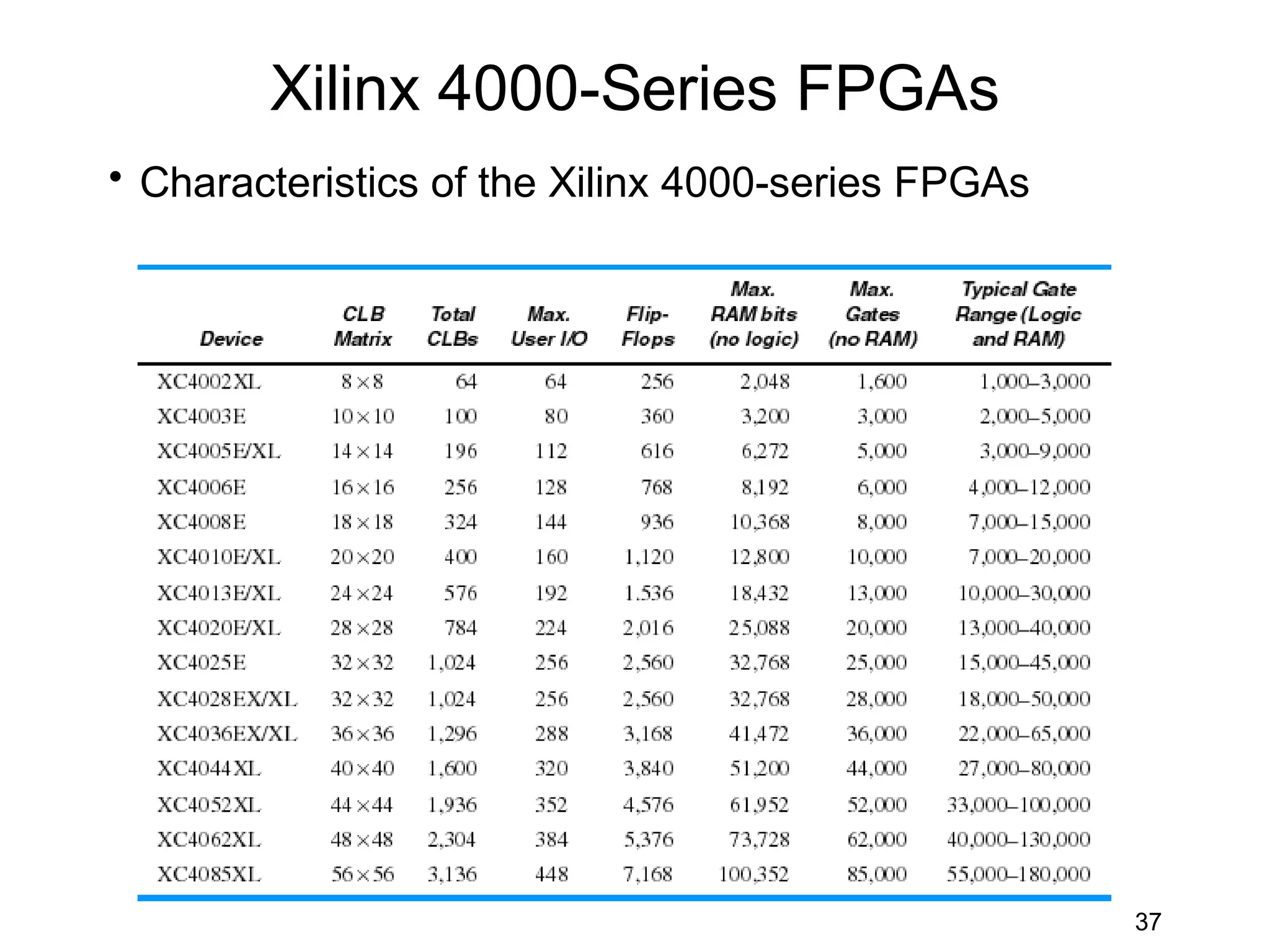
• Characteristics of the Xilinx 4000-series FPGAs


                                                    37
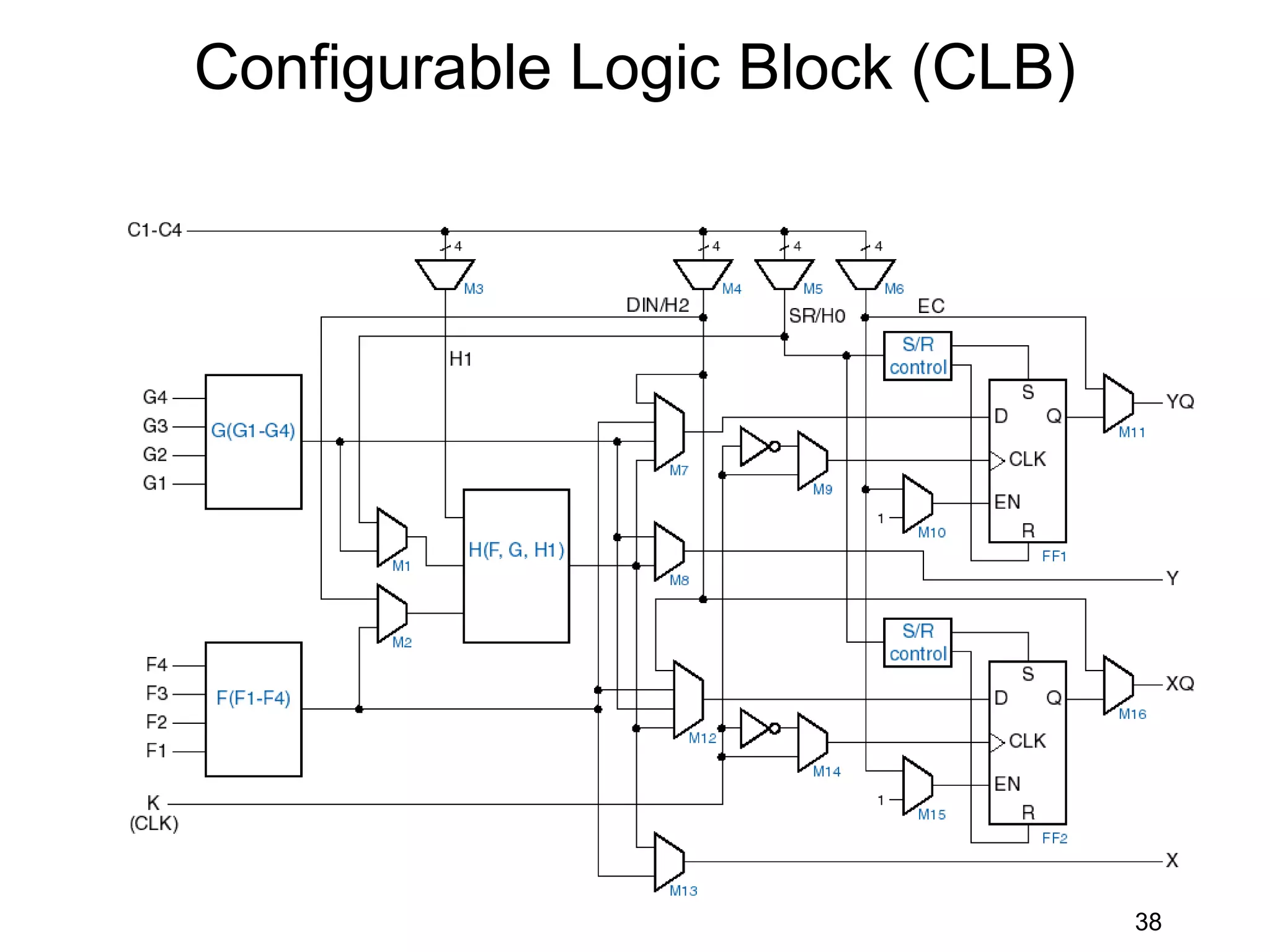
Configurable Logic Block (CLB)


                                 38
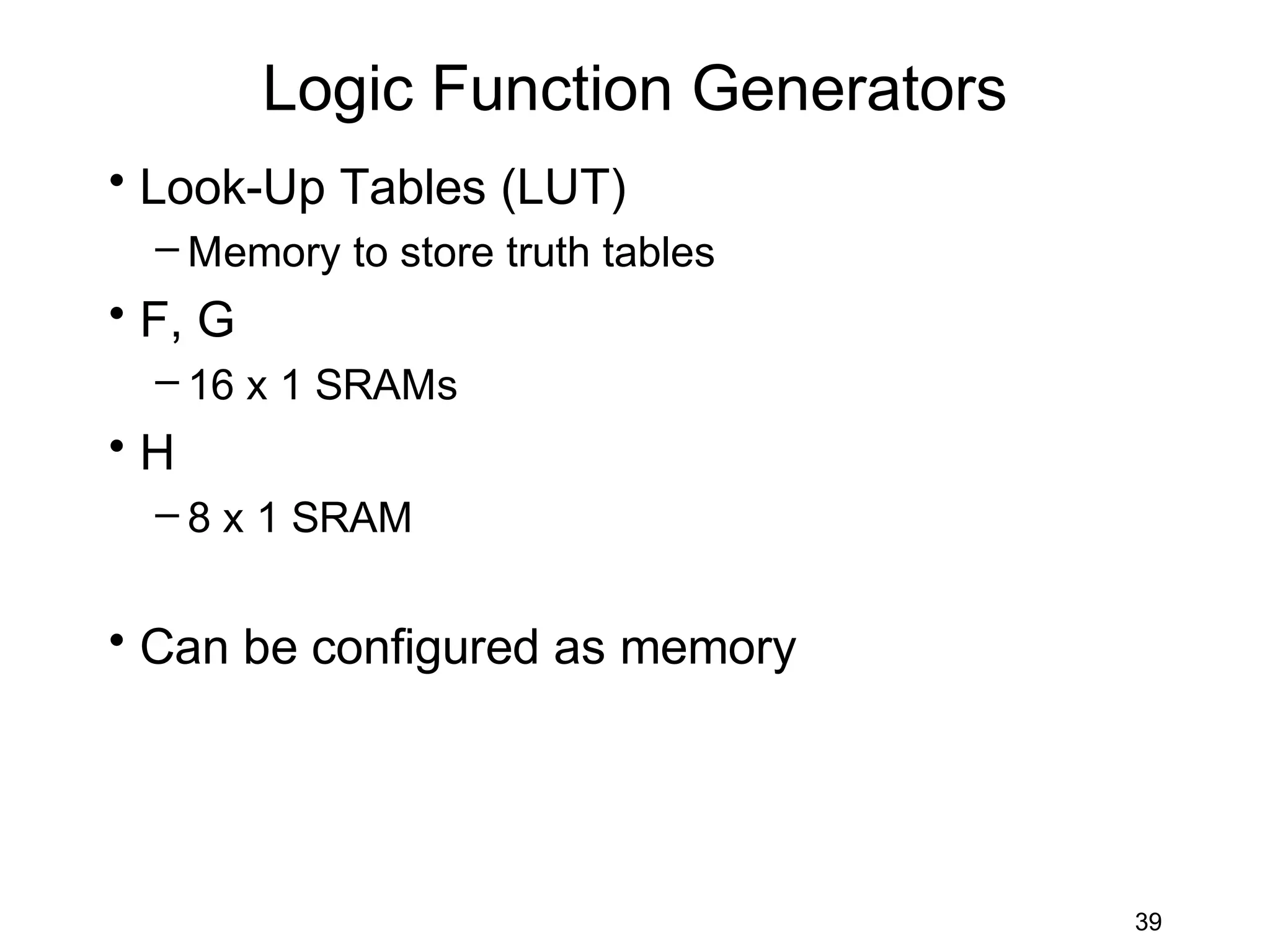
Logic Function Generators
• Look-Up Tables (LUT)
  – Memory to store truth tables
• F, G
  – 16 x 1 SRAMs
•H
  – 8 x 1 SRAM


• Can be configured as memory


                                     39
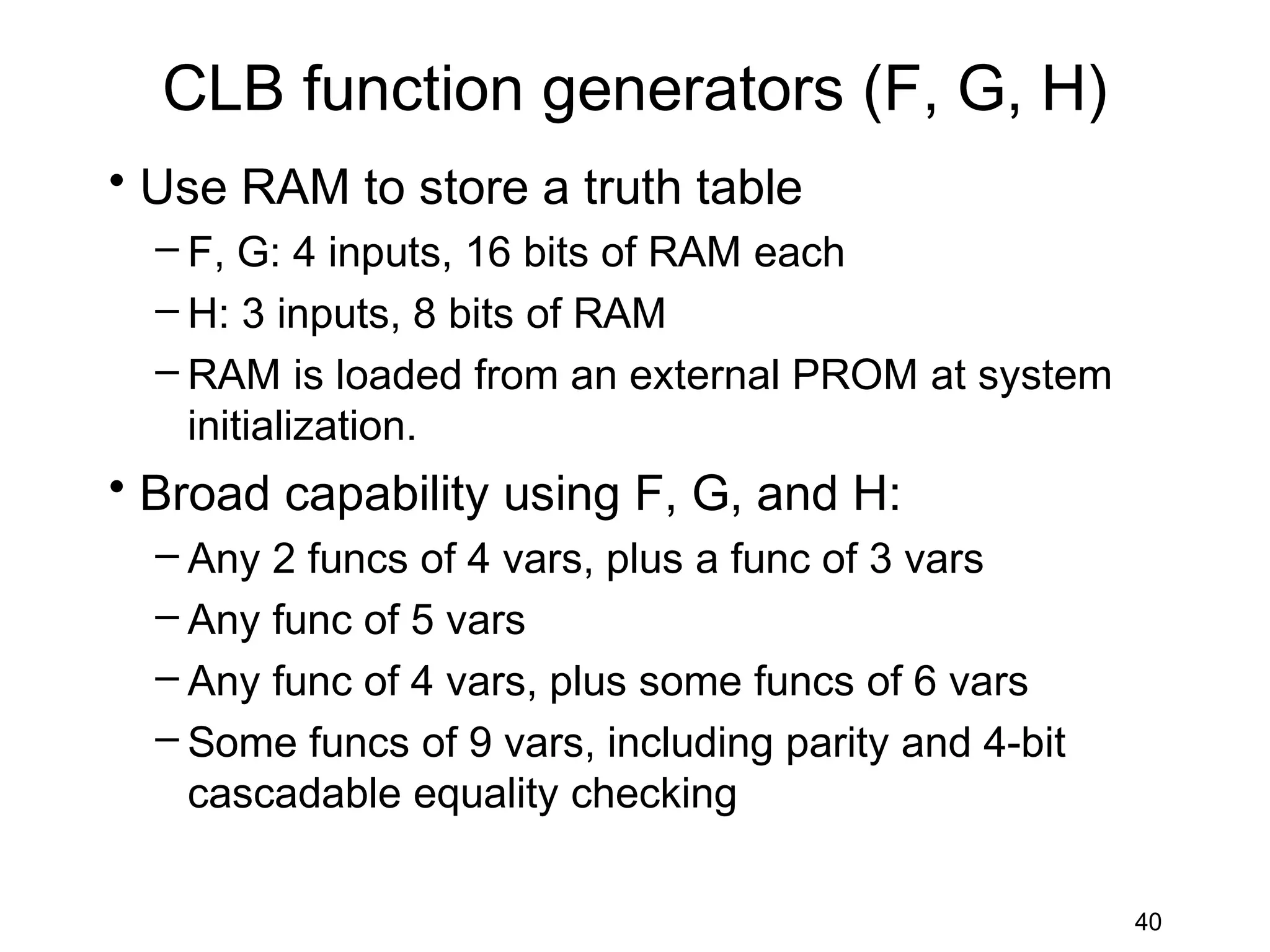
CLB function generators (F, G, H)
• Use RAM to store a truth table
  – F, G: 4 inputs, 16 bits of RAM each
  – H: 3 inputs, 8 bits of RAM
  – RAM is loaded from an external PROM at system
    initialization.
• Broad capability using F, G, and H:
  – Any 2 funcs of 4 vars, plus a func of 3 vars
  – Any func of 5 vars
  – Any func of 4 vars, plus some funcs of 6 vars
  – Some funcs of 9 vars, including parity and 4-bit
    cascadable equality checking

                                                       40
FPGAs
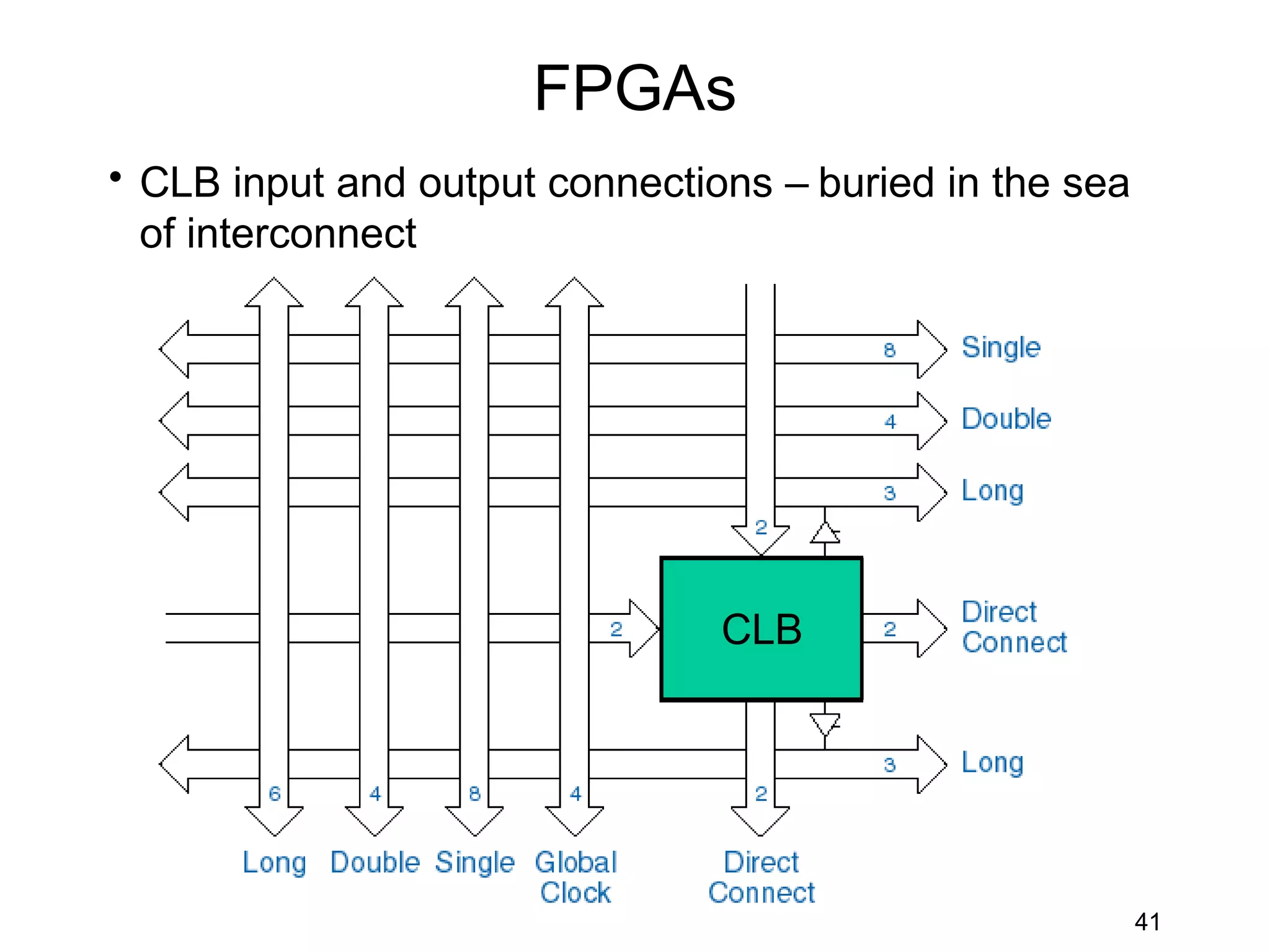
• CLB input and output connections – buried in the sea
  of interconnect


                                CLB


                                                         41
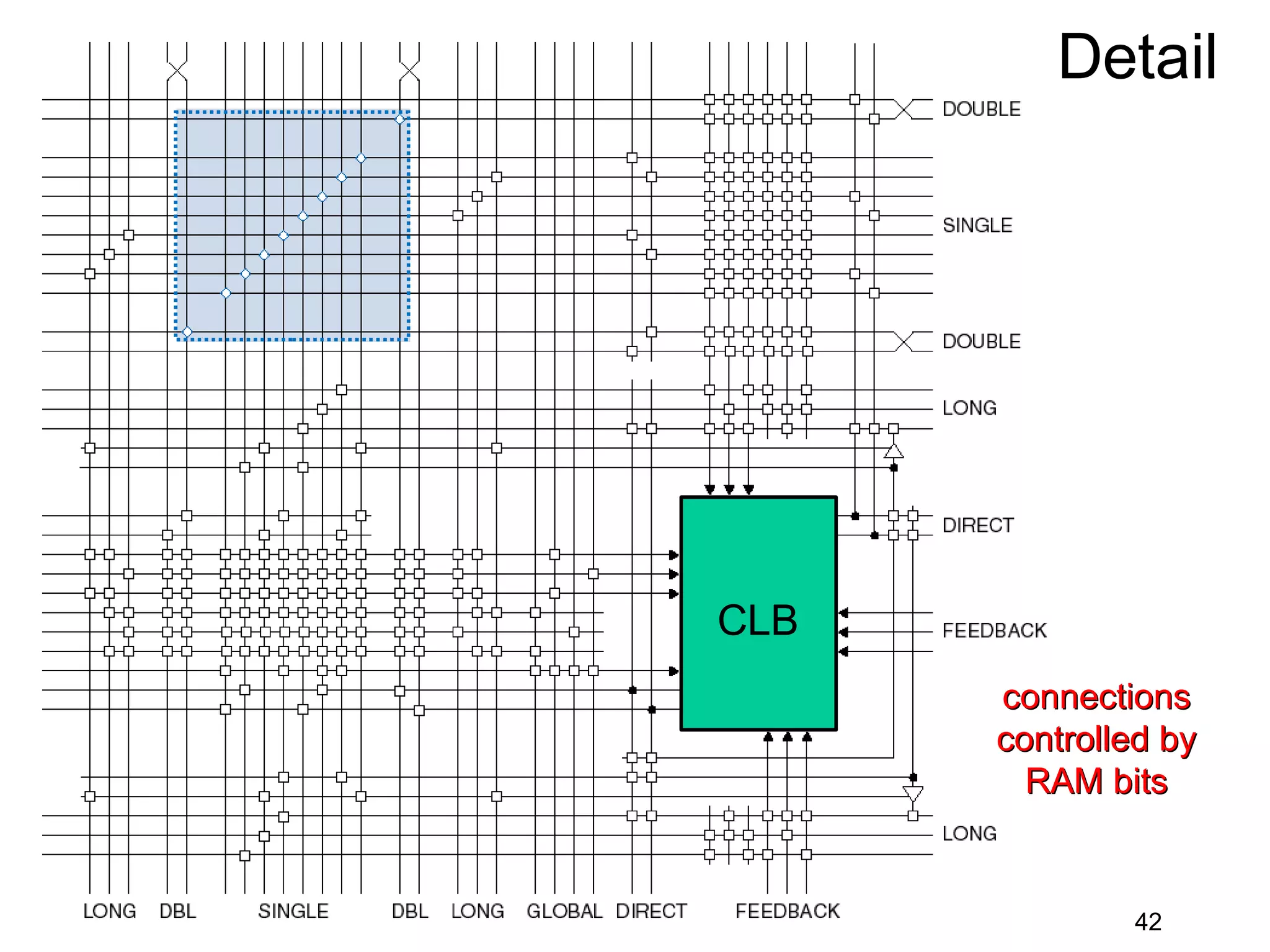
Detail


CLB
      connections
      controlled by
        RAM bits


              42
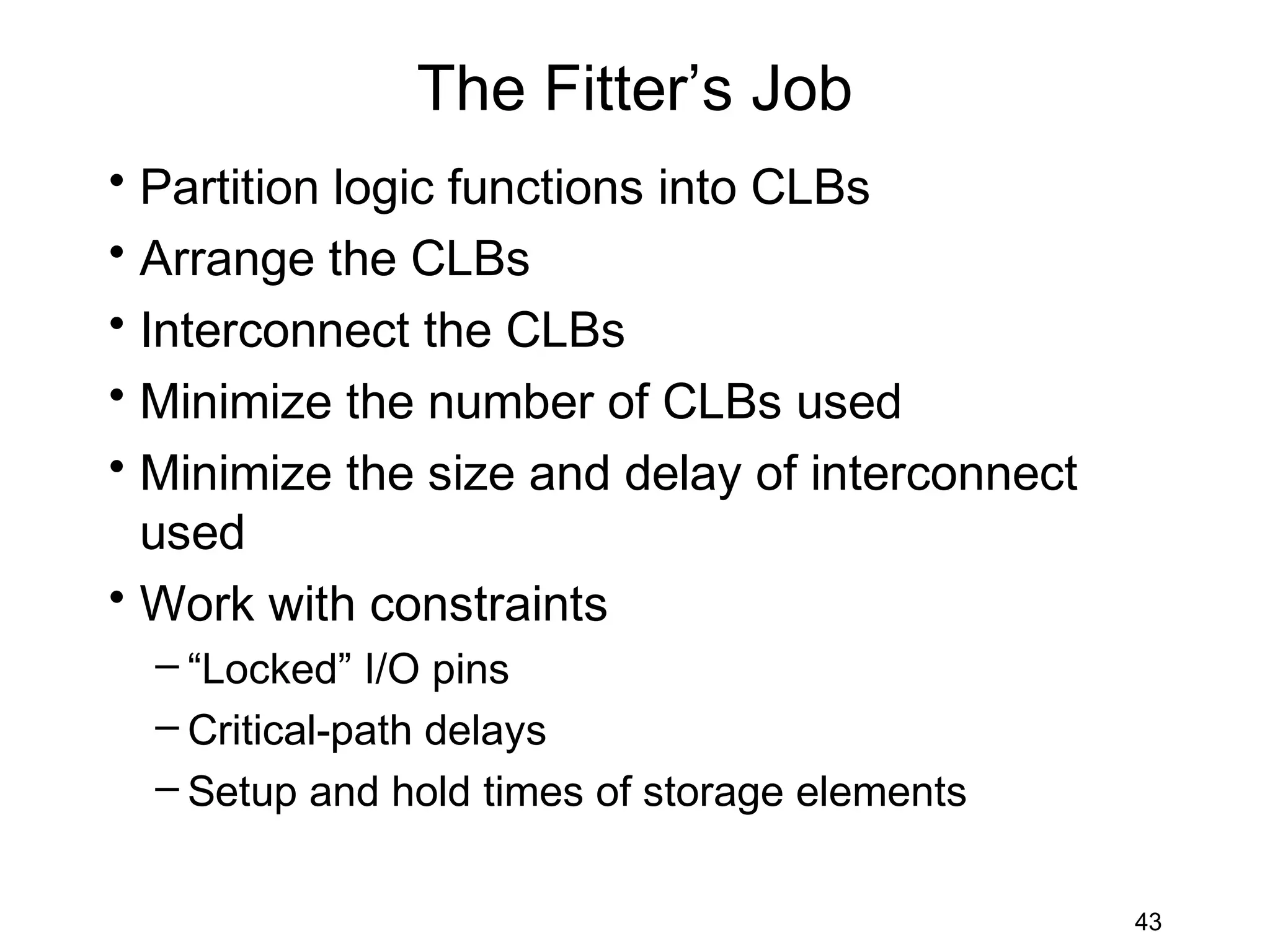
The Fitter’s Job
• Partition logic functions into CLBs
• Arrange the CLBs
• Interconnect the CLBs
• Minimize the number of CLBs used
• Minimize the size and delay of interconnect
  used
• Work with constraints
  – “Locked” I/O pins
  – Critical-path delays
  – Setup and hold times of storage elements

                                                43
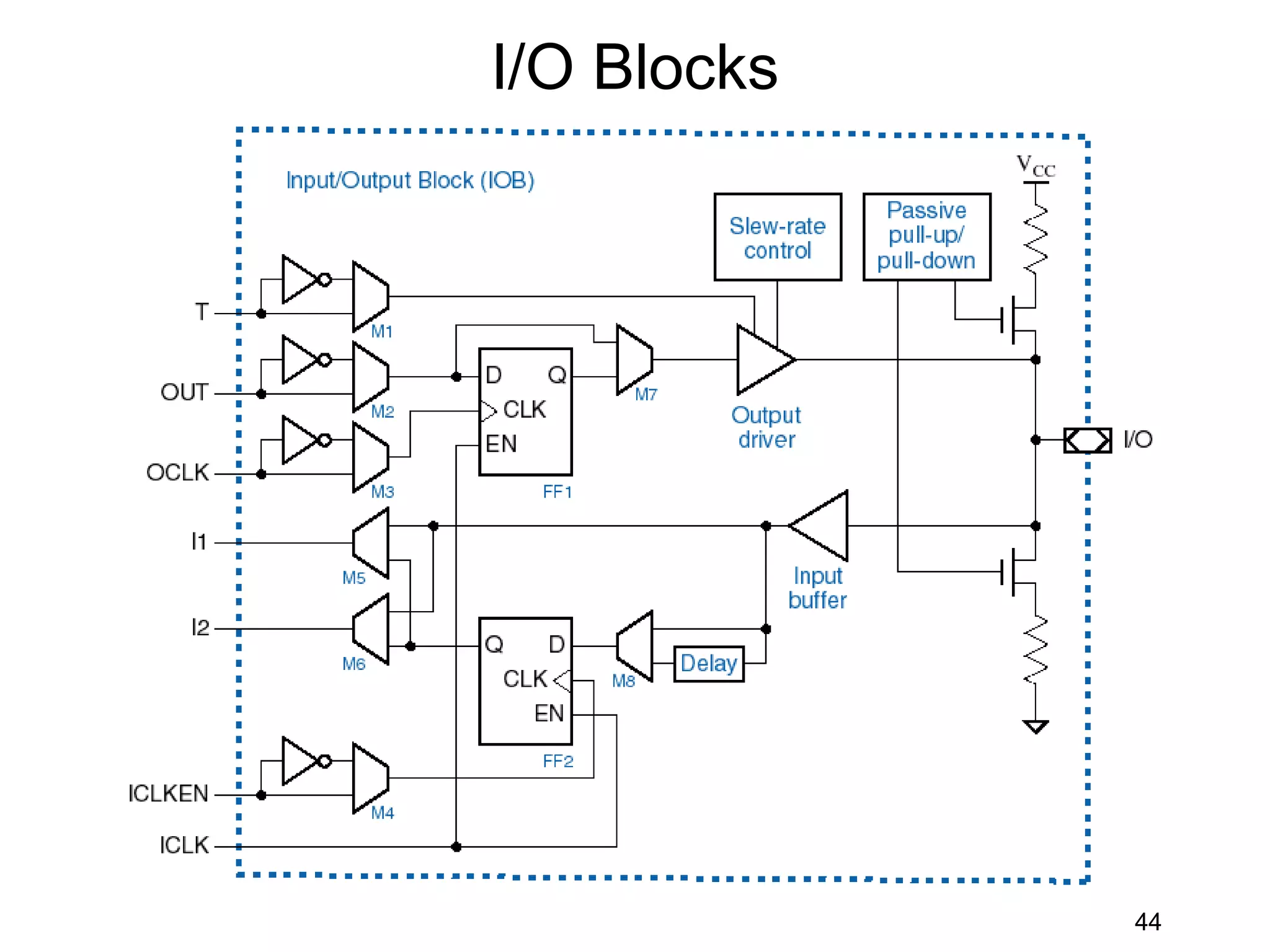
I/O Blocks


             44
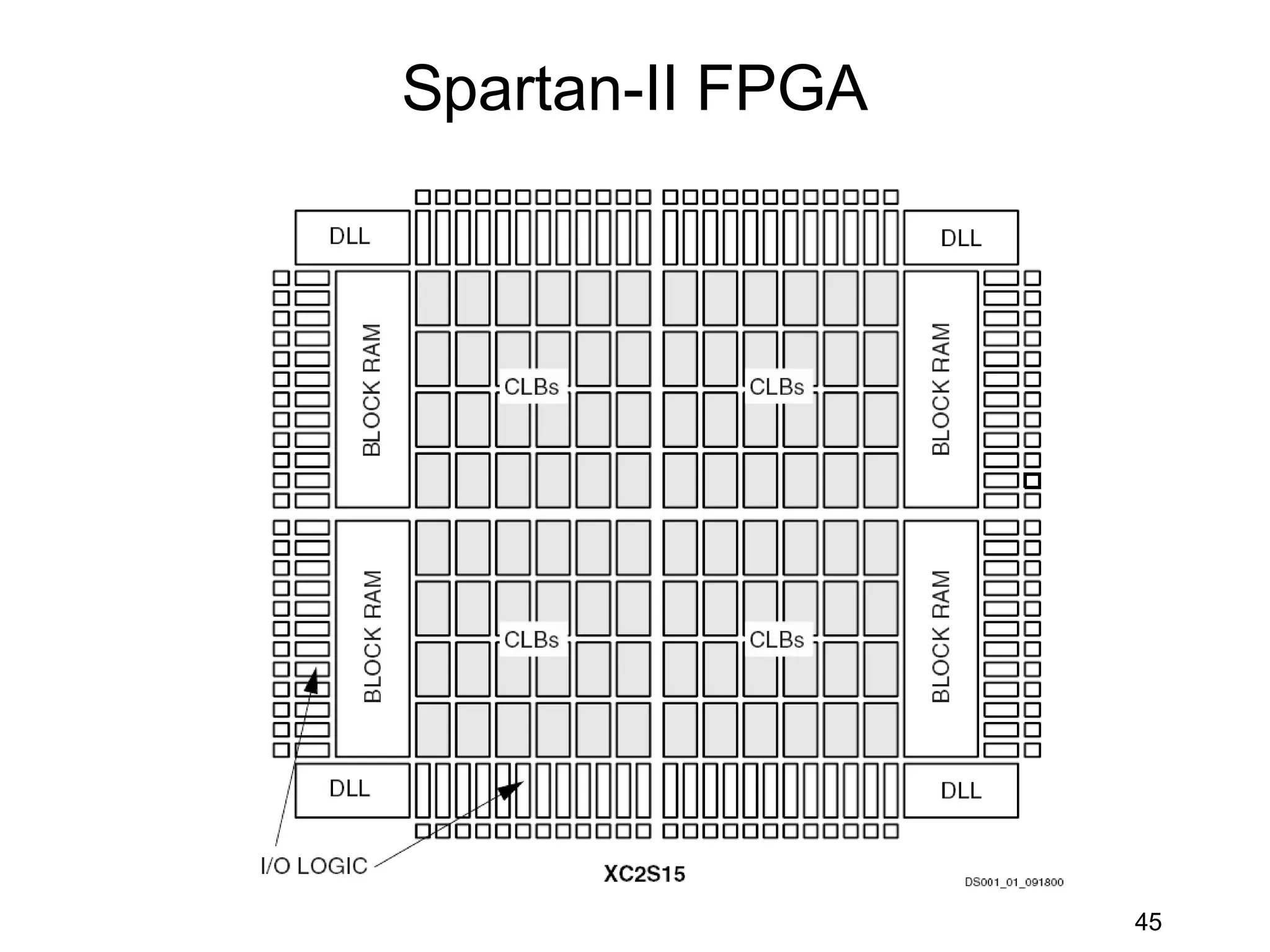
Spartan-II FPGA


                  45
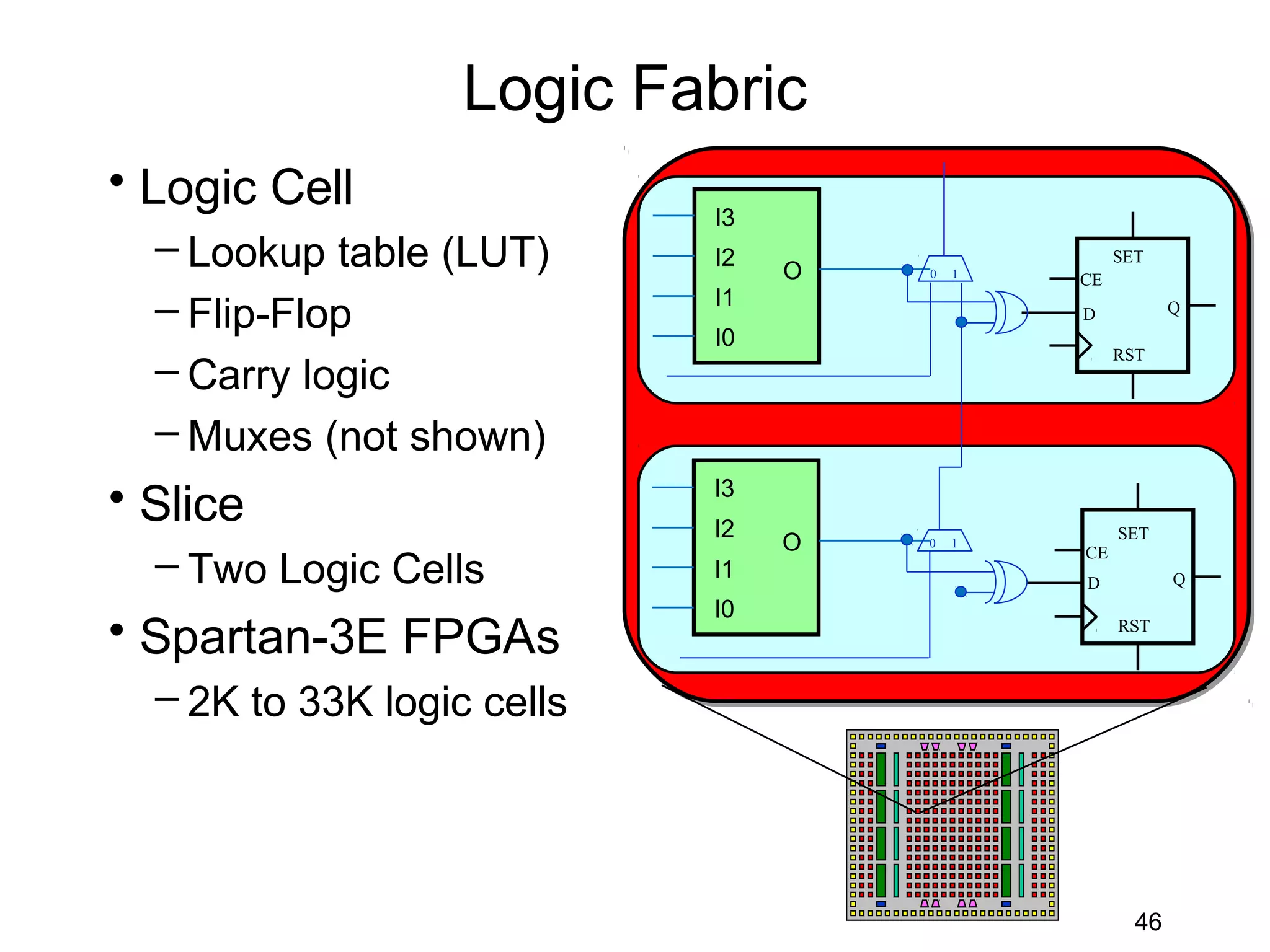
Logic Fabric
• Logic Cell
                            I3
  – Lookup table (LUT)      I2
                                 O   0   1
                                                  SET
                                             CE
                            I1
  – Flip-Flop                                D           Q
                            I0
                                                  RST
  – Carry logic
  – Muxes (not shown)
• Slice                     I3
                            I2                    SET
                                 O   0   1
                                             CE
  – Two Logic Cells         I1               D           Q
                            I0
• Spartan-3E FPGAs                                RST


  – 2K to 33K logic cells


                                                    46
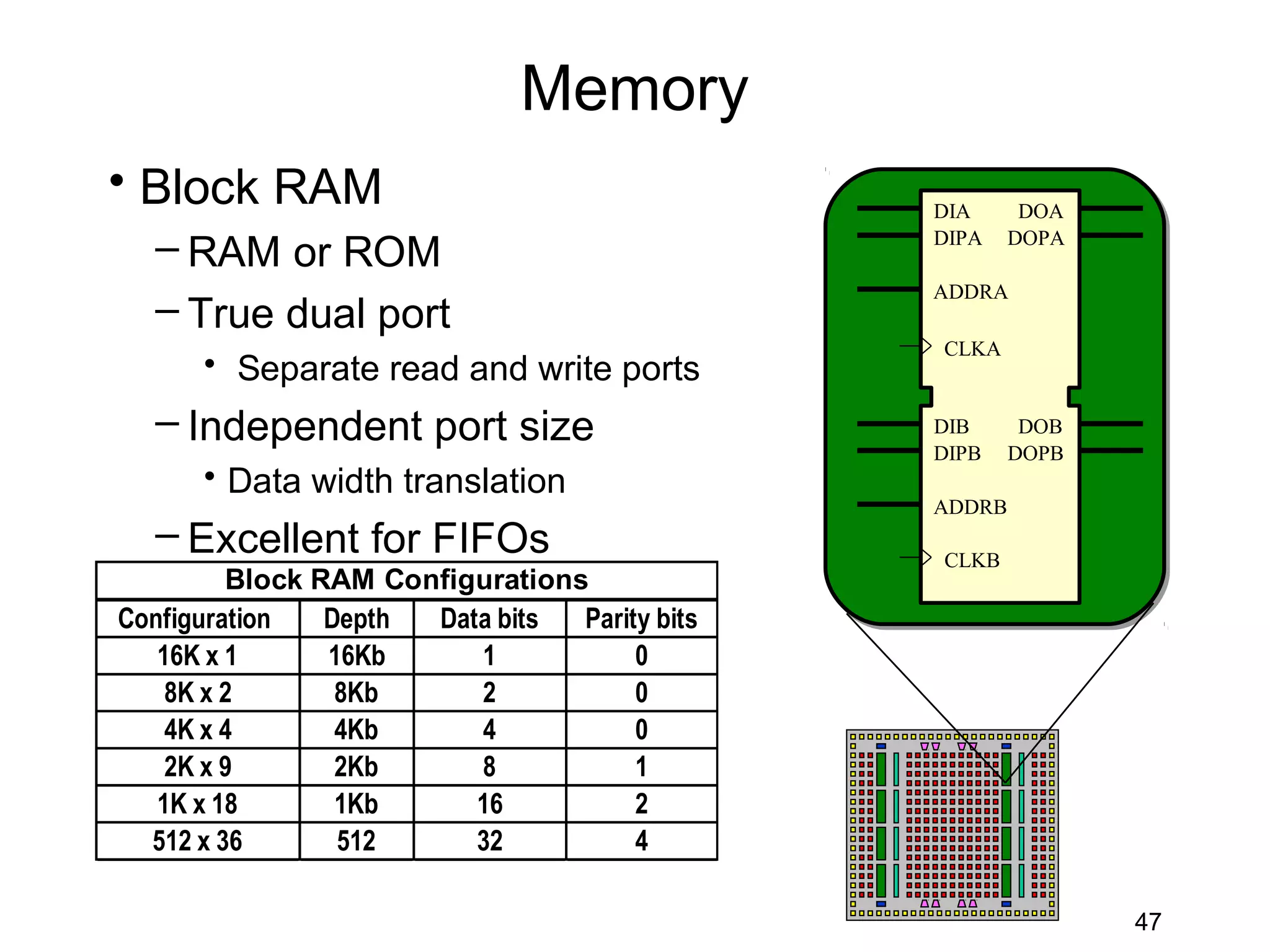
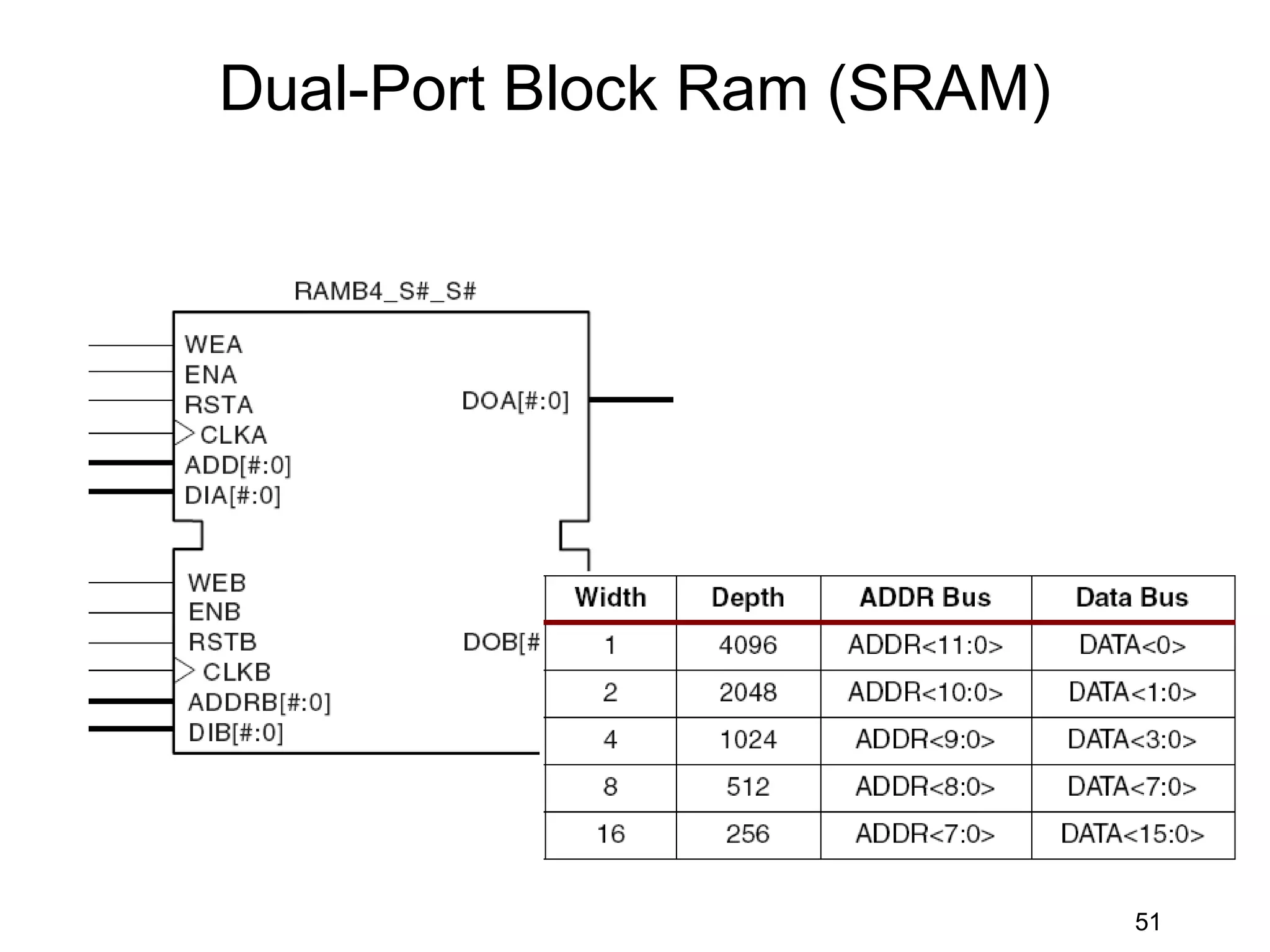
Memory
• Block RAM                                    DIA      DOA
                                               DIPA    DOPA
  – RAM or ROM
                                               ADDRA
  – True dual port
                                               CLKA
      • Separate read and write ports
  – Independent port size                      DIB      DOB
                                               DIPB    DOPB
      • Data width translation
                                               ADDRB
  – Excellent for FIFOs                        CLKB
         Block RAM Configurations
Configuration   Depth Data bits  Parity bits
   16K x 1      16Kb     1            0
    8K x 2       8Kb     2            0
    4K x 4       4Kb     4            0
    2K x 9       2Kb     8            1
   1K x 18       1Kb     16           2
  512 x 36       512     32           4

                                                              47
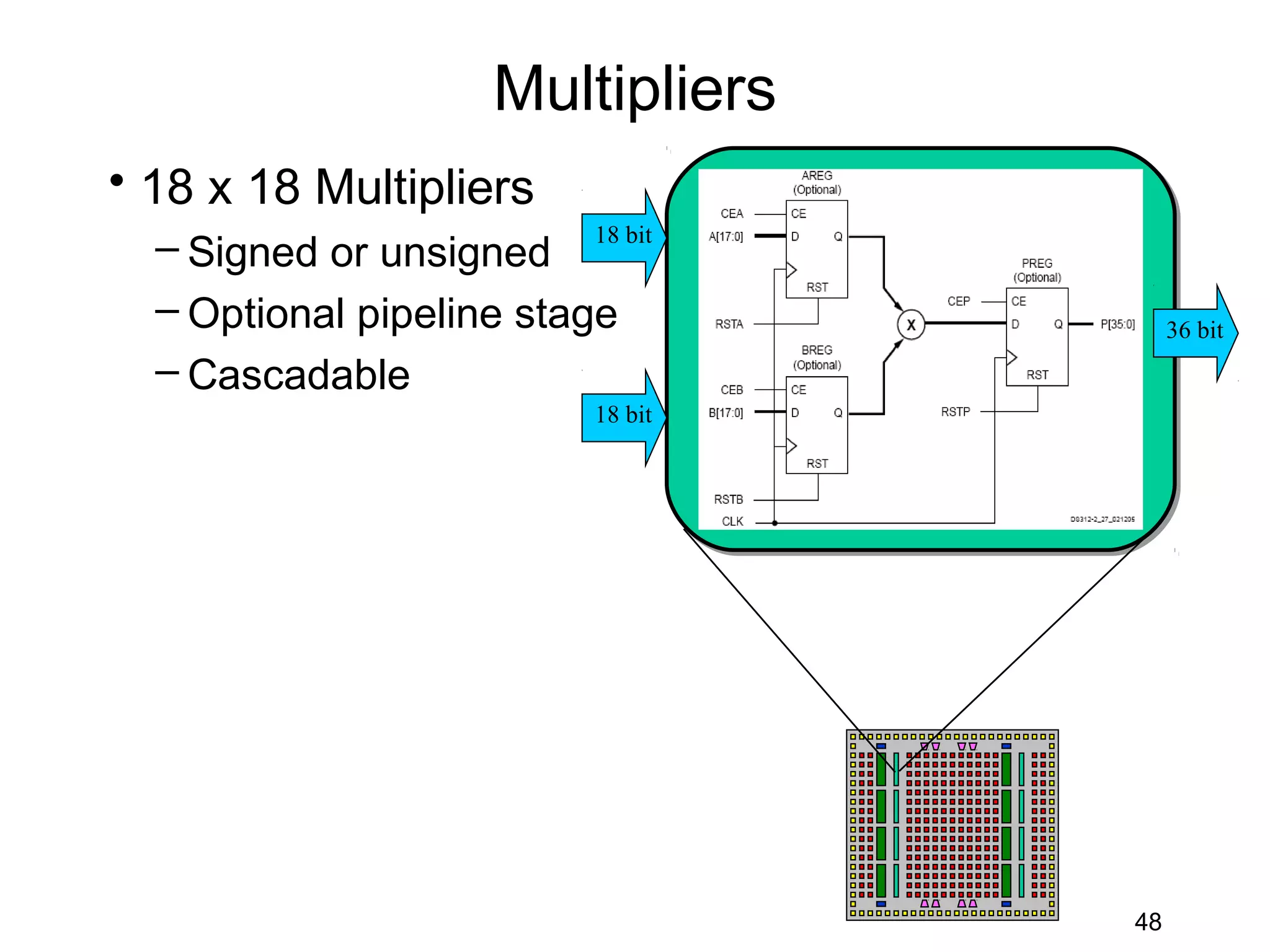
Multipliers
• 18 x 18 Multipliers
  – Signed or unsigned 18 bit
  – Optional pipeline stage            36 bit
  – Cascadable
                         18 bit


                                  48
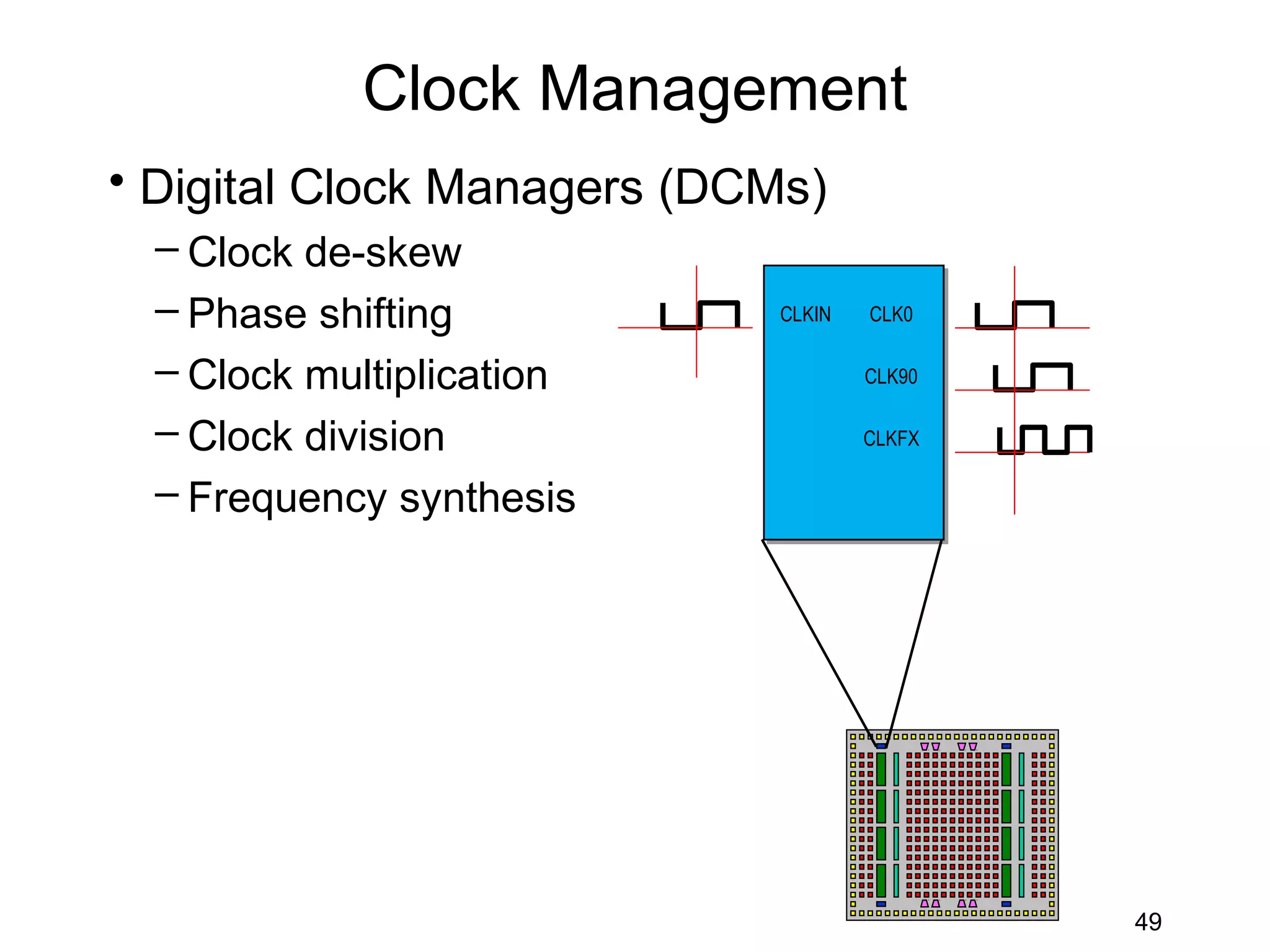
Clock Management
• Digital Clock Managers (DCMs)
  – Clock de-skew
  – Phase shifting          CLKIN   CLK0

  – Clock multiplication            CLK90

  – Clock division                  CLKFX

  – Frequency synthesis


                                            49
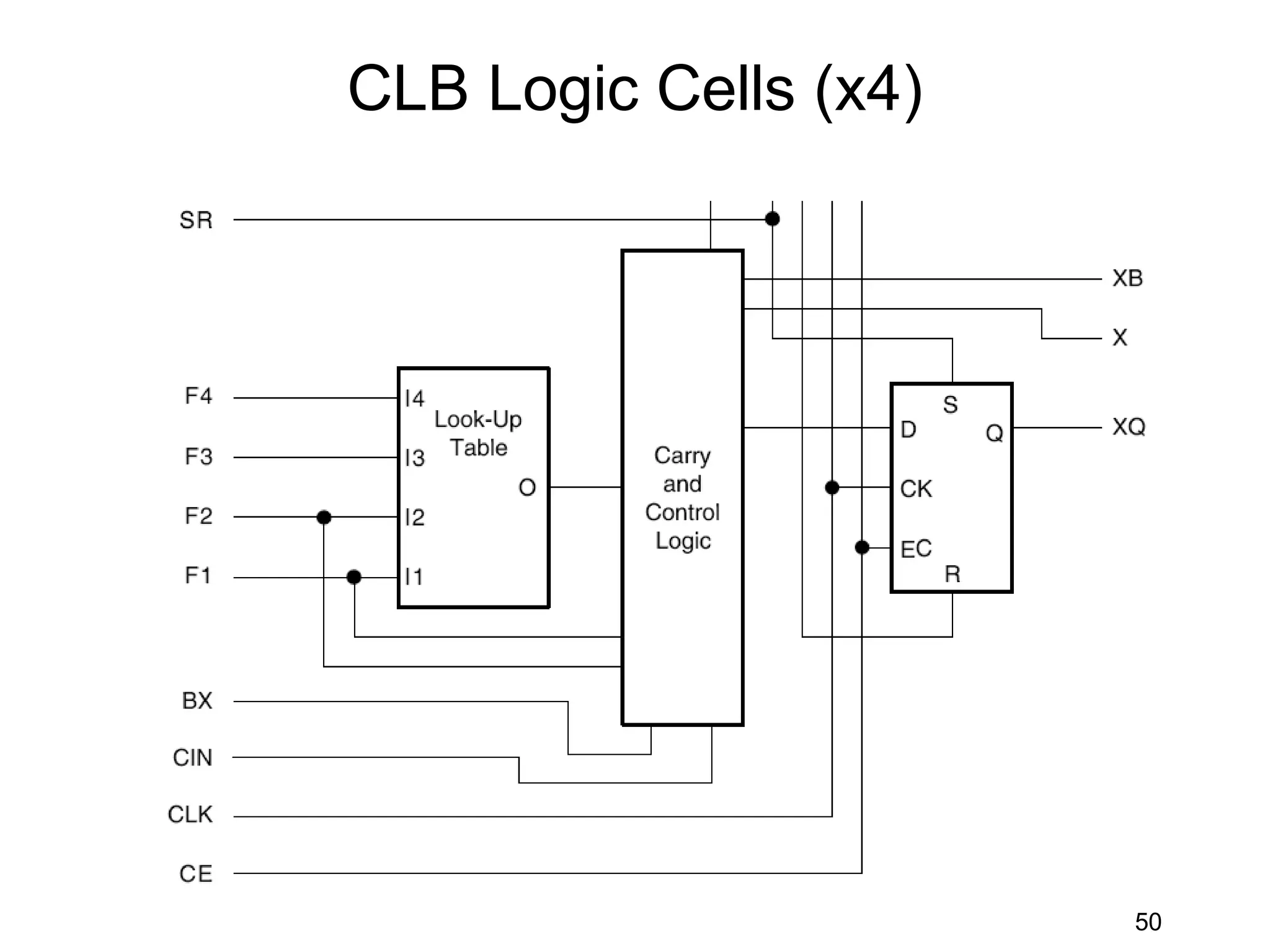
CLB Logic Cells (x4)


                       50
Dual-Port Block Ram (SRAM)


                             51
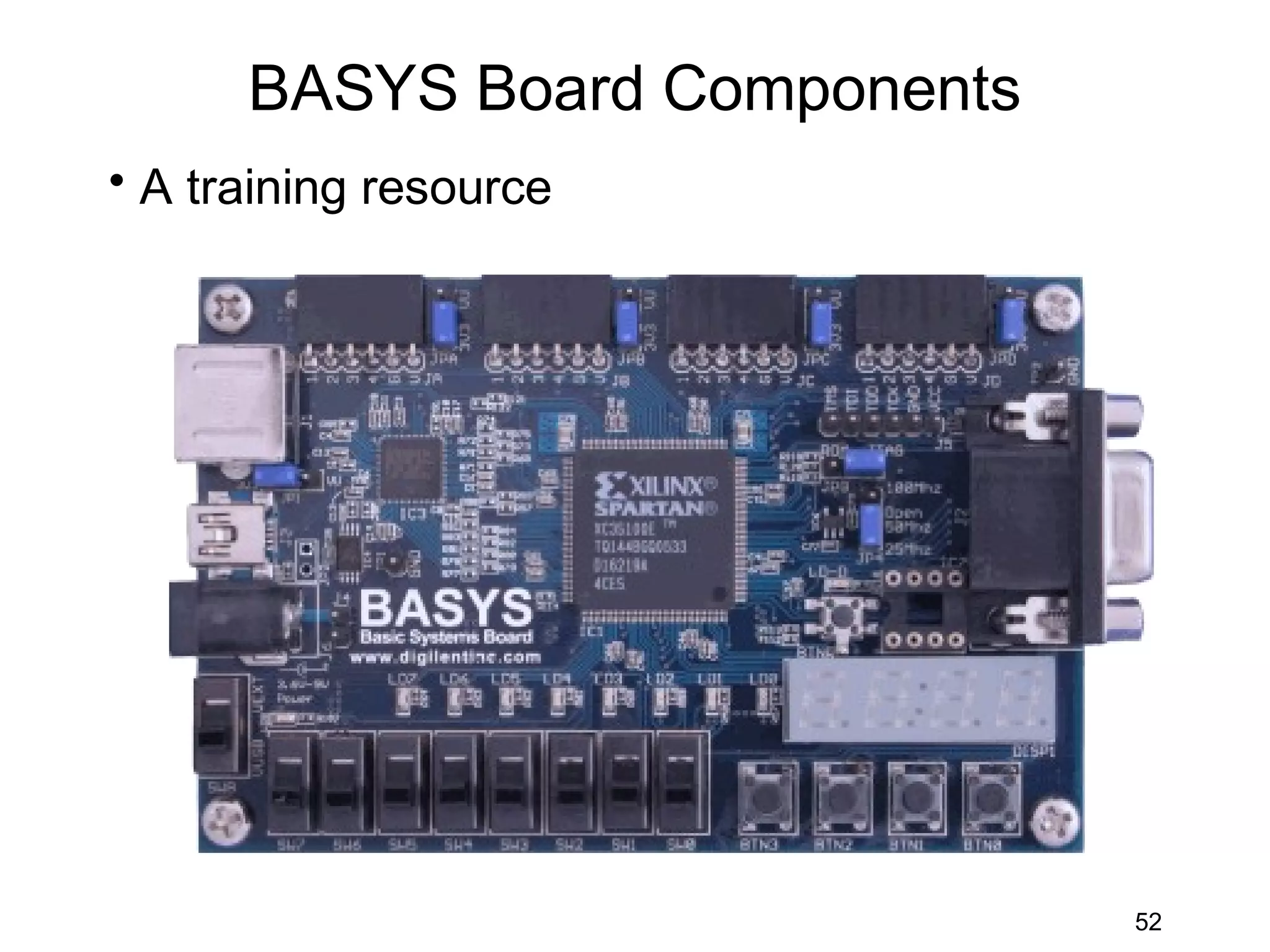
BASYS Board Components
• A training resource


                               52
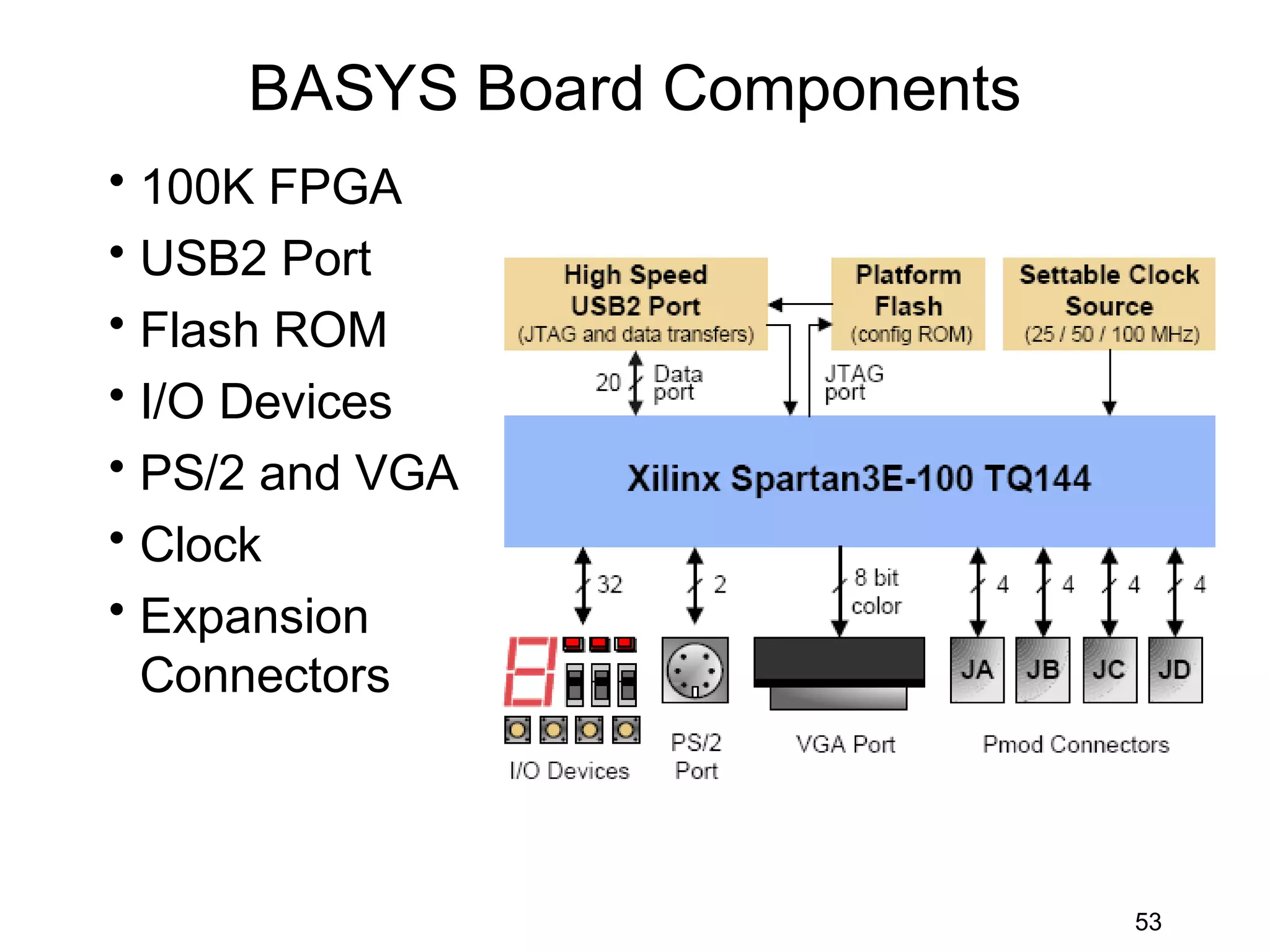
BASYS Board Components
• 100K FPGA
• USB2 Port
• Flash ROM
• I/O Devices
• PS/2 and VGA
• Clock
• Expansion
  Connectors


                              53
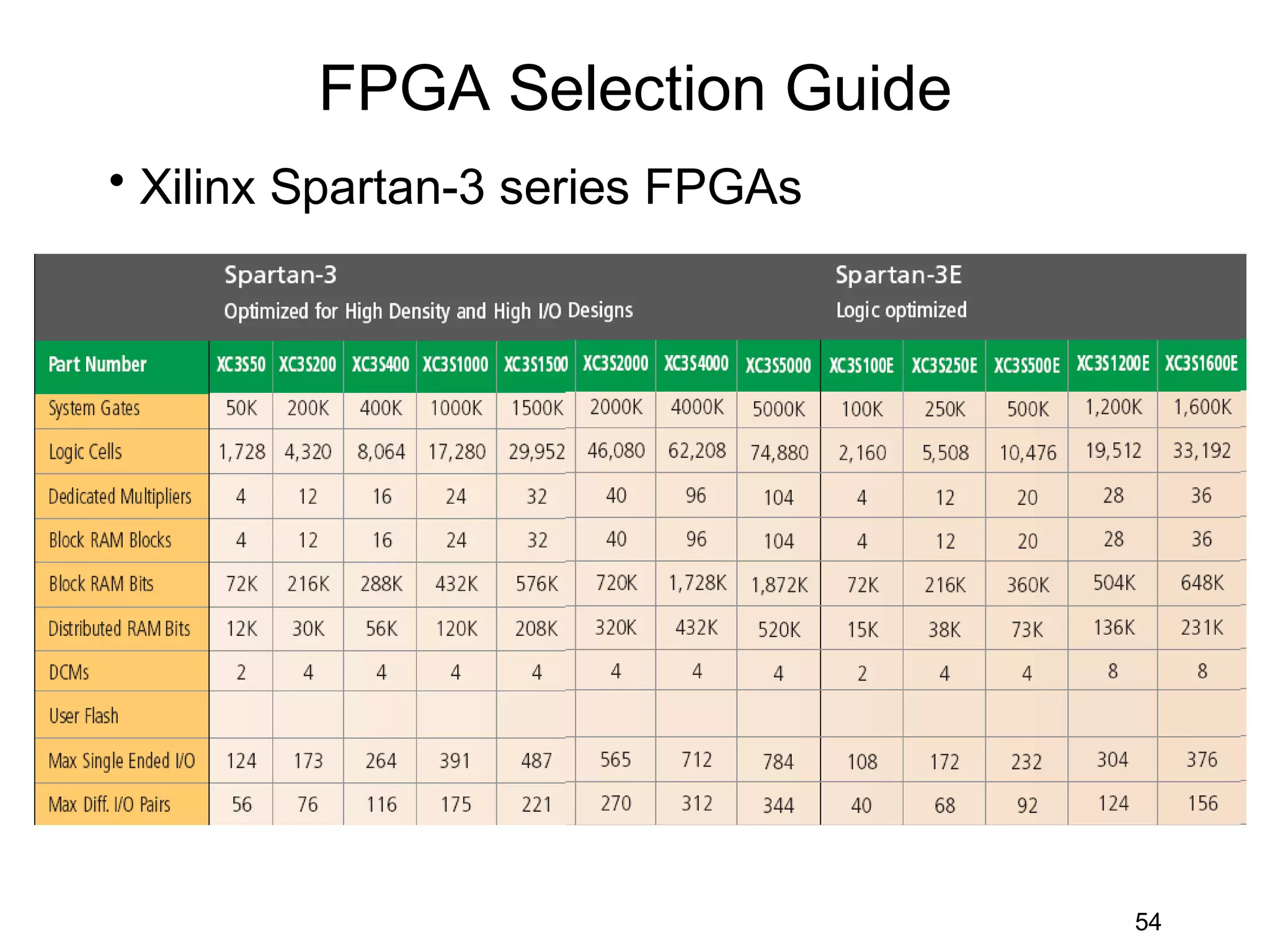
FPGA Selection Guide
• Xilinx Spartan-3 series FPGAs


                                  54
Summary
• Complex Programmable Logic Devices
  – Function Blocks
    • AND Arrays and Macrocells
  – Programmable Interconnect
  – I/O
• Field Programmable Gate Arrays
  – Configurable Logic Blocks
    • Look-up Tables
  – Programmable Interconnect
  – I/O


                                       55

FPGA

  • 1.
    EET 3350 DigitalSystems Design Textbook: John Wakerly Chapter 9: 9.6 FPGAs 1
  • 2.
    FPGA • FPGA Basics •FPGA Architecture – CLBs – I/O Blocks – Switch Matrix • Xilinx FPGAs • System Development Boards 2
  • 3.
    Advantages of FPGA •The FPGA is one of the most popular logic circuit components and has revolutionized the way digital systems are designed. Some FPGA advantages include: – Low-cost – Fast-turnaround prototype implementation – Supported by CAD/EDA tools – High density – High speed – Programmable and versatile – Flexible – Reusable – Large amounts of logic gates, registers, RAM and routing resources – Quick time-to-market – SRAM FPGA provide the benefits of custom CMOS 3
  • 4.
    FPGA • There aretwo primary FPGA architectures: – fine-grained – coarse-grained • Another difference in architectures is the underlying technology used to manufacture the device. The common technologies are: – PROM/EPROM/EEPROM/FLASH based – Anti-fuse based – SRAM based 4
  • 5.
    Programmable Switch Technology •SRAM • Antifuse Control Pass Gate • EPROM SRAM SRAM Cell Cell 0 1 Multiplexer 0 or 1 MUX 5
  • 6.
    Programmable Switch Technology •SRAM • Antifuse Disadvantages • EPROM Volatile External Permanent Memory Required Large Area Required Advantages Reprogrammable, easily and quickly Requires only standard integrated circuit process technology (as opposed to Antifuse) 6
  • 7.
    Programmable Switch Technology •SRAM • Antifuse • EPROM 0 1 7
  • 8.
  • 9.
    Programmable Switch Technology •SRAM • Antifuse Disadvantages • EPROM Not reprogrammable; links made are permanent Requires extra circuitry to deliver the high programming voltage Advantages Small size Relatively low series resistance Low parasitic capacitance 9
  • 10.
    Programmable Switch Technology •SRAM • Antifuse Word Line Control Gate • EPROM Bit Line -- Oxide Layer Floating Gate 1 Drain Source Word Line Control Gate Bit Line ------- Oxide Layer Floating Gate 0 Drain Source 10
  • 11.
    Programmable Switch Technology •SRAM • Antifuse Disadvantages • EPROM High resistance of EPROM transistors High static power consumption UV light exposure needed to reprogram Advantages No external memory required; retains memory even without power Reprogrammable 11
  • 12.
    Programmable Switch Technology •A summary of programmable switches 12
  • 13.
    FPGA Architectures • Fine-grainedArchitecture – Fine-grained made up of a sea of gates or transistors or small macro cells – With programmable interconnect between them Almost the opposite of a CPLD 13
  • 14.
    FPGA Architectures • Coarse-grainedArchitecture – Coarse-grained FPGAs include bigger macrocells – The macrocells usually include Flip-Flops and Look Up Tables (LUTs) which are used to implement combinatorial logic functions – In a majority of these architectures, four-input look- up table (think of it as a 16x1 ROM) implement the actual logic – The larger logic block usually results in improved performance when compared to fine-grained architectures 14
  • 15.
    FPGA Process Technology •PROM/EPROM/EEPROM/FLASH based – These implementations are typically programmed out of circuit and can or cannot be reprogrammed • PROM is one time programmable (OTP) device can only be programmed once – EPROM cells are electrically programmed in a device programmer – Some EPROM-based devices are erasable using ultra-violet (UV) lights if they are in a windowed package – EEPROMs are in low-cost plastic packaging for production • Plastic packages cannot be UV erased, they are electrically erased 15
  • 16.
    FPGA Process Technology •PROM/EPROM/EEPROM/FLASH based – An Electrically-Erasable-Programmable-Read-Only- Memory (EEPROM) memory cell is physically larger than an EPROM cell but offers the advantage of being erased electrically with no special UV erasers require. • EEPROM devices can be erased, even in low-cost plastic packaging. – FLASH-erased (or bulk erased) electrically erasable programmable read-only memory. • FLASH has the electrically erasable benefits of EEPROM but the small, economical cell size of EPROM technology. 16
  • 17.
    FPGA Process Technology •Anti-fuse based – Anti-fuse is a one-time programmable (OTP) – Fuses are permanently put in place – The anti-part of anti-fuse comes from its programming method • Instead of breaking a metal connection by passing current through it, a link is grown to make a connection – Anti-fuses are either amorphous silicon or metal-to- metal connections 17
  • 18.
    FPGA Process Technology •Anti-fuse based – The advantages of anti-fuse FPGAs include: • They are usually physically quite small • They have low resistance interconnect – Disadvantages include • They require large programming transistors on the device • They cannot be reused (they are OTP) 18
  • 19.
    FPGA Process Technology •SRAM based – SRAM cells are implemented as function generators to simulate combinatorial logic and also are used to control multiplexors and routing resources – This is by far the most popular process technology – This method is similar to the technology used in static RAM devices but with a few modifications • The RAM cells in a memory device are designed for fastest possible read/write performance • The RAM cells in a programmable device are usually designed for stability instead of read/write performance • Consequently, RAM cells in a programmable device have a low-impedance connect to VCC and ground to provide maximum stability over voltage fluctuations 19
  • 20.
    FPGA Process Technology •SRAM based (cont.) – Because static memory is volatile (the contents disappear when the power is turned off), SRAM- based devices are "booted" after power-on – This makes them in-system programmable and re- programmable, even in real-time – As a result, SRAM-based FPGAs are common in reconfigure computing applications where the device's function is dynamically changed 20
  • 21.
    FPGA Process Technology •SRAM based (cont.) – The configuration process typically requires only a few hundred milliseconds at most – Most SRAM-based devices can boot themselves automatically at power-on much like a microprocessor – Most SRAM-based devices are designed to work with either standard byte-wide PROMs or with sequential-access serial PROMs 21
  • 22.
    FPGAs • Historically, FPGAarchitectures and companies began around the same time as CPLDs • FPGAs are closer to “programmable ASICs” – Large emphasis on interconnection routing – Timing is difficult to predict -- multiple hops vs. the fixed delay of a CPLD’s switch matrix – But more “scalable” to large sizes • FPGA programmable logic blocks have only a few inputs and 1 or 2 flip-flops, but there are a lot more of them compared to the number of macrocells in a CPLD 22
  • 23.
    FPGAs • General FPGAchip architecture, coarse-grained a.k.a. CLB: “configurable logic block” 23
  • 24.
    FPGAs • FPGAs donot contain AND or OR planes • Three major elements: Interconnection – Logic blocks Switches Logic Block – I/O blocks – Interconnection wires and switches all elements are programmable I/O Block 24
  • 25.
    Other FPGA BuildingBlocks • Clock distribution • Embedded memory blocks • Special purpose blocks: – DSP blocks: • Hardware multipliers, adders and registers – Embedded microprocessors/microcontrollers – High-speed serial transceivers
  • 26.
    FPGA – BasicLogic Element • LUT to implement combinatorial logic • Register for sequential circuits • Additional logic (not shown): – Carry logic for arithmetic functions – Expansion logic for functions requiring more than 4 inputs Select Out A B C LUT LUT D Q D Clock
  • 27.
    Look-Up Tables (LUT) •Look-up table with N-inputs can be used to implement any combinatorial function of N inputs • LUT is programmed with the truth-table A B C LUT LUT Z D LUT implementation A B Z C D Truth-table Gate implementation
  • 28.
    LUT Implementation • Example:3-input LUT • Based on multiplexers X1 X2 (pass transistors) 0/1 • LUT entries stored in 0/1 configuration memory 0/1 cells 0/1 F 0/1 0/1 0/1 0/1 configuration memory cells X3
  • 29.
    Other FPGA BuildingBlocks • Clock distribution • Embedded memory blocks • Special purpose blocks: – DSP blocks: • Hardware multipliers, adders and registers – Embedded microprocessors/microcontrollers – High-speed serial transceivers
  • 30.
    Special Features • Clockmanagement – PLL,DLL – Eliminate clock skew between external clock input and on-chip clock – Low-skew global clock distribution network • Support for various interface standards • High-speed serial I/Os • Embedded processor cores • DSP blocks
  • 31.
    Configuration Storage Elements •Static Random Access Memory (SRAM) – Logical configuration is controlled by the state of SRAM bits – FPGA needs to be configured at power-on by another separated ROM • Flash Erasable Programmable ROM (Flash) – Logical configuration is implemented by floating- gate transistors that can be turned off by injecting charge onto its gate. – FPGA itself holds the program – reprogrammable, even in-circuit
  • 32.
    FPGA • Xilinx refersto the “interconnection switches” as the switch matrix IOB IOB IOB IOB IOB IOB CLB CLB CLB CLB SM SM SM Programmable Switch Matrix IOB IOB CLB CLB CLB CLB SM SM SM IOB IOB CLB CLB CLB CLB SM SM SM IOB IOB CLB CLB CLB CLB IOB IOB IOB IOB 32
  • 33.
    FPGAs • Programmable SwitchMatrix programmable switch element turning the corner, etc. 33
  • 34.
    FPGA Logic Block •The storage cells in the LUTs in an FPGA are volatile – losing stored contents whenever the power is off • Using PROM to hold data permanently • The storage cells are loaded automatically from PROM when the chip is initialized Select Logic Block x1 Out 0/1 In1 0/1 In2 LUT 0/1 f In3 LUT D 0/1 In4 Q Clock x2 34
  • 35.
    FPGAs • An example of programming an FPGA x3 f f1 = x1 x2 x1 f 2 = x2 x3 x1 0 x2 0 0 f1 1 f2 f = x1 x2 + x2 x3 0 0 1 0 x2 x2 x3 f1 0 1 x1 f3 1 0/1 0/1 1 LUT 0/1 f f2 0/1 x2 35
  • 36.
    FPGAs • An example of programming an FPGA x3 f f1 = x1 x2 x1 f 2 = x2 x3 x1 0 x2 0 0 f1 1 f2 f = x1 x2 + x2 x3 0 0 1 0 x2 x2 x3 f1 0 1 x1 f3 1 0/1 0/1 1 LUT 0/1 f f2 0/1 x2 36
  • 37.
    Xilinx 4000-Series FPGAs •Characteristics of the Xilinx 4000-series FPGAs 37
  • 38.
  • 39.
    Logic Function Generators •Look-Up Tables (LUT) – Memory to store truth tables • F, G – 16 x 1 SRAMs •H – 8 x 1 SRAM • Can be configured as memory 39
  • 40.
    CLB function generators(F, G, H) • Use RAM to store a truth table – F, G: 4 inputs, 16 bits of RAM each – H: 3 inputs, 8 bits of RAM – RAM is loaded from an external PROM at system initialization. • Broad capability using F, G, and H: – Any 2 funcs of 4 vars, plus a func of 3 vars – Any func of 5 vars – Any func of 4 vars, plus some funcs of 6 vars – Some funcs of 9 vars, including parity and 4-bit cascadable equality checking 40
  • 41.
    FPGAs • CLB inputand output connections – buried in the sea of interconnect CLB 41
  • 42.
    Detail CLB connections controlled by RAM bits 42
  • 43.
    The Fitter’s Job •Partition logic functions into CLBs • Arrange the CLBs • Interconnect the CLBs • Minimize the number of CLBs used • Minimize the size and delay of interconnect used • Work with constraints – “Locked” I/O pins – Critical-path delays – Setup and hold times of storage elements 43
  • 44.
  • 45.
  • 46.
    Logic Fabric • LogicCell I3 – Lookup table (LUT) I2 O 0 1 SET CE I1 – Flip-Flop D Q I0 RST – Carry logic – Muxes (not shown) • Slice I3 I2 SET O 0 1 CE – Two Logic Cells I1 D Q I0 • Spartan-3E FPGAs RST – 2K to 33K logic cells 46
  • 47.
    Memory • Block RAM DIA DOA DIPA DOPA – RAM or ROM ADDRA – True dual port CLKA • Separate read and write ports – Independent port size DIB DOB DIPB DOPB • Data width translation ADDRB – Excellent for FIFOs CLKB Block RAM Configurations Configuration Depth Data bits Parity bits 16K x 1 16Kb 1 0 8K x 2 8Kb 2 0 4K x 4 4Kb 4 0 2K x 9 2Kb 8 1 1K x 18 1Kb 16 2 512 x 36 512 32 4 47
  • 48.
    Multipliers • 18 x18 Multipliers – Signed or unsigned 18 bit – Optional pipeline stage 36 bit – Cascadable 18 bit 48
  • 49.
    Clock Management • DigitalClock Managers (DCMs) – Clock de-skew – Phase shifting CLKIN CLK0 – Clock multiplication CLK90 – Clock division CLKFX – Frequency synthesis 49
  • 50.
  • 51.
  • 52.
    BASYS Board Components •A training resource 52
  • 53.
    BASYS Board Components •100K FPGA • USB2 Port • Flash ROM • I/O Devices • PS/2 and VGA • Clock • Expansion Connectors 53
  • 54.
    FPGA Selection Guide •Xilinx Spartan-3 series FPGAs 54
  • 55.
    Summary • Complex ProgrammableLogic Devices – Function Blocks • AND Arrays and Macrocells – Programmable Interconnect – I/O • Field Programmable Gate Arrays – Configurable Logic Blocks • Look-up Tables – Programmable Interconnect – I/O 55

Editor's Notes

  • #6 From Rose article (AMR) SRAM, where the switch is a pass transistor controlled by the state of a SRAM bit. SRAM = Static Random Access Memory Control Pass Gate When a one is stored in the SRAM cell the pass gate acts as a closed switch, and can be used to make a connection between two wire segments. When a zero is stored, the switch is open and the transistor presents a high resistance between the two wire segments. For Multiplexer SRAM cells connected to the select lines controls which one of the multiplexer inputs are connected to the output D-flipflops may be included with the multiplexer to hold the state of the selection (KCompton) Same idea as with the multiplexer – the bit can be used as the selection for an ALU (add, subtract, whatever…) (KCompton) Or, That bit can be used to select the output from the LUT
  • #7 From Rose article (AMR) SRAM, where the switch is a pass transistor controlled by the state of a SRAM bit. Since SRAM is volatile (needs to be reprogrammed after losing power), the FPGA must be loaded and configured at the time of chip power-up. This requires external permanent memory to provide the programming bits such as PROM, EPROM, EEPROM or magnetic disk. A major disadvantage of SRAM programming technology is its large area. It takes at least five transistors to implement an SRAM cell, plus at least one transistor to serve as a programmable switch. However, SRAM programming technology has two major advantages; fast re-programmability and that it requires only standard integrated circuit process technology.
  • #8 From Rose article (AMR) Antifuse, which, when electrically programmed, forms a low resistance path, and When a high voltage (from 11 to 20 volts, depending on the type of antifuse) is applied across its terminals the antifuse will “blow” and create a low resistance link.
  • #10 From Rose article (AMR) Antifuse, which, when electrically programmed, forms a low resistance path, and
  • #11 From Rose article (AMR) and howstuffworks EPROM, where the switch is a floating-gate transistor that can be turned off by injecting charge onto their floating gate. EPROM stands for Erasable Programmable Read Only Memory Can only go from 1 to 0 Read more on how EPROM works!!!!! … transistor that can be permanently “disabled.” This is accomplished by injecting a charge on the floating gate (gate 2 in the figure) using a high voltage between the control gate 1 and the drain of the transistor. This charge increases the threshold voltage of the transistor so that it turns off. The charge is removed by exposing the floating gate to UV light. This lowers the threshold voltage of the transistor and makes the transistor function normally. Rather than using an EPROM transistor directly as a programmable switch, the unprogrammed transistor is used to pull down a “bit line” when the “word line” is set high, as illustrated in Fig. 3. While this approach can be simply used to make a connection between the word and bit lines, it can also be used to implement a wired-AND style of logic, thereby providing both logic and routing. http://computer.howstuffworks.com/rom4.htm
  • #12 From Rose article (AMR), wikipedia (EPROM) EPROM, where the switch is a floating-gate transistor that can be turned off by injecting charge onto their floating gate. High static power consumption (because of pull-up resistor)
  • #47 Avnet SpeedWay Workshops Explain the basic LUT/Slice architecture. Since this is generic, you may decide to mention the CLB – don’t muddy the water, however. The main idea is to explain the composition of the logic fabric, and the typical fpga sizes in terms of logic cells. The F5MUX and FiMUX benefits and operations are covered in XAPP466 here: http://www.xilinx.com/bvdocs/appnotes/xapp466.pdf The basics are that the additional muxes have the capability of implementing any function of 5 inputs (F5), 6 inputs (F6), 7 inputs (F7) and 8 inputs (F8) without leaving the CLB. This doesn’t introduce any level of logic delay because the routes are inside the CLB. As far as mux functionality, the F5,6,7,8 muxes can be used to create 4:1, 8:1, 16:1 and 32:1 muxes.
  • #48 Avnet SpeedWay Workshops
  • #49 Avnet SpeedWay Workshops Pipelining in Spartan-3E means using the registers at the input and output of the multiplier. Unlike Spartan-3, the registers are part of the multiplier block and are not used from the fabric.
  • #50 Avnet SpeedWay Workshops