Weighted and Non weighted code
Weighted Code:- 
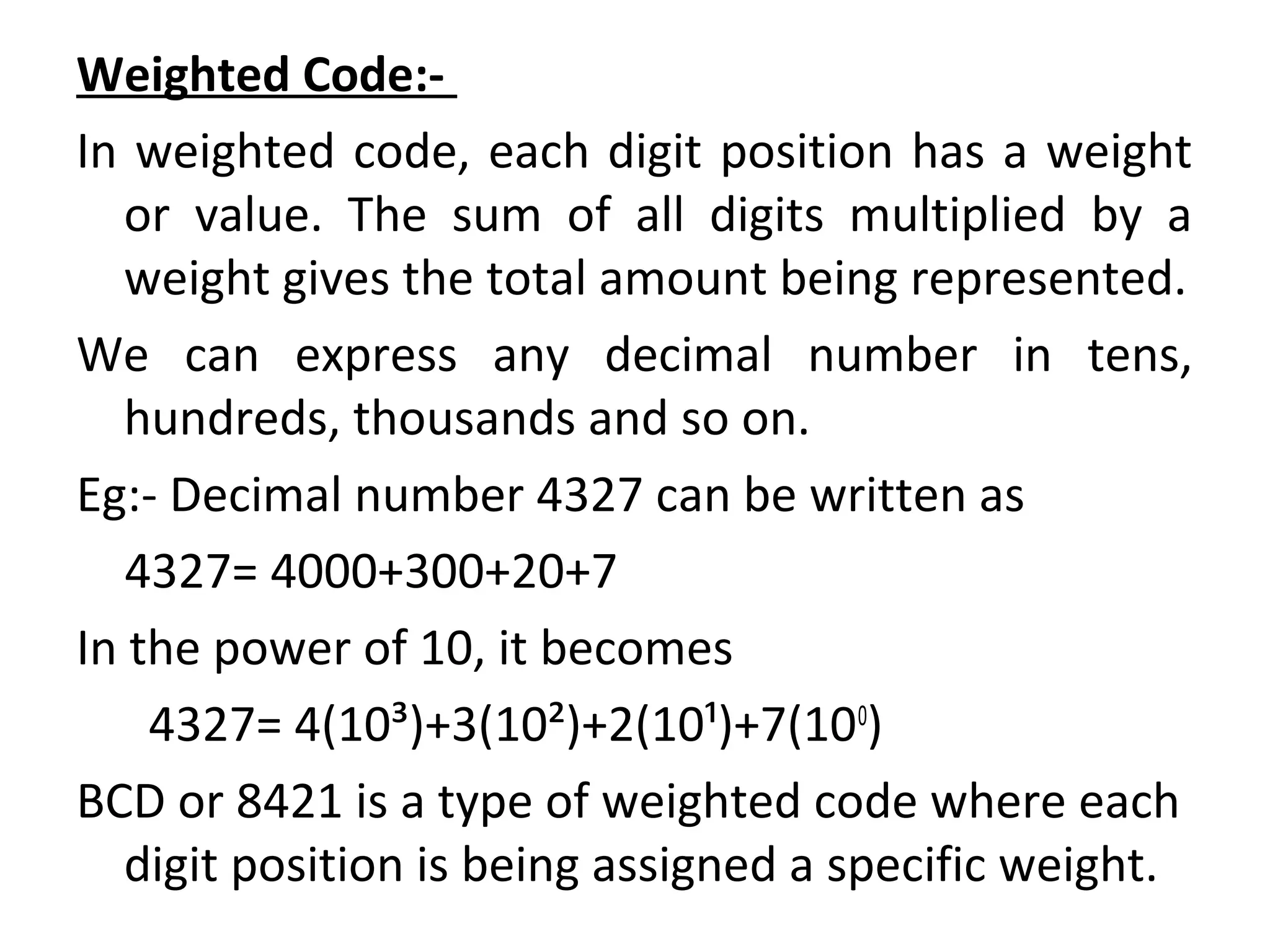
In weighted code, each digit position has a weight 
or value. The sum of all digits multiplied by a 
weight gives the total amount being represented. 
We can express any decimal number in tens, 
hundreds, thousands and so on. 
Eg:- Decimal number 4327 can be written as 
4327= 4000+300+20+7 
In the power of 10, it becomes 
4327= 4(10³)+3(10²)+2(10¹)+7(100) 
BCD or 8421 is a type of weighted code where each 
digit position is being assigned a specific weight.
Non-weighted code:- 
In non-weighted code, there is no positional 
weight i.e. each position within the binary 
number is not assigned a prefixed value. No 
specific weights are assigned to bit position in 
non –weighted code. 
The non-weighted codes are:- 
a) The Gray code b) The Excess-3 code
BCD or 8421 code:- 
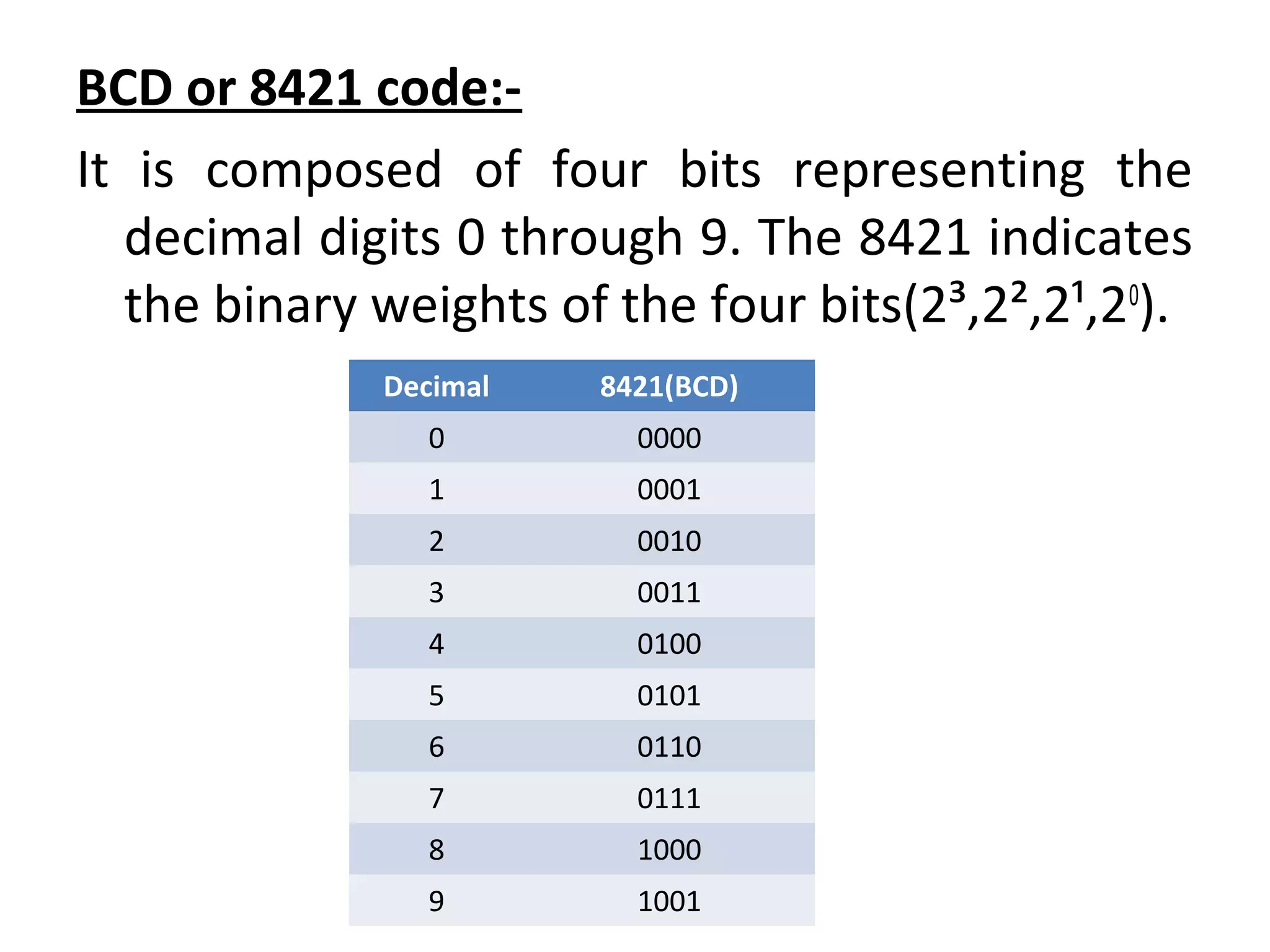
It is composed of four bits representing the 
decimal digits 0 through 9. The 8421 indicates 
the binary weights of the four bits(2³,2²,2¹,20). 
Decimal 8421(BCD) 
0 0000 
1 0001 
2 0010 
3 0011 
4 0100 
5 0101 
6 0110 
7 0111 
8 1000 
9 1001
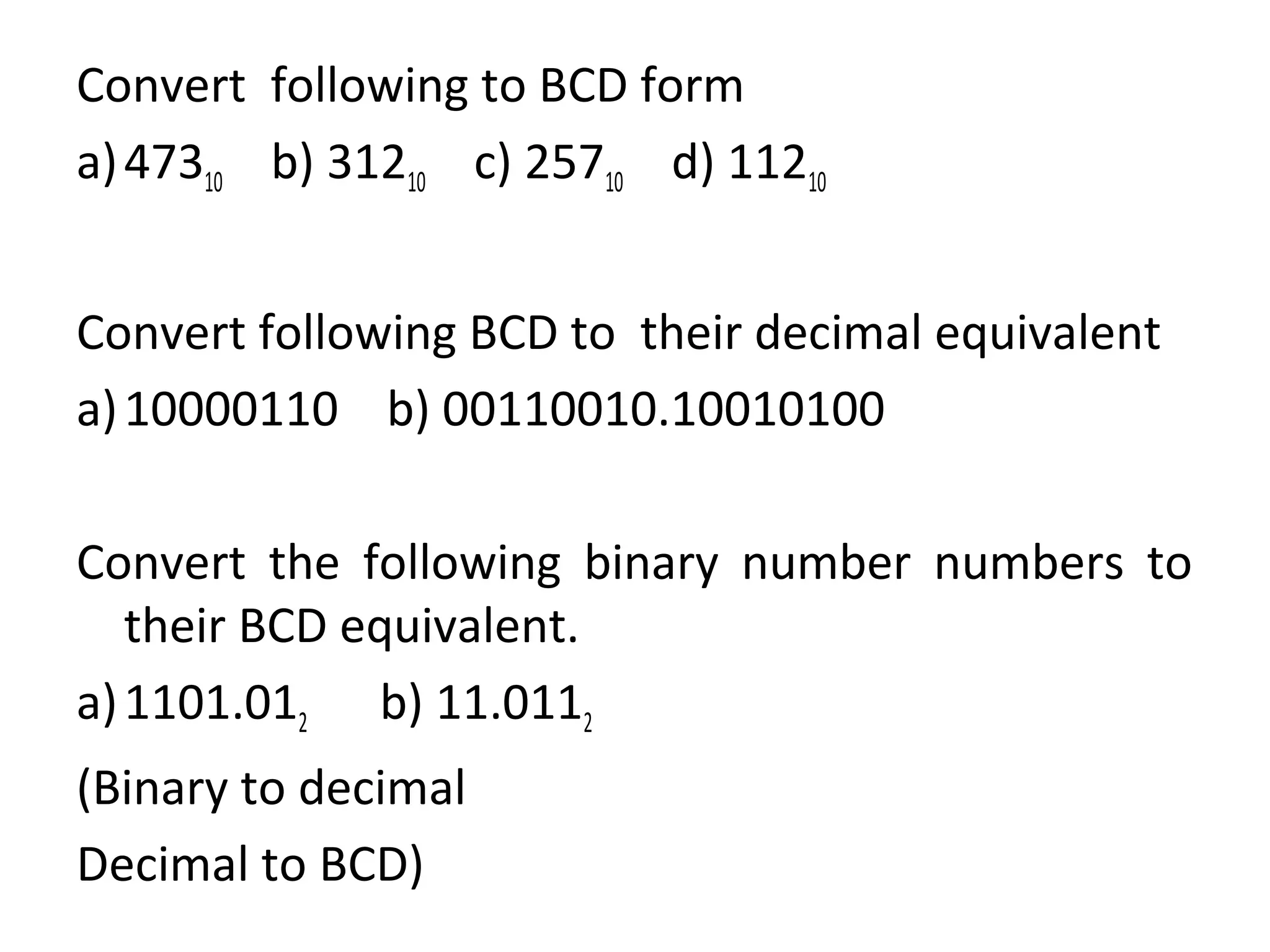
Convert following to BCD form 
a)47310 b) 31210 c) 25710 d) 11210 
Convert following BCD to their decimal equivalent 
a)10000110 b) 00110010.10010100 
Convert the following binary number numbers to 
their BCD equivalent. 
a)1101.012 b) 11.0112 
(Binary to decimal 
Decimal to BCD)
BCD addition 
Add two numbers as same as binary addition 
Case 1: If the result is less than or equals to 9 
and carry is zero then it is valid BCD. 
Case 2: If result is greater than 9 and carry is 
zero then add 6 in four bit combination. 
Case 3: If result is less than or equals to 9 but 
carry is 1 then add 6 in four bit combination.
Packed BCD 
The BCD numbers corresponding to decimal 
numbers beyond 9 are called as packed BCD 
Decimal (25) 0010 0101(Packed BCD)
9’s complement: 
9’s complement of a BCD number can be 
obtained by subtracting it from 9. 
10’s compliment: 
10’s compliment is obtained by adding 1 to 9’s 
compliment
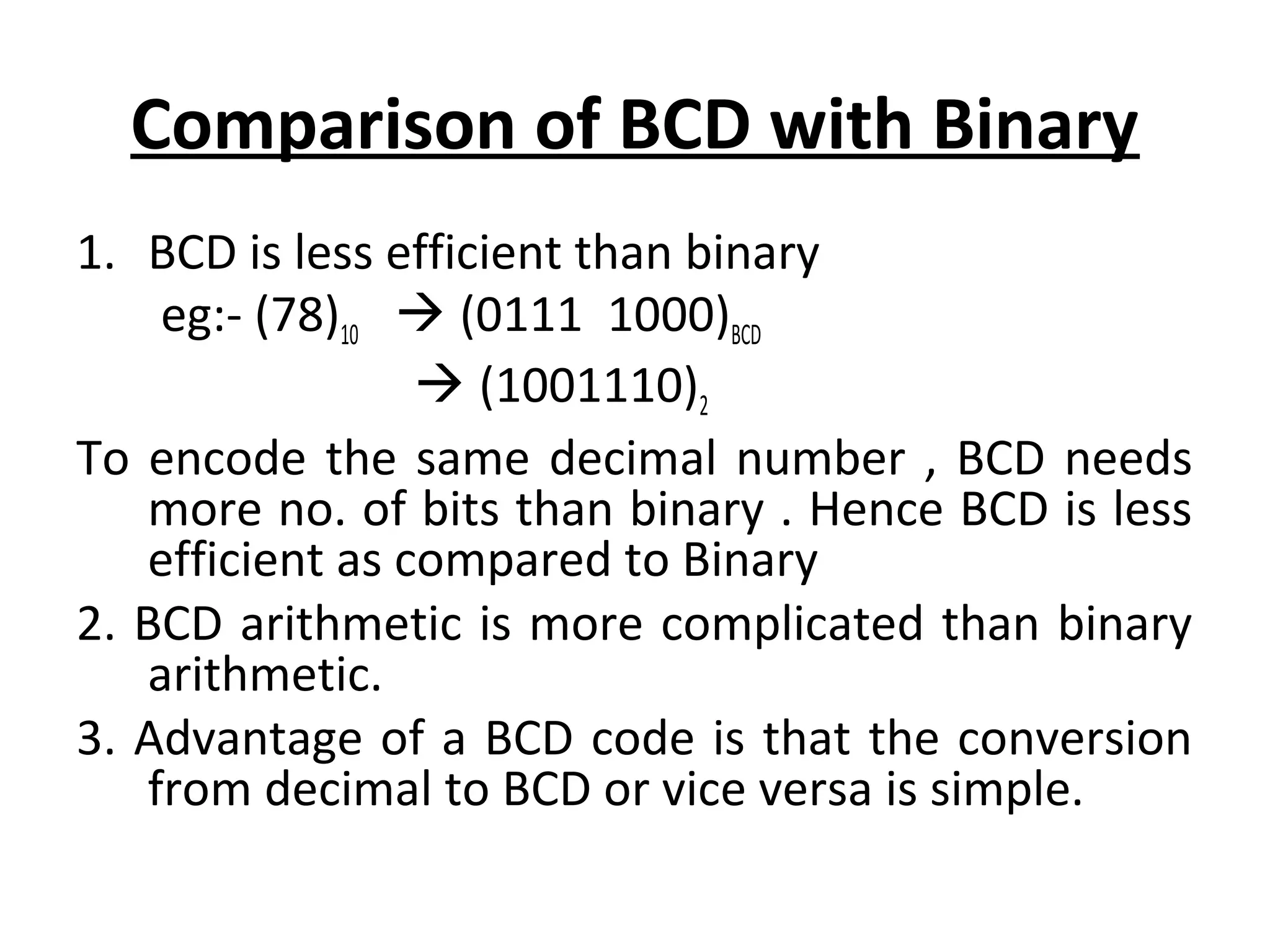
Comparison of BCD with Binary 
1. BCD is less efficient than binary 
eg:- (78)10  (0111 1000)BCD 
 (1001110)2 
To encode the same decimal number , BCD needs 
more no. of bits than binary . Hence BCD is less 
efficient as compared to Binary 
2. BCD arithmetic is more complicated than binary 
arithmetic. 
3. Advantage of a BCD code is that the conversion 
from decimal to BCD or vice versa is simple.
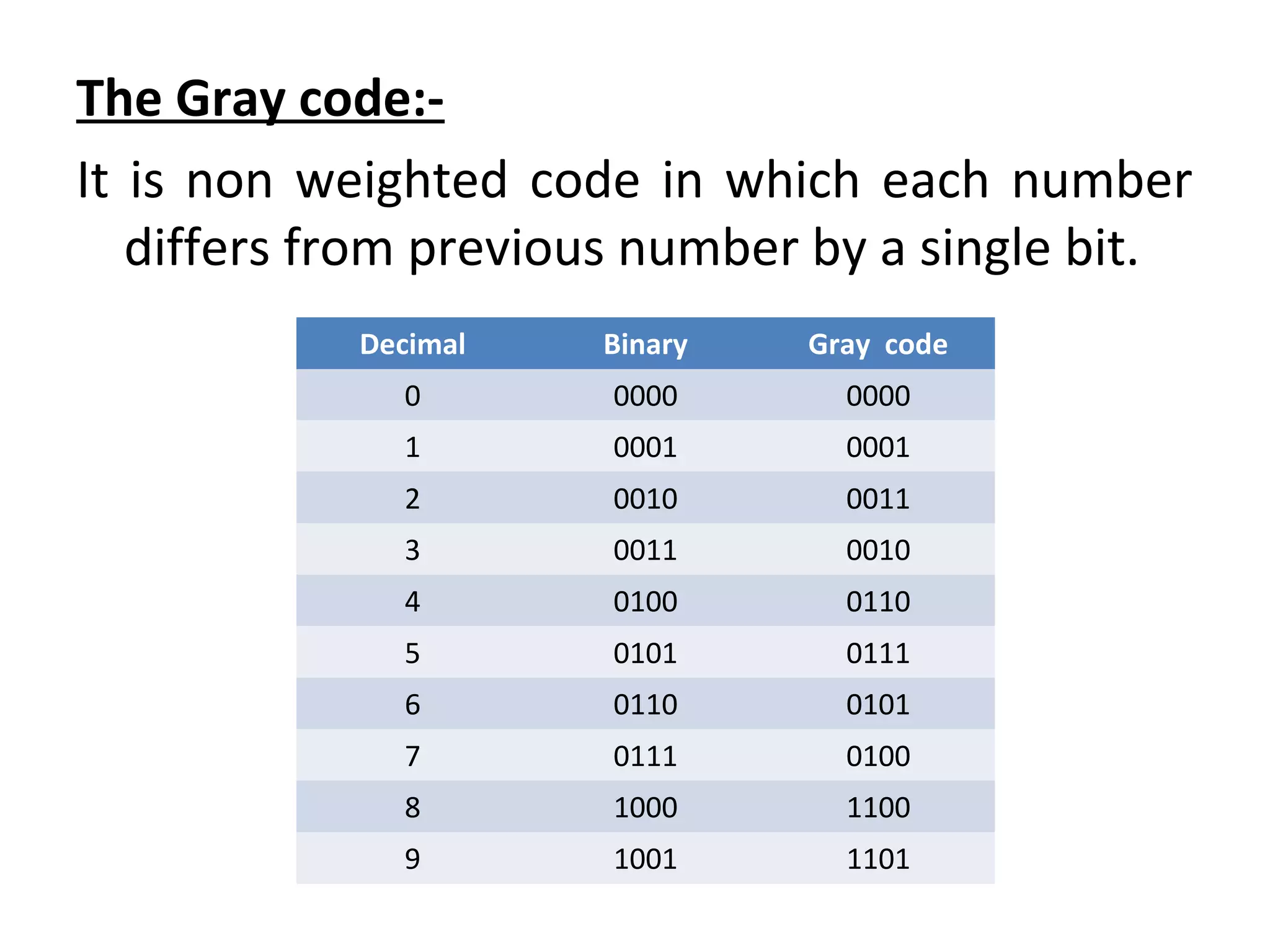
The Gray code:- 
It is non weighted code in which each number 
differs from previous number by a single bit. 
Decimal Binary Gray code 
0 0000 0000 
1 0001 0001 
2 0010 0011 
3 0011 0010 
4 0100 0110 
5 0101 0111 
6 0110 0101 
7 0111 0100 
8 1000 1100 
9 1001 1101
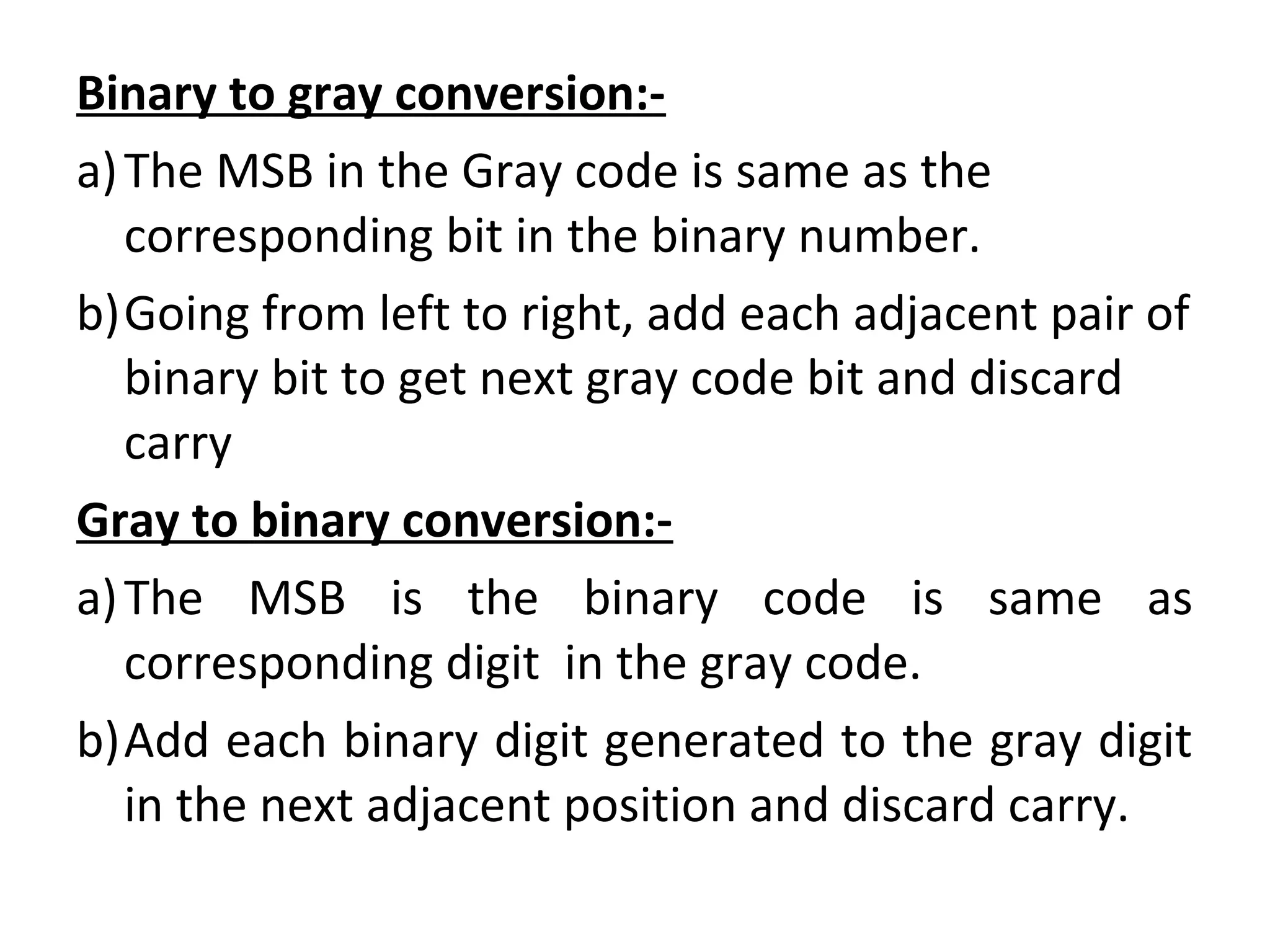
Binary to gray conversion:- 
a)The MSB in the Gray code is same as the 
corresponding bit in the binary number. 
b)Going from left to right, add each adjacent pair of 
binary bit to get next gray code bit and discard 
carry 
Gray to binary conversion:- 
a)The MSB is the binary code is same as 
corresponding digit in the gray code. 
b)Add each binary digit generated to the gray digit 
in the next adjacent position and discard carry.
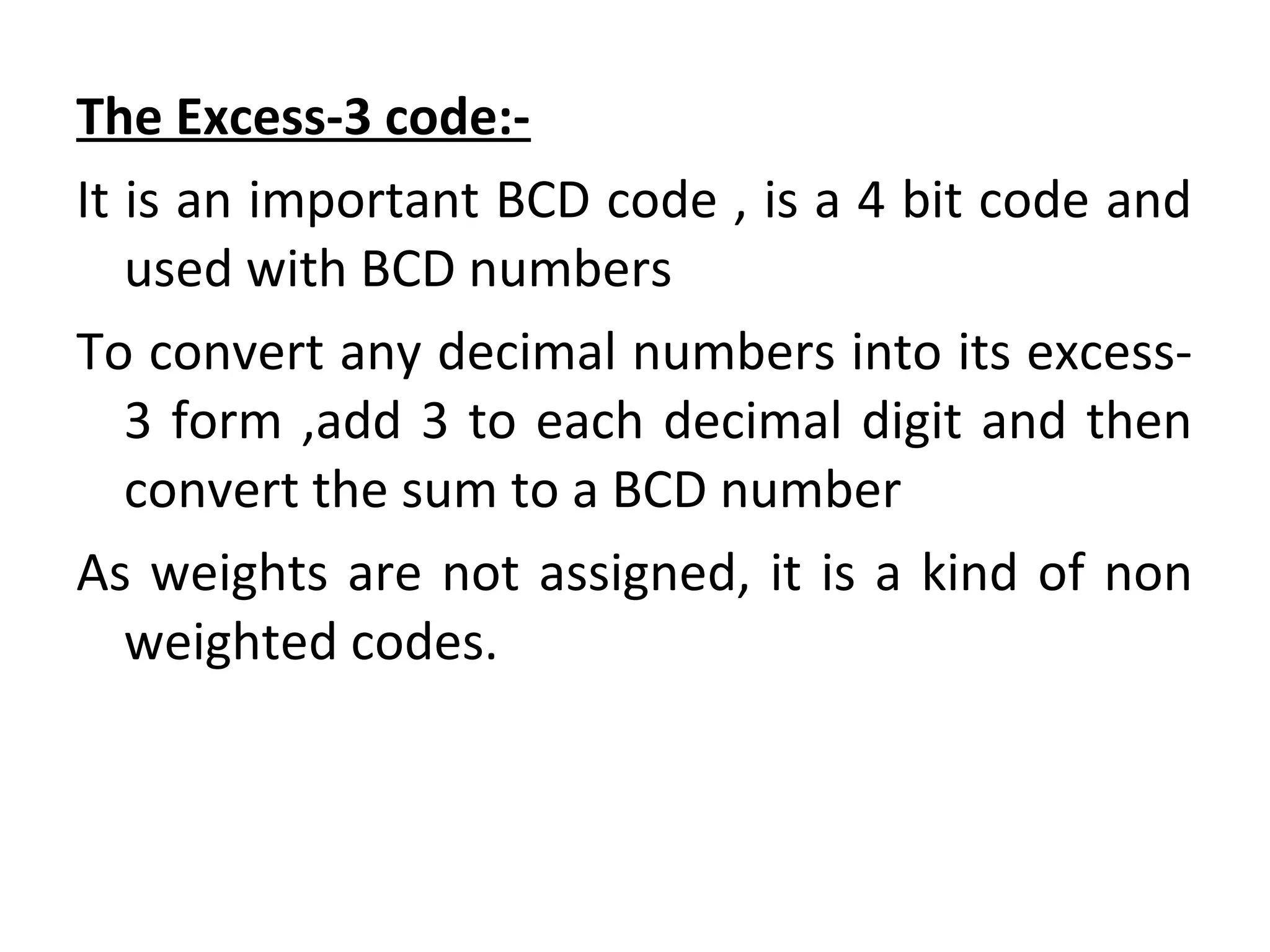
The Excess-3 code:- 
It is an important BCD code , is a 4 bit code and 
used with BCD numbers 
To convert any decimal numbers into its excess- 
3 form ,add 3 to each decimal digit and then 
convert the sum to a BCD number 
As weights are not assigned, it is a kind of non 
weighted codes.
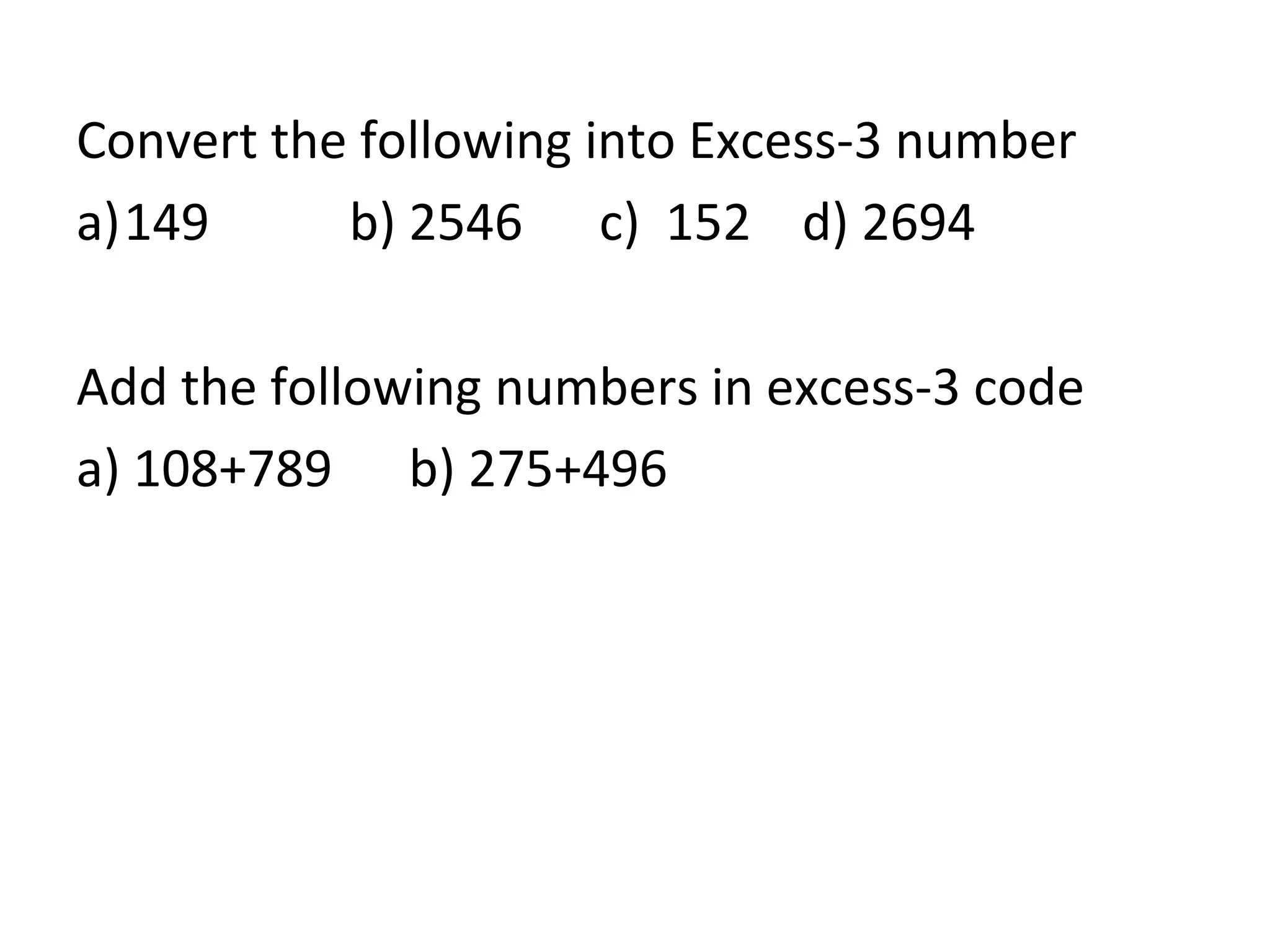
Convert the following into Excess-3 number 
a)149 b) 2546 c) 152 d) 2694 
Add the following numbers in excess-3 code 
a) 108+789 b) 275+496

BCD,GRAY and EXCESS 3 codes

  • 1.
    Weighted and Nonweighted code
  • 2.
    Weighted Code:- Inweighted code, each digit position has a weight or value. The sum of all digits multiplied by a weight gives the total amount being represented. We can express any decimal number in tens, hundreds, thousands and so on. Eg:- Decimal number 4327 can be written as 4327= 4000+300+20+7 In the power of 10, it becomes 4327= 4(10³)+3(10²)+2(10¹)+7(100) BCD or 8421 is a type of weighted code where each digit position is being assigned a specific weight.
  • 3.
    Non-weighted code:- Innon-weighted code, there is no positional weight i.e. each position within the binary number is not assigned a prefixed value. No specific weights are assigned to bit position in non –weighted code. The non-weighted codes are:- a) The Gray code b) The Excess-3 code
  • 4.
    BCD or 8421code:- It is composed of four bits representing the decimal digits 0 through 9. The 8421 indicates the binary weights of the four bits(2³,2²,2¹,20). Decimal 8421(BCD) 0 0000 1 0001 2 0010 3 0011 4 0100 5 0101 6 0110 7 0111 8 1000 9 1001
  • 5.
    Convert following toBCD form a)47310 b) 31210 c) 25710 d) 11210 Convert following BCD to their decimal equivalent a)10000110 b) 00110010.10010100 Convert the following binary number numbers to their BCD equivalent. a)1101.012 b) 11.0112 (Binary to decimal Decimal to BCD)
  • 6.
    BCD addition Addtwo numbers as same as binary addition Case 1: If the result is less than or equals to 9 and carry is zero then it is valid BCD. Case 2: If result is greater than 9 and carry is zero then add 6 in four bit combination. Case 3: If result is less than or equals to 9 but carry is 1 then add 6 in four bit combination.
  • 7.
    Packed BCD TheBCD numbers corresponding to decimal numbers beyond 9 are called as packed BCD Decimal (25) 0010 0101(Packed BCD)
  • 8.
    9’s complement: 9’scomplement of a BCD number can be obtained by subtracting it from 9. 10’s compliment: 10’s compliment is obtained by adding 1 to 9’s compliment
  • 9.
    Comparison of BCDwith Binary 1. BCD is less efficient than binary eg:- (78)10  (0111 1000)BCD  (1001110)2 To encode the same decimal number , BCD needs more no. of bits than binary . Hence BCD is less efficient as compared to Binary 2. BCD arithmetic is more complicated than binary arithmetic. 3. Advantage of a BCD code is that the conversion from decimal to BCD or vice versa is simple.
  • 10.
    The Gray code:- It is non weighted code in which each number differs from previous number by a single bit. Decimal Binary Gray code 0 0000 0000 1 0001 0001 2 0010 0011 3 0011 0010 4 0100 0110 5 0101 0111 6 0110 0101 7 0111 0100 8 1000 1100 9 1001 1101
  • 11.
    Binary to grayconversion:- a)The MSB in the Gray code is same as the corresponding bit in the binary number. b)Going from left to right, add each adjacent pair of binary bit to get next gray code bit and discard carry Gray to binary conversion:- a)The MSB is the binary code is same as corresponding digit in the gray code. b)Add each binary digit generated to the gray digit in the next adjacent position and discard carry.
  • 12.
    The Excess-3 code:- It is an important BCD code , is a 4 bit code and used with BCD numbers To convert any decimal numbers into its excess- 3 form ,add 3 to each decimal digit and then convert the sum to a BCD number As weights are not assigned, it is a kind of non weighted codes.
  • 13.
    Convert the followinginto Excess-3 number a)149 b) 2546 c) 152 d) 2694 Add the following numbers in excess-3 code a) 108+789 b) 275+496