CONGENITAL
HYPERTROPHIC PYLORIC
STENOSIS
Dr. kundan
Department of surgery
Patna medical college & Hospital
HYPERTROPHIC PYLORIC
STENOSIS
 One of most common GI disorders during
early infancy.
 The history of what we now refer to as
infantile hypertrophic pyloric stenosis dates
back to the early 1700s.
 Blair described an infant with postmortem
findings consistent with hypertrophic pyloric
stenosis in 1717
 Described by Hirschsprung in 1888.
 Hypertrophy of circular muscles of pylorus
results in constriction and obstruction of
gastric outlet.
EPIDEMIOLOGY AND
ETIOLOGY
• Incidence: 1-2/1000 live births
• Epidemiology: more in first born males
M:F - 4-5:1
• Etiology: Unknown
• Genetic- 11q14-22 and Xq23
• Familial
• Gender
• Ethnic origin- more in whites
• As new technology and concepts have
evolved,additional associations that involve IHPS
and gastrointestinal peptides, growth factors,
neurotrophins, changes in neural development,
and nitric oxide have been described.
•
ASSOCIATED ANOMALIES
 Esophageal atresia
 Tracheoesophageal fistula
 Hirschsprung disease
 Exomphalos
 Inguinal hernia
 Hypospadias
 Undescended testis
CLINICAL
PRESENTATION
 History: 2nd
- 8th
week of life
 Projectile, frequent episodes of non-bilious
vomiting 30-60 minutes after feeding
 Weight loss
 Persistent hunger
 Jaundice (2%)- due to
decreased hepatic glucoronosyl
transferase associated
with starvation
 Examination:
 Palpable olive shaped mass (1.5-2cm) to
the right of epigastric area.
 Visible gastric peristalsis
from Lt. upper quadrant to
epigastrium
 s/o dehydration
PATHOPHYSIOLOGY
• Vomiting → loss of H and Cl →⁺ ⁻
Hypochloremic hypokalemic metabolic
alkalosis
• Protracted vomiting → ECF volume deficit →
urinary excretion of K and H to preserve Na⁺ ⁺ ⁺
and water
• Initial alkalotic urine becomes acidotic-
Paradoxical aciduria
• Hypochloremic hypokalemic metabolic
alkalosis with paradoxical aciduria with
secondary respiratory acidosis
• Hyponatremia may not be evident because of
hypovolemia
DIAGNOSIS
 History and physical examination
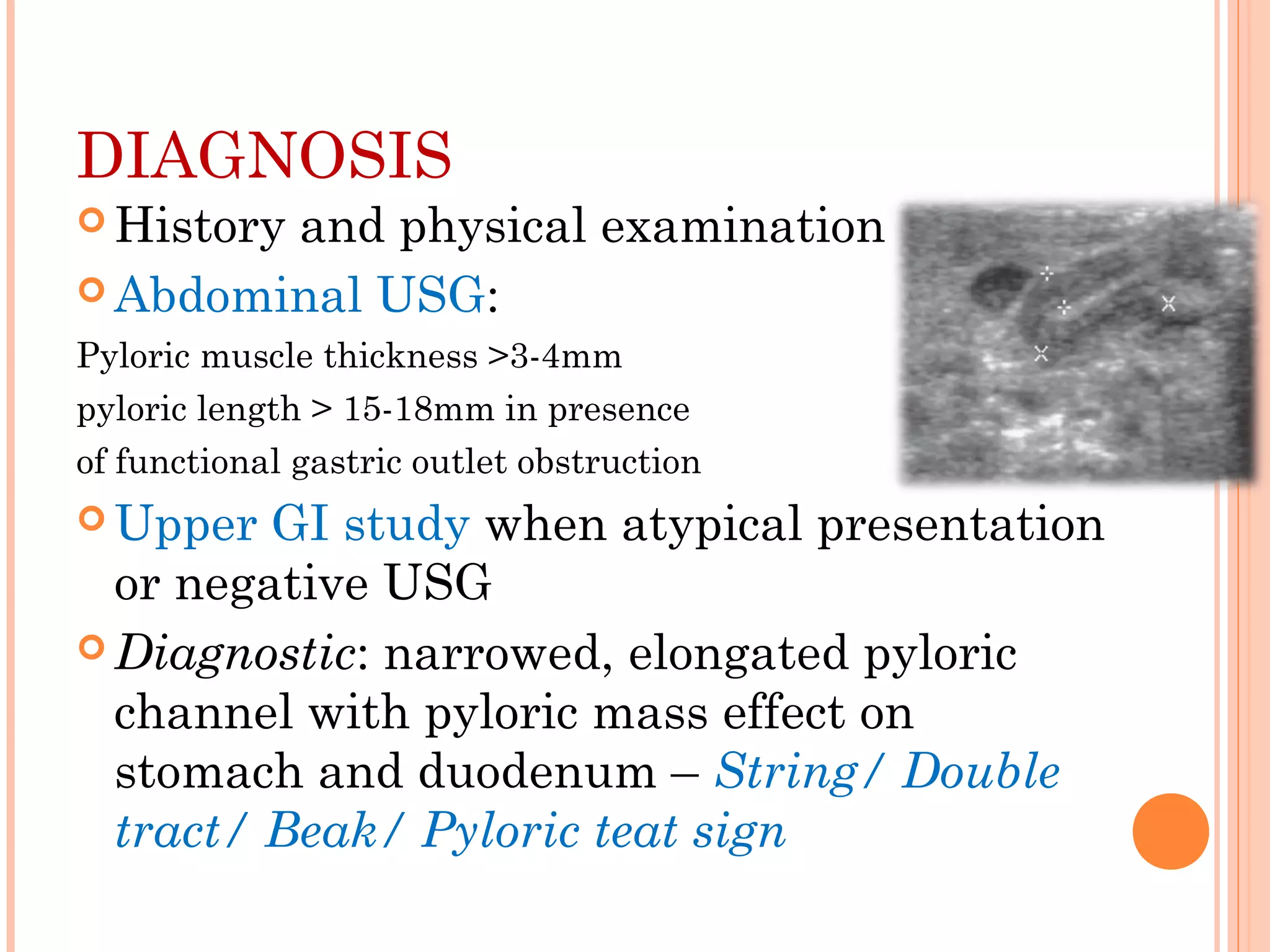
 Abdominal USG:
Pyloric muscle thickness >3-4mm
pyloric length > 15-18mm in presence
of functional gastric outlet obstruction
 Upper GI study when atypical presentation
or negative USG
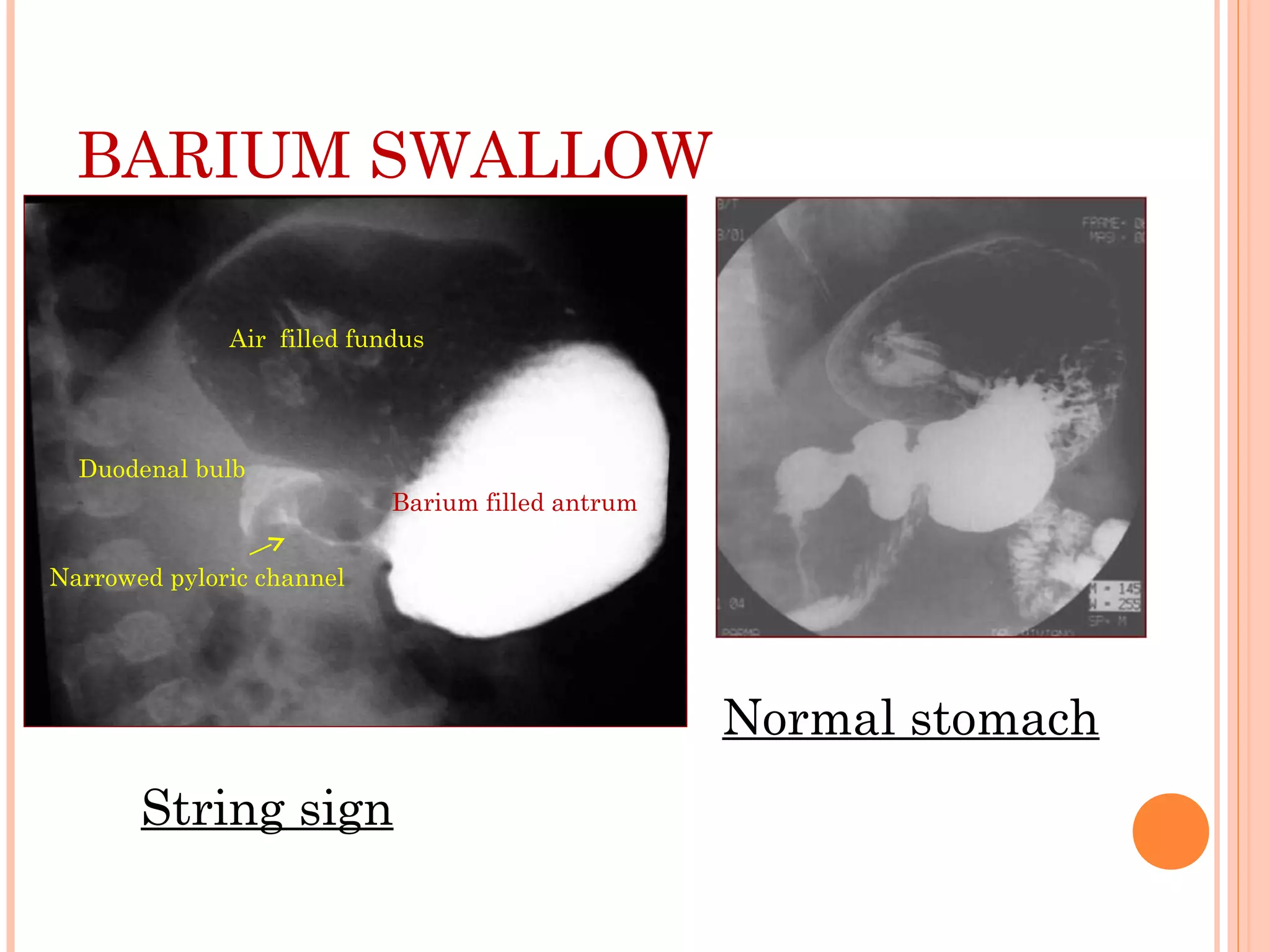
 Diagnostic: narrowed, elongated pyloric
channel with pyloric mass effect on
stomach and duodenum – String/ Double
tract/ Beak/ Pyloric teat sign
BARIUM SWALLOW
Duodenal bulb
Air filled fundus
Barium filled antrum
Narrowed pyloric channel
String sign
Normal stomach
DIFFERENTIAL DIAGNOSIS
 Gastroesophageal reflux, with or without hiatal
hernia.
Differentiated by radiologic studies. Also
amount of vomitus is smaller, and the infant does
not usually lose weight.
 Adrenal insufficiency.
Differentiated by absence of
metabolic acidosis, hyperkalemia, and elevated
urinary sodium.
 Viral gastroenteritis.
Unusual in infants less than 6
weeks of age. Associated with significant diarrhea
and sick contacts.
• Treatment: medical emergency but NOT
surgical emergency
• Definitive treatment: Ramstedt
Pyloromyotomy
• Anaesthetic considerations
• Patient related: infant age group
severe dehydration
electrolyte imbalance
• Surgery related: open/ laparoscopic
Celiac reflex
• Anaesthesia related: pulmonary aspiration
PONV
PREOPERATIVE
PREPARATION
• Correction of fluid deficits- over 24-48 hrs
• Deficit: isotonic fluid 0.9% saline (20ml/kg
bolus)
• Maintenance: 0.45% saline in 5% Dextrose at
1.5 times maintenance rate +10-40 meq/L
KCL added once urine output established
• Correction of electrolyte imbalances
• Prevention of aspiration: aspiration through
NGT
Surgery should only take place when
dehydration corrected, normal S. Na and K,
Cl > 90mmol/L, HCO <28mmol/L and BE⁻ ₃
<+2.
SURGICAL MANAGEMENT
 Once resuscitated the infant can undergo the
Fredet-Ramstedt pylormyotomy, which is the
procedure of choice.
Ramstedt described this operative procedure to
alleviate the condition in 1907
 It consist of incision in to the sphincter muscle of
pylorus.
 NG tube is passed and gastric content are
aspirated just prior to surgery.
SURGERY
 Laparoscopic Procedure
1 2 3
COMPLICATIONS
 Complications after pyloromyotomy should be
minimal if performed by experienced surgeons.
 Perforation (In a large series of infants
undergoing open pyloromyotomy, the incidence of
perforation was 2.3%).
 Wound-related complications occurred in 1%.
POSTOPERATIVE CARE
• Post op pain relief:
Acetaminophen 30-40mg/kg rectal
suppository
LA infiltration of surgical incision
• Post op concerns:
Respiratory depression and apnea due to CSF
alkalosis and intraop hyperventilation
Hypoglycemia
Hypothermia
Therefore post op monitoring for 12 hrs is recommended in
these patients.

Congenital hypertrophic pyloric stenosis

  • 1.
    CONGENITAL HYPERTROPHIC PYLORIC STENOSIS Dr. kundan Departmentof surgery Patna medical college & Hospital
  • 2.
    HYPERTROPHIC PYLORIC STENOSIS  Oneof most common GI disorders during early infancy.  The history of what we now refer to as infantile hypertrophic pyloric stenosis dates back to the early 1700s.  Blair described an infant with postmortem findings consistent with hypertrophic pyloric stenosis in 1717  Described by Hirschsprung in 1888.  Hypertrophy of circular muscles of pylorus results in constriction and obstruction of gastric outlet.
  • 3.
    EPIDEMIOLOGY AND ETIOLOGY • Incidence:1-2/1000 live births • Epidemiology: more in first born males M:F - 4-5:1 • Etiology: Unknown • Genetic- 11q14-22 and Xq23 • Familial • Gender • Ethnic origin- more in whites • As new technology and concepts have evolved,additional associations that involve IHPS and gastrointestinal peptides, growth factors, neurotrophins, changes in neural development, and nitric oxide have been described. •
  • 4.
    ASSOCIATED ANOMALIES  Esophagealatresia  Tracheoesophageal fistula  Hirschsprung disease  Exomphalos  Inguinal hernia  Hypospadias  Undescended testis
  • 5.
    CLINICAL PRESENTATION  History: 2nd -8th week of life  Projectile, frequent episodes of non-bilious vomiting 30-60 minutes after feeding  Weight loss  Persistent hunger  Jaundice (2%)- due to decreased hepatic glucoronosyl transferase associated with starvation
  • 6.
     Examination:  Palpableolive shaped mass (1.5-2cm) to the right of epigastric area.  Visible gastric peristalsis from Lt. upper quadrant to epigastrium  s/o dehydration
  • 7.
    PATHOPHYSIOLOGY • Vomiting →loss of H and Cl →⁺ ⁻ Hypochloremic hypokalemic metabolic alkalosis • Protracted vomiting → ECF volume deficit → urinary excretion of K and H to preserve Na⁺ ⁺ ⁺ and water • Initial alkalotic urine becomes acidotic- Paradoxical aciduria • Hypochloremic hypokalemic metabolic alkalosis with paradoxical aciduria with secondary respiratory acidosis • Hyponatremia may not be evident because of hypovolemia
  • 8.
    DIAGNOSIS  History andphysical examination  Abdominal USG: Pyloric muscle thickness >3-4mm pyloric length > 15-18mm in presence of functional gastric outlet obstruction  Upper GI study when atypical presentation or negative USG  Diagnostic: narrowed, elongated pyloric channel with pyloric mass effect on stomach and duodenum – String/ Double tract/ Beak/ Pyloric teat sign
  • 9.
    BARIUM SWALLOW Duodenal bulb Airfilled fundus Barium filled antrum Narrowed pyloric channel String sign Normal stomach
  • 10.
    DIFFERENTIAL DIAGNOSIS  Gastroesophagealreflux, with or without hiatal hernia. Differentiated by radiologic studies. Also amount of vomitus is smaller, and the infant does not usually lose weight.  Adrenal insufficiency. Differentiated by absence of metabolic acidosis, hyperkalemia, and elevated urinary sodium.  Viral gastroenteritis. Unusual in infants less than 6 weeks of age. Associated with significant diarrhea and sick contacts.
  • 11.
    • Treatment: medicalemergency but NOT surgical emergency • Definitive treatment: Ramstedt Pyloromyotomy • Anaesthetic considerations • Patient related: infant age group severe dehydration electrolyte imbalance • Surgery related: open/ laparoscopic Celiac reflex • Anaesthesia related: pulmonary aspiration PONV
  • 12.
    PREOPERATIVE PREPARATION • Correction offluid deficits- over 24-48 hrs • Deficit: isotonic fluid 0.9% saline (20ml/kg bolus) • Maintenance: 0.45% saline in 5% Dextrose at 1.5 times maintenance rate +10-40 meq/L KCL added once urine output established • Correction of electrolyte imbalances • Prevention of aspiration: aspiration through NGT Surgery should only take place when dehydration corrected, normal S. Na and K, Cl > 90mmol/L, HCO <28mmol/L and BE⁻ ₃ <+2.
  • 13.
    SURGICAL MANAGEMENT  Onceresuscitated the infant can undergo the Fredet-Ramstedt pylormyotomy, which is the procedure of choice. Ramstedt described this operative procedure to alleviate the condition in 1907  It consist of incision in to the sphincter muscle of pylorus.  NG tube is passed and gastric content are aspirated just prior to surgery.
  • 14.
  • 15.
  • 16.
    COMPLICATIONS  Complications afterpyloromyotomy should be minimal if performed by experienced surgeons.  Perforation (In a large series of infants undergoing open pyloromyotomy, the incidence of perforation was 2.3%).  Wound-related complications occurred in 1%.
  • 17.
    POSTOPERATIVE CARE • Postop pain relief: Acetaminophen 30-40mg/kg rectal suppository LA infiltration of surgical incision • Post op concerns: Respiratory depression and apnea due to CSF alkalosis and intraop hyperventilation Hypoglycemia Hypothermia Therefore post op monitoring for 12 hrs is recommended in these patients.

Editor's Notes

  • #18 Therefore post op monitoring for 12 hrs is recommended in these patients.