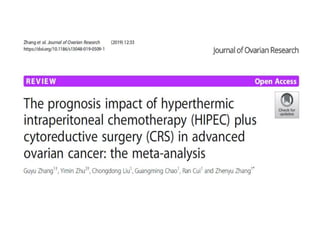
Hyperthermic
intraperitoneal chemotherapy (HIPEC) plus
cytoreductive surgery (CRS) in advanced
ovarian cancer: the meta-analysis
Dr Kundan
Department of Surgical Oncology
Mahavir Cancer Sansthan
• The earliest known use of hyperthermia to
treat cancerous tissue was by the Ancient
Greeks, Romans, and Egyptians around 2000
BC.
• Presently, hyperthermia is divided into the
following three categories: local,regional/part-
body, and whole body.
• However, clinical results by HT alone have not
always been satisfactory.
• The most striking cellular changes in response
to HT are the disruptions of cytoskeletal
structures.
• Exposure of cells to heat stress leads to
protein denaturation and aggregation in the
cells, assuming that the accumulation of
unfolding proteins is the signal which initiates
the heat-shock response.
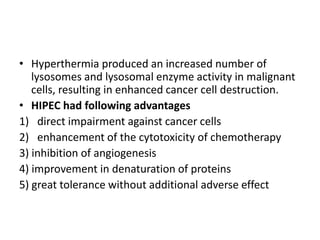
• Hyperthermia produced an increased number of
lysosomes and lysosomal enzyme activity in malignant
cells, resulting in enhanced cancer cell destruction.
• HIPEC had following advantages
1) direct impairment against cancer cells
2) enhancement of the cytotoxicity of chemotherapy
3) inhibition of angiogenesis
4) improvement in denaturation of proteins
5) great tolerance without additional adverse effect
• Systemic chemotherapy has little effect on PM
because the blood-peritoneal barrier (BPB)
impedes the penetration of drugs from the
systemic circulation into the peritoneal cavity.
• Intraperitoneal (IP) chemotherapy
concentrates drugs locoregionally in the
peritoneal cavity to a greater extent than does
systemic chemotherapy.
• Gynaecologic Oncology Group-
debulking to zero residual disease (RD0);
optimal debulking (0-10mm, RD1);
suboptimal debulking (>10mm, RD2).
Table : PCI cutoff levels and 5-year survival rates in patients with peritoneal metastases, treated at
Peritoneal Surface Malignancy Treatment Centers belonging to Japanese NPO to support peritoneal
surface malignancy treatment
Source : Y. Yonemura et al. Hyperthermic Oncology from Bench to Bedside
• Epithelial ovarian cancer has a marked
propensity for peritoneal spread, which makes
it suitable for aggressive loco-regional
therapies.
• 5-year survival rate of less than 30%
For CRS alone, the DESKTOP OVAR Trial showed that macroscopically
completely resected tumours showed significantly longer overall
survival compared to patients who had any visible residual tumour.
[median 45.2 vs. 19.7 months; hazard ratio (HR) 3.71; 95% confidence
interval (CI) 2.27-6.05; P < .0001]
• Survival of ovarian cancer patients treated with cytoreductive
surgery and perioperative intraperitoneal chemotherapy
Morbidity, hospital stay and mortality for patients with ovarian cancer treated with
cytoreductive surgery and heated intraoperative intraperitoneal chemotherapy
• 429 patients who underwent randomization, 415 were
eligible.
• Grade 3 and 4 pain, fatigue, and hematologic,
gastrointestinal, metabolic, and neurologic toxic effects
were more common in the intraperitoneal-therapy group
than in the intravenous- therapy group (P ≤ 0.001).
• The median PFS in the intravenous-therapy and
intraperitoneal-therapy groups was 18.3 and 23.8 months,
respectively (P = 0.05 by the log-rank test).
• The median duration of OS in the intravenous-therapy and
intraperitonealtherapy groups was 49.7 and 65.6 months,
respectively (P = 0.03 by the log-rank test).
• In this meta-analysis, comparative clinical
trials were included.
• Experimental group - patients who were
treated with CRS + hyperthermic
intraperitoneal chemotherapy (HIPEC),
• Control group - the patients treated with
traditional treatment without HIPEC
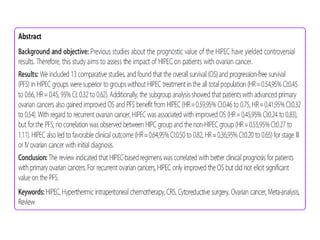
Pooled data demonstrated that there was an improvement in OS HIPEC groups
compared with the groups without HIPEC treatment in all population (HR = 0.54,95%
CI:0.45 to 0.66,)
Forest plot of PFS
Subgroup analysis
• The current meta-analysis demonstrated that
the HIPEC not only improved OS significantly
but also prolonged the PFS in all population.
• Subgroup analysis indicated that HIPEC was
associated with better clinical outcome
whether primary or recurrent patients. Even
stage III or IV ovarian cancer patients could
benefit from HIPEC.
• In conclusion, there is an emerging body of
evidence that supports the use of HIPEC with CRS
and systemic chemotherapy for primary and
recurrent EOC compared to CRS and
chemotherapy alone.
• Maximal cytoreduction remains essential for
overall survival rates, even when HIPEC is used.
• In both primary and recurrent EOC treated with
HIPEC+CRS, the importance of complete
cytoreduction remains vital for long-term survival
outcomes.
Hipec  _ meta analysis

Hipec _ meta analysis

  • 1.
    Hyperthermic intraperitoneal chemotherapy (HIPEC)plus cytoreductive surgery (CRS) in advanced ovarian cancer: the meta-analysis Dr Kundan Department of Surgical Oncology Mahavir Cancer Sansthan
  • 3.
    • The earliestknown use of hyperthermia to treat cancerous tissue was by the Ancient Greeks, Romans, and Egyptians around 2000 BC. • Presently, hyperthermia is divided into the following three categories: local,regional/part- body, and whole body. • However, clinical results by HT alone have not always been satisfactory.
  • 4.
    • The moststriking cellular changes in response to HT are the disruptions of cytoskeletal structures. • Exposure of cells to heat stress leads to protein denaturation and aggregation in the cells, assuming that the accumulation of unfolding proteins is the signal which initiates the heat-shock response.
  • 7.
    • Hyperthermia producedan increased number of lysosomes and lysosomal enzyme activity in malignant cells, resulting in enhanced cancer cell destruction. • HIPEC had following advantages 1) direct impairment against cancer cells 2) enhancement of the cytotoxicity of chemotherapy 3) inhibition of angiogenesis 4) improvement in denaturation of proteins 5) great tolerance without additional adverse effect
  • 9.
    • Systemic chemotherapyhas little effect on PM because the blood-peritoneal barrier (BPB) impedes the penetration of drugs from the systemic circulation into the peritoneal cavity. • Intraperitoneal (IP) chemotherapy concentrates drugs locoregionally in the peritoneal cavity to a greater extent than does systemic chemotherapy.
  • 13.
    • Gynaecologic OncologyGroup- debulking to zero residual disease (RD0); optimal debulking (0-10mm, RD1); suboptimal debulking (>10mm, RD2).
  • 14.
    Table : PCIcutoff levels and 5-year survival rates in patients with peritoneal metastases, treated at Peritoneal Surface Malignancy Treatment Centers belonging to Japanese NPO to support peritoneal surface malignancy treatment Source : Y. Yonemura et al. Hyperthermic Oncology from Bench to Bedside
  • 16.
    • Epithelial ovariancancer has a marked propensity for peritoneal spread, which makes it suitable for aggressive loco-regional therapies. • 5-year survival rate of less than 30%
  • 18.
    For CRS alone,the DESKTOP OVAR Trial showed that macroscopically completely resected tumours showed significantly longer overall survival compared to patients who had any visible residual tumour. [median 45.2 vs. 19.7 months; hazard ratio (HR) 3.71; 95% confidence interval (CI) 2.27-6.05; P < .0001]
  • 20.
    • Survival ofovarian cancer patients treated with cytoreductive surgery and perioperative intraperitoneal chemotherapy
  • 21.
    Morbidity, hospital stayand mortality for patients with ovarian cancer treated with cytoreductive surgery and heated intraoperative intraperitoneal chemotherapy
  • 23.
    • 429 patientswho underwent randomization, 415 were eligible. • Grade 3 and 4 pain, fatigue, and hematologic, gastrointestinal, metabolic, and neurologic toxic effects were more common in the intraperitoneal-therapy group than in the intravenous- therapy group (P ≤ 0.001). • The median PFS in the intravenous-therapy and intraperitoneal-therapy groups was 18.3 and 23.8 months, respectively (P = 0.05 by the log-rank test). • The median duration of OS in the intravenous-therapy and intraperitonealtherapy groups was 49.7 and 65.6 months, respectively (P = 0.03 by the log-rank test).
  • 26.
    • In thismeta-analysis, comparative clinical trials were included. • Experimental group - patients who were treated with CRS + hyperthermic intraperitoneal chemotherapy (HIPEC), • Control group - the patients treated with traditional treatment without HIPEC
  • 29.
    Pooled data demonstratedthat there was an improvement in OS HIPEC groups compared with the groups without HIPEC treatment in all population (HR = 0.54,95% CI:0.45 to 0.66,)
  • 30.
  • 31.
  • 32.
    • The currentmeta-analysis demonstrated that the HIPEC not only improved OS significantly but also prolonged the PFS in all population. • Subgroup analysis indicated that HIPEC was associated with better clinical outcome whether primary or recurrent patients. Even stage III or IV ovarian cancer patients could benefit from HIPEC.
  • 33.
    • In conclusion,there is an emerging body of evidence that supports the use of HIPEC with CRS and systemic chemotherapy for primary and recurrent EOC compared to CRS and chemotherapy alone. • Maximal cytoreduction remains essential for overall survival rates, even when HIPEC is used. • In both primary and recurrent EOC treated with HIPEC+CRS, the importance of complete cytoreduction remains vital for long-term survival outcomes.