ANORECTAL AANNOOMMAALLIIEESS 
((IIMMPPEERRFFOORRAATTEE AANNUUSS))
ANORECTAL ANOMALIES 
Dr.B.SELVARAJ MS;Mch; FICS; 
ASSOCIATE PROFESSOR IN PEDIATRIC SURGERY 
MELAKA MANIPAL MEDICAL COLLEGE 
MELAKA 75150 MALAYSIA 
M 
M 
M 
C
ANORECTAL ANOMALIES 
Able to identify associated anomalies 
Appropriate workup to confirm the type of anomaly 
Objectives 
1 
2 
3 
4 
5 
Identify anomalies in male && ffeemmaallee bbaabbiieess 
PPllaannnniinngg ooff ssuurrggiiccaall ttrreeaattmmeenntt ffoorr ddiiffffeerreenntt ttyyppeess 
PPrrooppeerr ppoossttoopp ccaarree && ffoolllloowwuupp 
M 
M 
M 
C
ANORECTAL ANOMALIES-Embryology 
M 
M 
M 
C 
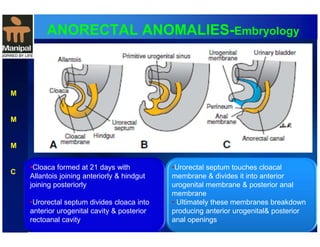
•Cloaca formed at 21 days with 
Allantois joining anteriorly & hindgut 
joining posteriorly 
•Urorectal septum divides cloaca into 
anterior urogenital cavity & posterior 
rectoanal cavity 
•Urorectal septum touches cloacal 
membrane & divides it into anterior 
urogenital membrane & posterior anal 
membrane 
• Ultimately these membranes breakdown 
producing anterior urogenital& posterior 
anal openings
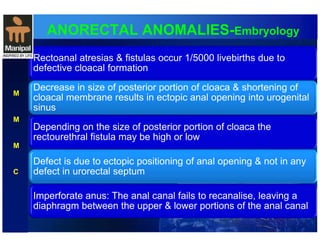
ANORECTAL ANOMALIES-Embryology 
Rectoanal atresias & fistulas occur 1/5000 livebirths due to 
defective cloacal formation 
Decrease in size of posterior portion of cloaca & shortening of 
cloacal membrane results in ectopic anal opening into urogenital 
sinus 
Depending on the size of posterior portion of cloaca the 
rectourethral fistula may be high or low 
Defect is due to ectopic positioning of anal opening & not in any 
defect in urorectal septum 
Imperforate anus: The anal canal fails to recanalise, leaving a 
diaphragm between the upper & lower portions of the anal canal 
M 
M 
M 
C
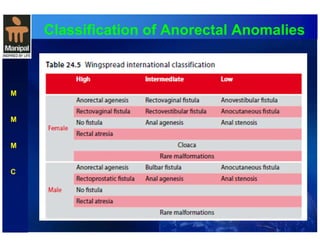
Classification of Anorectal Anomalies 
M 
M 
M 
C
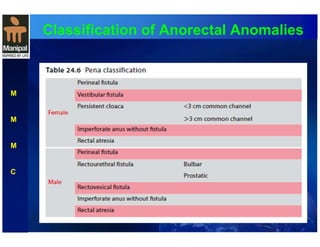
Classification of Anorectal Anomalies 
M 
M 
M 
C
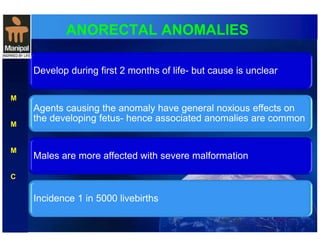
ANORECTAL ANOMALIES 
Develop during first 2 months of life- but cause is unclear 
Agents causing the anomaly have general noxious effects on 
the developing fetus- hence associated anomalies are common 
Males are more affected with severe malformation 
Incidence 1 in 5000 livebirths 
M 
M 
M 
C
ANORECTAL ANOMALIES 
Present as absence of anus in it’s normal position 
In mild forms bowel outlet opens in perineum outside the well 
developed muscle sphincter complex 
In severe forms bowel outlet opens in urogenital tract in males 
& genital tract in females 
Neonatal recoginition of type of anomaly is essential for 
planning the surgical management 
M 
M 
M 
C
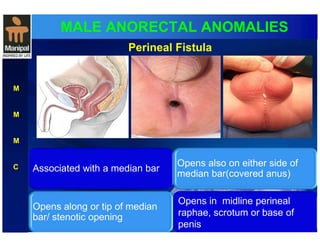
MALE ANORECTAL ANOMALIES 
Perineal Fistula 
M 
M 
M 
C Associated with a median bar 
Opens also on either side of 
median bar(covered anus) 
Opens along or tip of median 
bar/ stenotic opening 
Opens in midline perineal 
raphae, scrotum or base of 
penis
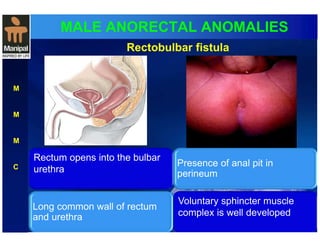
MALE ANORECTAL ANOMALIES 
Rectobulbar fistula 
M 
M 
M 
C 
Rectum opens into the bulbar 
urethra 
Presence of anal pit in 
perineum 
Long common wall of rectum 
and urethra 
Voluntary sphincter muscle 
complex is well developed
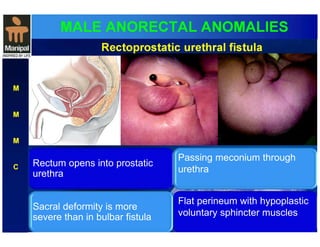
MALE ANORECTAL ANOMALIES 
M 
M 
M 
Rectoprostatic urethral fistula 
C Rectum opens into prostatic 
urethra 
Passing meconium through 
urethra 
Sacral deformity is more 
severe than in bulbar fistula 
Flat perineum with hypoplastic 
voluntary sphincter muscles
MALE ANORECTAL ANOMALIES 
M 
M 
M 
C 
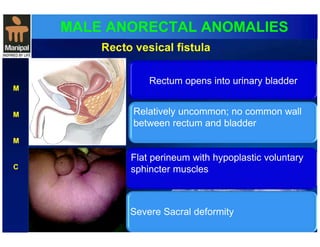
Recto vesical fistula 
Rectum opens into urinary bladder 
Relatively uncommon; no common wall 
between rectum and bladder 
Flat perineum with hypoplastic voluntary 
sphincter muscles 
S evere Sacral deformity
MALE ANORECTAL ANOMALIES 
M 
M 
M 
C 
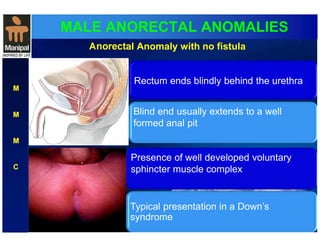
Anorectal Anomaly with no fistula 
Rectum ends blindly behind the urethra 
Blind end usually extends to a well 
formed anal pit 
Presence of well developed voluntary 
sphincter muscle complex 
T ypical presentation in a Down’s 
syndrome
MALE ANORECTAL ANOMALIES 
M 
M 
M 
C 
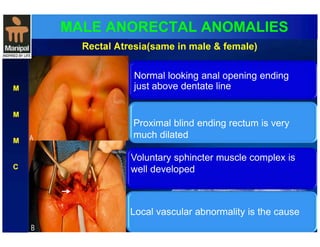
Rectal Atresia(same in male & female) 
Normal looking anal opening ending 
just above dentate line 
Proximal blind ending rectum is very 
much dilated 
Voluntary sphincter muscle complex is 
well developed 
L ocal vascular abnormality is the cause
FEMALE ANORECTAL ANOMALIES 
M 
M 
M 
C 
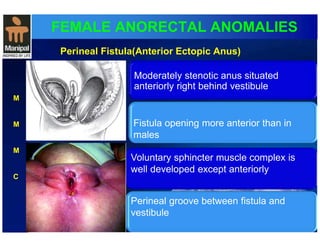
Perineal Fistula(Anterior Ectopic Anus) 
Moderately stenotic anus situated 
anteriorly right behind vestibule 
Fistula opening more anterior than in 
males 
Voluntary sphincter muscle complex is 
well developed except anteriorly 
Perineal groove between fistula and 
v estibule
FEMALE ANORECTAL ANOMALIES 
M 
M 
M 
C 
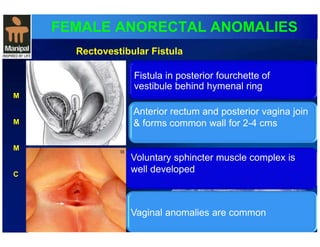
Rectovestibular Fistula 
Fistula in posterior fourchette of 
vestibule behind hymenal ring 
Anterior rectum and posterior vagina join 
& forms common wall for 2-4 cms 
Voluntary sphincter muscle complex is 
well developed 
Vaginal anomalies are common
FEMALE ANORECTAL ANOMALIES 
M 
M 
M 
C 
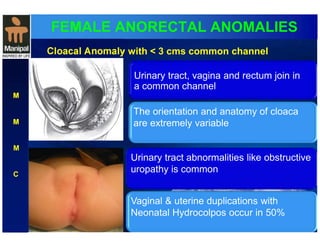
Cloacal Anomaly with < 3 cms common channel 
Urinary tract, vagina and rectum join in 
a common channel 
The orientation and anatomy of cloaca 
are extremely variable 
Urinary tract abnormalities like obstructive 
uropathy is common 
Vaginal & uterine duplications with 
Neonatal Hydrocolpos occur in 50%
FEMALE ANORECTAL ANOMALIES 
M 
M 
M 
C 
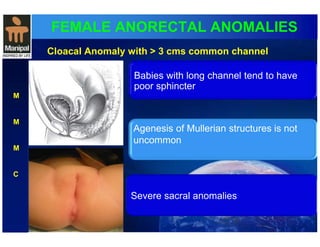
Cloacal Anomaly with > 3 cms common channel 
Babies with long channel tend to have 
poor sphincter 
Agenesis of Mullerian structures is not 
uncommon 
Severe sacral anomalies
FEMALE ANORECTAL ANOMALIES 
M 
M 
M 
C 
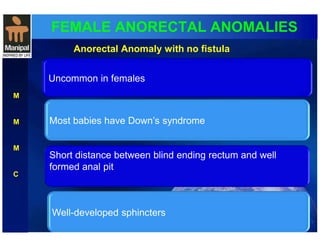
Anorectal Anomaly with no fistula 
Uncommon in females 
Most babies have Down’s syndrome 
Short distance between blind ending rectum and well 
formed anal pit 
Well-developed sphincters
ANORECTAL ANOMALIES 
M 
M 
M 
C 
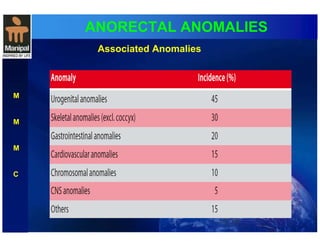
Associated Anomalies
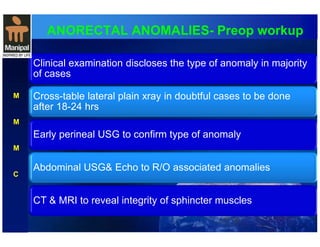
ANORECTAL ANOMALIES- Preop workup 
Clinical examination discloses the type of anomaly in majority 
of cases 
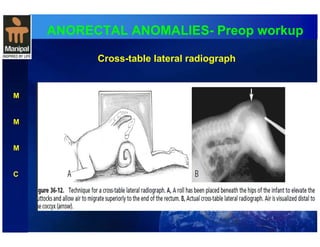
Cross-table lateral plain xray in doubtful cases to be done 
after 18-24 hrs 
Early perineal USG to confirm type of anomaly 
Abdominal USG& Echo to R/O associated anomalies 
CT & MRI to reveal integrity of sphincter muscles 
M 
M 
M 
C
ANORECTAL ANOMALIES- Preop workup 
M 
M 
M 
C 
Cross-table lateral radiograph
ANORECTAL ANOMALIES- Preop workup 
M 
M 
M 
C 
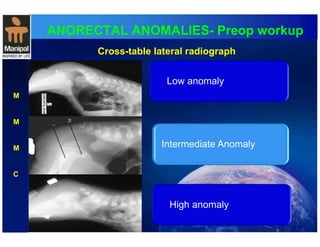
Cross-table lateral radiograph 
Low anomaly 
Intermediate Anomaly 
High anomaly
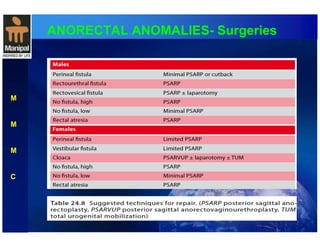
ANORECTAL ANOMALIES- Surgeries 
M 
M 
M 
C
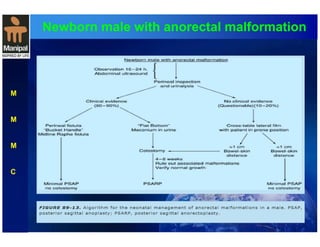
Newborn male with anorectal malformation 
M 
M 
M 
C
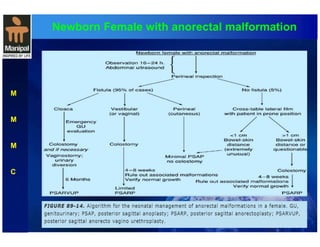
Newborn Female with anorectal malformation 
M 
M 
M 
C
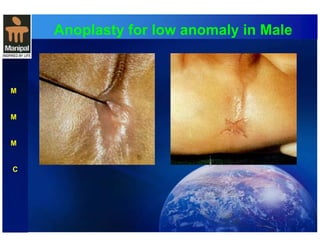
Anoplasty for low anomaly in Male 
M 
M 
M 
C
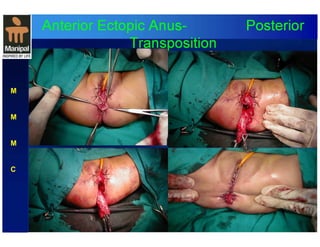
Anterior Ectopic Anus- Posterior 
Transposition 
M 
M 
M 
C
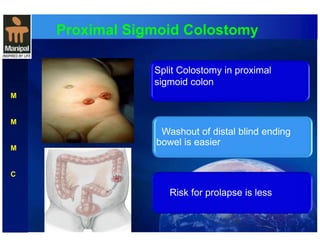
Proximal Sigmoid Colostomy 
M 
M 
M 
C 
Split Colostomy in proximal 
s ig m oid colon 
Washout of distal blind ending 
bowel is easier 
Risk for prolapse is less
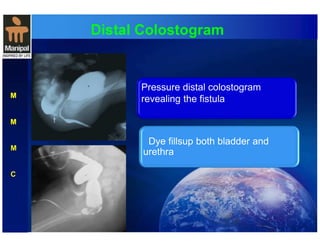
Distal Colostogram 
M 
M 
M 
C 
Pressure distal colostogram 
revealing the fistula 
Dye fillsup both bladder and 
urethra
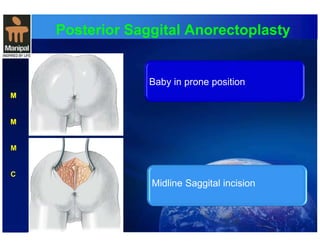
Posterior Saggital Anorectoplasty 
M 
M 
M 
C 
Baby in prone position 
Midline Saggital incision
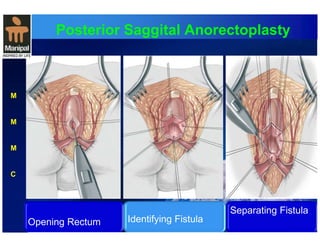
Posterior Saggital Anorectoplasty 
M 
M 
M 
C 
O p e ning Rectum 
Identifying Fistula 
Separating Fistula
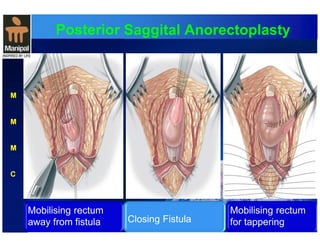
Posterior Saggital Anorectoplasty 
M 
M 
M 
C 
Mobilising rectum 
away from fistula 
Closing Fistula 
Mobilising rectum 
for tappering
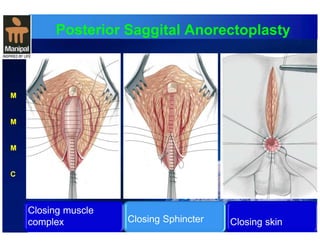
Posterior Saggital Anorectoplasty 
M 
M 
M 
C 
Closing muscle 
complex 
Closing Sphincter 
Closing skin
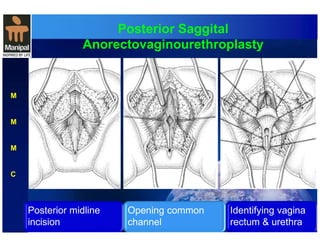
Posterior Saggital 
Anorectovaginourethroplasty 
M 
M 
M 
C 
Posterior midline 
incision 
Opening common 
channel 
Identifying vagina 
rectum & urethra
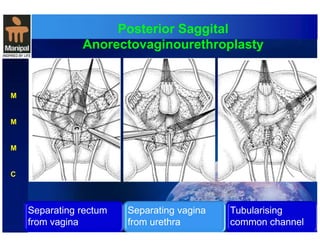
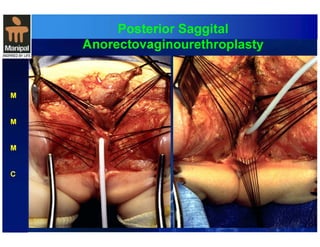
Posterior Saggital 
Anorectovaginourethroplasty 
M 
M 
M 
C 
Separating rectum 
from vagina 
Separating vagina 
from urethra 
Tubularising 
common channel
Posterior Saggital 
Anorectovaginourethroplasty 
M 
M 
M 
C
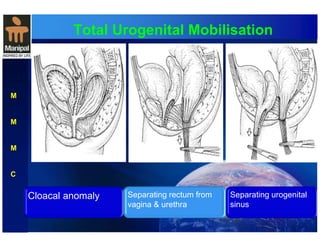
Total Urogenital Mobilisation 
M 
M 
M 
C 
Cloacal anomaly 
Separating rectum from 
vagina & urethra 
Separating urogenital 
sinus
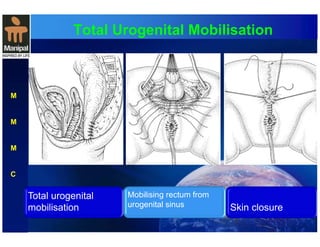
Total Urogenital Mobilisation 
M 
M 
M 
C 
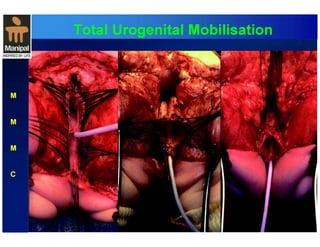
Total urogenital 
mobilisation 
Mobilising rectum from 
urogenital sinus 
Skin closure
Total Urogenital Mobilisation 
M 
M 
M 
C
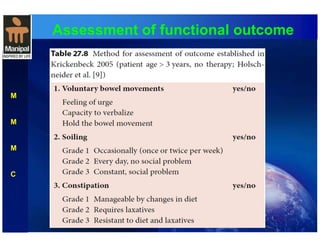
Assessment of functional outcome 
M 
M 
M 
C
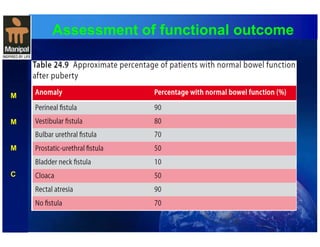
Assessment of functional outcome 
M 
M 
M 
C
Anorectal anomaly(Imperforate Anus)

Anorectal anomaly(Imperforate Anus)

  • 1.
  • 2.
    ANORECTAL ANOMALIES Dr.B.SELVARAJMS;Mch; FICS; ASSOCIATE PROFESSOR IN PEDIATRIC SURGERY MELAKA MANIPAL MEDICAL COLLEGE MELAKA 75150 MALAYSIA M M M C
  • 3.
    ANORECTAL ANOMALIES Ableto identify associated anomalies Appropriate workup to confirm the type of anomaly Objectives 1 2 3 4 5 Identify anomalies in male && ffeemmaallee bbaabbiieess PPllaannnniinngg ooff ssuurrggiiccaall ttrreeaattmmeenntt ffoorr ddiiffffeerreenntt ttyyppeess PPrrooppeerr ppoossttoopp ccaarree && ffoolllloowwuupp M M M C
  • 4.
    ANORECTAL ANOMALIES-Embryology M M M C •Cloaca formed at 21 days with Allantois joining anteriorly & hindgut joining posteriorly •Urorectal septum divides cloaca into anterior urogenital cavity & posterior rectoanal cavity •Urorectal septum touches cloacal membrane & divides it into anterior urogenital membrane & posterior anal membrane • Ultimately these membranes breakdown producing anterior urogenital& posterior anal openings
  • 5.
    ANORECTAL ANOMALIES-Embryology Rectoanalatresias & fistulas occur 1/5000 livebirths due to defective cloacal formation Decrease in size of posterior portion of cloaca & shortening of cloacal membrane results in ectopic anal opening into urogenital sinus Depending on the size of posterior portion of cloaca the rectourethral fistula may be high or low Defect is due to ectopic positioning of anal opening & not in any defect in urorectal septum Imperforate anus: The anal canal fails to recanalise, leaving a diaphragm between the upper & lower portions of the anal canal M M M C
  • 6.
    Classification of AnorectalAnomalies M M M C
  • 7.
    Classification of AnorectalAnomalies M M M C
  • 8.
    ANORECTAL ANOMALIES Developduring first 2 months of life- but cause is unclear Agents causing the anomaly have general noxious effects on the developing fetus- hence associated anomalies are common Males are more affected with severe malformation Incidence 1 in 5000 livebirths M M M C
  • 9.
    ANORECTAL ANOMALIES Presentas absence of anus in it’s normal position In mild forms bowel outlet opens in perineum outside the well developed muscle sphincter complex In severe forms bowel outlet opens in urogenital tract in males & genital tract in females Neonatal recoginition of type of anomaly is essential for planning the surgical management M M M C
  • 10.
    MALE ANORECTAL ANOMALIES Perineal Fistula M M M C Associated with a median bar Opens also on either side of median bar(covered anus) Opens along or tip of median bar/ stenotic opening Opens in midline perineal raphae, scrotum or base of penis
  • 11.
    MALE ANORECTAL ANOMALIES Rectobulbar fistula M M M C Rectum opens into the bulbar urethra Presence of anal pit in perineum Long common wall of rectum and urethra Voluntary sphincter muscle complex is well developed
  • 12.
    MALE ANORECTAL ANOMALIES M M M Rectoprostatic urethral fistula C Rectum opens into prostatic urethra Passing meconium through urethra Sacral deformity is more severe than in bulbar fistula Flat perineum with hypoplastic voluntary sphincter muscles
  • 13.
    MALE ANORECTAL ANOMALIES M M M C Recto vesical fistula Rectum opens into urinary bladder Relatively uncommon; no common wall between rectum and bladder Flat perineum with hypoplastic voluntary sphincter muscles S evere Sacral deformity
  • 14.
    MALE ANORECTAL ANOMALIES M M M C Anorectal Anomaly with no fistula Rectum ends blindly behind the urethra Blind end usually extends to a well formed anal pit Presence of well developed voluntary sphincter muscle complex T ypical presentation in a Down’s syndrome
  • 15.
    MALE ANORECTAL ANOMALIES M M M C Rectal Atresia(same in male & female) Normal looking anal opening ending just above dentate line Proximal blind ending rectum is very much dilated Voluntary sphincter muscle complex is well developed L ocal vascular abnormality is the cause
  • 16.
    FEMALE ANORECTAL ANOMALIES M M M C Perineal Fistula(Anterior Ectopic Anus) Moderately stenotic anus situated anteriorly right behind vestibule Fistula opening more anterior than in males Voluntary sphincter muscle complex is well developed except anteriorly Perineal groove between fistula and v estibule
  • 17.
    FEMALE ANORECTAL ANOMALIES M M M C Rectovestibular Fistula Fistula in posterior fourchette of vestibule behind hymenal ring Anterior rectum and posterior vagina join & forms common wall for 2-4 cms Voluntary sphincter muscle complex is well developed Vaginal anomalies are common
  • 18.
    FEMALE ANORECTAL ANOMALIES M M M C Cloacal Anomaly with < 3 cms common channel Urinary tract, vagina and rectum join in a common channel The orientation and anatomy of cloaca are extremely variable Urinary tract abnormalities like obstructive uropathy is common Vaginal & uterine duplications with Neonatal Hydrocolpos occur in 50%
  • 19.
    FEMALE ANORECTAL ANOMALIES M M M C Cloacal Anomaly with > 3 cms common channel Babies with long channel tend to have poor sphincter Agenesis of Mullerian structures is not uncommon Severe sacral anomalies
  • 20.
    FEMALE ANORECTAL ANOMALIES M M M C Anorectal Anomaly with no fistula Uncommon in females Most babies have Down’s syndrome Short distance between blind ending rectum and well formed anal pit Well-developed sphincters
  • 21.
    ANORECTAL ANOMALIES M M M C Associated Anomalies
  • 22.
    ANORECTAL ANOMALIES- Preopworkup Clinical examination discloses the type of anomaly in majority of cases Cross-table lateral plain xray in doubtful cases to be done after 18-24 hrs Early perineal USG to confirm type of anomaly Abdominal USG& Echo to R/O associated anomalies CT & MRI to reveal integrity of sphincter muscles M M M C
  • 23.
    ANORECTAL ANOMALIES- Preopworkup M M M C Cross-table lateral radiograph
  • 24.
    ANORECTAL ANOMALIES- Preopworkup M M M C Cross-table lateral radiograph Low anomaly Intermediate Anomaly High anomaly
  • 25.
  • 26.
    Newborn male withanorectal malformation M M M C
  • 27.
    Newborn Female withanorectal malformation M M M C
  • 28.
    Anoplasty for lowanomaly in Male M M M C
  • 29.
    Anterior Ectopic Anus-Posterior Transposition M M M C
  • 30.
    Proximal Sigmoid Colostomy M M M C Split Colostomy in proximal s ig m oid colon Washout of distal blind ending bowel is easier Risk for prolapse is less
  • 31.
    Distal Colostogram M M M C Pressure distal colostogram revealing the fistula Dye fillsup both bladder and urethra
  • 32.
    Posterior Saggital Anorectoplasty M M M C Baby in prone position Midline Saggital incision
  • 33.
    Posterior Saggital Anorectoplasty M M M C O p e ning Rectum Identifying Fistula Separating Fistula
  • 34.
    Posterior Saggital Anorectoplasty M M M C Mobilising rectum away from fistula Closing Fistula Mobilising rectum for tappering
  • 35.
    Posterior Saggital Anorectoplasty M M M C Closing muscle complex Closing Sphincter Closing skin
  • 36.
    Posterior Saggital Anorectovaginourethroplasty M M M C Posterior midline incision Opening common channel Identifying vagina rectum & urethra
  • 37.
    Posterior Saggital Anorectovaginourethroplasty M M M C Separating rectum from vagina Separating vagina from urethra Tubularising common channel
  • 38.
  • 39.
    Total Urogenital Mobilisation M M M C Cloacal anomaly Separating rectum from vagina & urethra Separating urogenital sinus
  • 40.
    Total Urogenital Mobilisation M M M C Total urogenital mobilisation Mobilising rectum from urogenital sinus Skin closure
  • 41.
  • 42.
    Assessment of functionaloutcome M M M C
  • 43.
    Assessment of functionaloutcome M M M C