Infantile Hypertrophic Pyloric
Stenosis
Dr Muki
MD 5
2013
INTRODUCTION
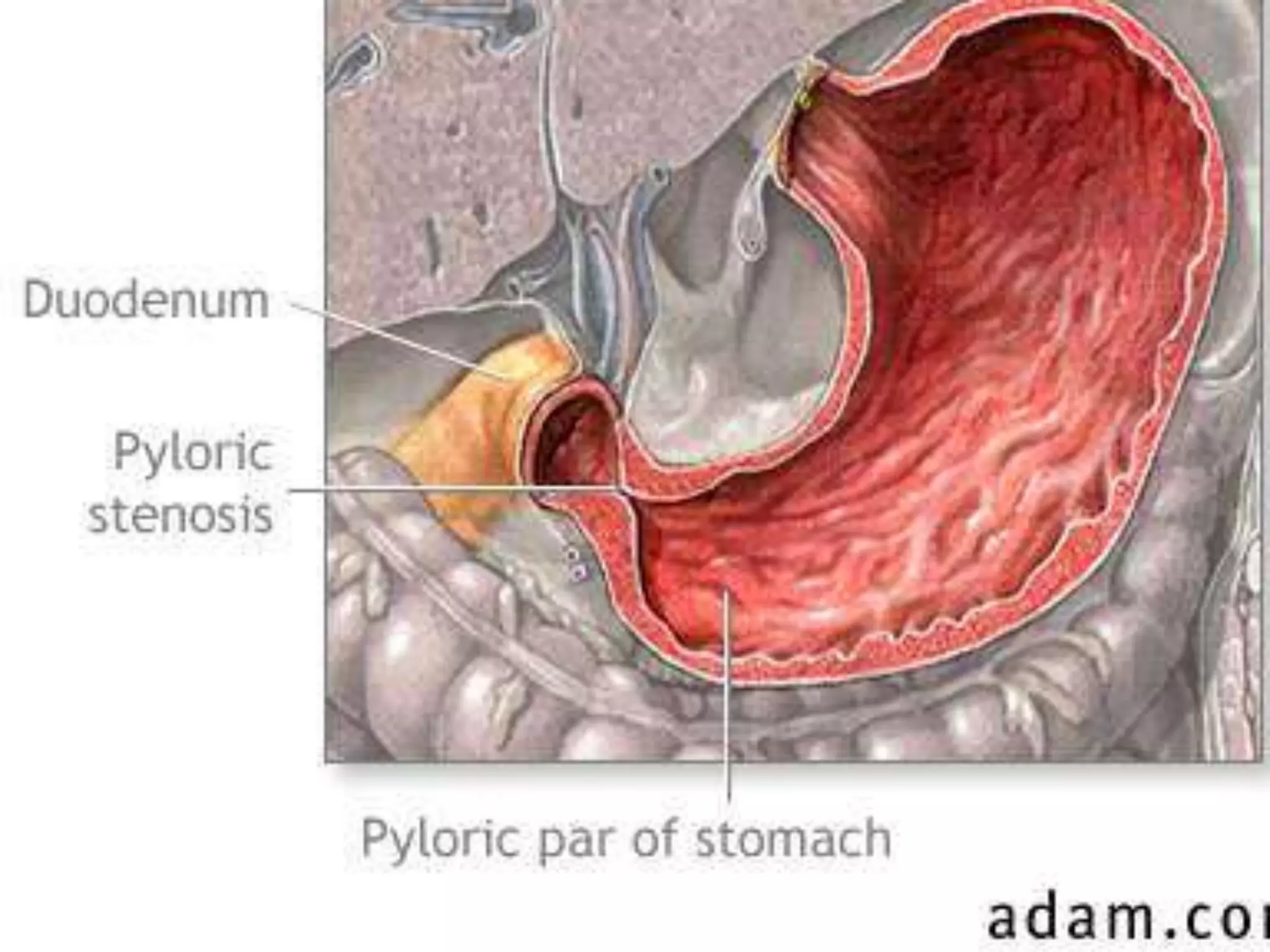
Pyloric stenosis, or infantile hypertrophic pyloric
stenosis (IHPS) is a condition characterised by
hypertrophy of the two muscle layers of the
pylorus.
• The pyloric canal lengthens, the whole pylorus
thickens, and the mucosa becomes
oedematous causing functional obstruction of
the gastric outlet.
Epidemiology
• The incidence of IHPS is approximately 2 to 5 per
1,000 births per year in most white populations.
• The male-to-female ratio is approximately 4:1.
• Male and female children of affected fathers carry a
risk of 5% and 2% respectively, of developing IHPS.
• The incidence is 2.4 per 1000 live births in whites,
1.8 in Hispanics, 0.7 in blacks, and 0.6 in Asians. It is
also less common amongst children of mixed race
parents.
Clinical Presentation
Symptoms
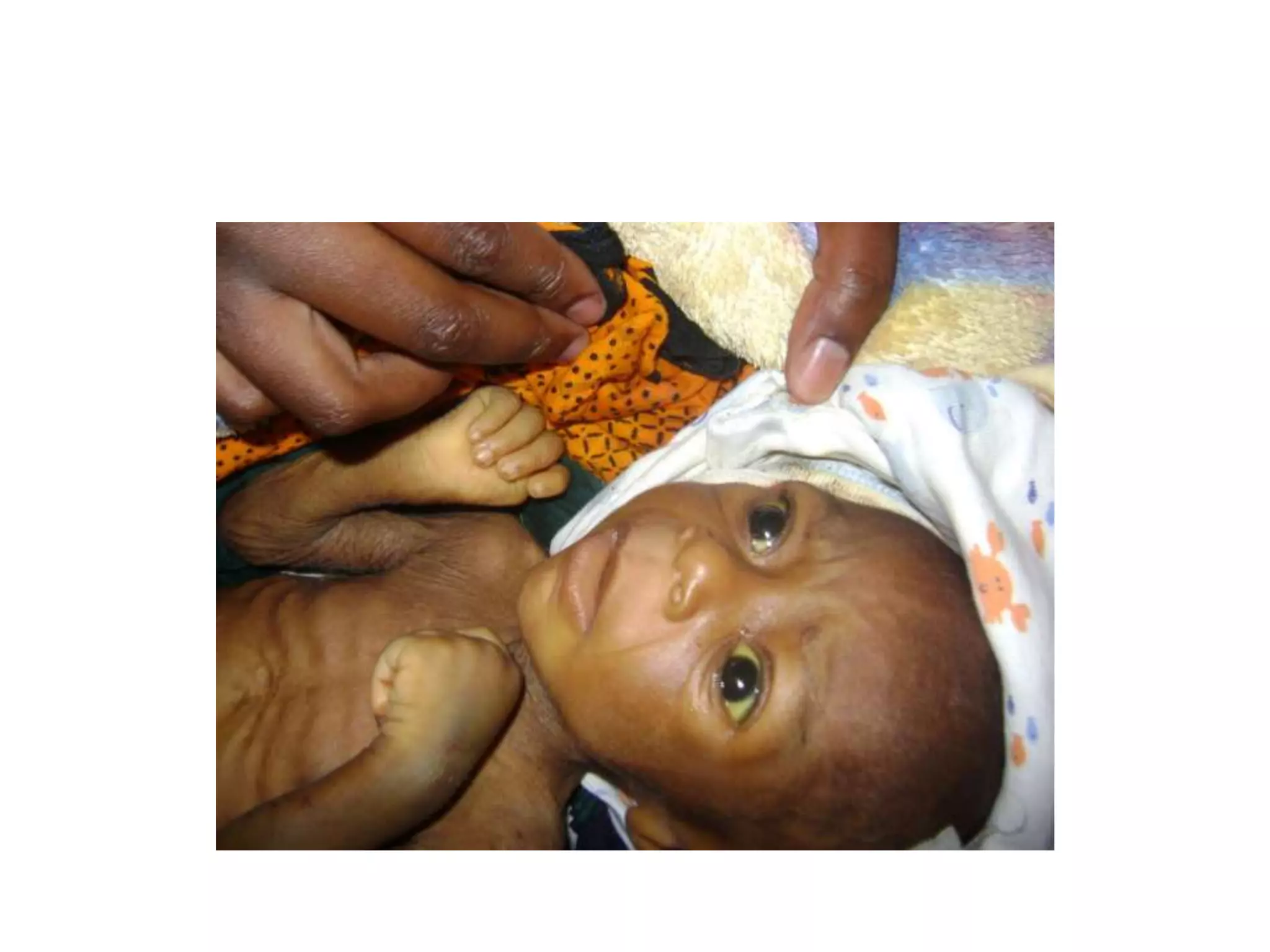
Vomiting is the first symptom in most children
• may occur after every feeding or only after some
feedings
• Usually starts around 3 weeks of age, but may
start any time between 1 week and 5 months of
age
• Forceful (projectile vomiting)
• The infant is hungry after vomiting and wants to
feed again
Other symptoms generally appear several weeks
after birth and may include:
• Dehydration gets worse with the severity of
the vomiting .Prolonged vomiting leads to the
loss of large quantities of gastric secretions
rich in H+ and Cl- .
• As a result of dehydration, the kidney
attempts to conserve Na+ to maintain volume,
by exchanging them for K+ and H+ .
• Starvation can exacerbate diminished hepatic
glucoronyl transferase activity, and indirect
hyperbilirubinemia may be seen in 1-2% of
affected infants.
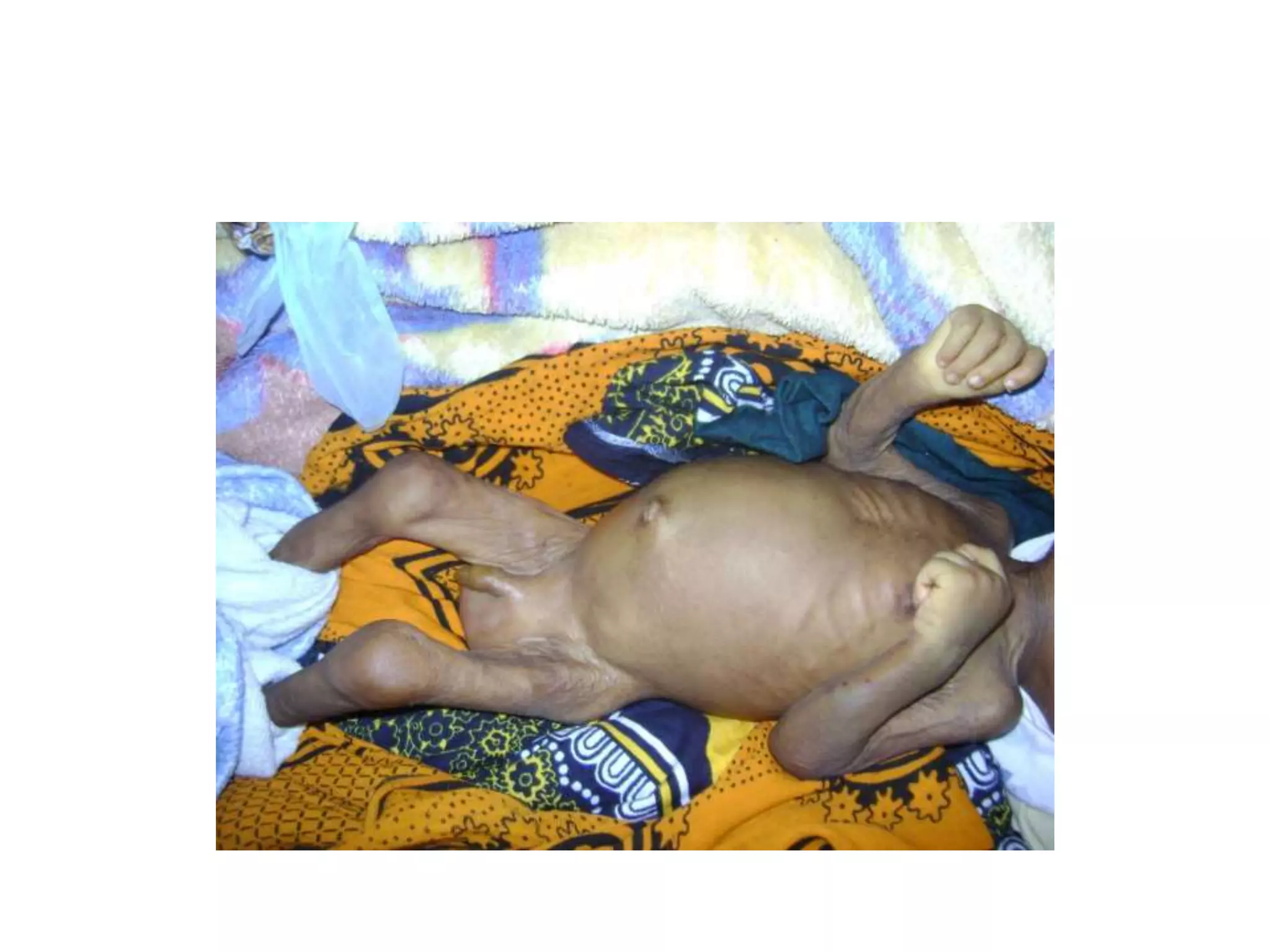
• Failure to gain weight or weight loss .
• Wave-like motion of the abdomen shortly after
feeding and just before vomiting occurs
• The peristaltic waves can be seen across abdomen
passing from right to left and reverse immediately
prior to vomiting
Etiology
It has been found that,in IHPS specimens, the muscle
layer is deficient in:
– The quantity of nerve terminals
–Markers for nerve-supporting cells
– Peptide-containing nerve fibers
• It is postulated that this abnormal innervation of
the muscular layer leads to failure of relaxation of
the pyloric muscle, increased synthesis of growth
factors, and subsequent hypertrophy, hyperplasia,
and obstruction.
• There is an increased incidence of IHPS in
infants receiving erythromycin. The reason is
unclear, although a prokinetic effect on gastric
muscle contraction is postulated.
Diagnosis
• Initially suggested by the typical clinical presentation.
In physical examination : The mass is firm, mobile,
approximately 2 cm, best palpated from the left, located
in the midepigasrtrium beneath the liver edge.
• Palpation of the hard muscle mass or olive is
diagnostic in conjunction with a typical history.
• Diagnosis by palpation of olive only successful
49% of cases in recent years vs. 78% 30 years
ago.
• Palpation requires a calm infant with relaxed
abdominal musculature, which is difficult in these
hungry babies.
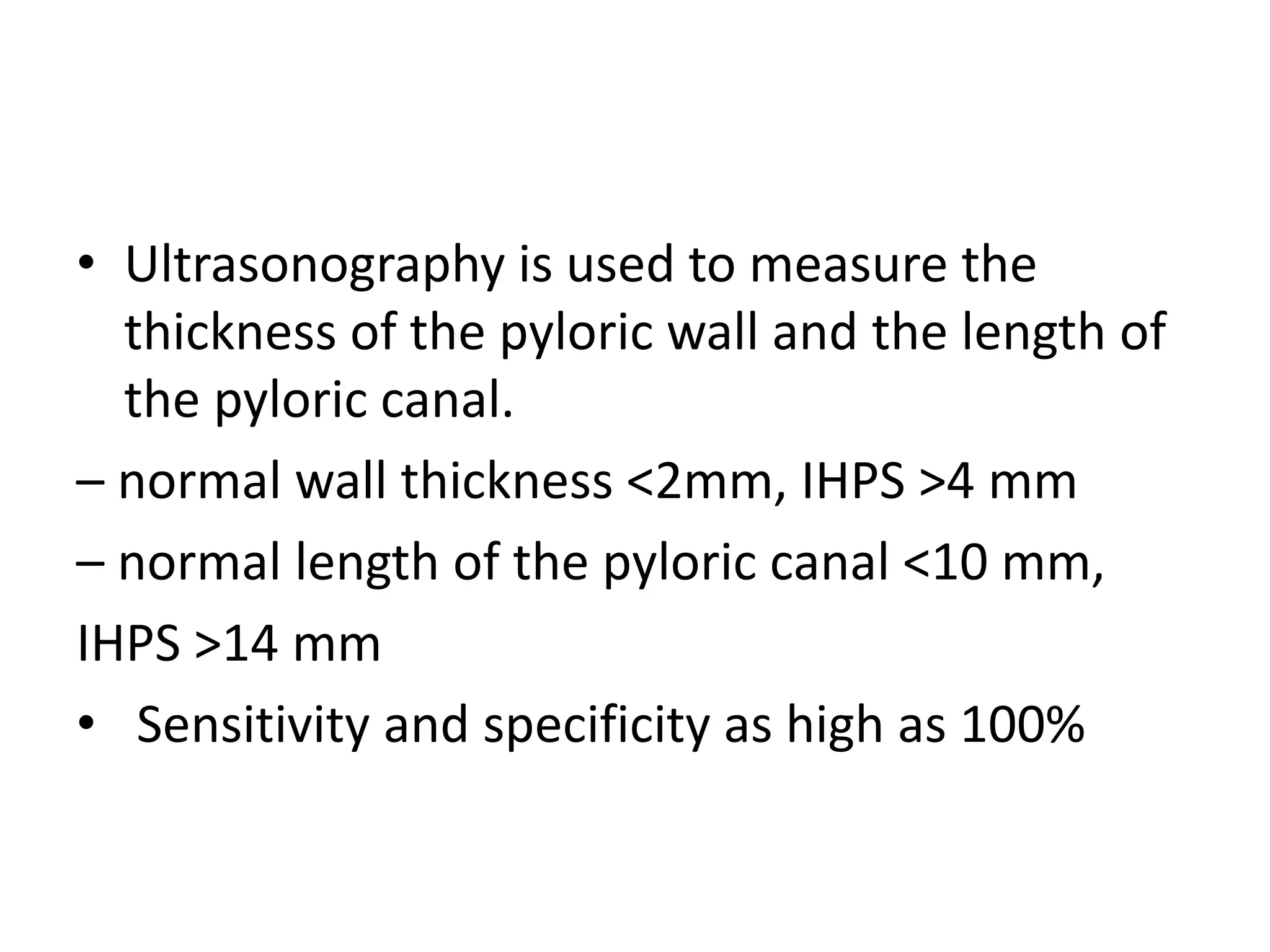
• Ultrasonography is used to measure the
thickness of the pyloric wall and the length of
the pyloric canal.
– normal wall thickness <2mm, IHPS >4 mm
– normal length of the pyloric canal <10 mm,
IHPS >14 mm
• Sensitivity and specificity as high as 100%
Differential Diagnosis
• Gastroesophageal reflux, with or without hiatal
hernia. Differentiated by radiologic studies. Also
amount of vomitus is smaller, and the infant does
not usually lose weight.
• Adrenal insufficiency. Differentiated by absence of
metabolic acidosis, hyperkalemia, and elevated
urinary sodium.
• Viral gastroenteritis. Unusual in infants less than 6
weeks of age. Associated with significant diarrhea
and sick contacts.
Treatment
The preoperative treatment is directed toward
correcting the fluid, acid-base, and electrolyte
losses.
• Intravenous fluid therapy is begun with 0.45–0.9%
saline, in 5–10% dextrose, with the addition of
potassium chloride in concentrations of 30–
50mEq/L.
• Fluid therapy should be continued until the infant
is rehydrated and the serum bicarbonate
concentration is less than 30mEq/dL, which
implies that the alkalosis has been corrected.
• Most infants can be rehydrated within 24 hours
SURGICAL MANAGEMENT
• Once resuscitated the infant can undergo the
Fredet-Ramstedt pylormyotomy, which is the
procedure of choice.
• It consist of incision in to the sphincter muscle
of pylorus.
• NG tube is passed and gastric content are
aspirated just prior to surgery.
REFERENCES AND FURTHER READING
• Medscape Reference. Drugs, Diseases & Procedures. Paediatric
Pyloric Stenosis [Online]. 2012 [cited19th August 2012]. Available
from: http://emedicine.medscape.com/article/803489-overview
(accessed25th November 2012).
• MacDonald NJ, Fitzpatrick GJ, Moore KP, Wren WS and Keenan M.
Anaesthesia for congenital hypertrophic pyloric stenosis. A review
of 350 patients. Br. J. Anaesth. 1987;59:672-677.
• Panteli C. New insights into the pathogenesis of infantile pyloric
stenosis. Pediatr Surg Int. 2009:25(12);1043-1052.
• Perger L, Fuchs JR, Komidar L, Mooney DP. Impact of surgical
approach on outcome in 622 consecutive pyloromyotomies at a
paediatric teaching institution. J Pediatr Surg. 2009;44:2119-25.
Thank U For you attention

Infantile hypertrophic pyloric stenosis

  • 1.
  • 4.
    INTRODUCTION Pyloric stenosis, orinfantile hypertrophic pyloric stenosis (IHPS) is a condition characterised by hypertrophy of the two muscle layers of the pylorus. • The pyloric canal lengthens, the whole pylorus thickens, and the mucosa becomes oedematous causing functional obstruction of the gastric outlet.
  • 6.
    Epidemiology • The incidenceof IHPS is approximately 2 to 5 per 1,000 births per year in most white populations. • The male-to-female ratio is approximately 4:1. • Male and female children of affected fathers carry a risk of 5% and 2% respectively, of developing IHPS. • The incidence is 2.4 per 1000 live births in whites, 1.8 in Hispanics, 0.7 in blacks, and 0.6 in Asians. It is also less common amongst children of mixed race parents.
  • 7.
    Clinical Presentation Symptoms Vomiting isthe first symptom in most children • may occur after every feeding or only after some feedings • Usually starts around 3 weeks of age, but may start any time between 1 week and 5 months of age • Forceful (projectile vomiting) • The infant is hungry after vomiting and wants to feed again
  • 8.
    Other symptoms generallyappear several weeks after birth and may include: • Dehydration gets worse with the severity of the vomiting .Prolonged vomiting leads to the loss of large quantities of gastric secretions rich in H+ and Cl- . • As a result of dehydration, the kidney attempts to conserve Na+ to maintain volume, by exchanging them for K+ and H+ .
  • 9.
    • Starvation canexacerbate diminished hepatic glucoronyl transferase activity, and indirect hyperbilirubinemia may be seen in 1-2% of affected infants. • Failure to gain weight or weight loss . • Wave-like motion of the abdomen shortly after feeding and just before vomiting occurs • The peristaltic waves can be seen across abdomen passing from right to left and reverse immediately prior to vomiting
  • 10.
    Etiology It has beenfound that,in IHPS specimens, the muscle layer is deficient in: – The quantity of nerve terminals –Markers for nerve-supporting cells – Peptide-containing nerve fibers • It is postulated that this abnormal innervation of the muscular layer leads to failure of relaxation of the pyloric muscle, increased synthesis of growth factors, and subsequent hypertrophy, hyperplasia, and obstruction.
  • 11.
    • There isan increased incidence of IHPS in infants receiving erythromycin. The reason is unclear, although a prokinetic effect on gastric muscle contraction is postulated.
  • 12.
    Diagnosis • Initially suggestedby the typical clinical presentation. In physical examination : The mass is firm, mobile, approximately 2 cm, best palpated from the left, located in the midepigasrtrium beneath the liver edge. • Palpation of the hard muscle mass or olive is diagnostic in conjunction with a typical history. • Diagnosis by palpation of olive only successful 49% of cases in recent years vs. 78% 30 years ago. • Palpation requires a calm infant with relaxed abdominal musculature, which is difficult in these hungry babies.
  • 13.
    • Ultrasonography isused to measure the thickness of the pyloric wall and the length of the pyloric canal. – normal wall thickness <2mm, IHPS >4 mm – normal length of the pyloric canal <10 mm, IHPS >14 mm • Sensitivity and specificity as high as 100%
  • 14.
    Differential Diagnosis • Gastroesophagealreflux, with or without hiatal hernia. Differentiated by radiologic studies. Also amount of vomitus is smaller, and the infant does not usually lose weight. • Adrenal insufficiency. Differentiated by absence of metabolic acidosis, hyperkalemia, and elevated urinary sodium. • Viral gastroenteritis. Unusual in infants less than 6 weeks of age. Associated with significant diarrhea and sick contacts.
  • 15.
    Treatment The preoperative treatmentis directed toward correcting the fluid, acid-base, and electrolyte losses. • Intravenous fluid therapy is begun with 0.45–0.9% saline, in 5–10% dextrose, with the addition of potassium chloride in concentrations of 30– 50mEq/L. • Fluid therapy should be continued until the infant is rehydrated and the serum bicarbonate concentration is less than 30mEq/dL, which implies that the alkalosis has been corrected. • Most infants can be rehydrated within 24 hours
  • 16.
    SURGICAL MANAGEMENT • Onceresuscitated the infant can undergo the Fredet-Ramstedt pylormyotomy, which is the procedure of choice. • It consist of incision in to the sphincter muscle of pylorus. • NG tube is passed and gastric content are aspirated just prior to surgery.
  • 17.
    REFERENCES AND FURTHERREADING • Medscape Reference. Drugs, Diseases & Procedures. Paediatric Pyloric Stenosis [Online]. 2012 [cited19th August 2012]. Available from: http://emedicine.medscape.com/article/803489-overview (accessed25th November 2012). • MacDonald NJ, Fitzpatrick GJ, Moore KP, Wren WS and Keenan M. Anaesthesia for congenital hypertrophic pyloric stenosis. A review of 350 patients. Br. J. Anaesth. 1987;59:672-677. • Panteli C. New insights into the pathogenesis of infantile pyloric stenosis. Pediatr Surg Int. 2009:25(12);1043-1052. • Perger L, Fuchs JR, Komidar L, Mooney DP. Impact of surgical approach on outcome in 622 consecutive pyloromyotomies at a paediatric teaching institution. J Pediatr Surg. 2009;44:2119-25.
  • 18.
    Thank U Foryou attention