Etiology, investigations &Etiology, investigations &
Management ofManagement of
Retroperitoneal MassRetroperitoneal Mass
PROF. Dr A. B. SINGH UNITPROF. Dr A. B. SINGH UNIT
Department of SurgeryDepartment of Surgery
Patna Medical College & HospitalPatna Medical College & Hospital
Objective…
 Retroperitoneal anatomy
 Etiology of retroperitoneal mass
 Clinical features of retroperitoneal mass
 Investigations of retroperitoneal mass
Management of retroperitoneal mass
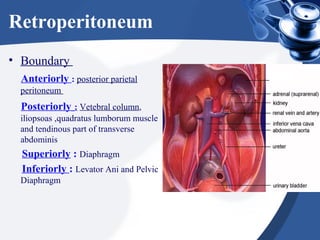
Retroperitoneum
• Boundary
Anteriorly : posterior parietal
peritoneum
Posteriorly : Vetebral column,
iliopsoas ,quadratus lumborum muscle
and tendinous part of transverse
abdominis
Superiorly : Diaphragm
Inferiorly : Levator Ani and Pelvic
Diaphragm
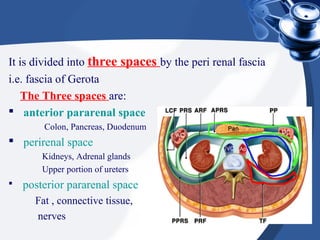
It is divided into three spaces by the peri renal fascia
i.e. fascia of Gerota
The Three spaces are:
 anterior pararenal space
Colon, Pancreas, Duodenum
 perirenal space
Kidneys, Adrenal glands
Upper portion of ureters
 posterior pararenal space
Fat , connective tissue,
nerves
Causes of Retroperitoneal
Swelling
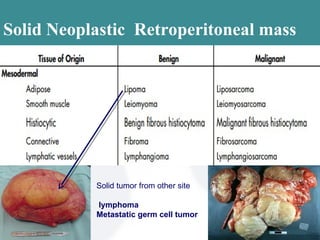
Solid Neoplastic Retroperitoneal mass
Solid tumor from other site
lymphoma
Metastatic germ cell tumor
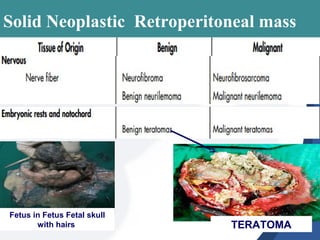
Solid Neoplastic Retroperitoneal mass
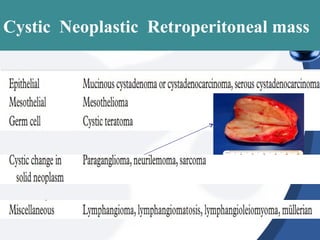
Fetus in Fetus Fetal skull
with hairs TERATOMA
Cystic Neoplastic Retroperitoneal mass
Non- Neoplastic Retroperitoneal mass
Solid Cystic
Retroperitoneal fibrosis
( ORMOND’S Disease)
Hematoma
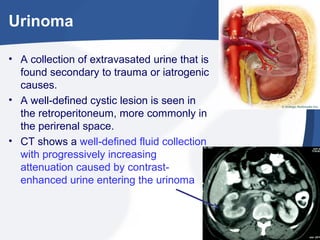
urinoma
Pseudocyst
CliniCal
presentation and
investigations
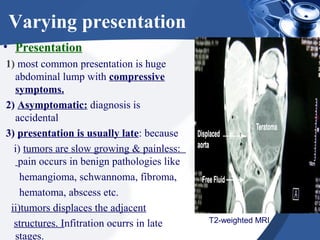
Varying presentation
• Presentation
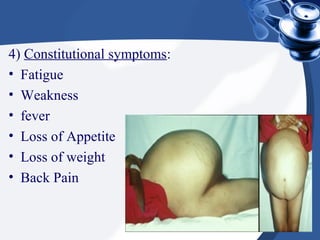
1) most common presentation is huge
abdominal lump with compressive
symptoms.
2) Asymptomatic: diagnosis is
accidental
3) presentation is usually late: because
i) tumors are slow growing & painless:
pain occurs in benign pathologies like
hemangioma, schwannoma, fibroma,
hematoma, abscess etc.
ii)tumors displaces the adjacent
structures. Infitration ocurrs in late
stages.
T2-weighted MRI
4) Constitutional symptoms:
• Fatigue
• Weakness
• fever
• Loss of Appetite
• Loss of weight
• Back Pain
Symptoms and Signs of
Retroperitoneal Mass
1) Due to retroperitoneal mass:
i)No clinical findings unless the swelling is very large
on examination:
• Consistency:Firm to hard mass
• surface :Smooth , but in lymphoma it
is nodular
• Margins: can not be traced properly because of deep
position of the swellings
• Not moving with respiration.
• Non mobile.
• Non tender
• Does not fall forward
(confirmed by knee-elbow position).
ii) Deep seated dull ache abdominal pain.
iii) Flank pain : most commonly in carcinoma of kidney
2) Due to compression on adjacent organs:
i) Back Pain- Severe back pain often following pressure by
tumor mass, hematoma, and abscess over muscles, facet joint and
vertebral column.
Radicular Pain- Radiating type of pain along the nerve root due to
its compression.
ii) Obstruction of Viscera and Tubular Organs – usually
of duodenum , colon , ureter , pancreas, kidney
resulting in
• Nausea and Vomiting-
• Colicky Pain-
• Constipation/ obstipation
• Urinary Retention-
iii) Compression of Aorta
• Hypertension-
• Renal Insufficiency-
• Mesenteric Ischemia-
• Intermittent Claudication-
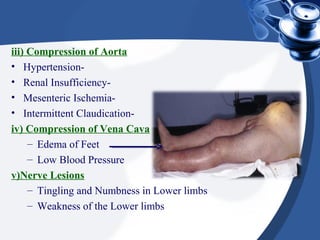
iv) Compression of Vena Cava
– Edema of Feet
– Low Blood Pressure
v)Nerve Lesions
– Tingling and Numbness in Lower limbs
– Weakness of the Lower limbs
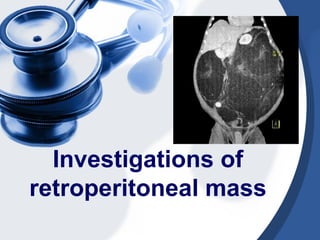
Investigations of
retroperitoneal mass
Investigation
1) Routine blood investigations: to know about
i) hemoglobin: anemia
ii) blood and serum creatinine- raised on compression of
kidney and ureter
iii) liver function test
iv) Effect of paraneoplastic syndrome
Hypoglycemia:- due to increased insulin like hormone
Hypercalcemia:- due to increased ectopic PTH hormone
Catecholamines:- paraganglioma
v) Tumor markers:-AFP(alfa feto protein), beta-HCG- Will be
raised in primary germ cell tumor
2) Chest X ray PA view:- lung metastasis
3) Plane X ray abdomen:- signs of intestinal obstruction, obliterated
psoas shadow, calcification of tumor mass.
5)Usg abdomen : nature of mass(solid/cystic)
and relation to the adjacent structures.
6)CT abdomen and pelvis
7) CT chest
8) CT/usg guided/laproscopic core biopsy
9)PET-CT
10)FNAC has got limited role as the representative
tissue may not be obtained .
11) IVU ;- Can show obstruction and displacement of
kidney and ureter, distortion of renal pelvis and
bladder compression.
12) Confirmation of diagnosis is only by tissue biopsy.
Indications of preoperative biopsy
An unusual appearing mass
Unresectable tumor
Distant mets
Patient being considered for
neoadjuvant chemotherapy
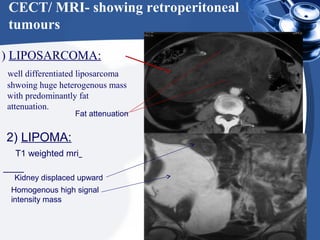
CECT/ MRI- showing retroperitoneal
tumours
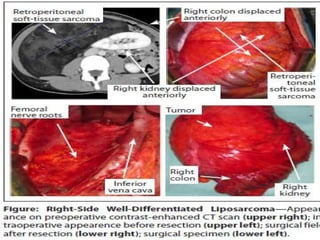
1) LIPOSARCOMA:
well differentiated liposarcoma
shwoing huge heterogenous mass
with predominantly fat
attenuation.
Fat attenuation
2) LIPOMA:
T1 weighted mri
Homogenous high signal
intensity mass
Kidney displaced upward
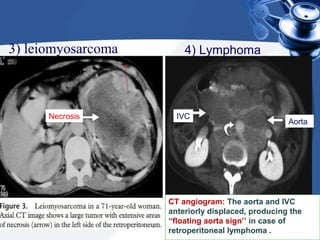
3) leiomyosarcoma
Necrosis
CT angiogram: The aorta and IVC
anteriorly displaced, producing the
“floating aorta sign’’ in case of
retroperitoneal lymphoma .
4) Lymphoma
IVC
Aorta
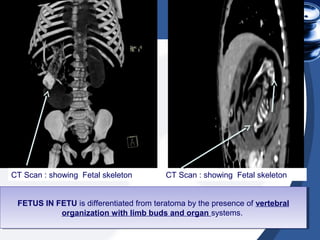
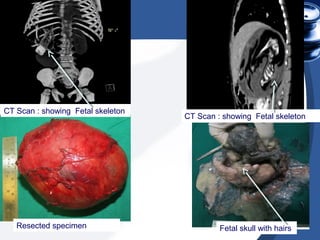
CT Scan : showing Fetal skeleton CT Scan : showing Fetal skeleton
FETUS IN FETU is differentiated from teratoma by the presence of vertebral
organization with limb buds and organ systems.
FETUS IN FETU is differentiated from teratoma by the presence of vertebral
organization with limb buds and organ systems.
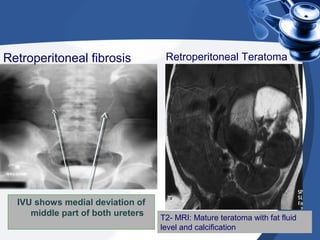
IVU shows medial deviation of
middle part of both ureters
Retroperitoneal fibrosis
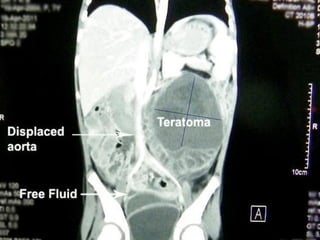
T2- MRI: Mature teratoma with fat fluid
level and calcification
Retroperitoneal Teratoma
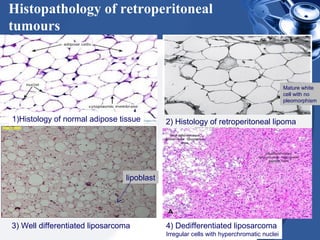
Histopathology of retroperitoneal
tumours
1)Histology of normal adipose tissue 2) Histology of retroperitoneal lipoma
3) Well differentiated liposarcoma 4) Dedifferentiated liposarcoma
Irregular cells with hyperchromatic nuclei
Mature white
cell with no
pleomorphism
lipoblast
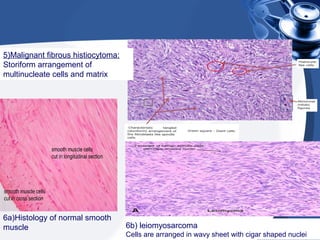
5)Malignant fibrous histiocytoma:
Storiform arrangement of
multinucleate cells and matrix
6b) leiomyosarcoma
Cells are arranged in wavy sheet with cigar shaped nuclei
6a)Histology of normal smooth
muscle
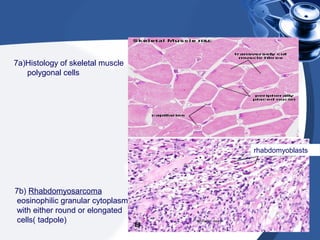
7b) Rhabdomyosarcoma
eosinophilic granular cytoplasm
with either round or elongated
cells( tadpole)
7a)Histology of skeletal muscle
polygonal cells
rhabdomyoblasts
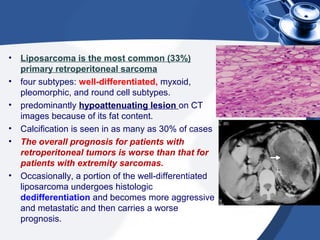
• Liposarcoma is the most common (33%)
primary retroperitoneal sarcoma
• four subtypes: well-differentiated, myxoid,
pleomorphic, and round cell subtypes.
• predominantly hypoattenuating lesion on CT
images because of its fat content.
• Calcification is seen in as many as 30% of cases
• The overall prognosis for patients with
retroperitoneal tumors is worse than that for
patients with extremity sarcomas.
• Occasionally, a portion of the well-differentiated
liposarcoma undergoes histologic
dedifferentiation and becomes more aggressive
and metastatic and then carries a worse
prognosis.
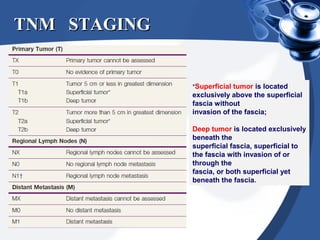
TNM STAGINGTNM STAGING
*Superficial tumor is located
exclusively above the superficial
fascia without
invasion of the fascia;
Deep tumor is located exclusively
beneath the
superficial fascia, superficial to
the fascia with invasion of or
through the
fascia, or both superficial yet
beneath the fascia.
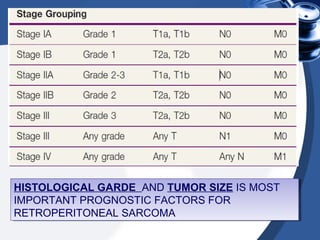
HISTOLOGICAL GARDE AND TUMOR SIZE IS MOST
IMPORTANT PROGNOSTIC FACTORS FOR
RETROPERITONEAL SARCOMA
HISTOLOGICAL GARDE AND TUMOR SIZE IS MOST
IMPORTANT PROGNOSTIC FACTORS FOR
RETROPERITONEAL SARCOMA
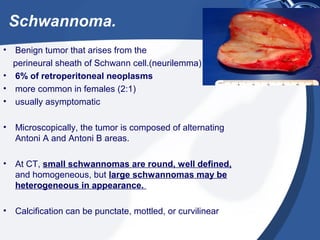
Schwannoma.
• Benign tumor that arises from the
perineural sheath of Schwann cell.(neurilemma)
• 6% of retroperitoneal neoplasms
• more common in females (2:1)
• usually asymptomatic
• Microscopically, the tumor is composed of alternating
Antoni A and Antoni B areas.
• At CT, small schwannomas are round, well defined,
and homogeneous, but large schwannomas may be
heterogeneous in appearance.
• Calcification can be punctate, mottled, or curvilinear
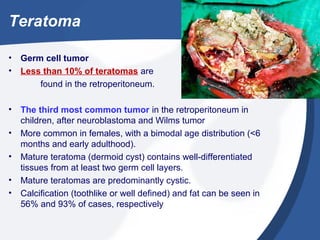
Teratoma
• Germ cell tumor
• Less than 10% of teratomas are
found in the retroperitoneum.
• The third most common tumor in the retroperitoneum in
children, after neuroblastoma and Wilms tumor
• More common in females, with a bimodal age distribution (<6
months and early adulthood).
• Mature teratoma (dermoid cyst) contains well-differentiated
tissues from at least two germ cell layers.
• Mature teratomas are predominantly cystic.
• Calcification (toothlike or well defined) and fat can be seen in
56% and 93% of cases, respectively
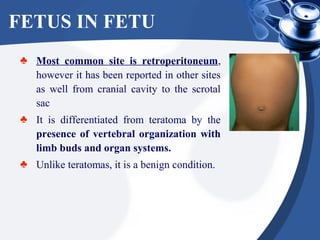
FETUS IN FETU
♣ Most common site is retroperitoneum,
however it has been reported in other sites
as well from cranial cavity to the scrotal
sac
♣ It is differentiated from teratoma by the
presence of vertebral organization with
limb buds and organ systems.
♣ Unlike teratomas, it is a benign condition.
CT Scan : showing Fetal skeleton
Resected specimen Fetal skull with hairs
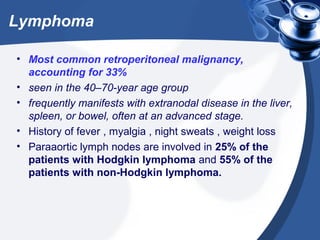
Lymphoma
• Most common retroperitoneal malignancy,
accounting for 33%
• seen in the 40–70-year age group
• frequently manifests with extranodal disease in the liver,
spleen, or bowel, often at an advanced stage.
• History of fever , myalgia , night sweats , weight loss
• Paraaortic lymph nodes are involved in 25% of the
patients with Hodgkin lymphoma and 55% of the
patients with non-Hodgkin lymphoma.
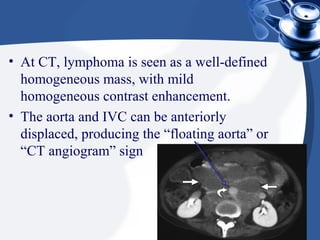
• At CT, lymphoma is seen as a well-defined
homogeneous mass, with mild
homogeneous contrast enhancement.
• The aorta and IVC can be anteriorly
displaced, producing the “floating aorta” or
“CT angiogram” sign
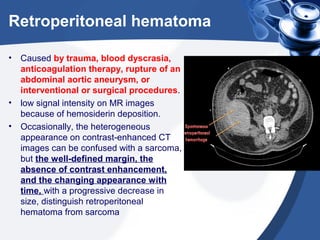
Retroperitoneal hematoma
• Caused by trauma, blood dyscrasia,
anticoagulation therapy, rupture of an
abdominal aortic aneurysm, or
interventional or surgical procedures.
• low signal intensity on MR images
because of hemosiderin deposition.
• Occasionally, the heterogeneous
appearance on contrast-enhanced CT
images can be confused with a sarcoma,
but the well-defined margin, the
absence of contrast enhancement,
and the changing appearance with
time, with a progressive decrease in
size, distinguish retroperitoneal
hematoma from sarcoma
Urinoma
• A collection of extravasated urine that is
found secondary to trauma or iatrogenic
causes.
• A well-defined cystic lesion is seen in
the retroperitoneum, more commonly in
the perirenal space.
• CT shows a well-defined fluid collection
with progressively increasing
attenuation caused by contrast-
enhanced urine entering the urinoma
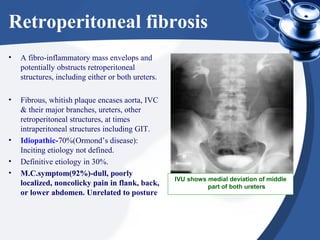
Retroperitoneal fibrosis
• A fibro-inflammatory mass envelops and
potentially obstructs retroperitoneal
structures, including either or both ureters.
• Fibrous, whitish plaque encases aorta, IVC
& their major branches, ureters, other
retroperitoneal structures, at times
intraperitoneal structures including GIT.
• Idiopathic-70%(Ormond’s disease):
Inciting etiology not defined.
• Definitive etiology in 30%.
• M.C.symptom(92%)-dull, poorly
localized, noncolicky pain in flank, back,
or lower abdomen. Unrelated to posture
IVU shows medial deviation of middle
part of both ureters
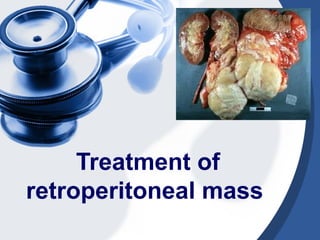
Treatment of
retroperitoneal mass
Medical management :
Retroperitoneal Lymphoma : Chemotherapy is principal treatment
Non Hodgkins’s Lymphoma treatment regime – R-CHOP
( Rituximab, Cyclophosphamide, Oncovin, Predinisolone)
Hodgkin’s lymphoma treatment regime – ABVD
( Adriyamycin, Bleomycin, Vinblastin,Dacarbazin )
Retroperitoneal fibrosis :
In early cases : Empirical therapy includes
corticosteroids : predinisolone for one year
tamoxifen : 10 mg day per for 6 month to 3 year
azathioprine
indicated only when associated with raised ESR , Leucocytosis , Anti-Nuclear
Antibody Positive cases
Patients with hydronephrosis and uremia- Emergency decompression
(by Per-cutaneous Nephrostomy or Indwelling DJ stent.)
Chemotherapy for retroperitoneal sarcoma :
Indications: neoadjuvant
unresectable tumor ( Palliative )
Distant metastasis
Treatment regimens :
AIM : Adriyamycin , Iphosphamide , Mesna
MAID: Mesna , Iphosphamide, Adriyamycin, Dacarbazine
Chemotherapy for retroperitoneal metastatic lymphnode :
BEP : Bleomycin , Etoposide , Cisplatin
Indication : in unresectable lymphnode ( Stage 3 germ cell tumor )
Surgical Treatment :
Surgery is Primary treatment & potentially curative
 Treatment of retroperitoneal fibrosis :
Bilateral ureterolysis, even if single ureter invloved.
Omental wrap: In extensive retroperitoneal fibrosis cases,
surround the ureters with omentum and reposition them within the peritoneal
cavity.
 Treatment of retroperitoneal benign swelling & cyst
Simple ENUCLEATION is sufficient
 Treatment of retroperitoneal Metastatic lymph nodes
Retroperitoneal lymph node dissection (RPLND) –
Nerve Sparing Technique is preferable
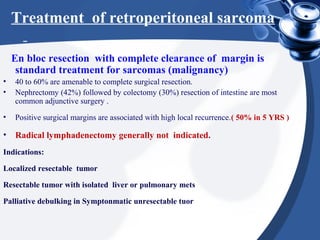
Approach : Open /Laproscopy
Indication: Stage IIC/ III seminomatous tumor
Stage I /II nonseminomatous tumor
En bloc resection with complete clearance of margin is
standard treatment for sarcomas (malignancy)
• 40 to 60% are amenable to complete surgical resection.
• Nephrectomy (42%) followed by colectomy (30%) resection of intestine are most
common adjunctive surgery .
• Positive surgical margins are associated with high local recurrence.( 50% in 5 YRS )
• Radical lymphadenectomy generally not indicated.
Indications:
Localized resectable tumor
Resectable tumor with isolated liver or pulmonary mets
Palliative debulking in Symptonmatic unresectable tuor
Treatment of retroperitoneal sarcoma
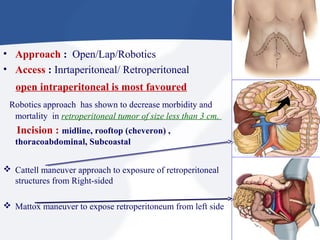
• Approach : Open/Lap/Robotics
• Access : Inrtaperitoneal/ Retroperitoneal
open intraperitoneal is most favoured
Robotics approach has shown to decrease morbidity and
mortality in retroperitoneal tumor of size less than 3 cm.
Incision : midline, rooftop (cheveron) ,
thoracoabdominal, Subcoastal
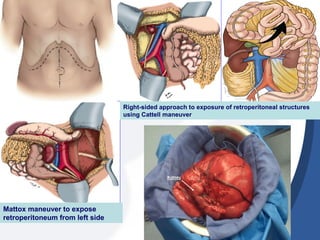
 Cattell maneuver approach to exposure of retroperitoneal
structures from Right-sided
 Mattox maneuver to expose retroperitoneum from left side
Mattox maneuver to expose
retroperitoneum from left side
Right-sided approach to exposure of retroperitoneal structures
using Cattell maneuver
 Contraindications of surgery :
Tumor invading major vascular structure
Multiple Distant metastasis
Gross peritoneal invasion / peritoneal disease
Patient not fit for major surgery
• Complications of surgery :
hemorrhage
Damage to adjacent bowel , kidney , ureter, nerve
Chylous ascitis
retrograde ejaculation
Application of metallic clips at
surgical fields is essential. It
acts as a guide for planning
post op radiotherapy
Application of metallic clips at
surgical fields is essential. It
acts as a guide for planning
post op radiotherapy
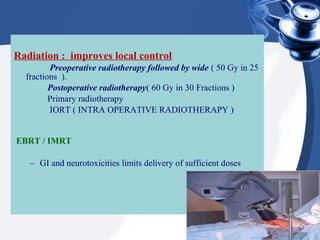
Radiation : improves local control
Preoperative radiotherapy followed by wide ( 50 Gy in 25
fractions ).
Postoperative radiotherapy( 60 Gy in 30 Fractions )
Primary radiotherapy
IORT ( INTRA OPERATIVE RADIOTHERAPY )
EBRT / IMRT
– GI and neurotoxicities limits delivery of sufficient doses
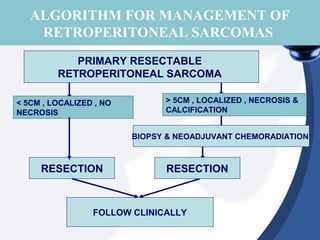
ALGORITHM FOR MANAGEMENT OF
RETROPERITONEAL SARCOMAS
PRIMARY RESECTABLE
RETROPERITONEAL SARCOMA
BIOPSY & NEOADJUVANT CHEMORADIATION
FOLLOW CLINICALLY
RESECTION
< 5CM , LOCALIZED , NO
NECROSIS
> 5CM , LOCALIZED , NECROSIS &
CALCIFICATION
RESECTION
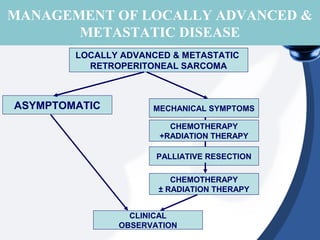
MANAGEMENT OF LOCALLY ADVANCED &
METASTATIC DISEASE
LOCALLY ADVANCED & METASTATIC
RETROPERITONEAL SARCOMA
ASYMPTOMATIC MECHANICAL SYMPTOMS
PALLIATIVE RESECTION
CHEMOTHERAPY
± RADIATION THERAPY
CLINICAL
OBSERVATION
CHEMOTHERAPY
+RADIATION THERAPY
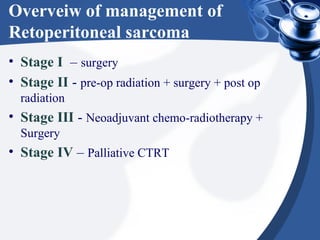
Overveiw of management of
Retoperitoneal sarcoma
• Stage I – surgery
• Stage II - pre-op radiation + surgery + post op
radiation
• Stage III - Neoadjuvant chemo-radiotherapy +
Surgery
• Stage IV – Palliative CTRT
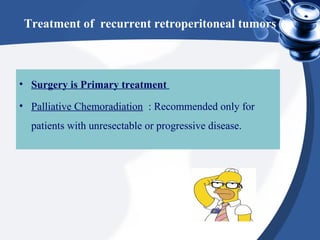
Treatment of recurrent retroperitoneal tumors
• Surgery is Primary treatment
• Palliative Chemoradiation : Recommended only for
patients with unresectable or progressive disease.
Key Facts :
• Lymphoma is most common retroperitoneal tumor
• Liposarcoma is most common primary reroperitoneal
tuomr
• Retroperitoneal sarcoma has got worse prognosis among
all soft tissue tumor
• Liver followed by peritoneum is most common site of
distant metasatsisof retroperitoneal tumor .
• FNAC has got no role is retroperitoneal sarcoma .
• CECT is investigation of choice for the retroperitoneal
lesion.
Retroperitoneal mass

Retroperitoneal mass

  • 1.
    Etiology, investigations &Etiology,investigations & Management ofManagement of Retroperitoneal MassRetroperitoneal Mass PROF. Dr A. B. SINGH UNITPROF. Dr A. B. SINGH UNIT Department of SurgeryDepartment of Surgery Patna Medical College & HospitalPatna Medical College & Hospital
  • 2.
    Objective…  Retroperitoneal anatomy Etiology of retroperitoneal mass  Clinical features of retroperitoneal mass  Investigations of retroperitoneal mass Management of retroperitoneal mass
  • 4.
    Retroperitoneum • Boundary Anteriorly :posterior parietal peritoneum Posteriorly : Vetebral column, iliopsoas ,quadratus lumborum muscle and tendinous part of transverse abdominis Superiorly : Diaphragm Inferiorly : Levator Ani and Pelvic Diaphragm
  • 5.
    It is dividedinto three spaces by the peri renal fascia i.e. fascia of Gerota The Three spaces are:  anterior pararenal space Colon, Pancreas, Duodenum  perirenal space Kidneys, Adrenal glands Upper portion of ureters  posterior pararenal space Fat , connective tissue, nerves
  • 6.
  • 7.
    Solid Neoplastic Retroperitonealmass Solid tumor from other site lymphoma Metastatic germ cell tumor
  • 8.
    Solid Neoplastic Retroperitonealmass Fetus in Fetus Fetal skull with hairs TERATOMA
  • 9.
  • 10.
    Non- Neoplastic Retroperitonealmass Solid Cystic Retroperitoneal fibrosis ( ORMOND’S Disease) Hematoma urinoma Pseudocyst
  • 11.
  • 12.
    Varying presentation • Presentation 1)most common presentation is huge abdominal lump with compressive symptoms. 2) Asymptomatic: diagnosis is accidental 3) presentation is usually late: because i) tumors are slow growing & painless: pain occurs in benign pathologies like hemangioma, schwannoma, fibroma, hematoma, abscess etc. ii)tumors displaces the adjacent structures. Infitration ocurrs in late stages. T2-weighted MRI
  • 13.
    4) Constitutional symptoms: •Fatigue • Weakness • fever • Loss of Appetite • Loss of weight • Back Pain
  • 14.
    Symptoms and Signsof Retroperitoneal Mass 1) Due to retroperitoneal mass: i)No clinical findings unless the swelling is very large on examination: • Consistency:Firm to hard mass • surface :Smooth , but in lymphoma it is nodular • Margins: can not be traced properly because of deep position of the swellings • Not moving with respiration. • Non mobile. • Non tender • Does not fall forward (confirmed by knee-elbow position).
  • 15.
    ii) Deep seateddull ache abdominal pain. iii) Flank pain : most commonly in carcinoma of kidney 2) Due to compression on adjacent organs: i) Back Pain- Severe back pain often following pressure by tumor mass, hematoma, and abscess over muscles, facet joint and vertebral column. Radicular Pain- Radiating type of pain along the nerve root due to its compression. ii) Obstruction of Viscera and Tubular Organs – usually of duodenum , colon , ureter , pancreas, kidney resulting in • Nausea and Vomiting- • Colicky Pain- • Constipation/ obstipation • Urinary Retention-
  • 16.
    iii) Compression ofAorta • Hypertension- • Renal Insufficiency- • Mesenteric Ischemia- • Intermittent Claudication- iv) Compression of Vena Cava – Edema of Feet – Low Blood Pressure v)Nerve Lesions – Tingling and Numbness in Lower limbs – Weakness of the Lower limbs
  • 17.
  • 18.
    Investigation 1) Routine bloodinvestigations: to know about i) hemoglobin: anemia ii) blood and serum creatinine- raised on compression of kidney and ureter iii) liver function test iv) Effect of paraneoplastic syndrome Hypoglycemia:- due to increased insulin like hormone Hypercalcemia:- due to increased ectopic PTH hormone Catecholamines:- paraganglioma v) Tumor markers:-AFP(alfa feto protein), beta-HCG- Will be raised in primary germ cell tumor 2) Chest X ray PA view:- lung metastasis 3) Plane X ray abdomen:- signs of intestinal obstruction, obliterated psoas shadow, calcification of tumor mass.
  • 19.
    5)Usg abdomen :nature of mass(solid/cystic) and relation to the adjacent structures. 6)CT abdomen and pelvis 7) CT chest 8) CT/usg guided/laproscopic core biopsy 9)PET-CT 10)FNAC has got limited role as the representative tissue may not be obtained . 11) IVU ;- Can show obstruction and displacement of kidney and ureter, distortion of renal pelvis and bladder compression. 12) Confirmation of diagnosis is only by tissue biopsy. Indications of preoperative biopsy An unusual appearing mass Unresectable tumor Distant mets Patient being considered for neoadjuvant chemotherapy
  • 20.
    CECT/ MRI- showingretroperitoneal tumours 1) LIPOSARCOMA: well differentiated liposarcoma shwoing huge heterogenous mass with predominantly fat attenuation. Fat attenuation 2) LIPOMA: T1 weighted mri Homogenous high signal intensity mass Kidney displaced upward
  • 21.
    3) leiomyosarcoma Necrosis CT angiogram:The aorta and IVC anteriorly displaced, producing the “floating aorta sign’’ in case of retroperitoneal lymphoma . 4) Lymphoma IVC Aorta
  • 22.
    CT Scan :showing Fetal skeleton CT Scan : showing Fetal skeleton FETUS IN FETU is differentiated from teratoma by the presence of vertebral organization with limb buds and organ systems. FETUS IN FETU is differentiated from teratoma by the presence of vertebral organization with limb buds and organ systems.
  • 23.
    IVU shows medialdeviation of middle part of both ureters Retroperitoneal fibrosis T2- MRI: Mature teratoma with fat fluid level and calcification Retroperitoneal Teratoma
  • 24.
    Histopathology of retroperitoneal tumours 1)Histologyof normal adipose tissue 2) Histology of retroperitoneal lipoma 3) Well differentiated liposarcoma 4) Dedifferentiated liposarcoma Irregular cells with hyperchromatic nuclei Mature white cell with no pleomorphism lipoblast
  • 25.
    5)Malignant fibrous histiocytoma: Storiformarrangement of multinucleate cells and matrix 6b) leiomyosarcoma Cells are arranged in wavy sheet with cigar shaped nuclei 6a)Histology of normal smooth muscle
  • 26.
    7b) Rhabdomyosarcoma eosinophilic granularcytoplasm with either round or elongated cells( tadpole) 7a)Histology of skeletal muscle polygonal cells rhabdomyoblasts
  • 27.
    • Liposarcoma isthe most common (33%) primary retroperitoneal sarcoma • four subtypes: well-differentiated, myxoid, pleomorphic, and round cell subtypes. • predominantly hypoattenuating lesion on CT images because of its fat content. • Calcification is seen in as many as 30% of cases • The overall prognosis for patients with retroperitoneal tumors is worse than that for patients with extremity sarcomas. • Occasionally, a portion of the well-differentiated liposarcoma undergoes histologic dedifferentiation and becomes more aggressive and metastatic and then carries a worse prognosis.
  • 28.
    TNM STAGINGTNM STAGING *Superficialtumor is located exclusively above the superficial fascia without invasion of the fascia; Deep tumor is located exclusively beneath the superficial fascia, superficial to the fascia with invasion of or through the fascia, or both superficial yet beneath the fascia.
  • 29.
    HISTOLOGICAL GARDE ANDTUMOR SIZE IS MOST IMPORTANT PROGNOSTIC FACTORS FOR RETROPERITONEAL SARCOMA HISTOLOGICAL GARDE AND TUMOR SIZE IS MOST IMPORTANT PROGNOSTIC FACTORS FOR RETROPERITONEAL SARCOMA
  • 30.
    Schwannoma. • Benign tumorthat arises from the perineural sheath of Schwann cell.(neurilemma) • 6% of retroperitoneal neoplasms • more common in females (2:1) • usually asymptomatic • Microscopically, the tumor is composed of alternating Antoni A and Antoni B areas. • At CT, small schwannomas are round, well defined, and homogeneous, but large schwannomas may be heterogeneous in appearance. • Calcification can be punctate, mottled, or curvilinear
  • 31.
    Teratoma • Germ celltumor • Less than 10% of teratomas are found in the retroperitoneum. • The third most common tumor in the retroperitoneum in children, after neuroblastoma and Wilms tumor • More common in females, with a bimodal age distribution (<6 months and early adulthood). • Mature teratoma (dermoid cyst) contains well-differentiated tissues from at least two germ cell layers. • Mature teratomas are predominantly cystic. • Calcification (toothlike or well defined) and fat can be seen in 56% and 93% of cases, respectively
  • 33.
    FETUS IN FETU ♣Most common site is retroperitoneum, however it has been reported in other sites as well from cranial cavity to the scrotal sac ♣ It is differentiated from teratoma by the presence of vertebral organization with limb buds and organ systems. ♣ Unlike teratomas, it is a benign condition.
  • 34.
    CT Scan :showing Fetal skeleton CT Scan : showing Fetal skeleton Resected specimen Fetal skull with hairs
  • 35.
    Lymphoma • Most commonretroperitoneal malignancy, accounting for 33% • seen in the 40–70-year age group • frequently manifests with extranodal disease in the liver, spleen, or bowel, often at an advanced stage. • History of fever , myalgia , night sweats , weight loss • Paraaortic lymph nodes are involved in 25% of the patients with Hodgkin lymphoma and 55% of the patients with non-Hodgkin lymphoma.
  • 36.
    • At CT,lymphoma is seen as a well-defined homogeneous mass, with mild homogeneous contrast enhancement. • The aorta and IVC can be anteriorly displaced, producing the “floating aorta” or “CT angiogram” sign
  • 37.
    Retroperitoneal hematoma • Causedby trauma, blood dyscrasia, anticoagulation therapy, rupture of an abdominal aortic aneurysm, or interventional or surgical procedures. • low signal intensity on MR images because of hemosiderin deposition. • Occasionally, the heterogeneous appearance on contrast-enhanced CT images can be confused with a sarcoma, but the well-defined margin, the absence of contrast enhancement, and the changing appearance with time, with a progressive decrease in size, distinguish retroperitoneal hematoma from sarcoma
  • 39.
    Urinoma • A collectionof extravasated urine that is found secondary to trauma or iatrogenic causes. • A well-defined cystic lesion is seen in the retroperitoneum, more commonly in the perirenal space. • CT shows a well-defined fluid collection with progressively increasing attenuation caused by contrast- enhanced urine entering the urinoma
  • 40.
    Retroperitoneal fibrosis • Afibro-inflammatory mass envelops and potentially obstructs retroperitoneal structures, including either or both ureters. • Fibrous, whitish plaque encases aorta, IVC & their major branches, ureters, other retroperitoneal structures, at times intraperitoneal structures including GIT. • Idiopathic-70%(Ormond’s disease): Inciting etiology not defined. • Definitive etiology in 30%. • M.C.symptom(92%)-dull, poorly localized, noncolicky pain in flank, back, or lower abdomen. Unrelated to posture IVU shows medial deviation of middle part of both ureters
  • 41.
  • 42.
    Medical management : RetroperitonealLymphoma : Chemotherapy is principal treatment Non Hodgkins’s Lymphoma treatment regime – R-CHOP ( Rituximab, Cyclophosphamide, Oncovin, Predinisolone) Hodgkin’s lymphoma treatment regime – ABVD ( Adriyamycin, Bleomycin, Vinblastin,Dacarbazin ) Retroperitoneal fibrosis : In early cases : Empirical therapy includes corticosteroids : predinisolone for one year tamoxifen : 10 mg day per for 6 month to 3 year azathioprine indicated only when associated with raised ESR , Leucocytosis , Anti-Nuclear Antibody Positive cases Patients with hydronephrosis and uremia- Emergency decompression (by Per-cutaneous Nephrostomy or Indwelling DJ stent.)
  • 43.
    Chemotherapy for retroperitonealsarcoma : Indications: neoadjuvant unresectable tumor ( Palliative ) Distant metastasis Treatment regimens : AIM : Adriyamycin , Iphosphamide , Mesna MAID: Mesna , Iphosphamide, Adriyamycin, Dacarbazine Chemotherapy for retroperitoneal metastatic lymphnode : BEP : Bleomycin , Etoposide , Cisplatin Indication : in unresectable lymphnode ( Stage 3 germ cell tumor )
  • 44.
    Surgical Treatment : Surgeryis Primary treatment & potentially curative  Treatment of retroperitoneal fibrosis : Bilateral ureterolysis, even if single ureter invloved. Omental wrap: In extensive retroperitoneal fibrosis cases, surround the ureters with omentum and reposition them within the peritoneal cavity.  Treatment of retroperitoneal benign swelling & cyst Simple ENUCLEATION is sufficient  Treatment of retroperitoneal Metastatic lymph nodes Retroperitoneal lymph node dissection (RPLND) – Nerve Sparing Technique is preferable Approach : Open /Laproscopy Indication: Stage IIC/ III seminomatous tumor Stage I /II nonseminomatous tumor
  • 45.
    En bloc resectionwith complete clearance of margin is standard treatment for sarcomas (malignancy) • 40 to 60% are amenable to complete surgical resection. • Nephrectomy (42%) followed by colectomy (30%) resection of intestine are most common adjunctive surgery . • Positive surgical margins are associated with high local recurrence.( 50% in 5 YRS ) • Radical lymphadenectomy generally not indicated. Indications: Localized resectable tumor Resectable tumor with isolated liver or pulmonary mets Palliative debulking in Symptonmatic unresectable tuor Treatment of retroperitoneal sarcoma
  • 46.
    • Approach :Open/Lap/Robotics • Access : Inrtaperitoneal/ Retroperitoneal open intraperitoneal is most favoured Robotics approach has shown to decrease morbidity and mortality in retroperitoneal tumor of size less than 3 cm. Incision : midline, rooftop (cheveron) , thoracoabdominal, Subcoastal  Cattell maneuver approach to exposure of retroperitoneal structures from Right-sided  Mattox maneuver to expose retroperitoneum from left side
  • 47.
    Mattox maneuver toexpose retroperitoneum from left side Right-sided approach to exposure of retroperitoneal structures using Cattell maneuver
  • 48.
     Contraindications ofsurgery : Tumor invading major vascular structure Multiple Distant metastasis Gross peritoneal invasion / peritoneal disease Patient not fit for major surgery • Complications of surgery : hemorrhage Damage to adjacent bowel , kidney , ureter, nerve Chylous ascitis retrograde ejaculation Application of metallic clips at surgical fields is essential. It acts as a guide for planning post op radiotherapy Application of metallic clips at surgical fields is essential. It acts as a guide for planning post op radiotherapy
  • 50.
    Radiation : improveslocal control Preoperative radiotherapy followed by wide ( 50 Gy in 25 fractions ). Postoperative radiotherapy( 60 Gy in 30 Fractions ) Primary radiotherapy IORT ( INTRA OPERATIVE RADIOTHERAPY ) EBRT / IMRT – GI and neurotoxicities limits delivery of sufficient doses
  • 51.
    ALGORITHM FOR MANAGEMENTOF RETROPERITONEAL SARCOMAS PRIMARY RESECTABLE RETROPERITONEAL SARCOMA BIOPSY & NEOADJUVANT CHEMORADIATION FOLLOW CLINICALLY RESECTION < 5CM , LOCALIZED , NO NECROSIS > 5CM , LOCALIZED , NECROSIS & CALCIFICATION RESECTION
  • 52.
    MANAGEMENT OF LOCALLYADVANCED & METASTATIC DISEASE LOCALLY ADVANCED & METASTATIC RETROPERITONEAL SARCOMA ASYMPTOMATIC MECHANICAL SYMPTOMS PALLIATIVE RESECTION CHEMOTHERAPY ± RADIATION THERAPY CLINICAL OBSERVATION CHEMOTHERAPY +RADIATION THERAPY
  • 53.
    Overveiw of managementof Retoperitoneal sarcoma • Stage I – surgery • Stage II - pre-op radiation + surgery + post op radiation • Stage III - Neoadjuvant chemo-radiotherapy + Surgery • Stage IV – Palliative CTRT
  • 54.
    Treatment of recurrentretroperitoneal tumors • Surgery is Primary treatment • Palliative Chemoradiation : Recommended only for patients with unresectable or progressive disease.
  • 55.
    Key Facts : •Lymphoma is most common retroperitoneal tumor • Liposarcoma is most common primary reroperitoneal tuomr • Retroperitoneal sarcoma has got worse prognosis among all soft tissue tumor • Liver followed by peritoneum is most common site of distant metasatsisof retroperitoneal tumor . • FNAC has got no role is retroperitoneal sarcoma . • CECT is investigation of choice for the retroperitoneal lesion.